
25 Fifteen-Minute Team Building Activities for Meetings (In Person & Virtual)
A host-tested list of 25 team building activities that start, land and finish inside 15 minutes, for meetings, huddles and video calls.
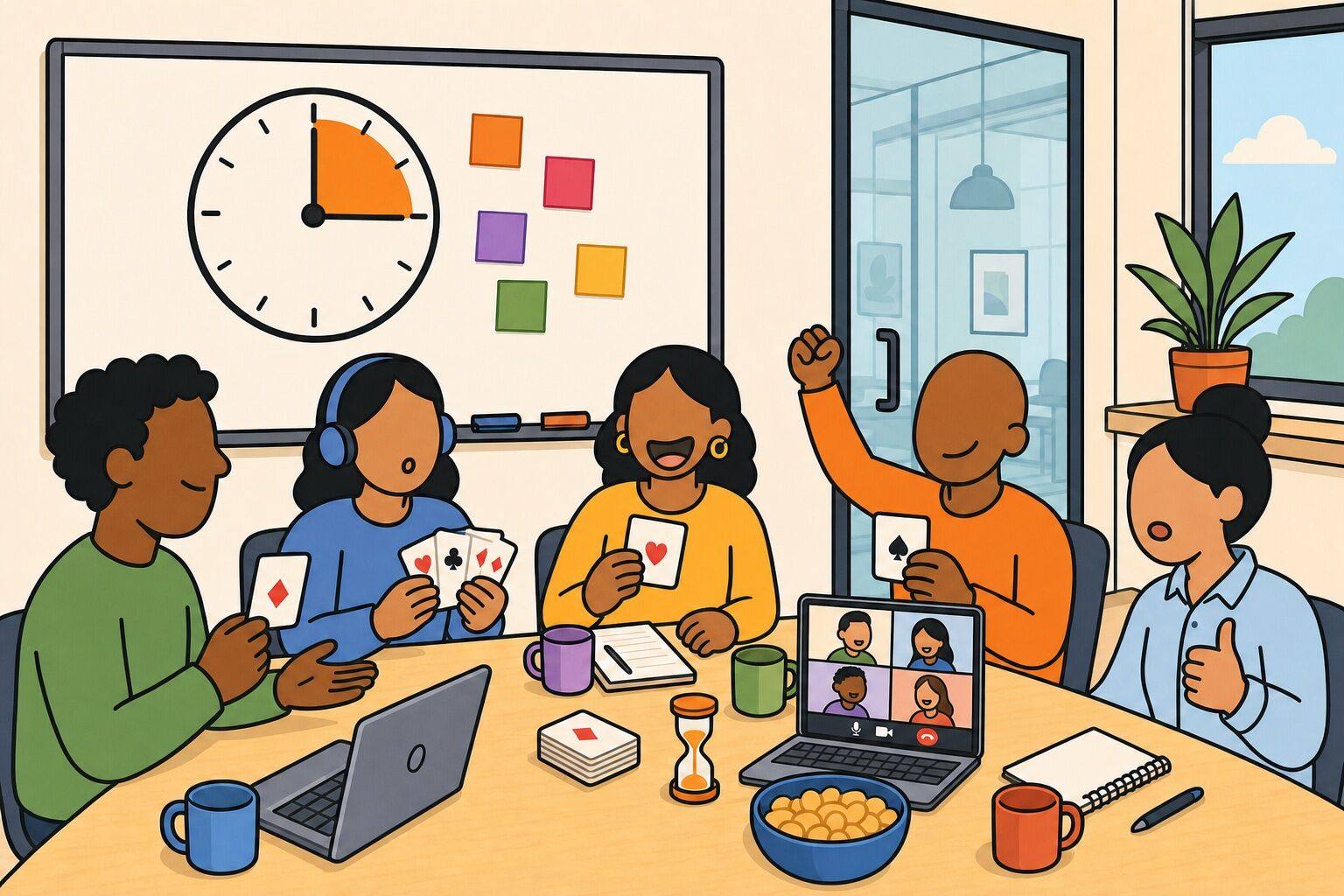
A host-tested list of 25 team building activities that start, land and finish inside 15 minutes, for meetings, huddles and video calls.
Fifteen minutes is the most underrated slot on a team's calendar. It is too short to book an event around, too long to waste on "any updates?", and it shows up constantly: the front of a weekly meeting, the back half of a huddle, the gap before a client call, the awkward five minutes after a demo finishes early.
We have spent the last decade building team experiences for a living, and the 15-minute block is the format managers ask us about most often between events. So this guide is the short-format playbook: 25 activities our hosts actually run or recommend, each one designed to start, land and finish inside a quarter of an hour, in person or on a video call.
Every activity below has step-by-step instructions, a group size, and a real materials cost, so you can pick one on a Monday morning and run it the same day.
This list includes:
Here we go!
15-minute team building activities are short games, check-ins and challenges that a team can start and finish inside a quarter of an hour, usually attached to a meeting rather than scheduled as their own event. Examples include a one-word check-in, a lightning scavenger hunt, and a card castle contest. The purpose is to get people talking to each other instead of at a slide deck, and to build the small habits of trust and communication that longer events deepen later. These are also called 15-minute team building games, 15-minute team building exercises, quick team building activities, 15-minute icebreakers, and 15-minute activities for adults.
Fifteen-minute sessions are the short end of quick team building and a subcategory of team building activities. They are similar to 30-minute team building activities, one minute games, team meeting games, and virtual meeting games, and this guide includes 15-minute icebreakers, 15-minute games for virtual meetings, 15-minute problem solving games, creative 15-minute exercises, and 15-minute activities for large groups. Managers often slot these into morning meeting games and daily standups.
The reason short sessions fail is almost never the activity. It is the shape of the block. Fifteen minutes feels like plenty until you spend four of them explaining rules and three more waiting for stragglers.
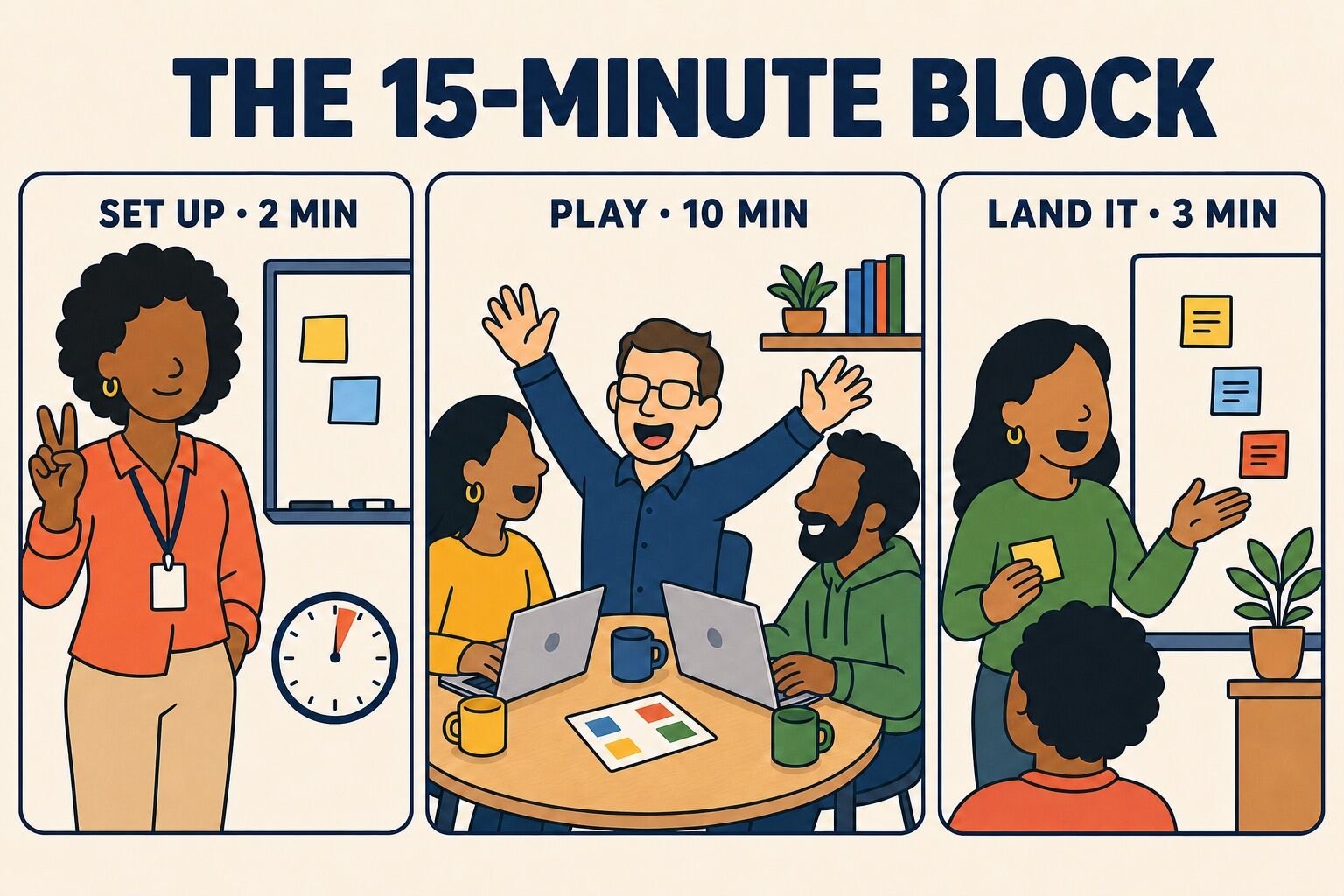
Here is the shape our hosts use, scaled down to a quarter of an hour:
Two more rules of thumb. First, put the activity at the start of the meeting, not the end. Team building at the end is the first thing cut when the agenda runs long, and everyone knows it. Second, pick the activity for the room you actually have: a group of 8 in a conference room and a group of 60 on a video call need different games, which is why the sections below are split that way.
It also helps to treat the 15 minutes as part of the meeting rather than an interruption to it. A meeting-science review by Mroz, Allen, Verhoeven and Shuffler in Current Directions in Psychological Science recommends that leaders call a meeting only when necessary, keep it small, circulate an agenda in advance, start on time, and actively encourage participation from all attendees. A short game at the top of the hour is one of the simplest ways to do that last part, because it gets every voice into the room before the first agenda item.
Thirty minutes a week is our baseline recommendation, and two 15-minute slots are the easiest way to hit it. One at the start of your Monday meeting, one attached to a mid-week huddle, and you are there without booking anything.
Every activity in this guide is free or nearly free, works with materials you already have, and fits a quarter-hour block. Use the table to pick one, then jump to the instructions.
| Activity | Best for | Group size | Time | Cost |
|---|---|---|---|---|
| One-Word Check-In | Opening a meeting | 3–100+ | 5–10 min | Free |
| Rose, Bud, Thorn | Weekly check-ins | 3–15 | 10–15 min | Free |
| Bad Day, Good Day | Venting and gratitude | 4–15 | 10–15 min | Free |
| Playing Favorites | Getting to know a new team | 4–20 | 10–15 min | Free |
| Something in Common | Building relationships | 6–100+ | 10–15 min | Free |
| Finish the Phrase | Fast, low-pressure fun | 4–20 | 10–15 min | Free |
| Lightning Scavenger Hunt | Energy on a video call | 5–100+ | 10–15 min | Free |
| Can You Hear Me Now? | Communication | 5–30 | 10–15 min | Free |
| Chat Waterfall | Getting quiet people talking | 5–100+ | 5–10 min | Free |
| Guess the Workspace | Remote teams | 5–25 | 10–15 min | Free |
| Pancakes vs Waffles | Debate and decision-making | 5–30 | 10–15 min | Free |
| Heads Up! | Big laughs, low prep | 4–20 | 10–15 min | Free app, paid decks |
| Card Castle Contest | Hands-on problem solving | 4–30 | 15 min | $5 for card decks |
| Puzzle Race | Coordination under time pressure | 4–24 | 15 min | $10–$20 for mini puzzles |
| Memory Tray | Observation and recall | 3–20 | 10–15 min | Free |
| Remote Viewing | Descriptive communication | 4–16 | 10–15 min | Free |
| Grapevine | Showing how messages drift | 6–20 | 10–15 min | Free |
| Blackout Poetry | Creative thinking | 3–30 | 15 min | $5 for markers |
| Origami Challenge | Following instructions together | 3–30 | 15 min | Free with scrap paper |
| Paper Plane Races | Friendly competition | 4–30 | 15 min | Free |
| Walk-and-Talk Pairs | Real conversation and ideas | 4–40 | 15 min | Free |
| Square Breathing Reset | High-stress weeks | 1–100+ | 5–10 min | Free |
| Human Bingo | Mixing a big room | 15–100+ | 15 min | Free printable |
| Spectrum Line-Up | Large groups, fast | 10–100+ | 10–15 min | Free |
| Workplace Praise Party | Recognition | 5–100+ | 15 min | Free |
These are the openers: low stakes, no props, and safe for a group that has never done anything like this before. If your team is new to short-format team building, start here before moving to games with rules. For longer versions of the same idea, see our full list of icebreaker games.
The simplest opener there is, and the one our hosts fall back on when a group needs warming up fast. Everyone answers a question in exactly one word, which removes the pressure of performing an answer.
Here is how to run it:
The follow-up is the whole game. A round of single words takes two minutes and tells you almost nothing; two follow-up questions turn it into a real check-in.
Best for: Opening any meeting, any size
Time: 5–10 minutes
Materials (cost): None (free)
What we have learned: Ask the follow-up of someone whose word was neutral, not someone whose word was dramatic. "Fine" and "busy" hide more interesting answers than "chaotic" does.
Need a prompt on short notice? Our check-in generator will give you one:
A three-part check-in that gives structure to "how is everyone doing" without letting the meeting drift into a therapy session.
Here is how to play:
Ending on the bud rather than the thorn matters. Teams that close on the thorn walk into the agenda flat.
Best for: Recurring weekly meetings with a stable group
Time: 10–15 minutes for up to 12 people
Materials (cost): None (free)
What we have learned: Managers should go last, not first. When the leader shares a thorn first, everyone else's thorn quietly shrinks to match it.
A venting-and-gratitude pair that ends every round on an upswing. Each teammate shares one thing that made their day harder, then one thing that made it better.
Here is how to play:
Because the good day always comes second, the activity ends positive every single time, which is the reason it survives on teams that find pure gratitude exercises too saccharine.
Best for: Teams that would roll their eyes at a gratitude circle
Time: 10–15 minutes
Materials (cost): None (free)
A get-to-know-you round that works best when the questions are specific enough to produce a story instead of a one-word answer.
Here is how to play:
Prompts that reliably produce a story:
Skip the generic ones. "Favorite color" and "favorite type of weather" fill time without producing conversation. For more prompts in this vein, see our get to know you games.
Best for: New teams, new hires, cross-department groups
Time: 10–15 minutes
Materials (cost): None (free)
What we have learned: Sending the prompts in advance roughly doubles the quality of the answers. People do not think faster under pressure, they just answer shorter.
A connection game we use in our own events, because it produces the kind of specific shared detail that people remember months later.
Here is how to play:
Best for: Teams that work together but do not know each other
Time: 10–15 minutes
Materials (cost): None (free)
What we have learned: The "nothing obvious" rule is not optional. Without it, groups settle on the first thing they find and stop talking at minute two. With it, they keep digging, and the digging is where the conversation happens.
A fast, low-pressure game that uses common sayings to get a room laughing within about 30 seconds.
Here is how to play:
Song lyrics, film quotes and advertising taglines work as well as proverbs, and mixing eras keeps the game fair across a group with a wide age range.
Best for: Groups that want fun without personal disclosure
Time: 10–15 minutes
Materials (cost): None (free)
Short games are harder on video than in a room. A gap in a conference room fills itself with chatter; a gap on a video call is just silence. Every game in this section is built to avoid that: clear rounds, a visible timer, and something for people to do in the first 20 seconds. They also pair well with the rest of our advice on how to make virtual meetings fun.
Whichever platform you are on, the three features that matter for a 15-minute game are the same: breakout rooms, the chat panel, and reactions. Check that your account has all three enabled before the meeting rather than during it.
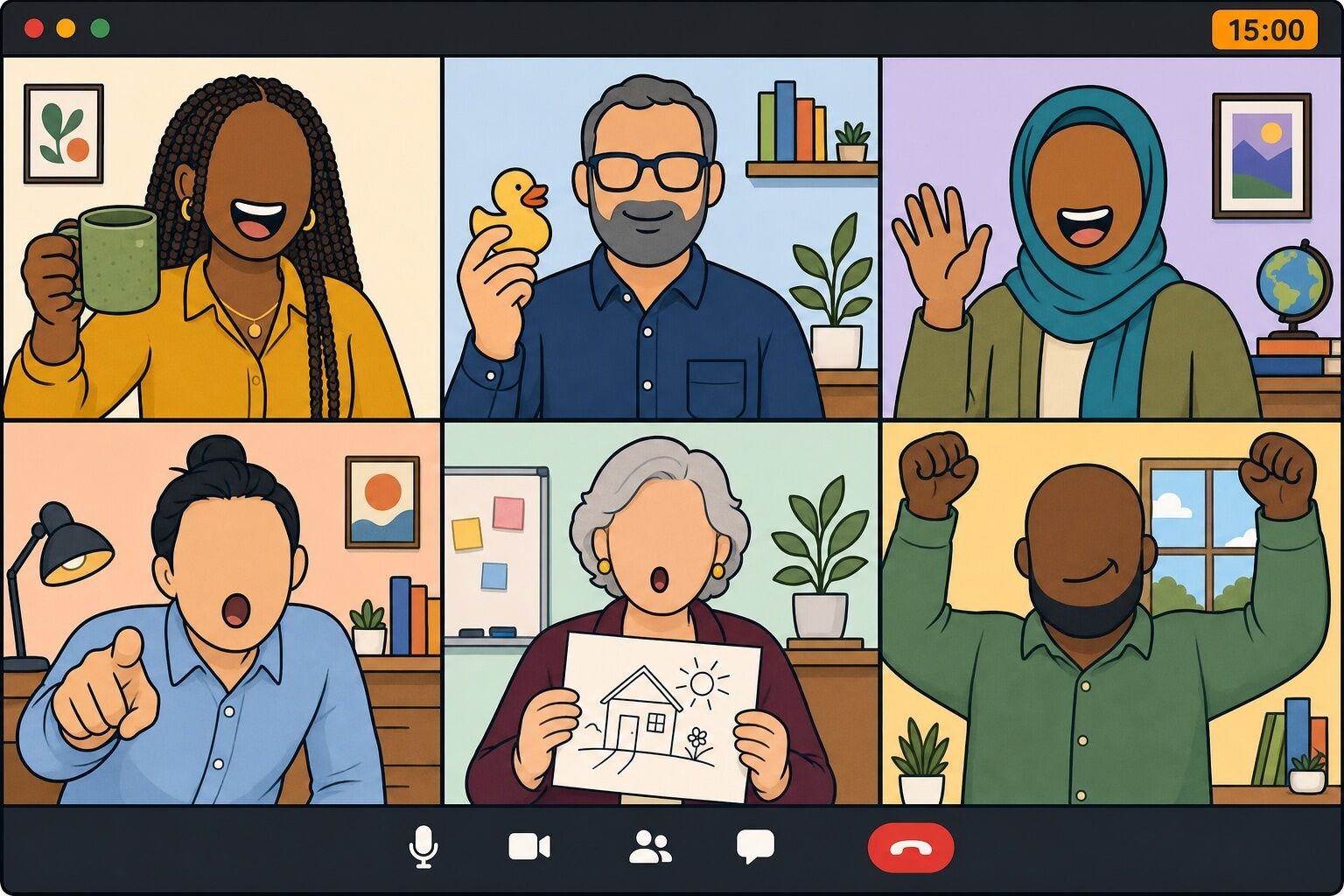
A format our hosts run in live events, compressed to fit a meeting. Players race to find household or desk objects and hold them up to the camera, which gets everyone out of their chair and produces instant laughs.
Here is how to play:
The interpretive prompts are what make it work. "Find a pen" is a race; "find something older than you" is a conversation.
Best for: Waking up a flat video call
Time: 10–15 minutes
Materials (cost): None (free)
What we have learned: Run this early in the meeting, not after an hour of slides. Once people have settled into passive mode, getting them to stand up is a much harder sell.
A drawing-by-description game that turns communication problems into an obvious, funny demonstration in about ten minutes.
Here is how to play:
The debrief writes itself: the instructions were perfectly clear to the person giving them, and six people still drew six different things. For more games built on the same idea, see our communication games.
Best for: Teams that keep having "I thought you meant" problems
Time: 10–15 minutes
Materials (cost): Paper and pens (free)
What we have learned: The speaker should be someone senior. It lands much better when the person discovering that their instructions were ambiguous is the person who usually gives instructions.
A host technique more than a game, and the fastest way we know to get a quiet video call talking. Everyone answers at once instead of waiting for a turn.
Here is how to run it:
The no-enter rule is the trick. It removes the social cost of going first and stops early answers from anchoring everyone else's.
Best for: Large calls, quiet teams, and meetings with a hard stop
Time: 5–10 minutes
Materials (cost): None (free)
What we have learned: Reading answers aloud and crediting people by name is not optional. A waterfall nobody acknowledges teaches the room that the chat does not get read.
A photo guessing game built for remote teams, using the one thing everyone on a distributed team has in common and never talks about: where they actually work.
Here is how to play:
The explanations are the good part. Every desk has one strange object with a story attached to it.
Best for: Distributed teams who have never met in person
Time: 10–15 minutes
Materials (cost): None (free)
What we have learned: Make the photos optional and collect them privately. A teammate working from a kitchen table should never feel like the odd one out in a round of desk photos.
A debate game from our hosted events. The group has to eliminate one item at a time, and the arguing is the entire point.
Here is how to play:
Keep the stakes silly. Breakfast foods, movie sequels and office snacks all work; anything that maps onto a real workplace disagreement does not.
Best for: Lively groups, and any team that needs a low-stakes way to practice disagreeing
Time: 10–15 minutes
Materials (cost): None (free)
What we have learned: Good discussion scenarios have no obvious correct answer. The point is not to solve the hypothetical, it is to hear how teammates think, negotiate, disagree and eventually make a decision together.
The charades-style phone app, which works surprisingly well on a video call because the guesser holds their phone up to the camera and the whole team can see the prompt.
Here is how to play:
Best for: Groups that want noise and laughing, fast
Time: 10–15 minutes
Materials (cost): Free app; extra decks are a few dollars
These are the ones with a puzzle at the center. They reward teams that organize before they act, which makes them useful for groups that tend to charge at problems individually. For longer versions and more formats, see our list of problem solving games.
A few decks of playing cards and a hard deadline produce a genuinely difficult engineering problem.
Here is how to play:
Cards are better than paper or blocks here, because the whole thing collapses regularly and teams have to decide whether to rebuild the same design or change approach.
Best for: In-person groups with table space
Time: 15 minutes
Materials (cost): One deck of cards per team ($5 total)
What we have learned: Teams that spend the first minute planning almost always beat teams that start stacking immediately. Say nothing about this beforehand and let the results make the point in the debrief.
Small jigsaw puzzles, one timer, and a twist that forces teams to talk to each other.
Here is how to play:
The swap is what turns a solo activity into a team one. Without it, four people take turns reaching into the same box.
Best for: In-person teams, quieter groups
Time: 15 minutes
Materials (cost): Mini puzzles, $10–$20 for a set
An observation challenge that takes 60 seconds to set up and works identically in a room or on a webcam.
Here is how to play:
For a team version, have players work in pairs and combine their lists. Two people almost always beat the best individual, which is a nice, quiet point to end on.
Best for: Any group, any format
Time: 10–15 minutes
Materials (cost): Objects you already own (free)
A descriptive communication challenge that is much harder than it sounds, because the good clues are the indirect ones.
Here is how to play:
Best for: Teams working on precise communication
Time: 10–15 minutes
Materials (cost): Desk objects (free)
What we have learned: Run one pair at a time with everyone else watching. It is slower, but the audience learns more from hearing three bad clues than from giving their own.
The classic message-passing game, run as a deliberate demonstration of how information degrades between the top of an org chart and the bottom.
Here is how to play:
Phrases with concrete detail work best. "Chocolate-covered donut," "pink-and-black Cadillac," or a fake project update with a deadline in it.
Best for: In-person groups of 8 to 20
Time: 10–15 minutes
Materials (cost): None (free)
What we have learned: Follow it with one question: where in our actual work does a message get passed along more than twice? That is the conversation, and it usually runs longer than the game.
The activities in this section are less about competition and more about changing the state of the room. They are the ones to reach for before a brainstorm, after a hard week, or when a team has been staring at the same problem for three days. They work in an office, a breakout room, or outdoors, and several of them also show up in our list of team building games.
A creative exercise that turns an existing page into something new, and requires nothing but paper and a marker.
Here is how to run it:
Using workplace material is the version worth trying. A poem made from a project brief or a set of quarterly goals tends to say something the brief did not.
Best for: Warming up before creative work
Time: 15 minutes
Materials (cost): Printed pages and markers ($5)
What we have learned: Print a different page for each person. When everyone starts from the same text, the room compares poems instead of writing them.
A precision exercise disguised as a craft. Teams follow folding instructions to build the same shape, and the gap between "following instructions" and "getting it right" shows up fast.
Here is how to run it:
For a competitive version, put people in pairs where only one person can see the instructions and only the other can touch the paper.
Best for: Detail-oriented teams and remote teams alike
Time: 15 minutes
Materials (cost): Scrap paper (free)
A build-and-test challenge with a five-second payoff, which is exactly the right ratio for a short block.
Here is how to run it:
The second round is the interesting one. Watching a team decide whether to copy the leader or defend their own design is a small, honest look at how the team handles a better idea.
Best for: In-person groups with a hallway
Time: 15 minutes
Materials (cost): Paper (free)
Fifteen minutes of walking, in pairs, with one question to discuss. It is the least game-like activity on this list and one of the most reliable.
Here is how to run it:
There is decent evidence for the walking part. Stanford experiments by Oppezzo and Schwartz, published in the Journal of Experimental Psychology: Learning, Memory, and Cognition, found that walking boosted creative idea generation by an average of around 60% compared with sitting, and that 81% of participants in the first experiment were more creative while walking.
Best for: Idea generation and cross-team pairs
Time: 15 minutes
Materials (cost): None (free)
What we have learned: Give the pairs one question, not three. A single question gets discussed properly; a list gets answered.
A short, guided breathing exercise for the weeks when a team does not need a game, it needs a minute. Also the best 15-minute wellness activity to have in your back pocket before a high-stakes presentation.
Here is how to run it:
Best for: Crunch weeks, post-incident debriefs, pre-presentation nerves
Time: 5–10 minutes
Materials (cost): None (free)
What we have learned: Make it opt-in and keep it secular. Frame it as a reset before the next meeting rather than as mindfulness practice, and participation goes up noticeably.
Above roughly 25 people, most short activities break. Turn-taking becomes the whole activity, and the quiet third of the room never speaks. The fix is structural: everyone participates at the same time, and only a few people report back. For longer formats at scale, see our large group games.
A mingling game that scales to a full room, because everyone is playing at once and nobody is waiting for a turn.
Here is how to play:
Write the squares for your actual company. Generic squares ("likes pizza") get signed instantly and teach nobody anything.
Best for: All-hands meetings, onboarding weeks, conferences
Time: 15 minutes
Materials (cost): Printed cards (free)
What we have learned: Cap it at one signature per person. Without that rule, three extroverts sign 40 cards and the room never actually mixes.
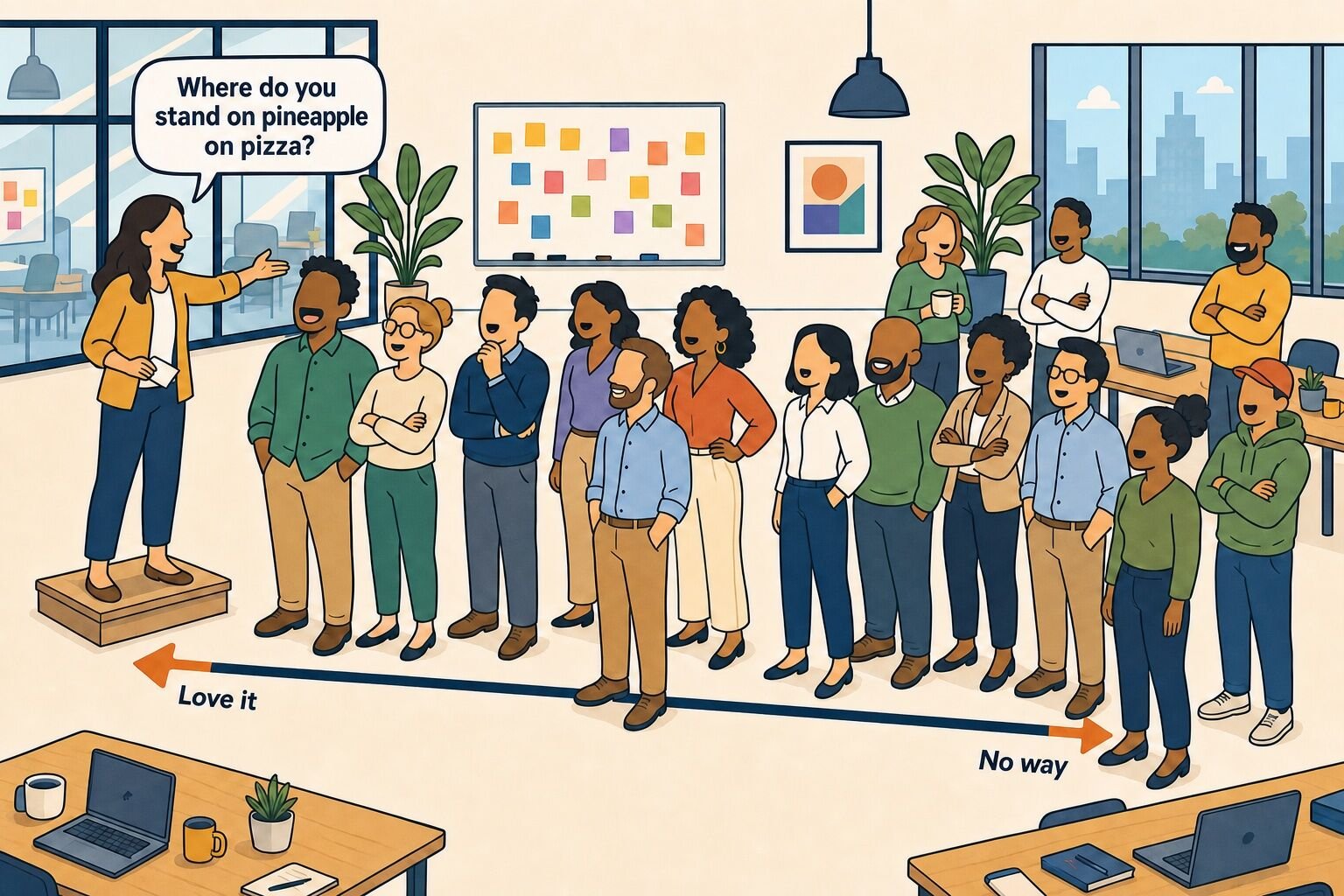
An opinion game that gets a hundred people moving and talking in under two minutes, with no props at all.
Here is how to play:
Slipping one genuine work statement in near the end gives you a fast, visible read on the room that a survey would take a week to produce.
Best for: Big rooms, all-hands meetings, offsite kickoffs
Time: 10–15 minutes
Materials (cost): None (free)
What we have learned: Start silly and stay silly for at least three rounds. If the first statement is about work, people position themselves politically instead of honestly.
Fifteen minutes of a team telling each other what they are good at, structured so it does not turn into a slow round of compliments.
Here is how to run it:
Specificity is the whole thing. "You are great to work with" costs nothing; "you rewrote that customer email at 6pm and it saved the renewal" is the version people remember.
Best for: End of a project, end of a quarter, after a hard stretch
Time: 15 minutes
Materials (cost): None (free)
What we have learned: Do not let managers go first. When praise starts at the top of the org chart, the rest of the round turns into an echo of whatever the manager valued.
We build and host team experiences for a living, and the honest version is that 15 minutes is a different tool than an event, not a smaller one. 88% of the virtual events we run are 60 to 90 minutes long, and that length is not an accident. It takes real time for a quiet group to warm up, for a story to develop, for a competition to build stakes. A quarter of an hour cannot do that.
What 15 minutes is extremely good at is frequency. An event is a spike; a short activity every week is a habit. Teams that do something small and regular walk into their next big event already warmed up, and the event goes better for it.
A few things we have found true of the short format specifically:
Same slot, every week. Teams that put the activity on the calendar at a fixed time stick with it. Teams that run one "when there is time" do it twice and quietly stop.
Rotate the person running it. When the manager always facilitates, the activity reads as a management initiative. When it rotates, people start bringing their own games, which is the point at which it becomes the team's thing rather than yours.
Match the game to the group size. This is the most common mistake we see, and it is the easiest to fix.
| Group size | What changes | What to run in 15 minutes |
|---|---|---|
| 3–12 people | Everyone can take a turn, so games with rounds work and the conversation can go deep. | Rose, Bud, Thorn, Remote Viewing, Can You Hear Me Now? |
| 13–25 people | Turn-taking starts eating the clock. Split into pairs or small teams and have only a few groups report back. | Something in Common, Card Castle Contest, Pancakes vs Waffles |
| 26+ people | Nobody can take a turn. Everyone must participate simultaneously, with two or three voices sampled aloud. | Chat Waterfall, Spectrum Line-Up, Human Bingo |
Do not skip the debrief, but do keep it to one question. The debrief is where a game becomes team building. One question is enough: "what did that show us about how we work?" Ask it, take two answers, and move on.
Not everything that fits in 15 minutes belongs in 15 minutes. Some formats need more room to breathe, and some are just not good. Here is what we would skip, including a few that appeared on earlier versions of this list.
| Activity | Why skip it | Verdict |
|---|---|---|
| Two Truths and a Lie | It works as a quick icebreaker for five or six people, but it is heavily overused and gets slow the moment every person in the room needs a turn. | Usually skip |
| A "quick" escape room or murder mystery | Puzzle formats need time to build stakes. Compressed into 15 minutes, players get the setup and the frustration without the payoff. | Book the full slot |
| Virtual karaoke | Audio latency makes singing together impossible, and solo karaoke puts enormous pressure on one person while everyone else watches. | Skip it |
| Trust falls | A physical-risk exercise with real liability, built on a metaphor that does not survive contact with an actual workplace. | Skip it |
| Balloon sculpting | We had this on a previous version of this list. In practice it is 12 minutes of inflating balloons and two minutes of holding up a lopsided dog. | Cut from our list |
| Charades with a big group | One person performs while 30 people watch, and the camera frame kills body language on video. It is a fine party game and a poor 15-minute team activity. | Shrink the group |
| Open-floor "anyone have anything fun to share?" | With no structure, the same two people fill the silence every week. Any game on this list beats it, and takes the same 15 minutes. | Add structure |
| Personality-test share-outs | Fifteen minutes is enough time to label colleagues and not nearly enough to discuss what the labels mean, which is how a team ends up with nicknames instead of insight. | Needs a workshop |
Fifteen minutes will not transform a team on its own. What it will do is make the next 15 minutes easier, and then the next, until a team that used to open meetings with silence opens them talking. Pick one activity from the table above, put it at the start of your next meeting, and run the same one three weeks in a row before you change it. Consistency beats variety at this length.
If you would rather have someone else run it, our hosts lead virtual and in-person team building activities for teams of every size.
Next, read about team building for leaders, leadership activities, and team bonding ideas.
Answers to the questions managers ask us most about short-format team building.
15-minute team building activities are short games, check-ins and challenges that a team can start and finish inside a quarter of an hour, usually attached to an existing meeting rather than scheduled as their own event. Examples include a one-word check-in, a lightning scavenger hunt, and a card castle contest.
The formats that hold up on video are the ones where everyone participates at once. A Chat Waterfall, where the whole team types an answer and sends it on a count of three, a Lightning Scavenger Hunt, where players race to hold objects up to the camera, and Pancakes vs Waffles, a fast debate game, all work well. Avoid turn-taking games on calls larger than about a dozen people.
We recommend at least 30 minutes of team building per week as a starting point, which two 15-minute slots cover comfortably. Teams that book a fixed weekly slot stick with it; teams that run one whenever there is time usually stop after a couple of tries.
Yes, as long as nobody has to wait for a turn. Above roughly 25 people, use formats where everyone plays simultaneously and only two or three voices are sampled aloud, such as a Spectrum Line-Up, Human Bingo, or a chat-based shout-out round.
Almost none. Most of the activities on this list need nothing at all, and the rest use paper, markers, a deck of playing cards, or a set of mini jigsaw puzzles. The most expensive activity in our summary table costs about $20 for a whole team.
Yes, but keep it to one question. Something like "what did that show us about how we work?" takes 60 seconds, collects two answers, and is the step that turns a game into team building. A longer debrief eats the time the activity was supposed to save.
Comments (0)
Leave a Comment