
27 Bonfire Night Games, Activities & Party Ideas for Kids, Adults and Work Teams
Choose from 27 Bonfire Night games and activities, including a Guy Fawkes quiz, crafts and a work social agenda.
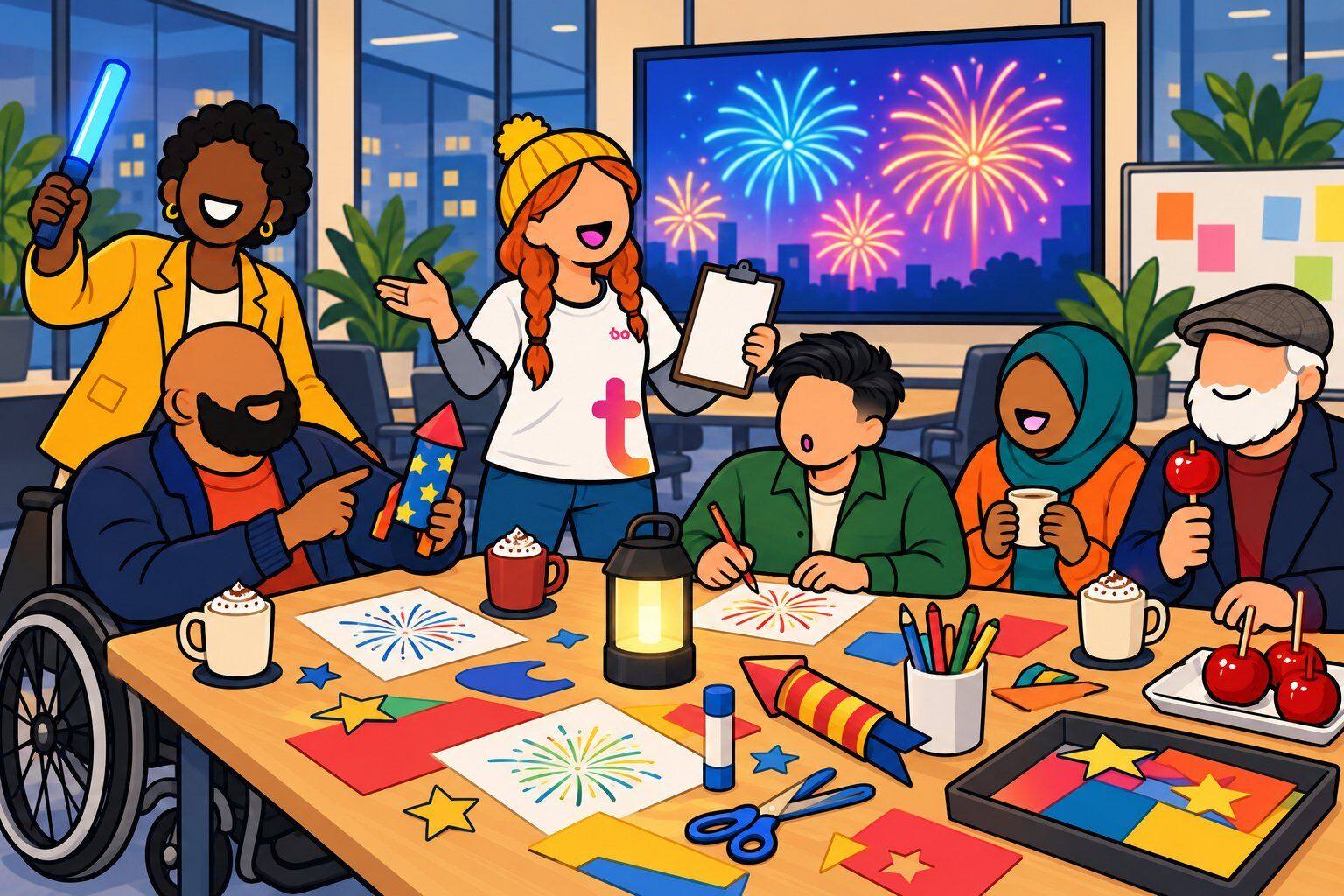
Choose from 27 Bonfire Night games and activities, including a Guy Fawkes quiz, crafts and a work social agenda.
Bonfire Night games, activities and party ideas for families, work teams, youth groups and care homes: choose from 27 ideas with steps, timings and estimated materials costs. Bonfire Night, also called Guy Fawkes Night or Fireworks Night, falls on 5 November.
Bonfire Night games are a subcategory of holiday team building activities and party games for work. They are similar to campfire games, Halloween games and outdoor group games, and they include Guy Fawkes activities and Bonfire Night games for kids. These ideas are also called Guy Fawkes Night games, Fireworks Night activities, 5 November party ideas and bonfire party games.
This list includes:
Bonfire Night is the British celebration held on 5 November each year. It remembers the night in 1605 when Guy Fawkes was found beneath the House of Lords with 36 barrels of gunpowder, part of a plan led by Robert Catesby to blow up Parliament and King James I at the State Opening. The plot failed, and an Act of Parliament passed in January 1606 made 5 November an annual day of thanksgiving. Bonfires and fireworks became part of the commemorations. The Act was repealed in 1859, but the bonfires, fireworks and the effigy on top of the fire (the "guy") carried on as a popular tradition.
Bonfire Night traditions include bonfires, fireworks and foods such as jacket potatoes, toffee apples and parkin, a ginger and oatmeal cake. You can also celebrate indoors with crafts, a quiz and a recorded display.
Bonfire Night games include quizzes about the plot, movement games and afternoon crafts. The DIY activities below use paper, battery lights and ready-made food. For live fireworks, plan a visit to an organised display as spectators, with games at a separate venue. Outdoor games take place in daylight; indoor games use a lit room.
Pick by who is coming and where you are, then jump to the full instructions.
| Setting | Start here | Time |
|---|---|---|
| Indoor work social for 10 to 20 | Guy Fawkes Quiz, Light-Drawing Pictionary, Bonfire Night Food Table | 2 hours |
| Family craft-and-games party | Bonfire Backdrop, Remember, Remember, Toffee Apple Decorating | 90 minutes, including a meal break |
| Kids' party (ages 4 to 10) | Firework Moves, Straw Rockets, Glow Stick Treasure Hunt | 90 minutes |
| Youth group or teens | Glow-Stick Capture the Flag, Wink Murder, Campfire Story Circle | 2 hours |
| Care home or indoor afternoon | Bonfire Night Reminiscence Circle, Indoor Fireworks Afternoon, Fireworks Painting | 90 minutes |
| Remote team | Virtual Bonfire Night, Guy Fawkes Quiz on a call | 60 to 90 minutes |
Choose a party format, food and two or three games from the sections below.
Best for: 4 to 20 people, ages 5 and up, at indoor craft tables
Time: 30 minutes
Materials: A large sheet of backing paper, brown card, red/orange/yellow tissue paper, glue sticks, scissors and marker pens (£5 to £10)
Build a paper bonfire as the backdrop for the evening's photos and performances. Each guest contributes a flame with a word or picture about Bonfire Night.
Best for: Any size of group, with food quantities planned for the guest count
Time: 1 hour of prep, served over the whole evening
Materials: A trestle table, slow cooker or flask for soup, foil, paper cups and bowls (£5 to £8 a head)
Choose two savoury dishes, a sweet option and hot drinks. The costs below are planning estimates, not supplier quotes.
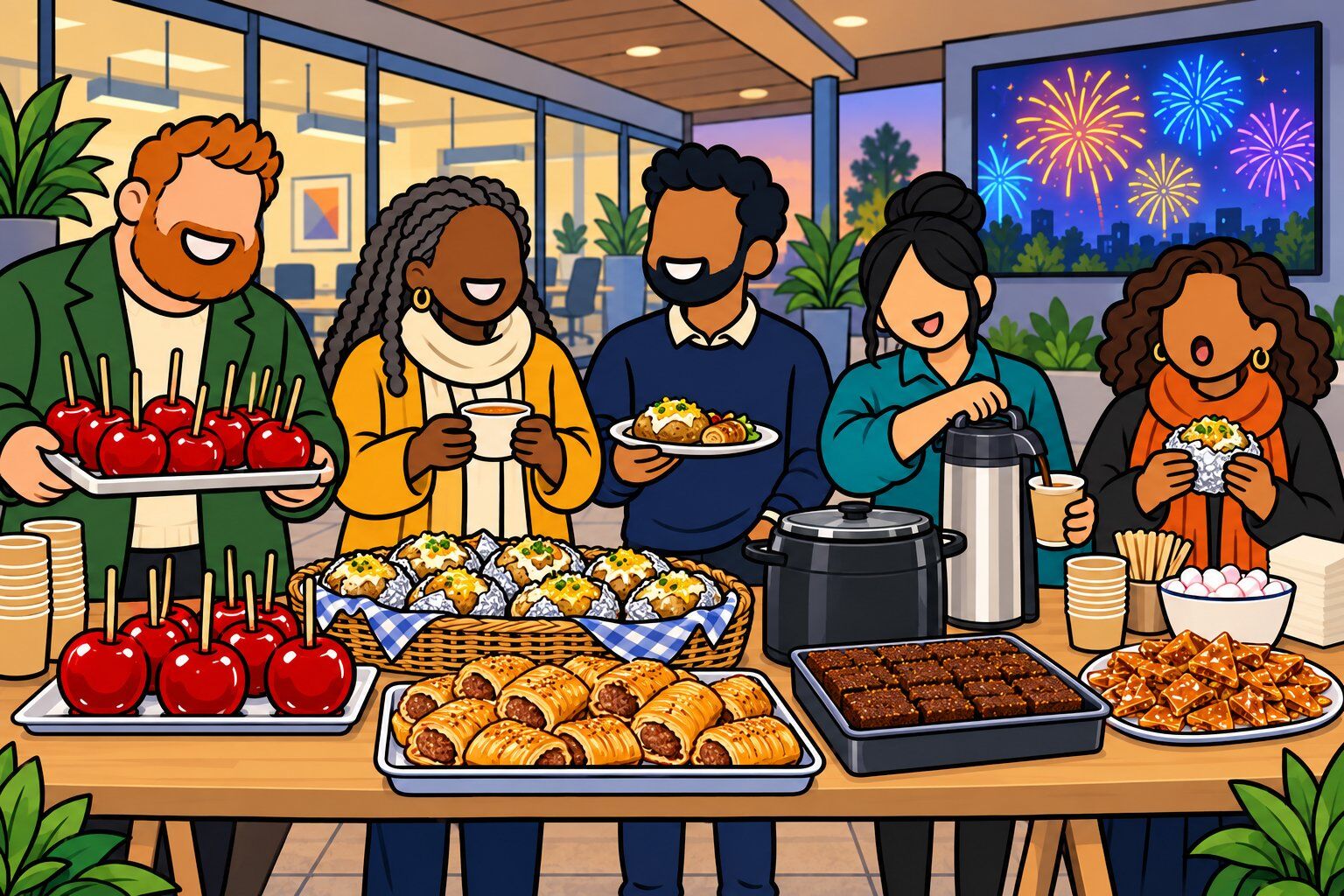
Best for: 5 to 50 people, ages 5 and up, in table groups of up to five
Time: 20 minutes
Materials: One battery LED wand per person, pattern cards and a phone camera per table (£10 to £25 for reusable supplies)
Create a short light routine with battery wands in a lit indoor room. This is a coordinated group performance, with seated and standing versions.
Best for: 6 to 20 people at tables, ages 6 and up
Time: 20 minutes
Materials: One ready-made toffee apple per person, writing icing, sprinkles, paper wrappers, markers and a plate per person (£2 to £4 a head)
Turn bought, finished toffee apples into party characters. All the coating is made before the event; this station uses no pan, hob or heated sugar. Offer a paper apple cut-out for anyone who prefers a craft version.
Best for: 8 to 20 friends, family members or coworkers attending as spectators
Time: Allow 45 minutes for food and 45 minutes for indoor games, plus the organiser's admission/display times, travel and queueing
Materials: Display tickets, the organiser's visitor information, a group contact list and an indoor room for afterwards (ticket and travel costs vary; food approximately £5 to £8 a head)
Make an organised display the outing and host the games at a separate indoor venue. Build the invitation around the actual event timetable rather than squeezing a display into a fixed party slot.
Use a lit indoor room for light drawing, memory games and acting. Battery wands provide the light-drawing prop.
Best for: 6 to 20 players in two teams, ages 8 and up
Time: 15 minutes
Materials: One battery LED wand, a timer and word slips (£3 to £8)
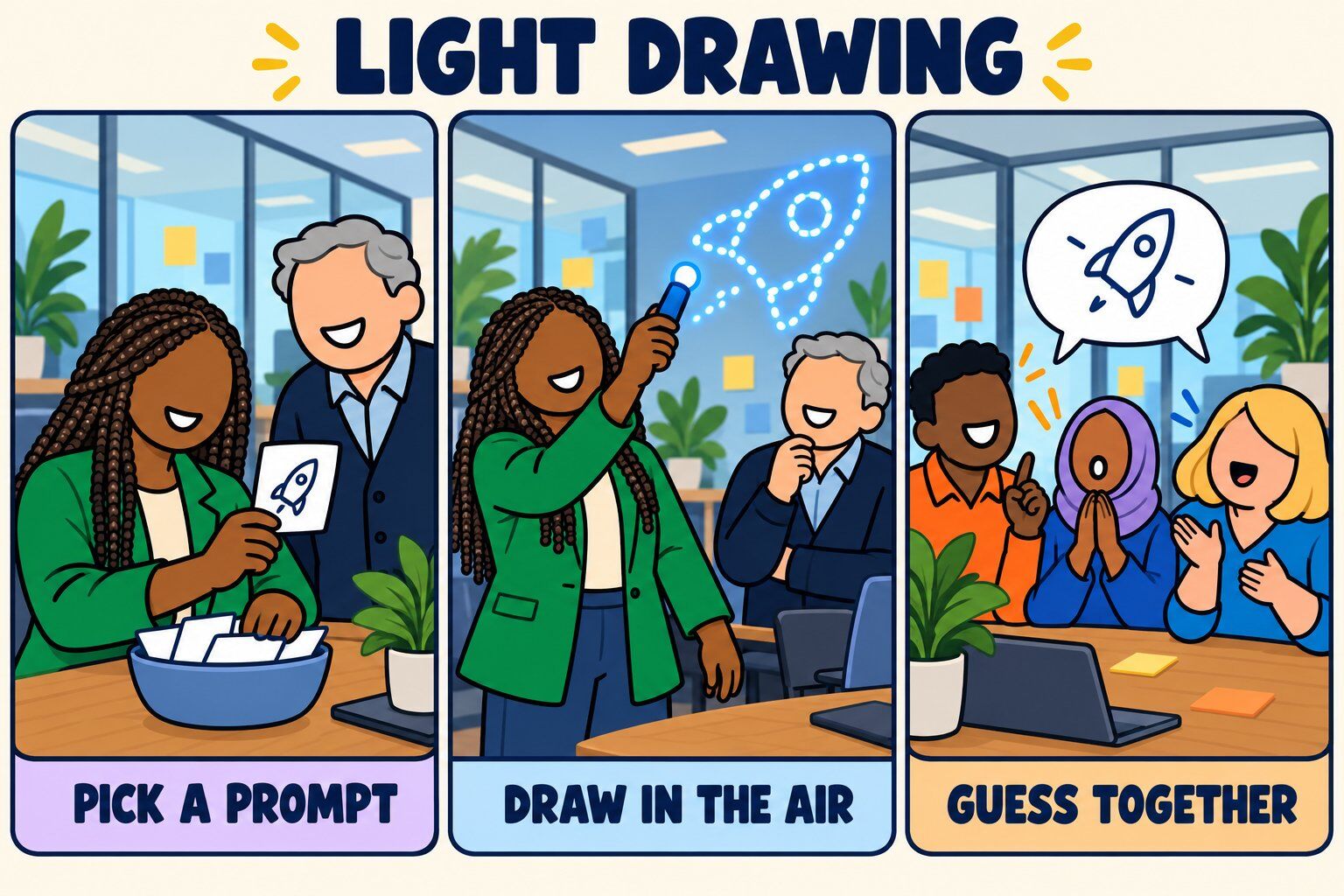
Draw a shape in the air with a battery wand while teammates guess. Keep the room lights on: players follow the movement of the wand, so a long-exposure camera or dark room is unnecessary. Players can draw seated.
Best for: 5 to 15 players in a circle, ages 6 and up
Time: 10 minutes
Materials: None (free)
A memory chain named after the traditional rhyme. Play seated at a table or on a video call.
Best for: 8 to 30 players in a circle, all ages
Time: 10 minutes
Materials: One foil-wrapped potato (cold) and a phone with a playlist (free)
The classic passing game with the right prop for the night. The potato goes around the circle while the music plays, and whoever holds it when the music stops is out.
Best for: 6 to 20 players in two teams, ages 8 and up
Time: 25 minutes; 30 minutes for 17 to 20 players
Materials: Prompts on slips of paper, a timer (free)
Charades with a Bonfire Night prompt list. Play indoors with the lights on. Mime every prompt without physical props.
For more words, use our random charades generator.
These Bonfire Night games for kids suit ages 4 to 10 and a crowd of excited children in coats. They run in daylight, in a garden the adults have walked first. Use an indoor room for the table games if preferred. The firework games and the crafts for the afternoon follow in the next two sections.
Best for: 4 to 20 players taking turns, all ages
Time: 15 minutes
Materials: A pack of glow stick bracelets, six plastic bottles filled with water, a glow stick dropped into each bottle (£5)
The bottles glow as targets and the bracelets become rings. Set up in daylight, with enough light to see the ground and throwing line.
Best for: 6 to 20 children, ages 4 to 10, in a garden or fenced area
Time: 15 minutes
Materials: A pack of 50 to 100 glow sticks in several colours, a bucket per team, a torch per adult and boundary rope (£5 to £8)
Teams collect glow sticks by colour. Play in daylight; stop if the ground or boundary becomes difficult to see.
Best for: 4 to 12 players taking turns, ages 6 and up
Time: 15 minutes
Materials: Six apples, a shallow tub of water, a large slotted spoon, a tray, towels and a food-safe marker (£3 to £5)
This apple-bobbing variation uses a spoon to collect apples. There is no biting, face-dipping or eating during play. Put the tub on a stable table indoors or outside in daylight.
These two games use fireworks as a theme. Play outdoors in daylight or indoors with room for the activity. Stop outdoor play if the ground or boundaries become hard to see.
Best for: 6 to 30 children, ages 4 to 9
Time: 10 minutes
Materials: None (free)
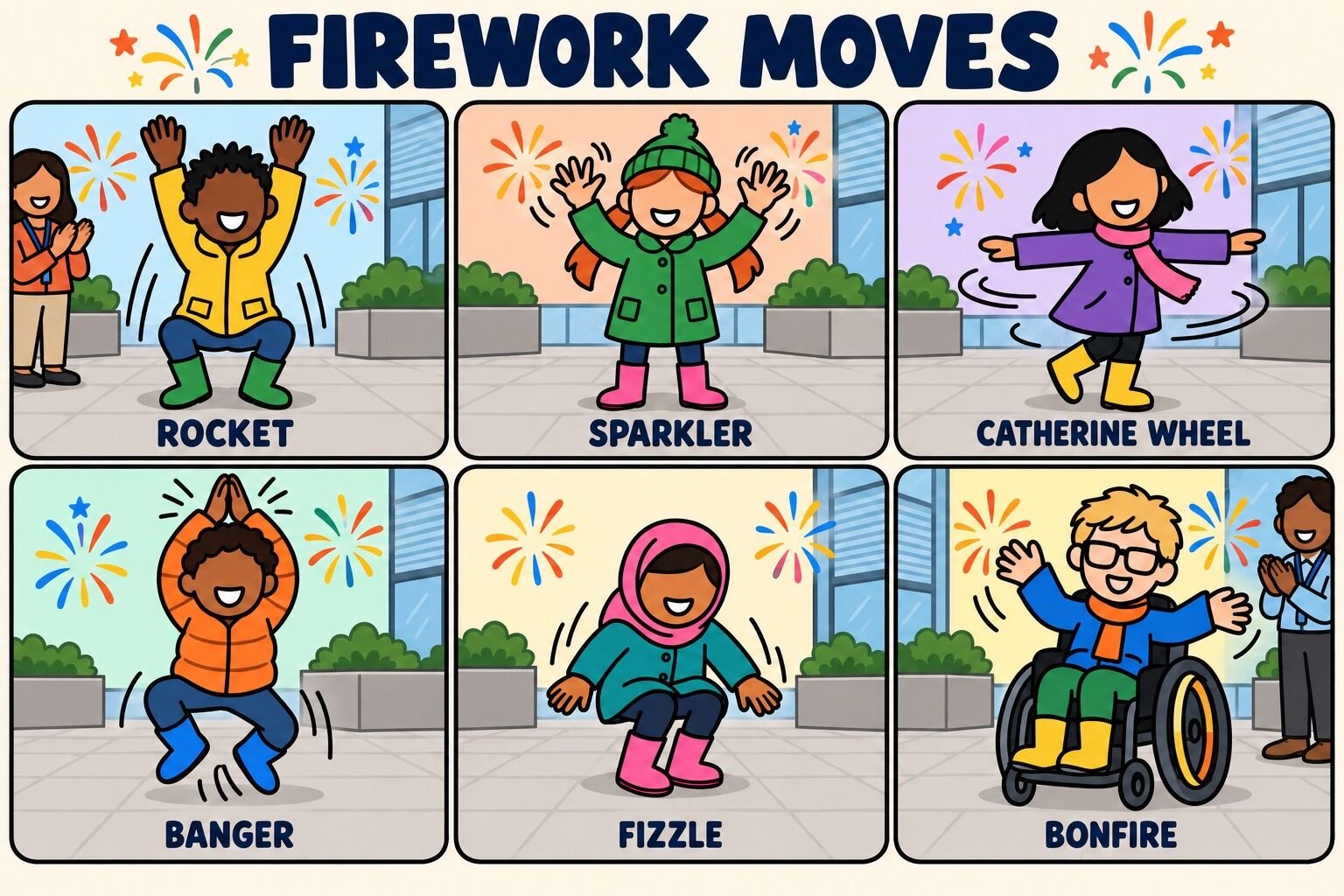
A caller names a firework and players act it out. Outdoors, choose level ground in daylight. Offer seated arm movements for anyone who prefers them.
Best for: 4 to 20 children, ages 5 to 11, in pairs
Time: 25 minutes to build and launch
Materials: Drinking straws, paper, pencils, sticky tape, scissors, a tape measure (£5)
Each child builds a paper rocket and launches it with a straw. Use an empty indoor launch lane or an outdoor area in daylight; keep everyone behind the launch line.
Set up an afternoon craft table, then use the finished work to decorate the indoor party room.
Try fireworks painting or battery-lit jar lanterns. Use the finished decorations on the indoor party tables and noticeboards.
Best for: 4 to 30 people, ages 3 and up, any indoor space
Time: 30 minutes
Materials: Black paper or card, poster paint in bright colours, cardboard tubes, plastic forks, old toothbrushes, paper plates for palettes and wipes (£5 to £10)
Use cardboard stamps, forks and toothbrushes to print colourful bursts on black paper. Put a wipe at each seat and paint plates in the middle of the table.
Best for: 4 to 20 people, ages 5 and up
Time: 30 minutes, plus drying
Materials: Clean glass jars, tissue paper in orange, yellow and red, PVA glue, brushes, battery tea lights, decorative ribbon (£5 to £10)
Make a tabletop lantern with a battery tea light for the indoor decorations.
Guy Fawkes activities tie the party back to the story it commemorates. The quiz below has 20 questions with checked answers, the Guy contest turns the effigy tradition into a craft, and the two games turn the plot into a performance.
Best for: 6 to 60 players in teams of 3 to 6, ages 10 and up; works on a video call
Time: 20 to 30 minutes
Materials: The questions below, answer sheets, pens, a prize (free)
Run this as a pub-style quiz: read each question twice, allow 45 seconds per question including the reading, then reserve ten minutes for marking and the tiebreaker. Award one point per fully correct answer; use the same rule for every team. Question 2 distinguishes the plot’s leader, Robert Catesby, from Guy Fawkes.
| # | Question | Answer |
|---|---|---|
| 1 | In which year did the Gunpowder Plot take place? | 1605 |
| 2 | Who was the leader of the plot? | Robert Catesby (not Guy Fawkes) |
| 3 | How many plotters were there in total? | 13 |
| 4 | In which English city was Guy Fawkes born? | York |
| 5 | Which country's army did Fawkes fight for before the plot? | Spain's army, in the Netherlands |
| 6 | Beneath which chamber of Parliament was the gunpowder stored? | The House of Lords, in a rented cellar |
| 7 | How many barrels of gunpowder were found? | 36 |
| 8 | Who received the anonymous letter that gave the plot away, and on what date? | Lord Monteagle, on 26 October 1605 |
| 9 | What false name did Fawkes give when he was arrested? | John Johnson |
| 10 | At what time of day was Fawkes discovered? | In the early hours of 5 November 1605, with fuses and matches |
| 11 | Where and when were the surviving plotters tried? | Westminster Hall, 27 January 1606 |
| 12 | Where was Fawkes executed, and on what date? | Old Palace Yard, Westminster, on 31 January 1606 |
| 13 | Which Act made 5 November an annual day of thanksgiving, and when was it repealed? | The Thanksgiving Act (also called the Observance of 5th November Act), passed in January 1606 and repealed in 1859 |
| 14 | Which ceremonial search still takes place before every State Opening of Parliament? | The Yeomen of the Guard search the cellars of the Palace of Westminster |
| 15 | Complete the rhyme: "Remember, remember..." | "...the fifth of November, gunpowder treason and plot" |
| 16 | Which Sussex town is known for its Bonfire Night processions? | Lewes |
| 17 | In which Devon town do residents carry flaming tar barrels through the streets on Bonfire Night? | Ottery St Mary |
| 18 | Which king was the plot intended to kill? | James I |
| 19 | Parkin, the Bonfire Night cake of the north of England, is made with which grain? | Oats, as oatmeal (with black treacle and ginger) |
| 20 | Does the cellar used by the plotters still exist? | No; it was destroyed in the 1834 fire at Parliament |
Historical answers follow UK Parliament's Gunpowder Plot FAQ and the sources linked with the historical handout. The local-tradition answers are documented by Visit Lewes and Ottery's Tar Barrels organisers; these are quiz facts, not suggested outings. Sarah Cook's parkin recipe at Good Food confirms the oatmeal answer. Question 15 quotes the traditional anonymous rhyme, reproduced in Hansard’s record of 17 October 2019. That record verifies the wording, not when the rhyme originated. For more rounds, see our trivia games for adults.
Tiebreaker: give teams 30 seconds to write down the year in which the Gunpowder Plot's 400th anniversary fell. 2005. If teams remain tied, share the win.
Best for: 6 to 30 people in teams of 3 to 5, ages 6 and up
Time: 40 minutes
Materials: Old clothes per team (trousers, shirt, jumper), newspaper or straw for stuffing, string, a pillowcase for the head, felt tips, a hat, paper voting tokens and a labelled vote bucket per team (free to £5)
Make a stuffed guy, vote on the entries and keep them as decorations. Announce before starting that none of the entries will be burned.
Best for: 8 to 30 people in teams of 4 to 6, ages 10 and up
Time: 25 minutes
Materials: A timer, a one-paragraph summary of the plot for each team, whatever props are to hand (free)
Each team performs the plot in exactly one minute. Use the summary below, then decide which details fit the time limit.
Historical handout: In 1605, Robert Catesby led a plan to kill King James I at the opening of Parliament. The plotters rented a cellar beneath the House of Lords and stored gunpowder there. On 26 October, Lord Monteagle received an anonymous letter warning him to stay away from Parliament. Searches followed. Guy Fawkes, using the name John Johnson, was arrested in the early hours of 5 November; 36 barrels of gunpowder were discovered. The surviving conspirators were tried for treason in Westminster Hall on 27 January 1606 and convicted. Parliament also passed an Act in January 1606 making 5 November an annual thanksgiving. The commemorations grew to include bells, bonfires and fireworks.
Handout sources, checked 17 October 2026: Royal Museums Greenwich's account of the plot, UK Parliament's chronology and Parliament's history of the commemorations.
Best for: 8 to 25 players seated in a circle, ages 8 and up
Time: 15 minutes
Materials: Slips of paper with one marked "plotter" (free)
Wink Murder, the classic circle game, with a Bonfire Night frame: one secret plotter is eliminating the other players with a wink while a detective tries to work out who it is. Play it indoors with the lights on; it does not work in the dark.
For a work team, choose a bake-off, a scheduled social or a virtual event. Confirm the venue and guest numbers before buying supplies.
Best for: Work teams of 8 to 50, anyone who bakes
Time: 30 minutes of judging on the night; bakes made in advance
Materials: Entrants' bakes, paper plates, scorecards, a prize (free to £10)
Invite entries in two categories: parkin and bonfire toffee.
Best for: 10 to 20 coworkers in an indoor room with tables
Time: 120 minutes, 5pm to 7pm; food and entries prepared beforehand
Materials: Prepared food, bake-off entries, quiz sheets, pens, a battery LED wand, word slips and a timer (approximately £8 to £12 a head)
This indoor agenda gives each activity its full running time and includes handovers. Assign one host to the quiz and games, and one helper to the food, bake-off scores and room reset. It fits all 10 to 20 guests without simultaneous games.
| Time | What happens | Participation and lead |
|---|---|---|
| 5:00–5:20 (20 min) | Welcome and prepared food table | Everyone eats; helper oversees the table |
| 5:20–5:50 (30 min) | Guy Fawkes Quiz, including marking | Host reads; two to four teams of 3 to 5 |
| 5:50–5:55 (5 min) | Break and set out word slips | Helper resets; host totals any remaining scores |
| 5:55–6:10 (15 min) | Light-Drawing Pictionary | Two teams; six artist turns each, volunteers draw and everyone may guess |
| 6:10–6:15 (5 min) | Set out bake-off scorecards and entries | Helper; guests choose whether to taste or read recipe stories |
| 6:15–6:45 (30 min) | Bake-off judging, score calculation and prizes | Helper runs judging; host announces results |
| 6:45–7:00 (15 min) | Wink Murder, three timed rounds | Whole group with the host facilitating; helper clears the food table |
For a display outing, use Display Trip and After-Party as a separate schedule based on the event's actual times. A journey and display are not included in these 120 minutes.
Best for: Remote and hybrid teams; the hosted event takes 10 to 1,000 people, and this DIY plan is for up to 25 on one call
Time: 60 to 90 minutes
Materials: A video call; for the DIY version, a hot chocolate sachet and a bar of bonfire toffee posted to each person (£4 to £8 a head including postage); the hosted event is priced per person on its event page
A remote team can mark 5 November on a call with something warm, something sweet and a few games. The DIY programme below is a flameless quiz-and-stories call. For a separately hosted format, our tiny campfire includes camp-style icebreakers, a haunted riddle challenge and a shipped s'mores kit; ask the booking team about its format, kit requirements and delivery for your locations. Its minimum booking lead time is 14 days.
See tiny campfire details and current pricing for the hosted format, duration options and booking information.
Schedule the field game in daylight. The seated story circle can follow indoors. Assign leaders to each group and to the field boundary.
Best for: 10 to 40 players in two teams, ages 11 and up, on a flat field with a clear boundary
Time: 30 minutes
Materials: Glow stick bracelets in two colours (one per player), two bundles of glow sticks as flags, cones and glow sticks for the centre line and the boundary (£8 to £12)
Play in daylight. Glow bracelets identify teams; they are not lighting for the field. Stop when you cannot clearly see the ground or boundary without them.
Best for: 6 to 12 people per circle, ages 11 and up; split 13 to 25 into two or three circles
Time: 20 minutes
Materials: Prompt cards and a timer (free)
Finish with a seated story round indoors, or in a lit seating area separate from the active games. The campfire theme needs no live flame or toasting activity.
For more prompts, see our campfire questions.
Offer an indoor afternoon with optional sound, seated activities and food selected by the care home’s staff for each resident.
Best for: 4 to 15 residents and visitors, seated
Time: 30 to 45 minutes
Materials: Prompt cards; refreshments selected and served by care-home staff; a box of objects to pass round: a woolly scarf and gloves, a battery light wand, an empty treacle tin, the rhyme printed large, old photos of bonfire nights if the home has any (£5 for the treats)
Use photos, familiar objects and optional questions to invite Bonfire Night memories. Offer the object box first, and let anyone listen without speaking.
Best for: 6 to 30 residents, families and staff
Time: 90 minutes
Materials: LED sparkler wands or battery candles, a projector or large TV with a recorded fireworks display, hot chocolate, jacket potatoes, the Fireworks Painting kit (£15 to £25)
A Bonfire Night without noise or cold: the food, the painting and a display on screen with the sound low, or off for anyone who prefers it.
Use this checklist to organise a spectator visit and a separate flameless party. The display organiser supplies the event's visitor instructions; your group coordinator handles tickets, meeting arrangements and the indoor programme.
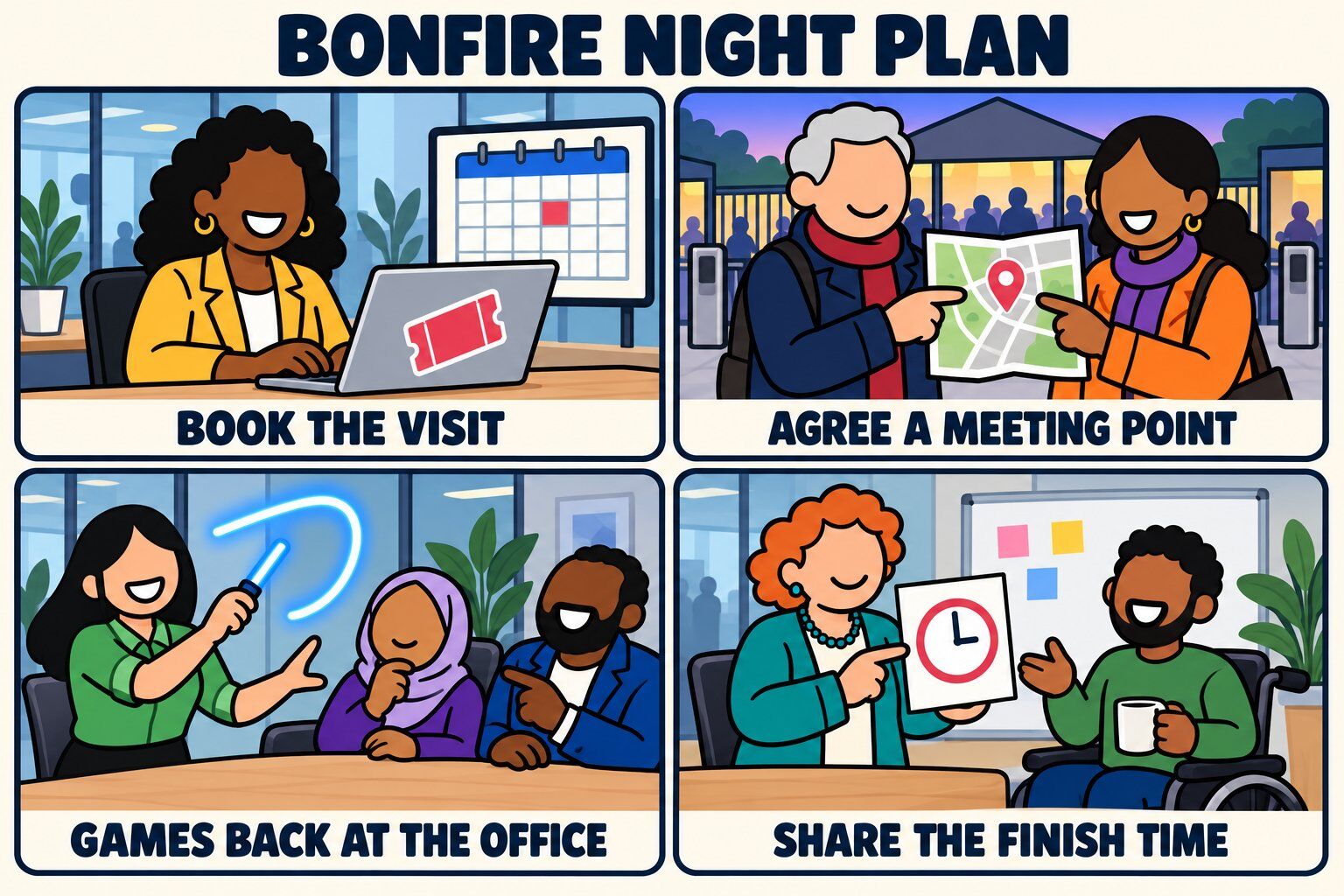
| Plan | Confirm before the invitation goes out |
|---|---|
| Display visit | Read the organiser's current visitor information, admission time, accessibility details and cancellation policy. Book the required tickets. |
| Group arrangements | Name a coordinator, share a contact number and meeting point, and agree how guests report independent arrivals or early departures. |
| Travel and timing | Add the journey, arrival allowance and queueing to the published display time. Give the indoor activities their own full slots. |
| Party supplies | Pack battery wands, paper decorations, quiz sheets and prepared food. The DIY programme contains no fire lighting, real sparklers or fireworks handling. |
| Games | Match attendance to each activity's capacity. Use a dedicated daylight space for outdoor games and a lit room for indoor games; assign a facilitator per simultaneous group. |
| Alternative programme | Offer indoor games and a recorded display with optional sound for guests skipping the outing, or if the event is cancelled. |
Use these planning suggestions to adapt the list to your group.
| Small group (under 15) | Large group (40+) | |
|---|---|---|
| Best games | Remember, Remember, Light-Drawing Pictionary, Wink Murder, Toffee Apple Decorating | Guy Fawkes Quiz at tables, Firework Moves in groups of 6 to 30; Glow-Stick Capture the Flag in separate games of 10 to 40; Build-a-Guy Contest in groups of 6 to 30. Assign a facilitator and separate space to each simultaneous group. |
| Display outing | One coordinator shares tickets and meeting arrangements | Split into named travel groups, each with a coordinator; confirm group booking arrangements with the display organiser |
| Light patterns | Groups of up to five rehearse a four-shape sequence | Table groups of up to five, each with a leader; pair tables for simultaneous performances |
| Who runs it | One host | One overall coordinator, a facilitator per activity group and boundary leaders for field games |
| Food | Jacket potatoes from the oven | A trestle table, a caterer or a local food van |
Leave out these formats and use the alternatives below.
| Game | Why skip it | Play instead |
|---|---|---|
| Chubby Bunny (marshmallows in the mouth) | Mouth-filling contests make eating the performance; this programme keeps food in the meal break | Tell stories in the Campfire Story Circle |
| Drinking games (Sevens and the like) | A drink forfeit excludes guests who do not want to drink | Remember, Remember, with the same counting-and-concentration fun |
| Marshmallow peeling records | The supposed record has no agreed scoring or useful endpoint | The Bake-Off, which has real judging |
| Spin-until-dizzy races | Spinning adds a forfeit to a race when a short movement game would fit the theme | Firework Moves, with slow turns and a seated option |
| Balloon popping by sitting on prompts | Wet grass, dark, balloons that do not pop; nothing to do with the night | Bonfire Night Charades for the same acting prompts |
| Sticker "mosquito bite" games | The sticker mechanic does not use the Bonfire Night theme | Glow Stick Treasure Hunt |
| A DIY fireworks display for a crowd | A display needs its own event planning; it is outside this games-and-spectator programme | The Display Trip and After-Party |
| Real-sparkler drawing games | A burning prop determines the turn length and cannot be reused between rounds | Light-Drawing Pictionary with a reusable battery wand and a timer |
Choose a party format, two or three games and a clear finish time. Run movement games while there is daylight, then move to the indoor quiz, crafts or story circle. Match the group sizes and timings to the people attending.
If you would rather have a host run the games, browse our virtual and in-person team building events.
Next, check out our lists of large group games, indoor group games for a wet November and Halloween office party ideas for the week before.
Answers to common questions about Bonfire Night games, activities and party ideas.
Bonfire Night, also called Guy Fawkes Night, is the British celebration held on 5 November. It commemorates the failure of the 1605 Gunpowder Plot, led by Robert Catesby, to kill King James I and blow up Parliament. Guy Fawkes was arrested and 36 barrels of gunpowder were discovered beneath the House of Lords. Parliament made 5 November an annual thanksgiving in January 1606; the Act remained in force until 1859. Bonfires and fireworks became part of the commemorations.
Try Remember, Remember, Hot Potato with a cold foil-wrapped potato, Bonfire Night Charades, Glow Stick Ring Toss and the Guy Fawkes Quiz. Light-Drawing Pictionary uses a battery LED wand. Play outdoor movement games in daylight on a dedicated play area, and use a lit indoor room for seated and acting games.
Try Firework Moves, Straw Rockets, Glow Stick Ring Toss, Apple Scoop and a Glow Stick Treasure Hunt. Match the activity to the children's ages and run outdoor games in daylight. Hide hunt objects within reach without climbing or lifting. Apple Scoop uses a spoon and has no eating or timer. Fireworks painting, a paper bonfire backdrop and battery-lit jar lanterns suit an indoor craft table.
Traditional Bonfire Night food is hot and easy to eat standing up: jacket potatoes wrapped in foil, sausages in rolls, soup in paper cups and hot chocolate, with toffee apples, bonfire toffee (a dark treacle toffee) and, in the north of England, parkin, a sticky ginger cake made with oatmeal and black treacle that is baked a few days early and kept in a tin so it softens.
For 10 to 20 coworkers, use the two-hour indoor agenda: 20 minutes for food, 30 for the quiz, 15 for light drawing, 30 for a bake-off and 15 for Wink Murder, plus two five-minute handovers. To visit an organised display, build a separate itinerary around its actual admission and display times, travel and queueing. Remote teams can use the DIY quiz-and-stories call.
Use battery lights, a Guy Fawkes quiz, paper crafts, a Build-a-Guy contest with entries kept as decorations, and a seated story circle. An indoor afternoon can include a recorded fireworks display with the sound low or off. The DIY activities in this list use no live flame, real sparklers or fireworks handling.
Comments (0)
Leave a Comment