
14 Christmas Contest Ideas & Competitions (With Rules)
Choose a Christmas contest your team can run: wrapping races, trivia, paper sleighs and more, with materials, timing and a clear way to pick winners.
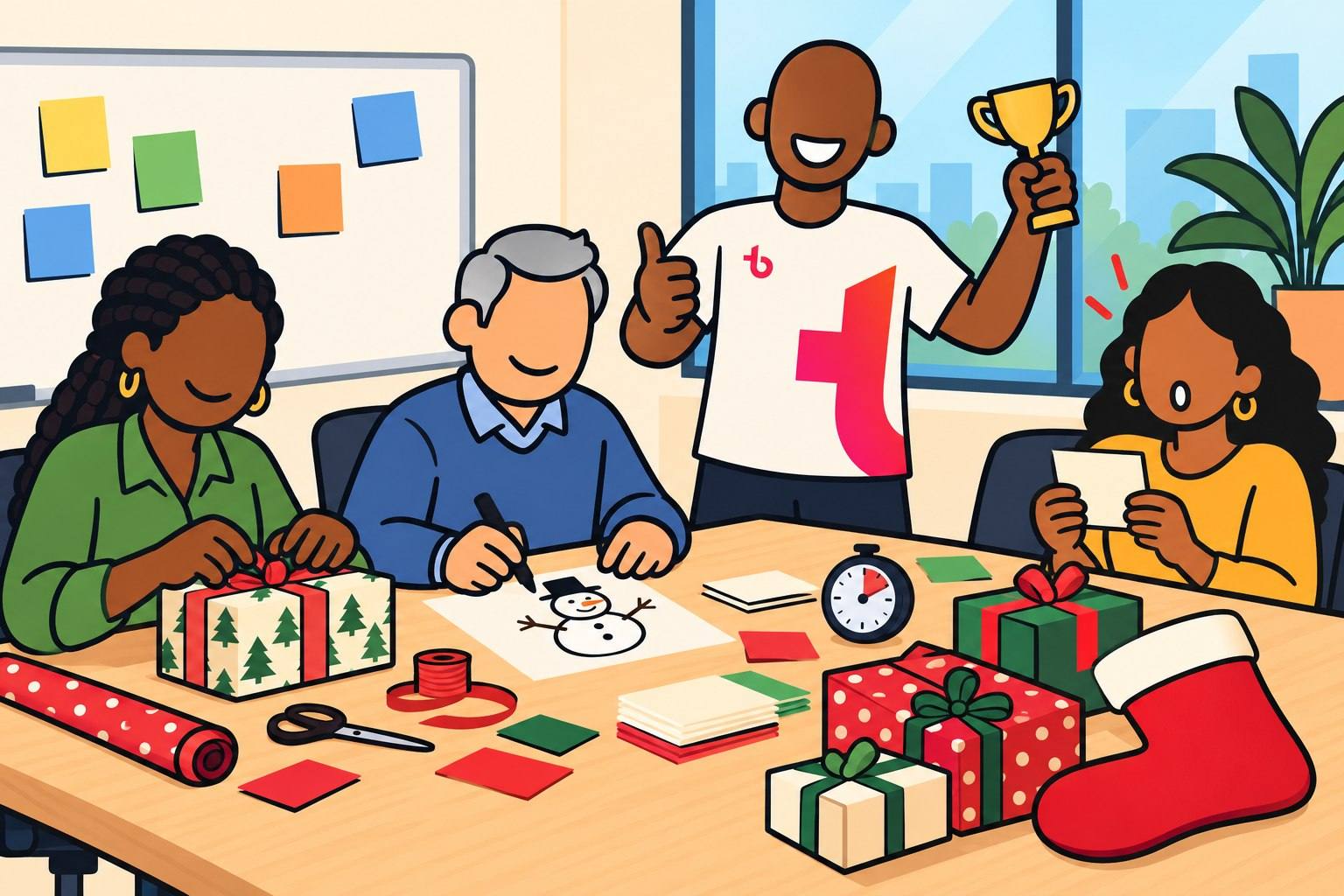
Choose a Christmas contest your team can run: wrapping races, trivia, paper sleighs and more, with materials, timing and a clear way to pick winners.
Christmas contest ideas are festive competitions with a clear task, time limit and way to choose a winner. Try a gift-wrapping race, candy cane fishing, a Christmas price-guessing game or a paper-sleigh building challenge. For work, choose a mix of making, guessing and teamwork so the same skill does not decide every round.
These activities are seasonal work competitions and fit into an office Christmas party. They are similar to Christmas games but end in a score and a winner. A close creative sibling is an office Christmas decorating contest. Options include Christmas trivia and a holiday scavenger hunt. You may also know them as Christmas competitions, Christmas challenges or holiday contests.
This list includes:
For a short office event, pick one contest from each of three types: a timed task, a guessing round and a creative challenge. The times below are suggested activity slots for the stated group sizes, including instructions and scoring. Prepare the materials beforehand.
On a phone, swipe across the table to read the scoring column.
| Contest | Group | Time | Winner decided by |
|---|---|---|---|
| 1. Christmas trivia | 3–6 teams of 2–5 | 15 min | Correct answers |
| 2. Wrapping races | 4–8 entrants | 10 min | Checks, then time |
| 3. Stocking delivery challenge | 3–6 pairs | 10 min | Correct routes at the buzzer |
| 4. Candy cane fishing | 4–8 players per station | 10 min | Catches |
| 5. Jingle bell pong | 2–4 teams of 3 | 15 min | Scoring throws |
| 6. Christmas Carol-oke | 3–6 volunteer acts | 15 min | Interpretation and delivery |
| 7. Tabletop decorating | 3–5 teams | 30 min | Three-criterion rubric |
| 8. Paper sleigh load test | 3–5 teams of 2–4 | 30 min | 50 g pouches held across a gap |
| 9. Paper elf photo | Individual entries | 20 min to create | Story, props and caption |
| 10. Advent calendar recall | 6–30 players | 10 min | Objects remembered |
| 11. Christmas price guessing | 6–30 players | 15 min | Closest estimates |
| 12. Mystery holiday sounds | 6–20 players | 10 min | Correct actions identified |
| 13. Gingerbread code hunt | 3–6 teams of 2–4 | 15 min | Codes recorded |
| 14. Write a Christmas carol | 3–5 teams of 3–5 | 20 min | Required words and story |
For a mixed-holiday office event, choose tasks that need no Christmas trivia: wrapping races, stocking delivery, the sleigh build or photo storytelling. Invite employees to choose a winter, mailroom or gift-delivery theme while keeping the scoring rules.
Winter mail sort: This adapts contest 3 below. Use the stocking challenge’s 18 cards and 60-second limit, but label three plain mail trays North, East and West. Replace every star with a circle, every bell with a triangle, and all other pictures with a parcel outline. Keep each card’s written color and any PRIORITY label. Update the rule card to say “triangle” and “circle”; the same six-six-six answer key still applies. Pairs can run the whole contest with paper trays and cards, without holiday clothing or decorations.
These office Christmas contest ideas fit a meeting room and use supplies the organizer can provide. Run them during an agreed activity slot, with a scorekeeper or noncompeting role available.
Best for: Three to six teams of two to five. Time: 15 minutes. Materials/cost: Ten prepared questions, answer sheets and pens; no purchases needed if supplies are available.
Prepare ten questions across holiday films, foods, songs and traditions, checking the answers before the event. Read each question aloud and display it, then allow 30 seconds for discussion. Each team writes one answer; collect all sheets before revealing the key. Award one point per correct answer.
Keep one numerical question in reserve as the tie-break. For example, “How many gifts are given in total across all verses of ‘The Twelve Days of Christmas’?” The answer is 364, counting each repeated gift. Closest estimate wins. Preview the question categories in the invitation so teams know what to expect.
Best for: Four to eight individual entrants. Time: 10 minutes. Materials/cost: Identical empty boxes, equal pre-cut paper sheets and six tape strips per person; use spare packaging.
Give everyone a station and demonstrate three completion checks: the box is fully covered, both ends are closed, and the paper stays attached when the organizer lifts the box. Start a two-minute timer. Entrants raise a hand when finished; record their completion times, but leave each package in place until time ends.
Award one point per completed check, out of three. Highest score wins, with the fastest recorded finish breaking a tie among fully completed packages. A team version lets pairs divide folding and taping, with all entrants competing as pairs.
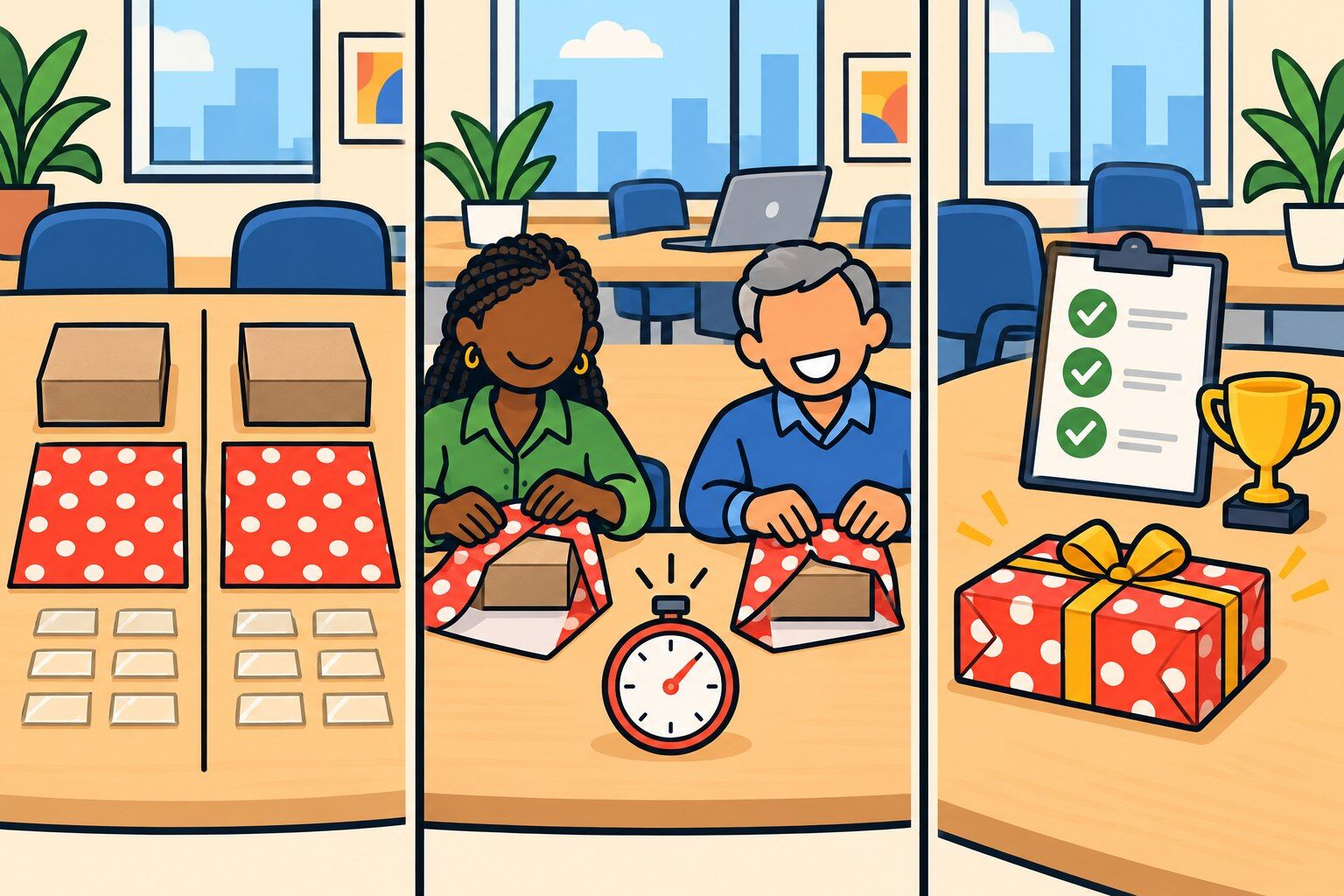
Best for: Three to six pairs. Time: 10 minutes. Materials/cost: Three paper stocking mats labeled North, East and West, 18 gift-tag cards and a rule card per pair; use printed or hand-drawn paper.
Turn each table into a tiny holiday sorting room. Prepare the following identical set for every pair, writing each color on its card as well as showing it. Only the first two cards carry a PRIORITY label:
Keep this ordered rule card visible. Apply the first matching rule to each tag, then stop:
Give pairs 60 seconds to sort. One partner can read while the other moves cards, or both can sort. Everyone stops at the buzzer; leave cards where they are. Award one point for each card fully on its correct mat, out of 18. Unplaced cards and cards between mats earn zero. Highest score wins; use the common unresolved-tie rule below, with no individual finish-time recording.
Answer key: North has the two PRIORITY tags and four stars; East has the six red tags showing a tree, gift, mitten, boot, candle or bow; West has the three ordinary bells, blue tree, green mitten and ordinary yellow gift. Each destination receives six cards. In the reveal, compare the PRIORITY red bell with the ordinary red bell: their different destinations show why rule order matters.
A swinging hook, an unlikely bounce and a dramatic carol give guests three very different ways to compete. Set them up as separate stations, or choose one for a party break.
Best for: Four to eight players per station. Time: 10 minutes. Materials/cost: Ten wrapped candy canes, a wide container, a 60 cm (2 ft) dowel, string and one plastic hook-shaped candy cane; one small shared kit.
Tie the plastic cane to 30 cm (12 in) of string on the dowel. Arrange ten wrapped canes hook-up in a wide container so they can lift out separately. Mark a line 30 cm (1 ft) from the container’s near edge. Keeping the rod-holding hand behind that line, each player has 45 seconds to hook canes and land them on a tray. The free hand stays off the string and candy.
Score one point per cane on the tray when time ends. Reset the same arrangement before each turn. Tied leaders take a 20-second round. Set the station at a comfortable seated height and keep the starting distance the same for everyone.
Best for: Two to four teams of three. Time: 15 minutes. Materials/cost: Six reusable cups, three ping-pong balls and a tray; use available party supplies.
Arrange the cups in a triangle on a tray at the far end of a table and mark a throwing line 1.5 m (5 ft) from the nearest cup. Each teammate gets three underhand throws, with one bounce on the table required before the ball enters a cup. Count one point for each ball that comes to rest inside. Retrieve balls after each player's turn and keep all cups in play.
The nine throws give each team a possible nine points. Tied teams each take three additional throws, one per player. For the Christmas theme, decorate the cups with bell shapes or ring a bell after a score. Use lightweight balls for throwing rather than metal bells.
Best for: Three to six volunteer acts. Time: 15 minutes. Materials/cost: A lyric sheet, a speaker if needed and scorecards; use a permitted recording or sing unaccompanied.
Offer three familiar carols in advance and let each act choose one. Give soloists or small groups the same 45-second performance slot, with lyrics available. The assignment is to give the song a playful interpretation, such as a weather report or a dramatic sports commentary.
Three noncompeting judges score each act from zero to five for clarity of the chosen interpretation and zero to five for inventive delivery. Average their totals for a score out of ten. Break ties with the higher average interpretation score. This rewards the creative idea without turning vocal training or lyric memory into an entry requirement.
One of these Christmas challenges rewards visual design; the other tests a structure. Both start with equal materials, so entrants can concentrate on what to make.
Best for: Three to five teams. Time: 30 minutes. Materials/cost: Matching cardboard bases, colored paper, markers and tape; one equal kit per team.
Give teams 20 minutes to build a small “North Pole delivery depot” on their base, followed by a one-minute explanation each. Three noncompeting judges award zero to five points for a recognizable theme, inventive details and a finished presentation. Average their totals, out of 15; use theme score first to break ties.
Keep this round on one tabletop so it fits within a larger contest program.
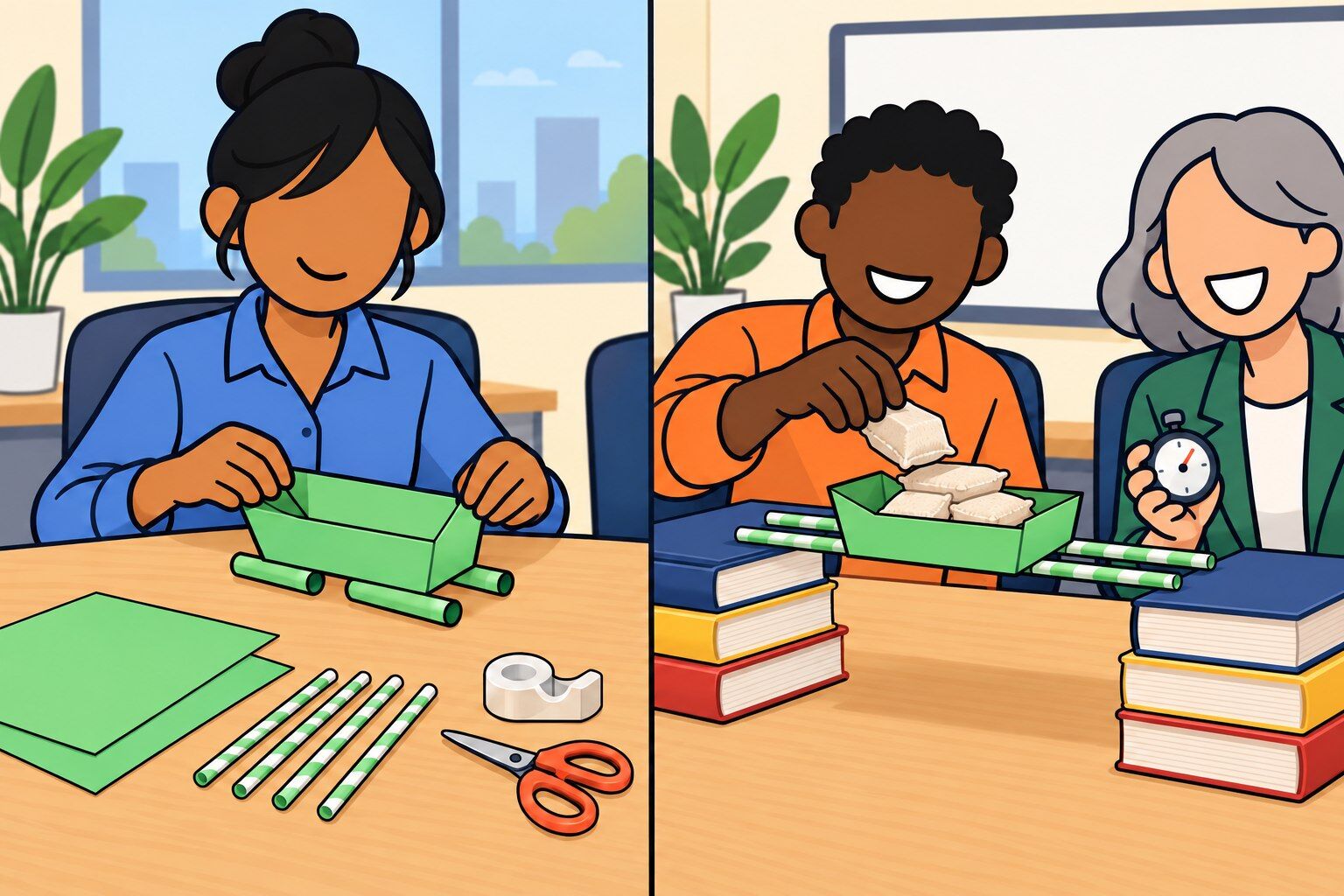
Best for: Three to five teams of two to four. Time: About 30 minutes. Materials/cost: Two equal sheets of card, four paper straws and 30 cm (12 in) of tape per team; shared scissors, a ruler, two equal book stacks and 25 identical sealed 50 g (1¾ oz) rice pouches weighed by the organizer. Use small flat zip bags roughly 10 × 7 cm (4 × 2¾ in), requiring 1.25 kg (2¾ lb) of rice for the shared test kit. Reuse the kit between teams.
Give teams ten minutes to build a paper sleigh with a tray and two runners. Set the book stacks 15 cm (6 in) apart, with their tops about 10 cm (4 in) above the table. The sleigh must bridge that open gap: only the runner ends may rest on the books, and the tray must stay over the gap without touching a book or the tabletop. Teams can cut, fold and join their kit but cannot add other materials. Tray walls and room for a centered stack of flat pouches are part of the design brief.
Use the same test station for every team. The organizer places one rice pouch at a time in the tray, centered over the gap, stacking additional pouches on the same central footprint. They may re-seat a pouch while placing it, then remove their hands for five seconds; no adjustments are allowed during that hold. The score is the number of pouches held for the full five seconds before a pouch falls, the structure fails or the tray touches a support or the table. Count the last successful load, not the addition that caused failure. Pilot a sample build with the actual card and pouches before the event. Start with 25 pouches, but prepare more matching pouches if the pilot approaches that load: the supply count is not a scoring cap. If any team holds every available pouch, make more equal loads and continue testing the surviving builds before declaring the result.
Highest load wins. Allow extra testing time if a build lasts longer than expected, then ask teams to show the fold or support they would keep for a second attempt. The open span makes the design choices visible as the weight increases.
Best for: Individual entries submitted during a workday. Time: A 20-minute creation slot, plus judging after the deadline. Materials/cost: A shared paper elf template, paper, markers and access to a phone camera; no special equipment needed.
Ask each entrant to photograph the paper elf solving a tiny holiday problem: untangling ribbon, sorting gift tags or delivering a miniature parcel. Accept one photo and a caption of up to 12 words. A close-up on an office tabletop is enough; provide an office camera or a shared device for anyone who needs one.
Remove entrant names before three judges score the visible story, inventive use of ordinary props and caption fit from zero to five each. Average totals for a score out of 15. The story score breaks ties. Crop out people, screens and documents that are unrelated to the entry. You can rerun this format with a paper snowman, keeping the same rules.
These rounds work on a video call with a shared screen and private answer submissions. Give everyone the same response window, then enjoy the reveal together.
Best for: Six to 30 participants. Time: 10 minutes. Materials/cost: One slide showing 12 holiday objects, plus an answer form or paper; free with existing software.
Make a slide with a bell, mitten, star, bow, candle, stocking, sled, snowflake, candy cane, gift tag, pine cone and mug. Show the slide for 45 seconds without note-taking, then hide it. Players have two minutes to list as many objects as they remember; positions do not count.

Award one point per correct object, counting duplicates once. For tied leaders, show six different objects for 20 seconds and give 30 seconds to recall them. A live version uses a tray covered with a cloth. Offer clearly described objects for a spoken-memory version when a visual-only round would exclude a participant.
Best for: Six to 30 players. Time: 15 minutes. Materials/cost: Six product slides, a prepared answer key and a response sheet; no purchases required.
Select five specific holiday products and one tie-break product from one retailer, such as a gift bag, ornament set, mug, ribbon spool and tabletop tree. Record each displayed price and the date when preparing the slides. State the currency and whether tax and delivery are excluded. Show the product name, size and quantity while keeping the price hidden.
Allow 30 seconds per guess, then reveal the saved price. The closest estimate earns one point, whether above or below; equally close guesses each earn a point. After five rounds, tied leaders estimate the price of a sixth, previously unseen product from the prepared answer key. Closest estimate wins. The saved answer key controls scoring even if a retailer later changes a price.
Best for: Six to 20 participants. Time: 10 minutes. Materials/cost: Five short recordings made by the organizer, headphones or a speaker, and answer sheets; use existing equipment.
Record five distinct actions: crumpling wrapping paper, pulling tape from a dispenser, shaking a small bell, cutting paper with scissors and zipping a winter coat. Test that listeners can distinguish the clips before the party. Play each five-second clip twice, allowing 20 seconds to submit a guess.
Score one point for the correct action; decide acceptable wording in the key beforehand. Highest total wins. Keep a sixth tested clip for a tie-break. Use this round when everyone can hear the audio comfortably; the recall contest provides a visual alternative for another event.
These team competition ideas give people a shared puzzle or creative brief. Divide the searching, writing and presenting so everyone has a useful role.
Best for: Three to six teams of two to four. Time: 15 minutes. Materials/cost: Twelve paper gingerbread figures with unique codes, answer sheets and pens; use office printing supplies.
Place the figures in approved communal areas before play. Give each a distinct code such as STAR7 or BOW4. Teams have eight minutes to find the figures and record their codes, leaving every figure in place for other teams. Define the search zone and make all clues readable without moving equipment or opening drawers.
Each correct unique code earns one point, up to 12. All teams stop together; the highest total wins. Break a tie by asking how many of the figures wore a drawn hat, with that count fixed in the organizer's key. Closest estimate wins. Leaving clues in place lets teams solve the same search rather than compete for a shrinking pile of objects.
Best for: Three to five teams of three to five. Time: 20 minutes. Materials/cost: A shared document or paper, pens and scorecards; no additional spend needed.
Give every team the same five words: parcel, midnight, snowflake, kettle and detour. In eight minutes, teams write an original six-line holiday verse using all five. They can perform it as a chant, spoken poem or original tune, with a maximum of 45 seconds per team. Assign writer, idea collector and presenter roles, combining them in smaller groups.
Award one point for each required word used, up to five. Three noncompeting judges also score story clarity and inventive use of the words from zero to five each; average each criterion. Add those averages to the word points for a total out of 15. Use story clarity to break ties. Provide the text as well as the performance so everyone can follow the verse.
For a family gathering, pair younger and older participants for wrapping, recall or the paper sleigh challenge. Supply the same kit to each pair and let children take a hands-on role. For small children, choose large picture cards and paper props rather than small game pieces.
Try a 12-minute classroom snowman code hunt: Before class, place eight large paper snowmen in reachable, approved spots, each with a different printed code such as STAR7. Form teams of two to four and give each a sheet with eight answer spaces. Spend two minutes explaining the search area, four minutes finding and recording codes, two minutes checking answers together, three minutes sharing how teams searched, and one minute announcing the result.
Leave every snowman in place and award one point per correct unique code, up to eight. Use the teacher’s approved materials and keep the search inside one classroom. This winter version uses paper props and reading rather than small loose objects or holiday trivia.
Send the rules with the invitation. A complete announcement tells entrants the task, team size, supplied materials, start and stop times, scoring, tie-break and prize. State whether entries must be made during the event, and give every team the same preparation window.
Use the tie-break stated for each activity. If it does not separate the leaders, or no extra tie-break is listed, declare joint winners. Tell entrants this default before play and have enough prizes to follow it.
| Contest type | How to score | Useful tie-break |
|---|---|---|
| Accuracy or recall | One point per correct answer | One prepared extra question |
| Timed task | Completion checks first | Time among fully completed entries |
| Throws or catches | Successful attempts with equal turns | A shorter equal-turn round |
| Creative entry | Average of three judges' published criteria | Highest priority criterion, stated beforehand |
For a zero-to-five creative criterion, use the same scale throughout: zero means missing, one means barely evident, three means clear and complete, and five means especially well developed; two and four sit between those descriptions. Judges score independently before totals are compared. For example, totals of 10, 12 and 14 average to 12. Keep any audience favorite award separate from the judged result.
For a 45-minute league, keep three to six teams of two to four together throughout. Give each team one identical wrapping kit. Each team wraps one box, submits one trivia answer sheet and submits one combined recall list. During recall, everyone watches without writing; teammates discuss and compile their list only after the slide disappears.
| Minutes | Round | Team score |
|---|---|---|
| 5 | Welcome and rules | Demonstrate the checks and explain league points |
| 10 | Wrapping | One shared box: 0–3 checks; time separates completed boxes |
| 15 | Trivia | One answer per team per question; 0–10 correct |
| 10 | Recall | One combined list; 0–12 unique correct objects |
| 5 | Awards and cleanup | Add the league points from the three rounds |
Rank each round separately, then award three league points for first, two for second and one for third; other places earn zero. Tied teams receive the points for their shared place and skip the next place: two teams tied first each get three points, and the next team gets one. Add league points, not the different raw scores. The highest total wins the league.
Choose a prize that can be split between teammates: a modest equal-value voucher for each member, a shared snack selection with alternatives, or a reusable traveling trophy. Budget for joint winners before play. Separate awards for a clever idea or memorable performance let the closing celebration recognize more than the final score.
Choose the contest by its task and winning condition: wrapping for a timed challenge, recall for a quick shared round, or a sleigh build for a longer team activity. Prepare one sample entry or practice turn, test the answer key, and leave enough time to show the results.
For a broader seasonal plan, explore holiday team building activities. Remote groups can add virtual Christmas games, while an office gift exchange can follow the awards. For a hosted option, browse our virtual and in-person team building activities.
Answers about choosing, running and judging holiday competitions.
Christmas trivia, wrapping races, candy cane fishing, the stocking delivery challenge and a paper sleigh load test work with organizer-supplied materials. Choose a mix of guessing, making and teamwork, and publish the rules before play.
Try a two-minute wrapping race, a 45-second candy cane fishing turn or a holiday memory round. Prepare equal supplies or the same set of objects for everyone. Score completed checks, successful catches or correctly recalled objects.
Use an answer key or countable result where possible. For creative entries, publish two or three criteria and have three noncompeting judges score independently. Average their totals, announce the tie-break beforehand and allow joint winners if the tie remains.
Advent calendar recall, Christmas price guessing and a mystery holiday sounds quiz work on a video call. Use private answer submissions and the same response window for everyone. Choose a visual or audio format that all participants can access.
A modest equal-value voucher for each winning teammate, a shared snack selection with alternatives or a traveling trophy can suit a workplace contest. Set the budget before the event and allow for joint winners.
Give everyone the same paper elf template and a prompt such as solving a tiny holiday problem. Accept one photo and a short caption by a fixed deadline. Remove entrant names before judging the story, use of props and caption fit with a published rubric.
Comments (0)
Leave a Comment