
34 Office Christmas Decorating Contest Ideas, Themes & Rules
Decorate whole cubicles, desks, doors and trees with 34 Christmas contest ideas, plus a company-funded budget, fair judging and a ready-to-use invitation.

Decorate whole cubicles, desks, doors and trees with 34 Christmas contest ideas, plus a company-funded budget, fair judging and a ready-to-use invitation.
Office Christmas decorating contests are friendly competitions in which coworkers create a holiday display within agreed space, time and supply limits. Turn a cubicle into a kraft-paper gingerbread cottage, wrap a workstation like a giant present, or build a funny North Pole help desk for a team gathering. Publish the judging criteria before anyone starts building so creativity matters more than spending.
These contests are a type of workplace competition and holiday team building. They can be part of an office Christmas party, alongside a holiday scavenger hunt. They are similar to other Christmas contests. They are also called office holiday decorating competitions, Christmas cubicle contests, or desk decorating challenges.
Choose your format: Run a 75-minute tabletop build for a team gathering, or give individuals and departments a decorating week for desks, cubicles and doors. Both formats use the 20-point rubric below; the entry rules and schedule differ.
This list includes:
The first half of December gives people time to enjoy the displays during office party season. Schedule removal before colleagues leave for the holiday break.
| Format | Entries and supplies | Schedule |
|---|---|---|
| 75-minute team build | Teams of three to five; one tabletop display per team and an organizer-supplied craft kit. | Five-minute briefing, five-minute plan, 35-minute build, 15-minute tour and judging, five-minute awards, ten-minute cleanup. |
| Week-long desk, cubicle or door contest | One individual entry or one entry per department. Judge individual and department entries separately. For example, give each entry $25 of company-funded purchases, plus access to shared tools. Tell entrants which desk, cubicle or door surfaces they can decorate. | Announce in advance, open a four-day decorating window, judge on Friday, then collect a photo vote. Leave the displays up until the published removal date. |
Example December 2026 schedule: Use the week labels to adapt this plan in another year. In this example, the office stays open through December 24.
| When | What happens |
|---|---|
| Week 1, Tuesday (December 1) | Announce the contest, budget and scorecard. |
| Week 1, Friday (December 4) | Close registration and share the entry list. |
| Week 2, Monday–Thursday (December 7–10) | Decorate during the agreed work-time slots; finish by Thursday at 5 p.m. |
| Week 2, Friday (December 11) | Judges tour from 10–11 a.m. Post one photo per entry afterward; close People’s Choice voting at 3 p.m. and announce results at 4 p.m. |
| Weeks 3–4 (December 14–24) | Enjoy the displays, then take them down by 3 p.m. on the office’s last working day before the break: Thursday, December 24 in this example. |
Move the removal date to your own last working day, and arrange a backup person for anyone taking earlier leave.
For the decorating week, agree on work-time access with managers before announcing it. Ask each entrant to submit a title card, display location and short description by the decorating deadline so judges can follow a prepared route.
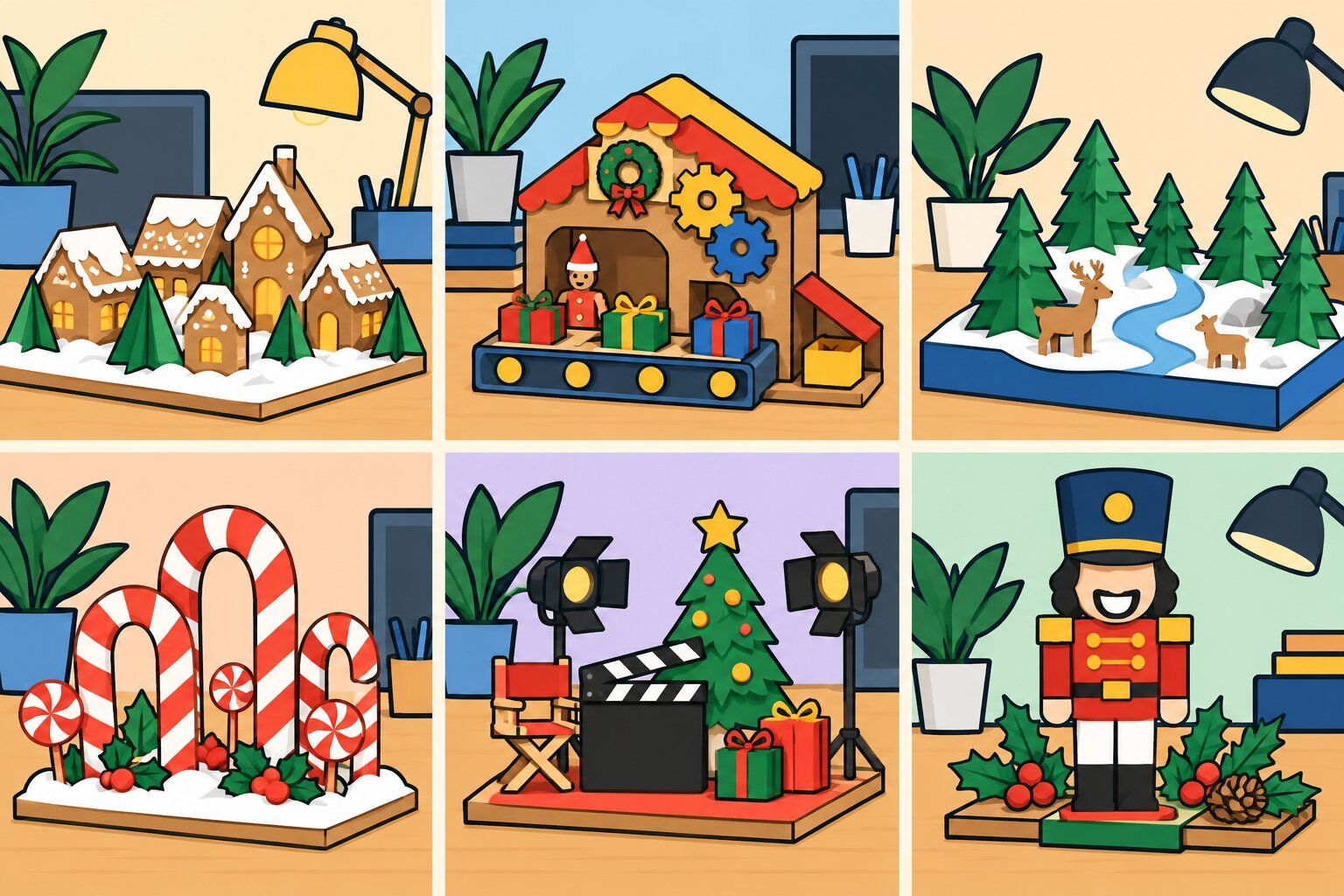
Choose one theme for everyone to interpret, or let each team select a different theme from the list. Each theme below has a decorating-week version for a real workspace and a quick tabletop version for the 75-minute event. Times are rough planning estimates with supplies ready. Quick builds use the shared kit; larger displays use the company-funded budget and borrowed decorations described in the rules. Check the building and lighting rules before buying materials.
| Theme | Distinctive feature | Good format |
|---|---|---|
| Gingerbread village | Cardboard buildings with paper icing | Cubicle or tabletop |
| Toy workshop | A pretend assembly line and handmade toys | Shared workspace or tabletop |
| Winter wonderland | Layered trees and a winding paper stream | Desk or shared display |
| Two-color Christmas | One consistent color pair | Door panel or tree |
| Nutcracker parade | A bold uniform and tall hat | Wall panel or tabletop |
| Holiday movie scene | Two or three recognizable movie details | Cubicle or shoebox display |
Best for: Small teams who like making individual pieces. Quick tabletop time: 30–35 minutes. Decorating-week time: 1–2 hours. Materials: Clean small boxes, brown paper, white paper strips, markers and removable adhesive; use a shared kit.
Decorating-week version: Cover a shared display wall with kraft-paper shop fronts and outline the windows with white ribbon “icing.” Add paper-plate peppermints and a reusable wreath to the central bakery, then connect neighboring panels with a paper street so the department becomes one village.
Quick version: Assign each teammate a building such as a bakery, library or post office. Cover the boxes with brown paper, add white-paper “icing,” and arrange the buildings on one base with a connecting street. Agree on one window shape or roof color so separate pieces form a village.
Best for: Teams who enjoy inventing details. Quick tabletop time: 30–35 minutes. Decorating-week time: 1–2 hours. Materials: Small cartons, paper tubes, colored paper and markers from the shared kit.
Decorating-week version: Turn a spare worktable into Santa’s assembly station with toy-making, quality-check and gift-wrapping areas. Arrange borrowed toy trains or blocks, empty gift boxes and a wrapping-paper backdrop; finish with stockings labeled for fictional elf jobs.
Quick version: Make a pretend conveyor belt from a strip of dark paper. Add three stages: toy parts, assembly and gift wrapping. Build a few simple paper toys, then place each at the appropriate stage. A tiny quality-control station gives the scene a story without needing moving machinery.
Best for: A winter theme without Christmas characters. Quick tabletop time: 25–35 minutes. Decorating-week time: 1–2 hours. Materials: Green, white and blue paper, cardboard and scissors from the shared kit.
Decorating-week version: Build a winter woodland across the cubicle panels with tall paper fir trees, white snowbanks and a blue stream. Add a small artificial tree and reusable silver garland to bring the scene forward from the backdrop, with animal silhouettes peeking between the trunks.
Quick version: Fold trees in different heights and stand them on a blue or white base. Run a paper stream through the middle and add small animal silhouettes. Leave visible space between the trees so the landscape reads clearly. White paper shapes provide snow.
Best for: A simple design challenge. Quick tabletop time: 25–35 minutes. Decorating-week time: 45–90 minutes. Materials: Two colors of paper and reusable ornaments, plus a neutral base; shared supplies.
Decorating-week version: Choose two colors and repeat them across a wreath, reusable garland, shatterproof ornaments and gift-wrapped empty boxes. Place the largest pieces at the ends of a shared work area and smaller ornaments between them, so the palette ties the whole space together.
Quick version: Choose a pair such as red and white, blue and silver, or green and gold. Repeat three shapes at different sizes—stars, circles and stripes, for example—across a board or miniature tree. The challenge is to create variety with a limited palette rather than covering every surface.
Best for: Teams who want one central character. Quick tabletop time: 30–35 minutes. Decorating-week time: 1–2 hours. Materials: Three lightweight boxes, paper tubes, colored paper and markers; shared kit.
Decorating-week version: Make a tall, flat nutcracker from colored paper on a cubicle end panel, with a black hat, gold ribbon trim and oversized buttons. Add two smaller nutcracker silhouettes on neighboring panels and a row of wrapped empty gifts below to create a toy-soldier parade.
Quick version: Build a small freestanding figure with a broad base, a square torso and a hat. Divide the work into structure, face and uniform details, then assemble the pieces. Give the nutcracker a paper accessory that tells a story, such as a miniature music stand or gift list.
Best for: Groups who enjoy visual storytelling. Quick tabletop time: 30–35 minutes. Decorating-week time: 1–2 hours. Materials: A shoebox or equivalent base, paper, markers and small recycled props.
Decorating-week version: Give a cubicle or shared wall the look of a holiday movie set: a snowy train window, a toy-shop counter or a whimsical village street. Use a wrapping-paper backdrop, large handmade props and a marquee bearing your own scene title; invite visitors to guess the movie that inspired it.
Quick version: Choose one scene rather than trying to reproduce an entire film. Try the paper snowflakes and oversized candy of Elf, the red-brick house and toy cars of Home Alone, a train and golden ticket from The Polar Express, or Whoville’s curved roofs and an overstuffed gift sack from How the Grinch Stole Christmas. Pick two or three signature details. During the tour, visitors can guess the film before reading the team’s title card. This guessing round is just for fun and does not affect the judged score.
Use the joke as the display’s focal point. Fictional workplace problems keep the humor easy to share without turning a real coworker into the punchline.
Best for: Teams who like writing jokes. Quick tabletop time: 30–35 minutes. Decorating-week time: 60–90 minutes. Materials: A small box counter, paper signs and pretend request cards; shared kit.
Decorating-week version: Turn the outward-facing cubicle panels into an elf service counter with a large “North Pole Help Desk” sign. Hang a stocking for incoming requests, attach oversized joke tickets to a corkboard and add a ribbon-trimmed box marked “Resolved before Christmas.”
Quick version: Build a tiny service counter and write three fictional requests: “Sleigh GPS only routes to the North Pole,” “Toy assembly requires one missing screw,” and “Cookie inventory mysteriously shrinking.” Add a paper elf and a miniature queue of gifts waiting for help. Give the desk one optimistic solution, such as “Have you tried turning the sleigh off and on?”
Best for: A compact comic scene. Quick tabletop time: 25–35 minutes. Decorating-week time: 60–90 minutes. Materials: Cardboard reindeer silhouettes, paper accessories and a shoebox base.
Decorating-week version: Create a reindeer travel agency on the cubicle walls with a warm-weather backdrop, paper palm trees and a “Back in January” board. Set an empty suitcase beside a small artificial tree inside the workstation and use gift tags as fictional luggage labels.
Quick version: Create a miniature staff noticeboard announcing that the reindeer are on their well-earned January break. Add a tiny suitcase, a sun hat and a postcard from somewhere warm. Keep the visual joke to one scene so visitors can understand it at a glance.
Best for: A quick desk display. Quick tabletop time: 20–30 minutes. Decorating-week time: 45–60 minutes. Materials: White paper, a paper carrot, a small cardboard hat and a title card.
Decorating-week version: Make a large snowman silhouette for a cubicle wall, then give it a drooping scarf, sideways hat and paper calendar full of meetings. Add a white-paper puddle along the bottom of the panel and a “Requesting a cooler office” sign, keeping the joke on the wall rather than the floor.
Quick version: Arrange a flat white-paper “puddle,” hat and carrot beside a miniature laptop. Add a sign reading “Booked the meeting room with the strongest heating.” Make a second tiny sign showing the snowman’s solution: a meeting moved outdoors.
These familiar settings work well when visitors will walk past the display throughout the week. Build one clear focal point, then repeat its colors or shapes around the entry.
Best for: A welcoming winter scene. Quick tabletop time: 30–35 minutes. Decorating-week time: 1–2 hours. Materials: Reused cardboard, brown paper strips, red paper and empty paper cups from the supply kit.
Decorating-week version: Turn a shared breakout-room wall into a cocoa lodge with wide kraft-paper “logs,” a plaid wrapping-paper border and a large cocoa-menu sign. Add a reusable wreath and an arrangement of empty mugs and cocoa tins on a side table; keep any actual drinks at a separate refreshment station.
Quick version: Cover a box front with horizontal paper “logs,” add a peaked roof and place a paper fireplace inside. Arrange miniature cocoa mugs and a plaid-paper blanket beside it.
Best for: A bright, recognizable Christmas theme. Quick tabletop time: 25–35 minutes. Decorating-week time: 1–2 hours. Materials: Red and white paper, cardboard circles, paper tubes and clear reused packaging.
Decorating-week version: Make a sweet-shop frontage across the cubicle panels with red-and-white wrapping paper, a flat striped awning and paper-plate peppermints. Add a reusable candy-colored wreath and empty sweet boxes tied with ribbon.
Quick version: Make a striped shop awning and a display of oversized paper peppermints, lollipops and wrapped sweets. Give the shop a name and arrange three treats in its window.
Best for: A department with several contributors. Quick tabletop time: 30–35 minutes using printed outlines. Decorating-week time: 1–2 hours. Materials: Twelve paper panels, markers, cardboard and optional reusable gold ribbon.
Decorating-week version: Give twelve sections of a shared display wall one large numbered panel each, with drawings of the song’s gifts. Connect them with reusable gold ribbon and add a matching gold ornament beneath each number, so coworkers can follow the sequence along the wall.
Quick version: Give each contributor a numbered panel illustrating one gift from the song: a partridge and pear tree, golden rings, calling birds or drummers. Arrange all twelve in sequence so visitors can follow the song. Stand the folded panels in a row on the tabletop. The shared numbering ties different drawing styles together.
Best for: A shared wall or wide cubicle panel. Quick tabletop time: 20–30 minutes. Decorating-week time: 45–90 minutes. Materials: Borrowed indoor LED light sets, reusable ornaments and a freestanding display frame; use the company budget for anything missing.
Decorating-week version: Where the building allows lights, arrange a labeled indoor LED set in a simple tree or star shape on a suitable display frame. Place ornaments beside it and keep nearby paper decorations separate from the lights; use the lighting checklist in the rules. Judge the display under the same room lighting as the other entries.
Quick version: Arrange a few battery-operated LED candles among reusable ornaments on a tray, if your building allows them. Make three different-height ornament clusters so the display has shape even without a large backdrop.
A cubicle contest can transform the whole workstation. The organizer should say which panels, shelves and desk fronts are in play; keep the monitor, keyboard, equipment vents and walkway clear. Group similar-sized cubicles together, and give compact desks their own category.
Whole-cubicle concepts: These six ideas use the walls and desk front together. Use the company-funded budget for new materials and borrow reusable decorations where possible.
Best for: A cubicle with several connected panels. Estimated decorating time: 1–2 hours. Materials: Kraft-paper rolls, paper plates, white ribbon and red markers.
Cover the panels with brown kraft paper and run white ribbon around the edges as icing. Draw peppermint swirls on paper plates, add a flat roof outline to the back panel and label the entrance “Gingerbread Cottage.” Carry the candy pattern around the desk front so the workstation reads as one house.
Best for: A cubicle with a broad back panel. Estimated decorating time: 1–2 hours. Materials: Brown paper rolls, a brick-pattern sheet and borrowed stockings.
Draw rounded log ends along wide brown-paper strips and arrange them horizontally across the panels. Make a flat paper fireplace and mantel on the back wall, then attach lightweight stockings underneath. Add a plaid-paper window on a side panel.
Best for: A colorful whole-workstation makeover. Estimated decorating time: 45–90 minutes. Materials: Wrapping-paper rolls, wide ribbon and one reusable bow.
Cover the cubicle panels and desk front with the same wrapping paper, then run two broad ribbon bands across the back panel like a wrapped parcel. Place a giant bow at their crossing and add an oversized tag addressed to the team. Wrap the furniture surfaces named in the contest rules, leaving all electronics and working space uncovered.
Best for: Teams who enjoy adding written details. Estimated decorating time: 1–2 hours. Materials: Kraft paper, reused cartons, envelopes, ribbon and stockings.
Make the cubicle panels look like sorting shelves with rows of oversized envelopes addressed to fictional North Pole residents. Put empty parcels in a small stack inside the workstation and label a stocking “Express delivery.” Add a desk-front postbox façade with a drawn slot and a few comically urgent cookie orders.
Best for: A winter scene that spans several panels. Estimated decorating time: 1–2 hours. Materials: Blue paper, white circles, silver ribbon and a small artificial tree.
Make a large circular snow-globe outline across the back panel, then continue its blue sky and white snow dots onto the side panels. Add a town skyline inside the circle and a broad paper pedestal along the desk front. Place a small artificial tree inside the scene; keep the globe as a wall picture rather than enclosing the workstation in plastic.
Best for: A cubicle beside another participating team. Estimated decorating time: 1–2 hours. Materials: Dark paper, gold ribbon, empty gift boxes and a clock cutout.
Turn the desk front into the side of a train carriage with large paper wheels and gold window trim. Make the back panel a station departure board listing Toytown, Snowflake Junction and Cookie Depot. Stack a few empty gift parcels as luggage inside the cubicle; neighboring entries can choose their own destination names.
Desk-scale concepts: For smaller workspaces, agree on a footprint that leaves room to work; 18 by 24 inches is one example, not a rule for every desk. Each idea below can stay up through decorating week or serve as a quick event build.
Best for: A desk corner. Estimated decorating time: 20–30 minutes. Materials: Borrowed shatterproof baubles, small cups and a tray.
Nestle baubles in cups at three heights to make a bright little ornament garden. Arrange them on a tray with reusable ribbon around the edge and add a tiny “Do not water” sign. Repeat two or three colors so it looks deliberate rather than like a box of spare decorations.
Best for: One desk or a shared counter. Estimated decorating time: 30–35 minutes. Materials: A shoebox, striped paper, small empty boxes and ribbon.
Turn a shoebox on its side and add a striped paper awning. Arrange tiny wrapped empty parcels as the merchandise and write a menu of fictional gifts, such as “One uninterrupted lunch.” Set the stall beside a small paper tree and a handwritten shop sign.
Best for: A desk with room for one small base. Estimated decorating time: 25–35 minutes. Materials: Paper tubes, fabric scraps, markers and folded paper.
Dress three paper tubes in scrap-fabric scarves and draw a different singing mouth on each. Give them folded-paper songbooks and arrange them on a single base. Add a little streetlamp cutout behind them to make the group look like a caroling scene.
Best for: A funny desk entry. Estimated decorating time: 25–35 minutes. Materials: Black and white card, a small box and sticky notes.
Fold three penguin figures and seat them around an overturned small box as a meeting table. Add a sticky-note agenda reading “Ice review, fish forecast, holiday leave” and a tiny wreath on the chairperson’s seat. Keep the figures on a base so the whole meeting can move when you need the desk.
Start with the doors the organizer has cleared under the building rules below. Use flat designs, leave handles, windows and required signs visible, and check that the door still opens and closes easily. If a door cannot be covered, make the same design on a nearby display board.
Best for: A simple full-height design. Estimated decorating time: 30–45 minutes. Materials: White and colored paper from the company supply pool.
Arrange three large white circles vertically, with a paper scarf crossing the middle and a carrot nose near the top. Give the snowman mismatched buttons and a tilted hat. Leave gaps in the design wherever the door needs to remain clear.
Best for: A door with room for a flat house outline. Estimated decorating time: 45–60 minutes. Materials: Kraft paper, white ribbon and paper peppermints.
Use brown paper as the house front and outline it with white ribbon icing. Add peppermint shapes and a flat candy-striped roof within the door surface, without extending onto the frame. A small paper wreath gives this cottage its own front door.
Best for: A door with an open lower panel. Estimated decorating time: 45–60 minutes. Materials: Brick-pattern paper, red and orange paper and stocking cutouts.
Build a flat brick pattern across the lower panel and add paper flames. Place a paper mantel above it and attach illustrated stockings with fictional elf names. Finish with a flat wreath drawing above the fireplace.
Best for: A funny door entry. Estimated decorating time: 45–60 minutes. Materials: Green paper, a sack-shaped cutout and paper ornaments.
Make a green paper hand appear to pull the design into a large gift sack. Leave a few paper ornaments trailing across the door toward it and add the title above the scene. Keep the sack flat so it cannot catch on anyone passing.
Best for: A team that likes office jokes. Estimated decorating time: 30–45 minutes. Materials: Large paper sheets and markers from the shared supplies.
Turn the door into an oversized email window: “Away delivering gifts. For urgent cookie matters, contact the elves.” Add a small calendar, a sleigh icon and a fictional return date. Use large lettering so the punchline is easy to read on the tour.
Register the door location when entering the week-long contest. Group comparable doors together for judging and include the entry in the Friday photo ballot.

Use similar-sized artificial trees for a fair comparison, or let everyone decorate a flat tree silhouette if space is tight. These six themes work for a decorating week; for the quick event, use small trees and prepare the ornament pieces beforehand. Borrow the trees and decorations where possible, then use the company budget for missing supplies.
Best for: A coordinated department display. Estimated decorating time: 30–35 minutes for a small tree; 60–90 minutes for a larger tree. Materials: Two colors of reusable ornaments and ribbon.
Choose a pair such as blue and silver, then place the largest ornaments first. Spread each color around the tree before filling gaps with smaller pieces, and repeat one color in the topper. A short length of reusable tinsel can add texture if your building allows it.
Best for: A team with several contributors. Estimated decorating time: 30–35 minutes small; 1–2 hours large. Materials: Card, ribbon, markers and a borrowed tree.
Give everyone the same ornament template and let each person add a winter pattern or a favorite part of the team’s year. Use matching ribbon loops to bring the different designs together. Hang the ornaments at varied heights and finish with a group-made star.
Best for: Teams who enjoy working with a surprise. Estimated decorating time: 30–35 minutes small; 60–90 minutes large. Materials: Equal organizer-packed bags of ornaments and ribbon.
Give each team an identical sealed bag of decorations and reveal the contents together. Teams may rearrange or transform the pieces, but may not add outside materials. Ask them to name their finished design; judge what they made from the kit rather than how expensive it looks.
Best for: Departments that want a personal theme. Estimated decorating time: 30–35 minutes with precut ornaments; 1–2 hours large. Materials: Card cutouts, ribbon and a borrowed tree.
Decorate with lightweight pictures of the team’s tools: calculators for accounting, paint palettes for design or tiny paper laptops for IT. Add gift tags naming a project the team is proud of and a topper shaped like its signature tool. Use replicas rather than hanging real equipment.
Best for: A funny Christmas tree theme. Estimated decorating time: 25–35 minutes small; 60–90 minutes large. Materials: Blank calendar squares, paper speech bubbles and ribbon.
Cover the tree with fictional meeting invitations and ornaments saying “Quick sync,” “One more thing” and “Circling back.” Crown it with a star labeled “Meeting cancelled.” Keep names and real messages off the tree so the joke stays friendly.
Best for: A team that likes sharing places. Estimated decorating time: 30–35 minutes with cards ready; 60–90 minutes large. Materials: Blank postcard-size cards, markers and ribbon.
Invite each person to draw a real or imagined winter destination on a small card. Hang the cards as ornaments and connect them visually with one ribbon color. Add a paper compass topper.
Use the main 20-point rubric for all six tree ideas. For a separate instruction-following game, provide a tree outline and map with ten required ornament placements. Award one point for each correct placement, out of ten; a tie remains a tie. Keep that accuracy game separate from the creative-design contest.
Publish these rules with the invitation and fill in the dates, supplies and display dimensions. Let people join during a work-time slot agreed with their manager, and make it fine to sit this one out.
Lighting checklist: Where your building allows lights, follow the U.S. Department of the Interior’s office holiday checklist: choose LED sets with a recognized testing mark such as UL or FM, unplug them before leaving for the day, keep cords out of doorways, and never connect one extension cord or power strip to another. Follow the set’s instructions and your building’s electrical limits. Keep lights separate from paper, packages and cloth, as Rochester’s guidance advises. Switch off battery lights when leaving, too. Keep exits, signs, alarms and sprinklers clear; use no open flames. These sources describe their own buildings, so the organizer’s building rules take priority.
Put that advice into the five-minute planning period: one person sketches the layout, another prepares the base, and others make the details. Change roles if someone wants to try a different part.
| 75-minute example agenda | Minutes |
|---|---|
| Explain rules and show supplies | 5 |
| Plan and divide tasks | 5 |
| Build | 35 |
| Tour and judge | 15 |
| Announce results | 5 |
| Clean up | 10 |
This agenda suits about four to six entries. Give each team a one-minute explanation, with the remaining tour time for viewing and scoring. For more entries, extend judging or divide the competition into separate groups.
Use a 20-point scorecard for the main award. Each judge scores four criteria from one to five. One means the element is barely developed, three means it is clear and complete, and five means it is especially thoughtful and well executed.
| Criterion | Maximum | What judges look for |
|---|---|---|
| Theme clarity | 5 | The scene communicates one recognizable idea; details support it. |
| Creative choices | 5 | The team has added an original interpretation or surprising detail. |
| Craft and presentation | 5 | The finished entry is stable, readable and intentionally arranged. |
| Use of supplied materials | 5 | The design makes thoughtful use of the shared kit, borrowed decorations and company-funded supplies. |
| Total per judge | 20 | Average the three judges’ totals for the final score. |
For example, scores of 14, 16 and 18 give an entry a final average of 16 out of 20. Resolve a tie using the higher average for creative choices, then use of supplied materials; if still tied, share the award. Check entries against the shared rules before the decorating deadline, leaving people time to fix a problem. Then let the judges score the finished displays.
Optional extra categories include Best Visual Joke, Best Reuse of Materials, and People’s Choice. Keep People’s Choice separate from the judged result: one vote per person, no voting for your own entry, and shared winners for a tie.

For remote or hybrid teams, choose one format that everyone can enter: a tabletop scene, a paper ornament, or a digital display board. Keep physical and digital entries in separate categories if you offer both.
Set a common deadline and ask for one clear photograph or exported image plus a description of up to 50 words. Show every entry at the same size on a shared slide deck. Let the maker present for one minute, or have the organizer read their description. Score entries with the published rubric.
A close-up of the decoration is enough; nobody needs to share a view of their home. A folded-paper ornament or one-page digital design gives people a way to join without decorating a whole room.
Keep prizes modest and clear in advance: a reusable desk trophy, a company-funded team treat with dietary alternatives offered, or a printed certificate featuring a photo of the entry. During the tour, point out a detail you enjoyed in every entry, from a clever gift tag to a carefully made ornament.
Choose the format line that matches your event, then fill in the brackets:
Join our optional office Christmas decorating contest! Choose a Christmas, winter or year-end theme and register by [deadline].
Team-build format: On [date], teams of three to five will create one tabletop display during our 75-minute event. We begin at [time], with five minutes to plan and 35 minutes to build using the supplied kit.
Decorating-week format: Enter your [desk/cubicle/door] individually or as a department. Decorate from [start date] through [deadline] with up to [amount] in new supplies bought by the company for each entry. Borrowed decorations are welcome and do not count toward that limit. Judges visit on [date/time]; the photo vote closes at [time].
Our attached scorecard covers theme clarity, creative choices, craft and use of materials. Awards are announced at [time]. Remove displays by [date/time]. Contact [organizer] to check which surfaces you can decorate, request supplies or volunteer as a noncompeting judge.
Choose the contest format first, then pick a theme that fits the space and time available. Publish the scorecard before the first ornament appears. The resulting displays give coworkers something to make, discuss and enjoy together. Extend the gathering with Christmas trivia questions, Christmas icebreakers, or Christmas games.
Answers about themes, rules and fair judging.
This list has 34 ideas: 13 broad themes, six whole-cubicle concepts, four desk displays, five door designs and six tree ideas. Try a gingerbread cottage cubicle, gift-wrapped workstation, winter wonderland, LED light gallery or funny meeting-themed tree. The broad themes include both decorating-week and quick tabletop versions.
Publish a rubric before decorating starts. One option is four criteria worth five points each: theme clarity, creative choices, craft and presentation, and use of supplied materials. Three independent judges score each entry; average their totals for a final score out of 20.
Turn the cubicle into a kraft-paper gingerbread cottage, a log cabin with stockings, a giant wrapped present, Santa’s mailroom, a snow globe or a North Pole station. Carry the theme across the panels and desk front that the organizer has included in the contest. Leave the monitor, keyboard, equipment vents and walkway clear.
Start by asking facilities which doors can be decorated, because fire doors may be off-limits. Set a decorating window, company-funded supply budget and judging date. Try a giant snowman, gingerbread house front, flat fireplace or Santa’s out-of-office reply. Keep handles, windows and signs clear, and check that each door opens and closes easily.
State who can enter, which surfaces can be decorated, the company-funded supply budget, how borrowed decorations count, work-time slots, judging criteria, tie-break procedure and removal date. Include the building’s material and lighting rules. Make participation optional and offer shared supplies so nobody has to spend personal money.
Start with the published rubric. Choose one clear theme, add an original detail, finish the display neatly and use the available materials thoughtfully. Check the idea from the doorway before adding more decorations. In this guide’s rubric, each of those four areas is worth five points; extra spending earns no separate points.
Comments (0)
Leave a Comment