
30 Competitive Team Building Games (Team vs Team, Indoor & Virtual)
A scoreboard changes a room. Here are 30 competitive team building games, from team vs team formats to quick office competitions, with rules, group sizes, timings and costs.
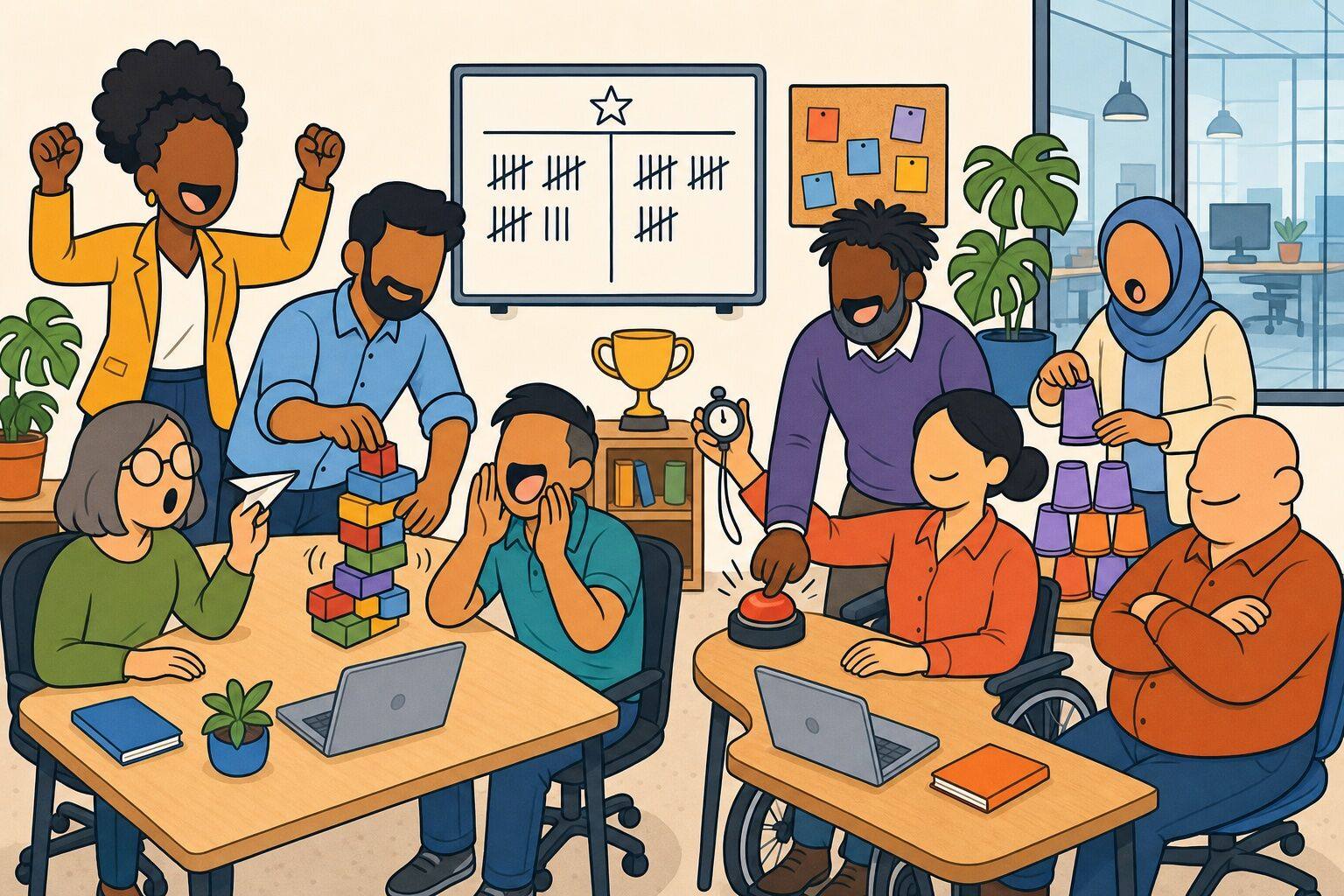
A scoreboard changes a room. Here are 30 competitive team building games, from team vs team formats to quick office competitions, with rules, group sizes, timings and costs.
A scoreboard changes a room. The same group that politely takes turns during an icebreaker will argue about the rules, invent a chant, and beg for one more round the moment points are involved. We have watched it happen thousands of times: the activity barely matters, but the moment someone writes two columns on a whiteboard, everybody leans in.
We design and run competitive games for a living. Our hosts run head-to-head formats for corporate teams all year, and every round we run gets tuned from post-event surveys and reviews. Scoring gets simpler, timers get shorter, and the games that only work for the loudest three people in the room get retired.
The 30 games below are the ones that survived that filter, plus the classics that still earn their spot. Every one is a real competition with a winner, a clear set of rules, and a way to run it without buying anything expensive.
This list includes:
Here we go.
Competitive team building games are group activities where teams or players score points, race a clock, or play head-to-head for a win. Examples include trivia tournaments, tug of war, paper plane contests, and egg drop challenges. The competition is the hook, and the real work happens underneath it: teams have to divide roles, communicate under time pressure, and decide together what to do next. These games are also called "team competition games," "team vs team games," "group competition games," "competitive activities," and "competitive team challenges."
Competitive team building games are a subcategory of team building games and one branch of team building activities. They are similar to competitive games, work competitions, office challenge ideas, and team building game shows, and the large-format version is large group games. Within this guide you will find team vs team games, group competition games for large groups, competitive games for work, quick competitive games, competitive team sports, and virtual competitive games. Managers most often use them inside employee engagement activities and at offsites.
There is decent evidence that this kind of structured play does something. A meta-analysis of 60 effect sizes in Small Group Research by Klein, DiazGranados, Salas and colleagues found team building has a moderate positive effect on team outcomes overall, strongest on affective and process outcomes, with goal setting and role clarification the most effective components. Read that list again and you have a decent description of a good competitive game: a clear goal, an obvious set of roles, and a result everybody can see.
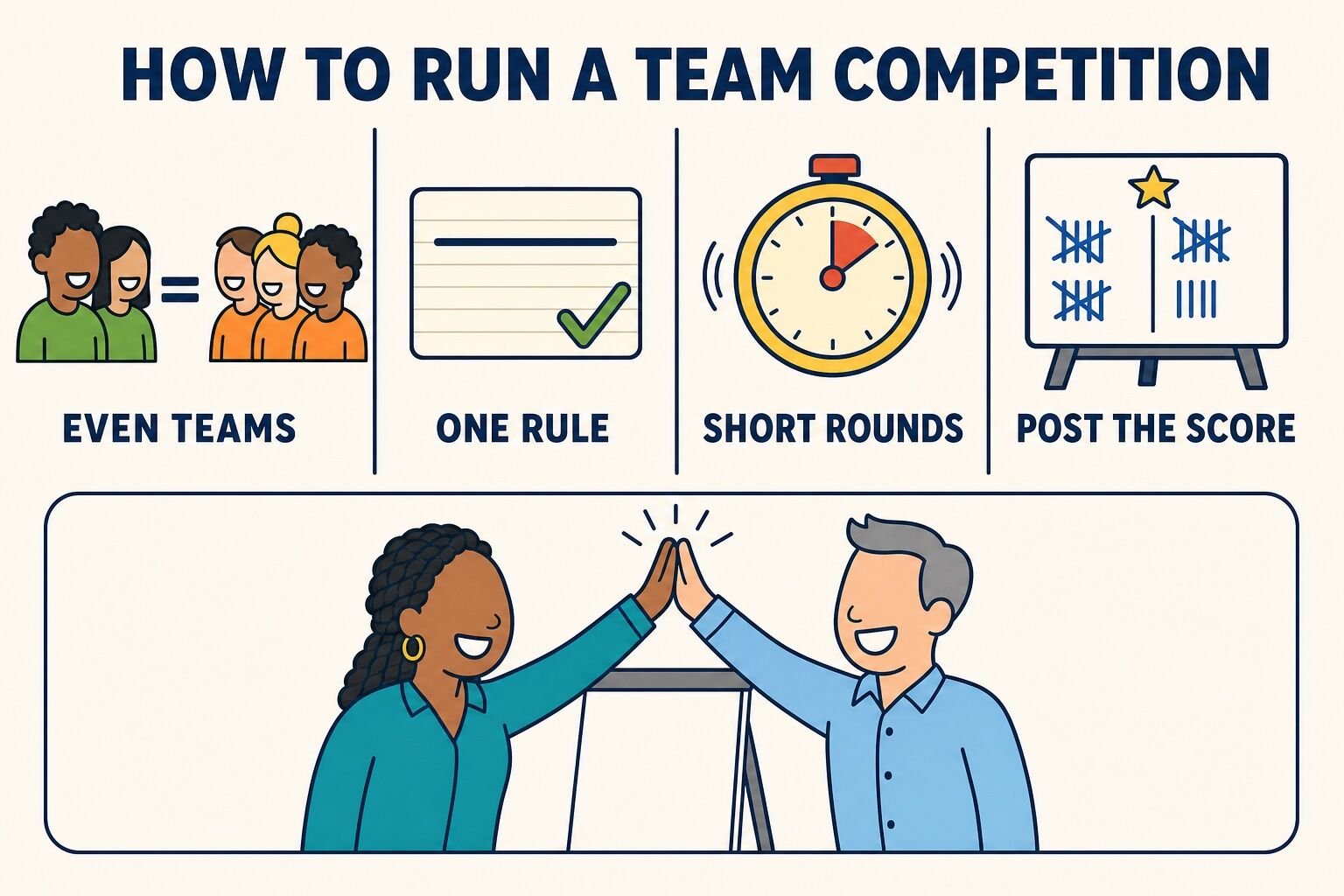
One caution before the list. Competition is a dial, not a switch. Turn it up too far and you get the version of workplace competition nobody enjoys: the same department winning every time, a prize big enough to make people strategize instead of play, and a quiet colleague who now dreads Thursdays. Every game below is written to be run at the friendly setting, and the what we've learned section covers how to keep it there.
These are the head-to-head formats: two or more teams, alternating turns, and one scoreboard. They work in a conference room, a cafeteria, or a rented offsite space, and they scale from two small squads to a room split down the middle.
A game-show format built on your own team's answers. You poll the company in advance, rank the responses, and then two teams face off guessing what their coworkers said.
How to play:
Best for: 10 to 60 people, all-hands meetings and offsites
Time: 25 to 35 minutes
Materials (cost): A survey form and a slide deck (free)
What we've learned: Company-specific prompts beat general knowledge every time. Questions about your own office produce inside jokes, and inside jokes are the part people repeat in the hallway a week later. Keep one prompt in reserve for a tiebreaker, because the final round is the one that ends in a genuine argument about whether an answer counts.
Trivia is the most reliable competitive format we run, as long as you build it rather than download it. A tournament structure keeps every team alive longer than a single quiz does.
How to play:
Best for: 8 to 100 people, any setting
Time: 30 to 45 minutes
Materials (cost): Question sheets, pens, and a scoreboard (free)
What we've learned: The company round is the one people remember. Photos of the office from five years ago, the founder's first job title, or the number of meeting rooms named after coffee drinks will beat any general-knowledge question you can buy. Grab prompts from our list of trivia questions, then write the company round yourself.
Every competition runs better when the teams have names. Use this generator to hand each team an identity before the first round:
Drawing under pressure is a great equalizer, because talent helps less than you would expect and speed helps more.
How to play:
Best for: 6 to 40 people, indoors
Time: 20 to 30 minutes
Materials (cost): Whiteboards or flip charts and markers ($0 to $30)
What we've learned: Running both teams simultaneously instead of alternating turns roughly doubles the energy and halves the run time, because nobody stands around watching. The same trick works on video calls, where the shared whiteboard becomes the canvas. Here are virtual Pictionary games for remote teams.
The oldest team game on this list, and still one of the most competitive once you add a clock and a running score.
How to play:
Best for: 6 to 30 people, indoors with standing room
Time: 20 to 30 minutes
Materials (cost): Paper slips and two envelopes (free)
What we've learned: Charades lives and dies on the prompt list. Movie titles are fine, but prompts drawn from your own workplace, like "the printer jam" or "the all-hands livestream freezing," land far harder. If you are short on ideas, use our charades generator.
A tournament of ridiculous arguments. Teams get a silly proposition, two minutes to prepare, and 90 seconds to convince the room, with the audience voting a winner through to the next round.
How to play:
Best for: 8 to 50 people, any setting
Time: 25 to 40 minutes
Materials (cost): Prompt cards and a timer (free)
What we've learned: For debate-style team games, inconsequential topics are usually better than serious ones: people can argue with ridiculous conviction without bringing politics, workplace disagreements, or other baggage into the room.
A word-association game of spies and codenames, played as a best-of-three between two teams. It rewards the kind of shared context that teams build over time, which is exactly why it is fun to watch a new hire and a ten-year veteran work out each other's logic.
How to play:
Best for: 6 to 16 people, small teams and lunch-hour play
Time: 15 minutes per round
Materials (cost): A word-association card game ($20 to $25) or a free browser version
What we've learned: The clue-giver role is the whole game, so rotate it deliberately. Quiet teammates are frequently the best at it, and giving them the seat is a low-key way to hand somebody the microphone without putting them on a stage.
Once a room passes 30 people the constraint changes. Explaining and scoring start to take longer than the game itself, so the formats that win are the ones with a single rule, parallel play, and a result you can see from across the room. For more ideas at this scale, see our list of large group activities.
The best large group competition we know, because it needs no supplies, takes four minutes, and ends with a hundred people cheering for two finalists.
How to play:
Best for: 20 to 300 people, conferences and all-hands
Time: 5 to 10 minutes
Materials (cost): Nothing (free)
What we've learned: The cheering rule is the entire game. Without it, losers drift back to their seats and check their phones. With it, the last round feels like a stadium, which is a strange thing to achieve with a ten-second children's game.
Teams race through a list of items and photo challenges inside a time limit. The competition works because the clock forces teams to split up and trust each other's judgment.
How to play:
Best for: 10 to 100 people, offices and offsites
Time: 30 to 45 minutes including scoring
Materials (cost): Printed lists and phone cameras (free)
What we've learned: Photo challenges outperform object hunts. "Find a stapler" produces a stapler, while "recreate a famous album cover with three coworkers" produces the picture that ends up in the company newsletter. Our list of scavenger hunt ideas has more prompts.
Two teams, two territories, two flags. This is the purest team vs team game on the list, and it works as well in a park as it does in a conference center with long corridors.
How to play:
Best for: 16 to 80 people, outdoors or a large open space
Time: 20 to 30 minutes
Materials (cost): Two bandanas and a set of cones ($10 to $20)
What we've learned: The strategy huddle does more for team building than the running does. Give teams five minutes to assign defenders, scouts and runners and you get a live demonstration of how your group makes decisions with a clock on. It pairs well with the rest of our field day games.
A non-verbal relay where blindfolded teammates are steered by touch alone. The game looks silly and turns out to be a genuine communication exercise.
How to play:
Best for: 12 to 60 people, open indoor space
Time: 15 to 25 minutes
Materials (cost): Blindfolds, beanbags and buckets ($20 to $30)
What we've learned: Teams that agree on their tap code before the whistle beat teams that improvise it, every single time. That gap is the lesson, and it is worth naming out loud in the debrief.
Teams move as one body with balloons wedged between every player. It is chaotic, extremely photogenic, and much harder than it looks.
How to play:
Best for: 15 to 60 people, a gym, cafeteria or lawn
Time: 15 to 20 minutes
Materials (cost): A bag of balloons and cones ($10)
What we've learned: Slow teams win this one. The groups that sprint drop balloons in the first ten feet, and somebody always works that out around round two and starts calling a rhythm for their line.
These are build-and-solve competitions: a pile of cheap materials, a hard constraint, and a measurable result. They fit in a conference room, run on supplies from a drugstore, and produce the most useful debriefs of anything on this list. For the non-competitive cousins of these challenges, see our problem solving games.
Teams build the tallest free-standing structure they can from spaghetti, tape and string, with a marshmallow on top. The marshmallow is the twist, because it weighs more than anyone plans for.
How to play:
Best for: 8 to 40 people, conference rooms
Time: 25 to 35 minutes
Materials (cost): Spaghetti, tape, string and marshmallows (about $2 per team)
What we've learned: Teams that build a small prototype in the first three minutes almost always beat teams that spend those minutes planning on paper. Swap the materials for cardboard, bottles and glue and the same challenge becomes a bridge build, scored by how much weight the span holds before it fails.
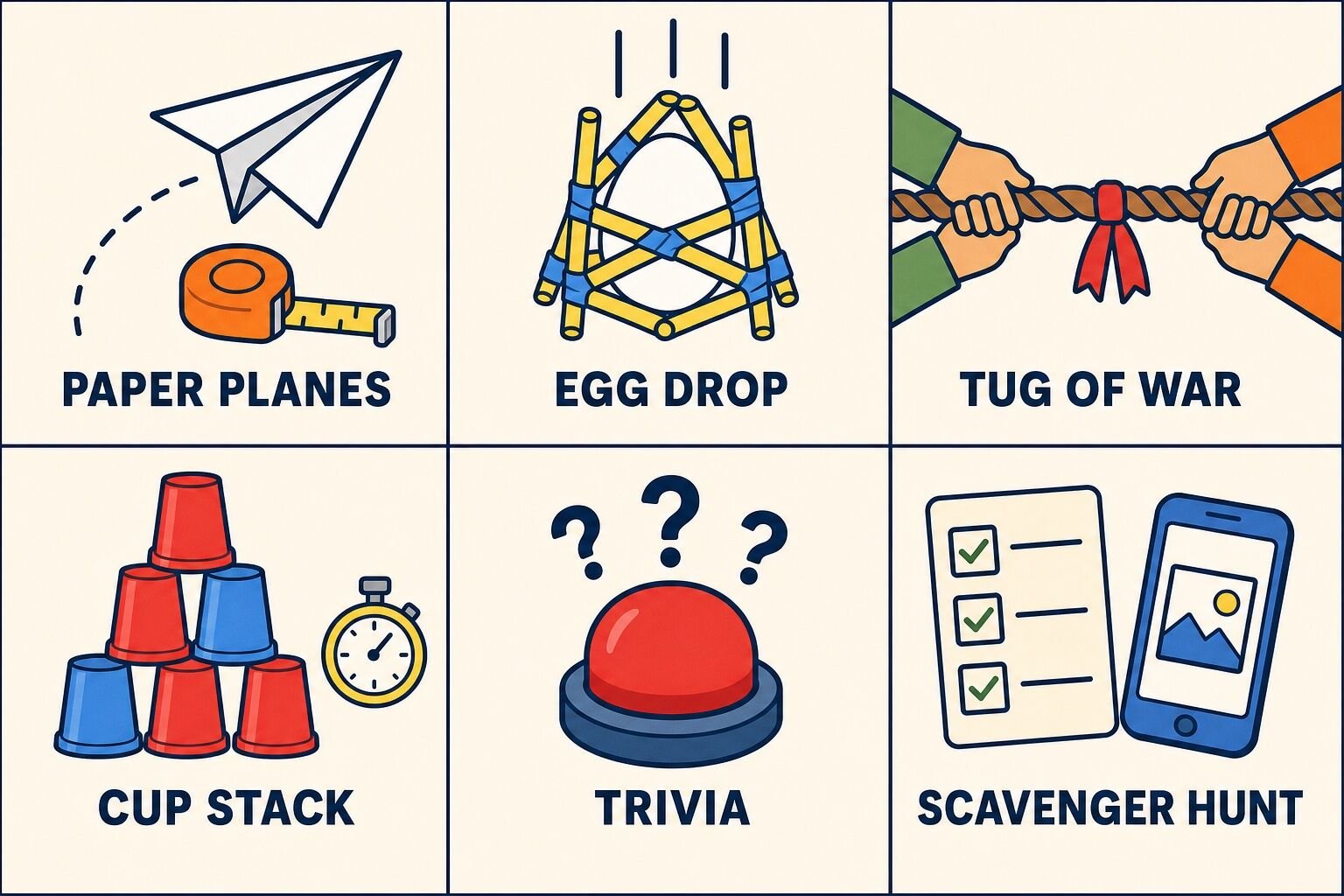
Build a container that keeps a raw egg intact through a fall. Messy, memorable, and the only game here with a genuinely binary result.
How to play:
Best for: 8 to 40 people, a space you can wipe down
Time: 30 to 40 minutes
Materials (cost): Craft supplies, eggs and a tarp ($15 to $25)
What we've learned: The tiebreaker round is where the fun is, so plan for it rather than treating a three-way tie as an inconvenience. Also buy twice as many eggs as you have teams, because at least one will break during construction.
One teammate can see the model, nobody else can touch it, and the team has to reproduce it from description alone. It is the sharpest communication test on this list.
How to play:
Best for: 8 to 30 people, conference rooms
Time: 20 to 30 minutes
Materials (cost): Two or more identical block sets ($20 to $40)
What we've learned: Teams that agree on shared vocabulary in the first minute, deciding what counts as the front and what they call each color, finish roughly twice as fast. This is the game we recommend when a group's real problem is handoffs between roles rather than morale.
Cheap, fast and endlessly repeatable. Teams design, name and fly a plane, and a tape measure settles the argument.
How to play:
Best for: 6 to 50 people, a corridor, atrium or lawn
Time: 15 to 20 minutes
Materials (cost): Paper, clips, tape and a tape measure (free to $10)
What we've learned: Two scoring categories is the upgrade that makes this game worth running. Distance rewards one design and accuracy rewards the opposite, so teams have to decide what they are optimizing for, and the losing designers of round one become the favorites in round two.
Identical jigsaw puzzles, two or more teams, one clock. The twist is that a few pieces start in the wrong box.
How to play:
Best for: 8 to 32 people, tables required
Time: 30 to 45 minutes
Materials (cost): Identical puzzles ($10 to $15 each)
What we've learned: The swapped pieces turn a race into a negotiation, and watching who walks over to the rival table first tells you plenty about a team. Without that twist this is just a quiet puzzle, so do not skip it.
Games that fit in the last ten minutes of a meeting. There is no setup, no materials worth mentioning, and no reason not to run one when an agenda finishes early. Our lists of quick team building activities and minute to win it games have more in this format.
Two teams alternate naming items in a category until one side runs dry. A one-sentence rule set that produces a surprising amount of shouting.
How to play:
Best for: 4 to 50 people, any setting including video calls
Time: 5 to 10 minutes
Materials (cost): Nothing (free)
What we've learned: The five-second shot clock is what makes this work. Without it teams deliberate and the game dies. With it people blurt, and the blurting is the fun part.
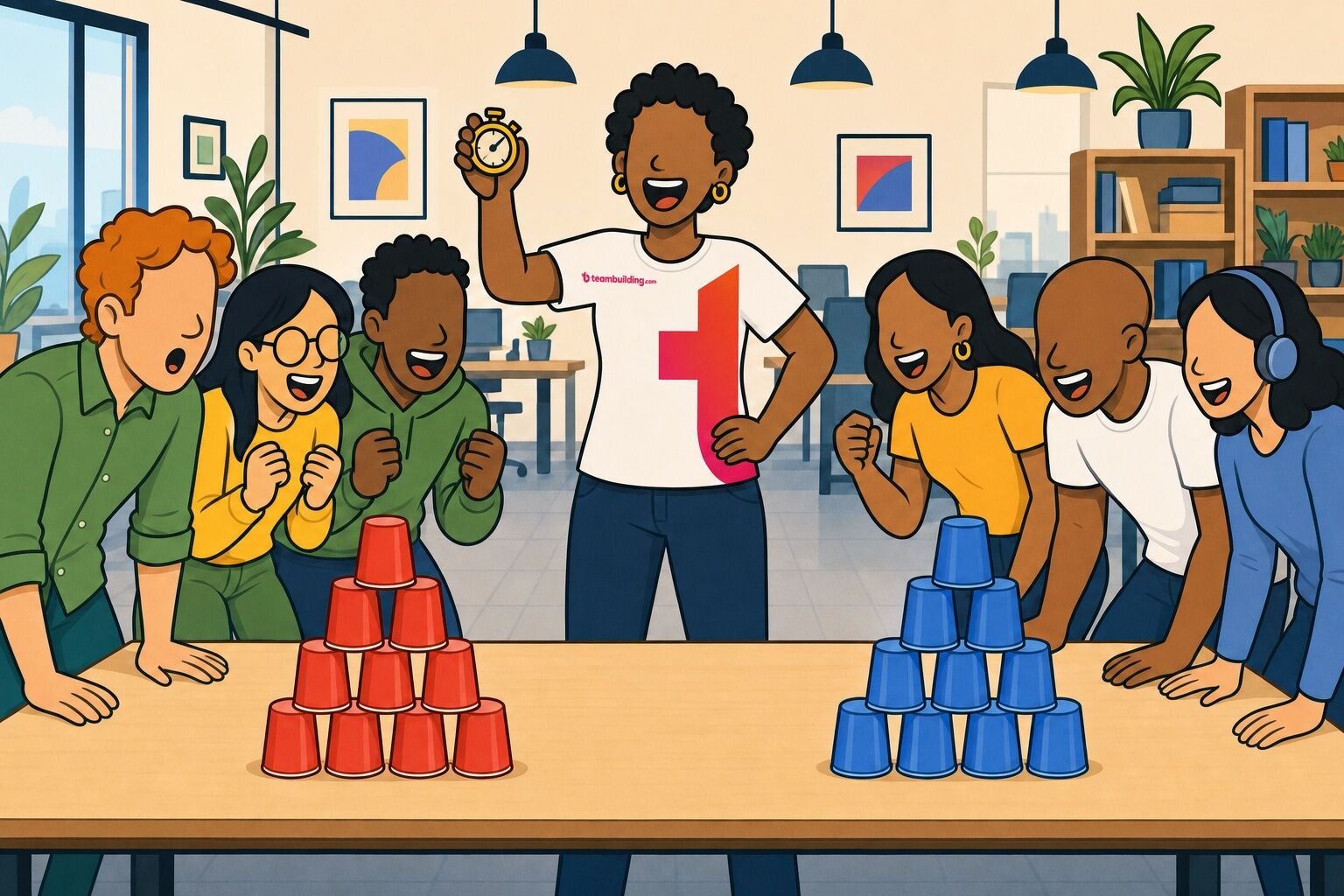
A pyramid of plastic cups, a relay line and a timer. The most reliable physical game we know for a room with limited space.
How to play:
Best for: 8 to 40 people, indoors
Time: 10 minutes
Materials (cost): Plastic cups ($5)
What we've learned: Round two always beats round one, because teams start coaching each other between turns. If you only have time for one round, you are running the warm-up and skipping the game.
The fastest way to get a whole room on its feet and down to one winner. Ideal as the opening two minutes of a large meeting.
How to play:
Best for: 20 to 500 people, conferences and all-hands
Time: 2 to 5 minutes
Materials (cost): A coin (free)
What we've learned: Pure luck is a feature here, not a bug. Nobody feels bad about losing a coin flip, so this is the one competitive game with zero risk of bruising an ego, which makes it a good opener before the games that do.
Office basketball, run as a proper bracket. Ten minutes, one recycling bin, one champion.
How to play:
Best for: 8 to 32 people, an office or open-plan area
Time: 10 to 15 minutes
Materials (cost): Scrap paper and a bin (free)
What we've learned: Brackets do more work than scores in short games. A bracket gives everybody a clear stake in a two-minute matchup, and it turns the final into an event the whole room stops to watch.
Sports are the oldest team building format there is, and for a workplace the best ones share three traits: a short learning curve, a low injury risk, and room for the least athletic person on the team to contribute. That rules out most of what people ask us for, which tends to be the sport the person asking is good at. The six below hold up with a mixed-ability group of colleagues. For the full outdoor programme around them, see our guide to outdoor team building.
If you coach an actual sports team and landed here looking for bonding games for athletes, skip the sports and run the non-sporting items instead. Your players already compete together; what they usually lack is a setting where the rookie can beat the captain, which is what Custom Trivia Tournament, Blind Build and The Great Debate Bracket are for.
The best corporate sport we know right now. The court is small, the rules take two minutes to explain, and a complete beginner can win a point off a regular in the first game.
How to play:
Best for: 8 to 32 people, mixed fitness levels
Time: 60 to 90 minutes
Materials (cost): Paddles, balls, court time ($10 to $25 per person)
What we've learned: Reshuffling partners is what turns a sport into team building. Fixed teams mean people spend an hour with the colleagues they already know, which is the opposite of the point.
Soccer scales down beautifully. Five players a side on a small pitch means constant touches for everyone, and the game rewards passing far more than sprinting.
How to play:
Best for: 10 to 30 people, a pitch, gym or park
Time: 45 to 60 minutes
Materials (cost): A ball, cones and pinnies ($20 to $40, plus pitch rental)
What we've learned: The three-pass rule is the whole trick. Without it, two competitive players take over and the other eight jog. With it, the team with the best passing wins, and passing is a thing you can practice in twenty minutes.
Fast rounds, quick eliminations and no skill prerequisite. Dodgeball is the most spectator-friendly sport on this list, because a game lasts three minutes and the sideline is as loud as the court.
How to play:
Best for: 12 to 60 people, a gym or hall
Time: 45 to 60 minutes
Materials (cost): Foam ball set ($30 to $60) plus gym rental
What we've learned: Run a consolation bracket for teams knocked out early. Otherwise half your group is sitting on a bench 15 minutes into an hour-long activity, which is how a high-energy event turns into a long wait.
The lowest-barrier competition on this list. Players can hold a drink, hold a conversation, and still be in contention, which is why it works at a company picnic where a real sport would not.
How to play:
Best for: 8 to 50 people, lawns, patios and picnics
Time: 45 to 90 minutes running in the background
Materials (cost): A cornhole set ($60 to $150, reusable)
What we've learned: Cornhole is best as a background bracket rather than a scheduled activity. Put the boards up at the start of a picnic, post a bracket sheet next to them, and let the tournament run itself over two hours while everything else continues.
Two teams, one rope, total clarity about who won. It takes 90 seconds, needs no explanation, and every field day still ends with it for a reason.
How to play:
Best for: 16 to 60 people, grass or sand only
Time: 10 to 15 minutes
Materials (cost): A tug of war rope ($40 to $80, reusable)
What we've learned: Order and rhythm beat raw strength. The team that puts its heaviest player at the back and pulls on a count will usually beat a stronger team pulling out of sync, and the round-two adjustment is where teams figure that out. Run it on grass, never on pavement, and check hands for rings first.
A two-person race where partners have adjacent legs tied together. It is short, it is funny, and it does something no other race does: it makes coordination more valuable than speed.
How to play:
Best for: 10 to 40 people, grass
Time: 15 minutes
Materials (cost): Bandanas or soft rope ($10)
What we've learned: The two-minute practice window is not optional. Pairs that practice count out a rhythm and walk; pairs that do not practice fall over in the first five feet, which is funny exactly once.
Competition translates to video calls better than almost anything else, because a scoreboard solves the awkward silence problem that ruins most remote social events. Breakout rooms give you teams, the chat gives you a buzzer, and a shared screen gives you a scoreboard. For a full remote field day, see virtual office Olympics, and for more formats in this style, our list of virtual team challenges.
The fastest competitive game in our virtual events. The host calls an item, everybody sprints to find one, and the first few people back on camera score. It is 60 seconds of noise, and it works on the first try with a group that has never met.
How to play:
Best for: 5 to 100+ people, video calls
Time: 10 minutes
Materials (cost): Whatever is in the room (free)
What we've learned: Mix in one prompt that begs for a story, like "the strangest thing on your desk." Half the scoring rounds keep the energy up and the storytelling round is what people actually remember from the session.
A communication game we built for our own hosted events. One player describes an abstract image using only geometric language while their teammates draw it blind, and the closest drawing wins the round.
How to play:
Best for: 6 to 40 people, video calls
Time: 15 to 20 minutes
Materials (cost): Paper and pens (free)
What we've learned: The no-questions round then the questions round is the whole design. The gap between the two sets of drawings is the most persuasive argument for asking clarifying questions that we have ever put in front of a team.
Two breakout rooms, the same set of puzzles, one clock. Running an escape room as a race rather than a single group experience changes the dynamic completely.
How to play:
Best for: 8 to 40 people, video calls
Time: 40 to 50 minutes
Materials (cost): Free if you build it, $15 to $30 per person for a hosted room
What we've learned: The hint tax is what keeps a race fair. Without a price on hints, one team grinds in silence for 20 minutes while the other asks for help and finishes. Our list of virtual escape rooms covers the hosted options.
A two-minute competition that is trivially easy to run and surprisingly addictive for a remote team. Everyone takes the same typing test and posts their score.
How to play:
Best for: 4 to 100 people, video calls and chat channels
Time: 5 to 10 minutes
Materials (cost): A free typing test site (free)
What we've learned: Scoring by team average rather than fastest finger is what keeps this from being a one-person victory lap, and accuracy has to count or somebody will type gibberish at 140 words per minute and call it a win.
Every game on this list with its group size, run time and cost, so you can pick one against the constraints you actually have.
| Game | Best for | Group size | Time | Cost |
|---|---|---|---|---|
| Survey Showdown | All-hands energy | 10–60 | 25–35 min | Free |
| Custom Trivia Tournament | Mixed-ability groups | 8–100 | 30–45 min | Free |
| Pictionary Playoff | Fast laughs indoors | 6–40 | 20–30 min | $0–$30 |
| Charades Showdown | No-prep classics | 6–30 | 20–30 min | Free |
| The Great Debate Bracket | Persuasion and speaking | 8–50 | 25–40 min | Free |
| Codeword Tournament | Small teams at lunch | 6–16 | 15 min per round | $20–$25 |
| Rock Paper Scissors Tournament | Huge rooms, zero prep | 20–300 | 5–10 min | Free |
| Scavenger Hunt Race | Getting people moving | 10–100 | 30–45 min | Free |
| Capture the Flag | Strategy and teamwork | 16–80 | 20–30 min | $10–$20 |
| Human Snake Relay | Non-verbal communication | 12–60 | 15–25 min | $20–$30 |
| Balloon Caterpillar Race | Photos and chaos | 15–60 | 15–20 min | $10 |
| The Tallest Tower | Prototyping and planning | 8–40 | 25–35 min | ~$2 per team |
| Egg Drop | Engineering under pressure | 8–40 | 30–40 min | $15–$25 |
| Blind Build | Precise communication | 8–30 | 20–30 min | $20–$40 |
| Paper Plane Contest | Quick design contests | 6–50 | 15–20 min | $0–$10 |
| Puzzle Race | Negotiation between teams | 8–32 | 30–45 min | $10–$15 per team |
| Category Countdown | The last ten minutes | 4–50 | 5–10 min | Free |
| Cup Stack Relay | Tight indoor spaces | 8–40 | 10 min | $5 |
| Heads or Tails Elimination | Opening a big meeting | 20–500 | 2–5 min | Free |
| Paper Toss Playoff | Office bracket play | 8–32 | 10–15 min | Free |
| Pickleball Round Robin | Mixed fitness levels | 8–32 | 60–90 min | $10–$25 per person |
| Five-a-Side Soccer | Passing and rotation | 10–30 | 45–60 min | $20–$40 plus pitch |
| Dodgeball Tournament | Short, loud rounds | 12–60 | 45–60 min | $30–$60 plus gym |
| Cornhole Tournament | Picnics and patios | 8–50 | Runs in background | $60–$150 |
| Tug of War | A decisive finale | 16–60 | 10–15 min | $40–$80 |
| Three-Legged Race | Pairs across departments | 10–40 | 15 min | $10 |
| Lightning Scavenger Hunts | Remote energy in 10 min | 5–100+ | 10 min | Free |
| Can You Hear Me Now? | Remote communication | 6–40 | 15–20 min | Free |
| Escape Room Face-Off | Remote problem solving | 8–40 | 40–50 min | Free–$30 per person |
| Typing Speed Races | Standing chat challenges | 4–100 | 5–10 min | Free |
Our hosts run competitive formats for corporate teams every week, and the patterns are consistent enough that we now build them into how every new game gets designed.
Short rounds beat long games. A 90-second round with a visible clock produces more noise than a 20-minute challenge, and it gives you a natural reset point when a team falls behind. When a game drags, the problem is almost never the game. It is the round length.
Reset the scoreboard. A single cumulative score across an hour means the team that wins round one coasts and everybody else disengages. Multiple short competitions with separate winners, or a final round worth double, keeps every team live until the end.
Mix the teams deliberately. Department versus department sounds fun and quietly reinforces exactly the divides you were hoping to soften. Draw random teams, or seed them so each one holds a mix of tenure, function and seniority.
Keep prizes small and silly. A trophy that lives on the winning team's desk until the next event beats a gift card, because a valuable prize turns a game into a negotiation. The bragging rights are the reward, and they are free.
Make it a habit rather than an annual event. We recommend at least 30 minutes of team building per week as a starting point, and short competitive games are the easiest way to hit that without booking anything. The quick competitive games above are all under 15 minutes for exactly this reason.
The proof that the format works is that teams keep coming back: 41% of companies that book a team building event with us return to book at least one more.
Group size changes what works more than the topic does. Here is how we adjust.
| Group size | What changes | Formats that work | Host tip |
|---|---|---|---|
| 5 to 15 people | Everyone plays every round, and one dominant player can take over | Build challenges, word games, head-to-head rounds with rotating roles | Rotate the key role, whether that is drawer, describer or clue-giver, so the same person cannot carry the team |
| 16 to 40 people | Turn-taking stalls, so you need teams playing in parallel | Relays, build contests, brackets, table-team trivia | Split into teams before you explain the rules, and appoint a scorekeeper per team |
| 40 to 100+ people | Explaining and scoring take longer than the game itself | One-rule games, elimination formats, whole-room tournaments with a finale | Demonstrate instead of describing, and put the final two players or teams on a stage |
Not every competition belongs at work. These are the ones we either retired from our own events or advise clients against, usually because the competitive element is aimed at the wrong thing.
| Activity | Why skip it | Verdict |
|---|---|---|
| Sales-leaderboard games | Gamifying individual performance metrics is management, not team building. It creates winners who were already winning and quietly punishes everyone assigned a harder territory. | Not team building |
| Weight-loss challenges | Competing over bodies invites comparison and exclusion, and the health framing does not make it safer. Run a step or activity-minute challenge instead if you want a wellness contest. | Skip it |
| Eating contests | Genuinely risky, unpleasant to watch, and impossible for anyone with a dietary restriction to join. A cook-off gets you the food theme without the ambulance. | Skip it |
| Trust falls as a contest | Timing or scoring a trust fall adds pressure to an exercise whose entire point is the absence of pressure, and the injury risk is real. | Skip it |
| Full-contact sports | Flag football, rugby and full-court basketball split a workplace into the athletic and the spectating, and one sprained ankle undoes the goodwill of the whole day. | Better as five-a-side |
| Musical chairs | Adults lunging at furniture is how offsites generate incident reports, and the first person out then watches the entire rest of the game. | Skip it |
| Two-hour tournaments with one winner | Half the room is eliminated in the first twenty minutes. If you want a long bracket, run a consolation side so everybody keeps playing. | Add a consolation bracket |
| Department-versus-department leagues | A season-long rivalry between teams that already compete for budget hardens the exact divides team building is supposed to soften. Mixed teams fix it. | Mix the teams |
| Big-prize competitions | Once a prize is worth real money, people optimize for it. Rules get lawyered, the fun drains out, and the losers are genuinely annoyed. | Shrink the prize |
| Forced-fun icebreaker competitions | Scoring a getting-to-know-you round pressures people into sharing for points. Keep the personal stuff non-competitive and see our icebreaker games instead. | Keep it unscored |
Competition is the cheapest energy source available to anyone running a team event. It costs nothing, it needs no equipment, and it works on a group that has heard every icebreaker question ever written. The only real skill is knowing where to set the dial: short rounds, mixed teams, small prizes, and a scoreboard that resets before anybody gets attached to it.
Pick three games from this list, keep the supplies in a drawer, and run one whenever a meeting finishes early or a group needs waking up. If you would rather have someone else write the rules, keep the score and referee the arguments, our hosts run competitive formats for teams at teambuilding.com activities.
Next, check out our lists of Amazing Race games, indoor team building activities, and company offsite ideas.
Common questions about running competitive games with a work team.
Competitive team building games are group activities where teams or players score points, race a clock, or play head-to-head for a win. Examples include trivia tournaments, paper plane contests, egg drop challenges and tug of war. The competition supplies the energy, while the teamwork happens underneath it as teams divide roles, communicate under time pressure and make decisions together.
For groups over 30 people, the best formats have one rule, parallel play and a visible result. A rock paper scissors tournament works for up to 300 people in under ten minutes, heads or tails elimination opens a room of 500, and scavenger hunt races, capture the flag and balloon caterpillar races all split a large group into teams that play at the same time rather than taking turns.
Run short rounds with a reset scoreboard so no team can coast on an early lead, draw mixed teams instead of pitting department against department, and keep prizes small and symbolic. A trophy that sits on the winning team's desk until the next event beats a gift card, because a valuable prize turns a game into a negotiation.
Lightning scavenger hunts, Can You Hear Me Now?, escape room face-offs in breakout rooms and typing speed races all work well on video calls. Competition suits remote events because a scoreboard solves the awkward-silence problem: breakout rooms give you teams, the chat gives you a buzzer, and a shared screen gives you the score.
The best workplace sports have a short learning curve, low injury risk, and room for the least athletic person to contribute. Pickleball, five-a-side soccer, dodgeball and cornhole all qualify. Full-contact sports such as rugby and flag football do not, because they split a workplace into players and spectators and one injury can undo the goodwill of the whole day.
Most of the games on this list run 10 to 30 minutes, and rounds inside them should be 90 seconds to three minutes. We recommend at least 30 minutes of team building per week as a starting point, which short competitive games make easy to hit without booking anything.
MY TEAM DO NOTHING BUT THE BEST