
31 Large Group Energizers & Energizer Games for Work or School
Short, high-participation energizer games that reset a room of 20, 100 or 300 people in about three minutes, with instructions, timings and the ones we no longer recommend.
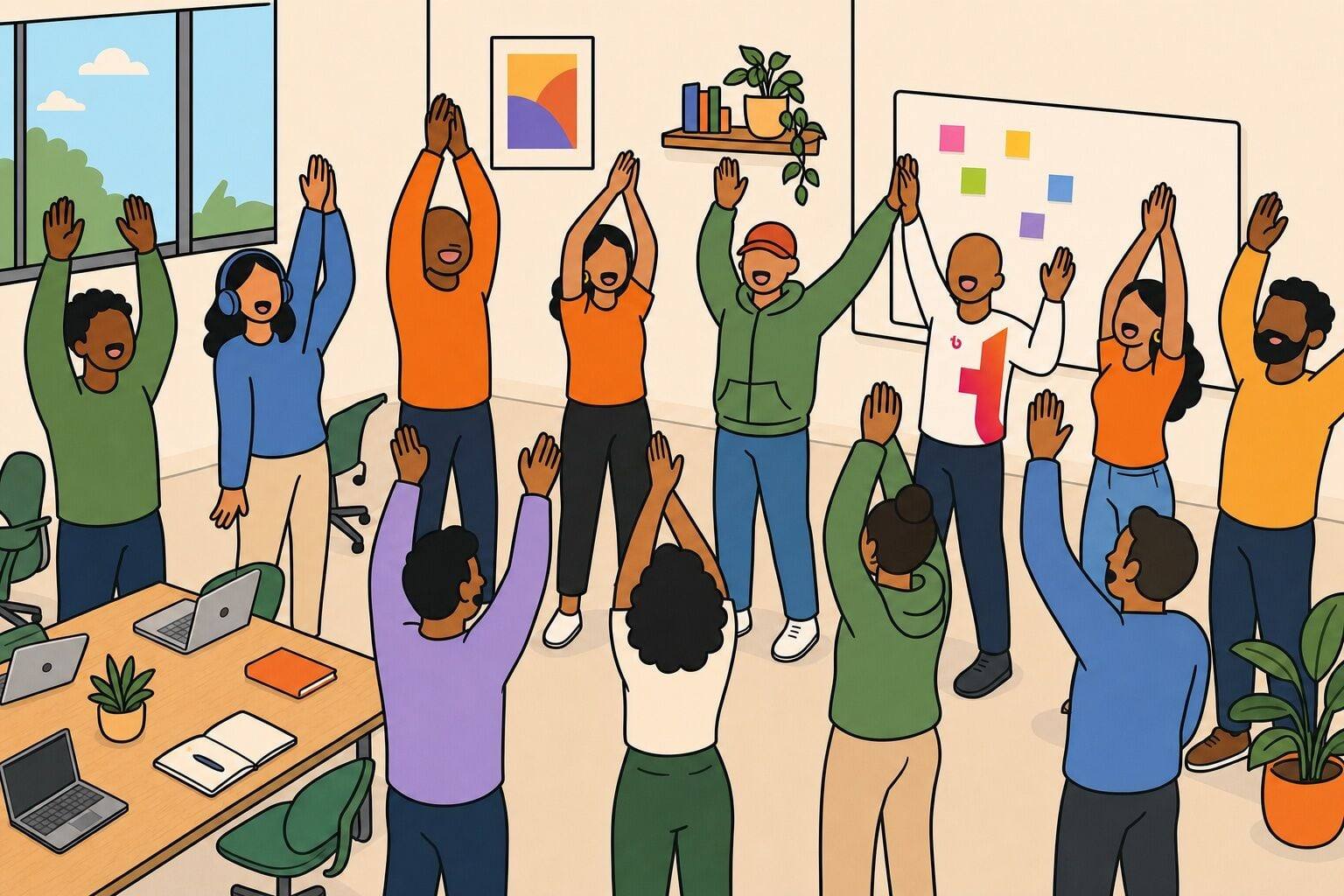
Short, high-participation energizer games that reset a room of 20, 100 or 300 people in about three minutes, with instructions, timings and the ones we no longer recommend.
Every long session has the same dead spot. Somewhere after the second presentation, the room goes quiet in the wrong way: phones come out, people sink into their chairs, and the next speaker has to work twice as hard for half the attention.
An energizer is the three-minute fix. It is not team building, it is not an icebreaker, and it is not a game you play for its own sake. It is a deliberate interruption that gets a big room moving, laughing and looking at each other again, and then hands the agenda straight back to whoever is next.
We design and run hosted team building events for a living, and a steady share of them are the big rooms — all-hands meetings, conference breakouts, training days and offsites where a facilitator is looking at 40, 100 or 300 faces. The energizers below are the ones that survive that scale. We also cut eight activities that used to be on this page, and we explain why near the end.
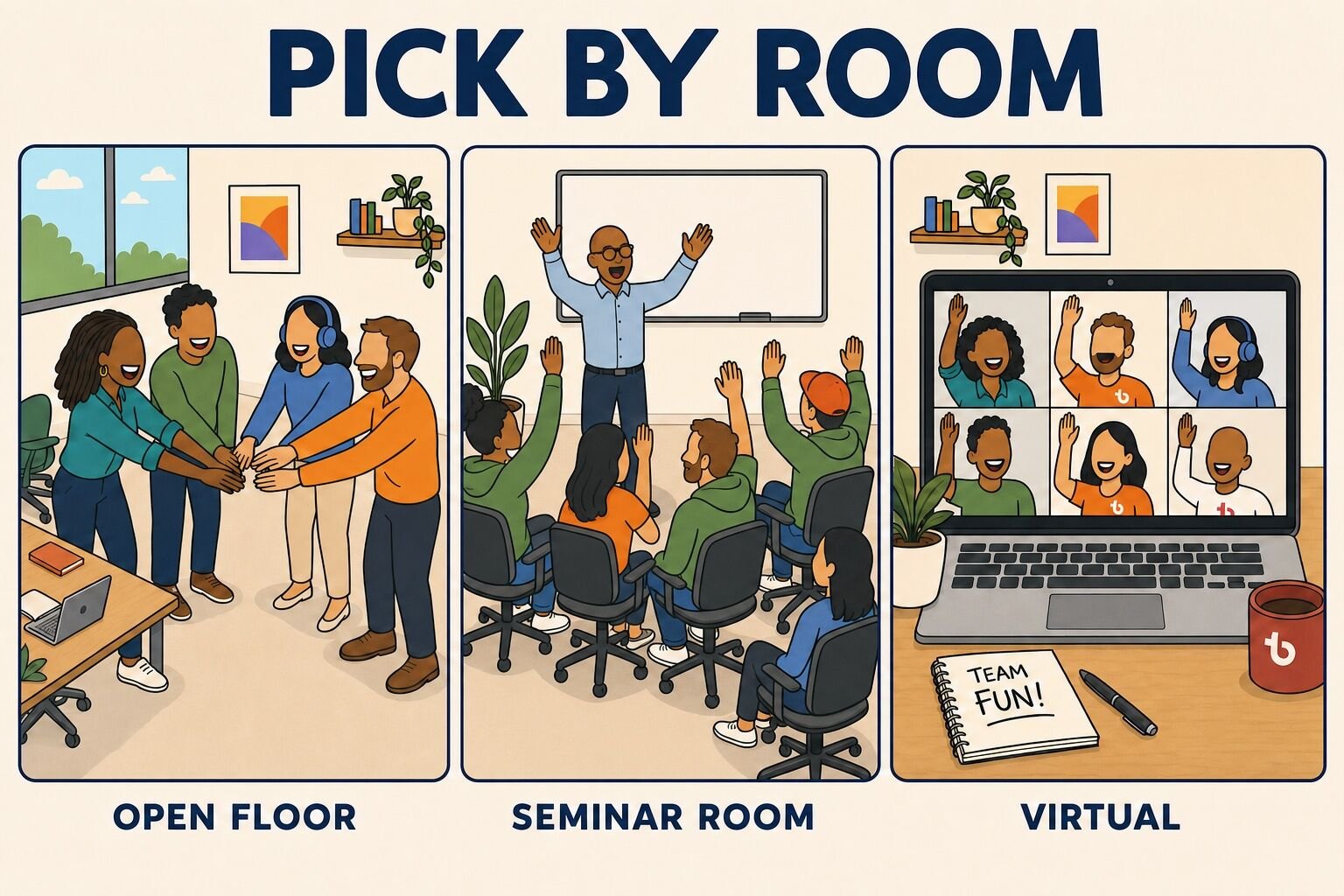
This list includes:
Here we go.
Large group energizers are short, high-participation activities, usually two to five minutes long, that reset the attention of a room of roughly 20 or more people in the middle of a longer session. Examples include Got You!, Cross the Room If and a guided stretch break. The defining feature is that everybody acts at the same time rather than taking turns, so the activity costs the same three minutes whether the room holds 20 people or 200.
Large group energizers are a subcategory of large group games and a close cousin of icebreaker games — the difference is timing and intent, since an icebreaker opens a session between strangers while an energizer rescues the middle of one. They are similar to large group icebreakers, quick team building activities, one minute games and 5 minute team building activities, and the recurring-meeting version is morning meeting games. These activities are also called "energizer games," "energiser activities," "group energizers," "meeting energizers" and "re-energizers for groups."
Running one is not a detour from the agenda. A meeting-science review by Mroz, Allen, Verhoeven and Shuffler in Current Directions in Psychological Science (2018) recommends that leaders call a meeting only when necessary, keep it small, circulate an agenda in advance, start on time, and actively encourage participation from all attendees. That last item is the whole job of an energizer. In a room of 100 people, participation does not happen on its own — somebody has to build a moment where speaking, standing or laughing is the normal thing to do.
Here is every energizer on this list, with the setting it is built for and how long it actually takes.
| Activity | Best for | Group size | Time | Cost |
|---|---|---|---|---|
| Got You! | Instant laughter | 10–200+ | 3 min | Free |
| Count to Twenty | Focus and listening | 10–40 per circle | 3–5 min | Free |
| Rock Paper Scissors Championship | Noise and competition | 20–300+ | 5 min | Free |
| Shake Down | Waking up a seated room | 10–500+ | 2 min | Free |
| Clump | Mixing people up | 20–150 | 5 min | Free |
| Pass the Pulse | Quiet focus | 15–60 per circle | 3–5 min | Free |
| Hot Takes | Opinions and laughter | 15–100 | 5 min | Free |
| Personality Corners | Getting people on their feet | 20–200 | 5 min | Free |
| Most Likely To | Teams that know each other | 10–50 | 5 min | Free |
| What's on Your Phone | Seated meetings | 10–100+ | 5 min | Free |
| Lightning Scavenger Hunt | Energy and movement | 10–200+ | 5 min | Free |
| Cross the Room If | Finding common ground | 25–300+ | 5 min | Free |
| Who Am I? | Mingling at conferences | 20–150 | 10 min | $ |
| Human Bingo | Rooms of strangers | 25–300+ | 10 min | $ |
| Name That Tune | Packed rooms with no space | 20–500+ | 5 min | Free |
| Snowball Fight | After-lunch slumps | 20–150 | 10 min | $ |
| The Candy Game | Table groups | 20–200 | 10 min | $ |
| Line Up Without Talking | Non-verbal teamwork | 15–100 | 5 min | Free |
| Guided Stretch Break | Long training days | Any size | 3 min | Free |
| Group Juggle | Learning names | 10–25 per circle | 5–8 min | $ |
| Walk and Talk | Before a brainstorm | Any size | 10 min | Free |
| Balloon Keep-Up | High energy and noise | 20–100 | 5 min | $ |
| The Name Game | New groups | 15–60 | 5 min | Free |
| Opposite Commands | Seated rows | Any size | 3 min | Free |
| Whisper Down the Lane | Rooms set in rows | 20–200 | 5 min | Free |
| No Smiling | Formal rooms that need loosening | 15–80 | 3 min | Free |
| Simon Says | Classrooms | Any size | 3 min | Free |
| Zip Zap Zop | Students and workshops | 10–30 per circle | 5 min | Free |
| Red Light, Green Light | Students with outdoor space | 15–100 | 5–10 min | Free |
| Chat Waterfall | Big video calls | 20–1,000 | 3 min | Free |
| Camera Scavenger Hunt | Remote all-hands | 15–500 | 5 min | Free |
These are the energizers to reach for when you have almost no time, no props and no idea how much floor space you will get. Every one of them works standing at a chair, and none of them need an explanation longer than two sentences.
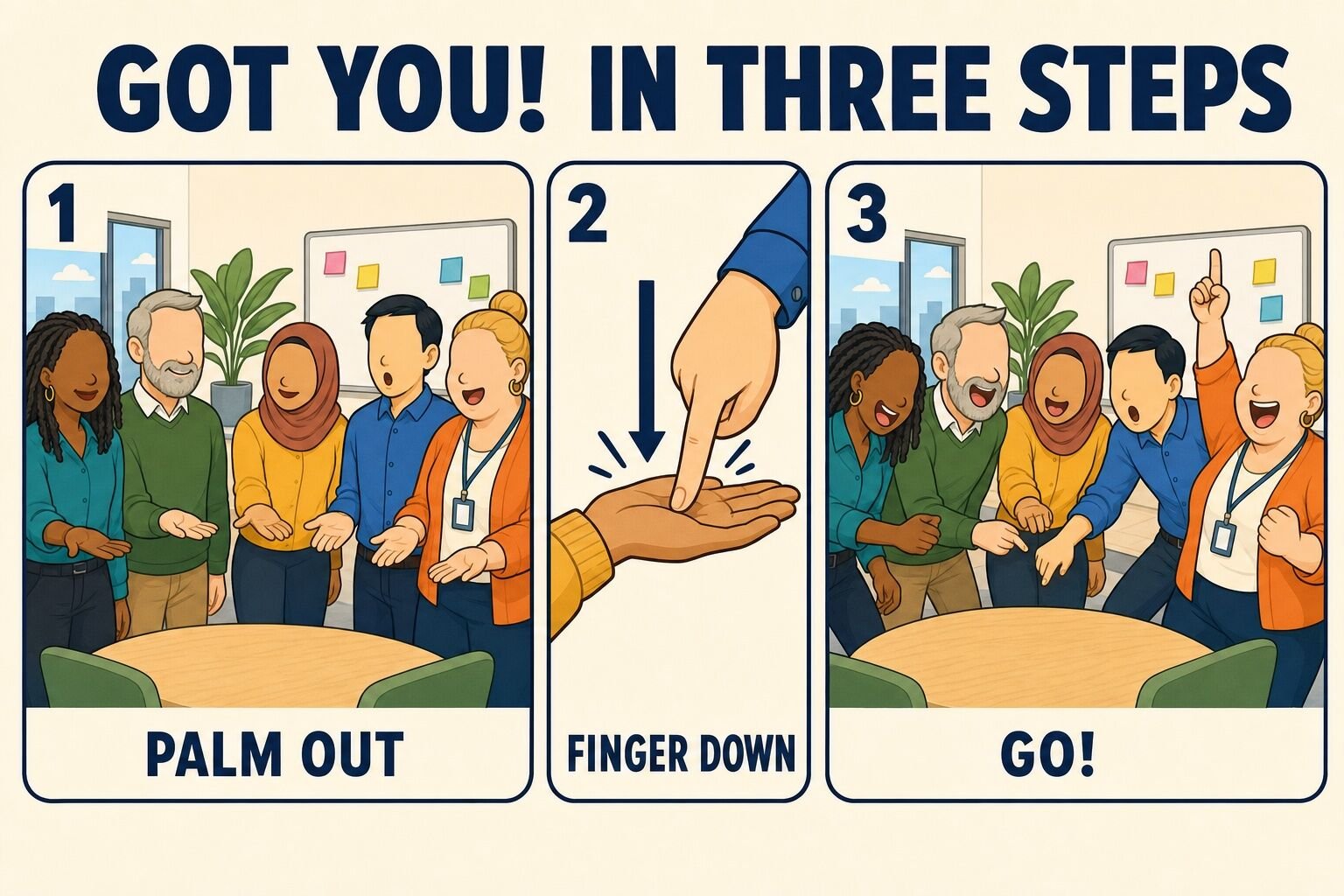
Got You! is the fastest energizer we know. The whole thing takes ninety seconds and it ends with a room full of people laughing at themselves.
To run it:
Best for: 10 to 200+ people
Time: 3 minutes
Materials (cost): None. Free.
What we have learned: Bury the trigger word in a story rather than counting down. "Three, two, one, go" gives everyone the same reaction time and the round ends in a tie. A rambling story about your morning coffee that suddenly contains the word "go" produces the chaos you are after.
Count to Twenty is a deceptively hard listening game that pulls a distracted room back into one shared focus.
To run it:
Best for: 10 to 40 people per circle
Time: 3 to 5 minutes
Materials (cost): None. Free.
What we have learned: Cap it at ninety seconds and celebrate the best attempt rather than insisting on a clean run. A group that reaches fourteen twice is having more fun than a group grinding out twenty.
A one-on-one game becomes a stadium event when the losers become fans. This is our go-to when a room is too big for anything that depends on hearing individual voices.
To run it:
Best for: 20 to 300+ people
Time: 5 minutes
Materials (cost): None. Free.
What we have learned: The cheering rule is the entire game. Without it, this is a knockout bracket where most of the room is eliminated in two minutes and then stands around. With it, nobody is ever out — they just change jobs.
Shake Down is the two-minute physical reset that improv and theater groups use as a warmup, and it works just as well on a room of finance directors after a long slide deck.
To run it:
Best for: 10 to 500+ people
Time: 2 minutes
Materials (cost): None. Free.
What we have learned: Offer a seated version out loud before you start: "shake from the wrists and ankles if standing is not comfortable today." Framing it as an option rather than an accommodation means nobody has to identify themselves to take it.
Clump gets a big room physically mixed in about four minutes, which makes it a great setup for any activity that needs fresh small groups afterward.
To run it:
Best for: 20 to 150 people
Time: 5 minutes
Materials (cost): None. Free.
What we have learned: Use Clump as a team-splitter and it stops being filler. Groups that self-select reproduce the org chart every time, and a fast physical scramble produces the mix you would otherwise have to impose.
Most energizers add noise. Pass the Pulse adds silence, which is sometimes exactly what an overstimulated room needs before a focused working session.
To run it:
Best for: 15 to 60 people per circle
Time: 3 to 5 minutes
Materials (cost): None. Free.
What we have learned: Always offer a no-contact version, such as a shoulder tap or passing a clap around the circle. Some groups are not a hand-holding group, and finding that out mid-activity is an awkward way to learn it.
These energizers are built for a room that is seated and staying seated: a monthly all-hands, a leadership meeting, a departmental update. They need no floor space, they run from the front of the room, and they hand the agenda back cleanly.
Hot Takes turns a quiet room into an opinionated one in about ninety seconds, because it is far easier to defend a stance on breakfast food than to "share something about yourself."
To run it:
Topics that reliably work:
Best for: 15 to 100 people
Time: 5 minutes
Materials (cost): None. Free.
What we have learned: A close vote is the whole payoff. A topic that splits the room roughly in half creates an argument people continue at lunch, while a 95-to-5 result gets a polite laugh and dies. Avoid anything that needs niche knowledge, and keep politics, religion and diet talk out of it.
Personality Corners is a this-or-that poll that people vote on with their feet, which makes it one of the few discussion energizers that gets a big room standing.
To run it:
Prompts to use:
For more prompts, here is a list of this or that questions.
Best for: 20 to 200 people
Time: 5 minutes
Materials (cost): None. Free.
What we have learned: Always include a third "neither" option. A binary forces the undecided middle to pick a side at random, and those people stop investing after round one.
Most Likely To works best with groups who already know each other, because the fun lives in the accusations.
To run it:
Prompts that land:
Here are more most likely to questions.
Best for: 10 to 50 people
Time: 5 minutes
Materials (cost): None. Free.
What we have learned: Keep every prompt flattering or neutral. "Most likely to be late" is a real complaint wearing a game costume, and the person on the receiving end knows it.
A scavenger hunt that needs no floor space, no props and no preparation, because everyone brought the game with them.
To run it:
Prompts to read:
Adapt the prompts to your group. For an audience that has not met, swap a few in from our list of get to know you questions.
Best for: 10 to 100+ people
Time: 5 minutes
Materials (cost): None. Free.
What we have learned: Never make the prompts confessional. A dating app or a photo of an ex turns a fun round into a disclosure nobody signed up for, and the room feels it immediately.
Lightning Scavenger Hunts are a format our hosts designed for our own events, and they are the most reliable way we know to put energy back into a flat room. The rounds are short on purpose.
To run it:
Here is our full guide to lightning scavenger hunts, including more prompts.
Best for: 10 to 200+ people
Time: 5 minutes
Materials (cost): None. Free.
What we have learned: The creativity bonus matters more than speed. It keeps the person who is slowest to their bag fully in the game, and it produces the moments people repeat afterwards — someone holding up a coworker as "something older than you" beats anyone finding a blue pen quickly.
Conference rooms have their own constraints. People are strangers, the chairs are in fixed rows, the schedule is tight, and badge lanyards are the only props in the building. These training energizers for large groups of adults are built for exactly that.
Cross the Room If shows a room of strangers how much they have in common in about four minutes, and it does it without anyone having to make a speech.
To run it:
Best for: 25 to 300+ people
Time: 5 minutes
Materials (cost): None. Free.
What we have learned: The pause is the activity. After each crossing, give the room three full seconds to look around before the next prompt. Facilitators who rush from statement to statement get a lot of walking and none of the recognition that makes this work.
Who Am I? gets a seated conference audience out of their chairs and talking to strangers, which is usually the hardest thing to make happen at an event.
To run it:
Best for: 20 to 150 people
Time: 10 minutes
Materials (cost): Sticky notes and pens, about $10 per 100 people.
What we have learned: Put two or three example names on a slide before people write. Without examples you get obscure regional celebrities and inside jokes from one department, and half the room spends ten minutes on an unguessable clue.
Human Bingo is the most efficient mixer we know for a room where nobody knows anybody, because everyone hunts at the same time and no one waits for a turn.
To run it:
For printable boards and more square ideas, see our icebreaker bingo guide.
Best for: 25 to 300+ people
Time: 10 minutes
Materials (cost): Printed cards and pens, about $15 per 100 people.
What we have learned: Write squares that are true of maybe one person in twenty. Squares like "drinks coffee" get filled by the nearest neighbor, and the mingling never happens.
When a room is packed wall to wall and nobody can move, sound is the only lever left. Name That Tune works with 500 people in fixed seating.
To run it:
Best for: 20 to 500+ people
Time: 5 minutes
Materials (cost): Speakers and a playlist. Free.
What we have learned: Test the audio in the actual room before the session. Music that sounds obvious through laptop speakers becomes unrecognizable mush through a ballroom PA, and a failed first clip costs you the room's attention.
Snowball Fight is an anonymous icebreaker disguised as a paper fight, and it is the best after-lunch energizer on this list.
To run it:
Best for: 20 to 150 people
Time: 10 minutes
Materials (cost): Scrap paper and pens, free to $5.
What we have learned: Give a prompt rather than an open field. "One surprising fact" gets you a page of "I like dogs." "Something you can do that nobody here knows about" gets you the room's attention for the rest of the afternoon.
The Candy Game gives people a reason to talk to the strangers they were seated with, and it scales to any room size because every table plays at once.
To run it:
A color key that works:
Best for: 20 to 200 people
Time: 10 minutes
Materials (cost): Multi-colored candy, about $20 per 100 people.
What we have learned: Always put a non-candy option on the table, such as colored tokens or sticky dots. Dietary restrictions, allergies and people who simply do not eat sugar should not have to opt out of the activity in order to opt out of the snack.
When the room has floor space — an open-plan office, a hotel ballroom with the chairs pushed back, a lawn at an offsite — movement is the strongest reset available. Stanford experiments by Oppezzo and Schwartz, published in the Journal of Experimental Psychology: Learning, Memory, and Cognition (2014), found that walking boosted creative idea generation by an average of around 60% compared with sitting, and that 81% of participants in the first experiment were more creative while walking. That research measured individual idea generation rather than group energy, so we would not stretch it into a claim about team building. But it is a good argument for getting people on their feet before you ask them to think.
A silent ordering challenge is a fast way to make a big group solve something together, and the silence makes it funny rather than stressful.
To run it:
Best for: 15 to 100 people
Time: 5 minutes
Materials (cost): None. Free.
What we have learned: Break groups over 60 into parallel lines of about 30 and race them. One line of 100 people takes so long to sort that the people at the ends never interact with anyone new.
The most underrated energizer in this guide is also the simplest. On a full training day, a deliberate stretch break beats another coffee round, and unlike most activities on this list it asks nothing social of anyone.
To run it:
For more options that work at a desk, see our list of desk exercises.
Best for: Any group size
Time: 3 minutes
Materials (cost): None. Free.
What we have learned: Say "move only in ways that feel good today" and then model a smaller version of each stretch yourself. A facilitator demonstrating a deep fold sets an expectation that half the room will quietly ignore, and the rest will follow uncomfortably.
Group Juggle is the rare energizer that teaches names while it runs, which makes it a strong opener for a multi-day workshop.
To run it:
For more name-learning formats, see our list of name games.
Best for: 10 to 25 people per circle
Time: 5 to 8 minutes
Materials (cost): Three or four soft balls per circle, about $15.
What we have learned: Use soft foam balls or rolled socks, never tennis balls, and tell people to toss underhand. This is the one energizer on this list where we have seen a room get genuinely competitive about throwing speed.
Walk and Talk is what we run when the room does not need noise, it needs air. It doubles as the first step of a brainstorm.
To run it:
Best for: Any group size
Time: 10 minutes
Materials (cost): None. Free.
What we have learned: Give the pairs a specific question and a hard return time. "Go take a walk" produces a fifteen-minute break and three people who come back with coffee; one question and a countdown clock produces the ideas you wanted.
Balloon Keep-Up is the loudest activity on this list, and for a room that has gone completely flat after lunch, that is the point.
To run it:
Best for: 20 to 100 people
Time: 5 minutes
Materials (cost): A bag of balloons, about $10.
What we have learned: Blow the balloons up ahead of time and keep spares in a bag. Nothing kills the energy of an energizer like 60 adults standing around watching a facilitator inflate balloons.
Sometimes there is no floor space, no budget, no props and no warning — a room set in tight rows and four minutes to fill before the next speaker. These energizers need nothing but your voice.
The Name Game gives everyone a memorable handle in a room of strangers, which pays off for the rest of the day.
To run it:
Best for: 15 to 60 people
Time: 5 minutes
Materials (cost): None. Free.
What we have learned: Cap the recall at two previous people rather than the whole chain. The traditional version punishes whoever goes last with a 30-name recital, and people spend the entire activity rehearsing instead of listening.
Opposite Commands scrambles the room's autopilot in about two minutes, and it works with people standing at their chairs in the tightest seating.
To run it:
Best for: Any group size
Time: 3 minutes
Materials (cost): None. Free.
What we have learned: Do not eliminate anyone. We have watched the elimination version empty a room in ninety seconds, leaving four competitive people playing while everyone else checks their phone.
A room set in long rows is built for this one. Every row is a team, and every row plays at the same time.
To run it:
Best for: 20 to 200 people
Time: 5 minutes
Materials (cost): None. Free.
What we have learned: Use a phrase from the session itself, such as the quarterly goal that was just presented. The distortion is funnier and the point lands: if a sentence cannot survive ten people, it will not survive the org chart either.
Telling a room of adults they may not laugh is the most efficient way to make them laugh.
To run it:
Best for: 15 to 80 people
Time: 3 minutes
Materials (cost): None. Free.
What we have learned: Ask for volunteers rather than drafting someone. Putting an unwilling person in front of a large group and telling them to be funny is the fastest way to create the one bad memory of the day.
Classrooms and student groups have more tolerance for movement and repetition than a boardroom, and less tolerance for anything that looks like a corporate exercise. These energizer games for students work in a classroom, a lecture hall or a school hall.
Simon Says is a three-minute warmup, not a main event, and treated that way it is excellent — the whole class plays at once and the rules need no explanation.
To run it:
Best for: Any class size
Time: 3 minutes
Materials (cost): None. Free.
What we have learned: The no-elimination version is the only one worth running with a big group. In the classic rules most of the room is out in ninety seconds, and then you have 28 bored spectators and two finalists.
Zip Zap Zop is a theater warmup that demands eye contact and quick reactions, which makes it a strong reset before any kind of group work.
To run it:
For more warmups like this, see our list of improv games.
Best for: 10 to 30 people per circle
Time: 5 minutes
Materials (cost): None. Free.
What we have learned: Cheer mistakes out loud, deliberately, from the first round. A group that celebrates the person who fumbles plays twice as fast as a group that goes quiet whenever someone slips.
Red Light, Green Light needs space and it needs a group that is happy to run, which makes it a student and youth-group energizer rather than an office one.
To run it:
For more options built for classrooms, see our list of team building activities for students.
Best for: 15 to 100 students
Time: 5 to 10 minutes
Materials (cost): None. Free.
What we have learned: Keep this one for students. We used to recommend it for adult work groups, and in practice it means asking colleagues in office clothes to sprint at each other on a hard floor. The payoff does not justify the twisted ankle.
A video call with 200 attendees is a different room entirely: nobody can move, most cameras are off, and only one person can talk at a time. The energizers that work there use the tools the platform already gives you — chat, reactions and the mute button.
Chat Waterfall is the only way we know to hear from 200 people in thirty seconds, and it works identically on any video platform.
To run it:
Best for: 20 to 1,000 people
Time: 3 minutes
Materials (cost): None. Free.
What we have learned: The "do not press enter yet" instruction is what makes this work. Without it, the first three answers anchor everyone else's, and by answer twenty the whole chat says "busy."
The virtual cousin of a lightning round: everyone leaves the frame at once, and the return is the fun part.
To run it:
For more formats built for video calls, see our list of video call games.
Best for: 15 to 500 people
Time: 5 minutes
Materials (cost): None. Free.
What we have learned: Ask for the story, not the object. The item is just a prompt — "something you have owned more than ten years" produces a hockey trophy and a five-minute conversation nobody would have started otherwise.
An energizer fails for one of about four reasons, and none of them are the activity itself. It was too long, it only had one person playing at a time, it asked for a personal disclosure, or it was dropped into the wrong moment. Here is what a decade of running hosted events for rooms of every size has taught us.
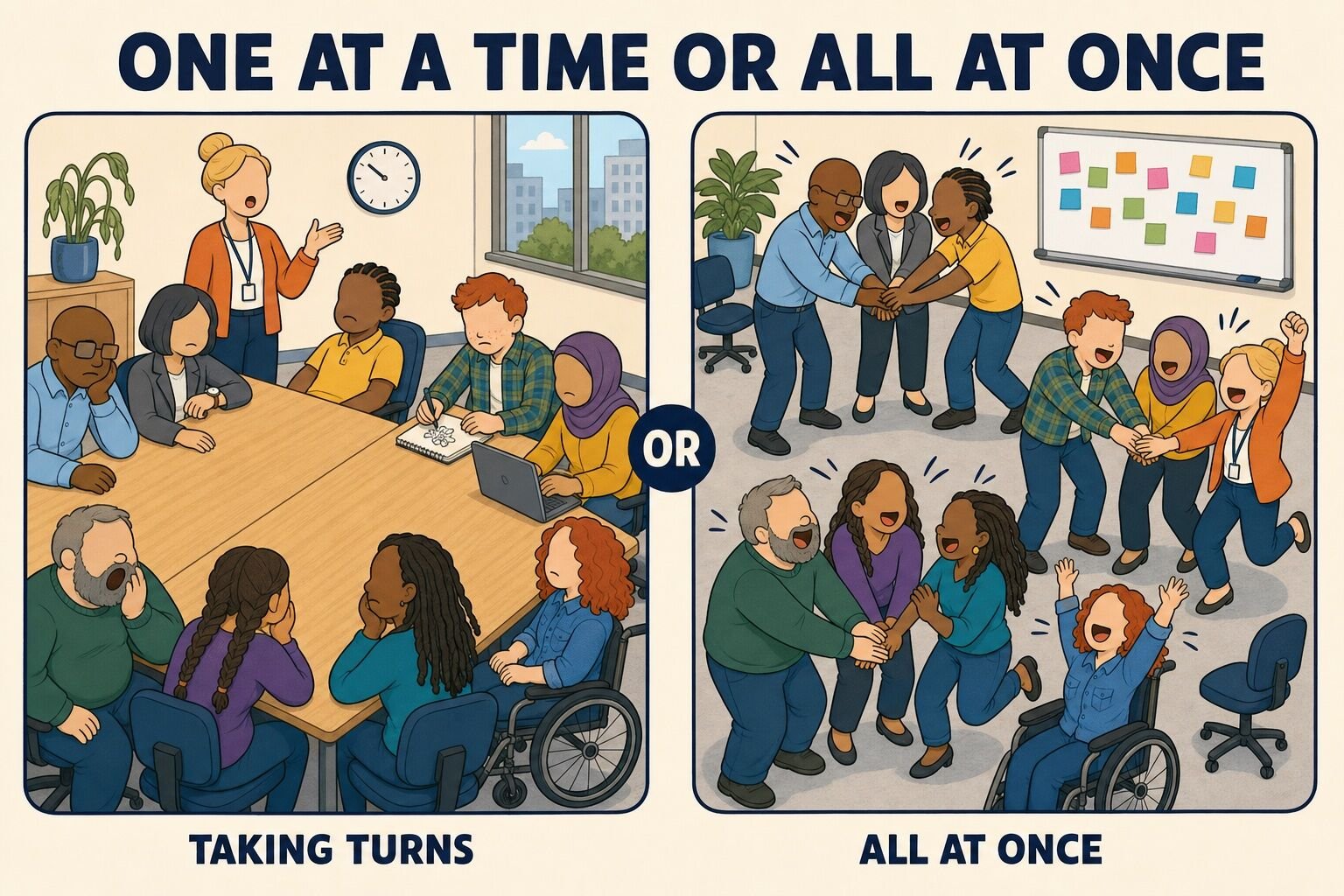
Parallel beats sequential, always. The single question that predicts whether an activity survives a big room is: how many people are doing something right now? Going around a circle of 60 people at 20 seconds each is 20 minutes of waiting for one turn. Splitting that room into six groups of ten, all playing simultaneously, costs three minutes and everybody plays.
Announce the length before you start. "This will take four minutes" gets a room to commit. An unannounced activity makes people calculate how much of their day is being taken, and that calculation is the opposite of energy.
Stop while people still want more. The most common facilitation mistake we see is running a good energizer for three rounds too many. Nobody remembers the round you cut.
Go first, and go bigger than you expect them to. Whatever you model is the ceiling for the room. A facilitator who gives a cautious hot take gets cautious hot takes back.
Never make participation a test. Elimination formats and put-someone-on-the-spot formats look energetic from the front of the room and feel awful from the middle of it. Offer a seated option, offer a no-contact option, and let people opt into visibility rather than requiring it.
Energizers also work best as a habit rather than a rescue. A three-minute opener at the top of a recurring meeting builds a room that is already warm, so you are not trying to resuscitate one that has gone cold.
Here is how the same activity changes when the room grows.
| What changes | Small group (under 15) | Large group (20+) |
|---|---|---|
| Turn-taking | Everyone can take a turn in a few minutes | Split into parallel circles or table groups, or use a show of hands |
| Instructions | You can clarify as you go | One sentence, demonstrated once, then go — questions do not scale |
| Space | Most activities fit around one table | Assume fixed seating unless you have checked the room yourself |
| Volume | Speaking voice is enough | A microphone, or an agreed silence signal such as a raised hand |
| Personal sharing | People will open up to a group they know | Keep prompts light — strangers in a big room will not, and should not have to |
| Time to run | 5 to 10 minutes | 3 to 5 minutes, because setup and reset eat the rest |
| Best formats | Pass the Pulse, Most Likely To, Group Juggle | Rock Paper Scissors Championship, Cross the Room If, Chat Waterfall |
This page used to list 21 activities, and eight of them do not appear above. Some were filler we wrote years ago — Business Card Swap assumed everyone carries business cards, Backward Names was a spelling test with a timer, and My Superpower was a slower version of The Name Game. Others are perfectly good activities that simply stop working once the room is big. Here is the full list of what to skip and why.
| Activity | Why skip it | Verdict |
|---|---|---|
| Going around the room for introductions | At 20 seconds each, a room of 60 spends 20 minutes waiting for one turn. This is the single most common way an energizer becomes the opposite of one. | Replace it — run Human Bingo instead |
| Trust falls | Real injury risk, and the forced vulnerability lands badly with anyone who did not choose to be in the room. | Skip it |
| One giant human knot | Above roughly ten people a knot is not harder, it is unsolvable, and a big group works that out eight minutes in. | Skip it |
| Freeze dance and dance-off energizers | Most adults will not dance in front of colleagues, so you get four enthusiastic people and a large silent audience. | Skip it |
| Deep personal check-ins | "Share your biggest fear" is a therapeutic exercise, not an energizer, and a room of near-strangers will give you safe non-answers anyway. Use light icebreaker questions instead. | Wrong tool |
| Elimination games with a single winner | By minute two, most of the room is out and watching. If you want a bracket, make the eliminated players into fans, as in Rock Paper Scissors Championship. | Change the rules |
| A 30-minute team building exercise billed as an energizer | Escape rooms, build challenges and full scavenger hunts are great activities, but they are the session, not the break inside it. | Different activity |
| Musical chairs | A physical scramble for seats among adults in work clothes, where the first person out waits the longest and the last two are essentially wrestling. | Skip it |
The best energizer for a large group is almost never the cleverest one. It is the one you can explain in a sentence, that puts every person in the room into motion at the same moment, and that ends before anyone wonders how long it will last.
Pick two or three from this list before a long session rather than planning one, and choose them by the room you will actually be standing in: open floor, fixed rows, or a grid of faces on a screen. Then watch the group after the first one and be willing to drop the rest if the energy is already back.
If you would rather have a professional host run the whole thing for a big group, you can browse team building events built for large groups, virtual and in person.
Next, check out our lists of fun group activities for adults, large group activities, and team building activities for work.
Answers to the questions facilitators ask us most about running energizers with big groups.
Large group energizers are short, high-participation activities, usually two to five minutes long, that reset the attention of a room of roughly 20 or more people in the middle of a longer session. Examples include Got You!, Cross the Room If and a guided stretch break. The defining feature is that everybody acts at the same time rather than taking turns, so the activity costs about the same three minutes whether the room holds 20 people or 200.
Three to five minutes is the working range for a large group, and we tell facilitators to announce the length out loud before starting. Anything past about eight minutes stops being a break inside the session and becomes an activity that needs its own slot on the agenda. Stop while people still want another round.
Timing and intent. An icebreaker opens a session and helps strangers get comfortable with each other, so it usually involves names, introductions or light personal sharing. An energizer is dropped into the middle of a session that has gone flat, asks nothing personal, and exists to get people moving and laughing before handing the agenda straight back.
The ones that need no props and no floor plan: Got You!, a Rock Paper Scissors Championship where losers become the winner's cheering section, Shake Down, Clump and Cross the Room If. Each works standing at a chair, each can be explained in one sentence, and each puts the entire room into motion at the same moment.
Run things in parallel. Split the room into table groups or circles that all play simultaneously, keep instructions to one demonstrated sentence, use a microphone and an agreed silence signal, and choose formats scored by table rather than by individual. Avoid anything that requires hearing one person at a time, and avoid elimination, which leaves most of the room watching within two minutes.
Formats built on chat, reactions and the camera. A Chat Waterfall — everyone types an answer and sends it on a countdown — collects 200 responses in thirty seconds, and a Camera Scavenger Hunt sends everyone off to fetch an object and brings the whole gallery back at once. Both scale to hundreds of attendees and need no breakout rooms.
Comments (0)
Leave a Comment