
34 Large Group Games for Adults (Indoor, Outdoor, Party & Work)
A game that works with eight people can fall apart with eighty. These 34 large group games are built to keep everybody playing at the same time.
A game that works with eight people can fall apart with eighty. These 34 large group games are built to keep everybody playing at the same time.
A game that works beautifully with eight people can fall apart with eighty. The mechanics that make a small group click, where everyone takes a turn, everyone hears the answer and one person keeps score in their head, are the exact mechanics that stall out once the room gets big.
We have been designing and running team building events since 2013, and as of September 2026 we have hosted more than 45,000 of them. Most are ordinary-sized teams, but a steady share are all-hands rooms, conference breakouts and company picnics where the facilitator is looking at 40, 80 or 300 faces and has 20 minutes to make something happen.
The games below are the ones that hold up at that scale. Some come straight from our hosted events, some are formats our hosts run at internal retreats, and some are classics we have watched succeed and fail enough times to know exactly where they break. We also cut ten games that used to be on this page, and we explain why near the end.
This list includes:
Here we go.
Large group games are games and activities built for roughly 15 or more players at once, where the structure keeps everybody participating instead of watching. Examples include Fishbowl, Coworker Feud and Capture the Flag. The defining feature is parallel participation: instead of 60 people taking turns, six teams of ten play simultaneously and compare results. These games are also called "big group games," "group games for adults," "party games for large groups" and "games for large groups of adults."
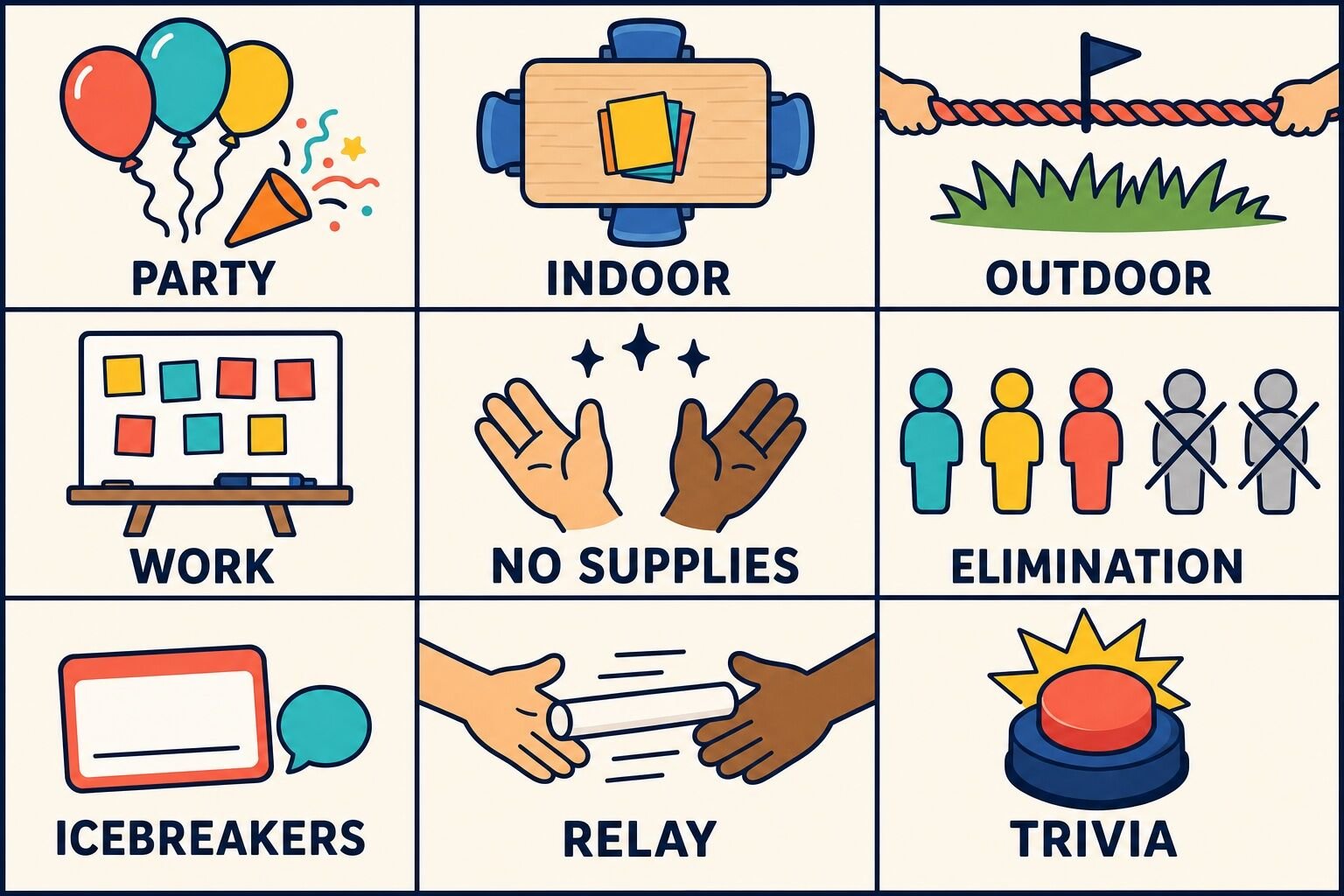
Large group games are a subcategory of team building games and the game-shaped half of large group activities. They are similar to large group icebreakers and party games for work, and the setting-specific versions are indoor group games and outdoor group games. Within the category, this guide covers party games for large groups, indoor and outdoor large group games, games for work, quick games that need no supplies, elimination games and icebreakers.
Structured play is not just filler on an all-hands agenda. A PLoS ONE meta-analysis by McEwan and colleagues pooled 72 controlled teamwork-training interventions covering 8,439 participants and found significant medium-to-large improvements in teamwork behaviors and team performance. The split inside that finding is the useful part: experiential methods such as workshops, simulations and team debriefs produced the gains, while purely didactic classroom education showed no significant effect. That research covers teamwork training rather than recreational games, so we would not stretch it into a claim about party games. But the direction travels: people get better at working together by doing things together, not by being talked at.
Before any of these run well, you need teams. For groups over about 20, we count off by number rather than letting people self-select, because self-selected teams reproduce the org chart and the whole point is to mix it up.
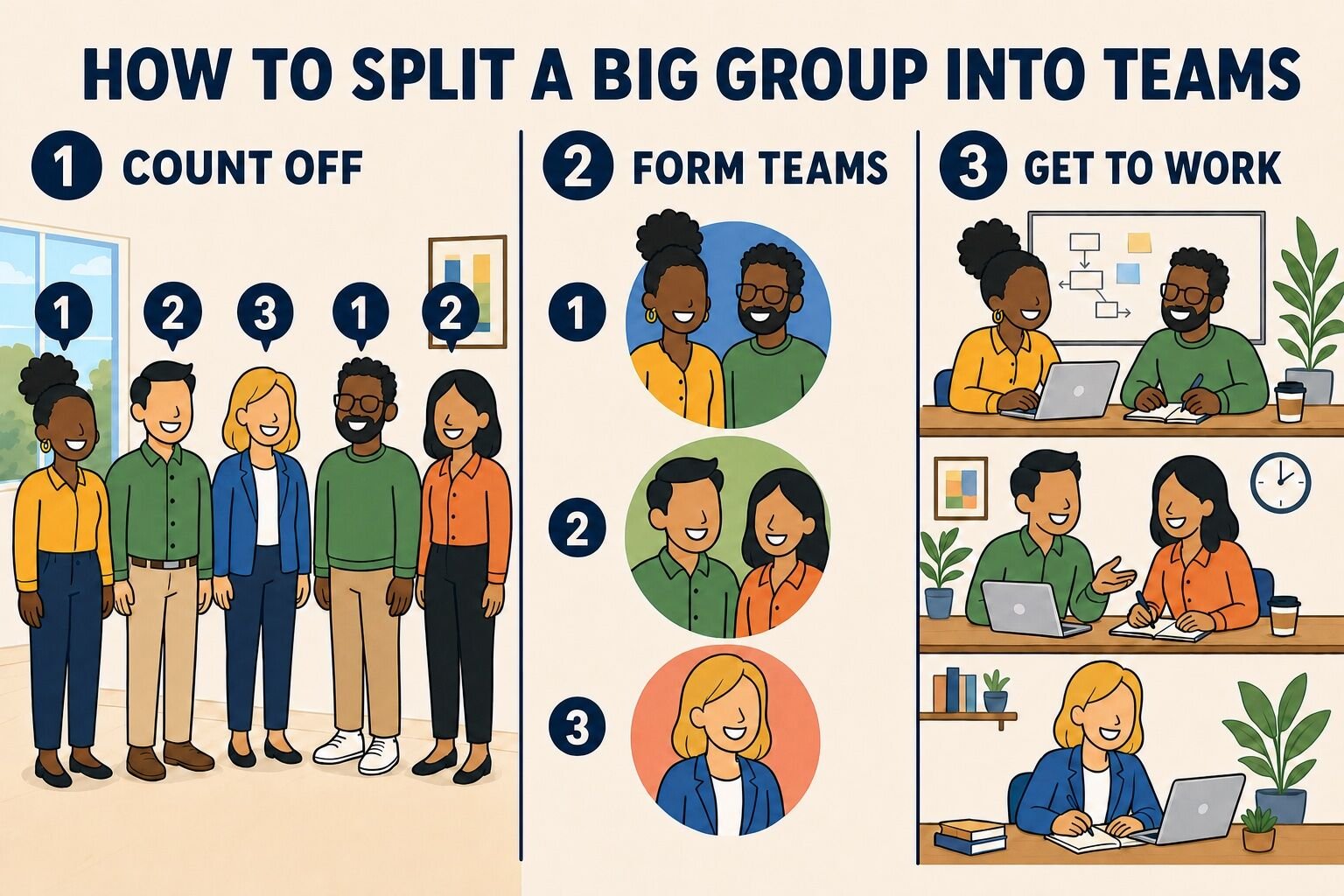
Here is every game on this list, with the group size it is actually built for.
| Activity | Best for | Group size | Time | Cost |
|---|---|---|---|---|
| Fishbowl | Laughter and teamwork | 12–60 | 30–45 min | Free |
| Werewolf | Social deduction | 10–30 per circle | 20–40 min | Free |
| Team Trivia Showdown | Friendly competition | 20–200+ | 45–60 min | Free |
| Charades Tournament | High-energy parties | 20–80 | 30–45 min | Free |
| The Left-Right Story | Very large rooms | 20–300+ | 5–10 min | $–$$ |
| Who Am I? | Mingling | 15–150 | 15–25 min | $ |
| Minute to Win It Stations | Rotating team play | 24–120 | 30–45 min | $–$$ |
| Human Battleship | Strategy and shouting | 20–60 | 25–40 min | Free |
| Sardines | Offsites in big venues | 15–50 | 15–25 min | Free |
| Marshmallow Tower Challenge | Creative problem-solving | 16–100 | 25–30 min | $ |
| Egg Drop Challenge | Engineering and nerve | 16–80 | 40–60 min | $ |
| Human Knot | Coordination | 8–10 per circle | 10–15 min | Free |
| Tug-of-War | Classic outdoor competition | 20–100 | 15–20 min | $ |
| Capture the Flag | Big fields and strategy | 20–100 | 30–45 min | $ |
| Water Balloon Dodgeball | Hot-weather picnics | 16–60 | 15–25 min | $ |
| Giant Relay Race | Everyone competing at once | 20–120 | 20–40 min | $ |
| Kickball Tournament | Company picnics | 18–60 | 60–90 min | $ |
| Coworker Feud | Getting to know the team | 20–150 | 30–45 min | Free |
| Photo Scavenger Hunt | Exploring the office | 15–100 | 30–60 min | Free |
| Team Name Draft | Warming up new teams | 18–120 | 10 min | Free |
| Collaborative Mural | Quiet, inclusive creativity | 20–300+ | 30–60 min | $$ |
| Speed Meet | All-hands and onboarding | 20–100 | 20–30 min | Free |
| Cross the Circle | Finding common ground | 15–60 | 10–15 min | Free |
| Count to Twenty | Listening and focus | 10–30 per circle | 5–10 min | Free |
| Silent Line-Up | Non-verbal communication | 15–100 | 5–10 min | Free |
| Zip Zap Zop | Waking a room up | 12–40 per circle | 5–10 min | Free |
| Rock-Paper-Scissors Tournament | Instant energy | 16–500+ | 5–10 min | Free |
| Heads or Tails | Auditoriums and keynotes | 30–1,000+ | 3–5 min | Free |
| Balloon Stomp | Chaotic fun | 15–60 | 10–15 min | $ |
| Murder in the Dark | Parties and offsites | 12–40 | 15–30 min | Free |
| Blob Tag | Outdoor energizers | 15–60 | 10–15 min | Free |
| Human Bingo | Breaking the ice at scale | 15–200 | 15–20 min | Free |
| Circle of Names | Learning names | 10–25 per circle | 10–15 min | Free |
| Partner Introductions | New or merged teams | 16–60 | 15–25 min | Free |
Party games for large groups have one job: get a loud, distracted, half-mingling room playing the same thing at the same time. That rules out anything with a long explanation or a single turn order. The seven below all work with a microphone, a rough count of heads and very little else.
Fishbowl, also known as Celebrity or Salad Bowl, is the best party game we know for a big room, because the same handful of paper slips gets funnier in every round.
To run it:
The magic is the repetition. By round three, "the one about the pineapple" is a running joke and a single gesture gets the whole room shouting the answer.
Best for: 12 to 60 people
Time: 30 to 45 minutes
Materials (cost): Paper slips, pens, a bowl and a phone timer. Free.
What we have learned: Cap the slips at three per person and read a couple aloud before you start. Inside jokes that only one department will recognize are the single most reliable way to make a big room go quiet.
Werewolf, sometimes called Mafia, is a social deduction game where a hidden minority of players tries to outlast the majority. It rewards the quiet observers on your team, which makes it a nice counterweight to games that reward volume. Here are the full Werewolf game rules.
To run it:
Best for: 10 to 30 people per circle
Time: 20 to 40 minutes
Materials (cost): One deck of playing cards or printed role cards. Free.
What we have learned: Deal roles on cards rather than tapping shoulders in the dark. At 25 players, shoulder-tapping takes almost four minutes of silence before the game even starts, and that is where the energy leaks out.
Table trivia is the most scalable competitive format there is, because 200 people playing in teams of eight takes exactly as long as 20 people playing in teams of eight. Our own hosted game shows are built on this structure, and you can run a solid version yourself with a slide deck and answer sheets. Here is a bank of trivia games to pull from.
To run it:
Best for: 20 to 200+ people
Time: 45 to 60 minutes
Materials (cost): Answer sheets, pens, a screen or projector. Free.
What we have learned: The company round outperforms every other round, every time. Questions like "how many people joined the team this year" or "which office drinks the most coffee" produce more arguing and laughing than any pop culture category, and they are the reason people remember the event a month later.
Charades struggles on a video call, where body language gets cropped by the camera frame. In a real room with a big group, it is one of the loudest, most reliable games you can run, especially as a bracket.
To run it:
Best for: 20 to 80 people
Time: 30 to 45 minutes
Materials (cost): Printed clue slips and envelopes. Free.
What we have learned: Workplace clues beat movie clues. "Trying to unmute yourself," "the printer is jammed again" and "someone reheated fish in the microwave" get a bigger reaction than any blockbuster title, and nobody is disadvantaged for not watching the right films.
The Left-Right Story is the only game on this list that genuinely works with 300 people standing in a ballroom, because the rules take 15 seconds to explain and nobody has to move.
To run it:
Best for: 20 to 300+ people
Time: 5 to 10 minutes
Materials (cost): A written story and one small prize per four players, roughly $2 to $5 each.
What we have learned: Write the story about your own team rather than downloading a generic one. The passing mechanic is only mildly fun on its own, but a story where the VP of Sales keeps leaving things in the wrong room is what makes the room laugh.
Who Am I?, sometimes played as Headbands, turns a standing-around-with-drinks crowd into a room full of conversations, which is exactly what a big party needs in its first 20 minutes.
To run it:
Best for: 15 to 150 people
Time: 15 to 25 minutes as an opener, or all evening as a background game
Materials (cost): Name tags and a marker, around $10.
What we have learned: The three-question rule is what makes it work at scale. Without it, two people solve each other's tags in four minutes and then stand together for the rest of the party, which is the opposite of what a mixer is for.
Rather than running one minute to win it game at a time while everyone watches, set up six stations and rotate teams through them. The room goes from one person playing to 48 people playing.
To run it:
Best for: 24 to 120 people
Time: 30 to 45 minutes
Materials (cost): Cups, ping-pong balls, dice, balloons and snacks, roughly $40 to $60 for six stations.
What we have learned: Put a volunteer scorekeeper at each station instead of one central host. The rotation only stays on schedule if nobody has to wait for you to walk over and adjudicate whether a cup counts.
Indoor large group games have to respect three constraints a field does not impose: fixed furniture, noise that carries, and the fact that somebody is probably on a call next door. These five work inside a conference room, a cafeteria or a hotel ballroom.
Human Battleship turns the board game into a live grid of people, and it gets better as the group gets bigger because a wider grid means more strategy.
To run it:
Best for: 20 to 60 people
Time: 25 to 40 minutes
Materials (cost): Chairs, paper signs and something to block the view. Free.
What we have learned: Give each team a designated caller and a designated plotter. Without those two roles, 30 people shout coordinates at once and the game turns into an argument about whose turn it was.
Sardines is hide-and-seek in reverse, and it is one of the few childhood games that genuinely improves with a bigger group and a bigger building. It is a great fit for an offsite at a venue people have not explored yet.
To run it:
Best for: 15 to 50 people
Time: 15 to 25 minutes per round
Materials (cost): None. Free.
What we have learned: Set a hard time limit and a recall signal, like a horn or a group text, before anyone hides. In a large venue a well-hidden group can stay hidden past the point where searching is still fun.
The Marshmallow Tower Challenge is a build-under-pressure exercise that scales perfectly, because every team of four works on an identical kit at their own table.
To run it:
Best for: 16 to 100 people
Time: 25 to 30 minutes including the debrief
Materials (cost): Spaghetti, tape, string and marshmallows, roughly $2 per team.
What we have learned: The debrief is worth more than the build. Ask each team when they first put the marshmallow on. The teams that tested the weight early almost always beat the teams that spent 15 minutes planning a beautiful structure and discovered in the last 30 seconds that it could not hold anything.
The Egg Drop Challenge is an engineering problem with a very public result, which is why it works in front of a crowd. Run it in teams rather than individually so that 60 people are not each holding one egg.
To run it:
Best for: 16 to 80 people
Time: 40 to 60 minutes
Materials (cost): Eggs and craft supplies, roughly $3 per team plus a tarp.
What we have learned: The lightest-carrier bonus is what turns this from a craft activity into a real decision. Without it, every team builds the same padded blob and the drop stops being suspenseful.
The human knot is a coordination puzzle where a tangled circle of people has to unwind itself without letting go of hands. The critical detail for a big group is that you run many small circles at once, never one giant one.
To run it:
Best for: 8 to 10 people per circle, unlimited circles
Time: 10 to 15 minutes
Materials (cost): None. Free.
What we have learned: This is the game people most often break by scaling it wrong. A circle of 20 is not a harder knot, it is an unsolvable one, and the group figures that out about eight minutes in and stops trying. Add circles, not people.
Outside, the constraint flips: you have all the space you want and none of the acoustics. Every game below is explained in one sentence, played with a whistle, and forgiving of people who wander off to get a drink. These are the core of most outdoor team building days.
Tug-of-War is the oldest large group game there is, and it survives because it is the rare competition where the strongest individual cannot win alone.
To run it:
Best for: 20 to 100 people
Time: 15 to 20 minutes
Materials (cost): A thick tug-of-war rope, roughly $40 to $80, plus gloves.
What we have learned: Coordinated pulling beats raw strength, which is worth pointing out in the debrief. Teams that find a rhythm and pull on a count routinely beat heavier teams pulling constantly. Bring gloves, insist on flat ground, and never let anyone wrap the rope around a hand or wrist.
Capture the Flag is the best large group game for a genuinely big outdoor space, because it rewards planning, decoys and coordination rather than pure speed.
To run it:
Best for: 20 to 100 people
Time: 30 to 45 minutes
Materials (cost): Cones and two flags or bandanas, around $25.
What we have learned: Name the roles out loud before the first round: attackers, defenders and one jailbreaker. Without assigned roles, almost everyone attacks, both flags fall in the first 90 seconds and the game is over before anybody warmed up.
Water Balloon Dodgeball is the hot-weather version of a classic, and the water is what makes it work for adults. Getting hit is refreshing instead of painful, so people who would sit out regular dodgeball will play.
To run it:
Best for: 16 to 60 people
Time: 15 to 25 minutes
Materials (cost): Balloons, buckets and a hose, roughly $20. Budget time to pick up every scrap afterward.
What we have learned: Tell people in the invite, not on the day. The difference between a great water game and a resented one is whether people had the chance to leave their laptop bag and good shoes inside.
A relay race is the most efficient way to get 100 people competing at once, because the waiting is built into the format instead of being an accident of it. Everybody has a job and everybody's job takes 30 seconds.
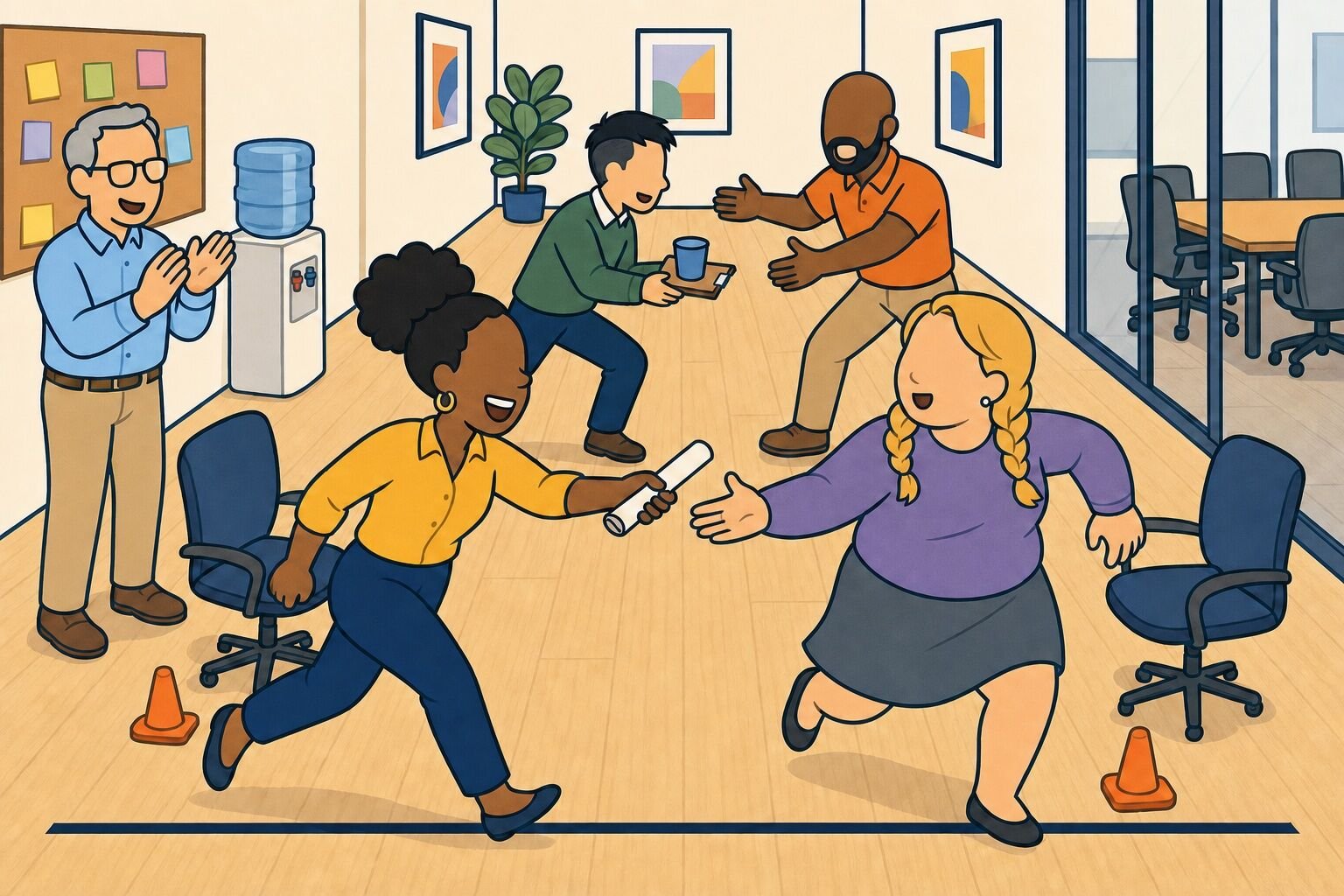
To run it:
Best for: 20 to 120 people
Time: 20 to 40 minutes
Materials (cost): Cones, batons, cups and sacks, roughly $30.
What we have learned: Build at least one leg that has nothing to do with speed. A cup-of-water leg or a balance leg means the fastest team does not automatically win, which keeps the slower lanes trying right up to the end.
Kickball is the company picnic sport we recommend over softball or ultimate frisbee, for one reason: everybody already knows how to kick a stationary ball, so there is no skill gate at the door. It is a staple of most company picnics.
To run it:
Best for: 18 to 60 people
Time: 60 to 90 minutes for a bracket
Materials (cost): A kickball and bases, roughly $30.
What we have learned: Add a non-playing role that matters: scorekeeper, announcer, photographer. At every picnic there are people who will not run bases but absolutely will commentate, and giving them a microphone keeps them at the event instead of at the snack table.
Games for work carry an extra requirement: they should not embarrass anyone, gate on physical ability, or require people to reveal anything personal. These five are the ones we reach for when the group includes executives, new hires and someone who did not know this was on the agenda. They also double as employee engagement activities you can repeat quarterly.
Coworker Feud is a survey-based game show where teams guess how their colleagues answered, and it is the single best work game on this list for a group that does not know each other well yet.
To run it:
Best for: 20 to 150 people
Time: 30 to 45 minutes
Materials (cost): A survey tool and a slide deck. Free.
What we have learned: Write questions that only your company could answer. Generic prompts produce generic answers, and the whole payoff of this format is the moment where 80 people discover that 41 of them said the same thing about the third-floor printer.
A photo scavenger hunt is the most flexible large group game for a workplace, because the list of prompts scales to whatever building, campus or neighborhood you have. Our hosts run a timed version of this in almost every in-person event.
To run it:
Best for: 15 to 100 people
Time: 30 to 60 minutes including the slideshow
Materials (cost): Phones and a shared album. Free. Here are more scavenger hunt ideas.
What we have learned: The final slideshow is the event, not the hunt. Budget at least ten minutes for it, project the photos big, and let people heckle. Teams that came fourth still leave happy if their photo got the biggest laugh.
Before any of the team games above, you have to turn a crowd into teams, and a five-minute naming ritual does more for group identity than an hour of assigned seating. This is the tiniest game on the list and the one we run most often.
To run it:
Use the generator below when a team needs a starting point:
Best for: 18 to 120 people
Time: 10 minutes
Materials (cost): A whiteboard. Free.
What we have learned: Insist on the gesture. The name alone gets forgotten in ten minutes, but a team that has physically done something silly together once will do it again when the scores are announced, and that is the difference between a room of individuals and a room of teams.
A Collaborative Mural is the best large group activity we know for groups that include people who genuinely do not want to compete, shout or run. Everyone contributes one tile and the tiles assemble into a single image.
To run it:
Best for: 20 to 300+ people
Time: 30 to 60 minutes
Materials (cost): Canvas panels and acrylic paint, roughly $3 to $6 per person.
What we have learned: Keeping the full image secret is what makes the reveal land, but it also means somebody will paint their square upside down. Mark a small arrow on the back of every panel, and hand out squares in a random order so neighbors are not painting adjacent tiles and comparing.
Speed Meet is speed networking with a timer and prompts, and it is the most efficient way to get a large group past name-and-job-title small talk. It is especially useful after a merger, a big hiring wave or a year of everyone being remote.
To run it:
Best for: 20 to 100 people
Time: 20 to 30 minutes
Materials (cost): Chairs, a timer and a slide of prompts. Free. For more prompts, see our get to know you games.
What we have learned: The final share-back is what converts this from a nice conversation into a group experience. Asking people to report the best thing they heard from someone else, rather than about themselves, means the whole room learns six interesting facts about six colleagues in three minutes.
These are the games to have memorized. No props, no prep, no printing, five to ten minutes each. They are what you run when a session is running early, a speaker is late, or the room has gone flat after lunch. Several also work as morning meeting games for a standing group.
Cross the Circle is a mixer that shows a big group how much it has in common in about eight minutes, without asking anybody to make a speech.
To run it:
Best for: 15 to 60 people
Time: 10 to 15 minutes
Materials (cost): None. Free.
What we have learned: Model the first three statements yourself, and make them light. The tone of the first few prompts sets the ceiling for the whole game, and a facilitator who opens with something mildly embarrassing about their own cooking gets much better rounds than one who opens with "cross the circle if you love your job."
Count to Twenty looks trivially easy written down and is genuinely hard in a room of 25 adults, which is exactly why it is one of the best communication games to run with no notice.
To run it:
Best for: 10 to 30 people per circle
Time: 5 to 10 minutes
Materials (cost): None. Free.
What we have learned: The group solves this by learning to leave space, not by getting faster. Point that out afterward, because it is the same skill that makes a 30-person meeting work. Research on group performance backs the instinct: as we cover in what we have learned, how evenly a group shares the floor predicts how well it performs together.
Silent Line-Up is a non-verbal coordination challenge that works with 15 people or 100, and it takes under a minute to explain.
To run it:
Best for: 15 to 100 people
Time: 5 to 10 minutes
Materials (cost): None. Free.
What we have learned: At 60 people or more, a leader always emerges in the first 30 seconds, usually by standing on a chair and pointing. That is worth naming in the debrief, because it is the most vivid example of informal leadership you will ever get from a five-minute game.
Zip Zap Zop is a focus and rhythm game borrowed from improv training. It is the fastest way to wake up a room of adults who have been sitting in chairs since nine in the morning. Here are more improv games that scale.
To run it:
Best for: 12 to 40 people per circle
Time: 5 to 10 minutes
Materials (cost): None. Free.
What we have learned: Do not enforce elimination on the first pass. Let the circle make mistakes freely for a minute, then add the rule. Groups that start with elimination in play tend to go slowly and safely, which is the opposite of what the game is for.
The Rock-Paper-Scissors Tournament is the highest-energy thing you can do with zero equipment, and it genuinely scales to hundreds of people because the field halves with every round. It is the most reliably competitive game we run as a warmup.
To run it:
Best for: 16 to 500+ people
Time: 5 to 10 minutes
Materials (cost): None. Free.
What we have learned: The cheering rule is the entire game. Plain rock-paper-scissors elimination leaves most of the room standing awkwardly after two minutes. With the cheering rule, the people eliminated first end up having the loudest time, and the final between two mid-level analysts gets a genuine ovation from 200 colleagues.
Elimination games for large groups solve a specific problem: they shrink a crowd down to a winner quickly and give everyone a clear moment of attention along the way. The trick is making sure the people knocked out first are not stuck doing nothing, which is why every game here gives eliminated players a job.
Heads or Tails is the fastest crowd game ever invented and the only one on this list that works with a thousand people in an auditorium. We have seen it used to open conference keynotes and to pick a raffle winner without a hat.
To run it:
Best for: 30 to 1,000+ people
Time: 3 to 5 minutes
Materials (cost): A coin. Free.
What we have learned: Commit-before-the-flip is not optional. If people can change their hands after the call, the last three rounds descend into an argument, and you will spend longer adjudicating than you did playing.
Balloon Stomp is loud, chaotic and over in ten minutes, which is exactly the right shape for the end of an outdoor session. Each player defends a balloon tied to their ankle while trying to pop everyone else's.
To run it:
Best for: 15 to 60 people
Time: 10 to 15 minutes
Materials (cost): Balloons and string, around $10. Collect every scrap of popped balloon afterward.
What we have learned: Say "no hands, no pushing, no grabbing" out loud and mean it. This is the game most likely to produce a twisted ankle at a company event, so run it on grass, ban anyone in dress shoes from playing, and keep the round under 90 seconds.
Murder in the Dark, also called Wink Murder, is a quiet elimination game that runs underneath a party rather than interrupting it. Players are eliminated by a wink, and the fun is entirely in the theatrical dying.
To run it:
Best for: 12 to 40 people
Time: 15 to 30 minutes
Materials (cost): Paper slips and a pen. Free.
What we have learned: The five-second delay is what makes it playable. Without it, everybody watches who died and instantly knows who they were standing near, and the detective's job stops being a job.
Blob Tag inverts elimination: getting caught does not put you out, it puts you on the growing team. It is the friendliest tag variant for a mixed-fitness group, because the blob gets slower as it gets bigger.
To run it:
Best for: 15 to 60 people
Time: 10 to 15 minutes
Materials (cost): Cones to mark the boundary. Free.
What we have learned: The split-at-six rule is essential. A blob of 20 people joined in one chain cannot turn, cannot run and cannot catch anybody, and the game dies about four minutes in without it.
Large group icebreaker games have to do their work in parallel, because a room of 60 people cannot go around and share one fact each without spending half an hour on it. These three get everyone talking at once. For more options, see our full lists of icebreaker games and connection games.
Human Bingo is the standard opener for a big room, and it earns that status: 100 people can play it simultaneously, it needs one sheet of paper each, and it ends with everyone having spoken to eight strangers.
To run it:
Use this card to run it without any prep:
Best for: 15 to 200 people
Time: 15 to 20 minutes
Materials (cost): Printed cards and pens. Free.
What we have learned: The follow-up questions are the payoff, not the bingo. Always reserve five minutes at the end to ask two or three people about their square. "Who ran the marathon?" turns a signature-collecting exercise into an actual introduction.
Circle of Names is the fastest way for a new or newly merged group to actually learn names, because it forces repetition instead of relying on one pass around the room.
To run it:
Best for: 10 to 25 people per circle
Time: 10 to 15 minutes
Materials (cost): None. Free.
What we have learned: Let the last few people go first if they volunteer. Position in the circle determines difficulty entirely, and the people who most want the challenge are usually happy to take the hardest seat, which keeps it from feeling like a punishment for sitting in the wrong chair.
Partner Introductions replaces the go-around-the-room introduction with a version that takes a quarter of the time and produces far more interesting information, because people are better at praising someone else than themselves.
To run it:
Best for: 16 to 60 people
Time: 15 to 25 minutes
Materials (cost): None. Free. For lighter prompts, try these fun games.
What we have learned: Letting the pair choose what gets shared is the safety valve. People disclose more in a one-to-one conversation than they want broadcast, and giving them veto power over what goes public means they say something interesting in the first place.
We have run team building for teams of four and for rooms of a thousand. The games that fail at scale nearly always fail the same way: they make people wait. One person acts while 59 watch. One team solves the puzzle while the rest listen. Every fix in this article is some version of running things in parallel.
Most events are not enormous. The median team building event on teambuilding.com has 16 participants, and half of all events fall between 10 and 27 people. That is useful context, because it means the typical "large group" a facilitator faces is not a stadium, it is a department that has outgrown a circle of chairs.
Our host team puts the practical dividing line at about 15 people. Below it, events run personal and high-touch, with many short rounds and everybody answering every question. Above it, they need structured hosting, breakout groups, polls and fewer, longer rounds so that everyone still gets to participate. That rule was written for our virtual events, where we have the cleanest data, but the same break point shows up in a conference room: somewhere around the fifteenth person, "let's go around the table" stops being a plan.
| Design choice | Small group (under 15) | Large group (15 or more) |
|---|---|---|
| Round structure | Many short rounds, everyone answers each one | Fewer, longer rounds scored by team |
| Turn-taking | Go around the room | Run parallel circles or take volunteers |
| Teams | Usually one group | Teams of six to eight, named and numbered |
| Scoring | The host keeps score in their head | A visible scoreboard and a dedicated scorekeeper |
| Instructions | Explain as you go | Demo one full round before starting |
| Room | A meeting room and a table | Open floor, clear sightlines and a microphone |
| Materials | Whatever is on the table | One counted kit per team, prepped in advance |
| Biggest risk | Awkward silence | People waiting their turn |
Design for the quiet half of the room. In a group of 50, roughly a third will never volunteer an answer, and that is not a character flaw to be fixed with enthusiasm. It is a design problem. Games that collect answers on paper, in teams, or by a show of hands get participation from people who will never grab a microphone. There is research pointing the same way: in studies of 699 people published in Science, Woolley and colleagues found that a group's collective intelligence was not strongly correlated with its members' average individual intelligence, but was correlated with members' social sensitivity, the equality of conversational turn-taking, and the proportion of women in the group. Those were short lab tasks with ad hoc groups rather than intact workplace teams, so we would not over-read it. But "how evenly the talking is shared" is a better predictor than "how smart the people are," and that is worth remembering when you design a game that lets one loud person answer everything.
Friendly competition does most of the work. When we read through our own event reviews looking for what participants actually loved, competition comes up constantly: points, buzzers, leaderboards, team names. It works because it gives people a reason to lean in without asking anybody to perform. The stakes are deliberately tiny.
Big groups are usually mixed groups. The rooms that are hardest to run games for are rarely hard because of the headcount. They are hard because half the group knows each other and half does not, or because some people are in the room and some are on a screen at the back of it. One event organizer described her team this way in her review afterward:
The format scales further than people expect. On the virtual side, where headcounts are recorded precisely, the median event is a team of 16, but we have hosted 448 virtual events with 100 or more participants, the largest with over 1,000 attendees. Big groups simply need the mechanics adjusted: breakout teams, co-hosts and scoring that keeps every room in the same game. If your large group is distributed rather than in one building, our guide to virtual team building for large groups covers the same principles for a screen.
Shorter than you think, every time. The most common planning mistake we see with big groups is scheduling one 90-minute activity instead of three 25-minute ones. A long game has a long failure mode: if it is not landing at minute 20, you still have 70 minutes of it. Three shorter games give you two chances to change direction, and they let you pair a loud one with a quiet one. A few one minute games between the big blocks cost you nothing and reset the room.
This page used to list 25 games, and ten of them do not appear above. Some were genuinely bad ideas that we wrote early and that got copied across the internet, which is a little embarrassing to admit. Others are perfectly good games that simply do not survive contact with a large group. Here is what we cut and why.
| Activity | Why skip it | Verdict |
|---|---|---|
| Musical chairs | A physical scramble for seats among adults in work clothes, where the first person out waits the longest and the last two are essentially wrestling. | Skip it |
| Going around the room for introductions | Sixty people at thirty seconds each is half an hour of waiting for one turn. Run Human Bingo or Partner Introductions instead. | Replace it |
| Eating contests | We recommended a watermelon eating contest here for years and we were wrong. Dietary restrictions, allergies and religious observance all rule people out, and nobody wants to be filmed doing it. | Skip it |
| Board games like Jenga or Monopoly | These are built for two to six players. With forty people, thirty-four of them are watching someone else's turn. | Better in small groups |
| Carnival stations such as a giant ring toss | On its own it is a queue, not a game: one person plays while everyone waits their turn in line. | Add structure — make it one of six timed rotating stations |
| Ultimate frisbee and other skill sports | They gate on athleticism and prior experience, so the same six people play and everyone else stands in the outfield. Kickball has no skill barrier. | An option, not the plan |
| Trust falls | Genuine injury risk, and the forced vulnerability lands badly with anyone who did not choose to be there. | Skip it |
| Simon Says as the main event | One person plays and everybody else is eliminated within ninety seconds, then watches. | Use as a 3-minute warmup |
| One giant human knot | Above roughly ten people a knot is not harder, it is unsolvable, and the group works that out eight minutes in. | Split the group — see Human Knot |
| Stop-and-go walking races | Another one we used to recommend. It is a children's game with a lot of setup, adult knees and almost no payoff. | Skip it |
Large group games are not small group games with more people added. They are a different design problem, and the answer is almost always the same: split the room into teams, run things in parallel, keep the rounds short, and give the people who are not currently playing something to do.
Pick two or three from this list rather than one long one, read the room after the first, and be willing to stop a game that is not landing. Nobody remembers the activity you cut. Everybody remembers the one that went on ten minutes too long.
If you would rather have a professional host run the whole thing for a big group, you can browse team building events built for large groups, virtual and in person.
Next, check out our lists of office Olympics ideas, field day games for adults, and team building activities for work.
Common questions about planning and running games for big groups.
Large group games are games built for roughly 15 or more players at once, where the structure keeps everybody participating instead of watching. The defining feature is parallel participation: instead of 60 people taking turns, six teams of ten play at the same time and compare results. Examples include Fishbowl, Coworker Feud and Capture the Flag.
Our host team puts the practical dividing line at about 15 people. Below it, a session can run personal and high-touch, with many short rounds and everybody answering every question. Above it, you need structured hosting, breakout teams, a visible scoreboard and fewer, longer rounds so that everyone still gets to participate. For context, the median team building event on teambuilding.com has 16 participants and half of all events fall between 10 and 27 people.
For a party, Fishbowl and a team trivia showdown are the most reliable. For a work session, Coworker Feud and a photo scavenger hunt need almost no equipment. For an enormous room, Heads or Tails and a Rock-Paper-Scissors Tournament both work with hundreds of people and no supplies at all.
Five games on this list need nothing but a room and a voice: Cross the Circle, Count to Twenty, Silent Line-Up, Zip Zap Zop and a Rock-Paper-Scissors Tournament. Each takes five to fifteen minutes, which makes them useful when a session runs early or the room goes flat after lunch.
For groups over about 20, count off by number rather than letting people pick their own teams, because self-selected teams reproduce the org chart. Aim for teams of six to eight, then spend two minutes on a team name, a motto and a group gesture. That naming ritual does more for group identity than assigned seating does.
Skip musical chairs, trust falls, eating contests and going around the room for introductions. Board games built for two to six players, such as Jenga, leave most of a big room watching. Skill sports like ultimate frisbee gate on athleticism, so the same few people end up playing while everyone else stands in the outfield.
This list is perfect for our upcoming retreat! Last year, our office tried a massive Rock-Paper-Scissors Tournament as a quick icebreaker. It was surprisingly intense for such a simple game, and seeing 50 adults cheering like kids really broke down walls. I’m definitely pitching Espionage! next to keep that high-energy vibe going!
Nice game suggestions, thank you so much! We are going on a large group trip so I was looking for some suggestions. Thank you!