
22 Leadership Games for Teams, Students & New Managers
Leadership games are structured activities that let people practice delegating, deciding and giving feedback before the stakes get real.
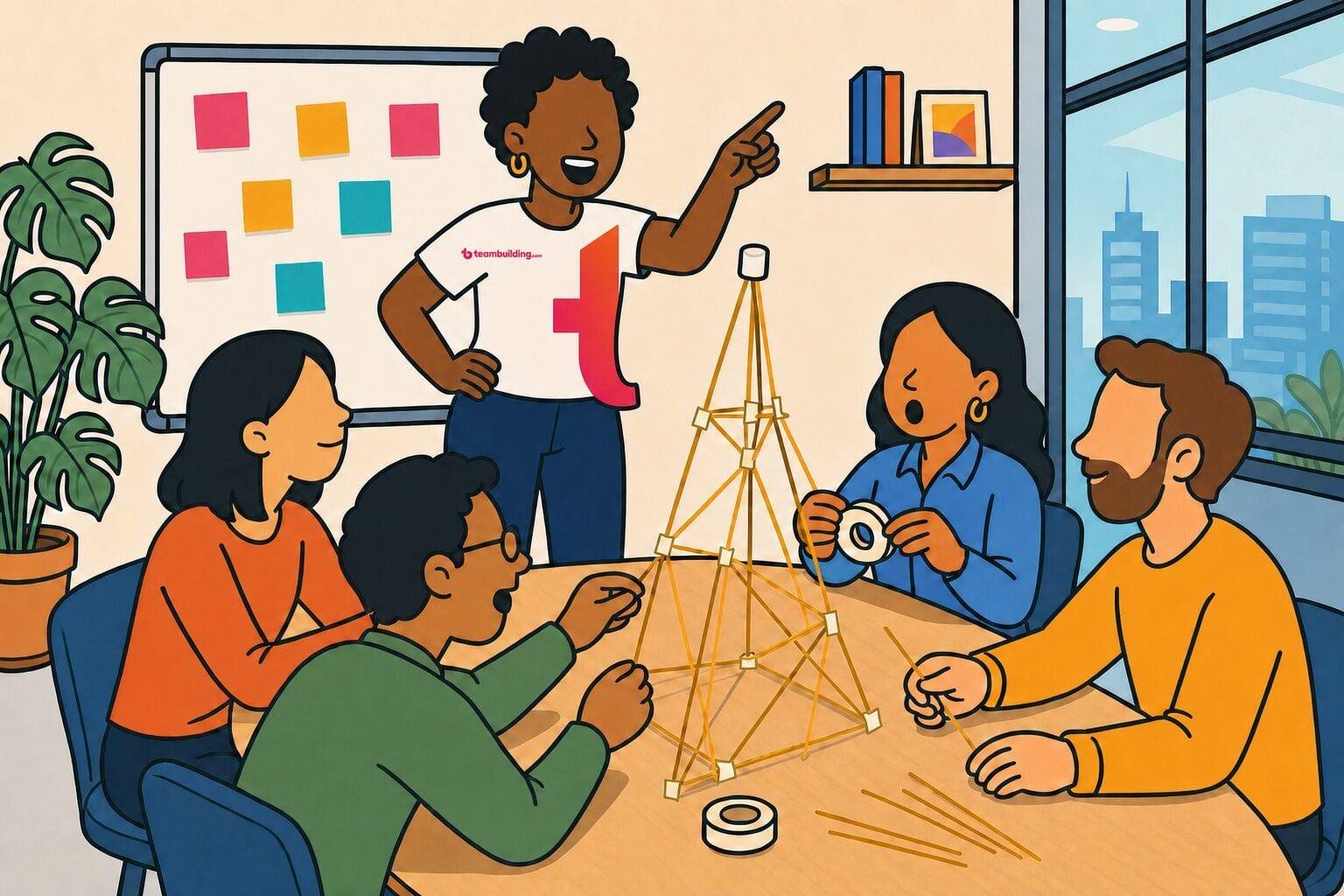
Leadership games are structured activities that let people practice delegating, deciding and giving feedback before the stakes get real.
Almost nobody gets taught how to lead before they are asked to do it. The promotion arrives, the team arrives with it, and the learning happens live on real work with real consequences. Leadership games shrink the stakes. A badly delegated task costs a spaghetti tower instead of a quarter, and a leader who talks over everyone finds out in ten minutes rather than ten months.
We run team building for a living. As of September 2026 we have hosted 45,000+ team building events across virtual and in-person formats since 2013, and a large share of them put ordinary employees in charge of something for a few minutes to see what happens. The games below are the ones that keep earning their slot.
The instinct to practice leadership through structured activity is also well supported. An American Psychologist evidence review by Lacerenza and colleagues concludes that four types of team development interventions, including leadership training and team building, are supported by meta-analytic evidence across education, health care, military and aviation settings. Games are the cheapest version of that practice.
This list includes:
Here we go!
Leadership games are structured group activities that put players in charge of something small, then make the results visible enough to talk about. Examples include the Tallest Tower Challenge, Blind Build, and Delegation Dash. The point is rehearsal rather than theory: participants practice delegating, giving instructions, making a call with incomplete information, and handing the reins to someone else, and the debrief afterward turns what happened into something they can repeat at work. These games are also called "leadership activities," "leadership development games," "leadership training games," "games for leadership," and "leader games."
Leadership games are a branch of team building games and overlap heavily with management games. They are similar to leadership activities, communication games, problem solving games, and executive team building, and the remote version of the category is virtual leadership activities. Within the category, this guide includes leadership games for teams at work, quick leadership games for meetings, leadership development games for new managers, leadership games for students and teens, and leadership retreat games for large groups. Facilitators most often schedule them inside a team building retreat or a leadership retreat agenda.
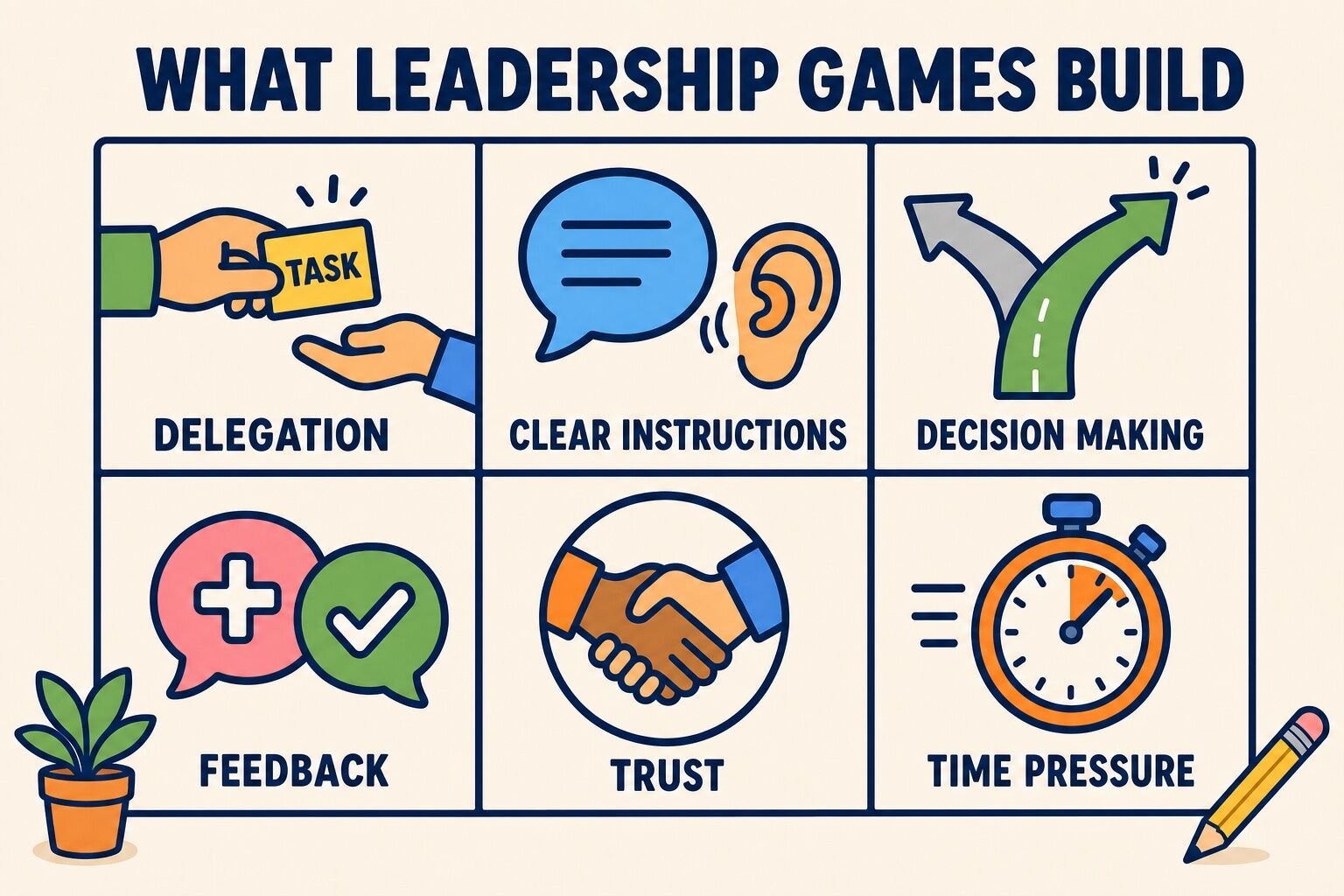
Most of these games train a handful of the same underlying skills, which is why a 20-minute build challenge can tell you more about a team than an hour-long workshop.
| Game | Best for | Group size | Time | Cost |
|---|---|---|---|---|
| Blind Build | Giving clear instructions | 4–24 | 20–30 min | $15–$25 |
| Tallest Tower Challenge | Planning under pressure | 6–40 | 20–30 min | ~$2 per team |
| Rotating Captains | Sharing the lead | 6–30 | 25–40 min | Free |
| Survival Island | Group decision-making | 5–30 | 30–45 min | Free |
| Bad Boss Improv | Naming management anti-patterns | 6–24 | 20–30 min | Free |
| 60-Second Story | Speaking with a point | 4–20 | 10–15 min | Free |
| Back-to-Back Drawing | Precision and listening | 4–30 | 10–15 min | Free |
| Scenario Roulette | Thinking on your feet | 5–25 | 15–25 min | Free |
| Delegation Dash | Delegating instead of doing | 5–20 | 20–30 min | Free–$10 |
| Feedback Fishbowl | Giving usable feedback | 8–20 | 30–40 min | Free |
| The Advice Circle | Asking for input, then deciding | 5–12 | 30 min | Free |
| Leadership Race | Honest self-assessment | 6–40 | 15–20 min | Free |
| Can You Hear Me Now? | Remote communication | 5–30 | 15–30 min | Free |
| Breakout Room Captains | Leading without a room | 10–60 | 20–30 min | Free |
| Virtual Escape Rooms | Coordinating under a clock | 4–30 | 45–60 min | Free–$30 per person |
| Human Knot | Emerging leaders | 8–16 | 10–15 min | Free |
| Silent Line-Up | Leading without words | 8–40 | 10 min | Free |
| Egg Drop Challenge | Owning a design decision | 6–40 | 30–45 min | ~$10 |
| Emotion Charades | Reading a room | 6–24 | 20–30 min | Free |
| Helium Stick | Aligning a big group | 8–14 per rod | 15–20 min | ~$5 |
| Minefield | Trust and clear direction | 6–40 | 20–30 min | ~$10 |
| Capture the Flag | Strategy across a big group | 16–100+ | 30–45 min | Free |
These are the workhorses. Each one gives a group a task that is simple to explain and impossible to finish without someone taking charge, which makes the leadership behavior visible to everybody in the room. They work in a conference room, a breakout space, or anywhere you can run indoor group games.
Blind Build is the clearest test of instruction-giving we know. One player, the Architect, sees a finished model. Everyone else has the same parts and no idea what they are making.
To play:
For a harder round, allow the Architect to speak only in 30-second bursts with 60 seconds of silence in between.
Best for: 4 to 24 people in teams of four to six
Time: 20 to 30 minutes
Materials (cost): Two identical sets of building blocks or paper cups ($15 to $25)
What we have learned: The Architect who spends the first 60 seconds deciding how to describe the model beats the Architect who starts talking immediately, every time. That pause is the whole lesson, and it is worth naming out loud in the debrief.
Teams get 20 sticks of uncooked spaghetti, a yard of tape, a yard of string and one marshmallow. The tallest freestanding structure with the marshmallow on top wins.
Give teams 18 minutes and announce time remaining at the halfway point and at three minutes. The marshmallow is the catch: it is heavier than it looks, and most teams only discover that when they place it at the end.
Best for: 6 to 40 people in teams of four
Time: 20 to 30 minutes
Materials (cost): Spaghetti, masking tape, string and marshmallows (about $2 per team)
What we have learned: Teams that build a small version early and test it outperform teams that spend 15 minutes debating and then build once. The best debrief question is not "who won" but "who decided the design, and at what point did that get decided?" Half the time nobody can answer, which is the more interesting finding.
Rotating Captains is less a game than a modifier you can bolt onto any team task, and it is the fastest way we know to surface quiet leaders.
Give teams a build, a puzzle, or a planning task that takes 20 minutes or more. Name one captain to start. Every three minutes, a timer sounds and the captain role passes to the next person clockwise. Only the current captain can make final calls, but they inherit whatever the last captain started.
Play one round with rotation and, if you have time, one round without, then compare the results.
Best for: 6 to 30 people in teams of five or six
Time: 25 to 40 minutes
Materials (cost): A timer and any team task (free)
What we have learned: Handovers are where the value is. Captains who spend 20 seconds briefing their successor save the team minutes of rework, and the teammates who never speak up in normal meetings usually run a perfectly good three minutes when the role is simply assigned to them.
Survival Island is a consensus exercise dressed up as an adventure. Tell the group their boat has gone down and they are on an island with a list of 12 salvaged items: rope, a tarp, two liters of water, a signal mirror, a lighter, a first aid kit, and so on.
To play:
For a variation with more scenarios, see our list of survival team building exercises.
Best for: 5 to 30 people
Time: 30 to 45 minutes
Materials (cost): A printed item list and pens (free)
What we have learned: The argument over the ranking is the game. The presentation is just the excuse for the argument. Set a hard deadline for the shared ranking, because groups without one will still be debating the lighter when the session ends.
This one borrows from improv games and is the most reliable laugh on this list. Teams draw a prompt naming a management anti-pattern: the manager who takes credit, the manager who vanishes for three weeks, the manager who asks for an update every 20 minutes, the manager who says "quick question" at 6 p.m.
Each team acts a 60-second scene. The audience guesses the anti-pattern, then the team replays the same scene the way it should have gone. Rotate until every team has performed twice.
Keep every character fictional. Impressions of anyone in the building are where this game goes wrong.
Best for: 6 to 24 people in teams of three or four
Time: 20 to 30 minutes
Materials (cost): Printed prompt slips (free)
What we have learned: The replay is what makes this worth running. Without it you get a funny 20 minutes of complaining. With it, people leave having physically rehearsed the alternative. For prompt material, our lists of signs of bad leaders and traits of good leaders are a useful starting point.
These fit inside a normal meeting without rearranging the furniture. Each runs in 15 minutes or less, which makes them a practical way to open a weekly leadership sync or add a warmup to team meeting games you already run.
Need prompts to get people talking first? Try our team building question generator:
Give the group a topic such as "a time you changed your mind," "a decision you regret," or "the best manager you ever had." Each person gets exactly 60 seconds to tell a complete story with a beginning, a middle and a point.
Award a point for finishing inside the minute and a second point if the group can state the takeaway in one sentence. Run three or four speakers per meeting rather than the whole team at once.
For more warmups in this length, see our one minute games.
Best for: 4 to 20 people
Time: 10 to 15 minutes
Materials (cost): A visible timer (free)
What we have learned: Share the topic 30 seconds before you start. Cold storytelling tests nerve rather than communication, and the stories get noticeably better with even a little thinking time.
Pair people up and seat them back to back. One person gets a simple line drawing, a house made of shapes or an abstract arrangement of a triangle, two circles and an arrow. The other gets blank paper.
The describer has four minutes to get their partner to reproduce the image. They may not name the object. "Draw a house" is out; "draw a square in the center, then a triangle sitting on its top edge" is in. Swap roles with a new image and compare results.
This pairs well with our active listening activities if you want a longer session on the same skill.
Best for: 4 to 30 people in pairs
Time: 10 to 15 minutes
Materials (cost): Paper, pens and printed shapes (free)
What we have learned: The no-naming rule is not a gimmick. It is the entire exercise, because it forces the describer to translate what they know into what the listener can actually act on. Drop the rule and the game takes 30 seconds and teaches nothing.
Write a stack of realistic management scenarios on cards: a teammate misses a second deadline, two people want the same project, a client escalates on a Friday afternoon, someone shares credit unevenly in a review.
A volunteer draws a card, reads it aloud, and has 90 seconds to say what they would do and why. The group then offers one thing they liked and one thing they would do differently. Run the same scenario twice with different volunteers before moving on.
Best for: 5 to 25 people
Time: 15 to 25 minutes
Materials (cost): Printed scenario cards (free)
What we have learned: Running a scenario twice is what turns this from a quiz into a discussion. The second answer is almost always better, and the room gets to see that there is more than one defensible call.
Newly promoted managers have a specific problem: they were hired for doing the work and are now paid for not doing it. These games attack that gap directly, and they sit well inside a broader set of professional development ideas.
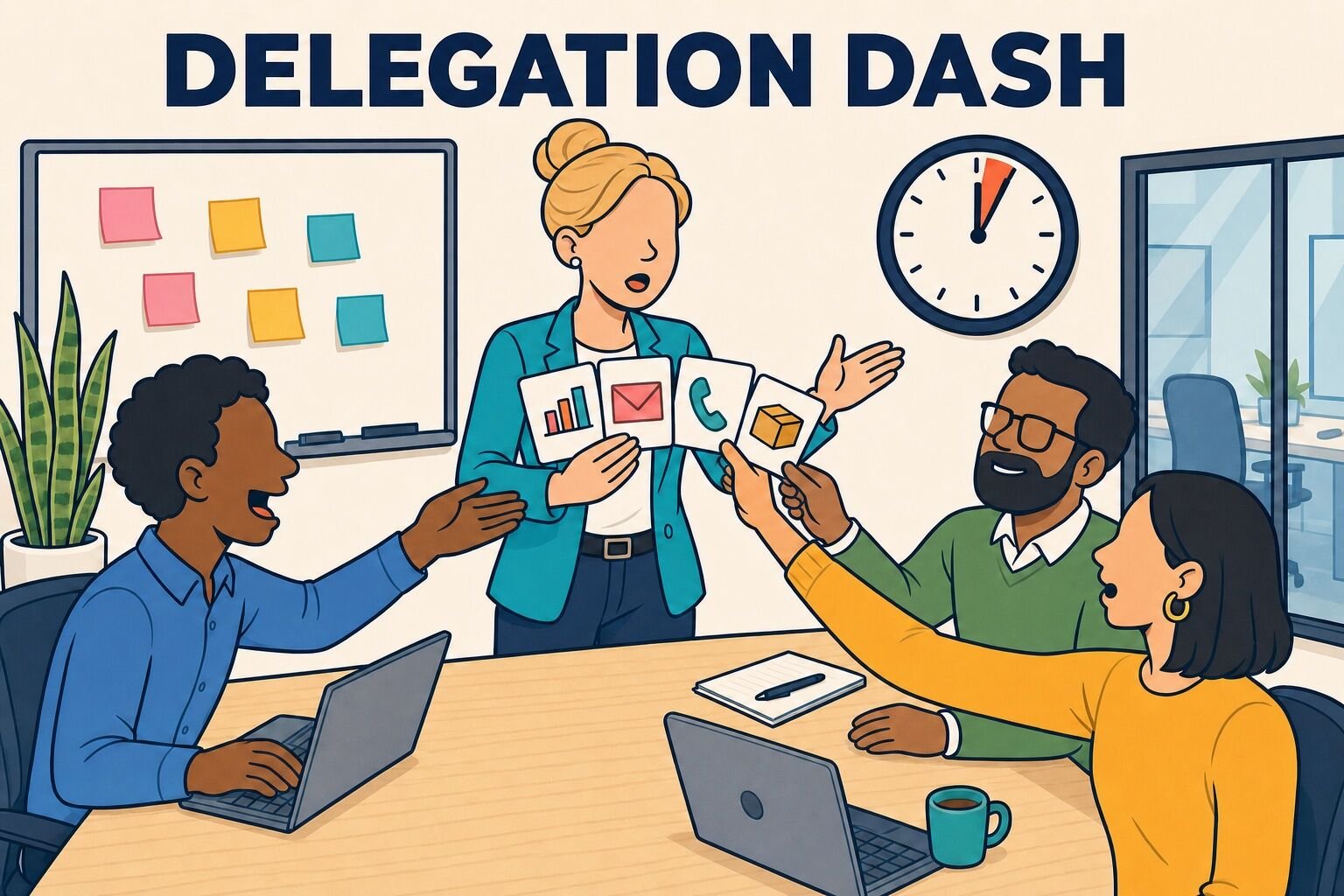
The manager of the round receives six task cards and eight minutes. The catch is that they may not complete a single task themselves. They can brief, allocate, check in and re-plan, and that is all.
To play:
Best for: 5 to 20 people, played in rounds
Time: 20 to 30 minutes
Materials (cost): Task cards and simple props (free to $10)
What we have learned: Most first-time managers delegate the tasks they dislike and quietly keep the ones they enjoy. Pointing that out gently, after the round rather than during it, is the most useful thing a facilitator can do all day. Our founder Michael Alexis puts the counterweight simply: managers win by giving employees more than they ask for. That applies to the briefing too, since a teammate handed context, a deadline and a reason outperforms one handed a task.
Split the group into an inner circle of four or five who perform a short task, such as planning a fictional product launch in eight minutes, and an outer circle who watch in silence.
Before the task starts, give every observer one specific thing to watch: who speaks first, who gets interrupted, how the decision actually gets made, whether anyone is left out. When the clock stops, observers share what they saw using the pattern "when you did X, the effect was Y." Then swap the circles.
This is a rehearsal space for a skill most people only practice under pressure. At teambuilding.com we believe in feedback first: some failures are okay and expected, missteps are par for the course in an organization that takes calculated risks, and we prefer coaching moments over consequences. A fishbowl is that philosophy in miniature.
Best for: 8 to 20 people
Time: 30 to 40 minutes
Materials (cost): None (free)
What we have learned: Assigning each observer one narrow thing to watch is the difference between useful feedback and a vague "that went well." Open-ended observation produces compliments. Narrow observation produces specifics.
One person brings a real decision they are facing: a hiring call, a project to cut, a process nobody likes. The group gets five minutes of questions only, no suggestions allowed. Then five minutes of advice, where every person offers exactly one recommendation. Then the decider says what they are going to do and why.
Rotate through two or three deciders per session. The discipline of questions-first is what stops the group from solving the wrong problem.
The framing here comes from another of our founder's rules: ask people for advice, not decisions, then make your own call. It is a useful thing for a new manager to feel in a room rather than read in a book.
Best for: 5 to 12 people
Time: 30 minutes
Materials (cost): None (free)
What we have learned: Requiring the decider to state a decision at the end, out loud, changes the whole exercise. Without it the session becomes a pleasant conversation that nobody acts on.
Line participants up along one wall and read out statements about leadership behavior: "I have given someone difficult feedback in the past month," "I know what each person on my team is working on today," "I have changed my mind because of something a teammate said."
Everyone takes one step forward for each statement that is true of them. Fifteen statements is about right. Afterward, ask people to pick the statement they most want to be able to step forward on next quarter and name it to a partner.
Pair it with our guide to the leadership skills worth developing if you want a follow-up discussion.
Best for: 6 to 40 people
Time: 15 to 20 minutes
Materials (cost): Printed prompts and open floor space (free)
What we have learned: This works as a self-assessment and fails as a competition. Say out loud at the start that there is no winner and that nobody should reach the far wall, or people optimize for steps and the honesty disappears.
Video calls strip out most of the informal signals a leader relies on. Nobody can read the room, side conversations do not exist, and silence reads as agreement when it usually is not. These three games work with those constraints instead of against them.
Can You Hear Me Now? is a communication game we developed for our own hosted virtual events. One person becomes the Reader and receives a simple visual clue, such as a bird or a sailboat. Everyone else needs a blank sheet of paper.
The Reader describes how to draw the image using only general visual instructions, without naming the object. Instead of "draw a bird," the Reader says, "draw a medium oval in the center of the page, then add a smaller circle touching its upper right side." After a few minutes everyone holds their drawing up to the camera and guesses the object.
Players earn a point for drawing and identifying correctly, and the Reader earns a point for every participant who succeeds, which quietly turns the Reader into a leader with a stake in everyone else's success.
Best for: 5 to 30 people
Time: 15 to 30 minutes
Materials (cost): Paper, pens and a video call (free)
What we have learned: People describe what they know rather than what the listener needs. The Reader can see the bird, so they say "bird-ish" things without realizing it. Watching that land badly, live, teaches more about briefing a remote team than a slide deck ever will.
Give every breakout room a named captain, a one-line brief, and a firm report-back time. The brief should be genuinely open, for example "come back with your team's three rules for a good meeting" or "pick the one process you would delete and be ready to defend it."
Rooms of five to seven work best. When the group returns, each captain presents for 60 seconds. Rotate captains every round so that by the end of a session most of the group has run a room.
Best for: 10 to 60 people
Time: 20 to 30 minutes
Materials (cost): A video platform with breakout rooms (free)
What we have learned: The report-back is what creates the leadership. Without a deliverable, breakout rooms turn into small talk. With one, the captain has to run a clock, pull in the quiet people, and land on an answer in eight minutes, which is a real management rep.
Virtual escape rooms put a team under a visible clock with more information than any one person can hold, which is exactly the condition that produces leaders. Someone has to decide what the group works on next.
Before you start, assign two roles: a scribe who keeps every clue in a shared document, and a timekeeper who calls out the halfway point. Everything else can stay fluid. If you would rather build your own, our list of escape room puzzles has ready-made material.
Best for: 4 to 30 people in teams of four to six
Time: 45 to 60 minutes
Materials (cost): Free browser-based rooms, or roughly $20 to $30 per person for a hosted room
What we have learned: The scribe role decides the outcome more often than the puzzle-solving does. Teams that lose track of clues re-solve the same puzzle twice and run out of clock.
Student groups need games with almost no setup, a short explanation, and an obvious win condition. These four work for middle school through college, and they scale from a classroom to a full assembly. For more classroom-friendly formats, see our team building activities for students.
Players stand in a tight circle, reach across with both hands, and grab two different people's hands. The group then untangles itself into a single circle without letting go.
Groups of eight to twelve are ideal. Larger groups should split, because a knot of 20 usually cannot be solved and the frustration outlasts the fun. Full instructions and variations are in our guide to the human knot game.
Best for: 8 to 16 people per circle
Time: 10 to 15 minutes
Materials (cost): None (free)
What we have learned: A leader appears within about 90 seconds, and it is rarely the loudest person. It is usually whoever first steps outside the knot to look at the whole shape, which is a nice point to make when you debrief.
Ask the group to arrange themselves in a line in order of birthday, height, distance travelled to get here, or number of siblings. The catch is that nobody may speak. Gestures only.
Give them three minutes, then check the order out loud. Run a second round with a harder category, such as "hours of sleep last night," where people need to invent a way to communicate a number.
Best for: 8 to 40 people
Time: 10 minutes
Materials (cost): None (free)
What we have learned: Someone always invents a signalling system in the first 30 seconds, and the group that adopts one system finishes twice as fast as the group where three people each invent their own. That is a leadership lesson students recognize immediately.
Teams get straws, tape, newspaper, string and a raw egg, and 25 minutes to build a container that protects the egg from a two-metre drop.
Require each team to name a lead designer before they start building, and require that the lead designer be the one to explain the design in 30 seconds before the drop. Drop every entry from the same height, in front of everybody.
Best for: 6 to 40 students in teams of four
Time: 30 to 45 minutes
Materials (cost): Eggs, straws, tape and newspaper (about $10)
What we have learned: Naming a lead designer up front changes the whole exercise. Without it the team builds four separate ideas and tapes them together; with it, someone has to choose, and choosing in front of your friends is the skill being practiced.
Print cards with a range of emotions: proud, embarrassed, relieved, overwhelmed, hopeful, frustrated. A player takes a card without looking and holds it to their forehead so that everyone else can see it.
The group describes situations that might cause the feeling, without using the word itself or its obvious synonyms. "How would you feel if you lost a game you practiced months for?" The player then guesses. Score a point per correct guess and rotate.
Follow it with a short conversation about noticing how teammates feel, which connects naturally to empathy at work and to broader emotional intelligence activities.
Best for: 6 to 24 students
Time: 20 to 30 minutes
Materials (cost): Printed emotion cards (free)
What we have learned: Mixing in less obvious emotions such as "relieved" or "overwhelmed" makes the game much better than the standard happy, sad, angry set. The harder words force players to describe real situations instead of pulling faces.
Retreats give you the two things most leadership games want and a normal workday does not: space and uninterrupted time. These three scale comfortably past 20 people and work outdoors or in any room where you can push the tables aside. For more formats at this scale, see our large group games.
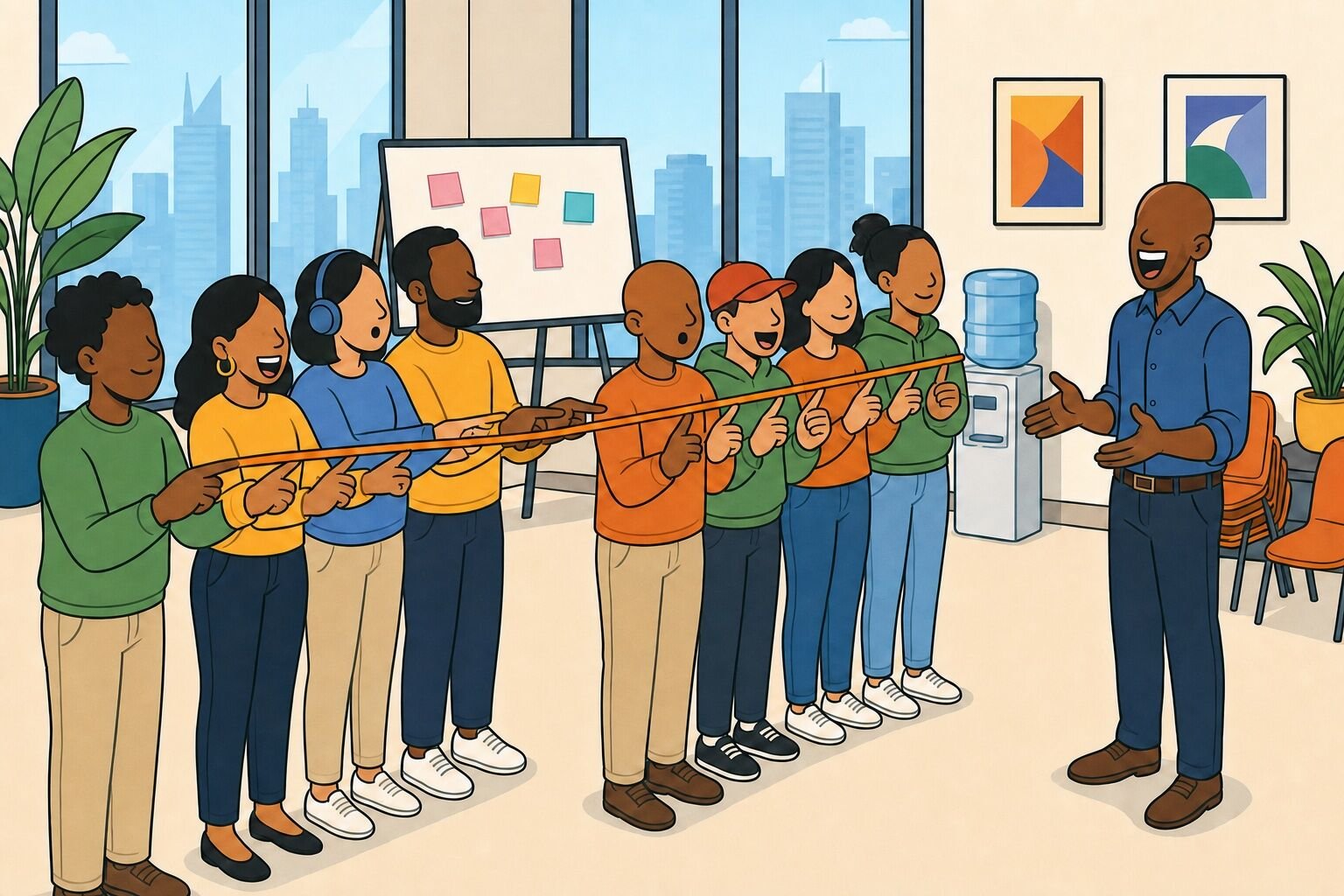
Two rows of people face each other. Everyone extends both index fingers at chest height, and the facilitator rests a long light rod across all of the fingertips. The only rule is that every finger must stay in contact with the rod at all times. The task is to lower it to the ground.
The rod goes up. It always goes up, because everyone is pressing lightly to keep contact and nobody notices they are doing it. Expect three to five minutes of comedy before a group solves it.
Best for: 8 to 14 people per rod, run several rods in parallel for bigger groups
Time: 15 to 20 minutes
Materials (cost): A long light dowel or tent pole (about $5)
What we have learned: The fix is almost always one person counting down slowly so the group moves together. Groups that solve it fast do not have better fingers, they have someone willing to take the count. That is the debrief in one sentence.
Scatter soft obstacles across an open floor: cones, cushions, water bottles, folded paper. One player is blindfolded at the start line. Their partner stands at the finish line and talks them through, using voice only.
Run several pairs at once so the room is noisy and instructions have to be specific. Add a rule that the guide may not say "left" or "right" for an advanced round, which forces them to invent a shared language on the spot. Swap roles so everyone does both jobs.
The debrief is about trust as much as direction, and it pairs well with other trust building exercises.
Best for: 6 to 40 people in pairs
Time: 20 to 30 minutes
Materials (cost): Blindfolds and soft obstacles (about $10)
What we have learned: Guides who start by agreeing on a vocabulary with their partner, "a step is one of your normal steps, and I will say stop before anything else," finish in half the time. Leaders who start narrating immediately walk their partner into a cone within 15 seconds.
Two teams, two territories, two flags. Each team tries to bring the opposing flag back to their own side without being tagged. Set your tagging rule before you start: tagged players freeze until a teammate frees them, or return to their own side and count to ten.
The leadership layer is the part people forget. Give each team five minutes to plan before play begins, and require that they publicly assign defenders, attackers and one person who calls adjustments mid-game. Play two rounds so teams can act on what went wrong the first time.
It works indoors in a large hall and shines as part of a wider outdoor team building afternoon.
Best for: 16 to 100+ people
Time: 30 to 45 minutes
Materials (cost): Two flags or bandanas and an open space (free)
What we have learned: The five-minute planning window is what makes this a leadership game instead of a recess game. Teams that skip it run around for 20 minutes and learn nothing. Teams that use it discover, in public, whether their plan survived contact.
A few patterns hold up across thousands of sessions.
The debrief is the product. The game is a machine for generating a shared story, and the five minutes afterward are where anybody actually learns something. Our usual sequence is three questions: what happened, what did the leader do that helped or hurt, and what would you do differently with the same three minutes. Skip that and you have run a nice activity.
People will not be honest in a debrief they do not feel safe in. Google's Project Aristotle, a study of more than 180 of its own teams, identified five dynamics that set successful teams apart, with psychological safety first in order of importance. In practice that means the facilitator names what is off-limits before the first game, keeps the manager out of the scoring, and never uses the debrief to settle a real grievance.
Assign the leader, do not wait for one. Leaving it open produces the same person leading every round, usually whoever is most senior or most comfortable talking. Assigning the role, rotating it, and giving it a clear scope is what gets the rest of the team a turn.
Group size changes the game more than the topic does. The median team building event we run has 16 participants, and half of all events fall between 10 and 27 people, which is why most of the games above are built for that range. Bigger groups are not worse, but they need different mechanics.
| What changes | Small groups (up to 15) | Large groups (16+) |
|---|---|---|
| Best formats | Discussion-led games like The Advice Circle and Feedback Fishbowl | Parallel team challenges like Egg Drop, Helium Stick and Capture the Flag |
| Leader role | Everyone leads at least once in a session | Leaders are assigned per team, and teams report back |
| Debrief | One conversation with the whole group | Teams debrief themselves, then each shares one takeaway |
| Facilitation | One facilitator is plenty | One facilitator per three or four teams, plus a visible clock |
| Timing | Allow extra time for discussion to breathe | Shorten rounds, because instructions and transitions eat the clock |
Competition does most of the motivational work. Points, a clock and a leaderboard give people a reason to lean in without asking anyone to perform, and the stakes stay low enough that losing is funny. One participant described it this way after a strategy-heavy event of ours:
Thirty minutes a week beats a day a year. A single offsite produces a good story and very little behavior change. A short game at the start of a recurring meeting, run consistently, is what makes new habits stick, and it costs almost nothing. Teams looking for a cadence can borrow from our guide for team building leaders.
Plenty of activities get filed under leadership because they involve a group and a challenge. Some of them are fine team building and teach nothing about leading. Others are a liability. Here is what we skip.
| Activity | Why skip it | Verdict |
|---|---|---|
| Trust falls | A physical risk with no leadership content. Nobody has ever delegated better because a colleague caught them, and the people who dislike being touched at work have no graceful way to opt out. | Skip it |
| Tug of war | Fun as a field-day event, but it rewards mass and grip strength rather than any decision a leader makes. There is nothing to debrief. | Not leadership |
| Blindfolded water relays | Pouring water between buckets while blindfolded soaks people, ruins clothing and produces a mess someone has to clean up. The Minefield teaches the same guidance skills dry. | Skip it |
| Elimination-style survival games | Voting teammates out builds alliances and resentment, not leadership. Keep the marooned-on-an-island premise and cut the elimination. | Skip it |
| Personality-type games | Sorting colleagues into four colors or letters is entertaining for an hour and then becomes a label people carry around. The evidence for using these types to predict performance is thin. | Usually skip |
| Spot the difference and similar puzzles | These are solo attention puzzles. One person finds the answers while everyone else watches, which is the opposite of the behavior you want to practice. | Not team building |
| Generic charades | Acting out movie titles is a perfectly good party game with no leadership frame at all. If you want it in a leadership session, use the workplace-scenario version in Bad Boss Improv. | Needs a reframe |
| Anything requiring a physical dare | High ropes leaps, ice baths and eating challenges put the people most willing to take risks at the center and quietly exclude everyone else. Participation stops being optional the moment the boss is watching. | Skip it |
| Unstructured "leadership discussions" | Putting managers in a room and asking them to talk about leadership produces the three most confident voices talking for 40 minutes. Add a structure such as Scenario Roulette and it works. | Add structure |
Leadership games are cheap rehearsal. Most of the ones on this list need nothing more than a timer, some paper, and a facilitator willing to ask three good questions afterward. The games that fail are the ones run as entertainment and then never discussed, which is why the debrief matters more than the materials list.
Pick two or three that fit your group's size and setting, run them more than once, and rotate who leads. The second time a team plays Blind Build or Rotating Captains is when you can see whether anything actually changed.
If you would rather have a professional host run the session for you, you can browse our virtual and in-person team building activities.
Next, check out our leadership icebreakers, the signs of a good manager, and our favorite leadership podcasts.
Answers to the questions we hear most about running leadership games at work and school.
Leadership games are structured group activities that put players in charge of something small and make the result visible enough to discuss afterward. Participants practice delegating, briefing, deciding with incomplete information and handing over the reins, then debrief what happened. Common examples include the Tallest Tower Challenge, Blind Build and Delegation Dash.
Pick games that fit in 15 minutes and need no setup. 60-Second Story, Back-to-Back Drawing and Scenario Roulette all run inside a normal meeting with a timer and some paper. Run one at the top of a recurring meeting rather than saving everything for an annual offsite, since a short game repeated weekly changes habits more than one long session a year.
The game generates a shared experience and the debrief converts it into something repeatable. An American Psychologist evidence review by Lacerenza and colleagues concludes that four types of team development interventions, including leadership training and team building, are supported by meta-analytic evidence across education, health care, military and aviation settings. In practice the learning comes from the five minutes after the game, not the game itself.
Student groups do best with almost no setup and an obvious win condition. The Human Knot, Silent Line-Up, the Egg Drop Challenge and Emotion Charades all work from middle school through college and scale from a classroom to an assembly. Requiring each team to name a lead designer or captain before they start is what turns a fun activity into a leadership exercise.
Most of the games on this list run 10 to 45 minutes, and the split matters: quick meeting games should finish in 15 minutes, while build challenges, fishbowls and retreat games need 30 to 45 minutes so there is time to debrief. Always reserve at least five minutes at the end for the discussion, because a game with no debrief is just an activity.
Skip trust falls, tug of war, blindfolded water relays, elimination-style survival games and personality-type sorting. They are either a physical risk, a test of strength rather than judgment, or a label people carry around afterward, and none of them give you anything about leading to debrief. Games that require a physical dare are also a problem, because participation stops being optional the moment a manager is watching.
Comments (0)
Leave a Comment