Murder Mystery Team Building: 12 Office Games, Party Ideas & Themes
12 murder mystery formats to run at work, two with a complete printable case, plus how to host, themes, clue ideas and team names, and the hosted murder mysteries our participants rate highest.
Published
·
Updated
Murder mystery team building is a game in which coworkers split into teams and solve a fictional crime from clues, usually in 60 to 90 minutes. You can run one yourself with printouts and a conference room, or book a host to run it for you.
This page covers both. The first half has 12 formats to run yourself, from a 20-minute lunch-break case to a party game for 200, and two of them come with a complete case you can print today: suspects, clues and solution. The second half ranks the hosted murder mysteries our participants rate highest and compares where to book one.
We host murder mysteries for a living. Our two history-based virtual games have been booked thousands of times, and most of the advice here comes from watching those teams get stuck, argue and crack the case.
Murder mystery team building is a group game where coworkers work together to solve a fictional crime. Players gather clues, question suspects, and piece together the motive, the method and the culprit, usually in teams that race each other to the right answer. The format can be a seated dinner, a game played in the office, a scavenger hunt, an escape-room-style lockbox, or a professionally hosted event in person or online. It is also called an office murder mystery game, a whodunit team building game, a corporate murder mystery party, a team building murder party, or a mystery dinner for work.
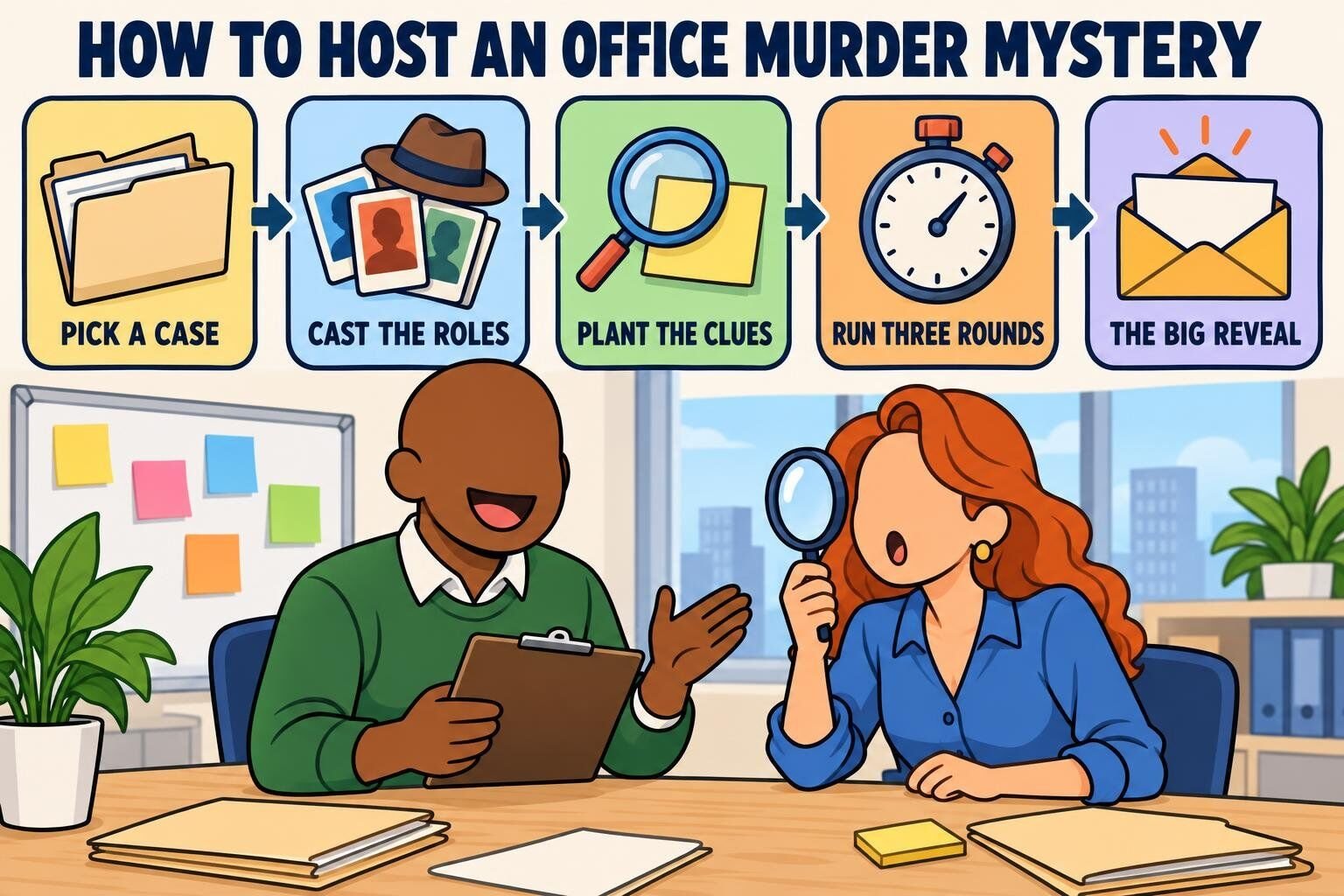
You do not need actors or a script-writing weekend. Every office murder mystery, bought or homemade, comes down to the same five steps.
Pick a case. Choose a format from the list below, then settle the solution before anything else: who did it, how, and the one piece of evidence that proves it. Keep the "victim" fictional and the tone light. A missing trophy or a toppled office plant plays as well as a body and keeps HR relaxed.
Cast the roles. Decide whether players are suspects (they get character cards and secrets) or detectives (they get case files and question the suspects). Detective-style games are easier on introverts and scale to large groups. Send roles two or three days ahead so people can add a hat or a prop if they want to.
Plant the clues. Plan three rounds of evidence. Each round should clear at least one innocent suspect, and the proof against the culprit should arrive in the last one. Hide physical clues before people arrive, or hand them out in envelopes at the start of each round.
Run three rounds. Give each round 15 to 20 minutes: release clues, let teams discuss, then take one question to a suspect or the host. A visible timer stops one slow team from stalling the room.
Stage the big reveal. Collect each team's accusation in writing (culprit, motive, method), then read the solution aloud and award a point for each part they got right. Finish with five minutes of "what tipped you off?" so teams can compare their reasoning.
Plan for 60 to 90 minutes in total, which covers the briefing, three rounds and the reveal. And before the day, hand the full set of clues to someone who has not seen the solution. If they cannot name the culprit and say why, the clues need fixing, not the players.
Office murder mystery games you can run yourself
These eight formats need little more than printouts, envelopes and a free conference room. Numbers 2 and 5 include a complete case, ready to print. For the others we give you the structure and you supply the story.
1. Classic Whodunit Dinner
The format most people picture: everyone plays a suspect, each with a character booklet, a secret and a few things they must reveal (or hide) over dinner. Between courses the host hands out new clues, and by dessert the group votes on the killer. It suits a team that enjoys a little performance and a long table.
To run it:
Buy a boxed game sized to your headcount, or write your own. Start with the solution, then give each guest a one-page character: name, tie to the victim, where they say they were, one secret, and one fact they know about another character.
Set one rule: innocent characters may dodge a question but must not lie. Only the killer may. A homemade case cannot be solved without it.
Send each person their character a few days early with a light costume suggestion (a hat or a scarf, never a full costume).
Run three rounds between courses. In each round, everyone reads one new clue aloud and the table questions the most suspicious person.
Collect secret ballots before dessert, then have the host read the solution.
Best for: 6 to 14 people per table Time: 1.5 to 2 hours, including the meal Materials (cost): character booklets and clue cards; free if you write them, or the price of a boxed kit
What we've learned: Give every character at least one clue that points at someone else. Players who only defend themselves go quiet by round two; players with something to accuse stay in the game.
2. Who Killed the Office Plant?
A gentle, office-specific case for teams that would rather not role-play a murder. The ficus by the kitchen has been found on its side, soil across the carpet, and somebody is keeping quiet about it. The whole case is below. Rename any suspect who sounds like a real colleague.
The case: The cleaner watered the ficus at 6:00 p.m. and left it standing. At 8:30 the next morning the office found it tipped over. Five people are under suspicion.
Suspect
What they say
Devon, the late-night coder
"I left around 5:30."
Ines, the intern
"I left at 5:00, same as every day."
Priya, always first in
"I got in at 8:45, after it was found."
Cal, the facilities lead
"I came in at 7:40 and went straight up to the fourth floor. I never got to my desk."
Reggie, the sales lead
"I was at a client dinner all evening and went straight home."
Badge log: Ines out 5:02 p.m. Devon out 5:32 p.m. Reggie in 9:14 p.m., out 9:26 p.m. Priya in 7:05 a.m. Cal in 7:40 a.m.
Printer log: Priya, 7:08 to 8:20 a.m., 120 pages, "fantasy league brackets."
Security guard's note from the 10:00 p.m. round: "Plant by the kitchen already on its side. Left a note for facilities."
Print shop pickup slip: "Trade show banner case, collected 8:50 p.m.," signed by Reggie.
The banner case itself (any wheeled suitcase), with soil on its wheels.
The solution: The checklist and the guard's note put the fall between 6:00 and 10:00 p.m., and the badge log shows only Reggie in the building during those hours. His dinner story breaks on the pickup slip: he collected the banner case at 8:50, wheeled it past the kitchen at 9:14 and clipped the pot. The soil on the wheels proves it. Priya lied about her arrival, but the printer log explains why, and the plant was already down when she badged in.
To run it:
Print the scenario and suspect statements as a case file for each team, plus one copy of each piece of evidence.
Hide the evidence in shared spaces (the kitchen, the printer, reception), never in anyone's desk. Tuck the pickup slip into the suitcase handle.
Split the group into teams of four to six. Give them 40 minutes, and ask them to photograph evidence and leave it in place.
Each team gets 60 seconds to present its accusation: who, when, and which evidence proves it. Award points for the right culprit, for explaining Priya's lie, and for the best courtroom speech.
Best for: 8 to 40 people, in the office Time: 60 minutes Materials (cost): printed case files, a suitcase and a spoonful of potting soil; free
What we've learned: Label each item "Evidence 1 of 6," "2 of 6" and so on. Teams then know when they have everything and stop emptying the kitchen cupboards, and you know what is still out there at cleanup.
3. Live-Action Clue
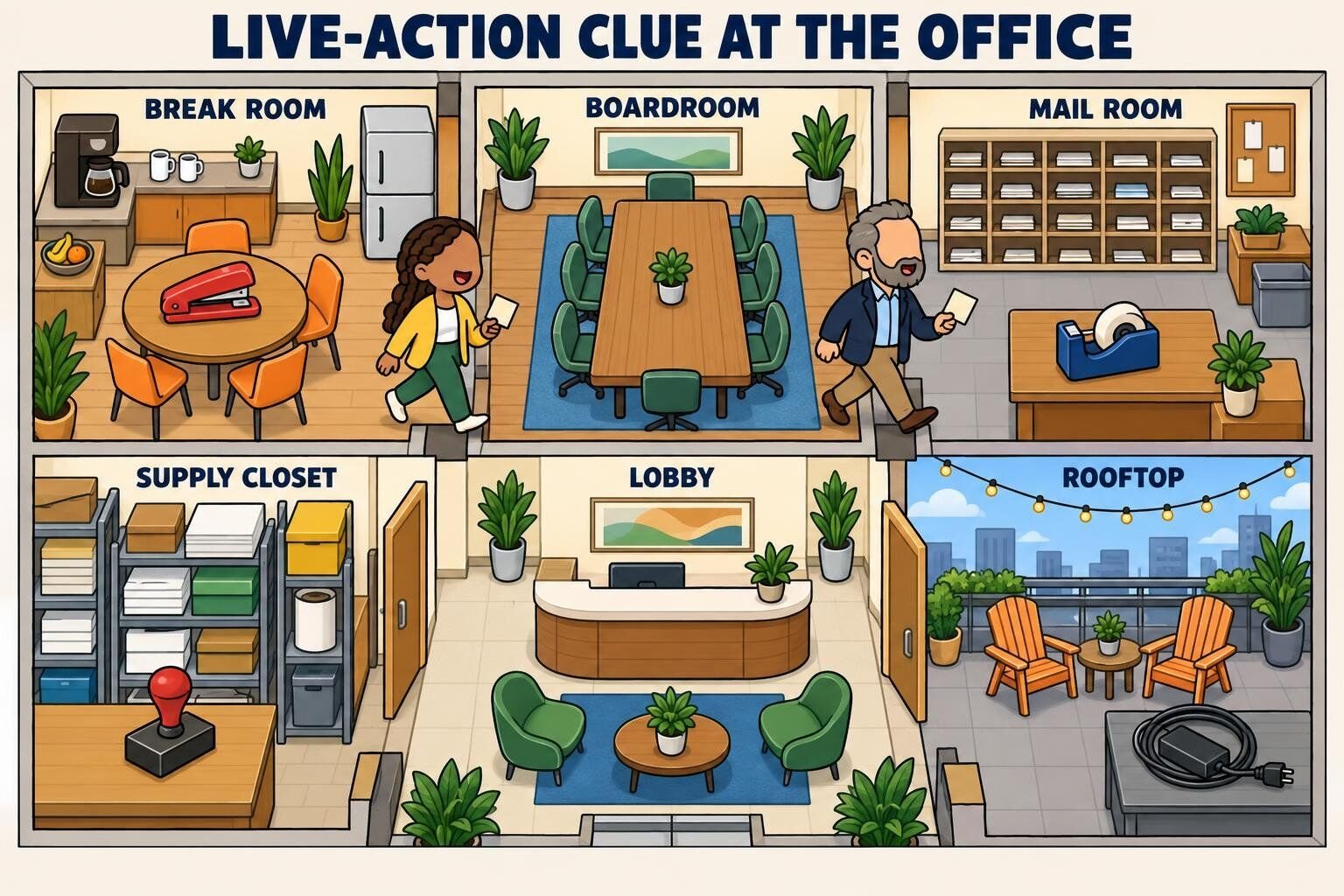
The board game, played at full scale. Each meeting room or corner of the office becomes a "room," each room holds one harmless office "weapon," and teams move around the floor making suggestions until they can name the suspect, the weapon and the room.
To run it:
Pick six spaces (break room, boardroom, mail room, supply closet, lobby, rooftop) and put one office item in each: a stapler, a coffee mug, a tape dispenser, a rubber stamp, a lanyard, a laptop charger. Invent six suspects.
Make a card for every suspect, item and room, 18 in all. Secretly set aside one of each as the solution, then deal the other 15 among six volunteer "room hosts," one stationed in each space.
Give every team a checklist of all 18. A team makes one suggestion to any room host ("the facilities manager, in the mail room, with the stapler"). If the host holds one of those three cards, they show it to that team only, and the team moves on.
Teams cross off each card they are shown. When one suspect, one item and one room remain, they report to the central "detective desk." The first correct accusation wins; a wrong one costs a five-minute time-out.
Best for: 12 to 60 people in teams of three or four Time: 45 to 60 minutes Materials (cost): printed suspect, weapon and room cards plus office supplies; free
What we've learned: Recruit room hosts from the people who would rather not run around. Give each a prop and a one-line persona, and they become what teams talk about afterward.
4. Case File Challenge
A detective game with no acting at all. Each team gets an identical dossier for a cold case: witness statements, a floor plan, a timeline, a few receipts and a phone record. Teams race to find the contradiction that breaks an alibi. It is the quietest format on this list, and the one to choose for a room of skeptics who "don't do games."
To run it:
Build a dossier of 10 to 15 documents around one contradiction that identifies the culprit: a receipt timestamped after an alibi, or a door that only opens with a badge the suspect claims to have lost. Write the solution first, then one document that clears each innocent suspect, then two or three that mislead. Or print the statements and evidence from Who Killed the Office Plant? (#2) as a ready-made dossier.
Seat teams of four to six at separate tables and start a 40-minute timer.
Hold back two documents as "lab requests," such as a fingerprint result or a second witness statement. A team gets one only by naming what it wants tested.
Teams submit a written solution: the culprit and the document that proves it. Score the culprit, the evidence and the finishing time.
Best for: 8 to 100 people, including teams that dislike role-play Time: 45 to 60 minutes Materials (cost): printed dossiers; free
What we've learned: Put the decisive clue in the dullest-looking document in the pile. Careful readers get rewarded, and this is often the game where the quietest person at the table breaks the case.
5. Lunch-Break Mini Mystery
A one-slide case for a 30-minute slot. The host shows four suspects and reveals one clue every few minutes. Tables can commit to an answer at any point, and the earlier they commit, the more it is worth. A complete case is below.
The case: The Golden Stapler, the office's employee-of-the-year trophy, vanished from its locked display case at reception during Tuesday's all-hands lunch, some time between 12:00 and 1:00. The suspects are Marge from accounting, runner-up three years running; Theo, the new hire, who was seen near reception; Bianca, the office manager, who holds the only key; and Gus, the courier, who delivered a parcel at 12:30.
The clues, in order:
The display case was opened with a key. Nothing was forced.
Bianca reported her keys missing at 11:45. They turned up on the kitchen counter at 1:15.
Marge sat at the front table from 11:55 to 1:05 and gave the toast at 12:30. Forty people saw her.
The reception camera shows the stapler still in its case at 12:40. Gus signed out of the building at 12:33.
Bianca was on a supplier call at her desk from 12:35 to 1:10, and the phone log confirms it.
The solution: Theo, the only suspect unaccounted for between 12:40 and 1:00. He borrowed Bianca's keys on the CEO's instructions and took the stapler to be engraved with this year's winner's name, a surprise for Friday's ceremony.
To run it:
Put the scenario and the four suspects on screen and give each table an answer card.
Reveal one clue every four minutes and let tables talk it over.
A table can lock in a suspect at any time by handing in its card. A correct answer is worth 5 points after the first clue, 4 after the second, and so on down to 1. A wrong answer scores nothing, and a locked card cannot be changed.
Read the solution. The highest score wins, and ties go to the table that locked in first.
To write your own, copy the shape: the first clue points at the wrong person, the second takes it back, and each of the last three clears one suspect.
Best for: any size, in person or on video Time: 20 to 30 minutes Materials (cost): one slide and answer cards; free
What we've learned: The lock-in rule creates all the drama. Without it, every table waits for the last clue and the game ends in a five-way tie.
6. Murder Mystery Scavenger Hunt
A murder mystery on the move. Teams follow a trail of clues around the office, a park or a few city blocks, and every location they reach unlocks a new piece of testimony. Walking keeps the energy up and spreads the group out, so it suits larger teams and summer outings.
To run it:
Choose six to eight checkpoints and write a riddle that leads from each one to the next. Our scavenger hunt clues are a good starting bank.
At each checkpoint, leave an envelope with one piece of evidence and a note asking teams to photograph it and put it back. The six items in Who Killed the Office Plant? (#2 above) fit a six-stop route.
Lay the route out as a loop and start each team at a different checkpoint, so nobody can follow the team in front.
Teams return to base and write down their accusation. Score the culprit, the evidence that proves it and the finishing time.
Best for: 10 to 80 people in teams of four to six Time: 60 to 90 minutes Materials (cost): envelopes and printed clues; free
What we've learned: Walk the route yourself with a timer, then check it for stairs. Build a step-free version before the day and tell teams about it in the invitation, because nobody wants to ask for it at the start line.
7. Murder Mystery Escape Room
Lock the solution in a box. Teams work through a chain of combination locks, each code hidden in the evidence, and the last lock guards the culprit's confession. It borrows the countdown tension of an escape room without needing a dedicated room.
To run it:
For each team, set up three lockable containers (two bags with double zips and a small cash box or toolbox work) and three four-digit combination padlocks.
Chain them: the opening case file hides the first code, the first bag holds the evidence that hides the second, and so on. Three hiding methods that hold up: a date in the evidence (a June 12 work anniversary opens 0612); a card with cut-out holes laid over a page of numbers; a phone number missing its last four digits, which appear on a business card elsewhere in the file.
Put a sealed confession in the final box. A team must hand you a written accusation before it opens the last lock, so the box confirms the answer and cannot supply it.
Give each team a 45-minute clock and two hints.
Best for: 4 to 30 people in teams of four to six Time: 45 to 60 minutes Materials (cost): three padlocks and three containers per team; padlocks cost a few dollars each
What we've learned: Test every lock with someone who did not set it. A code that only works if you know how the host was thinking stalls a team for the full 45 minutes.
8. Mafia
The classic social deduction game, and the lowest-prep murder mystery there is. A few players are secretly the mafia. Each "night" they quietly eliminate a player, and each "day" the town debates and votes someone out. It works best with a team that knows each other well enough to bluff.
To run it:
Pick a narrator, who runs the game and does not play. Deal everyone else a card: about one mafia member for every four players, one detective, one doctor, and townspeople for the rest.
At "night," everyone closes their eyes. The narrator wakes the mafia, who silently point at a target, then the doctor, who points at one player to protect, then the detective, who points at one player and gets a nod or a head shake: mafia or not.
By "day," the narrator announces who was eliminated, or that the doctor saved them. The group has three minutes to argue, then votes one player out.
Play until the town has voted out every mafia member, or the mafia are equal in number to everyone else. Our Werewolf game rules cover the role variants.
Best for: 8 to 16 people Time: 20 to 40 minutes per game Materials (cost): a deck of cards; free
What we've learned: Let eliminated players keep their eyes open at night, as silent spectators. Watching the mafia scheme is the best seat in the room, and nobody sits out a work event with nothing to do.
Corporate murder mystery party ideas
These formats scale to bigger rooms and bigger budgets: a holiday party, an all-hands, a conference evening or a client event. If yours is a December party, start planning early.
9. Character Check-In Party
A murder mystery layered on top of a party you were already throwing. Five fictional suspects look down from posters on the wall, and every guest who arrives becomes a witness: their name badge carries one fact about the night of the crime. Guests mingle and trade facts, the host stops the music twice with new developments, and the case closes at the toast.
To run it:
Build the case on three facts that together name the culprit, for example who held the key, who left the room at 9:15, and whose alibi is false.
Print one fact on each badge. Put each key fact on at least six badges, so it circulates even if half the room never plays, and fill the rest with red herrings.
Stop the music twice. The first announcement sets out the crime and the suspects. The second adds a twist and repeats one key fact for anyone who has been at the bar the whole time.
Leave accusation slips and a ballot box by the door. During the toast, read the solution and draw a winner from the correct slips.
Best for: 30 to 200 people at a holiday or office party Time: runs in the background of a 2 to 3 hour party Materials (cost): printed badges, posters and slips; free to low cost
What we've learned: Write the second announcement so that a guest who has spoken to nobody can still make a decent guess. The keen players carry the story, and everyone else gets a reveal they can follow.
10. Rival Detective Agencies
The large-group format. Every table is a rival detective agency with a name, a case file and an evidence budget. A host on a microphone runs the investigation from the stage: releasing evidence, selling extra clues, and interviewing "suspects" played by volunteers. It turns a ballroom of 150 people into one shared game, which is hard to do with most large group activities.
To run it:
Write the case as a dossier, as in the Case File Challenge (#4), and split its documents across three rounds.
Seat teams of six to eight at round tables, mixing departments, and give each an agency name card, an identical case file and 10 evidence tokens.
Run the three rounds. In each, the host reveals evidence on screen, then gives tables five minutes to spend tokens: two for an extra clue, one for a question to a suspect. Unspent tokens break ties.
Cast two or three outgoing volunteers as suspects and give them short scripts, so the room has someone to grill.
Tables submit final reports. Award the case to the most accurate agency and a bonus for the best theory that was wrong.
Best for: 30 to 300 people Time: 60 to 90 minutes Materials (cost): case files, a slide deck and a microphone; low cost if you write it, or book a hosted version
What we've learned: At this size the host is the game. If nobody on your team wants to hold a microphone for 90 minutes, this is the format to hand to a professional.
11. Murder Mystery Dinner Theater
Hire a troupe of actors to stage a mystery during a seated dinner. The actors play the suspects, interact with tables between courses, and guests question them before voting on the culprit. It is the most polished option, and the one that asks the least of your team.
To run it:
Book a dinner theater company or local improv troupe for a private corporate show, or buy tickets to a public show as a group.
Share your headcount, venue and any topics to avoid, so the script suits a work audience.
Seat mixed tables and assign a table "lead detective" to keep notes.
Ask whether each quote includes the meal. Some price the show alone and some the whole evening, and the two cannot be compared until you know which.
Best for: 20 to 150 people, client dinners, milestone celebrations Time: 2 to 3 hours Materials (cost): performer fees plus dinner; custom quotes
What we've learned: Ask the troupe how much audience participation the show requires. "Light interaction" and "you will be pulled on stage" are very different evenings for a finance team.
12. Hosted Murder Mystery Games
If you want the case written, the puzzles designed and a host to run it, this is what we do. Our murder mysteries lean on real history, a habit that goes back to 2013 and Museum Hack's irreverent museum tours, the story-first approach Newsweek covered in "Girls Gone Ancient With Museum Hack". After a ten-minute briefing, small groups spend about an hour working through clues and puzzles against the clock, and the host closes with the reveal, told as a story.
Murder in Ancient Egypt is a 90-minute virtual mystery for 10 to 1,000 people that investigates one of ancient Egypt's most infamous murders. With 3,000+ participant reviews as of September 2026, it is one of the most-reviewed games we run. Murder in the Speakeasy sets a fictional killing in a real 1923 club, the Krazy Kat, with real figures of the era among the characters. For teams in New York, Murder in Grand Central Terminal is a 90-minute in-person hunt for clues through the station itself, for 15 to 75 people.
Best for: 10 to 1,000 people (virtual) or 15 to 75 (in person, NYC) Time: 90 minutes Materials (cost): nothing to prepare; priced per person, starting around $40 to $50
Virtual murder mystery team building
Murder mysteries move to Zoom and Teams without much loss, because the game is mostly talking and breakout rooms give each team a private place to argue. Detective-style formats (case files, puzzles, a host who reveals clues) work far better online than suspect-style dinners, where a dozen people in character talk over each other on one call. The Lunch-Break Mini Mystery runs on a shared screen as written. Keep any virtual game to 60 to 90 minutes, the length the vast majority of virtual team events run. Our list of virtual murder mystery games, linked in the "Where this fits" box above, covers free and paid options.
Murder mystery party themes for work
A theme gives people permission to play and gives the suspects a reason to be in the same room. Keep the costume ask to a single accessory.
Theme
Setting
Light costume ask
Works well for
1920s speakeasy
A jazz club on the night of a big deal
Fedoras, pearls, suspenders
Holiday parties and dressy evenings
Ancient Egypt
A tomb excavation gone wrong
Gold accessories, explorer hats
History lovers and puzzle-heavy games
Hollywood premiere
A film wrap party where the director never arrives
Sunglasses, a red-carpet scarf
Teams that like a bit of performance
Victorian London
A Sherlock Holmes-style case at a manor house
Deerstalker caps, waistcoats
Detective formats and case file games
Film noir detective agency
A rainy city and a client with secrets
Trench coats, black and white outfits
Rival-agency games for large groups
Startup launch party
A product launch where the prototype vanishes
None: wear your company tee
Teams that want zero costume pressure
Holiday party mystery
Someone stole the holiday party's prize trophy
Festive sweaters
December parties and family-friendly events
Masquerade
A masked ball where everyone has a secret
A simple eye mask
Halloween parties without the gore
Murder mystery clue ideas
A case is fair when the answer can be proved from the evidence and not merely guessed. Write the solution first, add one clue that clears each innocent suspect, and save the proof against the culprit for last. These clue types work in almost any theme:
The police or lab report. Fingerprints on an object, the time of an incident, or which door badge was used. Release it mid-game when teams are stuck.
The broken alibi. A receipt, ticket stub or calendar invite with a timestamp that contradicts what a suspect claimed. It is the most satisfying clue to find, so hold it for the last round.
Number codes. A date, a cut-out card or a split phone number that opens a padlock. The Murder Mystery Escape Room (#7) shows how to chain them.
Objects and photos. A business card, a train ticket, a note in someone else's handwriting, or a photo of a room before something was moved. Players love spotting what changed.
The red herring with an explanation. A suspect caught in a lie that turns out to be about something else entirely, such as a secret job interview or a surprise party. It keeps a second suspect alive until the final round.
Murder mystery and detective team names
Detective agencies need names. Let teams choose from this list at the start, or give a bonus point for the best one they invent. Our full list of team names has hundreds more.
The Usual Suspects
Case Closed
The Clue Crew
The Red Herrings
Sherlock Homies
The Alibis
Motive and Opportunity
The Plot Thickeners
The Cold Case Club
The Butler Did It
The Gumshoes
Partners in Crime
The Smoking Mugs
Reasonable Doubt
Clueless but Confident
Best murder mystery team building events, ranked
These are the murder mystery and true crime events our participants rate highest, for the day you want the case written and hosted for you. The ranking uses our Team Building Score, a points total each event earns from confirmed bookings, participant reviews and ratings.
Ranked by our Team Building Score — a running points total earned through confirmed bookings, verified reviews, ratings, and listing quality, recalculated nightly. Every event shown also has at least 30 post-event survey responses per question; the happier, connected, and NPS columns are computed from the 1,693+ survey responses collected for the 4 events listed here — a subset of all post-event surveys across our catalog. Updated November 2026.
Where to book a murder mystery team building event
We are a team building company, so weigh our opinion accordingly. Corporate murder mysteries are usually booked one of four ways, and each suits a different kind of event.
Tickets for public hunts; quotes for private team events
Scavenger hunts and murder mystery games in museums and city neighborhoods
Worth a quote if you want a mystery on foot, in a museum or around town.
A boxed party kit
Do it yourself
Priced per kit
Small teams with a willing organizer
The cheapest route for 6 to 14 people. Read the player count carefully and test the clues before the night.
What we've learned from hosting murder mysteries
The same few patterns show up in almost every murder mystery we host.
Competition beats performance. Teams racing each other to the answer stay in the game longer than a table of suspects reading lines. If your group is not theatrical, choose a detective-style format and let the scoreboard do the work.
Everyone needs a job. Note-taker, timeline keeper, interrogator, skeptic. Hand out the jobs before the first clue, or two loud voices solve the case while four people watch.
The reveal is the payoff. Plan the last ten minutes as carefully as the first. Read the solution slowly, show which clue proved it, and let the winning team explain how they got there. That is the part people retell on Monday.
Murder mystery activities we don't recommend
An earlier version of this page suggested a zombie theme with actors stalking players. It is great fun for horror fans and a bad surprise for everyone else, so it is on this list now, along with five other ideas we would leave out of a work event.
The Lame List
Idea
Why skip it
Try instead
Gory crime scenes and fake blood
Somebody in the room will have a real reason not to find it funny. Fake blood also stains carpet.
A reluctant actor reads flatly and skips a clue, and the whole table loses a piece of the case.
A detective role with a case file
Final thoughts
The best murder mystery for your team is the one that matches how much they like to perform. Quiet, analytical teams will love a case file race; party crowds will happily play suspects over dinner; big groups need a host and a scoreboard. Pick a format, keep the case fictional and the costume ask light, and plan the reveal like the main event. And if writing a case is not how you want to spend a weekend, our virtual and in-person team building events include hosted murder mysteries for groups of 10 to 1,000.
Answers to the questions planners ask most often before running a murder mystery at work.
What is murder mystery team building?
Murder mystery team building is a group game where coworkers work together to solve a fictional crime. Players gather clues, question suspects and piece together the culprit, motive and method, usually in teams that compete to solve the case first. It can be a seated whodunit dinner, a game played around the office, a scavenger hunt, a lockbox escape room, or a professionally hosted event in person or online.
How long should an office murder mystery last?
Plan for 60 to 90 minutes. That covers a short briefing, three rounds of clues and a reveal. Short formats like a lunch-break mini mystery run in 20 to 30 minutes, while dinner theater evenings take two to three hours.
How many people do you need for a murder mystery at work?
Anywhere from 6 to several hundred, depending on the format. A whodunit dinner works best with 6 to 14 people per table, case file and scavenger hunt formats suit 8 to 100 people in teams of four to six, and a rival detective agency game with a host can run for 30 to 300. Hosted virtual murder mysteries can scale to 1,000 participants using breakout rooms.
How do you host a murder mystery at work for free?
Use a format that runs on printouts and things you already own. Who Killed the Office Plant? and the Lunch-Break Mini Mystery on this page each come with a complete case: suspects, clues and solution. Print the case, hide or reveal the evidence in rounds, and finish with a written accusation and a reveal. The only real cost is the organizer's prep time.
Can you do a murder mystery team building game virtually?
Yes. Detective-style formats work well on Zoom or Microsoft Teams because breakout rooms give each team a private space to discuss clues, and a host can release evidence on screen. Suspect-style dinners are harder online because people talk over each other on a single call. Our hosted virtual murder mysteries run for 90 minutes and suit groups of 10 to 1,000.
Is a murder mystery appropriate for a work event?
Yes, with a few guardrails. Keep the case fictional, skip gore and jump scares, make acting roles optional, and never base characters on real coworkers or real workplace conflict. If the word murder worries anyone, swap it for a theft or a sabotage; the game plays the same.




Comments (0)
Leave a Comment