
25 Team Meeting Games That Take 5 to 15 Minutes (Quick, Staff, Large Group & Virtual)
A host-tested list of 25 games for team meetings, each one built to open, play and finish inside 5 to 15 minutes, in person, in a town hall, or on a video call.
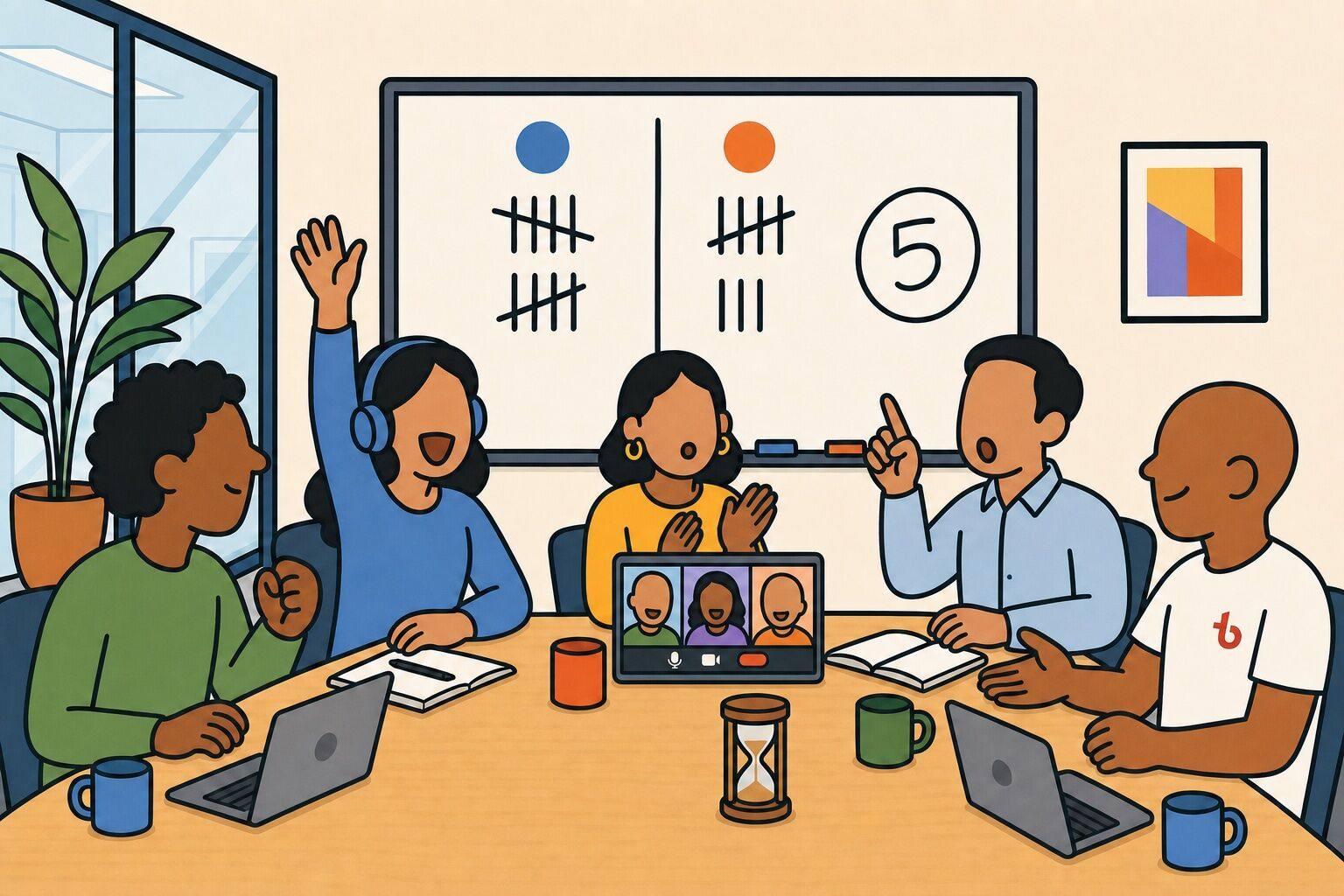
A host-tested list of 25 games for team meetings, each one built to open, play and finish inside 5 to 15 minutes, in person, in a town hall, or on a video call.
Most team meetings do not need more content. They need the first five minutes to go differently. A quick game at the top of the agenda gets every voice into the room before the first slide, and it does that in less time than the usual "any updates?" silence.
We run team building events for a living, and the question managers ask us most often between events is what they can do inside a normal meeting. So this is the meeting-sized playbook: 25 team meeting games that take 5 to 15 minutes, each with step-by-step instructions, a group size, a time and a real materials cost. Everything here has been run in a real room by our hosts or by teams we work with, in person, on video calls, and in the hybrid meetings where half the team is on a laptop screen.
This list includes:
Here we go!
Team meeting games are short, structured activities that a team plays inside a regular meeting, usually in the first or last ten minutes, to warm up the room, get quieter people talking, or reset energy between agenda items. Examples include a one-question icebreaker, a lightning scavenger hunt, and a two-minute trivia round. The purpose is to make the meeting itself more engaging and to build the small habits of trust that make the rest of the agenda run better. These games are also called games for team meetings, staff meeting games, meeting icebreakers, fun meeting activities, and meeting energizers.
Team meeting games are a subcategory of icebreaker games and of team building games more broadly. They are similar to morning meeting games, team huddle ideas, and quick team building, and the online versions are covered in our list of virtual meeting games. This guide includes quick meeting games, staff meeting games, meeting games for large groups and conference meetings, and virtual team meeting games. Managers use them in all-hands meetings, dedicated team building meetings, and as part of broader team meeting ideas.
There are a lot of meetings to improve. Organizational psychologist Steven Rogelberg, in The Surprising Science of Meetings (Oxford University Press, 2019), reports an estimate of 55 million meetings per day in the United States, and his earlier work with colleagues noted that by some estimates senior managers attend nearly 23 hours of meetings every week. Nobody is asking for those hours to get longer. The games below are built to make the meetings you already have feel shorter, because people are awake for them.
The reason meeting games fail is rarely the game. It is where the game sits. A game tacked onto the end of a 60-minute meeting is the first thing cut when the agenda runs long, and everyone in the room knows it. Put the game first, and it becomes the meeting kickoff: the thing that gets people off their inbox and into the room.
Here is the shape we recommend:
Our hosts run hundreds of events a month, and the advice they give managers who want to run their own is about preparation more than performance.
In practice, "100% prepared" for a meeting game means three things: the prompt or question list is written down before the meeting, the timer is already open, and you know how the game ends. That is a two-minute job the night before, and it is the difference between a game that lands and a game that fizzles while you scroll for a question.
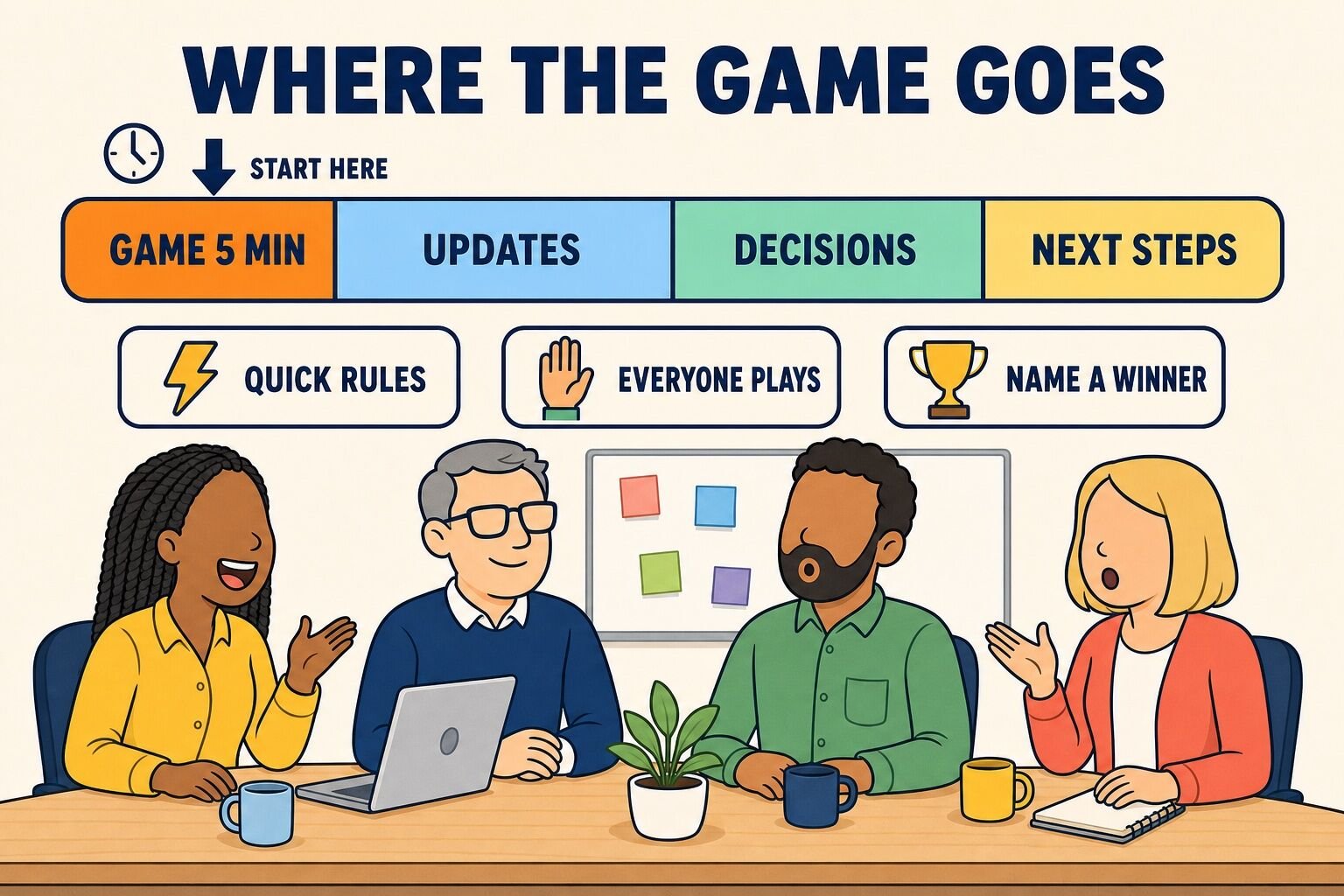
Every game on this list is free or nearly free, works with things already in the room, and fits inside 15 minutes. Use the table to pick one, then jump to the instructions.
| Activity | Best for | Group size | Time | Cost |
|---|---|---|---|---|
| One-Question Icebreaker | Opening any meeting | 3–20 | 3–5 min | Free |
| Two-Word Check-In | Weekly team meetings | 3–100+ | 3–5 min | Free |
| Would You Rather Vote | Waking up a quiet room | 5–100+ | 3–5 min | Free |
| Finish the Phrase | Fast laughs, zero prep | 4–20 | 5 min | Free |
| Guess the Number | Tying the game to the agenda | 4–100+ | 3–5 min | Free |
| This or That Sides | Getting people out of their chairs | 8–40 | 5 min | Free |
| 60-Second Shout-Outs | Recognition | 4–30 | 5 min | Free |
| Office Trivia | Staff meetings, company history | 5–50 | 10–15 min | Free |
| Office Mad Libs | Loosening up a formal team | 4–20 | 10 min | Free printable |
| Draw Your Weekend | Whiteboard rooms | 4–16 | 10 min | Free |
| Bet on the Crowd | Getting to know the team | 8–100+ | 10–15 min | Free |
| Something in Common | New or merged teams | 6–40 | 10 min | Free |
| Bad Idea Brainstorm | Before a real brainstorm | 4–20 | 10–15 min | Free |
| Two-Minute Expert | Recurring staff meetings | 4–30 | 10–15 min | Free |
| Live Poll Showdown | Town halls and conference meetings | 20–500+ | 5–10 min | Free polling tool |
| Guess the Colleague | All-hands meetings | 15–200 | 10 min | Free |
| Human Bingo | Mixing a big room | 15–200 | 10–15 min | Free printable |
| Stand Up If | Large groups, no props | 20–500+ | 5 min | Free |
| Table Tower | Conference tables | 12–200 | 10–15 min | About $5 per table |
| Chat Waterfall | Getting quiet people talking on video | 5–500+ | 5 min | Free |
| Lightning Scavenger Hunt | Energy on a video call | 5–100+ | 5–10 min | Free |
| Whose Background Is It? | Remote teams | 6–30 | 10 min | Free |
| Emoji Story | Chat-based teams | 5–50 | 5–10 min | Free |
| Slide Roulette | Confident teams, big laughs | 5–25 | 10–15 min | Free |
| Breakout Speed Rounds | Large video meetings | 10–200 | 10 min | Free |
These are the openers. No props, no setup, and safe for a team that has never played anything in a meeting before. If your team is new to this, start here and run one every week for a month before trying anything with rules. For a longer set of five-minute formats, see our list of 5-minute team building activities.
The simplest meeting game there is, and the one our hosts fall back on when a room needs warming up fast. Everyone answers the same easy question, in a sentence or less.
Here is how to run it:
Avoid questions that need thought or that touch anything sensitive. If someone has to pause to answer, the question is too hard for the first five minutes. Our full list of icebreaker questions has hundreds sorted by type, or use the generator below to pull one on the spot.
Best for: Opening any meeting
Time: 3–5 minutes
Materials (cost): None (free)
What we've learned: Ask the follow-up of the person whose answer was ordinary, not the one whose answer was wild. "Black coffee" hides a better story than "a triple caramel something" more often than you would expect.
A check-in that gives structure to "how is everyone doing" without letting the meeting drift. Each person describes their week in exactly two words, which removes the pressure of performing an answer and makes the round move fast.
Here is how to run it:
The two-word limit is the whole game. It is short enough that nobody feels put on the spot and specific enough that you learn something. Swap the question weekly with our check-in questions, or let the generator pick one.
Best for: Weekly team meetings, any size
Time: 3–5 minutes
Materials (cost): None (free)
The fastest way to wake up a quiet room. Read a "would you rather" question, everyone votes at once, and the minority has to defend itself.
Here is how to run it:
Three questions take about four minutes. Our list of would you rather questions is sorted by category if you want to theme them.
Best for: Waking up a quiet room
Time: 3–5 minutes
Materials (cost): None (free)
What we've learned: Read both options before anyone votes, and count the second option as carefully as the first. If hands go up on option A before B has been read, the whole room anchors on A and the vote tells you nothing.
A fill-in-the-blank round with no wrong answers and no prep. The host starts a sentence and each person finishes it as fast as possible.
Here is how to run it:
Best for: Fast laughs, zero prep
Time: 5 minutes
Materials (cost): None (free)
A one-minute game that doubles as a segue into the agenda. Pick a real number from the business and have the team guess it; closest wins.
Here is how to run it:
Best for: Tying the game to the agenda
Time: 3–5 minutes
Materials (cost): Sticky notes or chat (free)
What we've learned: Use the "answer at once" rule. If people guess out loud one by one, every guess after the first clusters around it and the reveal falls flat.
A "this or that" game played with feet instead of hands. The room becomes a two-sided vote, and people end up standing next to colleagues they would not normally sit with.
Here is how to run it:
Our list of this or that questions has enough pairs to run this every week for a year. On a video call, replace walking with cameras on for A, cameras off for B.
Best for: Getting people out of their chairs
Time: 5 minutes
Materials (cost): None (free)
Recognition, timed. Each person has a few seconds to thank one colleague for one specific thing from the past week. It is the quickest way we know to change the mood of a room.
Here is how to run it:
Best for: Recognition
Time: 5 minutes
Materials (cost): A timer (free)
What we've learned: "Specific" is the rule that matters. "Thanks to Priya for being great" does nothing; "thanks to Priya for rewriting the onboarding doc at 9pm on Tuesday" is the version people remember.
Staff meeting games are the ten-to-fifteen-minute formats: enough time for teams, rounds and a winner, still short enough to sit at the top of a regular weekly meeting. These work best in a conference room with a whiteboard, but every one has a video-call variation noted where it matters. If you have a full quarter of an hour to spend, our list of 15-minute team building activities goes deeper on this slot.
Trivia is the classic staff meeting game because it scales, it has a scoreboard, and you can point it at anything: company history, the industry, pop culture, or the team itself. The version that works in a meeting is short, in teams, and answered all at once.
Here is how to run it:
Eight questions with a 20-second clock runs about ten minutes including scoring. Our lists of trivia questions and trivia topics will keep you supplied for a year of meetings.
Best for: Staff meetings, company history
Time: 10–15 minutes
Materials (cost): Paper and a whiteboard (free)
What we've learned: Company questions beat general knowledge every time. Nobody remembers who won the pop-culture round; everybody remembers learning that the CFO used to be a lifeguard.
A fill-in-the-blank story game that loosens up a formal team faster than almost anything else, because the result is always ridiculous and nobody has to be funny on purpose.
Here is how to run it:
Best for: Loosening up a formal team
Time: 10 minutes
Materials (cost): Printed or shared template (free)
What we've learned: Put two or three blanks for real coworkers' names into the template. The stories get much funnier when the "adjective" describing a colleague comes from someone who did not know where it was going.
A whiteboard game for rooms that have one. Each person gets 30 seconds to draw something they did over the weekend, and the room guesses. It is Pictionary with a check-in built in.
Here is how to run it:
On a video call, use the whiteboard tool or have people draw on paper and hold it to the camera. Our list of whiteboard games has more formats for the same wall.
Best for: Whiteboard rooms
Time: 10 minutes
Materials (cost): Whiteboard and markers (free)
A guessing game about your own team, adapted from a round our hosts run in events. The host asks a question about the group, and everyone bets on how many people will answer yes.
Here is how to run it:
Best for: Getting to know the team
Time: 10–15 minutes
Materials (cost): Paper or chat (free)
What we've learned: The reveal is the game, so slow it down. Ask people to keep their hands up for a beat, and let the room look around. That is the moment a colleague learns that the quiet analyst has run three marathons.
A small-group game for new or recently merged teams. Groups race to find the most unusual thing every member shares. It forces real conversation because the obvious answers ("we all work here") do not count.
Here is how to run it:
Best for: New or merged teams
Time: 10 minutes
Materials (cost): None (free)
What we've learned: Ban the obvious answers out loud before the timer starts. Without that rule, every group comes back with "we all drink coffee," and the round is over before anyone has asked a real question.
A warm-up for any meeting that has a real brainstorm on the agenda. Teams compete to generate the worst possible ideas for a real problem, then flip the best of the worst into something usable.
Here is how to run it:
Best for: Before a real brainstorm
Time: 10–15 minutes
Materials (cost): Sticky notes (free)
What we've learned: Bad ideas lower the stakes. Once someone has suggested "print the update on the office toilet paper" out loud, nobody is embarrassed to pitch a real idea ten minutes later.
One person per meeting gives a two-minute presentation on something they know well that has nothing to do with work: sourdough, fantasy football, the history of the paperclip. The team asks questions for three minutes, then the meeting starts.
Here is how to run it:
Our founder, Michael Alexis, keeps a list of lessons from running the company, and one of them is about meetings specifically.
Two-Minute Expert is the lowest-stakes way to put that into practice: it gives someone the floor every week, and it teaches the whole team to present briefly.
Best for: Recurring staff meetings
Time: 10–15 minutes
Materials (cost): None, or up to three slides (free)
What we've learned: Start the rotation with a manager who picks a slightly embarrassing topic. It sets the bar at "fun," not "impressive," and the rest of the team relaxes.
Above about 25 people, turn-taking dies. Nobody wants to be the 30th person to share a fun fact, and a town hall or conference meeting has no time for it anyway. The meeting games that work for large groups are the ones where everyone plays at the same time and only a few voices are sampled aloud. Everything in this section runs from the front of a room with no props beyond a microphone and, at most, a free polling tool. For the standing-and-moving end of this range, see our list of large group energizers, and for more openers, large group icebreakers.
A three-question poll run from the stage, where the room tries to predict its own answers. It works in a 20-person meeting and a 500-person town hall equally well, because everyone answers on their phone at once.
Here is how to run it:
Our list of poll questions has enough options for every town hall this year.
Best for: Town halls and conference meetings
Time: 5–10 minutes
Materials (cost): Free polling tool
What we've learned: The "predict the room" step is what makes this a game instead of a survey. Without it people answer and forget; with it, the reveal gets a reaction.
An all-hands game built on facts collected in advance. Leaders share surprising facts about employees, and the room guesses who each fact belongs to. It works with hundreds of people because guessing is silent and simultaneous.
Here is how to run it:
Best for: All-hands meetings
Time: 10 minutes
Materials (cost): Slides (free)
What we've learned: Include at least one fact from senior leadership, and make it a good one. A CEO who once toured with a punk band does more for a town hall than any slide about values.
The best large-room mixer we know. Each person gets a bingo card of traits ("has a twin," "speaks three languages," "has met a celebrity") and has to find a different colleague to sign each square. It gets a room of 100 people talking to strangers in under a minute.
Here is how to run it:
For more versions, see our guide to icebreaker bingo.
Best for: Mixing a big room
Time: 10–15 minutes
Materials (cost): Printed cards (free)
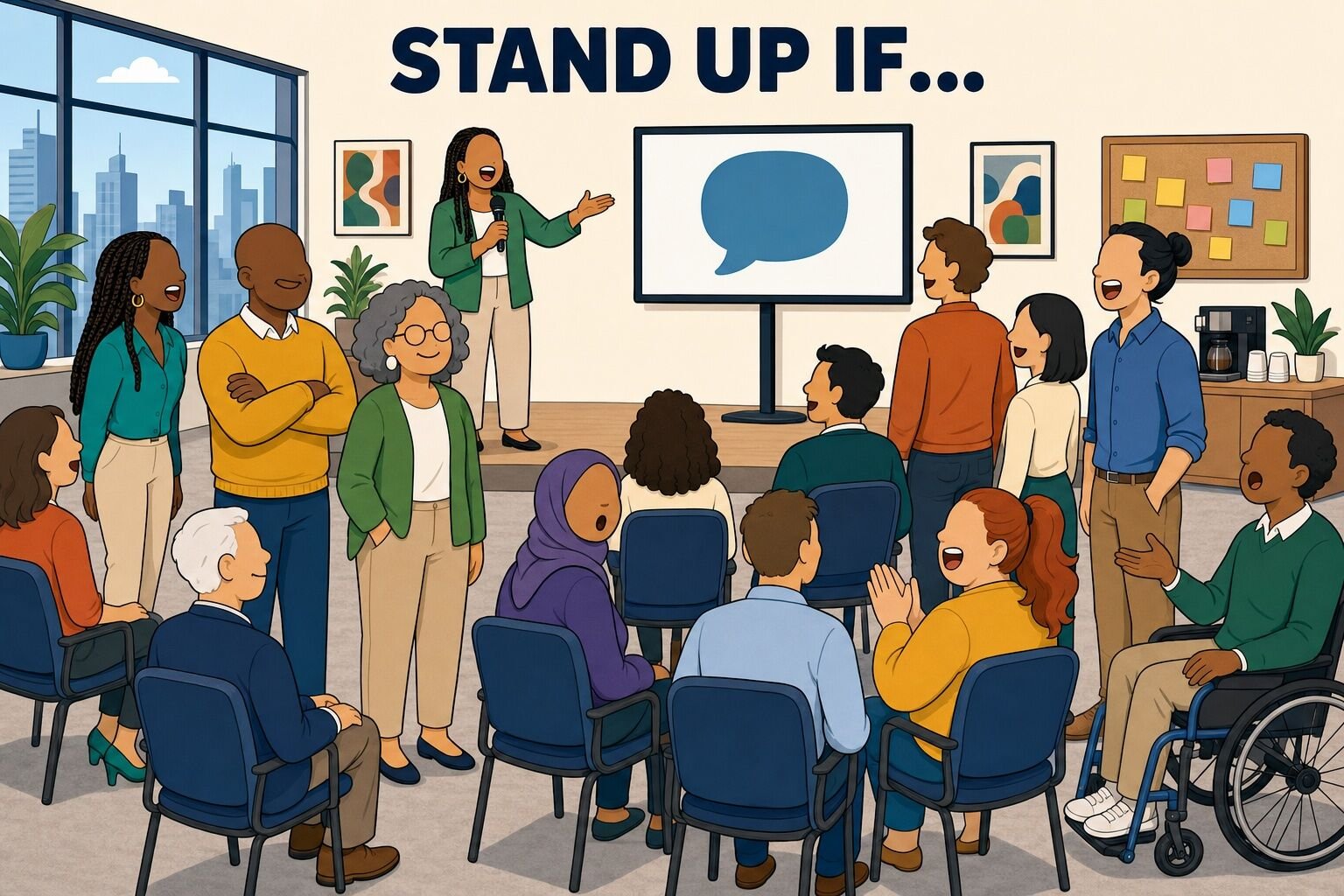
A five-minute game that needs nothing but a microphone. The host reads statements, and anyone the statement applies to stands up. It is a poll you can see from the stage, and it gets a seated audience moving without asking anyone to speak.
Here is how to run it:
Best for: Large groups, no props
Time: 5 minutes
Materials (cost): None (free)
What we've learned: End on a statement that gets everyone standing ("stand up if you are glad it is Friday") so the game finishes with the whole room on its feet and applauding, rather than with three people awkwardly sitting down.
A build challenge for conference-style rooms where people sit at round tables. Each table gets identical materials and ten minutes to build the tallest freestanding tower. It turns a room of strangers into teams before the first speaker.
Here is how to run it:
Best for: Conference tables
Time: 10–15 minutes
Materials (cost): About $5 per table
What we've learned: Say "freestanding" twice and demonstrate hands off. Every time we have skipped that, at least one table is holding its tower up when the timer ends and arguing that it counts.
Virtual team meeting games have one extra rule: silence is fatal. In a conference room, a pause gets filled by someone chatting; on a video call, a pause is just a grid of faces waiting. So the games that work online run on rails, use the chat panel as a second channel, and never make one person perform while 30 others watch. These six are the formats our hosts reach for when the group is remote or hybrid. For a longer list, see our video call games, and for the surrounding habits, our guide on how to make virtual meetings fun.
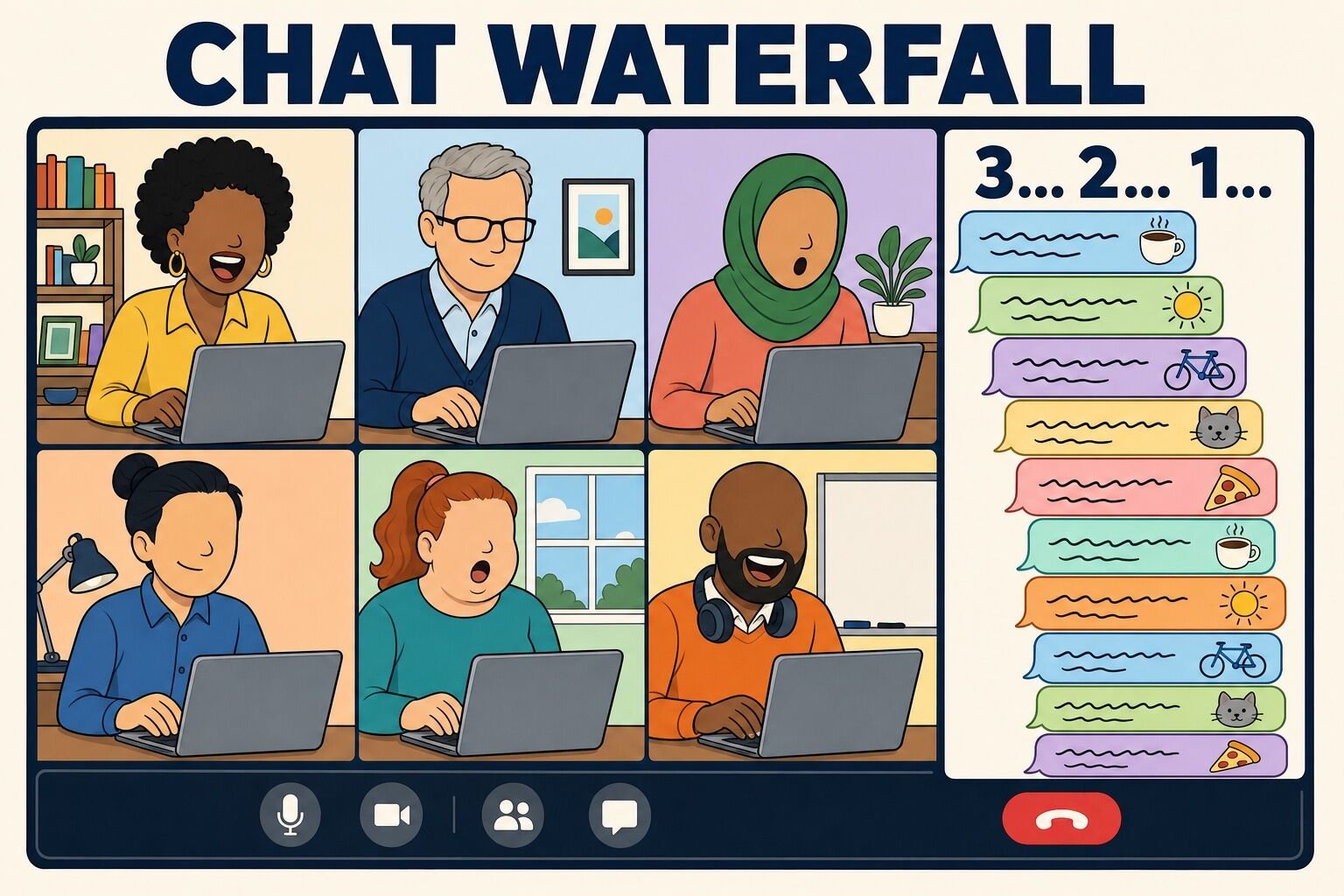
The single best fix for a quiet video call. Everyone types an answer to the same question but nobody sends until the host counts down, so the chat fills all at once and nobody is first.
Here is how to run it:
Best for: Getting quiet people talking on video
Time: 5 minutes
Materials (cost): Chat panel (free)
What we've learned: Read out the answers from people who rarely unmute. The waterfall is the one moment they have already participated, so a follow-up question feels like a continuation, not a spotlight.
A format from our own virtual events, cut down to meeting length. The host calls out an item, and everyone races to find it and hold it up to the camera. Three rounds, first back wins each.
Here is how to run it:
Best for: Energy on a video call
Time: 5–10 minutes
Materials (cost): Whatever is within reach (free)
What we've learned: Descriptive prompts beat specific ones. "A red thing" gets everyone back in ten seconds; "a stapler" leaves half the team searching drawers while the game stalls.
A guessing game for remote teams that never see each other's workspaces. Teammates send a photo of one corner of their desk or a view from their window, and the group guesses whose it is.
Here is how to run it:
Best for: Remote teams
Time: 10 minutes
Materials (cost): Slides (free)
A chat game where each person describes their weekend, their week, or their current project using only emoji, and the rest of the team decodes it.
Here is how to run it:
Best for: Chat-based teams
Time: 5–10 minutes
Materials (cost): Chat panel (free)
An improv presentation game for confident teams. A volunteer presents a slide deck they have never seen, one minute per slide, on a topic the host announces as they start. It is the loudest ten minutes a video meeting can have.
Here is how to run it:
Best for: Confident teams, big laughs
Time: 10–15 minutes
Materials (cost): A few random slides (free)
What we've learned: Ask for volunteers rather than picking. The people who put their hand up for this are always good at it; the people who do not would rather do any other game on this list.
The remote answer to "everyone play at once." The host sends the meeting into breakout rooms of two or three for two minutes with a single question, then shuffles and repeats. In ten minutes everyone has had three real conversations, which is more than most video meetings deliver in an hour.
Here is how to run it:
More formats for the same tool are in our list of Zoom breakout room ideas.
Best for: Large video meetings
Time: 10 minutes
Materials (cost): Breakout rooms (free)
What we've learned: Rooms of two beat rooms of four. With two people there is nowhere to hide and the conversation starts instantly; with four, everyone waits to see who goes first and the timer runs out.
We have run tens of thousands of hosted events, and the one thing a meeting game is not is a smaller version of one of them. An event has a host, a story, 60 to 90 minutes and a room that showed up to play. A meeting game has five minutes, a manager, and a room that showed up for the agenda. Treat it as a different tool, with different rules.
That number is why we do not try to squeeze an event into a meeting. The 60-to-90-minute window is where connection deepens; a meeting game does a different job, which is frequency. A five-minute game every week does more for a team over a quarter than one long session, because it changes how the meeting feels every single time.
Here is what holds up across the rooms we have seen:
| Small team meeting (3–12 people) | Large meeting or town hall (25–500 people) | |
|---|---|---|
| Format that works | Turn-taking rounds, whiteboard games, small-group challenges | Simultaneous answers: polls, chat, standing, breakouts |
| Time | 5–15 minutes | 5–10 minutes |
| Who speaks | Everyone, once | Everyone answers; two or three voices sampled aloud |
| Best openers | One-Question Icebreaker, Two-Word Check-In, Draw Your Weekend | Live Poll Showdown, Stand Up If, Chat Waterfall |
| Watch out for | The same two people answering every follow-up | Any format where the 30th person has to wait for a turn |
If you would rather have a host run the game, or the team is ready for a full session instead of a five-minute one, you can browse our virtual and in-person team building activities.
The old version of this article listed potlucks, dress-up days, personality tests and office retreats as team meeting games. They are fine ideas for an office; they are not games, and none of them fit inside a meeting. We cut them, along with a few real games that play badly in a meeting slot.
| Activity | Why skip it | Verdict |
|---|---|---|
| Werewolf or Mafia | A great social deduction game that needs at least seven players, a moderator, and 30 to 60 minutes. Started in a meeting, it either gets cut off mid-round or eats the agenda. Save it for a game night with our Werewolf game rules. | Game night, not meeting |
| Board games mid-meeting | Even a fast game like Codenames runs 15 to 30 minutes with setup, and only four to eight people can play at once. Our list of team building board games is for a lunch break or a dedicated session. | Better in a break |
| Two Truths and a Lie | Works for six new hires who have never met. For an established team it is slow, overused, and everyone has heard each other's lie twice already. | Usually skip |
| Never Have I Ever | Built around personal disclosure and drinking-game energy. The work-safe version is too tame to be fun and the fun version is not work-safe. | Skip it |
| Personality tests | Taking a quiz is a solo activity, and comparing results turns into either a debate about the test or a label people carry for years. Not a game, and not five minutes. | Not a meeting game |
| Long scavenger hunts around the office | A 20-minute hunt with clues and hidden objects pulls the meeting apart: half the team is back in five minutes and the other half is in the stairwell. Keep it to the lightning version. | Shorten it |
| Forced fun after bad news | A game on the same agenda as layoffs or a missed target reads as either tone-deaf or as an attempt to soften something that should not be softened. | Skip the game |
| Games at the end of the meeting | Not a bad game, a bad slot. The end of the meeting is the first thing cut when the agenda overruns, so the game never happens and the team stops expecting it. | Move it to the start |
A meeting game is not a treat you add when there is time. It is the first five minutes of the meeting, run on purpose, with a written prompt, an open timer and a known ending. Pick one game from this list, put it on the calendar for the same slot every week, and run it for a month before judging it. The meeting will feel different by the second week, and by the fourth the team will be suggesting the next game themselves.
Next, check out our lists of games at work, one minute games, and games to play with coworkers.
Answers to the questions managers ask us most about running games in meetings.
Team meeting games are short, structured activities a team plays inside a regular meeting, usually in the first five to fifteen minutes, to warm up the room, get quieter people talking, or reset energy between agenda items. Examples include a one-question icebreaker, a lightning scavenger hunt and a short trivia round. They are also called staff meeting games, meeting icebreakers and meeting energizers.
Five to fifteen minutes. Five-minute openers such as a two-word check-in or a would-you-rather vote fit any meeting; ten-to-fifteen-minute games such as office trivia or Bad Idea Brainstorm suit a weekly staff meeting. A meeting game is not a smaller version of a team building event: 88% of the virtual events we run are 60 to 90 minutes long, and a meeting game does a different job, which is frequency.
Games where everyone answers at once and only a few voices are heard aloud. Live Poll Showdown, Stand Up If, Guess the Colleague and Human Bingo all work from 25 people to several hundred. On video, Chat Waterfall and two-minute breakout speed rounds do the same job. Avoid any format where the 30th person has to wait for a turn.
Chat Waterfall, where everyone types an answer and sends on a countdown; a Lightning Scavenger Hunt, where players race to hold an item up to the camera; Emoji Story; and breakout speed rounds of two people for two minutes. The rule on video is that silence kills momentum, so pick games that run on rails and use the chat panel as a second channel.
At the start. A game in the first five minutes gives latecomers a soft landing, gets every voice into the room before the first decision, and cannot be cut when the agenda runs long. Skip the game entirely on days when the agenda is bad news such as layoffs or a missed target.
Almost never. Most games on our list need only a question, a timer and a whiteboard or chat panel. The exceptions are printed Human Bingo cards, a Mad Libs template, and about $5 per table of paper and tape for a tower-building challenge.
Comments (0)
Leave a Comment