40 Indoor Team Building Activities & Games for Work (Rain or Shine)
Indoor team building activities, games, and events for work teams, from hosted guacamole competitions and museum scavenger hunts to free games you can run in a conference room, with pricing and planning lessons from real events.
Published
·
Updated
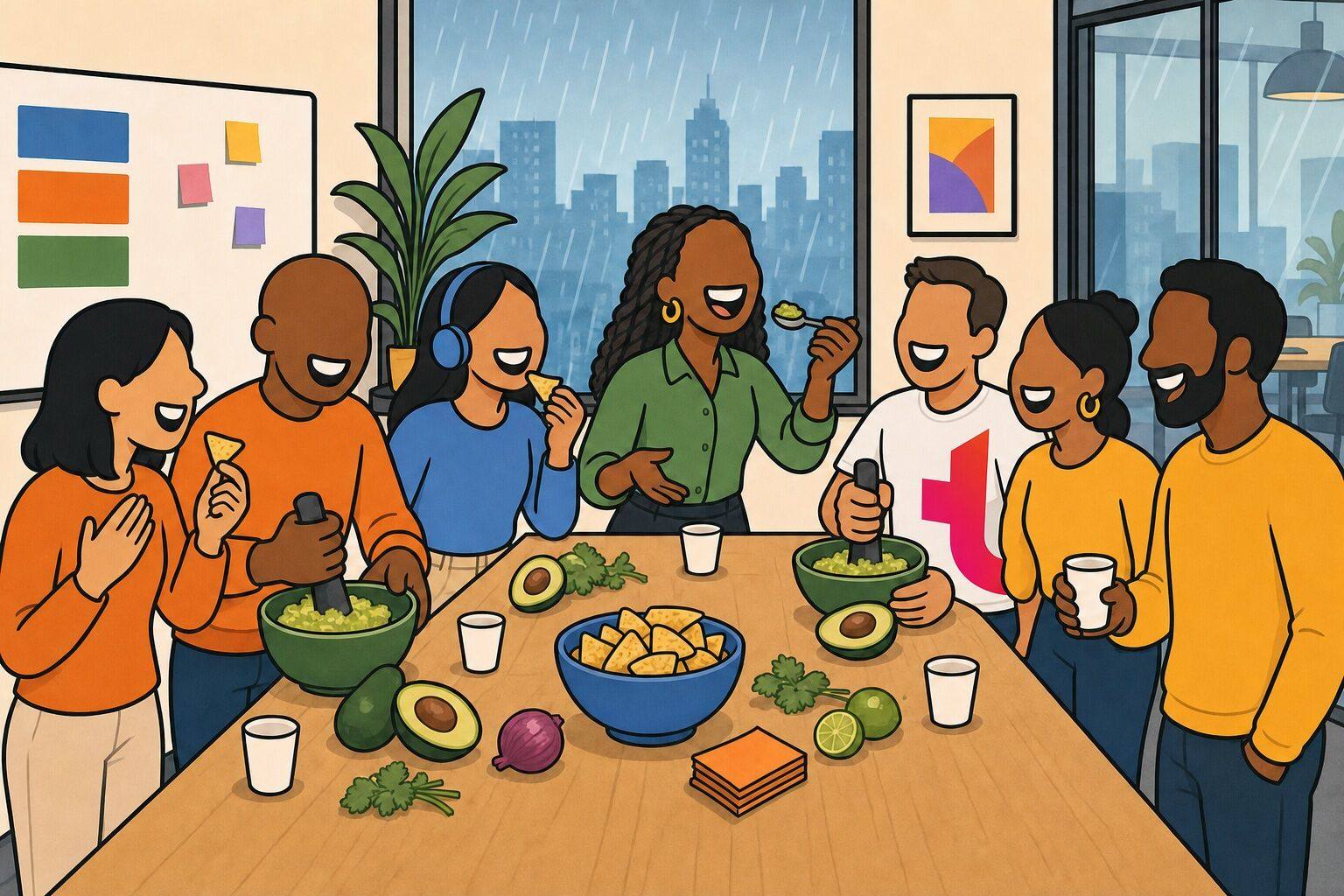
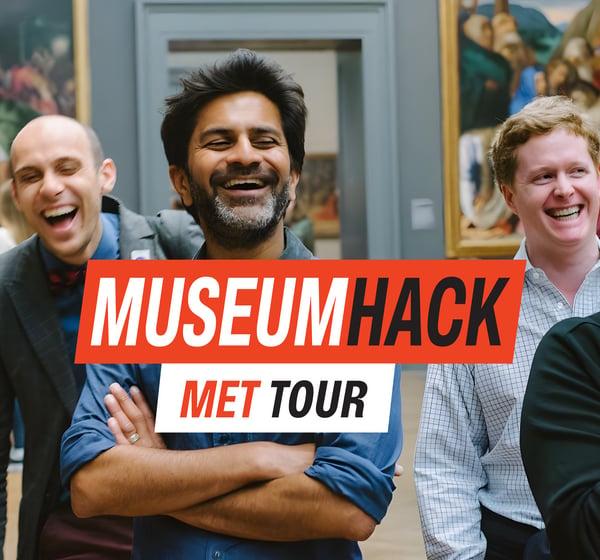
Most team building happens indoors. Our in-person roots are inside the Metropolitan Museum of Art, where our sister company Museum Hack has been leading renegade tours and scavenger hunts for corporate groups for more than a decade, and today our hosted indoor Originals run in conference rooms, event spaces, and hotel ballrooms across the United States. Our most-booked in-person event, The Great Guac Off, is a guacamole competition that has never once been rained out.
That is the case for indoor team building in one sentence: it happens on schedule. No weather date, no permits, no sunscreen, and everybody on the team can participate regardless of fitness. This guide collects the hosted events teams book most, the companies worth calling, and 40 games and activities you can run yourself in an office, a rented room, or a local venue, along with what we have learned running these events in real rooms.
Prefer to watch? This video walks through some of our favorite indoor team building activities:
What is indoor team building?
Indoor team building activities are games, events, and exercises that coworkers do together inside, usually in a conference room, an office common area, a rented event space, or a venue like an escape room, a museum, or a bowling alley. Example activities include trivia showdowns, cook-offs, office scavenger hunts, and improv shows. The purpose of these activities is to get colleagues talking, laughing, and solving problems together on a day the weather does not get a vote. These ideas are also called "indoor team bonding activities," "indoor team games," "team building games for the office," "indoor corporate team building activities," and "indoor teambuilding."
Does any of this work, or is it just a nice afternoon? The most-cited answer comes from a meta-analysis by Klein, DiazGranados, Salas and colleagues in Small Group Research (2009). Across 60 effect sizes, team building had a moderate positive effect on team outcomes overall, and the strongest effects were on affective and process outcomes, meaning how teammates feel about the team and how they work together, with goal setting and role clarification the most effective components. That matches what we see in the room: the games are the excuse, and the conversations they force are the point.
The best indoor team building activities you can book
Hosted indoor events solve the problem that sinks most DIY attempts: somebody on your team has to run the game, and that person does not get to play. Our indoor Originals are led by trained hosts who bring the supplies, keep score, and manage the energy in the room. We rank them with our Team Building Score, which combines post-event survey results, participant recommendation scores, and organizer reviews, and we publish exactly how it works.
Ranked by our Team Building Score — a running points total earned through confirmed bookings, verified reviews, ratings, and listing quality, recalculated nightly. Every event shown also has at least 30 post-event survey responses per question; the happier, connected, and NPS columns are computed from the 3,056+ survey responses collected for the 12 events listed here — a subset of all post-event surveys across our catalog. Updated October 2026.
The Great Guac Off is our highest-scoring in-person event and the most-reviewed one: 4.97 out of 5 across 1,812 reviews as of September 2026. Teams of four to six get avocados, limes, and a table of mix-ins, then compete through guacamole-themed trivia and mini-games to earn ingredients before a final mash-off judged by the whole room. It needs no kitchen, just tables, and it works in a conference room as well as a rooftop lounge.
Best for: 15 to 1,000 people Time: 60 to 90 minutes Materials (cost): Hosted, $80 per person, ingredients included
What we've learned: Food competitions get quiet people talking faster than any icebreaker, because the task gives everyone something to do with their hands. Our hosts also run the tasting as a blind vote, which keeps the outcome honest and the trash talk friendly.
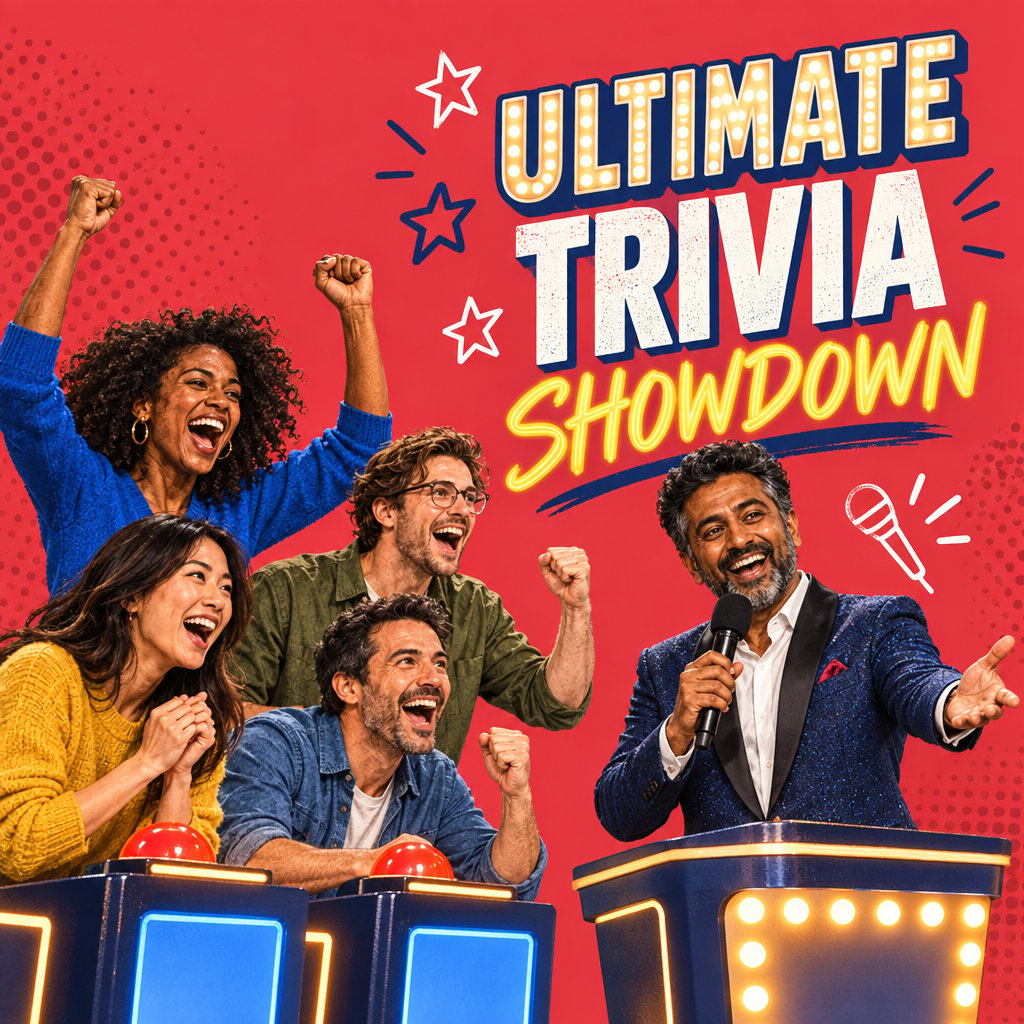
Ultimate Trivia Showdown is a hosted pub-style trivia night that fits inside a workday. Teams compete through themed rounds, picture rounds, and a final wager, with a host running the questions, the scoring, and the banter. Organizers can add a round about their own company, which is reliably the round people argue about longest.
Best for: 15 to 1,000 people Time: 60 to 90 minutes Materials (cost): Hosted, $50 per person
What we've learned: Trivia is the format most teams try to DIY, and the difference a host makes is pacing. A round that drags while somebody reads answers off a laptop loses the room; a host who keeps every round under eight minutes never does.
Museum Hack Scavenger Hunt at The Metropolitan Museum of Art
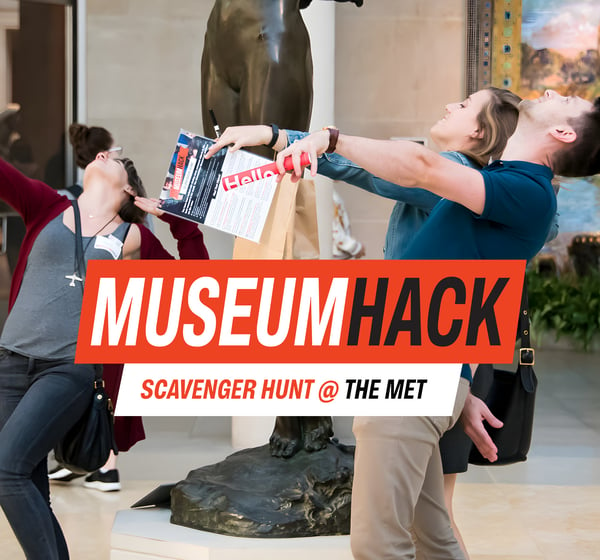
The Museum Hack Scavenger Hunt is the indoor event our New York clients book when they want a real outing rather than a conference room. A Museum Hack guide leads teams through the Met on a 90- to 120-minute race of photo challenges, art trivia, and puzzles built around the collection, and museum admission is included in the price. Sister hunts run at the National Portrait Gallery in Washington, DC, the Museum of Fine Arts Boston, the Field Museum in Chicago, and SFMOMA.
Best for: 15 to 1,000 people Time: 90 to 120 minutes Materials (cost): Hosted, $100 per person, museum admission included
Indoor events are easier to source than outdoor ones, which means more companies sell them and more of them are mediocre: generic trivia read from a script, or a "workshop" that is a lecture with snacks. The companies below are the ones we would actually consider. We are obviously biased, so we have kept our take on each honest and short.
Small teams that want an outing rather than a facilitated program
Search your city plus the activity. Confirm group minimums, private-room options, and whether a staff member runs the session or just checks you in.
Booking a hosted event is the easy path, but it is not the only one. The rest of this guide covers games, activities, and events you can run yourself.
Indoor team building games
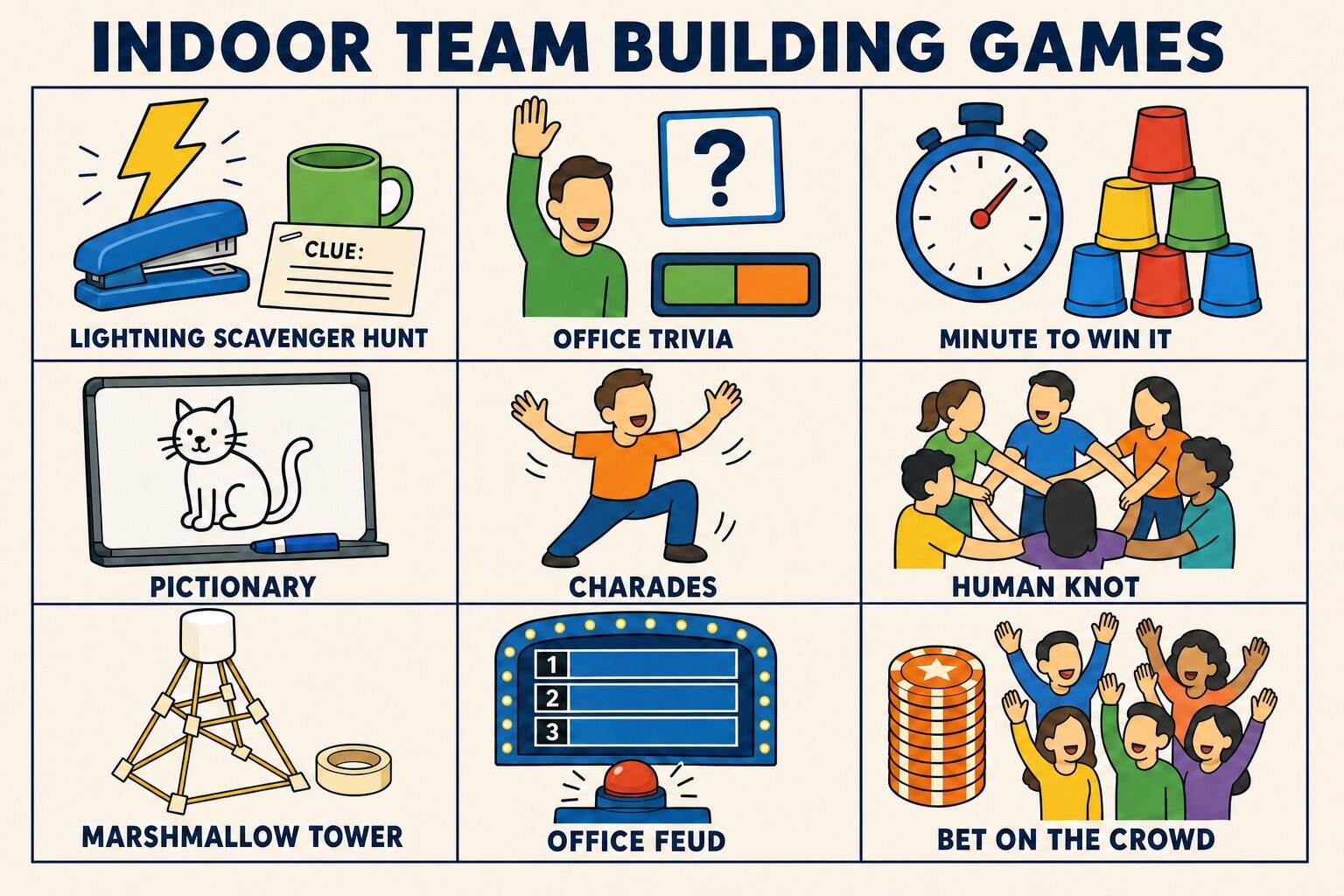
These are the games we reach for when a team has a conference room, a whiteboard, and an hour to fill. Most of them come straight from our hosted events, adapted so one coworker can run them, and each entry includes how to play, the ideal group size, and what our hosts have learned running it with real teams.
Lightning Scavenger Hunts are a format we developed for our hosted events. The host calls out a clue, everyone races to find the item or complete the task, and the first person back to the circle scores. Indoors, the office itself becomes the game board.
For example:
Bring back something that has been in this office longer than you have.
Find the ugliest mug in the kitchen.
Take a team photo with someone from a different department.
Find a sticky note with a word that describes your team.
Spell your team name using objects from your desk.
Award a point to the first person back with a qualifying item and a bonus point for the most creative answer. Run eight to ten clues in a session.
Best for: 6 to 100+ people Time: 10 to 20 minutes Materials (cost): A list of clues (free)
What we've learned: Ask about the finds. The mug with the 2009 conference logo has a story, and letting someone tell it before the next clue is where the connection happens. The race creates the energy; the stories create the bonding.
2. Office Trivia Showdown
Trivia is the most-attempted indoor team building game for a reason: everyone knows how to play, and it scales from one conference room to the whole company. Write five rounds of six questions, mixing general knowledge, pop culture, a picture round, and one round about your own company. Split the group into teams of four to six, have each team pick a name, and run the questions from a screen so nobody is squinting at a printout. Score after each round and read the standings aloud.
Finish with a final wager: each team bets up to ten points on a last question. It keeps trailing teams in the game until the end. Our trivia questions list has several hundred to start from.
Best for: 8 to 100+ people Time: 45 to 60 minutes Materials (cost): Questions, answer sheets, a screen (free)
What we've learned: Keep every round under eight minutes and read answers with energy. The company round is the one people remember, so make it about coworkers and history rather than the org chart, and check that every fact is public knowledge inside the team.
3. Minute to Win It
Minute to Win It games are 60-second challenges played with household objects, and they are the loudest ten dollars you will ever spend. Set up four or five stations around the room: stack 20 plastic cups into a pyramid and back, move ten cookies from forehead to mouth without hands, bounce ping-pong balls into a mug, keep two balloons off the floor for a full minute, unspool a roll of toilet paper with one hand. Teams rotate through the stations, one player per challenge, and a timekeeper records each attempt.
Best for: 8 to 50 people Time: 30 to 45 minutes Materials (cost): Cups, balloons, ping-pong balls, cookies, tape ($20 to $40)
What we've learned: Let each team choose who plays each station. People self-select into the challenge they can live with losing, which keeps the anxious half of the room in the game.
4. Office Feud
Office Feud is our in-room version of the survey game show, and it is one of the few games where the prep is the fun part. A week before, send the team ten short questions: "Name something coworkers do in the kitchen that annoys everyone," "Name a snack that disappears fastest from the break room." Tally the answers into top-five boards. On game day, two teams face off: one player from each buzzes in (a hand on the table works), the higher answer's team plays the board, and three strikes hand it to the other side.
Best for: 10 to 60 people Time: 30 to 45 minutes Materials (cost): A survey form and a slide deck for the boards (free)
What we've learned: The best questions are about the team, not the world. "Name a phrase our manager says in every meeting" gets a bigger laugh than any pop culture board, and nobody has to know trivia to play.
5. Bet on the Crowd
Bet on the Crowd is a guessing game from our hosted events that works especially well in big rooms. The host asks a question with a countable answer, such as "How many people in this room have run a marathon?" or "How many of us have never seen Star Wars?" Each team writes a bet, then the host asks for a show of hands and counts. The closest bet wins the round. Run ten questions, from silly to surprising.
Best for: 10 to 100+ people Time: 15 to 30 minutes Materials (cost): Questions and scrap paper (free)
What we've learned: The reveal is the game. When the hands go up, ask two or three of them a follow-up ("Which marathon?"). Teams learn more about each other in ten questions than in a month of standups.
6. Marshmallow Tower
The Marshmallow Tower challenge gives each team 20 sticks of dry spaghetti, a yard of tape, a yard of string, and one marshmallow, then 18 minutes to build the tallest freestanding structure with the marshmallow on top. Measure from the table to the marshmallow at the buzzer. Structures that fall before measurement score zero, which is where most of the drama comes from.
Best for: 8 to 40 people (teams of 4) Time: 25 to 30 minutes Materials (cost): Spaghetti, tape, string, marshmallows ($15 to $30)
What we've learned: Run a two-minute debrief. Ask which team tested the marshmallow's weight early and which saved it for the last 30 seconds. The teams that prototype fast usually win, and the lesson lands without anybody saying the word "agile."
7. Pictionary
Pictionary needs a whiteboard and a stack of prompts. Split into two teams and alternate: one player draws a prompt while their team guesses, with 60 seconds on the clock. No letters, numbers, or talking from the artist. Add a theme round for the office, such as company products, coworkers' hobbies, or inside jokes, and let the losing team choose the next category.
Best for: 6 to 30 people Time: 20 to 40 minutes Materials (cost): Whiteboard, markers, prompts (free)
What we've learned: Drawing skill has almost nothing to do with winning, and telling the group that up front gets the reluctant artists to the board.
8. Charades
Charades is the zero-prep indoor game: no supplies beyond a list of prompts, which you can write yourself or pull from our charades generator. Split into teams, and have players take turns acting out a prompt while their team guesses within 60 seconds. Theme the rounds to keep it fresh: movies, office life, company jargon, famous coworker moments.
Best for: 6 to 30 people Time: 20 to 40 minutes Materials (cost): Prompts (free)
What we've learned: Charades plays far better in person than on video, where body language is trapped in a small frame, so save it for the room and pick a different game for your remote teammates.
9. The Human Knot
The Human Knot takes no space, no equipment, and about ten minutes. Six to ten people stand in a circle, reach across, and grab one hand from two different people who are not next to them. The group then untangles itself into a circle without letting go. Time each knot, then run it again with a rule change, such as no talking.
Best for: 6 to 10 people per knot (run several at once for bigger groups) Time: 10 to 15 minutes Materials (cost): None (free)
What we've learned: Make participation opt-in and offer a "navigator" role for anyone who prefers not to hold hands. The navigator stands outside the knot and directs traffic, which is usually the reason the knot gets solved.
10. Something in Common
Something in Common is a connection game from our hosted events. Split the group into teams of five or six and give them five minutes to find the most unusual thing every member of the team has in common. "We all have jobs" scores nothing; "we have all been stung by a jellyfish" wins. Teams present their find, and the room votes on the most surprising.
Best for: 6 to 100+ people Time: 15 to 25 minutes Materials (cost): None (free)
What we've learned: Keep the teams small. Six people can discover something genuinely odd they share; twenty people can only agree that they all drink coffee. Shuffle the teams and play a second round so people meet a new group.
Indoor team building activities for large groups
Large groups indoors need three things: a format where everyone plays at the same time, a host with a microphone, and a scoreboard everybody can see. The large group team building formats below all scale to 100 or more people in a ballroom or an all-hands space.
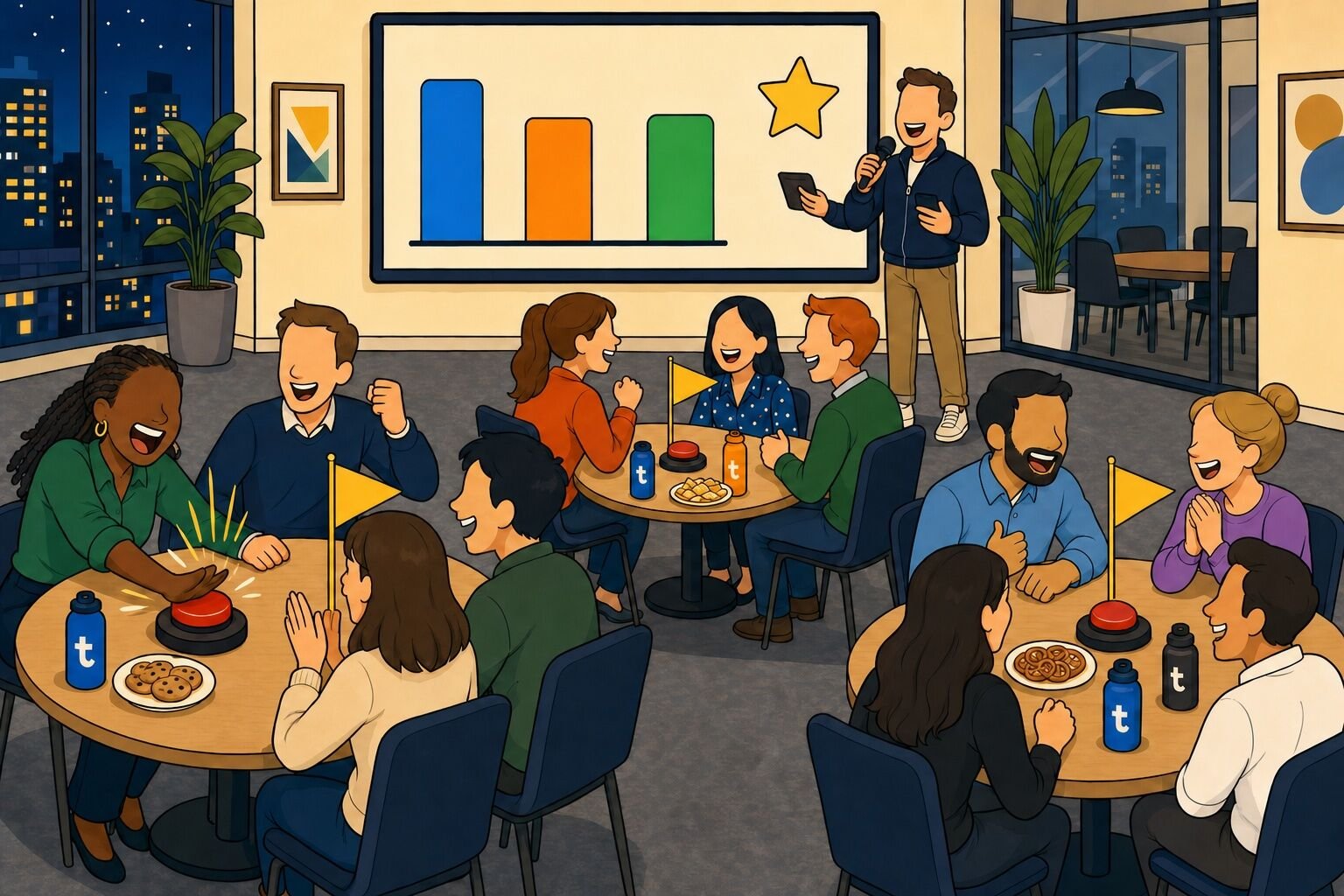
A game show is the format that fills a ballroom fastest, and it is what most of our hosted in-person events are built on. Set the room with teams of six to eight at round tables, a host at the front with a microphone, and a slide deck that runs three or four different game show formats in sequence: a buzzer round of fast trivia, a "guess the price" round with company swag, a lightning round of physical challenges, and a final wager. Give each table a buzzer, or a bell, and a small whiteboard for written answers.
Best for: 20 to 200+ people Time: 60 to 90 minutes Materials (cost): Buzzers or bells, mini whiteboards, a screen, a microphone ($30 to $100)
What we've learned: Change the game every 15 minutes. A single format for an hour flattens the energy; four short formats keep every table thinking they can still win.
12. Office Olympics
Office Olympics turns a large space into six to eight stations: chair curling, paper football, a rubber-band archery range, a wastebasket free-throw line, a "synchronized" desk-chair routine judged for style. Teams represent countries or departments, march in during an opening ceremony, and rotate through stations on a schedule. Total the medals and close with a podium.
Best for: 20 to 150 people Time: 60 to 120 minutes Materials (cost): Office supplies, tape, printed medals ($50 to $150)
What we've learned: Give every team a coach role for anyone who does not want to compete. The coach picks the lineup, keeps the score sheet, and leads the cheer, so nobody sits on the sidelines by default.
13. Improv Show
An improv show works for large groups because most of the room is the audience most of the time, and the audience does the suggesting. Pick four or five improv games, explain each one in 30 seconds, and call up three or four volunteers per scene. Keep scenes to two or three minutes. Rotate volunteers so 20 or 30 people get on stage over the hour, and let the audience shout the settings and occupations.
Best for: 15 to 100+ people Time: 45 to 60 minutes Materials (cost): A list of games and some chairs (free)
What we've learned: Start with the games where everyone plays at once from their seats, such as a whole-room "yes, and" story, before asking anyone to stand up. Warm audiences volunteer; cold ones do not.
14. Cook-Off or Bake-Off
Cook-offs are equal parts delicious and competitive. Choose a dish that travels well, such as chili, mac and cheese, salsa, or cookies, and collect sign-ups in teams. Entrants make the food at home or in a rented kitchen, then everybody else tastes and votes with a ballot or a bowl of beans. Tally, crown a winner, and photograph the podium. Our cook-off ideas guide has themes and scoring sheets.
Best for: 15 to 100+ people Time: 60 to 120 minutes Materials (cost): Ingredients, tasting cups, ballots ($5 to $15 per person)
What we've learned: Let the whole room vote instead of a judging panel. The crowd vote is more interactive, more forgiving, and the campaign speeches from each team are half the fun.
15. Casino Night
A casino night is the classic indoor evening event: rent a few blackjack, roulette, and poker tables (or make your own with felt and a deck), hand each guest a stack of play chips, and let the tables run for two hours. Bring in professional dealers if the budget allows; otherwise, recruit the coworkers who already run the office poker game. End with a raffle where chips buy tickets, so the winners of the night are decided by luck rather than skill.
Best for: 30 to 200+ people Time: 2 to 3 hours Materials (cost): Table rentals, chips, prizes ($15 to $60 per person)
What we've learned: Seed every table with a host or a confident dealer. A blackjack table with nobody explaining the rules empties out in ten minutes.
16. Charity Build
Charity builds give a large group a shared purpose that plain games cannot. Teams assemble care packages for a shelter, build bikes for a youth program, make fleece blankets for an animal rescue, or stuff backpacks with school supplies, usually with a competition layer on top: earn supplies through trivia rounds, then race to complete kits. Our charity team building guide lists formats and partner organizations, and our hosted Paws for a Cause runs the blanket version for you.
Best for: 15 to 200+ people Time: 60 to 90 minutes Materials (cost): Kit supplies ($20 to $40 per person)
What we've learned: Confirm with the receiving organization exactly what they need before you buy anything. A shelter that gets 200 identical fleece blankets it did not ask for is a logistics problem, not a gift.
Indoor activities for small groups
Small groups get options that large ones do not: a table for eight at a restaurant, a class with a real instructor, a venue with a private room. These small group team building ideas favor conversation over spectacle.
Board games are the ultimate rainy-day pastime and one of the best indoor activities for small groups. Pick fast, social team building board games such as Codenames, Wavelength, Just One, or Telestrations, which finish in 20 to 30 minutes and seat six or more. Set up two or three tables, rotate players after every game so everyone meets everyone, and track wins on a whiteboard for a light tournament feel.
Best for: 4 to 30 people Time: 60 to 120 minutes Materials (cost): Games you own or two or three new ones ($0 to $80)
What we've learned: Skip the three-hour strategy games. Party games with a talking component (Codenames, Wavelength) build more connection in 20 minutes than a long game where everyone stares at their own cards.
18. Paint and Sip
At a paint and sip, an instructor walks the group step by step through one painting while everybody enjoys a drink of their choice. Local studios host private sessions, or you can hire a teaching artist to come to the office with canvases and easels. Because everyone paints the same scene, the reveal at the end, when 12 versions of the same sunset go up on the wall, is the best moment of the night.
Best for: 6 to 30 people Time: 90 to 120 minutes Materials (cost): Studio session or artist plus supplies ($30 to $60 per person)
What we've learned: Offer non-alcoholic options as the default, not an afterthought. The "sip" should be optional; the painting is the activity.
19. Pottery or Craft Class
Pottery, candle-making, terrarium-building, and screen-printing classes give a small team a skill to learn and an object to take home. Book a private session at a local studio, or bring a kit-based version into the office (terrariums and candles need no special equipment). Pair people who do not usually work together at each station.
Best for: 6 to 20 people Time: 90 to 120 minutes Materials (cost): Class fee or kits ($35 to $75 per person)
What we've learned: Choose a craft where beginners finish with something they like. Wheel-thrown pottery humbles everyone on day one; hand-built mugs and candles send people home proud.
20. Indoor Climbing Gym
A climbing gym session pairs teammates as climber and belayer, which is trust building with an actual rope. Most gyms offer a group intro that covers harnesses, knots, and belay basics in 30 minutes, then opens the walls. Bouldering (short walls, no ropes) is the low-commitment version for anyone nervous about heights.
Best for: 4 to 20 people Time: 90 to 120 minutes Materials (cost): Gym day pass, rental shoes, instruction ($25 to $45 per person)
What we've learned: Make it opt-in and pair it with a meal afterward. The climbers get the adrenaline; everyone gets the dinner where the stories are told.
21. Bowling or Go-Kart Night
Bowling alleys and indoor go-kart tracks are the reliable after-work outing: weatherproof, low skill floor, and built for small groups. Book lanes or a private race session, split into teams, and add a team layer, such as combined lane scores or a relay race where each teammate drives one heat. Many venues bundle food, which solves dinner.
Best for: 6 to 30 people Time: 90 to 120 minutes Materials (cost): Venue booking and food ($20 to $50 per person)
What we've learned: Keep the teams mixed. A bowling lane of four people who already sit together is a Tuesday; a lane of four who have never spoken is team building.
22. Lunch and Learn
A lunch and learn is the quietest item on this list and, for small groups, one of the most effective. Order lunch, and have one teammate teach the group something for 20 minutes: a hobby, a skill from a past job, a deep dive on a tool everyone half-understands. Leave 20 minutes for questions. Rotate the presenter monthly.
Best for: 5 to 25 people Time: 45 to 60 minutes Materials (cost): Lunch (cost of food)
What we've learned: Non-work topics build more rapport than work topics. The engineer who teaches sourdough starter gets asked more questions afterward than the one who teaches the deployment pipeline.
Quick indoor team building activities
Not every indoor activity needs a booked room. These quick team building activities take five to fifteen minutes at the start of a meeting, need nothing more than the conference room you are already in, and are the ones we recommend when a manager asks for 5-minute team building that does not feel like a chore.
Read a this or that question and have everyone move to the side of the room that matches their answer: "pancakes or waffles," "window seat or aisle," "the office chair or the couch." Ask one person on each side to defend the choice in one sentence, then read the next question. Ten questions takes about eight minutes and gets a seated room on its feet.
Best for: 6 to 100+ people Time: 5 to 10 minutes Materials (cost): A list of questions (free)
What we've learned: Close votes are the fun ones. A 50/50 split creates a debate; a 95/5 split creates one embarrassed person. If a question splits badly, move on fast.
24. Best Thing on My Desk
Best Thing on My Desk is a show-and-tell game from our hosted events, and in an office it takes 30 seconds of prep: everyone grabs one object from their desk and brings it to the meeting. Go around the table, each person holds up the object and tells its story in under a minute. The concert ticket stub, the terrible mug from a client, the rock from a hike all count.
Best for: 4 to 20 people Time: 10 to 15 minutes Materials (cost): Whatever is on the desks (free)
What we've learned: Always ask a follow-up question, especially when someone's story sounds like it is the short version. The follow-up is where the interesting part lives.
25. Rose, Bud, Thorn
Rose, Bud, Thorn is a three-part check-in: each person shares a rose (something good this week), a bud (something they are looking forward to), and a thorn (something that is hard right now). Keep each share under a minute, and let people pass on the thorn if they prefer. Run it at the top of a weekly meeting and it becomes the part of the meeting people would miss.
Best for: 4 to 15 people Time: 5 to 15 minutes Materials (cost): None (free)
What we've learned: Managers go first and share a real thorn. If the leader's thorn is "too many great opportunities," nobody else will say anything true.
26. Paper Airplane Contest
Hand out one sheet of paper per person, give the room three minutes to fold, then line everybody up at one end of the hallway or the longest wall in the room. Launch in waves of five, mark the landing spot of each plane with a sticky note, and award prizes for distance, hang time, and "most creative crash." Add a team round where each team gets one sheet and must agree on a design.
Best for: 6 to 40 people Time: 10 to 15 minutes Materials (cost): Paper and sticky notes (free)
What we've learned: The team round is the team building. Watch which teams sketch first and which teams start folding immediately; the debrief writes itself.
27. Kudos Wall
A kudos wall turns a corkboard or a stretch of glass partition into a running record of thank-yous. Stock it with sticky notes and pens, and set one rule: every note names a person and a specific thing they did. Read a few aloud at the weekly meeting, then clear the board monthly and photograph it. It takes five minutes a week and it is one of the most durable employee appreciation ideas we know.
Best for: 5 to 200+ people Time: 5 minutes per week Materials (cost): Corkboard, sticky notes, pens (about $10)
What we've learned: Seed the wall with ten notes before you announce it. An empty board asks people to go first; a half-full board asks them to join in.
Corporate games ideas for the office
Corporate games are the indoor games that borrow their format from the business itself: pitch competitions, price guessing, company bingo. They work because the material is already in the room, and they are the easiest games to run at a quarterly meeting without anyone feeling they have been sent to camp.
28. Shark Tank Pitch-Off
Split into teams of four or five and give each team 20 minutes to invent a product and prepare a two-minute pitch. Keep the prompts silly (a gadget that solves the worst thing about Mondays, a subscription box for the office plant) or useful (a fix for a real customer complaint). A panel of three "sharks" hears the pitches, asks one question each, and invests play money. The team with the most funding wins.
Best for: 10 to 40 people Time: 45 to 60 minutes Materials (cost): Paper, markers, play money (free)
What we've learned: Give every team a required prop from the supply closet. Building the pitch around a stapler or a lanyard makes the ideas funnier and levels the field between the natural presenters and everyone else.
29. Office Bingo
Office Bingo hands everyone a card of things that happen around the office ("someone says 'circle back,'" "the printer jams," "a dog appears on a video call"), and players mark squares as they witness them across a day or a week. First to a line wins; first to a full card gets the parking spot. Print the cards from the generator below, or write your own squares about the quirks of your team.
Best for: 8 to 200+ people Time: Runs in the background over a day or a week Materials (cost): Printed cards (free)
What we've learned: Keep every square kind. "Someone arrives late" reads as surveillance; "someone brings donuts" reads as a game.
30. Guess the Coworker
Collect one fact per person in advance ("I once opened for a touring band," "I have never eaten a taco") along with a toddler-era photo, and build a slide deck. In the meeting, show a fact or a photo, and have teams write down who they think it is. Reveal, score, and let the person add the 20-second story. Twenty entries fits comfortably in half an hour.
Best for: 8 to 60 people Time: 20 to 30 minutes Materials (cost): A survey form and a slide deck (free)
What we've learned: Ask for a photo from toddler age rather than a newborn picture. Newborns all look alike; three-year-olds already look like the person at the desk.
31. Office Price Is Right
Gather ten items with a price the organizer can look up: a case of the office coffee, the ergonomic chair everyone wants, a company hoodie, the monthly bill for the snack wall. Show each item and have teams write a guess. Closest without going over scores a point, and a wildly wrong guess earns a laugh. Finish with a "showcase" of three items where teams bid on the total.
Best for: 8 to 60 people Time: 20 to 30 minutes Materials (cost): Items you already own (free)
What we've learned: Include one item that costs far more than anyone expects. The gasp when the room learns what the espresso machine cost is the highlight of the game.
Indoor team building events
Indoor team building events are the bigger occasions: a meal, a class, a party, a workshop. They take more planning than a game, and they are the ones teams remember at the end of the year. Most work for any group size as long as the venue fits.
32. Team Meal
A shared meal is the most-booked indoor team activity for a reason: it is easy to organize and almost nobody turns down free food. Reserve a long table at a restaurant or cater a team lunch in the office, and add the one thing that turns eating into team building: assigned seats that mix departments, plus a single table question everybody answers between courses.
Best for: 4 to 100+ people Time: 60 to 90 minutes Materials (cost): Food ($15 to $50 per person)
What we've learned: Family-style dishes beat plated meals. Passing platters forces conversation in a way that individual entrees do not.
33. Cooking Class
Cooking classes put a chef in charge of the team for two hours: pasta from scratch, dumplings, tacos, sushi rolls. Book a private session at a cooking school or a restaurant with a teaching kitchen, split the group into pairs or fours at stations, and eat what you made at the end. Competitive versions (best plating, chef's choice) add stakes without changing the format.
Best for: 8 to 40 people Time: 2 to 3 hours Materials (cost): Class fee ($60 to $120 per person)
What we've learned: Choose a menu with lots of hands-on steps. A class where the chef does the hard part and the team stirs is a demonstration, not an activity.
34. Office Holiday Party
The holiday party is the most common indoor team building event of the year, and the most common one to get wrong: a room, a bar, and a playlist is a party, not team building. Plan two structured activities into the schedule, such as a 20-minute game show or a gingerbread build-off, and keep them early, before the room splits into cliques. Our holiday team building guide has formats for December and for the smaller holidays throughout the year.
Best for: 10 to 500+ people Time: 2 to 4 hours Materials (cost): Venue, food, activities ($40 to $150 per person)
What we've learned: December is the busiest month for team building events by a wide margin, so venues and hosts book out weeks ahead. Reserve in October, and consider a January party if the calendar is already full.
35. Wine, Beer, or Coffee Tasting
A guided tasting works with a local sommelier, a brewery tour, or a coffee roaster who brings six single-origin pours to the office. Taste blind, have teams guess the region or the style, and score it. The coffee version happens at 10 a.m., costs a fraction of the wine version, and includes everyone, so we recommend it as the default.
Best for: 6 to 40 people Time: 60 to 90 minutes Materials (cost): Tasting host and samples ($20 to $60 per person)
What we've learned: If alcohol is involved, book the transportation before the tasting and make the non-alcoholic flight a real one, not a glass of water.
36. Workshop Day
A workshop day is a half day built around learning one skill together: storytelling, improv for presenters, negotiation, or design thinking. Hire a facilitator, cap the group at 25 per room, and alternate 20 minutes of teaching with 20 minutes of practice. Our corporate workshop ideas guide covers topics, and our hosted Art of Storytelling Workshop is the one teams book most.
Best for: 8 to 25 people per room Time: 2 to 4 hours Materials (cost): Facilitator fee ($50 to $150 per person)
What we've learned: Practice beats theory. A workshop where every participant tells one story out loud and gets feedback changes how the team presents; a lecture on storytelling changes nothing.
Indoor escape rooms and scavenger hunts
Puzzle formats are the indoor activities teams search for most, because they work in any building and they make collaboration the whole game. Here are the four versions we recommend, from free to fully hosted.
37. Office Scavenger Hunt
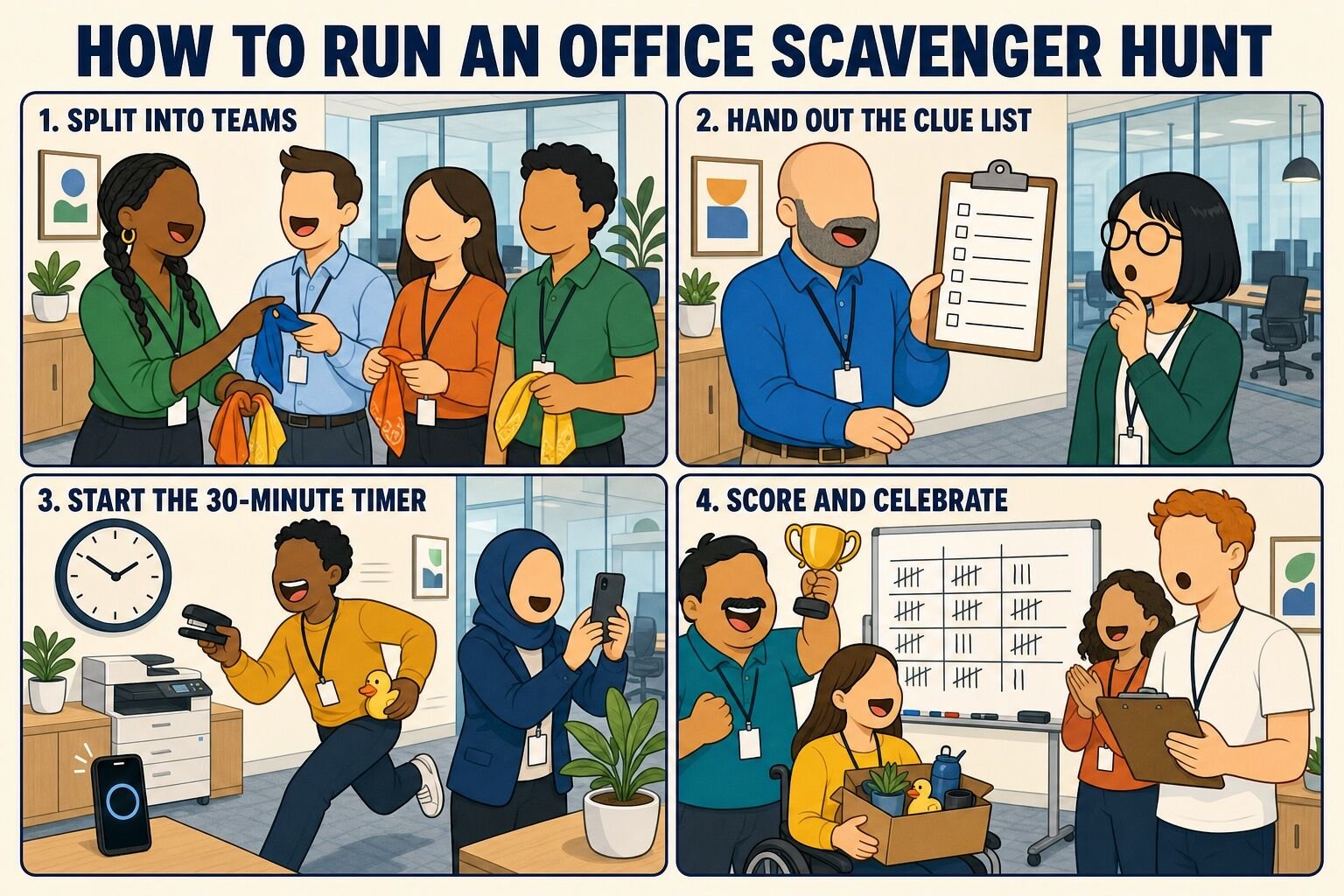
An office scavenger hunt uses the building as the board. Write a list of 15 to 20 items and tasks, mixing physical finds (a stapler older than the intern, a mug from a conference), photo challenges (the whole team in the smallest room in the office), and puzzle clues that point to a location. Split into teams of four, hand out the list, and start a 30-minute timer. Score at the whiteboard: one point per item, bonus points for creativity, and a penalty for anything that came from someone's actual desk without permission.
Best for: 8 to 100+ people Time: 30 to 45 minutes Materials (cost): A printed list and phones for photos (free)
What we've learned: Weight the photo challenges higher than the finds. Teams huddled over a phone comparing photos are laughing; teams sprinting for a stapler are just sprinting.
38. DIY Escape Room
You can build an escape room in a conference room with five or six linked puzzles and a lockbox. Start with a story (the quarterly report has been stolen, the coffee machine has been sabotaged), then chain the clues: a cipher on the whiteboard reveals a page number, the page reveals a code, the code opens a padlock on a box holding the next clue, and the final combination opens the door (or the snack cabinet). Give teams 45 minutes and two hints. Our escape room puzzles and escape room tips guides have puzzle templates and a build checklist.
Best for: 4 to 8 people per room (run rooms in parallel for bigger groups) Time: 45 to 60 minutes plus setup Materials (cost): Padlocks, lockbox, printed puzzles ($30 to $60)
What we've learned: Test the room on two coworkers who did not build it. The puzzle that seems obvious to the designer is usually the one that stalls every team.
39. Escape Room Outing
Commercial escape rooms take the building work off your plate. Most venues hold six to ten people per room and run several rooms at once, so a team of 30 can play in parallel and compare escape times afterward. Book private sessions, mix the teams across departments, and plan food nearby for the debrief, which is where the stories get told.
Best for: 6 to 40 people Time: 60 to 90 minutes Materials (cost): Venue booking ($25 to $45 per person)
What we've learned: Ask the venue for a room rated in the middle of its difficulty range. A room nobody escapes is a frustration, and a room everyone escapes in 20 minutes is a short afternoon.
40. Murder Mystery Party
A murder mystery gives every guest a character, a secret, and a motive. Boxed kits and downloadable scripts handle the plot for eight to twenty players; larger groups work with a hosted version where actors play the suspects and teams compete to solve the case. Send character sheets a few days ahead, encourage a costume piece or two, and run it over dinner in three acts: introductions, the crime, the accusation.
Best for: 8 to 100+ people Time: 90 to 120 minutes Materials (cost): Kit or script ($30 to $80) or a hosted event
What we've learned: Cast the quiet people as the suspects with the best secrets. A big role with a script gives someone who never speaks up a reason to hold the room.
What we've learned from hosting indoor events
Indoor events are the ones most teams plan themselves, which means we see the same mistakes on repeat: the room is wrong, the timing is wrong, or somebody who wanted to play ends up running the show. Here is what the data and our hosts tell us.
In-person team building peaks in September. Across confirmed events on teambuilding.com from 2023 through 2025, in-person events peak in September, which accounts for 12% of annual in-person volume, while virtual events peak in December, which accounts for a third of the year's virtual volume. If you want an indoor event in the fall, book the room early: the same weeks are the busiest for everyone.
Book about a month out. Teams book in-person events a median of 30 days in advance on our platform, compared with 21 days for virtual events. Indoor events need the runway for the venue, the catering, and the headcount, which always changes in the last week.
In-person is growing again. In 2025, virtual events made up 83% of team building bookings on our platform, down from 100% in 2021, with in-person events at 17% and climbing. Most of that in-person growth is indoors: conference-room competitions and game shows, museum hunts, and holiday parties with a hosted activity built in.
Plan for a group of about 16, then scale. Half of all team building events fall between 10 and 27 people, and the games in this guide are written for that range. The table below shows what to change at either end.
Small groups (under 15)
Large groups (30+)
Best formats
Board game tournament, escape room outing, cooking class, lunch and learn, Something in Common
Game show night, Office Olympics, cook-off, charity build, hosted competition
Room
One table where everyone can hear everyone
Round tables of 6 to 8, a microphone, a screen everyone can see
Structure
One activity and one long meal
Rotating rounds every 15 minutes, a visible scoreboard, co-hosts for the far tables
Teams
Pairs or one group
Teams of 6 to 8, mixed across departments
Watch out for
The activity ending before the conversation starts
Dead air between rounds and people drifting to the snack table
The person running it does not get to play. This is the quiet cost of DIY indoor events. Whoever keeps score, reads the questions, and manages the timer is working, not bonding. For a 30-minute game that is fine; for a 90-minute event, hire a host or rotate the job so the organizer gets at least one round in the game.
Fun is not a soft metric. A review of workplace-fun research in Human Resource Management Review (Michel, Tews and Allen, 2019) concluded that fun at work has generally demonstrated benefits for individuals and organizations, and in a related field study of 195 restaurant servers, manager support for fun reduced employee turnover. Our own numbers point the same way: 41% of the companies that book one event on teambuilding.com come back to book at least one more.
Keep it stealthy. Our hosted events are built on what we call stealth team building: participants come for the games and the laughter, and leave having practiced communication, collaboration, and connection without a formal training frame. The indoor games that work best follow the same pattern. Nobody needs to be told that the Marshmallow Tower is a lesson in prototyping; they figure it out at the debrief.
Indoor team building ideas we don't recommend
The internet is full of indoor team building lists that recycle the same ideas, including a few we published years ago and have since retired. Here is the Lame List: activities that read well and play badly in a real office.
The Lame List
Activity
Why skip it
Verdict
Trust falls
The cliché that made "team building" a punchline. Anxiety for the faller, awkwardness for everyone else, and no game to hide behind.
Skip it
Assassins with plastic spoons
A week-long game where coworkers stalk each other through the office distracts the people playing and unsettles the people who are not. We listed it once; we were wrong.
Skip it
Human chess
An hour of setup so that 32 people can stand on a taped grid while two people make decisions. Everybody else is a piece.
Skip it
Truth or Dare
The interesting dares cross professional lines, and the workplace-safe versions are not much fun. If you want the question half, use icebreaker questions instead.
Skip it
Office pranks and desk makeovers
Wrapping a coworker's cubicle in foil is funny to the wrappers. The person whose desk it is now has an afternoon of cleanup and a reason to skip the next event.
Skip it
Movie afternoons
Two hours facing a screen in the dark is a nice perk and a bad team building event, because nobody interacts. Pair it with a game beforehand.
Not team building
Karaoke at work
Two people love it, ten people dread it, and the people who dread it are the ones you were trying to include.
Opt-in only
Rage rooms
Smashing printers with a bat is memorable and genuinely fun for some. It is also loud, physical, and a strange message to send from HR. Keep it a voluntary outing, not the team event.
Opt-in only
DIY ropes course in the office
Balance beams made from furniture and "tightropes" across the break room are how someone ends up in urgent care. Use a real indoor ropes course with staff and harnesses.
Book a venue
Question tag by email
A game that lives in the inbox dies in the inbox. Ask the questions out loud in a meeting instead.
Skip it
Unstructured happy hours
A bar tab and a room is a social hour where the same three people talk. Add a 20-minute game at the start or it is not team building.
Add structure
Final thoughts
The best indoor team building activities are simple: a clear game, a role for everyone, and someone who keeps the energy up. You do not need a ballroom or a big budget. A conference room, a whiteboard, and one of the games above will get a team laughing together within ten minutes, rain or shine, and that is the whole point.
Answers based on indoor events we have hosted and platform data from confirmed team building bookings.
What are indoor team building activities?
Indoor team building activities are games, events, and exercises that coworkers do together inside, such as trivia showdowns, cook-offs, office scavenger hunts, escape rooms, and improv shows. They take place in conference rooms, office common areas, rented event spaces, or venues like museums and bowling alleys, and they can be hosted by a company like teambuilding.com or run yourself with a few supplies.
What are the best indoor team building activities for large groups?
The best indoor team building activities for large groups let everyone play at the same time and use a host with a microphone and a scoreboard everyone can see. Company game show nights, Office Olympics, cook-offs, charity builds, and hosted competitions like The Great Guac Off (15 to 1,000 people) all scale well. Seat groups of 30 or more at round tables of six to eight, mixed across departments, and change the game every 15 minutes.
How much does indoor team building cost?
Hosted indoor Originals on teambuilding.com run $50 to $100 per person, for example Ultimate Trivia Showdown at $50, The Great Guac Off at $80, and the Museum Hack Scavenger Hunt at the Met at $100 with admission included. DIY games like a lightning scavenger hunt, Office Feud, charades, and the human knot are free, and Minute to Win It or a marshmallow tower challenge costs $15 to $40 in supplies. Venue outings such as escape rooms, bowling, and climbing gyms typically cost $20 to $50 per person.
What are quick indoor team building activities for meetings?
Quick indoor team building activities that fit in the first ten minutes of a meeting include a This or That standoff (everyone moves to the side of the room that matches their answer), Best Thing on My Desk (each person tells the story of one object from their desk), Rose, Bud, Thorn check-ins, and a paper airplane contest. None of them need supplies beyond the conference room you are already in.
How far in advance should we plan an indoor team building event?
Teams book in-person events a median of 30 days in advance on teambuilding.com, compared with 21 days for virtual events, so plan about a month out for the venue, catering, and headcount. In-person events peak in September, and December is the busiest month for team building overall, so reserve rooms and hosts earlier in the fall and consider a January date if the December calendar is full.
Does indoor team building actually work?
The most-cited meta-analysis on the question, published in Small Group Research in 2009, found team building has a moderate positive effect on team outcomes overall, with the strongest effects on how teammates feel about the team and how they work together, and with goal setting and role clarification the most effective components. In our own data, 41% of companies that book one team building event on teambuilding.com return to book at least one more.














Comments (0)
Leave a Comment