
25 Communication Games for Teams That Fix Real Problems
Communication games make invisible problems visible in fifteen minutes. Here are the 25 our hosts keep using, with instructions, group sizes and debrief questions.
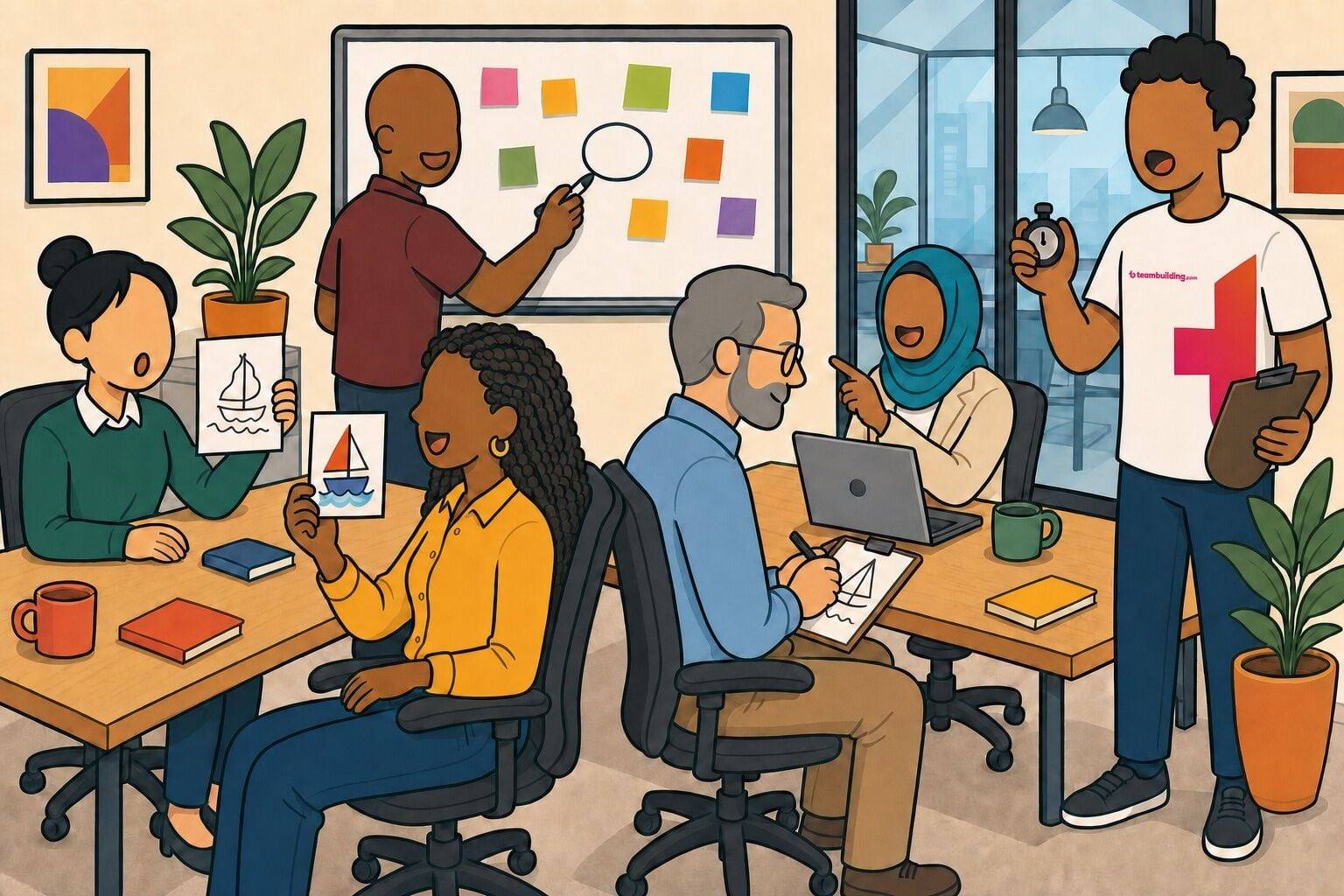
Communication games make invisible problems visible in fifteen minutes. Here are the 25 our hosts keep using, with instructions, group sizes and debrief questions.
Most of what gets called a "communication problem" at work is not a personality clash. It is someone giving instructions based on what is already in their own head, a listener who nods instead of asking, and a meeting where four people talk and eleven do not. Communication games make those gaps visible in about fifteen minutes, with laughter instead of a performance review.
We run team building for a living. As of September 2026, we have hosted 45,000+ Originals events for more than 1,000,000 participants, earning 83,000+ reviews averaging 4.96 out of 5. Communication mechanics sit underneath most of those events, and our hosts have watched the same games land or flop across thousands of rooms.
The 25 games below are the ones that keep earning their slot. We cut six from the previous version of this list, rewrote the instructions for the rest so you can actually run them, and added ten formats our hosts use that were not here before.
Communication games are activities that give teammates structured practice at exchanging information: giving instructions, listening closely, reading body language, and checking that a message landed the way it was sent. Examples include Can You Hear Me Now?, Back-to-Back Drawing, and Telephone. The purpose of these games is to surface miscommunication in a low-stakes setting, so the habits people build carry back into briefs, standups, and handoffs. They are also called "communication exercises for teams," "communication activities," "communication skills games," and "communication team building exercises."
Communication games are a category of team building games and a subcategory of team building activities. They are similar to collaboration games, problem solving games, teamwork games, trust building activities, and connection games. Within the category, this guide includes communication team building activities, quick communication exercises, listening games, nonverbal communication games, and versions built for large groups and video calls.
This list includes:
Here we go!
Every game on this list is free, and most need nothing but paper. Use the table to find one that fits your group size and the time you have.
| Activity | Best for | Group size | Time | Cost |
|---|---|---|---|---|
| Can You Hear Me Now? | Giving precise instructions | 5–30 | 15–30 min | Free |
| Back-to-Back Drawing | Describing and listening in pairs | 4–40 | 20 min | Free |
| Blind Build | Team briefing and handoffs | 6–30 | 25 min | Free |
| Minefield | Trust and direction-giving | 6–24 | 20–30 min | Free |
| Frostbite | Leading without doing | 8–30 | 30 min | Free |
| In So Many Words | Being concise | 3–50 | 10–15 min | Free |
| The Robot | Assumptions in instructions | 4–30 | 10–15 min | Free |
| Jargon Jail | Plain language at work | 4–25 | 15 min | Free |
| The 30-Second Update | Status updates and standups | 4–20 | 15–20 min | Free |
| Say It With Feeling | Tone and emotional read | 4–20 | 15 min | Free |
| Three-Minute Listen | Active listening | 4–100+ | 15 min | Free |
| One-Word Story | Attention and building on ideas | 5–20 | 10 min | Free |
| Mad Gab | Listening for meaning, not sound | 4–30 | 15 min | Free |
| Taboo | Explaining around a blocker | 4–20 | 20 min | Free or $20 deck |
| Describe the Word | Fast, precise description | 3–30 | 10 min | Free |
| Tree or Bob Ross? | Asking better questions | 3–20 | 10–20 min | Free |
| Charades | Nonverbal expression | 6–40 | 20–30 min | Free |
| Mirror | Reading body language | 4–40 | 10 min | Free |
| Lip Reading Liars | Context without audio | 6–25 | 20 min | Free |
| Reverse Charades | Group nonverbal coordination | 8–60 | 20 min | Free |
| Telephone | How messages degrade | 8–100+ | 10 min | Free |
| Birthday Lineup | Silent coordination at scale | 10–100+ | 10 min | Free |
| Broken Squares | Noticing what others need | 10–100+ | 30 min | Free |
| Guess the Emoji | Written and remote teams | 4–100+ | 10–15 min | Free |
| Chat Waterfall | Equal airtime on video calls | 6–200+ | 5–10 min | Free |
These are the full-length formats: enough structure to fill a 20 to 30 minute block, and enough friction to produce a real lesson. Each one puts information in one person's head and requires them to move it into someone else's.
Can You Hear Me Now? is a communication game our team developed for one of our hosted events, and it is the fastest way we know to prove that clear instructions are harder than they look.
To play:
Best for: 5 to 30 people
Time: 15 to 30 minutes
Materials (cost): Paper, pens, and a few printed picture cards (free)
What we've learned: The scoring is what makes it work. Because the Reader earns points from other people's drawings, they stop performing and start adapting, which is exactly the behavior you want from anyone writing a brief.
Back-to-Back Drawing is the pair version of the same idea, and it is the single most common communication exercise in corporate workshops for good reason.
To play:
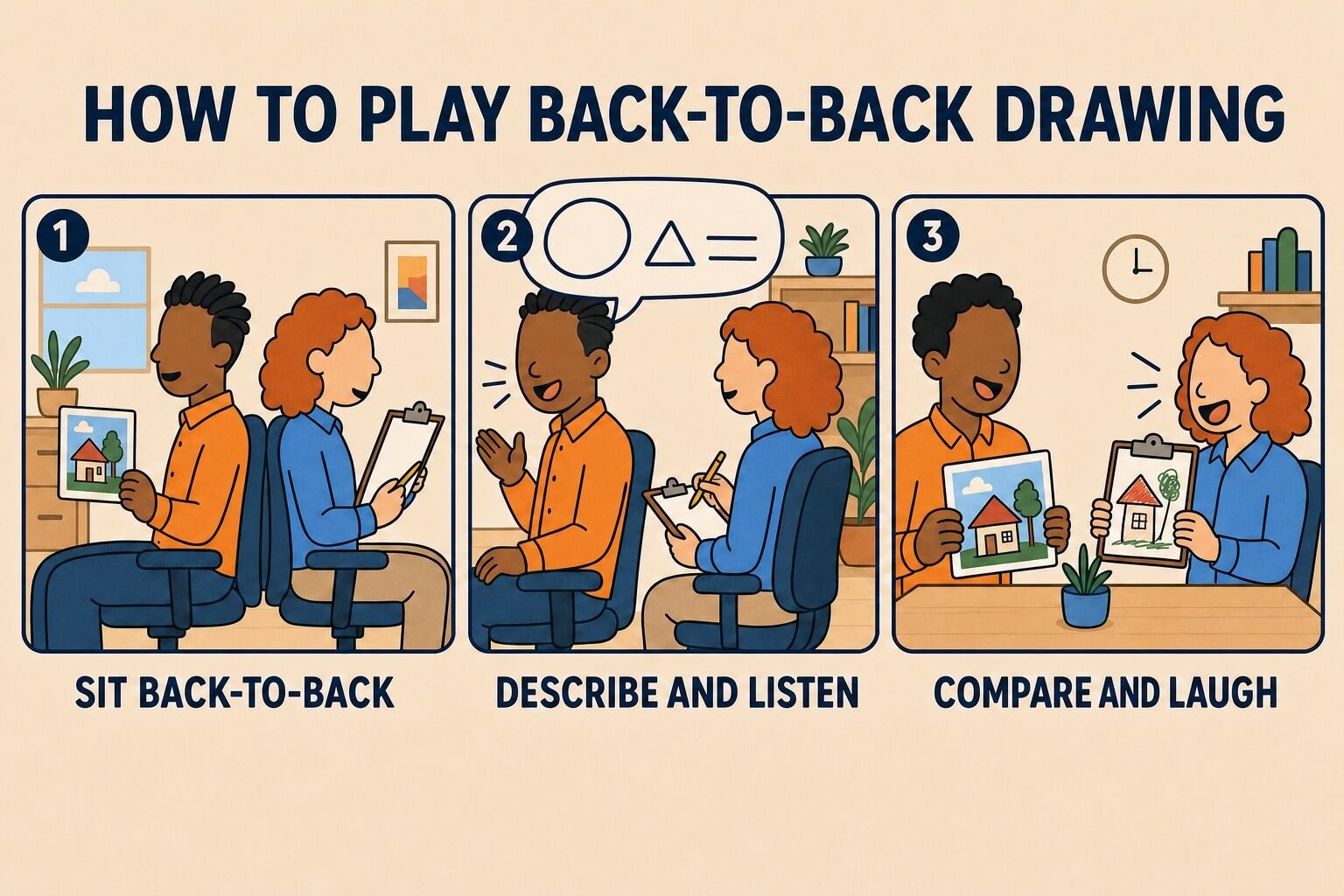
Best for: 4 to 40 people
Time: 20 minutes
Materials (cost): Printed images, paper, pens (free)
What we've learned: Blind drawing games are much harder than they sound. People tend to give instructions based on what they already know the image looks like, rather than what the listener actually needs to hear, which is exactly the communication gap the game exposes. Running the silent round first and the question round second makes the point without anyone having to say it out loud.
Blind Build takes the drawing games into three dimensions, which makes vague language much more expensive.
To play:
Best for: 6 to 30 people
Time: 25 minutes
Materials (cost): Two matching sets of blocks or stacked cups per team (free if you raid the supply closet)
What we've learned: The teams that win are almost never the ones with the best memory. They are the ones who agree on shared vocabulary in the first minute, deciding what "the tall piece" and "the base" mean before anyone starts building.
Minefield is the classic blindfolded obstacle course, and it is worth keeping because the feedback loop is instant: bad directions produce an immediate, visible bump.
To play:
Best for: 6 to 24 people
Time: 20 to 30 minutes
Materials (cost): Blindfolds and soft obstacles (free)
What we've learned: Always station a spotter and use soft objects only. A course that feels risky makes the blindfolded partner walk with their hands out and their ears closed, and the exercise stops being about communication.
Frostbite is a survival scenario that separates the person who knows what to do from the hands that can do it. It is one of our favorite team building challenges for new managers.
To play:
Best for: 8 to 30 people
Time: 30 minutes
Materials (cost): Card stock, tape, straws, blindfolds, a fan (about $10 per team)
What we've learned: New leaders almost always over-instruct at the start and go quiet at the end, right when their team needs the most guidance. Naming that pattern in the debrief lands harder than any slide about delegation.
These are short drills rather than games. Each targets one specific habit, takes 10 to 20 minutes, and slots neatly into the front of a regular meeting.
In So Many Words teaches people to cut a message down without losing it.
To play:
Best for: 3 to 50 people
Time: 10 to 15 minutes
Materials (cost): Paper and pens (free)
What we've learned: Run it on a real work question rather than a sandwich when the group is senior. The 5-word version of "what does our team do" is often the most useful sentence anyone writes that quarter.
The Robot exposes every assumption hiding inside a set of instructions, and it takes ten minutes.
To play:
Best for: 4 to 30 people
Time: 10 to 15 minutes
Materials (cost): Sandwich supplies (about $10)
What we've learned: Pick a robot with a straight face and a bit of restraint. The exercise works when the literalism is deadpan; it collapses when the robot starts playing for laughs and ignoring instructions that were actually clear.
Jargon Jail is the exercise most directly connected to the way your team already talks. It is a favorite for teams that work across functions, where one department's shorthand is another department's fog.
To play:
Best for: 4 to 25 people
Time: 15 minutes
Materials (cost): Slips of paper and a bowl (free)
What we've learned: The most valuable slips come from the people who have been at the company longest, because their jargon is invisible to them. Ask new hires to pull the terms they heard in their first week and the list writes itself.
The 30-Second Update turns rambling standups into something people can follow. It doubles as a warmup for presentation games and pitch practice.
To play:
Best for: 4 to 20 people
Time: 15 to 20 minutes
Materials (cost): A visible timer (free)
What we've learned: The listener-repeats-it step is the whole exercise. Without it people just practice talking fast; with it they learn which sentence is actually doing the work.
Say It With Feeling is about tone, which is the part of a message that survives longest and gets written down least. It pairs well with emotional intelligence activities.
To play:
Best for: 4 to 20 people
Time: 15 minutes
Materials (cost): Index cards (free)
What we've learned: Specific emotions beat broad ones every time. "Angry" produces the same shouted line from everyone, while "trying to seem calm" produces five completely different performances and a much better conversation about email tone.
Most communication training is really speaking training. These three games put the pressure on the listener instead, which is where a surprising number of workplace mix-ups start. For a deeper set, see our guide to active listening activities.
Three-Minute Listen is the simplest exercise on this list and the one teams report back on most often.
To play:
Best for: 4 to 100+ people (it scales because everyone works in parallel)
Time: 15 minutes
Materials (cost): A timer (free)
What we've learned: Banning note-taking is the part people push back on and the part that makes it work. Notes give the listener something to do with their attention; without them, they have to actually stay with the speaker.
One-Word Story forces everyone to listen to the sentence in progress rather than plan their own contribution.
To play:
Best for: 5 to 20 people
Time: 10 minutes
Materials (cost): None (free)
What we've learned: Hand the title to the group rather than choosing it yourself. A story about a real shared experience, like a launch week or an office move, gets far more laughs than a generic fairy tale.
Mad Gab is a listening puzzle disguised as nonsense. Players read out a string of unrelated words that sounds like a familiar phrase when you stop hearing the individual words. It fits nicely alongside other word games.
To play:
Best for: 4 to 30 people
Time: 15 minutes
Materials (cost): A written list of phrases (free)
What we've learned: Make the answer phrases specific to your company. Product names, office nicknames, and the title of whatever all-hands deck everyone is tired of all work, and they get a much bigger reaction than generic idioms.
These games all run on words alone. They are the easiest to set up, the easiest to run in a conference room or on a call, and the best fit for a 10 minute warmup.
Taboo is the best-known game about explaining an idea when your usual words are unavailable, which is most of what cross-functional work involves. If you want more options in this format, see our list of team building board games.
To play:
Best for: 4 to 20 people
Time: 20 minutes
Materials (cost): Homemade cards (free) or a retail deck (about $20)
What we've learned: Making your own deck out of internal terms turns a party game into a genuinely useful exercise. Put "roadmap," "sprint," and your own product names on the cards and watch how differently each department explains them.
Describe the Word is the quickest game here: no cards, no prep, one minute per round. We use a random word so nobody can prepare a clever description in advance.
To play:
Use the generator below to pull words on the fly:
Best for: 3 to 30 people
Time: 10 minutes
Materials (cost): None (free)
What we've learned: Abstract words are better than objects. "Chair" gets guessed in four seconds, while "patience" or "deadline" produces the kind of circling, rephrasing, and checking that the game is actually for.
Tree or Bob Ross? is a guessing game our hosts built around a single strange question, and it quietly teaches people to ask questions that actually narrow the field. See also our roundup of question games.
To play:
Best for: 3 to 20 people
Time: 10 to 20 minutes
Materials (cost): None (free)
What we've learned: Forcing the Thinker to answer even when neither option fits is the point. It mirrors the real skill of giving a useful answer to an imperfect question instead of stalling on "it depends."
Tone, posture, and timing carry a large share of any message, and they are the first things to go missing in a chat thread. These games take words away entirely so the rest of the signal becomes obvious.
Charades earns its place on every list of guessing games because it is the purest test of expressing an idea with no vocabulary at all.
To play:
Best for: 6 to 40 people
Time: 20 to 30 minutes
Materials (cost): Paper slips (free)
What we've learned: Work-specific prompts outperform movie titles. "Explaining the Q3 numbers to the board" or "the printer jams again" get bigger laughs and are far easier to act out than a film half the room has not seen.
Mirror is a two-minute exercise in paying close attention to another person's body.
To play:
Best for: 4 to 40 people
Time: 10 minutes
Materials (cost): None (free)
What we've learned: The leaderless round is the interesting one. Pairs that succeed slow down and make tiny offers; pairs that fail keep trying to take charge, which is a conversation about meetings waiting to happen.
Lip Reading Liars asks players to reconstruct a scene with the sound turned off, which is roughly what everyone does when they read a terse message from a colleague. It works well next to a few improv games.
To play:
Best for: 6 to 25 people
Time: 20 minutes
Materials (cost): Headphones (free)
What we've learned: Give the actors a scene with a clear emotional shift rather than a plot. Interpreters almost always read the relationship correctly and the facts completely wrong, which is a much more interesting finding than either group expects.
Reverse Charades flips the usual format: the whole team acts and one person guesses. It turns a solo performance into a coordination problem.
To play:
Best for: 8 to 60 people
Time: 20 minutes
Materials (cost): Prompt cards (free)
What we've learned: Banning the huddle is what makes this a communication game rather than a charades variant. Teams have to assign roles silently in the first three seconds, and the ones that do it well are visibly different from the ones that all mime the same thing.
Large rooms break most communication exercises, because pairs work in parallel but whole-group games turn into a few people performing for everyone else. These three are built to scale. For more formats that hold a big room, see our list of large group games.
Telephone is the oldest demonstration of message decay there is, and it still lands because everyone is certain they will be the one who passes it on correctly.
To play:
Best for: 8 to 100+ people
Time: 10 minutes
Materials (cost): Paper and pens (free)
What we've learned: One long line of 30 people is a waiting room with a punchline at the end. Parallel lines of six give you several different failure modes to compare, and nobody stands around for ten minutes.
Birthday Lineup is a silent coordination game that works just as well with 15 people as with 150. It is a regular in our collection of large group icebreakers.
To play:
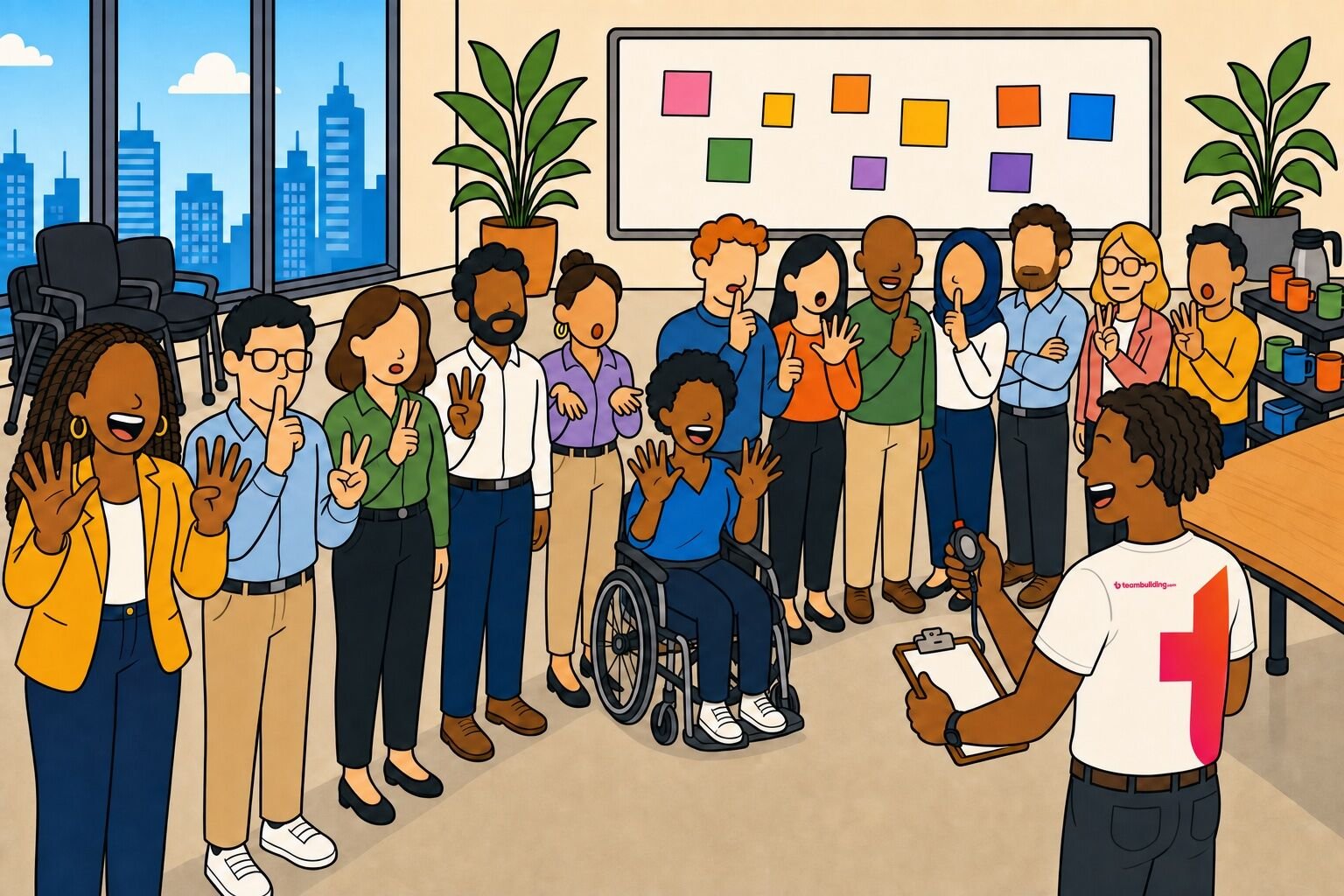
Best for: 10 to 100+ people
Time: 10 minutes
Materials (cost): None (free)
What we've learned: Someone always appoints themselves conductor in the first 30 seconds, and the group sorts twice as fast when they do. The second round, with a criterion nobody can mime easily, is where the real problem-solving happens.
Broken Squares is a classic silent puzzle where the only way to finish is to pay attention to what other people need. It runs in parallel teams, so a room of 100 works as well as a room of 10.
To play:
Best for: 10 to 100+ people (teams of five)
Time: 30 minutes including the debrief
Materials (cost): Card stock and scissors (free)
What we've learned: Most teams stall because one person completes a square early and then stops looking up. The debrief question that gets the best conversation is not "what went wrong" but "who was watching everyone else, and when did they start?"
On a video call you lose peripheral vision, crosstalk, and most body language, so the games that survive are the ones built around a shared screen or the chat box. Most of the exercises above adapt without much work: Can You Hear Me Now?, In So Many Words, Three-Minute Listen in breakout rooms, and Tree or Bob Ross? all play well remotely. For a wider set, see our guide to online team building games.
Guess the Emoji is a written communication game that works on a call or entirely in a chat channel, which makes it the rare activity you can run asynchronously. It is a staple of our Slack games roundup.
To play:
Best for: 4 to 100+ people
Time: 10 to 15 minutes live, or a full day asynchronously
Materials (cost): A chat tool (free)
What we've learned: The bonus point for solvable puzzles matters more than it sounds. Without it, people compete to be cryptic and the channel goes quiet; with it, they compete to be clear, which is the actual skill.
Chat Waterfall is a facilitation technique our hosts use constantly, and it doubles as a two-minute game. It fixes the most common problem on video calls: the same three people answering every question.
To play:
Best for: 6 to 200+ people
Time: 5 to 10 minutes
Materials (cost): Any video call with a chat box (free)
What we've learned: The "do not hit enter" instruction is doing all the work. Once the first three answers appear, everyone else edits toward them, and you end up measuring conformity instead of hearing the room.
A game by itself is a nice twenty minutes. What turns it into an activity that improves communication skills in the workplace is the five minutes after it, and a handful of choices you make before it starts.
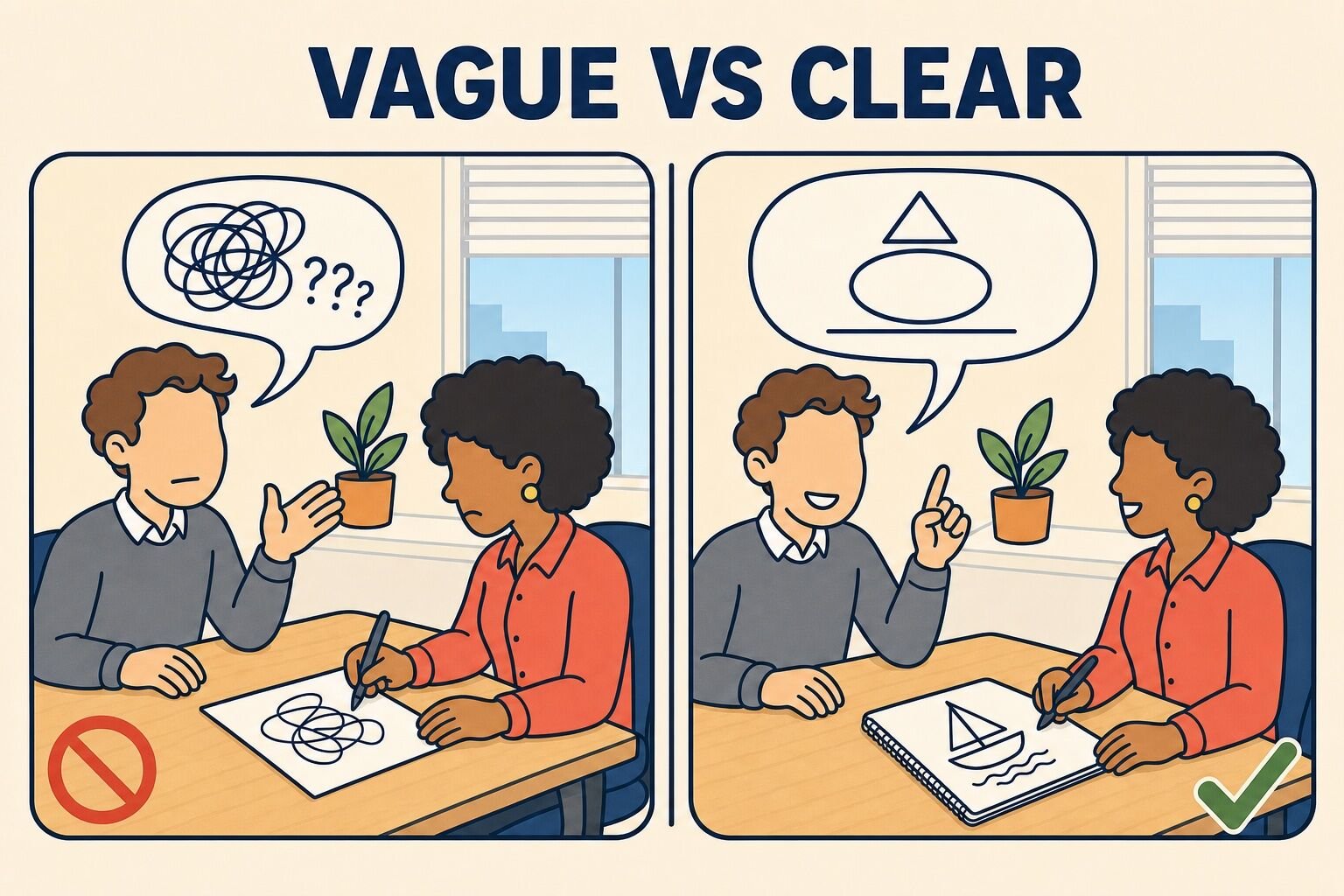
Pick the game for the gap, not the calendar. If handoffs are getting dropped, run Blind Build or The Robot. If your meetings are dominated by two voices, run Chat Waterfall or Three-Minute Listen. If a newly merged team is still speaking two dialects, run Jargon Jail. Choosing at random is how these end up feeling like filler.
Debrief with three questions, not a lecture. What did you assume the other person already knew? What information would have saved you two minutes? Where does this same thing happen in real work? Keep it to five minutes and write the answers where people will see them again.
Make it safe to admit confusion. The debrief only works if people will say "I had no idea what you meant" out loud. In a study of 51 work teams, Harvard's Amy Edmondson found that team psychological safety, a shared belief that the team is safe for interpersonal risk-taking, enables team learning behavior, which in turn drives team performance. The effect runs through learning, not around it, which is a reasonable argument for treating the debrief as the deliverable and the game as the setup.
Our co-founder Michael Alexis puts the same idea in five words on his personal list of life lessons, and it is the sentence we would put above every one of these exercises.
Run them small and often. Fifteen minutes at the start of an existing meeting, once a month, beats a half-day communication workshop nobody remembers by Friday. The games on this list were all sized for that slot on purpose.
A few patterns show up again and again across the rooms our hosts run.
The quiet-room problem is a turn-taking problem. The fix is almost never "encourage people to speak up." It is a mechanic that rotates the floor by design: a timer, a deal of cards, a waterfall. There is research behind this instinct. In studies of 699 people working in small groups, published in Science, Anita Woolley and colleagues found that a group's collective intelligence was not strongly correlated with members' average individual intelligence, but was correlated with members' social sensitivity, equality of conversational turn-taking, and the proportion of women in the group. Every game on this list that works in a big room is, underneath, a turn-taking device.
Pressure produces better communication than practice does. Teams get more out of ten minutes of a timed, scored game than an hour of open discussion about how they communicate. Participants tell us the same thing in their own words.
Group size changes the mechanic, not the lesson. The median team building event we run has 16 participants, and half of all events fall between 10 and 27 people, which is the size most of these games were written for. Bigger and smaller rooms both work, but they need different staging.
| Group size | What changes | Games that fit |
|---|---|---|
| Small (3 to 12) | Everyone is visible, so nobody can hide. You can run a single whole-group game and debrief together. Prompts can be more personal. | Back-to-Back Drawing, One-Word Story, Tree or Bob Ross?, Say It With Feeling |
| Medium (13 to 30) | Split into teams of four to six and run rounds in parallel. One facilitator can still hold the room and run a shared debrief. | Can You Hear Me Now?, Blind Build, Taboo, Jargon Jail |
| Large (30+) | Anything with a single speaker becomes a spectator sport. Use parallel teams, a visible scoreboard, and a co-facilitator per zone. | Birthday Lineup, Broken Squares, Telephone, Reverse Charades |
The debrief beats the game every time. When a team tells us months later that an activity changed something, they quote the conversation afterward, not the scores. If a session is running long, cut a round, not the debrief.
Plenty of activities get filed under "communication" without teaching anybody anything about it. Some are fine games in the wrong category, and a few are actively risky. Here are the ones we skip.
| Activity | Why skip it | Verdict |
|---|---|---|
| Trust falls | There is a real injury risk, opting out is visibly awkward, and falling backwards teaches nothing about how a team exchanges information. | Skip it |
| The Human Knot | It requires sustained hand-holding and contorted body contact, excludes anyone with mobility or sensory considerations, and the talking is incidental to the puzzle. | Skip it |
| Personality-type printouts as the activity | Handing out four-letter labels feels like insight, but it gives people a vocabulary for explaining their habits rather than practice changing them. The letters outlive the workshop. | Skip it |
| Unfacilitated conflict role-plays | Asking coworkers to act out a dispute they actually had, without a trained facilitator in the room, reliably turns a simulated conflict into a real one. | Skip it |
| "No-talking day" challenges | A full day of chat-only work is a productivity tax dressed up as an exercise, and the lesson lands in the first twenty minutes anyway. | Skip it |
| Egg drops and spaghetti towers billed as communication games | They are enjoyable engineering puzzles, but the most confident person still runs the table and the quietest person still hands them tape. | Use for problem solving instead |
| One 30-person line of Telephone | Twenty-eight people wait in silence for a single garbled punchline. The game is good; the staging is not. | Run parallel lines instead |
Communication games work because they make an invisible problem visible in a room where nothing is at stake. Someone gives a set of instructions that made perfect sense in their own head, watches five people draw five different things, and learns more in that moment than in any number of reminders to "over-communicate." Pick the game that matches the gap your team actually has, protect the five minutes afterward, and run it often enough that the vocabulary sticks.
If you would rather have a host run one for you, we have a catalog of virtual and in-person team building activities built on these same mechanics.
Next, browse our lists of conversation games, icebreaker games, and team bonding questions.
Answers to the questions teams ask most often before running these activities.
Communication games are activities that give teammates structured practice at exchanging information: giving instructions, listening closely, reading body language, and checking that a message landed the way it was sent. Examples include Can You Hear Me Now?, Back-to-Back Drawing, and Telephone. The purpose of these games is to surface miscommunication in a low-stakes setting so the habits carry back into briefs, standups, and handoffs. They are also called "communication exercises for teams" and "communication team building activities."
Good communication games for work include Blind Build, Jargon Jail, In So Many Words, The 30-Second Update, and Back-to-Back Drawing. Each one targets a habit that shows up in real work: briefing a team, dropping jargon, being concise, running a standup, and describing something the other person cannot see. All five run in 25 minutes or less with supplies you already have.
Pick the game for the gap your team actually has rather than at random, run it in 15 to 20 minutes at the front of an existing meeting, and protect five minutes at the end for a debrief. Ask three questions: what did you assume the other person already knew, what information would have saved you two minutes, and where does this same thing happen in real work. Teams that skip the debrief remember the game; teams that run it remember the lesson.
The best communication games for large groups are the ones that run in parallel rather than putting one person on stage. Birthday Lineup, Broken Squares, Reverse Charades, and Telephone played in parallel lines of six all work with 30 to 100+ people. Three-Minute Listen scales further still, because every pair works at the same time. Avoid any format where the whole room watches a single speaker.
Chat Waterfall and Guess the Emoji are built for video calls, and Guess the Emoji also runs asynchronously in a chat channel. Can You Hear Me Now?, In So Many Words, and Tree or Bob Ross? all translate without changes, and Three-Minute Listen works in breakout rooms. Games that rely on peripheral vision or crosstalk, like Mirror and Minefield, do not survive the move to a screen.
Comments (0)
Leave a Comment