
20 Morning Meeting Games You Can Run in 5 Minutes or Less
Twenty morning meeting games that fit inside a real agenda, from a two-minute weather check-in to a lightning scavenger hunt, with steps, timing and group size for each.
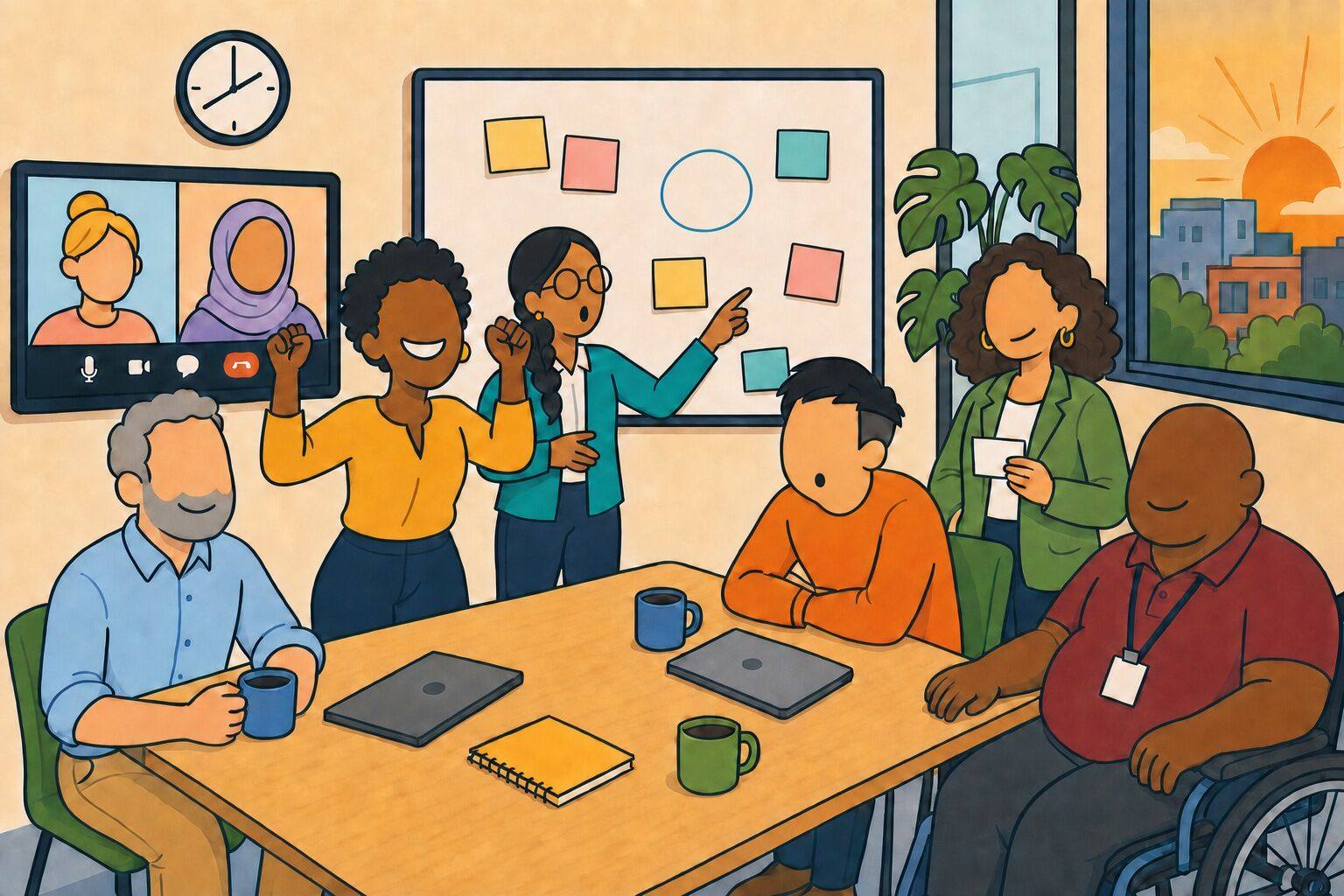
Twenty morning meeting games that fit inside a real agenda, from a two-minute weather check-in to a lightning scavenger hunt, with steps, timing and group size for each.
The first meeting of the day sets the tone for everything after it. Run it as a flat status round and the team clocks in mentally somewhere around 10 a.m. Open with two minutes of something fun and people arrive on time, unmute, and actually talk.
Organizational psychologist Steven Rogelberg, who wrote The Surprising Science of Meetings, reports an estimate of 55 million meetings a day in the United States, and earlier work with colleagues noted that by some estimates senior managers sit in nearly 23 hours of meetings every week. A lot of those meetings happen before 10 a.m. with a room that has not warmed up yet.
As of September 2026, we have run 45,000+ team building events across virtual and in-person formats since 2013, and our hosts open nearly every one of them with a warm-up that takes less time than the coffee line. The games below are the short ones: the openers that fit inside a real agenda instead of replacing it.
Every game on this list runs in five minutes or less, works in a conference room or on a video call, and needs nothing you do not already have. This list includes:
Here we go.
Morning meeting games are short warm-up activities that open the first meeting of the workday, usually lasting two to five minutes. Examples include a one-word check-in, a lightning scavenger hunt, and a rapid-fire trivia question. The purpose is to wake the room up, get every voice into the meeting early, and hand the agenda a group that is already talking.
Morning meeting games are a subcategory of team meeting games and a fast-format branch of icebreaker games. They are similar to large group energizers, virtual meeting games, quick team building activities, and 5 minute team building activities. Within the category you will find morning huddle games, staff meeting games, and virtual morning meeting games. These activities are also called morning huddle ideas, morning meeting energizers, morning meeting activities, fun morning meeting games, and Monday morning meeting ideas.
A morning game is not filler. In a review of the meeting-science literature, Mroz, Allen, Verhoeven and Shuffler recommend that leaders call a meeting only when it is necessary, keep it small, circulate an agenda in advance, start on time, and actively encourage participation from everyone in the room. A two-minute opener is the cheapest way we know to do that last part — it gets every person to speak once before the meeting decides who the talkers are.
Here are all 20 games, with the group size, run time, and what each one is good for.
| Activity | Best for | Group size | Time | Cost |
|---|---|---|---|---|
| Weather Report Check-In | Reading the room | 4–25 | 2 min | Free |
| Countdown Categories | Waking people up | 5–40 | 3 min | Free |
| Guess the Breakfast | Low-stakes conversation | 4–15 | 5 min | Free |
| Simon Says | Movement and focus | 5–50 | 4 min | Free |
| Quote of the Morning | Setting a tone | 3–30 | 4 min | Free |
| Morning Brainteaser | Problem solving | 3–100 | 5 min | Free |
| Yesterday, Today, Tomorrow | Standup structure | 3–12 | 5 min | Free |
| Mystery Metric | Connecting games to the work | 4–30 | 4 min | Free |
| Employee of the Day | Recognition | 5–60 | 5 min | Free |
| Meeting DJ | Starting on time | Any size | 3 min | Free |
| This Date in History | Trivia and debate | 4–40 | 5 min | Free |
| Lightning Scavenger Hunt | Energy and movement | 5–100+ | 5 min | Free |
| Morning Mad Libs | Laughs in a big room | 5–40 | 5 min | Free |
| Pancakes vs Waffles | Debate and decisions | 5–60 | 5 min | Free |
| Would You Rather Lightning Round | Fast participation | 5–100 | 4 min | Free |
| Standing, Sitting, Kneeling | Improv and play | 6–40 | 5 min | Free |
| Icebreaker Roulette | Breakout conversation | 6–100 | 5 min | Free |
| Two-Minute Trivia | Chat participation | 5–200 | 2 min | Free |
| Morning Word Jumble | Screen-share teams | 4–60 | 5 min | Free |
| Wave Stretch | Waking up bodies | 4–30 | 3 min | Free |
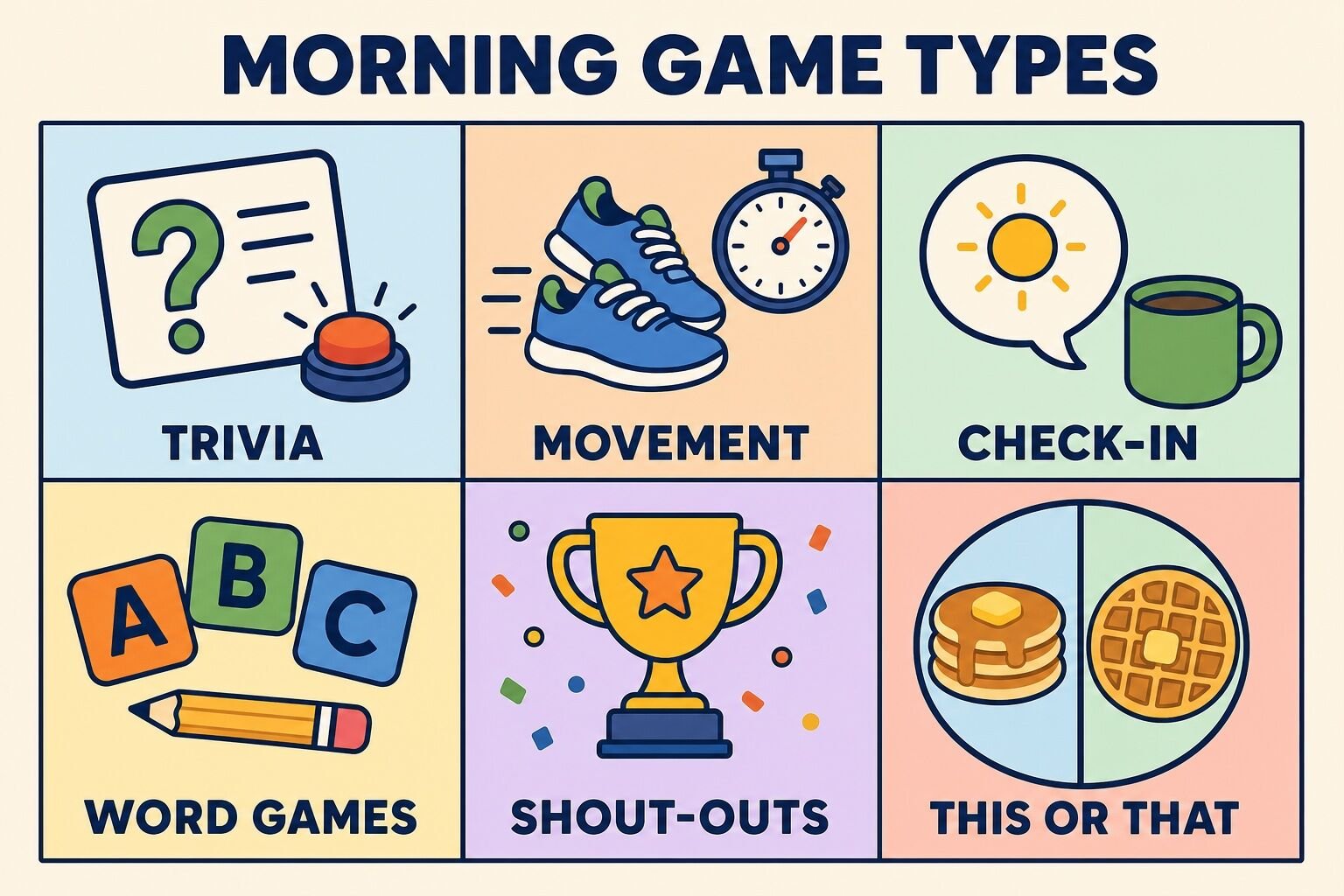
Start here if you have never opened a meeting with a game before. These six need no prep, no props, and no explanation longer than a sentence.
Weather Report Check-In is the fastest way to find out how a team is actually doing. Instead of asking "how is everyone," ask each person to describe their morning as a weather forecast.
Best for: 4 to 25 people
Time: 2 minutes
Materials (cost): None (free)
What we've learned: The metaphor is doing real work here. Our founder's life-lessons list includes answering "how are you?" with context beyond "good," which turns a throwaway greeting into a connection point. A weather forecast gives people permission to say "partly cloudy" on a day when "good" would have been a lie.
Countdown Categories is a 30-second shouting match that works like a shot of espresso for a quiet room.
Best for: 5 to 40 people
Time: 3 minutes
Materials (cost): A timer (free)
What we've learned: When we mine our event reviews for what participants actually loved, competition comes up again and again — points, buzzers, leaderboards, and team names. Keeping a running record turns a warm-up into a small rivalry with last Tuesday.
Guess the Breakfast is a three-question deduction game built around the only thing everyone in a morning meeting has in common.
Best for: 4 to 15 people
Time: 5 minutes
Materials (cost): None (free)
What we've learned: Food is the safest subject in the building. Everyone has an answer, nobody has to disclose anything personal, and the funniest rounds come from the people who skipped breakfast entirely.
Simon Says is the oldest trick on this list and still the most reliable way to get a sleepy group moving before nine.
Starter commands that work at a desk or in a conference room:
Best for: 5 to 50 people
Time: 4 minutes
Materials (cost): None (free)
What we've learned: Run it standing. The physical reset is the whole point, and a group that has already stood up once is noticeably more willing to speak during the agenda.
Quote of the Morning is a guessing game that doubles as a tone-setter for the day.
Best for: 3 to 30 people
Time: 4 minutes
Materials (cost): None (free)
What we've learned: The discussion beats the guessing. Teams that skip the closing question end up with a trivia game; teams that keep it end up with a 60-second conversation about how the team wants to work.
A Morning Brainteaser gives the group one hard thing to chew on before the easy things start.
For puzzles that hold up with adults, borrow from our list of problem solving games.
Best for: 3 to 100 people
Time: 5 minutes
Materials (cost): None (free)
What we've learned: Pick puzzles where the answer is satisfying rather than clever. If the reveal makes people groan instead of laugh, the group will not play again next week.
A daily huddle has less room to spare than a weekly meeting, so the best morning huddle games attach themselves to the work instead of interrupting it. Each of these five can share a slot with the status round.
Yesterday, Today, Tomorrow is the standup format turned into a game by adding one extra square.
Best for: 3 to 12 people
Time: 5 minutes
Materials (cost): A timer (free)
What we've learned: The "tomorrow" square is what makes this worth playing. Yesterday and today are a status report; tomorrow is where two people discover they are both planning to touch the same thing.
Mystery Metric is a guessing game we started running in our own internal huddles, and it is the rare warm-up that makes the dashboard more interesting.
Best for: 4 to 30 people
Time: 4 minutes
Materials (cost): None (free)
What we've learned: Rotate who chooses the number. When the metric comes from a different team every week, people learn what the rest of the company actually counts.
Employee of the Day is peer recognition squeezed into a five-minute slot, and it is the item on this list most likely to become a permanent ritual.
For ways to make the ritual stick beyond the meeting, see our guide to employee recognition programs.
Best for: 5 to 60 people
Time: 5 minutes
Materials (cost): None, or an optional small gift card
What we've learned: Read the reasons out loud. A name by itself is a formality; "she stayed on the call for 40 minutes after hours so the customer did not have to restart" is the part people remember.
Meeting DJ costs almost no meeting time at all, because it happens while people are still filing in.
Best for: Any group size
Time: 3 minutes
Materials (cost): A speaker or shared audio (free)
What we've learned: The walk-in song is a punctuality tool disguised as a game. People show up early to hear the pick, and the meeting starts on time without anyone having to police it.
This Date in History is a 60-second trivia round that gives the group something to argue about before the agenda does.
On This Day is a quick source for the three real events, as long as players do not peek.
Best for: 4 to 40 people
Time: 5 minutes
Materials (cost): None (free)
What we've learned: Make the fake fact boring. An outlandish invention is spotted instantly; a plausible one splits the room and produces the debate you actually wanted.
Once a meeting passes about 15 people, turn-taking games stop working. One round of 30 people eats the whole meeting. These staff meeting games keep everyone participating at once instead.
The lightning scavenger hunt is a format our hosts designed for large hosted events, and it shrinks neatly into a five-minute meeting opener.
Best for: 5 to 100+ people
Time: 5 minutes
Materials (cost): Whatever is already in the room (free)
What we've learned: Cap it at five prompts. Energy peaks on round two or three and then drops fast, so the trick is ending while people still want another one. In rooms above 40, award points to a team rather than a person, otherwise the same three sprinters win every round.
Morning Mad Libs is a fill-in-the-blank story that turns a big quiet room into a loud one, because everyone contributes a word and nobody has to perform.
Here is a starter template you can copy into your notes:
It was a [adjective] Monday morning. I arrived at the office at [number] o'clock, carrying a [adjective] cup of [noun]. My manager asked me to [verb] the quarterly [plural noun] before lunch, so I [verb ending in -ed] straight to my desk, where my [noun] had already [verb ending in -ed] all over my [body part]. Classic [day of the week].
Best for: 5 to 40 people
Time: 5 minutes
Materials (cost): A printed or on-screen template (free)
What we've learned: Take words from as many different people as possible instead of the first three voices. A story built by twelve contributors gets a bigger laugh than one built by three, because everyone is waiting to hear their own word land.
Pancakes vs Waffles is a debate game from our hosted events, and it scales to any room because the whole group votes at the same time.
Best for: 5 to 60 people
Time: 5 minutes
Materials (cost): None (free)
What we've learned: Inconsequential topics beat serious ones. People can argue with ridiculous conviction about breakfast foods without dragging politics or an old workplace disagreement into an 8:45 meeting.
A Would You Rather Lightning Round gets 100 people to participate in four minutes, because answering takes one hand instead of one turn.
Our list of question games has more prompts you can lift directly.
Best for: 5 to 100 people
Time: 4 minutes
Materials (cost): None (free)
What we've learned: The "why" is where the personality shows up. One explanation per prompt is the right amount. Ask for more and you have accidentally started a turn-taking game.
Standing, Sitting, Kneeling is a classic improv game that puts three volunteers on their feet while everyone else directs.
Best for: 6 to 40 people (3 players plus an audience)
Time: 5 minutes
Materials (cost): None (free)
What we've learned: Give the scene a boring setting. Actors have enough to manage with the position rule, and the comedy comes from ordinary people rearranging themselves for no reason.
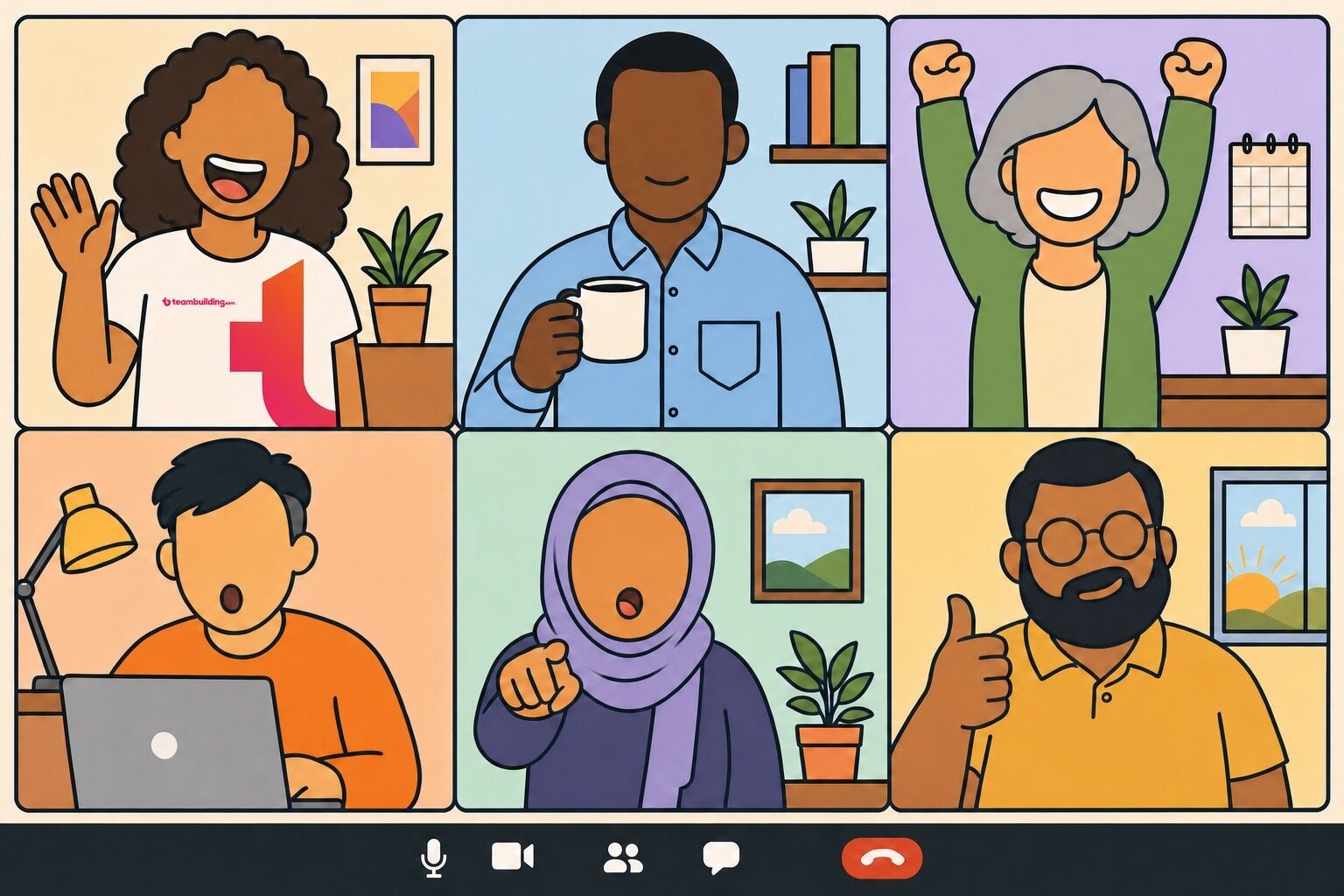
On a video call, the failure mode is different: nobody is asleep, they are just muted with the camera off. These four virtual morning meeting games are built for chat, breakout rooms, and screen share. For longer remote sessions, see our virtual energizers.
Icebreaker Roulette sends the whole call into tiny breakout rooms and lets a random generator do the facilitating.
If you would rather pick the prompts yourself, our list of icebreaker questions is sorted by theme.
Best for: 6 to 100 people
Time: 5 minutes
Materials (cost): A video platform with breakout rooms (free)
What we've learned: Use rooms of three, not six. In a room of three there is nowhere to hide, so the person who would have stayed muted for an hour ends up talking within 20 seconds.
Two-Minute Trivia is one question, answered by everybody at once, with a rule that makes the chat box work properly.
Our collection of virtual trivia ideas has categories to pull from all week.
Best for: 5 to 200 people
Time: 2 minutes
Materials (cost): None (free)
What we've learned: The "do not press enter yet" rule is the whole game. Without it, the first answer in chat spoils the round for everyone still thinking, and participation collapses to whoever types fastest.
A Morning Word Jumble gives the group a puzzle they can solve together over screen share.
For more puzzles in this family, see our list of word games.
Best for: 4 to 60 people
Time: 5 minutes
Materials (cost): Screen share (free)
What we've learned: Theme the words to something happening that day. A jumble of the five features shipping on Thursday is a warm-up and an agenda preview at the same time.
Wave Stretch is a silent, camera-on stretch that passes from person to person like a wave in a stadium.
For a longer version of the same idea, see team building yoga.
Best for: 4 to 30 people
Time: 3 minutes
Materials (cost): None (free)
What we've learned: The no-talking rule is what makes it work. Silence forces everyone to actually watch each other on screen, which is the opposite of what a normal video call trains people to do.
Not every opener needs a winner. Some mornings call for a ritual instead, especially on days when the agenda is heavy. These morning meeting activities take the same two to five minutes and carry no competitive pressure.
A weekly meeting has more room than a daily huddle, but that is exactly why it drifts. The fix is to budget the fun rather than improvise it.
For a Monday kickoff, we would spend that budget on one longer game plus a recognition moment: Pancakes vs Waffles for three rounds, then Employee of the Day for the week's first shout-out. For a Friday wrap, flip it: recognition first, then something loose like Morning Mad Libs.
If your weekly meeting can spare more than five minutes, our lists of 15-minute team building activities and office games pick up where this one stops.
Across 45,000+ events, the single most useful thing we can tell you about morning games is that group size changes everything and start time changes less than people assume.
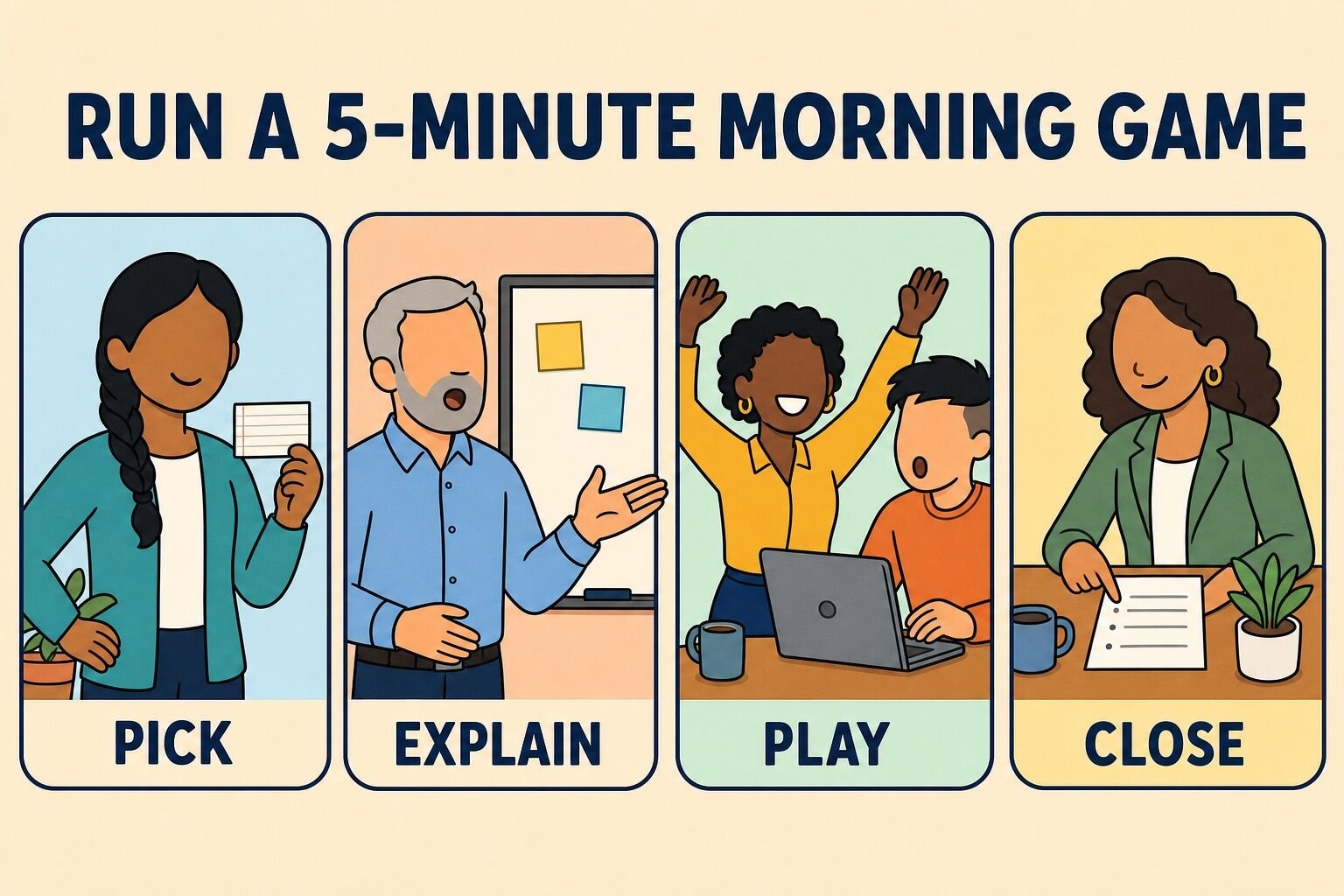
The median team building event we run has 16 participants, and half of all events fall between 10 and 27 people. That median is a useful benchmark for meeting games too, because the mechanics that work at 16 are not the mechanics that work at 60.
| Group size | What changes | Games that work best |
|---|---|---|
| Small groups (3–15) | Everyone can take a turn inside five minutes, and silence is uncomfortable enough that people fill it. Connection games work here: six people can discover something unusual they share. | Weather Report Check-In, Guess the Breakfast, Yesterday, Today, Tomorrow |
| Large groups (16+) | Turn-taking breaks. You need simultaneous participation — votes, chat, hands up — or breakout rooms, plus one clear emcee voice. Sixty people will not discover what they have in common. | Would You Rather Lightning Round, Two-Minute Trivia, Lightning Scavenger Hunt |
Four more things we would tell a manager running their first one:
One counterintuitive note from our own booking data: hosted team building events are an afternoon habit, with most starting between 2 p.m. and 4 p.m. local time. Mornings are almost entirely do-it-yourself territory, which is exactly why a short, repeatable, no-budget format matters more here than a big production.
We have run enough of these to know which ones land badly before nine. Some of the entries below are games we used to recommend ourselves, and a few are things we published years ago that we would not publish today.
| Activity | Why skip it | Verdict |
|---|---|---|
| Follow the leader dance-off | Dancing alone on camera or in front of a conference table puts enormous pressure on individuals, and an elimination format means the least comfortable people are out first and embarrassed about it. | Skip it |
| Mock interview guessing games | Five to ten questions per round means one round uses your entire five minutes, and only two people are actually playing. | Too slow |
| Morning crossword puzzles | Crosswords are a solitary, quiet activity. A group of people filling in a shared grid produces four minutes of silence and one person typing. | Not a group game |
| Never Have I Ever | The game runs on personal disclosures and carries drinking-game baggage. Neither belongs in a Tuesday standup. | Skip it |
| Two Truths and a Lie | It needs prep from every participant and a full turn each, so a team of 20 is looking at 15 minutes. Save it for onboarding week. | Usually skip |
| Virtual karaoke | Video-call latency makes singing together impossible, and solo karaoke at 9 a.m. is a lot to ask of anyone. | Skip it |
| Home office tours | Asking remote teammates to walk a camera around their home blurs a line some people would rather keep, and it quietly penalizes whoever has the smallest apartment. | Skip it |
| "Add something new to your background" games | Any game that requires homework before the meeting will have a 40% participation rate by week two. | Needs prep |
| Company history trivia | It rewards tenure and quietly tells every new hire they are an outsider. If you want company trivia, make the answers findable. | Rework it |
| Trust falls | A physical-risk exercise before coffee, with real liability, and no evidence it builds anything. There is no morning version of this that works. | Never |
Morning meetings are rough on late risers, and a room that is not awake yet will not disagree with anything, which is the most expensive thing a meeting can do. Two minutes of a game fixes more of that than another line on the agenda ever will. Pick one from this list, run it in the same slot every day for three weeks, and let the team tell you which ones to keep.
If you would rather hand the whole thing to someone else for an hour, we host virtual and in-person team building activities with a host who does the facilitating for you.
Next, check out our lists of one minute games, video call games, and large group icebreakers.
Answers to the questions managers ask us most about opening a meeting with a game.
Morning meeting games are short warm-up activities that open the first meeting of the workday, usually lasting two to five minutes. Examples include a one-word check-in, a lightning scavenger hunt, and a rapid-fire trivia question. The purpose is to wake the room up, get every voice into the meeting early, and hand the agenda a group that is already talking.
Five minutes or less. A useful budget is about 8% of the meeting for fun, which works out to roughly 10 minutes of icebreakers plus 5 minutes of recognition inside a 60-minute agenda, and proportionally less in a 15-minute daily huddle. If the rules take longer than a sentence to explain, the game has already used its slot.
For 16 people or more, use games where everyone participates at the same time instead of taking turns. Would You Rather lightning rounds, two-minute chat trivia, Pancakes vs Waffles votes, and lightning scavenger hunts all work at scale. Turn-taking games like Yesterday, Today, Tomorrow work best under about 15 people, which is roughly where our own events shift from personal rounds to structured hosting.
The best virtual morning meeting games are built for chat, breakout rooms and screen share. Icebreaker Roulette sends people into breakout rooms of three with a random question generator, Two-Minute Trivia has everyone type an answer in chat and send it at once, Morning Word Jumble runs over screen share, and Wave Stretch passes a silent stretch around the camera grid.
Use rooms of three rather than six in breakouts, ask for answers everyone gives at the same time rather than one at a time, and let people pass without explaining. Meeting research recommends that leaders actively encourage participation from all attendees, and a two-minute opener does it by getting every person to speak once before the meeting decides who the talkers are.
Skip dance-offs and karaoke, which put individuals under camera pressure; Never Have I Ever, which runs on personal disclosures; crosswords, which are a solitary activity; trust falls, which carry real physical risk; and any game that requires people to prepare something before the meeting, since participation collapses by the second week.
Comments (0)
Leave a Comment