43 Outdoor Team Building Activities, Games & Events Teams Actually Love
Outdoor team building activities, games, sports and events for work teams, from hosted city scavenger hunts and field days to free games you can run in a park, with pricing and planning lessons from 45,000+ events.
Published
·
Updated
We have been running team building events since 2013, when our sister company Museum Hack started leading renegade tours through the Metropolitan Museum of Art. Some of those groups asked for the same energy outside the museum walls, and the High Line Scavenger Hunt was born. As of August 2026, teambuilding.com has hosted 45,000+ events for more than 1,000,000 participants, earning 83,000+ reviews with an average rating of 4.96 out of 5.
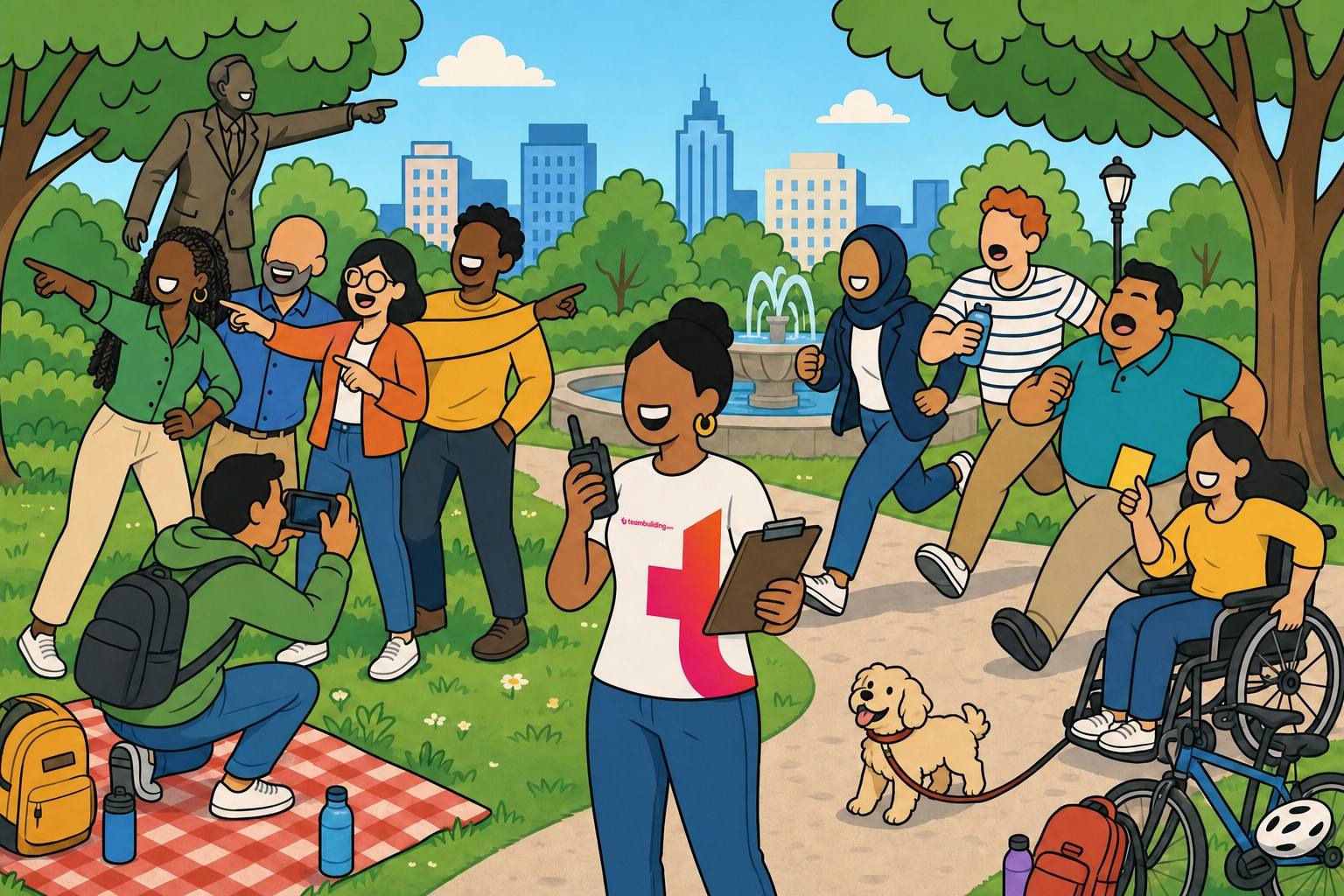
A meaningful share of those events happen outdoors: photo scavenger hunts through city landmarks, field days on rented sports fields, and team picnics with hosted games. We also plan plenty of outdoor events for our own remote team when we meet up in person. This guide collects what we have learned, plus the games and activities our hosts actually run, so you can plan an outdoor team building event that people talk about for the right reasons.
Prefer to watch? This video walks through some of our favorite outdoor team building activities:
What is outdoor team building?
Outdoor team building activities are games, events, and exercises that groups do together outside, usually in a park, on a sports field, at a beach, or on city streets. Example activities include photo scavenger hunts, field days, capture the flag, and team hikes. The purpose of these activities is to get coworkers moving, talking, and solving problems together away from their desks. These ideas are also called "outdoor team activities," "outdoor group activities for adults," "outdoor corporate events," "team building outside," and "outdoor team bonding activities."
Getting outside does more than change the scenery. In a series of Stanford experiments published in the Journal of Experimental Psychology (Oppezzo and Schwartz, 2014), walking boosted creative idea generation by an average of around 60% compared with sitting, and in the first experiment 81% of participants were more creative while walking. That is a good argument for taking the next brainstorm to the park, and it is why several of the ideas below are built around simply moving together.
The best outdoor team building activities you can book
Hosted outdoor events solve the two problems that sink most DIY attempts: nobody on your team has to run the games, and the energy does not depend on the one extrovert in the group. Our outdoor Originals are led by trained hosts who bring the supplies, keep score, and handle the logistics. Here are the two formats teams book most, followed by our city scavenger hunt series.
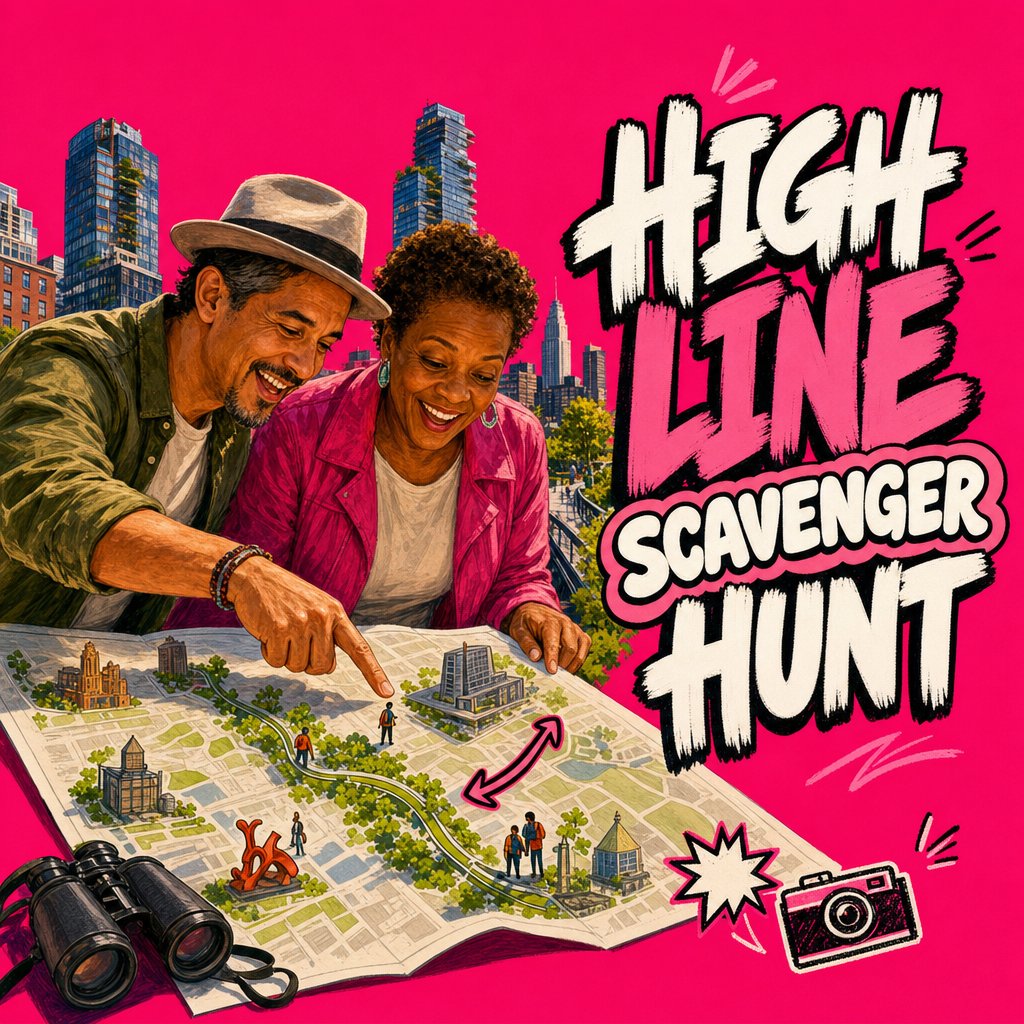
The High Line Scavenger Hunt is our highest-rated outdoor event: 4.98 out of 5 across 287 reviews as of August 2026. Teams race along the High Line, the elevated park built on old freight rail tracks on Manhattan's west side, solving clues and completing photo and video challenges tied to the art, architecture, and history around them. A host runs the 90-minute hunt, awards points in real time, and closes with a winners' ceremony.
Best for: 10 to 1,000 people (teams of 4 to 8) Time: 90 minutes Materials (cost): Hosted, $50 per person
What we've learned: Point values matter more than clue difficulty. Our hosts weight the creative photo challenges higher than the trivia, which keeps teams laughing instead of huddled around a phone searching for answers.
Field Day is a hosted outdoor competition for larger groups. Over 90 minutes, teams rotate through classic events like sack races, tug-of-war, and relay challenges, plus a few host-designed games you will not find at a school field day. We provide the equipment, the setup, and the scorekeeping; you provide the field and the trash talk.
Best for: 32 to 1,000 people Time: 90 minutes Materials (cost): Hosted, $80 per person
What we've learned: Every Field Day roster gets a "coach" role for teammates who do not want to run. Coaches call plays, keep the team's score sheet, and pick the lineup for each event, so nobody sits on the sidelines by default.
City photo scavenger hunts
Our photo scavenger hunt series takes the High Line format to landmark districts in other cities. Each hunt is 60 to 90 minutes, runs at $50 per person, and works for groups of 15 or more.
The Capitol grounds, Congress Avenue, murals and music history
60 to 90 min
If your city is not on the list, we build custom photo hunts for landmark districts, campuses, and conference venues. And if the forecast turns, the Museum Hack Scavenger Hunt at The Metropolitan Museum of Art is the indoor backup our New York clients use most.
Where to book outdoor team building events in 2026
Outdoor events have more moving parts than a conference room game: permits, weather, equipment, and a venue big enough for the group. The companies below handle those parts for you. We are obviously biased, so we have kept our take on each honest and short.
No live host, so the energy depends on your group. A solid choice for a team of six that wants to explore on its own schedule.
Local outfitters
Ropes courses, rafting, kayak and bike rentals
Book direct
Adventure activities that need certified guides and equipment
Search your city plus the activity. Confirm group minimums, insurance, and cancellation terms before you send the invite.
Booking a hosted event is the easy path, but it is not the only one. The rest of this guide covers games, sports, activities, and events you can run yourself.
Outdoor team building games
These are the games we reach for when a team has a lawn, a park, or a parking lot and 90 minutes to fill. Most need little more than cones and a whistle. Each entry includes how to play, the ideal group size, and what our hosts have learned running it with real teams.
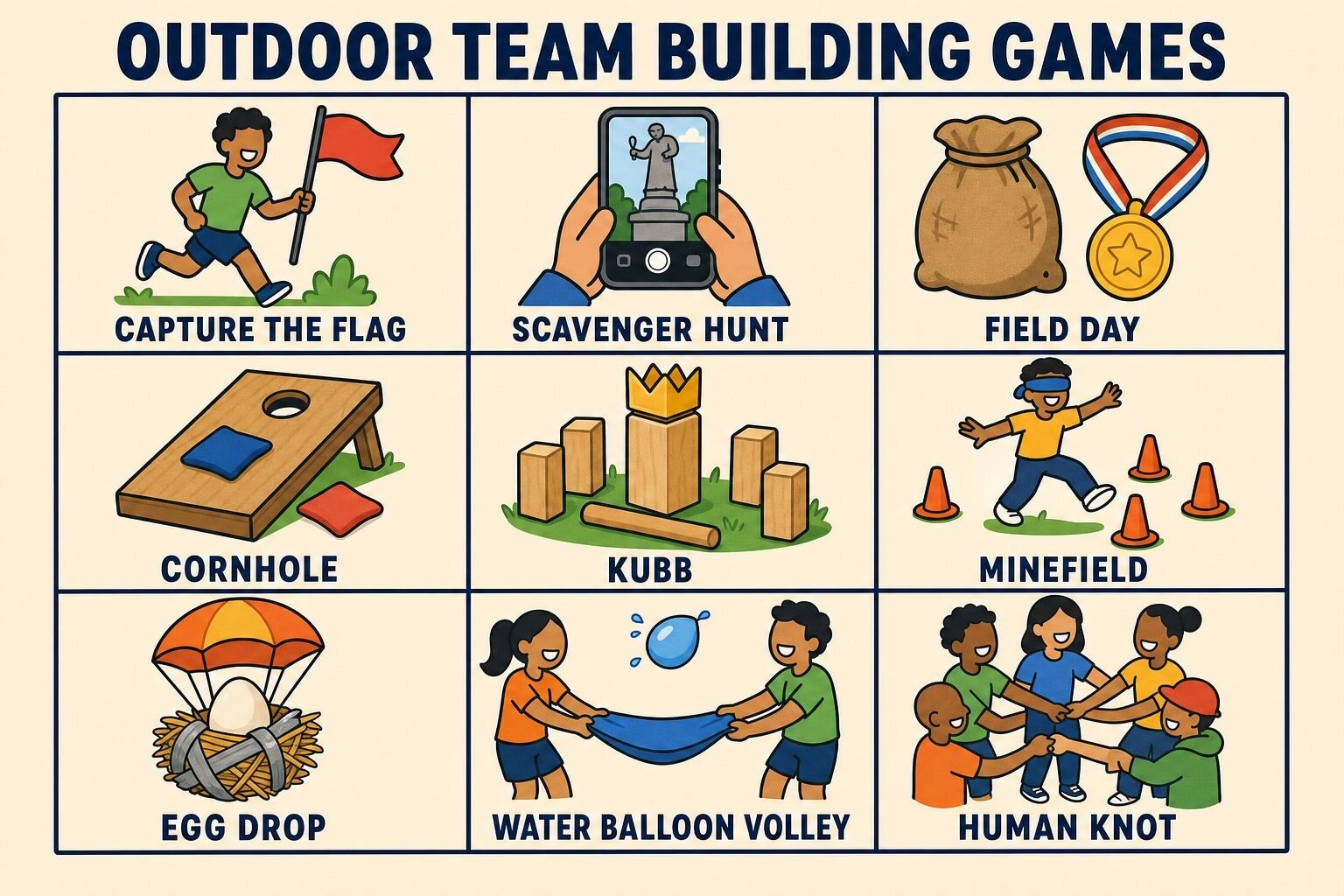
Capture the Flag is the outdoor team game most adults remember and almost none have played since school, which is exactly why it works. Split the group into two teams and divide the field in half with cones or a chalk line. Each team hides a flag (a bandana or a foam pool noodle) somewhere in its own territory. Players cross into enemy territory to grab the flag and carry it home. Anyone tagged on the wrong side of the line goes to "jail" until a teammate tags them free. The first team to bring the opposing flag back to its own side wins.
Set a 15-minute round limit and play best of three. Rotate a few players into "referee" roles each round so people who do not want to sprint still shape the game.
Best for: 10 to 40 people Time: 30 to 45 minutes Materials (cost): Two flags, cones or chalk (free)
What we've learned: Make the jail rule generous. If a single tag benches someone for the whole round, the least athletic teammates spend the game watching. A "walk back to your line" penalty keeps everyone playing.
2. Lightning Scavenger Hunt: Outdoor Edition
Lightning Scavenger Hunts are a format we developed for our hosted events. The host calls out a clue and everyone races to find or do it, then returns to the circle. Outdoors, the clues get better because the world gets bigger.
For example:
Find something that has been alive longer than you have.
Bring back a leaf with the most interesting shape.
Take a team photo with a stranger's dog (ask first).
Find a sign with a word that describes your team.
Spell your team name using objects on the ground.
Award a point to the first person back with a qualifying item and a bonus point for the most creative answer. Run eight to ten clues in a session.
Best for: 6 to 100+ people Time: 10 to 20 minutes Materials (cost): A list of clues (free)
What we've learned: Ask about the finds. If someone returns with a 1970s bottle cap or a leaf shaped like Ohio, let them tell the story before the next clue. The race creates the energy; the stories create the connection.
3. Photo Scavenger Hunt
A photo scavenger hunt is the DIY version of our city hunts. Write 15 to 25 prompts that mix landmarks, creative poses, and small-town-tourist silliness: "the whole team fitting inside one phone booth," "a recreation of a famous album cover," "something older than the company," "a teammate pretending to be a statue next to a real statue." Give each team the list, a shared photo album, and a hard deadline. Teams earn points per prompt, with judges' bonuses for creativity.
Reconvene at a patio or picnic table for the reveal. The slideshow at the end is the best part, so budget 15 minutes for it.
Best for: 8 to 100+ people (teams of 4 to 6) Time: 60 to 90 minutes Materials (cost): Prompt list, phones, a shared album (free)
What we've learned: Set a geographic boundary and a return time, and make the penalty for lateness steep (10% of points per minute). Without it, the most competitive team is always the last one back.
4. Amazing Race
An Amazing Race turns a neighborhood or campus into a course of stations. Teams receive a clue that leads to the first station, complete a challenge there (a puzzle, a physical task, a trivia question about the location), and earn the clue to the next stop. Five or six stations is plenty. Station challenges can be staffed by volunteers or self-serve with a sealed envelope and an honor-system task.
Stagger team start times by two minutes to avoid pileups, and put a "detour" option at one station where teams choose between a quick physical task and a slower mental one.
Best for: 12 to 60 people (teams of 4 to 6) Time: 60 to 120 minutes Materials (cost): Clue envelopes, station props ($20 to $100)
What we've learned: The race is only as good as its station tasks. One challenge per station that requires the whole team (a group jump-rope count, a human pyramid photo) beats three puzzles that one person solves while four watch.
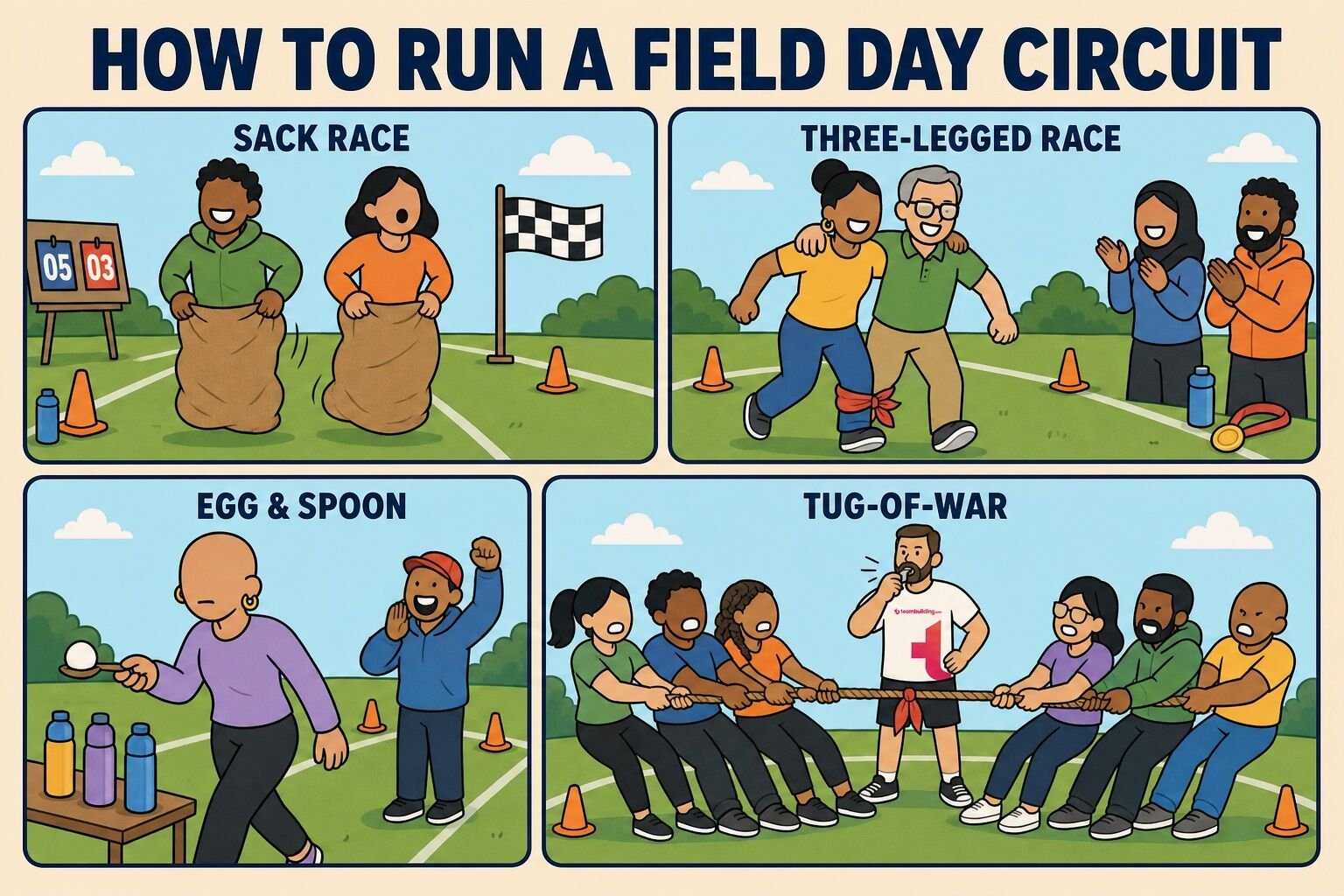
5. Field Day Circuit
You can run a scaled-down version of our hosted Field Day with four or five stations and a running scoreboard. Divide the group into teams of six to ten and rotate through:
Sack race: relay style, two laps per teammate.
Three-legged race: pair teammates who do not usually work together.
Egg-and-spoon relay: plastic eggs save cleanup; real eggs raise the stakes.
Tug-of-war: best of three, with a flag tied to the center of the rope.
Wheelbarrow race: short course, optional for anyone who would rather judge.
Award 5, 3, and 1 points for first, second, and third at each station, and finish with an all-team tug-of-war for double points. Medals from a party store cost a few dollars and get worn all afternoon. Our field day games guide (linked above) has more station ideas.
Best for: 20 to 200+ people Time: 60 to 90 minutes Materials (cost): Sacks, rope, spoons, eggs, cones, medals ($50 to $150)
What we've learned: Every station needs a non-running role: a starter, a judge, a scorekeeper. Assign those roles before the first whistle so teammates with mobility limits or bad knees choose a job instead of opting out.
6. Minute to Win It: Outdoor Edition
Minute to Win It games are 60-second challenges, and the messy ones belong outside. Set up stations with the supplies and a timer, then rotate teams through:
Stack a six-cup pyramid one-handed, then unstack it.
Bounce a ping-pong ball into a bucket from ten feet.
Move ten cotton balls across a table using a spoon held in your teeth.
Keep three balloons in the air for the full minute.
Empty a tissue box of ping-pong balls strapped to your back by shaking.
Each teammate attempts one challenge; the team's completed count is its score.
Best for: 8 to 50 people Time: 30 to 45 minutes Materials (cost): Cups, balls, balloons, cotton balls, a timer ($20 to $40)
What we've learned: Let teams choose who attempts which challenge. Drafting the tallest person for the balloon game and the steadiest hands for the cup stack is half the strategy and gets quieter teammates a role they picked.
7. Cornhole Tournament
Cornhole is the picnic game that every adult can play and most think they are good at. Set boards 27 feet apart (or closer for a casual crowd), pair players into teams of two, and run a single-elimination bracket. Bags on the board score one point, bags through the hole score three, and only the difference between the two teams' throws counts each round. First to 21 wins.
For a two-in-one activity, give each team a board and paint markers an hour before the tournament and have them decorate their side.
Best for: 8 to 40 people Time: 45 to 90 minutes Materials (cost): One or two cornhole sets ($60 to $150 per set)
What we've learned: Seed the bracket randomly and announce team names loudly. A round of team names before the first toss does more for the atmosphere than any prize.
8. Giant Lawn Games
Oversized versions of Jenga, Connect Four, and the Swedish lawn game Kubb are easy to mix into a picnic or offsite because people can drift between them. Kubb deserves a special mention: two teams throw wooden batons to knock over the other side's blocks, then the king in the middle, and a full game takes about 20 minutes with almost no explanation.
Set up three or four games in a row, hand out a punch card, and give a small prize to anyone who plays all of them with at least one person from a different department.
Best for: 10 to 60 people Time: 30 to 60 minutes Materials (cost): Giant games ($40 to $120 each, or rent)
What we've learned: The punch card is the team building. Without it, lawn games become a place where the three coworkers who already eat lunch together play Jenga for an hour.
9. The Human Knot
The Human Knot is a classic for a reason. Groups of six to ten stand in a tight circle, reach across, and grab the hands of two different people who are not next to them. Then, without letting go, the group untangles itself into a single circle. Most knots resolve in five to ten minutes; a few will end as two interlocking circles, which counts.
Outdoors, run several knots at once on soft grass and make it a race.
Best for: 6 to 10 people per knot, any number of knots Time: 10 to 15 minutes Materials (cost): None (free)
What we've learned: Ask before you assume everyone is comfortable with hand-holding and close contact. A quick "opt in or be the referee" makes the activity better for the people who would otherwise grit their teeth through it.
10. Minefield
Minefield is a communication game that exposes how people give instructions. Scatter cones, balls, and pool noodles across a marked-off area. One teammate is blindfolded at one end; a partner stands outside the field and guides them through using only verbal directions. Touching a "mine" adds a 15-second penalty. Time each pair, then swap roles.
Raise the difficulty for a second round by allowing only one-word instructions.
Best for: 6 to 30 people Time: 15 to 25 minutes Materials (cost): Blindfolds, cones, assorted objects (free with office supplies)
What we've learned: The debrief is the point. Ask each pair what instruction was most useful and what was useless. "Go left" versus "take two small steps toward the tree" is a lesson people remember at their next handoff meeting.
11. Egg Drop Challenge
Give each team a raw egg and a bag of identical supplies: straws, tape, string, a paper cup, a balloon, some cotton. Teams get 20 minutes to build a contraption that protects the egg from a drop of eight to ten feet (a picnic table or a second-story balcony works). Drop each entry in front of the group and award points for survival, lightest design, and best name.
Best for: 8 to 40 people (teams of 3 to 5) Time: 30 to 45 minutes Materials (cost): Eggs and craft supplies ($15 to $30)
What we've learned: Limit the supplies. When every team gets the same small kit, the debate over how to use it is where the collaboration happens. Unlimited tape produces a mummy, not a team.
12. Water Balloon Volley
Pairs hold a beach towel by the corners and use it to launch and catch a water balloon back and forth with another pair. Each successful catch moves both pairs one step back. The last dry pair wins. It is the perfect closing game on a hot afternoon.
Best for: 8 to 40 people Time: 15 to 30 minutes Materials (cost): Balloons, towels, a bucket ($10 to $20)
What we've learned: Tell people the day before. Someone in a linen blazer will still play, but they should get to choose that.
Outdoor sports for team building
Sports are the most common outdoor team building request we get and the easiest to get wrong. The best sports for team building are the ones with a low skill floor, a small equipment list, and rules that let a beginner contribute in the first five minutes. That rules out most things with a stick. Here are the ones that work.
All you need is a net, a ball, and a patch of sand or grass. To make volleyball a team building sport rather than a showcase for the two people who played in college, add house rules: a beginner may catch and throw once per rally, every player must touch the ball before it crosses the net at least once per set, and serves are underhand. Play short sets to 11 and rotate teams every set.
Best for: 6 to 12 per game; run multiple courts for bigger groups Time: 45 to 90 minutes Materials (cost): Net and ball ($40 to $100, or a public court)
14. Kickball
Kickball is baseball with the skill removed. Pitch a rubber playground ball, kick it, run the bases. Everybody understands it in one sentence and nobody needs equipment. Cap innings at five, let each team bat through the whole lineup once per inning regardless of outs, and you have a game that stays fun for the person who has not run since 2009.
Best for: 16 to 30 people Time: 60 to 90 minutes Materials (cost): Playground ball, four bases ($20)
What we've learned: The "everyone kicks each inning" rule is the whole game. It removes the three-up-three-down pressure that makes weaker kickers dread their turn.
15. Flag football
Flag football replaces tackling with a pull of the flag from an opponent's belt. Play five-on-five on a shortened field, two-hand touch if you do not have belts, and rotate the quarterback every drive so the same person does not throw every pass. Two 15-minute halves is plenty.
Best for: 10 to 16 people Time: 45 to 60 minutes Materials (cost): Football and flag belts ($40 to $80)
16. Ultimate frisbee
Ultimate is played without referees. Players call their own fouls and resolve disputes on the field, which is a team building exercise disguised as a sport. Teams advance a disc by passing (no running with it) and score by catching it in the end zone. Start with a five-minute throwing clinic so beginners can make a flat pass, then play games to five points.
Best for: 10 to 14 people Time: 45 to 60 minutes Materials (cost): A disc and cones ($15)
What we've learned: Mix skill levels deliberately and make the "spirit of the game" rule explicit. A team that argues a call for two minutes learns more about itself than a team that wins 5-0.
17. Pickleball
Pickleball has become the office sport of the decade: a small court, a slow plastic ball, and rules a beginner can absorb in ten minutes. Book two or three courts, run doubles with rotating partners, and keep games to 11 points. The shift toward active, low-key events like this is real; Bloomberg covered how office parties were trading booze for guac and pickleball back in 2023, and our own Angela Robinson was quoted in that piece.
Best for: 4 per court, any number of courts Time: 60 to 90 minutes Materials (cost): Court rental and paddles (often $10 to $30 per court-hour)
18. Bubble soccer
Players wear inflatable bubbles that cover them from knees to head and then attempt to play soccer, which mostly means bouncing off each other. Rent the bubbles from a local operator (they usually bring a referee), play five-minute matches, and keep a first-aid kit handy for the person who laughs too hard.
Best for: 10 to 20 people Time: 45 to 60 minutes Materials (cost): Bubble rental (varies by city; get a quote)
19. Golf scramble or mini golf tournament
A scramble is the team format of golf: every player hits, the team picks the best ball, and everyone plays from there. It hides bad shots and keeps the round moving, so beginners can join. If your group is mixed or short on time, a mini golf tournament delivers the same conversation time in one hour with zero skill required. Score by team, hand out a trophy, and let the losing team pick the next outing.
Best for: 8 to 100 people (foursomes) Time: 60 minutes (mini) to 4 hours (scramble) Materials (cost): Course fees ($10 to $25 per person for mini golf; more for a scramble)
Outdoor group activities for adults
Not every outdoor team activity needs a scoreboard. These are the low-key outdoor group activities for adults that work when the goal is conversation, fresh air, and a shared experience rather than competition.
20. Group hike
Pick a trail rated easy, three to five miles, with a scenic payoff. Announce the distance and elevation in the invite so people can self-select, and set a "sweep" at the back so nobody gets left behind. Build in two stops: one for a group photo and one for a five-minute "what's your favorite thing about your job right now" round. Bring more water than you think you need.
Best for: 6 to 30 people Time: 2 to 3 hours Materials (cost): Water, snacks, a trail map (free to $10 per person)
What we've learned: Pace the hike to the slowest walker and say so up front. The point is the conversations that happen side by side, and those do not happen when the group is strung out over half a mile.
21. Walking or food tour
A guided walking tour gives the group a shared story to react to. Food tours are the best version for teams because there are built-in stops, seats, and something to argue about at every one. Search your city plus "team food tour," confirm the group maximum, and ask the guide to weave in a few team questions between tastings. Museum Hack, our sister company, ran exactly this format for companies like Google and Johnson & Johnson before teambuilding.com existed, and it still holds up.
Best for: 8 to 25 people Time: 2 to 3 hours Materials (cost): Guide and tastings ($50 to $175 per person)
22. Bike ride
A group bike ride on a car-free path is a conversation on wheels. Rent bikes (or use a city bike-share) and plan a flat loop with a coffee stop at the halfway point. Ride in pairs and switch partners at each stop so people talk to more than one teammate.
Best for: 6 to 20 people Time: 90 minutes to 2 hours Materials (cost): Bike rental and helmets ($15 to $40 per person)
23. Kayaking or canoeing
Tandem kayaks turn a paddle into a teamwork exercise, because the boat only goes straight when both people cooperate. Book a calm-water outfitter, pair people across departments, and run a short "synchronized paddling" challenge before the float. Wetsuits and life vests come with the rental; a change of clothes is on you.
Best for: 6 to 24 people Time: 2 hours Materials (cost): Outfitter rental ($30 to $60 per person)
24. Outdoor volunteering
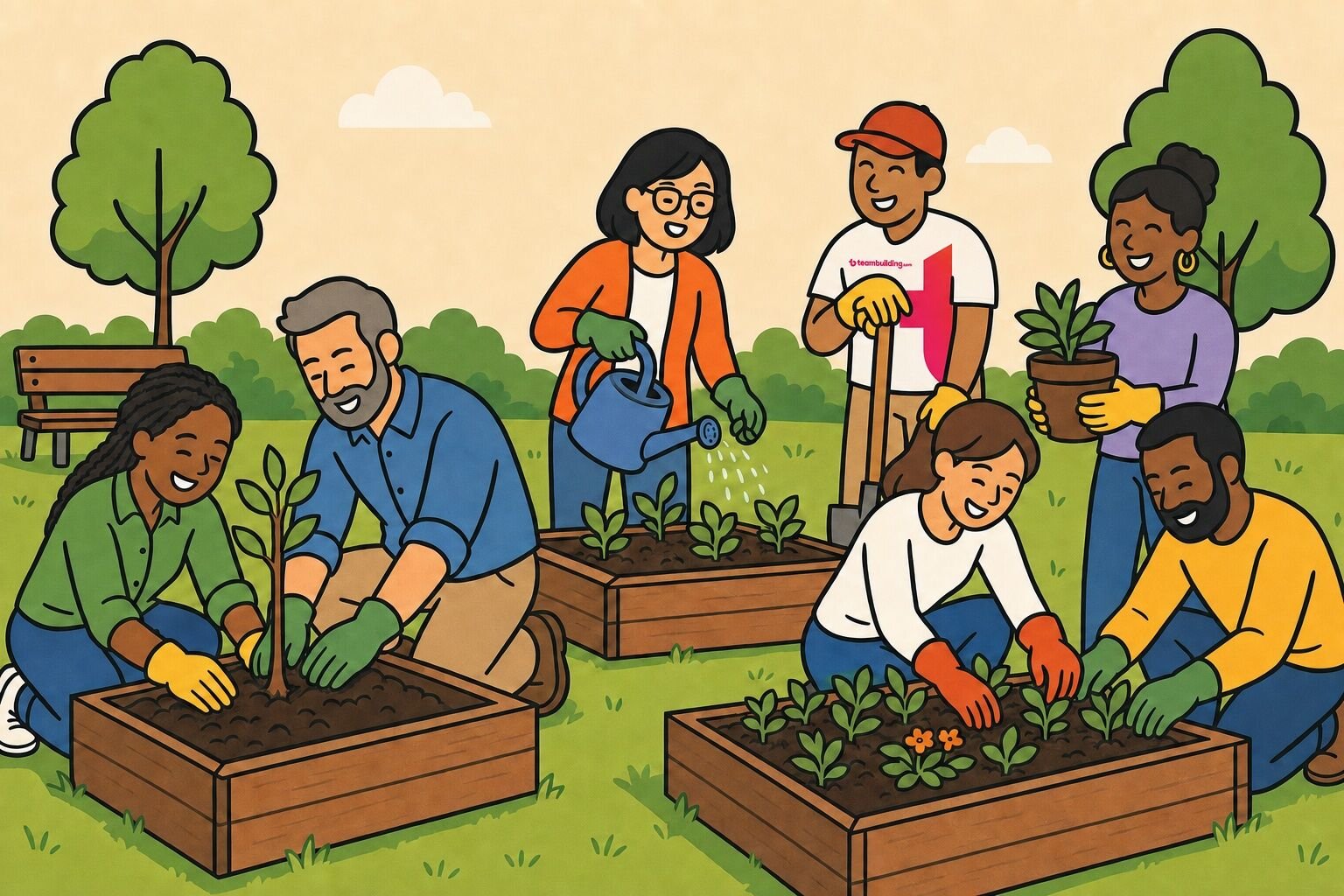
Park cleanups, tree plantings, trail maintenance, and community garden builds give a team a job to do together with a result you can photograph at the end. Contact a local parks department or conservancy; most have a corporate volunteer coordinator and will supply gloves, bags, and tools. Bring lunch for afterward. This is not a soft option. In Deloitte's 2017 Volunteerism Survey of 1,000 employed U.S. adults, 70% said volunteer activities boost morale more than company-sponsored happy hours, and 89% said companies that sponsor volunteering offer a better working environment. Find more ideas in our list of group volunteer opportunities.
Best for: 10 to 100+ people Time: 2 to 4 hours Materials (cost): Usually free; budget for lunch
What we've learned: Ask the organization for a measurable outcome before you arrive (bags collected, trees planted, feet of trail cleared). Announcing "we planted 60 trees" at the end turns a nice morning into something people repeat at dinner.
25. Community garden plot
Rent a plot at a community garden (or build raised beds behind the office) and make it a season-long team activity. Decide together what to grow, then rotate weekly watering and weeding duty in pairs. Harvest day is a team lunch. It is one of the few outdoor team building ideas that keeps paying off for months instead of an afternoon.
Best for: 5 to 20 people Time: 30 minutes a week for a season Materials (cost): Plot rental, seeds, tools ($50 to $300 for the season)
26. Outdoor yoga or fitness class
Hire an instructor to lead a 45-minute beginner-friendly class in a park, on a rooftop, or at the beach. Team building yoga works because the instructor sets the pace and nobody has to perform. Ask for an all-levels flow and skip anything that requires touching a partner unless you have checked with the group first.
Best for: 6 to 50 people Time: 45 to 60 minutes Materials (cost): Instructor and mats ($15 to $30 per person)
27. Tie-dye station
Buy blank white T-shirts (or tote bags) and a tie-dye kit, cover a few picnic tables, and let people make something they will actually wear. The activity takes 30 minutes plus overnight drying, so it works well at the start of an offsite: everyone gets their shirt back the next morning. Add a "best design" vote for a little friendly competition.
Best for: 8 to 40 people Time: 30 to 45 minutes Materials (cost): Shirts and dye kit ($8 to $15 per person)
28. Chalk mural
Give each team a box of sidewalk chalk and a 10-foot section of pavement, assign a theme (your company's year in review, a team crest, "what we're building"), and set a 30-minute timer. Judge on creativity and teamwork, then photograph the murals from a balcony or a step ladder before the rain gets them.
Best for: 8 to 60 people (teams of 4 to 6) Time: 30 to 45 minutes Materials (cost): Sidewalk chalk ($10 to $20)
29. Outdoor movie night
A projector, a white sheet or inflatable screen, and a lawn make a movie night. It is a social, not a team building activity on its own, so add a layer: themed team building movie trivia at intermission, a popcorn seasoning bar, and a vote on the film beforehand so people have a stake in it. Start after sunset and keep the runtime under two hours.
Best for: 15 to 100+ people Time: 2 to 3 hours Materials (cost): Projector and screen rental, snacks ($100 to $400)
Adventure team building activities
Adventure team building means activities with a physical challenge and a certified guide: ropes courses, rafting, climbing, and overnight trips. They create strong memories, and they carry a risk that many planners underestimate: a portion of your team may not be able or willing to participate. Every adventure activity needs a genuine opt-out that is not "wait in the car."
30. Ropes course
Low ropes courses (a few feet off the ground) are team puzzles: crossing a cable as a group, moving everyone through a "spider web" without touching the strands. High ropes and zip-line courses add height and individual courage. Book a facility with trained facilitators, tell them your team building goals, and ask for the low-ropes program if your group has mixed fitness or mobility. Most facilities offer a ground-based role for anyone who does not want to climb.
Best for: 8 to 40 people Time: Half day Materials (cost): Facility fee ($40 to $120 per person)
What we've learned: The facilitator's debrief after each element is where the value is. If the facility just runs you through the course like a theme park, you paid for a workout, not team building.
31. Whitewater rafting
A raft of six to eight people has to paddle in sync to get down the river, and a good guide turns that into a running lesson in communication. Choose class II to III rapids for a mixed group (thrilling, rarely dangerous) and book through a licensed outfitter. Plan the whole day around it, with a riverside lunch.
Best for: 6 to 40 people Time: Half to full day Materials (cost): Outfitter fee ($80 to $200 per person)
32. Geocaching or orienteering
Geocaching uses a free app to find containers hidden at GPS coordinates; orienteering uses a paper map and compass to hit checkpoints in order. Both turn a park into a navigation challenge with almost no cost. Give teams a list of five caches or checkpoints within a mile, a 60-minute limit, and a bonus for the best photo at each stop. Many parks publish permanent orienteering courses you can use for free.
Best for: 8 to 40 people (teams of 3 to 5) Time: 60 to 90 minutes Materials (cost): Free app or printed maps ($0 to $20)
33. Camping or glamping trip
An overnight is the deep end of outdoor team building: setting up camp, cooking together, and a campfire are collaboration without a facilitator. Glamping (pre-set tents, real beds, a bathroom) removes the reasons most people decline. Plan one structured block per day (a hike, a group cook-off) and leave the rest unscheduled. Bring our list of campfire games for the evening.
Best for: 6 to 30 people Time: 1 to 2 nights Materials (cost): Site and gear ($60 to $300 per person for glamping)
What we've learned: Overnights are voluntary, full stop. Make the invitation genuinely optional, offer a day-trip alternative, and be clear about sleeping arrangements before anyone commits.
Outdoor team building events
Outdoor team building events are the bigger occasions: company-wide, catered, and often the highlight of the summer calendar. Each of these works best with one hosted or structured activity in the middle of it. A picnic with nothing to do is lunch outside.
34. Company picnic
Reserve a park pavilion or a field near the office, cater or coordinate a potluck, and schedule a 60-minute activity block in the middle of the afternoon: a Field Day Circuit, a cornhole bracket, or a photo hunt. Put out lawn games for the unscheduled time, name a host for the activity block, and plan the timeline so the games happen before people start drifting home. Our full guide to company picnic ideas has themes, menus, and games.
Best for: 20 to 500 people Time: 3 to 4 hours Materials (cost): Venue, food, games ($25 to $75 per person)
35. Team BBQ cook-off
A barbecue becomes a team event when teams cook. Assign each team a protein or a category (burgers, sides, sauces), give them the same budget and an hour, and have a panel of judges (or a blind taste vote) pick the winners. Provide a couple of grills and a fire-safety lead. Our cook-off ideas guide has scoring sheets and categories.
Best for: 15 to 100 people Time: 2 to 3 hours Materials (cost): Grills, ingredients, judging supplies ($20 to $40 per person)
36. Beach day
Rent a stretch of beach or claim a public one early. Structure the day around a volleyball rotation, a sandcastle build-off judged on engineering and story, and a late-afternoon Water Balloon Volley. Keep the dress code work-appropriate (shorts, T-shirts, and sandals; no swimwear-only), provide shade tents and sunscreen, and end with an ice cream truck.
Best for: 15 to 200 people Time: 3 to 5 hours Materials (cost): Permits, tents, games, food ($30 to $80 per person)
37. Food truck fair
Book three or four food trucks with different cuisines to park outside the office, give everyone a voucher, and run a "passport" where people get a stamp for each truck they try. Add a taste-off vote and a small trophy for the winning truck. It is the easiest outdoor event to organize and one of the most attended.
Best for: 30 to 500 people Time: 90 minutes to 2 hours Materials (cost): Truck minimums and vouchers ($20 to $35 per person)
38. Fun run or charity 5K
Register the team for a local themed race (color runs and costume runs are the most beginner-friendly) or organize your own 5K walk-or-run loop for a cause. Make walking explicitly welcome, print team shirts, and set a group fundraising goal. Finish at a brunch.
Best for: 10 to 100+ people Time: Half day Materials (cost): Registration and shirts ($30 to $60 per person)
39. Summer offsite day
A one-day outdoor offsite combines a morning working session (a covered pavilion, a whiteboard, and coffee) with an afternoon of activities from this list. The mistake is over-scheduling: pick one hosted activity, one lawn-games block, and one meal, and leave the rest open. See our guides to team building retreats and company offsites for agendas.
Best for: 10 to 100 people Time: Full day Materials (cost): Venue, catering, activity ($75 to $250 per person)
Quick outdoor team building activities
These quick outdoor team building activities take 10 to 30 minutes and fit inside a normal workday. They are the fastest way to get the benefits of being outside without planning an event.
Move your next one-on-one outside. Walking side by side lowers the pressure of eye contact, and people say things on a path they would not say across a desk. Pick a 20-minute loop, leave the laptop, and let the agenda breathe. Managers who do this weekly tell us it is the single easiest change they have made.
Best for: 2 people Time: 20 to 30 minutes Materials (cost): None (free)
41. Walking meeting
For groups of three to eight, a walking brainstorm works when one person carries a phone to capture ideas and the group stops at the halfway point to review them. Keep the question narrow ("three ways to shorten onboarding") and the loop short. Stanford's walking-and-creativity research above is the reason this works.
Best for: 3 to 8 people Time: 20 to 30 minutes Materials (cost): None (free)
42. Circle energizers
Ten minutes outside in a standing circle resets a long meeting day. Our hosts use rapid games like Zip Zap Zop (pass an imaginary bolt of energy around the circle with a clap and a word; hesitate and you are out), a group count-to-20 where any two people speaking at once restarts the count, or a round of icebreaker questions answered in five words or fewer.
Best for: 6 to 30 people Time: 10 minutes Materials (cost): None (free)
43. Sidewalk kudos wall
Leave a bucket of chalk by the building entrance and a prompt on a sign: "Write one thing a teammate did this week that made your job easier." By lunch the sidewalk is a recognition wall people photograph. Reset it weekly with a new prompt.
Best for: Any size team Time: 15 minutes Materials (cost): Chalk and a sign ($10)
What we've learned from hosting outdoor events
Outdoor events are the ones clients worry about most, and usually for the wrong reasons. Weather is rarely what ruins them; a missing plan for the people who cannot or do not want to run is. Here is what the data and our hosts tell us.
September is the busiest month for in-person events. Across confirmed events on teambuilding.com from 2023 through 2025, in-person events peak in September, which accounts for 12% of annual in-person volume, while virtual events peak in December. Late summer is when the weather still cooperates, teams are back from vacation, and budgets have not yet gone to holiday parties.
Book about a month out. Teams book in-person events a median of 30 days in advance on our platform, compared with 21 days for virtual events. Outdoor events need the extra runway for park permits, equipment rentals, and a weather date.
Tuesday afternoons win. Across 22,000+ events on teambuilding.com, in-person events peak on Tuesdays and most events start between 2 p.m. and 4 p.m. local time. A Tuesday afternoon outdoor event gets attendance that a Friday at 5 p.m. never will.
Plan for a group of about 16, then scale. The median team building event on our platform has 16 participants, and half of all events fall between 10 and 27 people. The games in this guide are written for that range; the table below shows what to change at either end.
Small groups (under 15)
Large groups (30+)
Best formats
Photo hunt, kayaking, walking tour, Minefield, mini golf
Field Day, kickball, picnic with stations, city scavenger hunt
Structure
One activity, one long conversation-friendly meal
Rotating stations, a host with a microphone, a visible scoreboard
Teams
Pairs or one group
Teams of 6 to 10, mixed across departments
Watch out for
The activity running out before the bonding starts
Wait times at stations and people drifting to the food table
Give everyone a role that is not "athlete." Every activity above has a judge, scorekeeper, photographer, navigator, or coach role. Assign those roles before the event starts. When the only way to participate is to run, the people who will not run have already decided to skip it.
Weather planning is a decision, not a hope. Set a go/no-go time (24 hours out), a rain date, and an indoor backup you would actually enjoy. Provide shade and water for anything over 80°F, and shorten the physical blocks in the heat.
Keep it stealthy. Our hosted events are built on what we call stealth team building: participants come for the games and the laughs and leave having practiced communication, collaboration, and connection without a formal training frame. The outdoor games that work best follow the same pattern. Nobody needs to be told that Minefield is a communication exercise; they figure it out at the debrief.
Outdoor team building ideas we don't recommend
The internet is full of outdoor team building lists that recycle the same ideas, including a few we published years ago and have since retired. Here is the Lame List: activities that read well and play badly.
The Lame List
Activity
Why skip it
Verdict
Paintball
Welts, protective gear, and a meaningful share of the team who would rather do anything else. It is a hobby, not an inclusive work event.
Skip it
Trust falls
The cliché that made "team building" a punchline. It creates anxiety for the faller and awkwardness for everyone else, with no game to hide behind.
Skip it
Mud runs and obstacle races
The fitness gap on most teams is wide. The fittest third has fun and the rest count the minutes.
Opt-in only
Full-contact sports
Tackle football, rugby, and anything with a hard ball and a stick send someone home injured often enough that it is not worth it.
Skip it
Tailgates built around drinking
A cooler and a parking lot is a party, and it excludes people who do not drink. Add a game and a food plan or it is not team building. See our corporate event games.
Add structure
Graffiti walls
Legal risk, cleanup cost, and a lot of people who do not want to spray paint in work clothes. A chalk mural gets the creativity without the problems.
Skip it
All-day survival challenges
Building shelters and finding water sounds like a TV show and feels like a punishment. Save the wilderness skills for an optional retreat.
Skip it
Long hikes with no opt-out
A ten-mile hike is a great weekend for some and a miserable obligation for others. Cap work hikes at five easy miles and publish the plan.
Plan it better
Watching a game or concert together
Sitting in a row facing a stage is a social outing, not team building. Fine to do, but pair it with an activity beforehand.
Not team building
Outdoor karaoke
Everything hard about karaoke at work, plus wind noise and a public audience.
Skip it
Final thoughts
The best outdoor team building activities are simple: a clear game, a role for everyone, and a host (hired or volunteered) who keeps the energy up. You do not need a ropes course or a rented island. A park, a bag of cones, and one of the games above will get a team laughing together within ten minutes, and that is the whole point.
Answers based on outdoor events we have hosted and platform data from 45,000+ team building events.
What are outdoor team building activities?
Outdoor team building activities are games, events, and exercises that groups do together outside, such as photo scavenger hunts, field days, capture the flag, and team hikes. The goal is to get coworkers moving, talking, and solving problems together away from their desks. They can be hosted by a company like teambuilding.com or run yourself with a few supplies.
What are the best outdoor team building activities for large groups?
The best outdoor team building activities for large groups use rotating stations and a visible scoreboard so nobody waits around. Field Day (hosted, 32 to 1,000 people), a DIY field day circuit, kickball, a company picnic with game stations, and city photo scavenger hunts all scale well. Split groups of 30 or more into teams of six to ten mixed across departments.
How much does outdoor team building cost?
Hosted outdoor Originals on teambuilding.com run $50 to $80 per person, for example the High Line Scavenger Hunt at $50 and Field Day at $80. DIY games like capture the flag, photo scavenger hunts, and the human knot are free, and a full field day circuit costs about $50 to $150 in supplies. Adventure activities with certified guides, such as ropes courses and rafting, typically cost $40 to $200 per person.
What is the best time of year for outdoor team building?
September is the busiest month for in-person team building events on our platform, accounting for 12% of annual in-person volume across 2023 to 2025. Late spring and early fall offer the most reliable weather in most of the United States. Teams book in-person events a median of 30 days in advance, so plan about a month out and set a rain date.
What should we do if it rains on the day of an outdoor team building event?
Set a go/no-go decision time about 24 hours before the event, reserve a rain date, and choose an indoor backup you would actually enjoy, such as an indoor scavenger hunt, a game show, or a cooking competition. Covered pavilions let picnics and lawn games continue in light rain. Communicate the plan in the invitation so nobody is guessing on the morning of the event.








Comments (0)
Leave a Comment