
8 Free Pomodoro Timers & Apps for Solo and Team Work
Eight Pomodoro timers for solo work and shared focus sessions, with a free team timer, clear feature comparisons, and a practical first-session plan.

Eight Pomodoro timers for solo work and shared focus sessions, with a free team timer, clear feature comparisons, and a practical first-session plan.
A Pomodoro timer divides work into focus sessions and breaks, so you can decide what to work on, start a countdown, and stop checking the clock. Some timers also manage tasks, record time, or keep coworkers on the same schedule.
Want to start together? Open our free Team Pomodoro Timer, choose your work and break lengths, and share a room link. No account or download is required. We built this tool, and it is our first recommendation for shared work sessions; the alternatives below serve different needs.
Pomodoro timers put time management tips into practice. They sit alongside time tracking software and project management software, and can support time management activities with a team. They are also called focus timers, work timers, productivity timers, and Pomodoro apps.
This list includes:
A Pomodoro timer alternates a period of focused work with a short break. The familiar starting pattern is 25 minutes of work and a five-minute break, with a longer break after four work periods. Apps vary: some automate that whole pattern, while others let you build your own sequence.
Francesco Cirillo developed the Pomodoro Technique using a tomato-shaped kitchen timer. The complete method also covers planning, estimating effort, handling interruptions, and reflecting on your work. A countdown is one part of it.
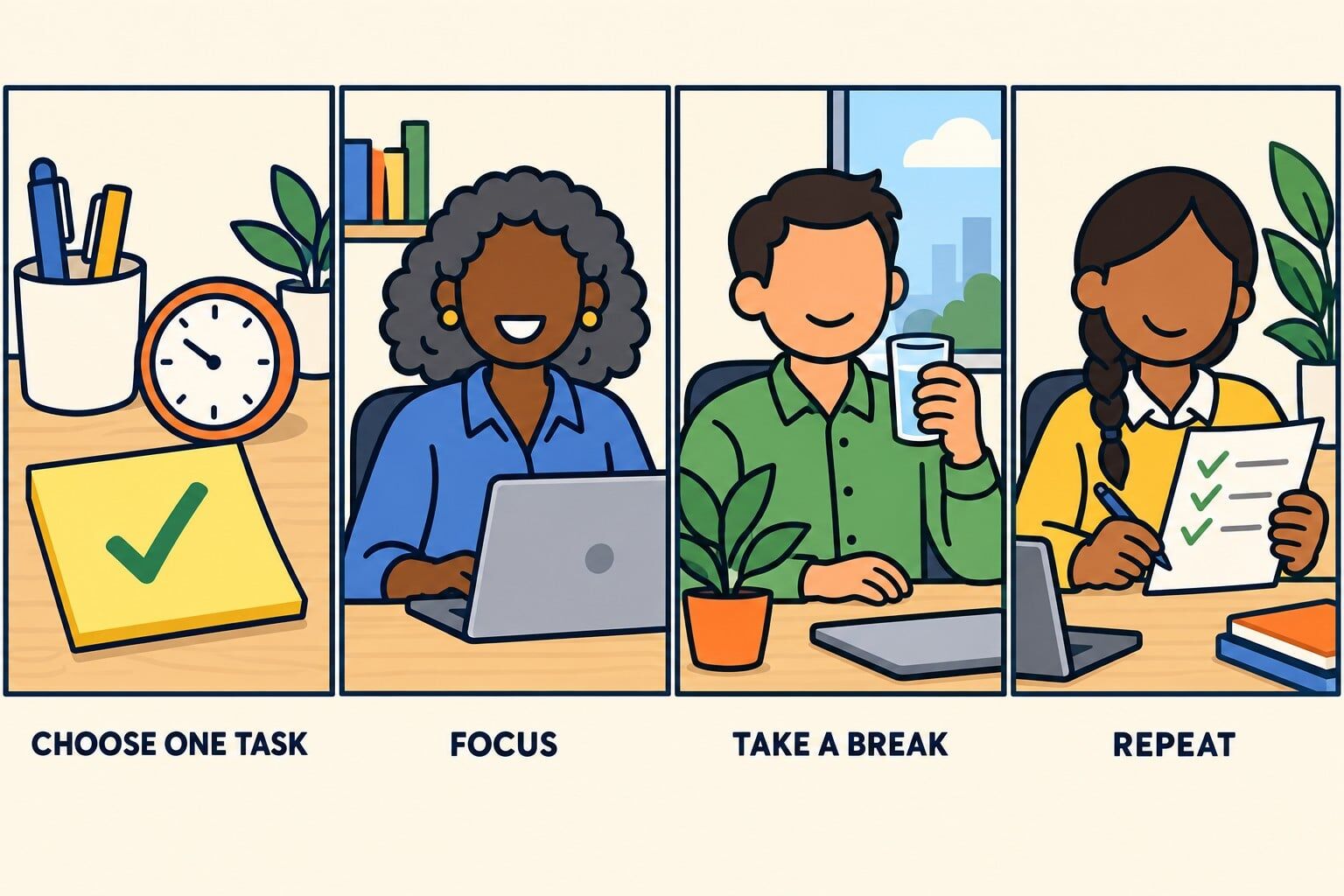
These eight tools cover shared sessions, simple browser timers, task lists, and time tracking. We checked the linked developers’ product pages in October 2026. This is an editorial comparison, not a benchmark test of every app. “Free” can mean a free core timer with optional paid features; check the current plan before relying on an integration or report.
| Timer | Best fit | Free access | Main tradeoff |
|---|---|---|---|
| 1. teambuilding.com Team Pomodoro Timer | One shared work-and-break schedule | Free; no sign-up | No task history or timesheet export |
| 2. Pomofocus | Solo work with a task list | Basic features free; premium extras | Projects and some reporting require premium |
| 3. MarinaraTimer | Sharing a custom sequence of timed periods | Free browser timer | A timer-focused interface rather than a task manager |
| 4. Toggl | Recording focus time against work | Free plan; paid plans available | Account and time-tracking setup |
| 5. Pomodoro Tracker | A timer beside a categorized to-do list | Browser timer; login for progress tracking | More tracking controls than a minimal countdown |
| 6. Focus Keeper | A simple focus, short-break, long-break routine | Browser timer; account features available | Check app-specific plans for extras |
| 7. Pomello | Working through Trello cards | Free desktop app | Requires a Trello-based workflow |
| 8. Forest | Staying away from distracting phone apps | Free core features; optional Plus plan | Some controls, including pausing, are paid features |
Best for: Coworkers who want to focus at the same time. Setup: Browser only. Cost: Free.
Our timer gives everyone in a room the same focus sessions, breaks, and countdown. Set the work duration, break duration, and number of rounds, then create a team session and share its link. Teammates enter a display name to join; the host controls the schedule.
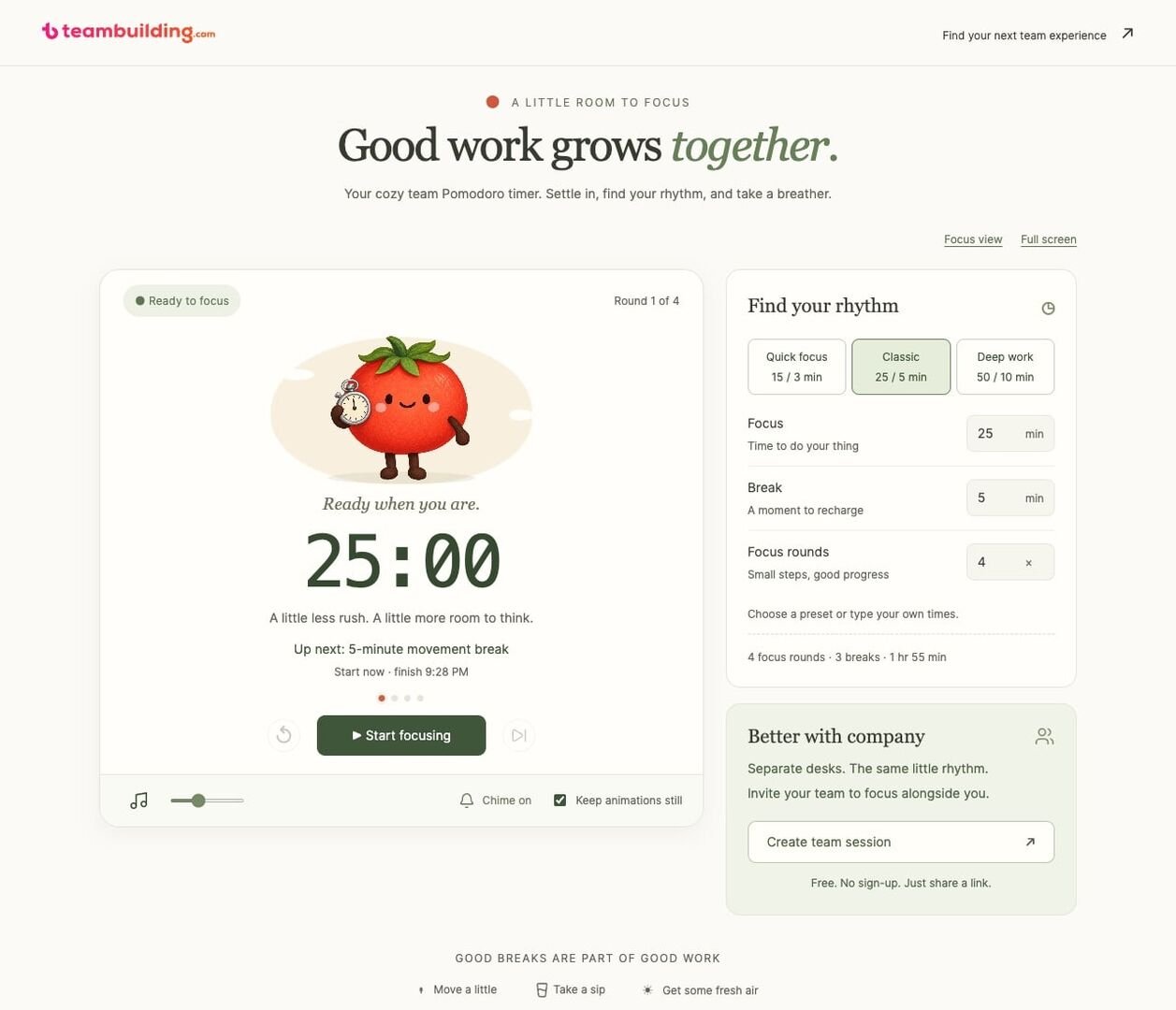
The tomato holds a stopwatch during silent focus. Music is enabled by default and plays during focus time after you start or join a session. You can turn it off. During a work session with music playing, the tomato strums a little guitar; breaks bring movement, water, or fresh-air prompts. Each person chooses their own music volume, chimes, and animation preference. Focus view clears away the setup panels, and fullscreen is available where the browser supports it.
Good to know: Rooms last 24 hours and hold up to 100 people. The timer finishes after the last work round, without adding a final break. It does not maintain individual work reports, block other apps, or provide chat or video. Choose it for a shared rhythm; use a time tracker if you need records of billable work.
Best for: Solo workers who want a timer and task list together. Setup: Desktop or mobile browser. Cost: Free basic features; premium options.
Pomofocus lets you add tasks, estimate the number of focus periods each needs, and select the task you are working on. Its finish-time estimate makes a long list easier to size before you start.
Add one task, enter your estimate, and start the timer. Custom durations, templates, and visual reports support a repeatable routine. Projects, annual reporting, CSV downloads, and integrations are among its premium features. It is a useful choice when your main question is “What should I work on next?”
Best for: A shareable timer with custom periods. Setup: Browser. Cost: Free.
MarinaraTimer offers a traditional Pomodoro timer, a custom timer, and a kitchen timer. Its standard cycle uses 25-minute work periods, five-minute breaks, and a 15-minute break after the fourth work period.
Choose Custom Timer if your schedule is less regular: name each period and give it a duration in hours, minutes, and seconds. The developer also supports sharing the timer with teammates. This flexibility is useful for a work block that includes planning, focused work, and a short review rather than identical repeated rounds.
Best for: Connecting focus sessions to time records. Setup: Account plus a supported app or browser extension. Cost: Free and paid plans.
Toggl’s Pomodoro timer is part of its time tracker. You can associate a work interval with a task or project and review the recorded time afterward.
Enable Pomodoro mode in the browser extension, desktop preferences, or mobile timer controls. This is a stronger fit than a standalone countdown if you already track client work. Keep the distinction clear: a shared project workspace does not necessarily mean everyone follows one synchronized countdown.
Best for: Categorizing tasks beside a work timer. Setup: Browser. Cost: Free browser timer.
Pomodoro Tracker places a to-do list alongside its timer, with fields for a category and short task description. The site also provides statistics and settings, and directs users to log in to track progress.
Enter a task such as “Draft the project brief,” assign a category, and start a focus period. Choose this if a plain task queue is useful to you. Avoid adding a second task system if your existing project board already tells you what to do next.
Best for: A clear focus-and-break routine. Setup: Browser, iOS, or Android. Cost: Start with the browser timer; check the chosen app’s plan for extras.
Focus Keeper puts focus time, short breaks, long breaks, and a round count on its main timer screen. That makes it easy to see which parts of the routine you are setting.
Set those intervals before your first round. The product also describes charts and saved focus history for users who want to review patterns. It is worth considering when you prefer a conventional Pomodoro cycle with a distinct long break.
Best for: People whose tasks already live in Trello. Setup: Desktop app and Trello workflow. Cost: Free download for Mac, Windows, and Linux.
Pomello turns Trello cards into Pomodoro tasks. Instead of copying a card into another to-do list, choose it as the work for your next focus period.
The small timer interface leaves room for your work. Its appeal depends on that Trello connection: if you do not use Trello, a browser timer is a shorter route to your first session. Check the current download for compatibility with your operating system.
Best for: Making phone distractions less tempting. Setup: Supported app or browser experience. Cost: Free core features; optional Plus plan.
Forest turns focus time into a growing virtual tree. Its current feature list includes app blocking and Plant Together group rooms, where participants share a focus session.
The group mechanic has a different feel from a neutral countdown: if someone gives up, the shared tree can wither. That may motivate some groups and feel pressuring to others. Check the plan comparison carefully; pausing and automatic focus after a break are listed as paid features. Let coworkers opt into this style of accountability.
If you want a free online work timer you can open immediately, start with the simplest tool that solves your actual problem:
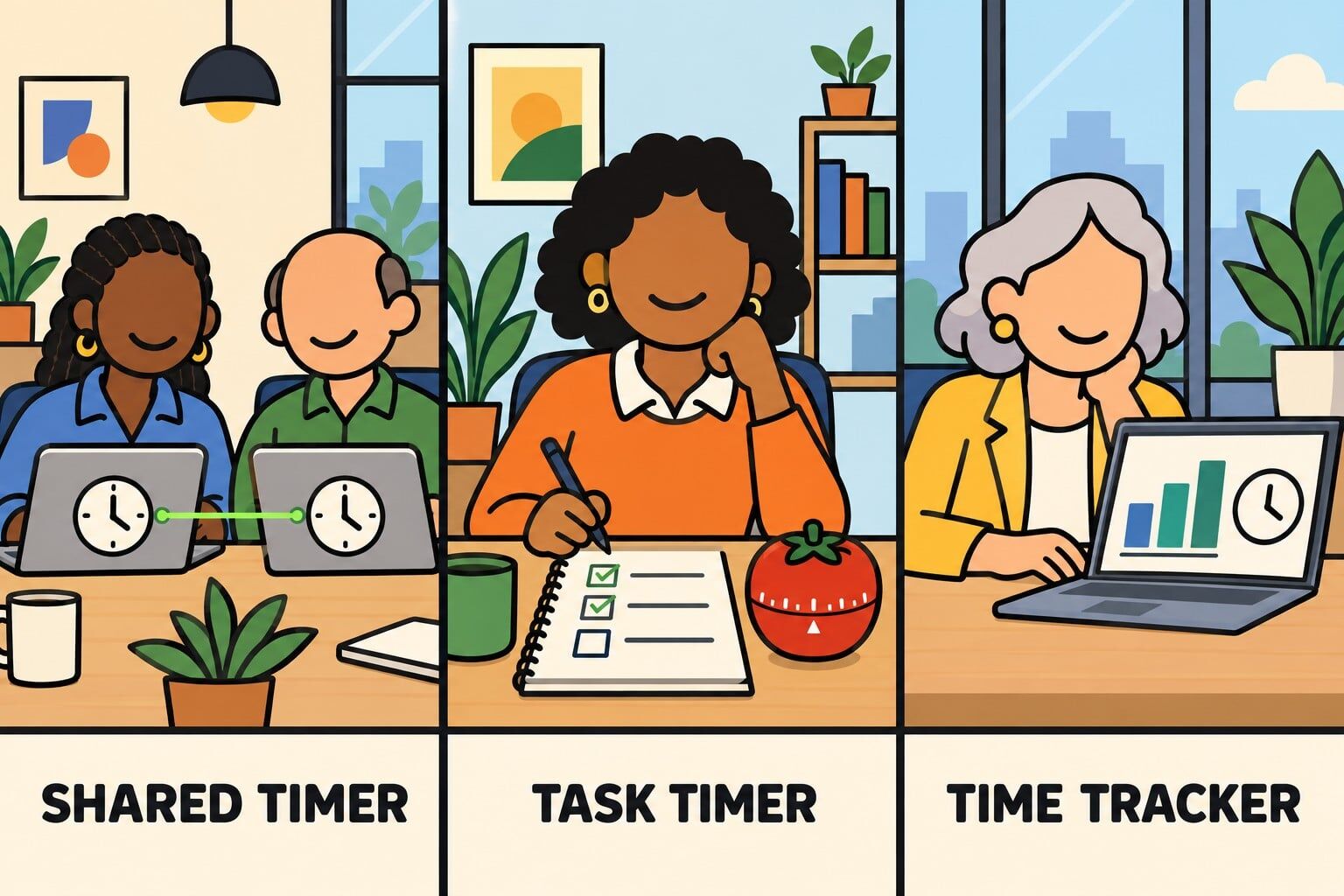
Before committing to a tool, run one short session. Check that you can hear its alert, change the duration, and return to the correct countdown after switching tabs. Browser timers cannot guarantee an audible alert while a device is asleep.
A shared session works best when everyone knows the end time and is free to work on a different task. You do not need a video meeting to use a team timer.
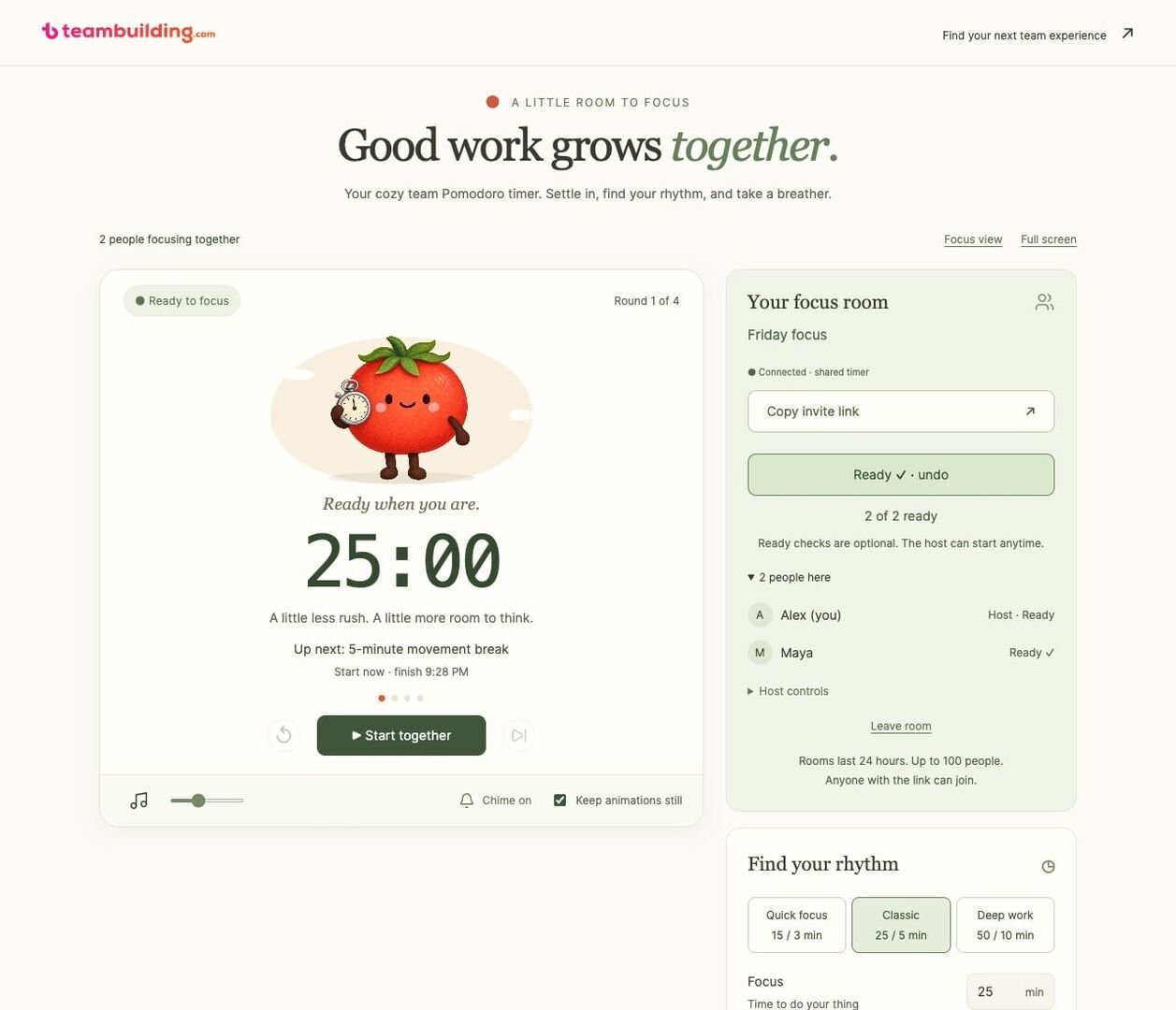
Host controls: The host can pause, resume, skip, end, reset, or transfer hosting. If Focus view is active, choose Show full page to reveal the settings. To change an ongoing schedule, edit the settings and choose Apply & restart; that resets the session for everyone. Guests follow the host’s schedule.
Presence is not proof of work. A participant can keep the room open in another tab. A sleeping device or lost connection can make someone temporarily disappear; reconnecting catches the timer up. Do not use the roster as an attendance or productivity report.
A timer answers “When is the next break?” A time tracker answers “Where did the time go?” Those are different requirements.
If you need client records, project totals, or exports, choose a tool that logs time against tasks. If you only want to work alongside coworkers, those features can add setup you do not need. Our timer coordinates the session but does not create individual timesheets or a lasting history of completed tasks.
For a lightweight personal record, write the task and completed rounds in a notebook. Record interruptions separately if they matter to your estimates. Do not treat a 25-minute countdown as evidence of 25 uninterrupted minutes or a particular amount of output.
Start with a duration that fits the task and the time you have. These are practical starting options, not universal attention-span rules.
| Focus / break | Try it for | Two focus rounds take |
|---|---|---|
| 15 / 3 minutes | Getting started on a task you have been avoiding | 33 minutes |
| 25 / 5 minutes | A first shared session or a mixed task list | 55 minutes |
| 50 / 10 minutes | Work where a short interval would interrupt your train of thought | 110 minutes |
Those totals include one break between two focus rounds. For our timer, total duration is (focus minutes × rounds) + (break minutes × breaks between rounds). Four 25-minute rounds with three five-minute breaks take 115 minutes. There is no automatic final long break; take one afterward if you plan to continue.
Our timer offers all three presets, plus custom focus and break lengths of 1–120 minutes and 1–12 rounds. Use the displayed finish time to check that the plan fits before the next meeting. Pausing changes the eventual finish time.
Choose a break you can finish before the next round. The goal is to step away from the task, not create another obligation.

There is a useful reason to try a short walk before an ideas task. In Oppezzo and Schwartz’s 2014 Stanford experiments, walking improved creative idea generation by around 60% on average compared with sitting. That finding concerns divergent creativity, not every kind of work, and does not establish an ideal Pomodoro schedule.
The best Pomodoro timer for work is the one that matches the job: a shared clock for coworkers, a task list for solo planning, or a tracker for time records. Start with two rounds, choose one task each, and decide afterward whether the rhythm helped.
Ready to try it? Open the free Team Pomodoro Timer and invite a coworker.
For more ways to shape your workday, explore books on focus, time management books, and employee wellness programs.
Common questions about focus timers, work sessions, and shared team schedules.
A Pomodoro timer divides work into focus periods and breaks. A common starting pattern is 25 minutes of work followed by a five-minute break, with a longer break after four work periods. Different apps let you customize or automate different parts of the pattern.
Our teambuilding.com Team Pomodoro Timer is built for coworkers who want one shared schedule without accounts or downloads. A host sets the work and break lengths and shares a room link. MarinaraTimer is another option if you want a custom sequence of differently named periods. Choose a separate time tracker if you need individual work records.
Yes. Our Team Pomodoro Timer works without an account, and you can use it alone or join a room with a display name. Other browser timers also offer immediate countdowns, though saving reports or syncing a history may require an account.
Twenty-five minutes of work and five minutes of rest is a common starting pattern. Try 15/3 if a shorter session helps you begin, or 50/10 for work that needs longer uninterrupted blocks. Those alternatives are practical settings, not universal rules for attention.
Yes. You can keep the room open while working in another tab, and returning to it catches the countdown up to the shared schedule. Sleeping devices and suspended browsers can interrupt audio or presence updates. The participant list is not an attendance or productivity record.
A teambuilding.com timer room expires 24 hours after creation and supports up to 100 people, including the host. Create a new room for another day. The schedule ends after the last work round, with no automatic final break.
Comments (0)
Leave a Comment