
19 Fun Question Games to Play With Friends

You found our list of fun question games to play with friends.
Question games are activities that use prompts to reveal personal answers about players. For example, "Never Have I Ever", Icebreaker Questions and Truth or Dare? The purpose of these games is to build relationships, boost engagement and have fun.
You can create these questions with a random question generator, and use them to play team building games. These games are similar to conversation games, get-to-know-you games, and quiz games.
This post contains:
Here we go!
From 21 questions to would you rather to two truths and a lie, here is a list of question and answer games for friends.
Question game requires players to use ingenuity and improvisational skills by restricting them to asking questions only. Players must ask questions back and forth for as long as possible without pausing or accidentally making a statement.
A typical exchange might sound like this:
You can either play question game with two participants at a time or play within a group and slowly eliminate players until only one remains.
In the 21 questions game, players take turns asking each other personal questions. Participants can either ask questions in succession, or can rotate players and ask questions one by one. Traditionally, the game ends once each player has asked 21 questions, and you can play as many rounds as you like.
Here are some prompts to start with:
For more examples of prompts to use for this game, check out our list of get to know you questions and 21 questions prompts.
Icebreaker questions are group questions games meant to spark discussion and help group members learn more about each other. Managers often use icebreakers to kick off meetings or conferences, and teachers, event organizers, and community leaders often use these conversation starters as well.
Here are some good icebreaker questions:
For more examples, check out our master list of icebreaker questions.
Trivia is among the top quiz games to play with friends. Though most games center around academic or entertainment categories, you can create a personal trivia game to test your crew's friendship knowledge, too.
Here are some sample trivia questions and answers you can use in your game:
For more tips and questions, check out our post on virtual trivia.
This or that is one of the most fun question games for friends that encourages players to choose between two options. Examples may include, "Coke or Pepsi?", "Summer or Winter?" or "Flying or Driving?" The answers reveal players' preferences. The fast-paced game demands immediate responses, but harder questions might require deliberation and debate, and can reveal a player's motivations.
Here are more this or that prompts:
For more examples, check out our post of this or that questions.
Would you rather presents two situations and asks players to choose the best option. The circumstances are often challenging, causing participants to think hard to decide the better fate. Explanations often accompany answers to would you rather questions, meaning players can learn about each other's logic and motivations.
Here are some good would you rather questions:
For more ideas, check out our full list of would you rather questions.
Never have I ever is a question game disguised by a statement. The point of the game is to find out what actions apply to specific group members. Although players state, "never have I ever," they really ask other players, "have you ever?" The results are sometimes surprising.
Here are some good never have I ever prompts:
Managers often use work-friendly versions of never have I ever as icebreakers.
For similar options, check out our list of icebreaker games for small groups.
Where do you stand is similar to would you rather or this or that questions. Instead of asking players to choose between two opposites or two situations, where do you stand requires participants to pick between two different opinions. These questions may be deep or silly.
Here are some where do you stand questions:
While you can ask probing questions that spark insightful debates, avoiding serious controversial topics preserves the light nature of the game.
Truth or dare is a game that asks participants to either answer a personal question or perform a daring act. Many folks play this game at sleepovers or parties while growing up. Though truths and dares can be R-rated, we recommend that you keep the game PG and impersonal if playing in a work setting, or with a group of relative strangers.
Use this tool to generate truth prompts:
Use this tool to generate dare prompts:
Truth or dare games can reveal how courageous or sincere your friends are, and showing vulnerability can help the group bond and grow closer.
Here is a random truth or dare generator.
When searching for fun question games for friends, consider fact or fiction! Fact or fiction asks players to guess whether a statement is true or make-believe. Players can either share a personal or random fact or fiction.
Here are some examples of statements to use during fact or fiction:
After every statement, ask "fact or fiction?" and let the other players guess whether your declaration is true or false. Feel free to ask trick questions, too. For instance, maybe you won the spelling bee in the fifth grade, not the fourth grade.
Two truths and a lie is a common icebreaker activity that asks participants to determine which two statements are real, and which is a fib. Folks can use this game to share surprising personal information that other players might not initially believe.
Here are a few examples for two truths and a lie:
Two truths and a lie exercises creativity and persuasive skills, and is a fun way to introduce yourself to new friends.
Here are more examples for two truths and a lie.
Guess who? is a game where players determine the identity of a chosen character by asking a series of questions to narrow down options. Though the board game version is popular, you can play by just asking questions, too.
Here are examples of guess who questions:
The round ends when players determine the identity of the secret person. Then, the player who guessed correctly takes a turn.
Most likely to, also called who is more, is a game that requires participants to choose the player that best fits the description. The game can have as few as two players, or can entertain a larger group.
Here are sample most likely to questions:
The game works best when all players answer at once, using methods such as a whiteboard, color-coded cards, raising hands, or pointing at other players, but you could discuss answers as well.
Check out this full list of most likely to questions.
One must go is a tournament-style question game that asks players to continually choose between two objects, until they finally determine an ultimate winner.
Here are some sample categories and questions for one must go:
Cheese dishes: mac and cheese, cheesecake, cheese fries, quesadilla, mozzarella sticks, fondue, paneer curry, halloumi, queso, grilled cheese
Exotic animals: lion, tiger, elephant, panda, cheetah, giraffe, lemur, monkey, penguin
Mythical creatures: dragons, unicorns, mermaids, fairies, werewolves, vampires, ghosts, zombies
Destinations: Tokyo, Paris, Hong Kong, London, New York City, Bangkok, Istanbul, Rome, Cancun, Madrid, Amsterdam, Cape Town, Cairo, Beijing, Lima, Buenos Aires
Pop Stars: Taylor Swift, Beyonce, Adele, Katy Perry, Lady Gaga, Rihanna, Ariana Grande, Britney Spears, Jennifer Lopez, Shakira
We also made a bracket you can use to track answers.
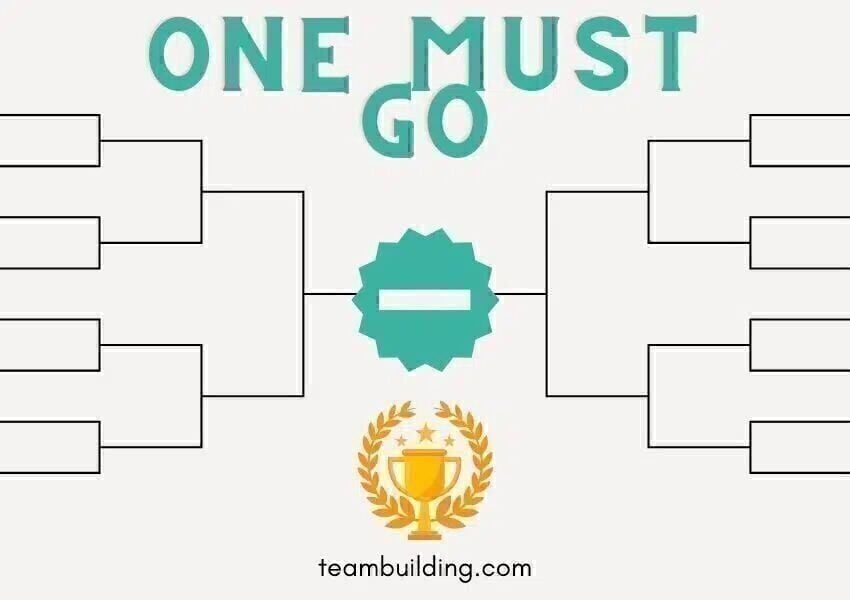
Feel free to answer individually, or decide as a group.
Here are a list of one must go questions.
Friends, soulmates, enemies is a family-friendly and work-safe version of the game "kiss, marry, kill." Each round, a player poses three names, and other players must label each of those figures as a friend, a soulmate, or an enemy.
Here are a few examples:
Though most questions involve famous figures, you could inanimate objects as well, for instance: burritos, tacos, quesadillas.
Friendly feud is a DIY version of the game Family Feud. To play, pose a question. Before the player or team answers, poll the opposite team or the audience to gather the top five answers. Then, award points for each correct guess.
Here are a few sample questions:
To make the game go quicker, limit the amount of turns for each player, or award points only for the top answer. Or, you can simply ask the group questions to see how players respond and how many answers overlap.
Here is a list of Family Feud questions for your game.
For more game show fun, you could also play team building Jeopardy.
Word association is a rapidfire game that asks players to blurt out the first word that comes to mind when a player says a particular word or phrase.
If you have problems generating words, then pick a starter from the list below:
Player one starts by saying a word, and player two responds with the first word that comes to mind. If more than two participants play, then rotate in a circle, otherwise, go back and forth between two players until one tires or stumbles.
Here are more vocabulary games for adults.
One of the simplest question formats is "yes or no?" and you can base entire games around these questions. For example, "do you like chocolate ice cream better than winning the lottery?"
Here is a list of yes or no questions you can use.
"How well do you know me?" is a question game that tests how well you know the other participants. The questions are designed to cover a wide range of topics, from big to small. You can win points for guessing correctly, or lose points for a wrong guess.
Here is a list of how well do you know me questions to try.
Questions games are a fun pastime and a great way to learn more about friends. The games have simple-to-follow rules, require no materials, and help people bond quickly. Plus, these activities can be fun for many age groups. Feel free to try these games with friends, family members, coworkers, acquaintances, or even strangers.
For more fun ways to connect with friends, check out our list of improv games for large groups, this one with funny icebreaker jokes, and this list of team bonding questions.
We also have a list of random questions, list of questions for balance game, list of fact or fiction questions, and list of the best rapid fire questions you can use.
Here are some common questions and answers about question games.
A question game is any activity based on prompts that reveal personal information about players. For example, "Never Have I Ever", Icebreaker Questions and Truth or Dare? The purpose of these games is to build relationships, boost engagement for participants and have fun.
Some fun question games for adults include this or that, would you rather, and trivia. These games provide a good blend of interesting questions and prompts that allow players to share information.
Playing a question game with friends is very easy! First, choose a game like most likely to, or questions only. Then select a date, time and place for your event. You can play your question game online over platforms like Zoom and Facetime, in person, or anywhere else you connect with friends.
I want to play
I like question games but the one I like is guess who