
Quiet Quitting Statistics [Free to Cite]
![Quiet Quitting Statistics [Free to Cite]](https://cdn1.teambuilding.com/cdn-cgi/image/format=webp,quality=72/images/articles///quiet-quitting-statistics.jpg)
You found our list of quiet quitting statistics.
Quiet quitting statistics are data and facts related to the quiet quitting trend. For example, how many employees are quiet quitting and what percentage of companies are investigating it. The purpose of this data is inform audiences and support journalistic narratives.
This data is related to quiet quitting and is similar to employee turnover statistics, employee engagement statistics and job satisfaction statistics.
This page includes:
Here are the facts.
You can use this data in any format, including social media, blogs, and presentations.
Please cite the source as TeamBuilding and link to https://teambuilding.com/blog/quiet-quitting-statistics.
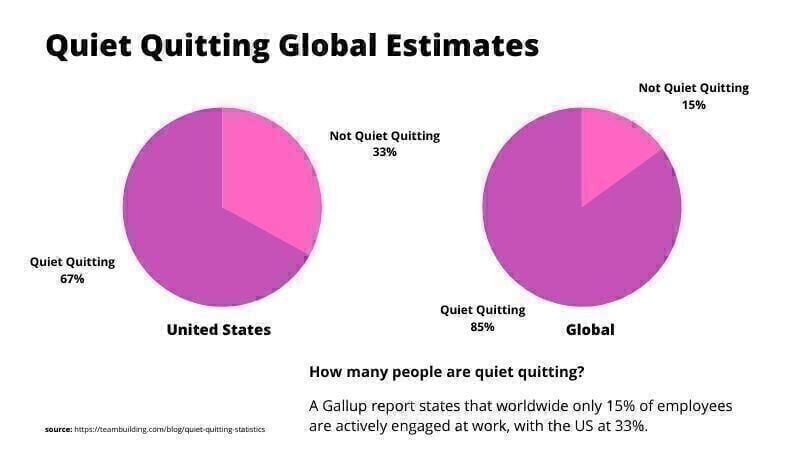
A Gallup report states that only 15 percent of employees are actively engaged at work, which means up to 85% could be quiet quitting. The numbers are a little better for the US, with 33% of employees engaged at work, approximately twice the worldwide average.
Perhaps surprisingly, the rate of employee engagement in Western Europe is very low, at 10% and only 8% in the United Kingdom. All of these numbers have been on a steady decline over the last decade.
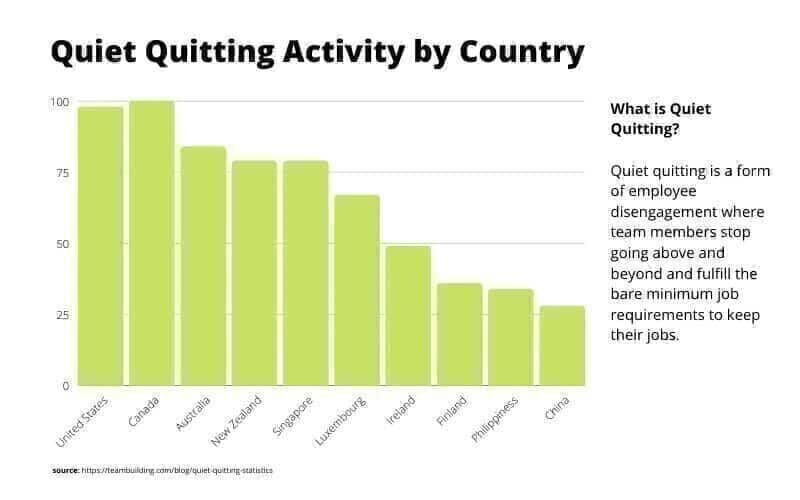
With the US as a baseline, here is how other countries deviate:
There are possible explanations for these data trends around work culture, employee benefits, social security, work-life balance and more.
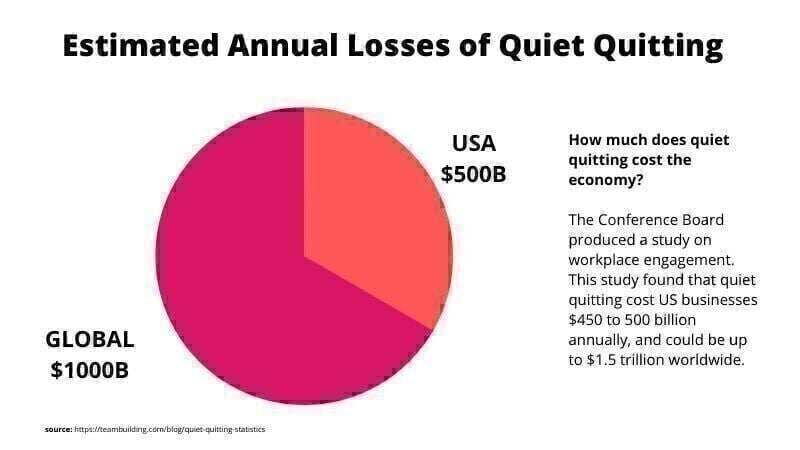
The Conference Board produced a study on workplace engagement. This study found that quiet quitting cost US businesses $450 to 500 billion annually, and could be up to $1.5 trillion worldwide.
These stats on employee engagement from Octanner show that employees expect acknowledgment or recognition for their efforts after completing a project. Of these employees, 79% state that more recognition by managers and leaders would result in higher engagement and job performance.
A report on workplace data by Pew Research shows that 47% or nearly half of all US employees believe that work is just way to pay the bills. This number would correlate with quiet quitting, since a lack of purpose or motivation at work is aligned with decreased engagement and productivity.
Up to 73 percent of US workers are considering leaving their jobs, which is data that closely correlates with quiet quitting.
The primary motivation for switching jobs is money. Nearly 74% of Millennial and Gen-Z employees would take a pay cut to work at their dream workplace.
With all the discussion of quiet quitting, there is a relatively low number of people following #quietquitting on LinkedIn. This number is increasing by about 50 people per day.
If you use data or statistics from this resource or re-share the infographic, please include a link to https://teambuilding.com/blog/quiet-quitting.
We will continue updating this resource with useful quiet quitting statistics, facts, and trends.
Next, check out this list of statistics on remote work, and these team building statistics.
We also have a list of signs employees are quitting.
Here are common questions and answers about quiet quitting statistics.
Quiet quitting stats are facts and delated related to quiet quitting. These stats and figures can help provide context and understanding for trends, as well as as support arguments for or against quiet quitting. These stats are primarily used by journalists to inform audiences.
The most surprising quiet quitting statistic is that up to 85% of employees worldwide may be quiet quitting. This data subverts view points that most people are generally content, engaged and productive at work.
Comments (0)
Leave a Comment