45 Zoom Games for Work, Ranked by 50,000+ Surveys (2026)
30 free Zoom games for work — organized for meetings, parties, small groups, and large groups — plus hosted game shows, escape games, and social games ranked by 50,000+ post-event surveys, with pricing and host tips.
Published
·
Updated
In March 2020, "Zoom" went from a niche software brand to the place where the world's teams suddenly lived. We were lucky: we had been running team building for years and were early to virtual — our guide to virtual team building activities has been read by hundreds of thousands of people since it was published — so when remote work went mainstream we were ready with hosted games built specifically for video calls.
Since then, teambuilding.com has hosted 34,000+ virtual team experiences on Zoom (as of August 2026, counting our pre-platform era), and we've run 45,000+ events overall across virtual and in-person formats since 2013. Along the way we've hosted Zoom games for teams at Salesforce, Starbucks, Pfizer, Walmart, Uber, and thousands of smaller companies.
Trusted by teams at
This guide is everything we know about Zoom games: 30 free games to play on Zoom with coworkers — organized for meetings, parties, small groups, and large groups — our top-ranked hosted game shows, escape games, and social games (ranked by 50,000+ post-event surveys), plus what two decades of combined hosting experience has taught us about what actually works inside a video call.
Zoom games are structured group activities played over a video call — trivia, scavenger hunts, bingo, drawing games, mystery games — using features like breakout rooms, chat, polls, spotlight, and screen sharing as the game mechanics. Teams use these games as icebreakers at the start of meetings, as energizers in the middle of long calls, and as full team building events in their own right.
These games are also called "games to play on Zoom with coworkers," "Zoom meeting games," "Zoom party games," "virtual games for groups," and "online Zoom games" — this list covers all of those.
One clarification, because we get asked: nearly every game here also works on Microsoft Teams, Google Meet, and Webex. We say "Zoom games" because that's where most teams play them — as of August 2026, about 85% of the hosted virtual events our advisors plan run on Zoom, with the rest split across Teams, Meet, and Webex.
Free Zoom games for work (full-length)
These games take twenty minutes or more, involve multiple steps, and build skills — communication, strategy, deduction — that carry back into day-to-day work. They're the right pick when the game is the meeting.
1. Virtual Werewolf
Playing Time: 30 to 90 minutes
Zoom Features Used: Private chat
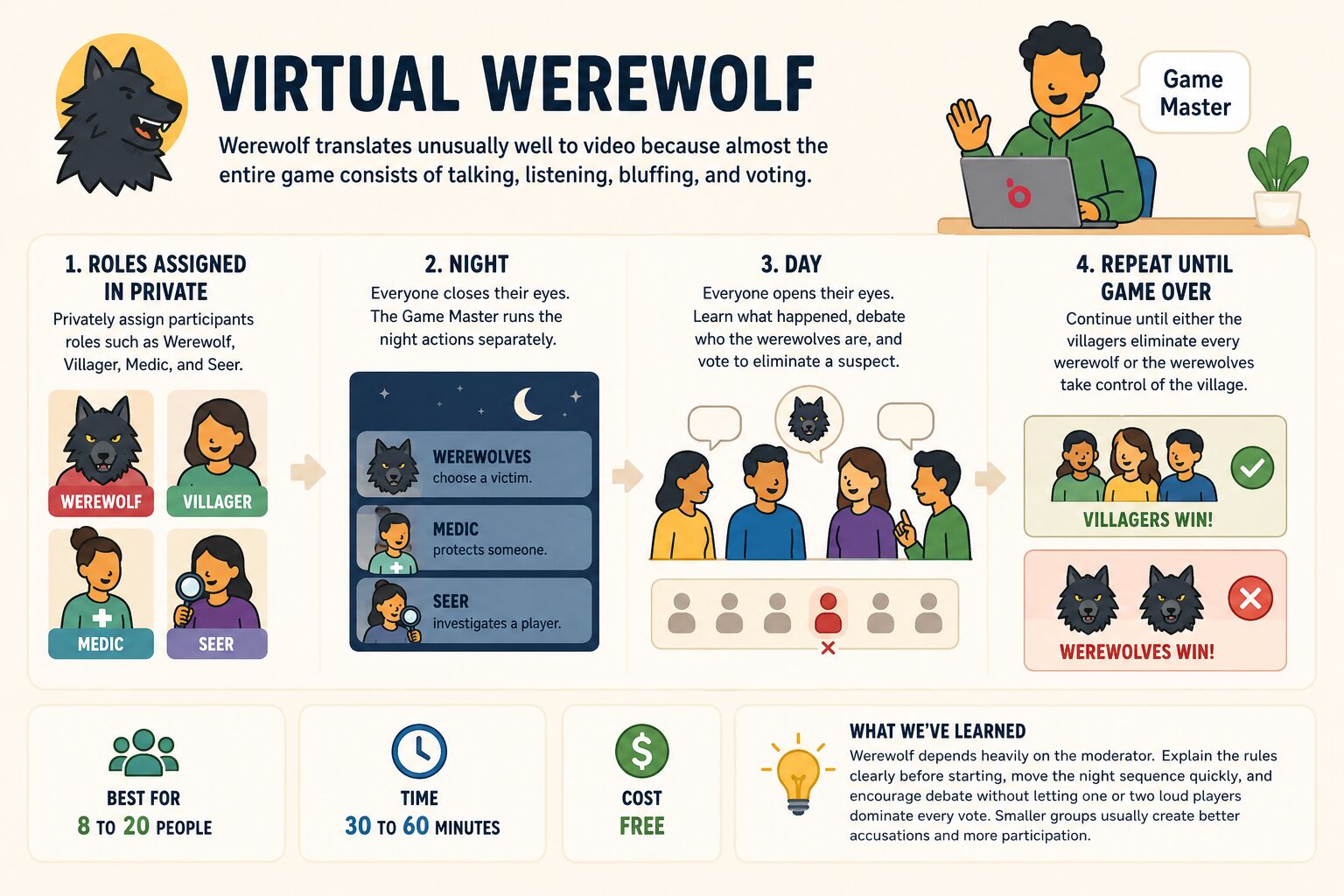
Werewolf is the classic game of deception, and it thrives on Zoom because private messages make secret roles effortless. Privately message each player a role: werewolf, medic, seer, hunter, or villager. Then declare that night has fallen and have everyone close their eyes — or just look away from the camera.
Each round, the werewolf picks someone to eat, the medic picks someone to save, and the seer guesses at the werewolf's identity, all via private message to the moderator. Then the sun rises, the results are revealed, and the group debates — and votes out — their prime suspect. If the werewolf survives to the end, the werewolf wins.
Pictionary adapts to Zoom almost perfectly: share your screen, open the whiteboard, and draw. The drawing teammate gets a prompt from an online Pictionary generator, and their team has one minute to guess. If they miss, other teams can steal.
For larger groups, have players use Zoom's annotate feature so multiple artists can work at once. Here are more virtual Pictionary games.
3. Zoom Scattergories
Playing Time: 20 to 30 minutes
Zoom Features Used: Chat
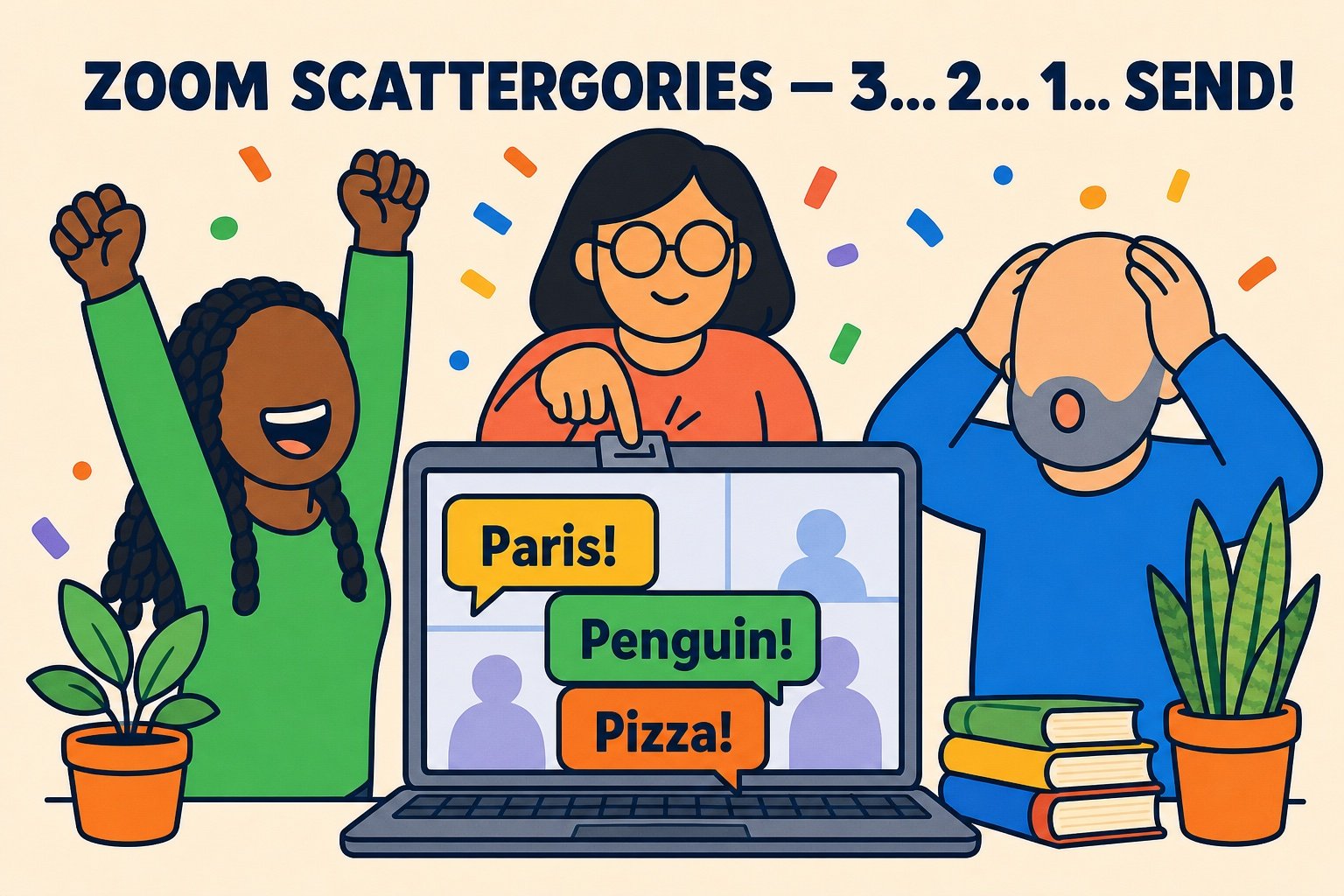
Scattergories is the word game where everyone races to name a car, a city, a flower, and a food that all start with the same letter — and it produces the single best chat-box moment in Zoom gaming.
Here is a Scattergories list generator:
To play Scattergories on Zoom, run one category at a time. Players type their answer in the chat but don't hit send. On the host's signal — we recommend a "3, 2, 1, send!" countdown — everyone hits enter at once and the chat floods with answers. Matching answers cancel out; unique answers score a point. The simultaneous reveal is the whole show: it's fast, fair, and shows the group exactly how alike (or unlike) their brains work.
In this game, teams draft a "dream team" of professionals with unusual jobs — a llama therapist, a medieval blacksmith, a cloud influencer — then justify how their squad would survive a zombie apocalypse or run a five-star hotel.
Pull professions from this list of strange jobs, a random job generator, or your favorite AI chatbot. Teams get five to ten minutes in breakout rooms to assign roles and build their plan, then return to the main room to pitch it. The most convincing, entertaining strategy wins.
The jobs are silly; the skill is real. Teams practice role assignment, planning, and persuasion — and the pitches are consistently the funniest part of the call.
Quick Zoom meeting games
These are short, simple games to slot into regular Zoom calls as icebreakers or energizers — five to twenty minutes, minimal setup. The 8% rule suggests spending at least eight percent of every meeting building connections between participants; these games are the easiest way to hit that number. There is research behind the silliness, too: a Journal of Applied Psychology study of 54 real team meetings found that patterns of humor and laughter were linked to team performance both immediately and nearly two years later.
5. Conference Call Bingo
Playing Time: Throughout the call
Zoom Features Used: None
Bingo, but the squares are things that happen on every video call: "someone talks while muted," "unexpected pet appearance," "can everyone see my screen?" Players mark squares as the moments occur, and the first to complete a row wins a prize.
Here is a free Zoom Bingo board you can use:
The game runs quietly in the background of a normal meeting, which makes it the rare Zoom game with zero agenda cost — and it keeps everyone weirdly attentive. Conference Call Bingo is a cousin of Online Team Building Bingo and icebreaker Bingo.
6. Something in Common
Playing Time: 10 to 15 minutes
Zoom Features Used: Breakout rooms
Send small teams into breakout rooms with one job: find the most unusual thing every member has in common. "We all wear glasses" scores zero style points; "we all won a celebrity lookalike contest" wins the game.
Play multiple rounds with tightening rules — round two excludes physical traits and places, round three restricts to a category like high school. To help teams dig, hand out a few exploratory prompts, or use this icebreaker question generator:
7. Lightning Scavenger Hunts ⚡
Playing Time: 10 to 20 minutes
Zoom Features Used: Spotlight (optional)
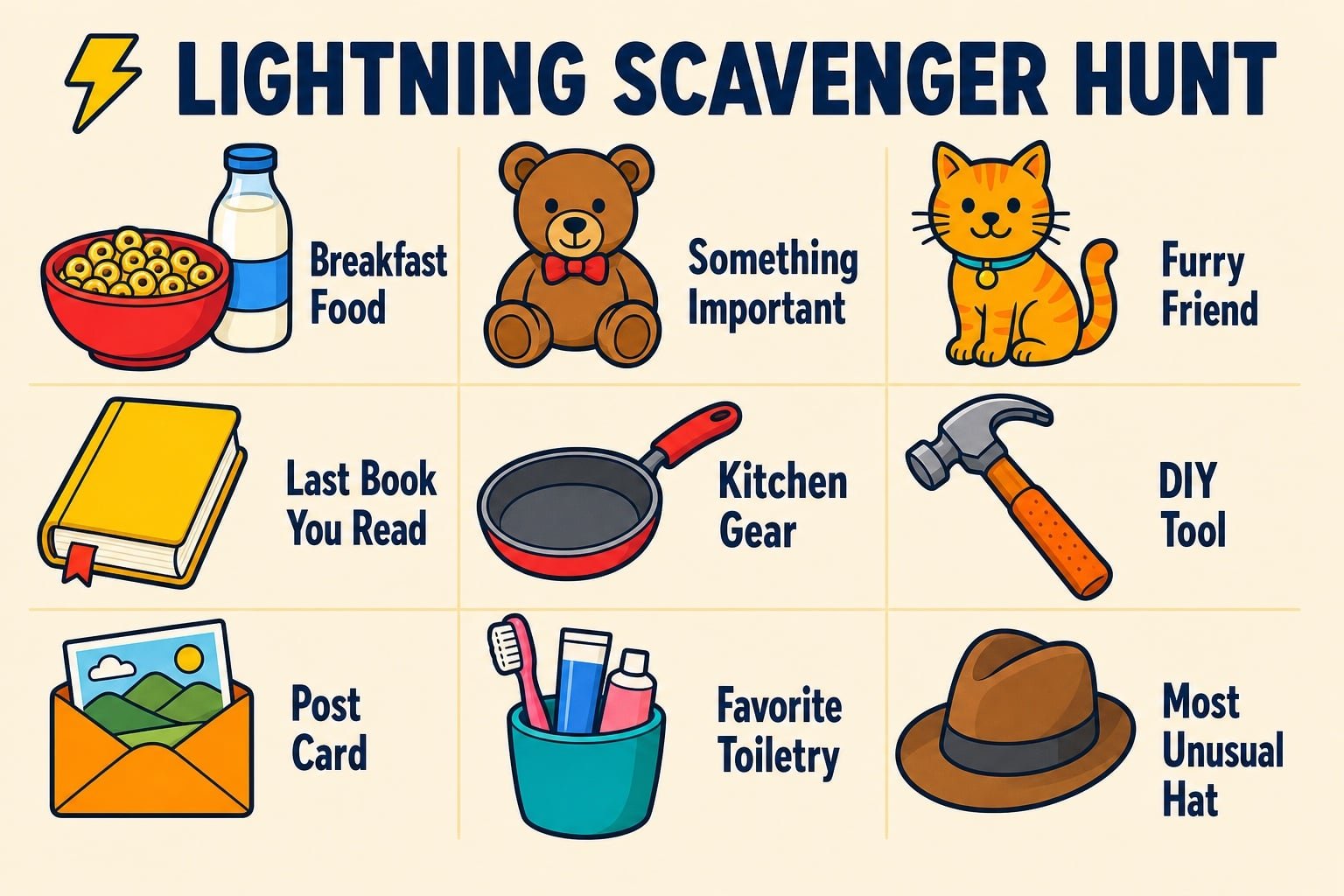
The best Zoom games get people out of their chairs. Lightning scavenger hunts send teammates sprinting through their homes to grab objects one at a time: something red, your favorite mug, the thing you've owned the longest, a book you did not enjoy.
Call out items one by one; first person back on camera with the item earns the point. The sprint is the energizer, but the stories are the team building — "the thing you've owned the longest" reliably produces show-and-tell moments no icebreaker question can match.
Everyone has watched a colleague deliver a passionate point while muted. Read My Lips turns the most familiar Zoom failure into a game: one player mutes themselves and says a word or phrase, and everyone else has one minute to guess it from lip movement alone. The turn-taker can drop hints in the chat if the group is hopelessly lost.
9. Ghost in the Zoom
Playing Time: 10 to 20 minutes
Zoom Features Used: Webcam, spotlight
One teammate "vanishes" by turning off their camera, then quizzes the group on what they remember: "How many posters are behind me?" "What color are my glasses?" Everyone answers from memory.
The game rewards people who genuinely pay attention to their coworkers on calls — and gently punishes the tab-switchers. Spotlight the vanishing player for fifteen seconds beforehand to make it easier, and strike randomly mid-meeting so nobody can study in advance.
10. Conspiracy Theory Factory
Playing Time: 15 to 20 minutes
Zoom Features Used: Breakout rooms, reactions
Teams receive three unrelated items — say, pineapples, the moon landing, and TikTok trends — and get three minutes in a breakout room to weave them into one semi-plausible conspiracy theory. Back in the main room, each team presents its "findings," and the audience votes with reactions: thumbs up for "I believe," open-mouth for "no way."
For an extra layer, have teams write the item lists for their rivals. It's a storytelling exercise wearing a tinfoil hat.
Zoom party games
Games for virtual happy hours, celebrations, and any call where the only agenda is fun. These run louder and sillier than the meeting games above.
11. Zoom Charades
Playing Time: 15 to 30 minutes
Zoom Features Used: Spotlight, mute
We're on record saying charades loses energy inside a camera frame — and it does, if you play it exactly like the living-room version. The Zoom fixes: play in teams so guessing is collective, spotlight the actor so they fill everyone's screen, mute them to prevent slip-ups, and choose prompts that work big — actions and animals beat movie titles with seven words.
Teammates shout guesses or type them in the chat; most correct guesses wins.
12. Taboo
Playing Time: 15 to 30 minutes
Zoom Features Used: Private chat
Taboo is the word game where you describe a target word without saying any of its five forbidden clue words. On Zoom, the moderator sends the active player their card by private message — or uses Lingolex's free Taboo generator, which has a built-in timer. The active player's teammates shout guesses, each correct word scores a point, and the sixty-second timer keeps the descriptions delightfully frantic.
13. Infinity Sketch
Playing Time: 10 to 20 minutes
Zoom Features Used: Whiteboard, annotate
The host calls out a random word — "cat," "airplane" — and players must draw it in one continuous line, without lifting their pen or releasing the mouse button. Break the line and you're out of the round. Most intelligible doodle wins.
Run it in small pools of three to four players using the annotate feature so everyone draws simultaneously and the group can police the one-line rule.
14. The Interview Impostor
Playing Time: 10 to 15 minutes
Zoom Features Used: Chat (optional)
One player secretly adopts the persona of a famous person, real or fictional, and the rest of the group "interviews" them: "What's your biggest pet peeve?" "How do you feel about your portrayal in movies?" The impostor answers in character — voice, mannerisms, opinions — and interviewers race to identify the celebrity within two or three minutes.
The host shares a funny video and everyone must keep a straight face. Laugh or smile and you're out — camera off for the round. Have teammates submit video candidates before the party; the last stone-faced player standing wins, and everyone learns exactly what breaks each coworker.
Zoom games for small groups
Games built for teams of roughly 15 or fewer, where everyone stays in one room and every person gets real screen time. (Why 15? In our experience that's the practical dividing line — below it, Zoom events can run personal and high-touch with many short rounds; above it, you need breakout rooms and structured hosting. More on that below.)
16. Story Races
Playing Time: 10 to 15 minutes
Zoom Features Used: Chat
A relay storytelling game played at typing speed. One player — the story master — starts telling a tale, then stops mid-sentence at a random moment. The first usable line typed into the chat becomes canon, and its author becomes the new story master. The story master may also reject the fastest answer for a funnier one, or put two options to a vote.
17. The Counting Game
Playing Time: 10 to 15 minutes
Zoom Features Used: Microphone
The group counts to ten, one voice at a time, with no turn order and no signals. If two people say a number simultaneously, the count restarts at one. It sounds trivial; on a video call, where body language and eye contact are compressed to thumbnails, it's genuinely hard — and it trains exactly the timing-and-listening muscle that makes real Zoom meetings less interrupt-y. To level up, play with cameras off, or keep counting past ten.
18. Spot the Difference
Playing Time: 10 to 20 minutes
Zoom Features Used: Breakout rooms, spotlight
The group studies everyone's video squares for one minute. Then teams split to breakout rooms, and each team picks one member to change one thing in their background before returning. Players hunt for the differences and guess in the chat; first correct spot scores.
Set ground rules — changed objects should be at least a few inches large — and let teams eliminate options by blacking out webcams one at a time. The game turns background clutter into connection: people notice details about each other's homes they'd never have asked about.
19. Mystery Doodle
Playing Time: 15 to 30 minutes
Zoom Features Used: Whiteboard, breakout rooms
Telephone, but drawn. One team starts a whiteboard drawing from a secret prompt. Every thirty seconds, the host pulls in another player from a breakout room to continue the drawing — without being told the prompt. When everyone has added to it, the group guesses the original prompt from the final artwork.
The debrief writes itself: everyone acted on partial information and assumptions, which is exactly how remote miscommunication works — except here the result is a hilariously mutated doodle instead of a missed deadline.
20. The Reaction Race
Playing Time: 15 to 20 minutes
Zoom Features Used: All of them
The host calls out rapid-fire challenges that can only be completed with Zoom's own tools: "first heart reaction I see gets a point," "type this tongue twister in the chat with zero typos," "change your background to the exotic animal you'd keep as a pet," "high-five the person in the box next to yours and screenshot it."
Mix solo tasks and team challenges, and have players set their display names to team names before you start so scoring stays sane. By the end, even your least technical teammate knows where every Zoom feature lives.
Zoom games for large groups
Zoom games for large groups are formats that stay fun with 20, 50, or 200 people — everyone participates simultaneously instead of waiting for a turn. Large virtual events work better than most people expect: the median virtual event we host has 16 participants, but we've run 448 virtual events with 100 or more participants, the largest with over 1,000 attendees. The mechanics below — polls, elimination, chat submissions, breakout brackets — are how you keep a big room in one game. Here are more virtual games for large groups beyond the Zoom-specific picks below.
For big groups with real stakes — company all-hands, holiday parties — a hosted game show is the reliable pick. Ultimate Game Show is our highest-rated large-format event, with 5,300+ reviews:
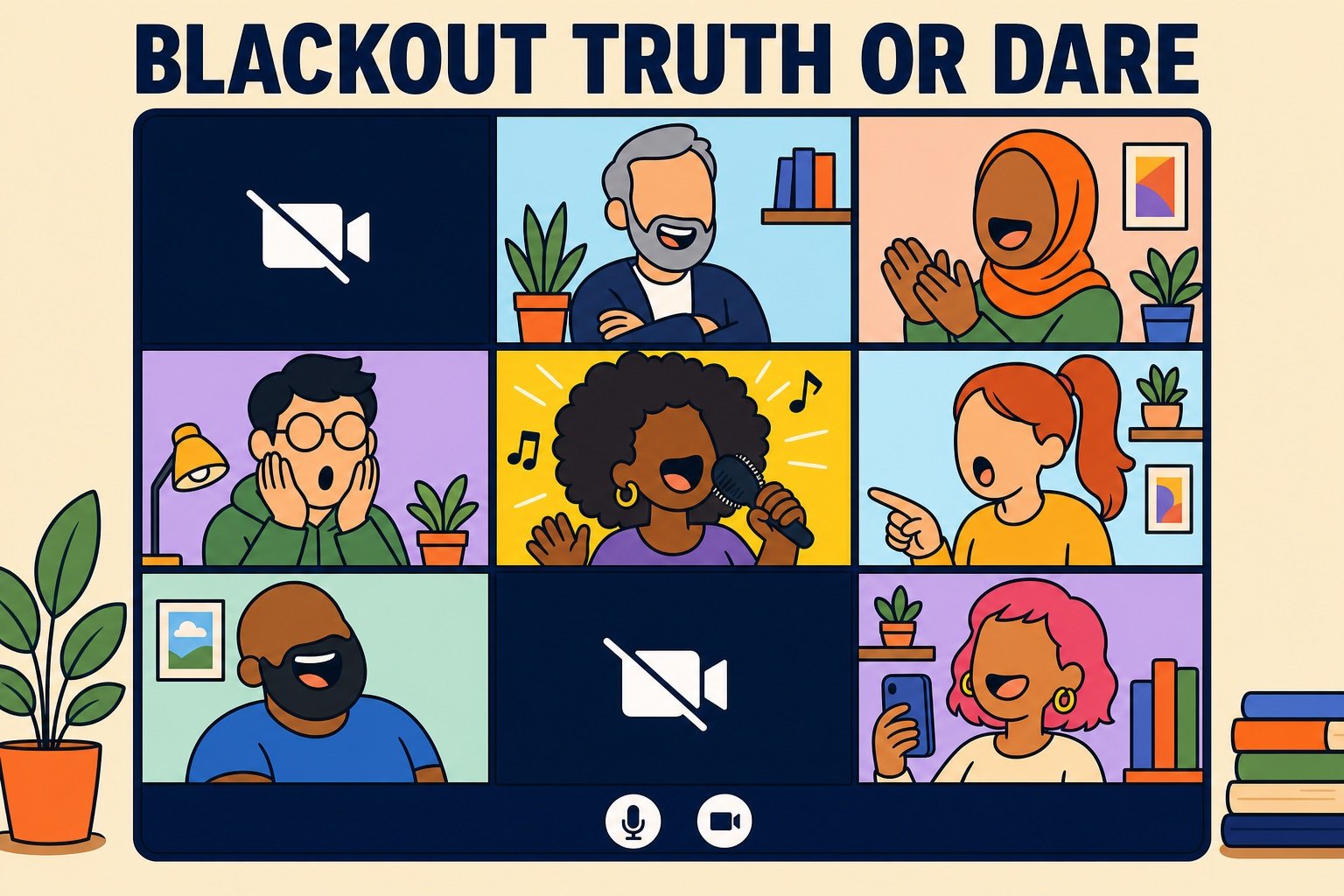
Classic truth or dare struggles at work — the fun dares cross professional lines and the safe ones are boring. Blackout Truth or Dare fixes both problems: the dare-master calls out a work-safe prompt, and any player who doesn't want to participate simply turns off their camera. The dare-master picks one brave remaining player to respond.
Use this work-safe Truth or Dare generator for prompts:
Because everyone opts in or out at once, nobody gets put on the spot, and the game moves fast even with 50 people. Prompts like "change your display name to your childhood nickname" or "sing the chorus of Firework" hit the sweet spot. Here are more work-safe Truth or Dare questions.
22. Virtual Guess Who?
Playing Time: 15 to 20 minutes
Zoom Features Used: Webcam
One player secretly picks a participant, and the group narrows down the identity with yes-or-no questions — "Does your person wear glasses?" — and after each answer, everyone who no longer fits the description turns off their camera — the gallery literally narrows until one face remains.
The game gets better when questions go beyond appearance: "Has your person been at the company more than ten years?" "Did your person travel abroad this year?" Suddenly it's a stealth get-to-know-you exercise for the whole call.
23. Murder Mystery
Playing Time: 60 to 90 minutes
Zoom Features Used: Breakout rooms
Murder mysteries are the deep end of Zoom games: characters, scripts, clues, and accusations, with teams splitting into breakout rooms to compare notes and solve the case. They're intense, immersive, and one of the most popular party formats for big groups — role-play gives even quiet teammates a script to hide behind.
You can run one yourself with a purchased kit, or browse our list of online murder mystery games — including the hosted versions that top our Team Building Score rankings above.
24. "Most Likely To"
Playing Time: 10 to 20 minutes
Zoom Features Used: Polls, chat
High school superlatives, workplace edition. The moderator asks "Who is most likely to drink three cups of coffee a day?" and everyone votes by poll or by typing a name in the chat. Count the votes, crown the winner, enjoy the debate.
The game is built for large groups — more voters means better data and bigger reveals. Keep prompts warm rather than pointed; here are good "Most Likely To" questions to start from.
25. Who Wins the Bracket?
Playing Time: 10 to 15 minutes
Zoom Features Used: Screen sharing, polls
Pick a topic — best snack food, best '90s song, best movie dad — seed a tournament bracket, and let the group vote each head-to-head matchup by poll. Screen-share a free bracket maker so everyone watches the tournament unfold.
Pause for the passionate debates; they're the actual team building. Here are more workplace competitions that adapt well to Zoom.
26. Bet on the Crowd
Playing Time: 15 to 20 minutes
Zoom Features Used: Polls
Run a poll — "cats or dogs?", "give up your phone or your car for a month?" — but before revealing results, have everyone predict which answer will win. Points go to correct predictors, not to the majority. It's a game about how well you know your coworkers, disguised as a game of opinions. Pull prompts from this list of this-or-that questions.
27. Guess the Movie
Playing Time: 15 to 25 minutes
Zoom Features Used: Screen sharing, chat
The moderator prepares clues about well-known movies — famous lines, character descriptions, plot summaries in exactly five words — and players race to name the film in the chat or by direct message. Stick to classics so nobody is locked out, and theme rounds ("movies from the year you were born") for variety. Most correct guesses wins.
28. Train the Robot
Playing Time: 15 to 25 minutes
Zoom Features Used: Screen sharing, breakout rooms
Pairs split into a "trainer" and a "robot." The robot shares their screen and follows the trainer's spoken instructions literally — open Auto Draw and sketch a trumpet, assemble a three-slide presentation about cats, navigate to a website using only keyboard shortcuts. Points for steps completed correctly.
The game is a communication drill in a funny hat: vague instructions produce chaos, precise ones produce results, and everyone feels the difference immediately. Here are more communication games in the same vein.
29. "Potpourri" Trivia Tournament
Playing Time: 20 to 60 minutes
Zoom Features Used: Chat, breakout rooms (optional)
Crowdsourced trivia: every player submits a few questions from their own areas of expertise ahead of time, and the host compiles them into a tournament. Players can't answer their own questions but can give teammates hints.
The crowdsourcing does double duty — it cuts the host's prep dramatically, and the categories become a map of the team's hidden interests. The bigger the group, the more delightfully unhinged the category mix. If your team gets hooked, a hosted trivia night with a professional quizmaster is the natural upgrade.
30. Whose Crib Is It?
Playing Time: 15 to 20 minutes
Zoom Features Used: Screen sharing
Before the call, participants privately send the moderator a photo of a corner of their home — ideally a room that never appears on camera. The moderator shares each photo, and the group races to guess whose home it is.
The best submissions are the not-so-obvious ones: the garage workbench, the overloaded bookshelf, the suspiciously organized spice rack. Every reveal comes with a story.
The best Zoom games you can book
The free games above are great — most of this article is free games — but if the event matters, a professional host changes everything. A good host handles the rules, the tech, the timing, and the energy, so every person on the call gets to just play.
Rather than tell you which of our games are "the best" based on vibes, we rank them with data. Our Team Building Score combines overall satisfaction, participant recommendation scores, organizer reviews, and engagement ratings from more than 50,000 post-event surveys — and we publish exactly how it works.
Below are our top-ranked hosted Zoom games in the three collections teams book most: game shows, escape games, and social games.
Top Zoom game shows
Buzzer-energy competition formats run by a host playing emcee — points, team names, and rapid rounds. The closest thing to putting your company inside daytime TV.
Ranked by our Team Building Score — a running points total earned through confirmed bookings, verified reviews, ratings, and listing quality, recalculated nightly. Every event shown also has at least 30 post-event survey responses per question; the happier, connected, and NPS columns are computed from the 2,350+ survey responses collected for the 5 events listed here — a subset of all post-event surveys across our catalog. Updated October 2026.
Top Zoom escape games
Puzzle-driven mysteries and escape rooms rebuilt for video calls — teams race through clues and codes in breakout rooms while a host keeps the story moving.
Ranked by our Team Building Score — a running points total earned through confirmed bookings, verified reviews, ratings, and listing quality, recalculated nightly. Every event shown also has at least 30 post-event survey responses per question; the happier, connected, and NPS columns are computed from the 3,206+ survey responses collected for the 5 events listed here — a subset of all post-event surveys across our catalog. Updated October 2026.
Top Zoom social games
Connection-first formats built on icebreakers, storytelling, and friendly competition — the games to pick when the goal is teammates actually knowing each other better.
Ranked by our Team Building Score — a running points total earned through confirmed bookings, verified reviews, ratings, and listing quality, recalculated nightly. Every event shown also has at least 30 post-event survey responses per question; the happier, connected, and NPS columns are computed from the 2,106+ survey responses collected for the 5 events listed here — a subset of all post-event surveys across our catalog. Updated October 2026.
Every event above runs on Zoom by default and includes a live host, a client advisor for customizations, and a 100% happiness guarantee. Want more options? Browse all 90+ virtual Originals →
Where to book hosted Zoom games in 2026
Plenty of companies sell hosted Zoom games, and candidly, most are selling generic trivia with impressive adjectives attached. I'm biased — I run a team building company — but I've been in this industry since before "Zoom games" existed as a concept, and I'm happy to point at the options that are genuinely worth considering.
Teams that want a large selection of activities and price points
The strongest alternative to teambuilding.com — a broad menu of virtual games, classes, and workshops. Think "quick energizer" more than "deep connection."
Not team building per se, but reliably fun: one person screen-shares the game and everyone plays from their phones. Someone on your team has to own setup, hosting, and audio sharing.
An established company in the space. Limited public reviews, but highly rated.
Booking a hosted event is the low-effort, high-reliability route — but running your own Zoom games from the lists above is free, and with the right game and a little prep, DIY sessions can be excellent. Either way, the next section is what makes them work.
How to run games on Zoom: what we've learned
We've hosted 22,000+ virtual events since 2021 (as of August 2026), and our post-event surveys ask outcome questions beyond star ratings. Of the nearly 18,000 virtual participants who have answered them, 98% said the event made them happier and 91% said they felt more connected to their teammates. Zoom games work. But the difference between a great session and an awkward one comes down to a few learnable rules.
The laughing itself is doing work: in a Journal of Neuroscience brain-imaging study, 30 minutes of social laughter triggered opioid-system (endorphin) release in brain regions tied to social bonding. A game that makes your team laugh on a Tuesday call isn't a break from connection — it's the mechanism.
Structure is everything on a video call. In person, a lull becomes chatting. On Zoom, a lull is just silence, and silence kills momentum fast. Set the rules in the first two minutes, use visible time limits, and never leave the group wondering what happens next. This is also why hosts matter so much: roughly one in five of our virtual event reviews mentions the host by name. Nobody remembers the software; everybody remembers who ran the show.
Keep sessions between 60 and 90 minutes. 88% of the virtual events we run fall in this window. Under an hour, the session ends right as your quieter teammates warm up — when clients book shorter events, nine times out of ten they tell us afterward they wished they'd booked the full length. Past 90 minutes, screen fatigue wins no matter how good the game is. For meeting games, think in 10-to-20-minute bites instead.
Friendly competition is the engagement engine. When we mine reviews for what participants loved, competition comes up constantly — points, buzzers, leaderboards, team names. It gives people a reason to lean in without asking anyone to perform. Keep the stakes at bragging-rights level; the competition is the mechanism, and the laughing is the point.
Group size changes the game — the line is about 15 people. This is the most practical thing we know about Zoom games, and it's why this article is organized the way it is:
Small groups (under ~15)
Large groups (15+)
Format
Everyone in one room, many short rounds
Breakout teams or simultaneous mechanics, fewer and longer rounds
Master four Zoom mechanics and every game runs smoother. The chat cascade ("type your answer, don't send until I count down") turns the chat box into a game show buzzer. Breakout rooms with a countdown timer create urgency that open-ended rooms never do. Spotlight makes one player the whole screen — essential for charades, impossible to replicate in gallery view. And if your game uses music or video, test "share sound" before the call, not during it.
How we develop new Zoom games
People sometimes ask where our hosted games come from. The honest answer is: a pipeline, not a brainstorm. Our team of hosts regularly designs dozens of new game concepts, and every one goes through the same gauntlet. First we play-test internally — our own remote team is the beta group, and a game that can't survive our staff on a Friday afternoon doesn't meet clients. The survivors go live with real teams, where post-event surveys and reviews tell us exactly which rounds dragged, which rules confused people, and which moments made the call. Hosts iterate between runs — tightening timers, rewriting prompts, rebalancing scoring — and formats that never find their energy get retired.
The games that stay in rotation get refreshed on a regular cycle so returning teams don't replay last year's event. That process is why the Top 10 above looks the way it does — and the Lame List below is partly a graveyard of formats that didn't survive it.
Advice from our event hosts
Our hosts have run Zoom games for tens of thousands of teams. Two pieces of their advice that apply to every game on this list:
"Have that camera on and, if you can, mic on too! It's one thing to be in the meeting, but it's another to be INVOLVED in the meeting."
— Sonya Stewart, teambuilding.com Event Host
"The best events are when even the host is focused on having a good time themselves because the attendees will have a good time if you are."
— Paisley Carswell, teambuilding.com Event Host
In other words: energy is set from the top of the call. If the organizer treats the game like a chore, so will everyone else.
Zoom games we don't recommend
Some game formats simply fail inside a video call — latency breaks them, the camera frame constrains them, or they put individuals under pressure that feels very different on-screen than in a room. We've watched these fail across thousands of events, so you don't have to.
The Lame List
Activity
Why skip it
Verdict
Zoom karaoke
Video-call latency makes singing together literally impossible — the delay stacks and the song collapses. Solo karaoke just puts one nervous person under a spotlight.
Skip it
Unstructured "game time"
Dropping 20 people into a call with "let's play something!" produces five minutes of talking over each other and then silence. Every game on this list works because someone runs it. Same failure mode as unstructured virtual happy hours.
Add a host
Marathon game sessions
Two-hour game nights sound generous and feel endless. Screen fatigue beats even great games past the 90-minute mark.
Cap at 90 min
Classic Truth or Dare
The interesting dares cross professional boundaries; the safe ones are dull. Blackout Truth or Dare is the version that actually works at work.
Play the SFW version
Two Truths and a Lie with 20+ people
Fine as a quick icebreaker for five people; with a big group it becomes a 40-minute queue where one person talks and nineteen wait.
Small groups only
Virtual movie nights
Two hours together, near-zero interaction. Watching a screen next to other people watching a screen is not a game, and on Zoom it isn't even cozy.
Not team building
Surprise performances
Springing "everyone shares a talent!" on an unsuspecting call creates anxiety, not bonding — especially for teammates who'd rather resign than sing.
Skip it
Games with expensive prizes
Big prizes flip the mood from playful to competitive-for-real: accusations of cheating, sandbagging, hurt feelings. Bragging rights are the right stakes.
Keep stakes low
Final thoughts
Zoom games earn their place on the calendar when they respect three rules we see proven in the survey data over and over: give the game structure, keep everyone participating at once, and end before fatigue wins. Whether that's five minutes of Scattergories chat-flooding in a Tuesday meeting or a hosted game show for the whole company, the goal is the same — a call people are glad they joined.
Run the free games above whenever you like; they're free forever and most need zero prep. And when the moment matters enough for a professional host, browse our hosted virtual events — including every game in the ranked collections above.
Answers based on 50,000+ post-event surveys and 22,000+ hosted virtual events.
What are good games to play on Zoom with coworkers?
The best games to play on Zoom with coworkers use the platform's own features as game mechanics: Conference Call Bingo, Lightning Scavenger Hunts, and Scattergories are free crowd-pleasers, while hosted events like Online Office Games (8,700+ reviews) handle everything for you. Pick a game matched to your group size, and always have one person run it — structure is what separates a fun game from an awkward call.
What free games can you play on Zoom?
Most games in this list are completely free: Conference Call Bingo, Read My Lips, the Counting Game, Scattergories, Lightning Scavenger Hunts, Blackout Truth or Dare, and more. They only need Zoom's built-in features — chat, breakout rooms, polls, spotlight, and screen sharing — plus a free online generator for prompts.
How long should Zoom games last?
Meeting games work best in 5-to-20-minute bites. For full game events, 60 to 90 minutes is the sweet spot: 88% of the hosted virtual events we run fall in this window. When clients book shorter sessions, nine times out of ten they tell us afterward they wished they had booked the full length — and past 90 minutes, screen fatigue wins.
How do you play Zoom games with a large group?
Above roughly 15 people, switch to games where everyone acts at once instead of taking turns: Blackout Truth or Dare, "Most Likely To" polls, bracket votes, and trivia tournaments. Use breakout rooms, polls, and a dedicated host who isn't also playing. The format scales further than most people expect — we've hosted 448 virtual events with 100+ participants, the largest with over 1,000 attendees.
How much do hosted Zoom games cost?
Professionally hosted Zoom games typically cost $20 to $45 per person on teambuilding.com, and include a live host, a client advisor, and a happiness guarantee. Events with shipped kits for each participant run more, and across the industry expect roughly $20 to $50 per person. Everything in the free sections of this list costs nothing to run yourself.
Do Zoom games actually work for team building?
Yes, when they're structured and someone runs them well. Our virtual events are rated 4.96 / 5 across 44,000+ reviews, and of the nearly 18,000 virtual participants who answered our post-event outcome questions, 98% said the event made them happier and 91% said they felt more connected to their teammates.
Comments (48)
Ivy
I usually don't make comments on posts but this collection of activities is amazing...the girls wanted to do 3 activities back to back. They had so much fun and were more engaged than they've been in a while.
Michael Alexis
Hi Ivy! So happy to hear it, thanks for sharing 🙂
Naomi Steelman
What a fantastic idea! I am going to use this in international student chats I am organizing! A great way to gauge perceptions of others, correct stigmas, share information about each other with context! Love it! Thank you for taking the time to share!
~Naomi S.
Ellen L Frank
I think 20 questions would be a good game to adapt to a zoom meeting. One person is privately given the answer by the host via private message in the chat and then each person starts to ask yes or no questions. Is it an animal? yes or no, then the next person asks, does it come in different colors?, yes or no, then the next person asks, is it bigger than a bread basket? Yes or no.....all the while people can be guessing in the chat and the first person that guesses wins! If they make it through 20 questions without guessing the item, then the person answering the questions wins. You could do hang man as well in guessing letters.
Pat Bowie
These are some really great ideas. My quick and fun favorite is still BINGO! You can do so much with it and it is less time consuming to create and bring to an end with smiles.
Jonathan Long
"Emoji Roulette"
Participants take screenshots of their most used emojis.
Create a list of players and give this this to each player.
Each person has up to five minutes to guess the five most used emojis by each person on the list.
Reveal the answers and award points for accuracy, getting the emojis in the correct order and similar.
You can use this to give out rewards and/or segway into a conversation about the importance of perception in sales or other topics of discussion.





















I usually don't make comments on posts but this collection of activities is amazing...the girls wanted to do 3 activities back to back. They had so much fun and were more engaged than they've been in a while.
Hi Ivy! So happy to hear it, thanks for sharing 🙂
What a fantastic idea! I am going to use this in international student chats I am organizing! A great way to gauge perceptions of others, correct stigmas, share information about each other with context! Love it! Thank you for taking the time to share!
~Naomi S.
I think 20 questions would be a good game to adapt to a zoom meeting. One person is privately given the answer by the host via private message in the chat and then each person starts to ask yes or no questions. Is it an animal? yes or no, then the next person asks, does it come in different colors?, yes or no, then the next person asks, is it bigger than a bread basket? Yes or no.....all the while people can be guessing in the chat and the first person that guesses wins! If they make it through 20 questions without guessing the item, then the person answering the questions wins. You could do hang man as well in guessing letters.
These are some really great ideas. My quick and fun favorite is still BINGO! You can do so much with it and it is less time consuming to create and bring to an end with smiles.
"Emoji Roulette"
Participants take screenshots of their most used emojis.
Create a list of players and give this this to each player.
Each person has up to five minutes to guess the five most used emojis by each person on the list.
Reveal the answers and award points for accuracy, getting the emojis in the correct order and similar.
You can use this to give out rewards and/or segway into a conversation about the importance of perception in sales or other topics of discussion.