30 Office Party Ideas, Games & Themes (Staff Parties on Any Budget)
Most office parties fail because nobody planned anything for people to do together. Here are 30 office party ideas, themes and games, from hosted events to a $150 afternoon, each with instructions, group sizes, timings and costs, plus a planning checklist, budget and agenda.
Published
·
Updated
Most office parties fail in the same quiet way. Somebody books a room, orders a platter, sends a calendar invite, and on the day everyone stands in the same clusters they sit in all week, eats, checks the clock, and leaves at the earliest polite moment. The food was fine. The problem was that nobody planned anything for people to actually do together.
We have hosted events at thousands of company parties, in offices, at venues, and on video calls, and the parties people remember have one thing in common: a single activity the whole room does at the same time. A cook-off, a game show, an awards night, a bingo card that forces you to talk to someone from accounting. The rest of the party, the food and the music and the decorations, takes care of itself once the room is in motion.
The 30 office party ideas below are the formats, themes and games we would actually run, sorted by the kind of party you are planning: a creative office party, a themed party, a party built around games, an annual staff party, a small work party, or a low budget office party. Every idea has step-by-step instructions, a group size, a time estimate and a cost, followed by a planning checklist, a sample budget and a run of show.
An office party is a social event a company holds for its employees to celebrate an occasion, mark a milestone, or simply give coworkers time together away from their desks. Office party ideas are the themes, games, activities and formats that turn that gathering into something people want to attend. Examples include a guacamole cook-off, a casino night, an office awards show, a company tailgate, and a decorated-desk contest. These events are also called work parties, staff parties, company parties, corporate parties, workplace parties, employee parties, office get-togethers and, when they happen after hours, staff nights out.
A party is a small thing next to pay and workload, but it is one of the few visible signals a company sends about whether it values the people in the building. In the American Psychological Association's 2023 Work in America Survey of 2,515 employed U.S. adults, 92% of workers said it is important to them to work for an organization that values their emotional and psychological well-being. A well-run party will not fix a bad culture, but it is a cheap and public way to show a good one, and a badly run one, the kind where the boss gives a speech and everyone eats in silence, sends the opposite message just as loudly.
The ideas in this guide are ordered from most structured to least. If you want the party to run itself, book a hosted event. If you have a budget and a committee, run one of the themes or games. If you have a Tuesday afternoon and $150, skip to the low budget section.
The best office party events you can book
Hosted events solve the problem that sinks most office parties: somebody on your team has to run the activity, and that person does not get to enjoy the party. Our in-person Originals are led by trained hosts who bring the supplies, run the games, keep score, and manage the energy in the room, so the organizer can stand with a drink like everyone else. We rank them with our Team Building Score, which combines post-event survey results, participant recommendation scores and organizer reviews.
Ranked by our Team Building Score — a running points total earned through confirmed bookings, verified reviews, ratings, and listing quality, recalculated nightly. Every event shown also has at least 30 post-event survey responses per question; the happier, connected, and NPS columns are computed from the 2,661+ survey responses collected for the 10 events listed here — a subset of all post-event surveys across our catalog. Updated October 2026.
Here is the one we would book for a first office party, because it works in a conference room as well as a rented loft and it feeds people at the same time.
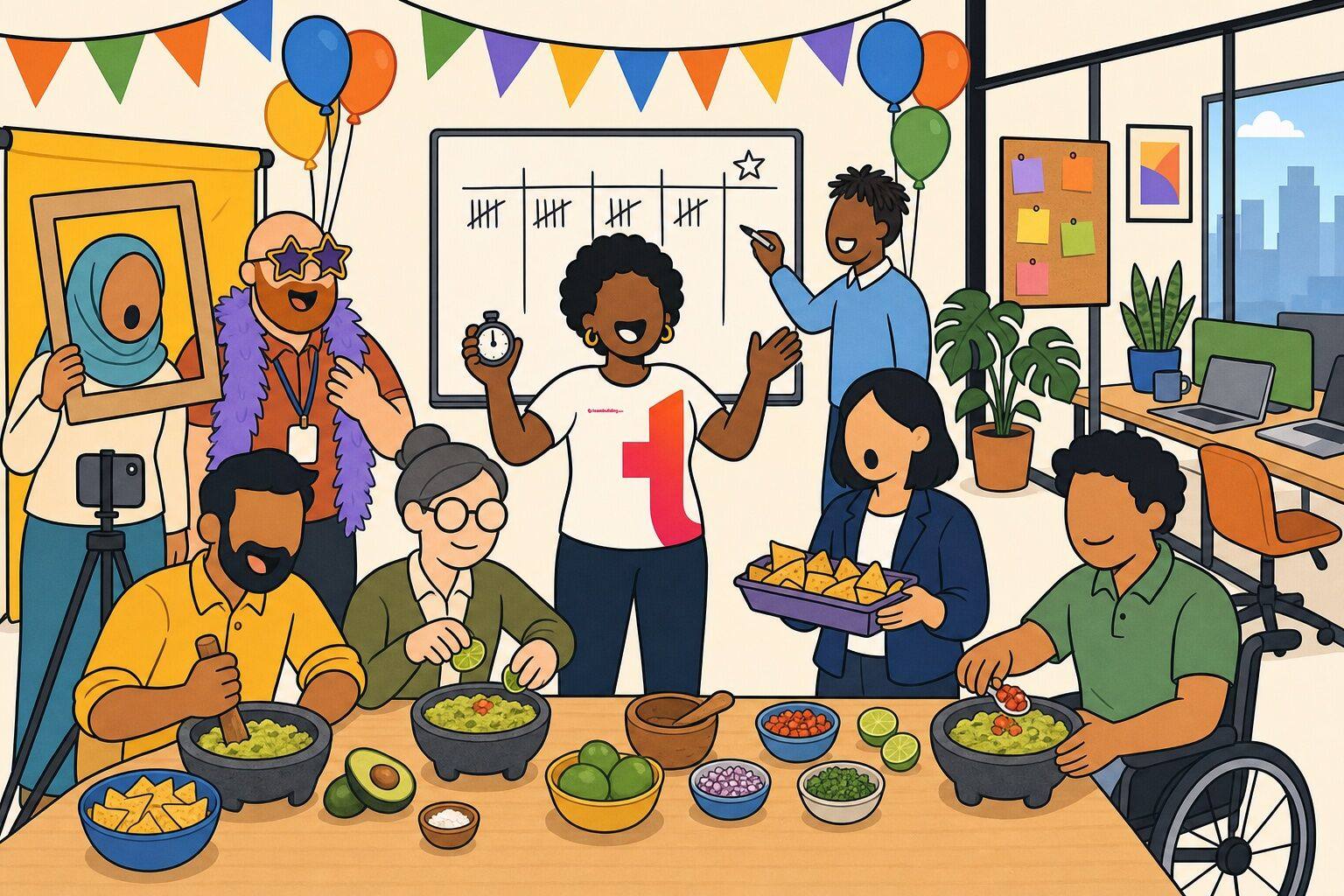
The Great Guac Off is our highest-scoring in-person event and the most-reviewed: 4.97 out of 5 across 1,812 reviews as of September 2026. Teams of four to six get avocados, limes and a table of mix-ins, then compete through guacamole-themed trivia and mini-games to earn extra ingredients before a final mash-off judged by the whole room. It needs no kitchen, just tables, and because everyone is standing, mixing and arguing about jalapeños within the first ten minutes, it doubles as the icebreaker for the rest of the party.
Best for: 15 to 1,000 people Time: 60 to 90 minutes Materials (cost): Hosted, $80 per person, ingredients included
Where to book office party entertainment
There are more companies selling office party entertainment than there are good ones, and a lot of the listings are a DJ, a photo booth and a sales page. For a party, the questions that matter are whether the vendor brings a host who can hold a room, whether they have run your headcount before, and whether the price on the quote is the price on the invoice. Here are the options we would actually consider, including our own.
$50 to $100 per person for hosted in-person Originals; marketplace vendors priced on each listing
Hosted cook-offs, game shows and museum hunts in major U.S. cities, plus vetted local vendors
Our pick for a host-led party activity, and we are obviously biased. 95% of our Original hosts are employees and the rest are long-term contractors, which keeps quality consistent and skips third-party markups.
Book direct; DJs and photo booths typically $500 to $1,500 per event, venues $25 to $75 per person
Filling out the party around one hosted activity
Search your city plus the service. Confirm group minimums, the setup and teardown time, and whether a staff member runs anything or just checks you in.
For a longer rundown of DJs, magicians, caricaturists and other acts, see our guide to corporate party entertainment. Booking a host is the easy path, but it is not the only one. Everything below is a party you can run yourself.
Office party ideas
These seven are the formats we reach for when a team asks for "something better than pizza in the break room." Each one gives the room a job to do, which is the difference between a party and a catered meeting.
1. Office Cook-Off
A cook-off is the do-it-yourself version of our most popular party event. Teams make a dish from the same base ingredients, the room tastes everything, and a winner is crowned. Chili, salsa and guacamole are the classic choices because none of them need a stove or a knife skills briefing.
How to run it:
Pick one dish and buy the base ingredients in bulk: avocados, limes, onions, tomatoes and salt for guacamole, or canned beans, tomatoes and spice packets for chili made in slow cookers.
Split the room into teams of four to six and give each team a table, a bowl, a masher or spoon, and a "pantry" of shared extras (jalapeños, cilantro, mango, bacon bits, hot sauce).
Set a 25-minute clock. Halfway through, announce a secret ingredient every team must use.
Number the bowls, hand out chips and voting slips, and let the whole room taste and score on flavor, presentation and creativity.
Award a trophy (a gold spray-painted avocado works) and read out the winning recipe.
Best for: 12 to 60 people Time: 60 to 75 minutes Materials (cost): Ingredients, bowls, chips and voting slips ($8 to $12 per person)
What we've learned: The secret ingredient is what turns a cooking task into a game. Our hosts reveal it at the halfway mark so teams have already committed to a plan and have to adapt. Keep it edible but strange, like pickle juice or a handful of pomegranate seeds.
2. Casino Night
Casino night is a company party idea that works for almost any headcount because guests can drift between tables at their own pace. Nobody plays for real money; everyone gets the same stack of chips at the door and cashes them in for raffle tickets at the end.
How to run it:
Set up three or four stations: blackjack, roulette (a printable wheel works), a poker table and a "wheel of fortune" spinner with company-themed prizes.
Recruit a dealer per table from your most theatrical coworkers, or rent tables with dealers from a local casino party company.
Give each guest $500 in play chips on arrival and let them trade chips for raffle tickets at any point.
Run a raffle in the final 15 minutes for prizes like a paid afternoon off, a lunch voucher or a ridiculous trophy.
Dress the room with playing-card garlands, dice centerpieces and a lounge playlist, and encourage cocktail attire.
Best for: 20 to 200 people Time: 2 to 3 hours Materials (cost): Chips, cards, printed wheels and prizes ($150 to $400 DIY; rented tables with dealers from about $1,000)
What we've learned: The raffle is what keeps people at the tables. Without a reason to accumulate chips, guests play one hand and go back to their friends. Announce the prizes early and post them on the wall.
3. Murder Mystery Party
A murder mystery turns the office into a live game of Clue. Guests play characters, a "victim" is discovered, and the room spends the evening trading clues and accusations. It is one of the few party formats that gives quiet people a script to hide behind.
How to run it:
Buy a script sized to your group; murder mystery party kits come in 8 to 20-player boxes, and larger groups can run two or three parallel games.
Send character assignments a week ahead with a costume suggestion so people arrive in character.
Open with the host reading the setup, then release clues in three rounds, with 15 minutes of mingling between each.
Collect written accusations before the reveal, then announce the killer and award prizes for the correct guess and the best performance.
Best for: 8 to 40 people Time: 90 minutes to 2 hours Materials (cost): Script or kit ($30 to $80), optional props and costumes
What we've learned: Cast the quiet people as the suspects with the best secrets. A big role with a script gives someone who never speaks in meetings a reason to hold the room, and those are the performances everyone talks about on Monday.
4. Office Game Show Night
Game show night is what our hosts run at hundreds of office parties a year, and a stripped-down version works fine with a laptop and a confident emcee. The format is a series of short rounds borrowed from TV, played by teams at tables, with a running scoreboard.
How to run it:
Survey the office a week ahead with ten questions ("name a snack that disappears from the kitchen first") to build a Family Feud-style round with real answers.
Plan five rounds of about ten minutes: the survey round, a picture round on the projector, a "name that tune" round with five-second clips, a company history round, and a final wager round.
Give each table a whiteboard or a stack of paper for answers and appoint one scorer.
Keep the emcee moving: read, reveal, score, next. Dead air is the enemy.
End with the final wager so the last-place table can still win.
Best for: 15 to 150 people Time: 60 to 90 minutes Materials (cost): Projector, buzzers or bells, prizes ($30 to $100)
What we've learned: The survey round is the best ten minutes of any office party we host because the answers are about the people in the room. Write the questions so the answers are funny but never at one person's expense.
5. Company Tailgate
A tailgate is a parking-lot party built around food, team colors and a game on a screen. It suits companies with a big lot, a sports-mad office, or a party budget that is mostly grill.
How to run it:
Reserve a section of the parking lot or the top level of the garage and confirm it with building management.
Rent a grill or two, or book a food truck, and set up a drinks cooler station with plenty of non-alcoholic options.
Ask people to wear team jerseys or company colors and run a car-decorating contest for the most committed.
Put the game on a portable screen and run cornhole, ladder toss and a flag football scrimmage on the side.
Hand out foam fingers or branded caps as the party favor.
Best for: 30 to 300 people Time: 2 to 4 hours Materials (cost): Grill rental or food truck, lawn games, screen ($15 to $30 per person)
What we've learned: The lawn games matter more than the game on the screen. Half the office does not follow the sport, and cornhole gives them something to do that is not watching other people watch football.
6. Food Truck Rally
A food truck rally is the easiest large staff party to run because the vendors bring the kitchen, the line is the mingling, and everyone gets to choose their own lunch. It also solves the dietary-restrictions problem in one move: book a mix of trucks and let people pick.
How to run it:
Book two to four trucks with different menus (tacos, a vegan option, dessert, coffee) for a two-hour window; most trucks take a guaranteed minimum plus per-plate pricing.
Print "food tokens" so employees do not pay, and hand each person two on the way out of the building.
Set up picnic tables, a speaker with a playlist and a lawn game or two in the lot.
Run a "best dish" vote at the end so the trucks compete for a bragging-rights plaque.
Best for: 50 to 500 people Time: 2 hours Materials (cost): Truck minimums, typically $15 to $25 per person
7. Silent Disco
A silent disco hands every guest a pair of wireless headphones with three channels and lets three DJs (or three playlists) compete for the room. It looks absurd from the outside, which is the point, and it works in an office because it makes no noise for the floor below.
How to run it:
Rent headphone sets from a local silent disco company; most rent per headset with a delivery fee.
Build three playlists with three different personalities: throwback pop, current hits, and one "chaos" channel of movie themes and novelty songs.
Color-code the channels so people can see who is dancing to what, and let guests switch as often as they like.
Run a "channel war" in the final 20 minutes where the DJ whose channel has the most headsets glowing wins.
Best for: 20 to 200 people Time: 1 to 2 hours Materials (cost): Headset rental ($8 to $15 per headset)
What we've learned: Nobody wants to be the first person on a dance floor, but everyone will nod along in headphones at their desk. Start the disco while people are still eating and the dance floor fills itself.
Office party themes
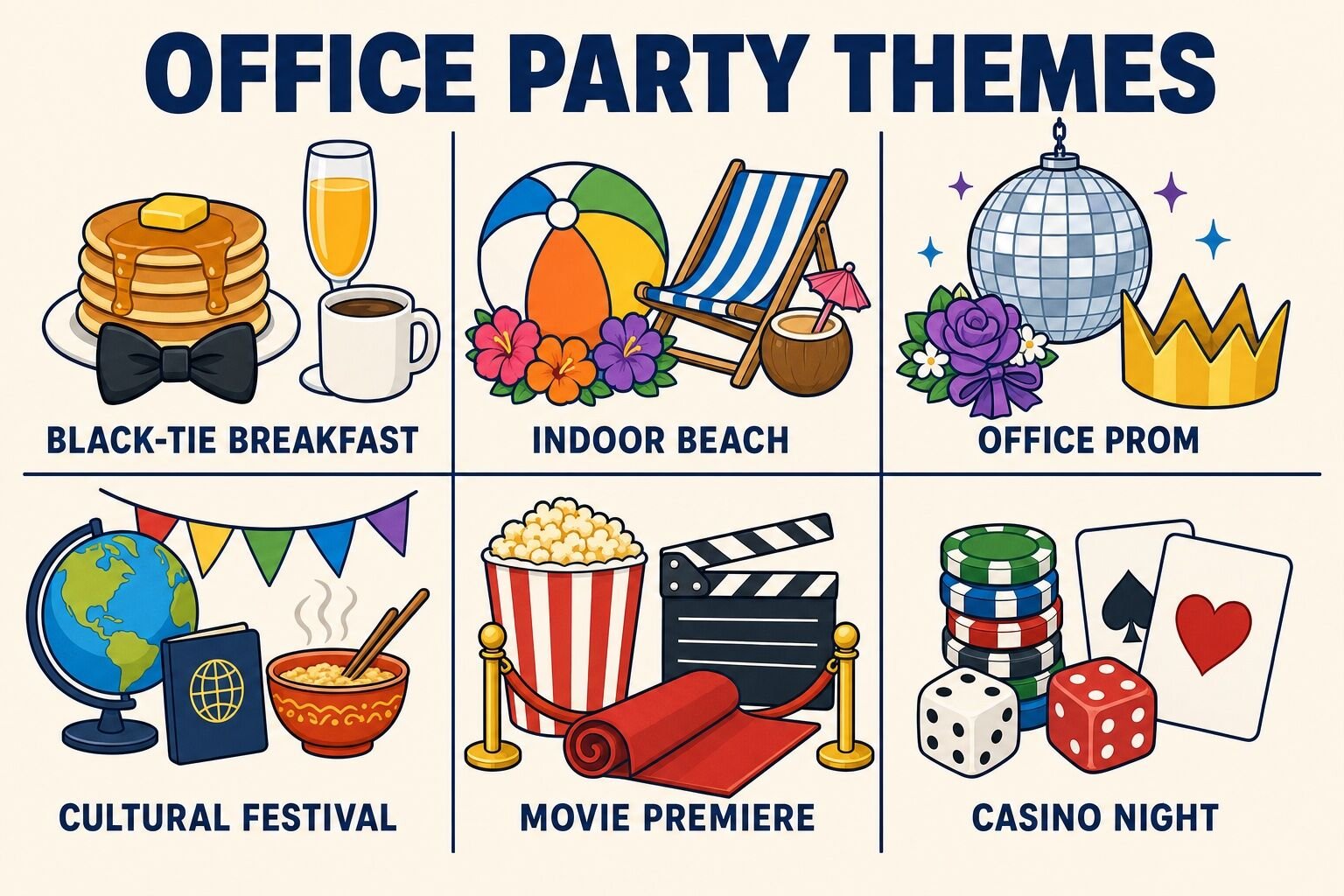
A theme does two jobs. It gives people a reason to dress up and show up, and it makes every other decision (food, playlist, decorations, the one game you run) easier because the theme has already made it. These five are the themes our clients ask about most, and each one is written so the office itself is the venue.
8. Black-Tie Breakfast
Breakfast is the meal nobody at work gets to enjoy properly, so a black-tie breakfast gives it the treatment usually reserved for a gala: formal attire, a mimosa bar, and a start time before the first meeting. It works especially well on a day when the team already has to dress up for a presentation or a client visit.
How to run it:
Send the invitation two weeks out with the dress code: suits, dresses, or "upscale pajamas" for the people who would rather commit to the bit.
Set a buffet of breakfast finger food (mini quiches, French toast sticks, one-bite cinnamon rolls, a fruit tower) and a mimosa or sparkling cider station.
Run a five-minute "best dressed" walk with a paper crown for the winner.
Send everyone back to their desks by 10 a.m. with a branded mug as the party favor.
Best for: 10 to 80 people Time: 60 to 90 minutes Materials (cost): Catered breakfast and drinks ($10 to $20 per person)
What we've learned: Morning parties get better attendance than evening ones because nobody has to give up their own time to come. For more menus, see our list of office breakfast ideas.
9. Indoor Beach Party
An indoor beach party is at its best in February, when the office needs it most. Leis at the door, a limbo pole in the hallway, a tropical playlist and a slushie machine turn a gray conference floor into somewhere people want to be for an afternoon.
How to run it:
Decorate with paper palm trees, beach towels over the chairs, and a projector loop of a beach scene on the biggest wall.
Serve fish tacos, fruit skewers and shaved ice or slushies, plus fruity mocktails with paper umbrellas.
Run a limbo contest, a beach-ball keep-it-up with a company-branded ball, and a sandcastle contest using kinetic sand on trays.
Hand out sunglasses and a small towel as the swag.
Best for: 15 to 100 people Time: 90 minutes to 2 hours Materials (cost): Decorations, food and props ($8 to $15 per person)
What we've learned: The limbo contest is the whole party. Play it early, play it loud, and let the tallest manager go first. Here are more beach party ideas for work.
10. Office Prom
Office prom is the annual party for teams that want an excuse to dress up without a formal awards dinner. It borrows the good parts of prom (a photo wall, a slow dance nobody takes seriously, a crowned king and queen) and skips the awkward parts, because everyone is an adult with a company card for the catering.
How to run it:
Pick a decade or a cheesy theme ("Under the Sea," "A Night in Paris") and decorate with streamers, balloons and a disco ball.
Set up a photo wall with a cardboard frame and let people take "prom photos" in pairs or groups.
Run a prom court vote during the week with nominations for categories like "most likely to reply-all."
Crown the winners, play one deliberately terrible slow song, then switch to a real playlist.
Best for: 20 to 150 people Time: 2 to 3 hours Materials (cost): Decorations, corsages, crowns and catering ($15 to $30 per person)
11. Cultural Festival
A cultural festival celebrates the countries, regions and traditions represented on your own team rather than a single national holiday. It runs like a trade show: stations around the room, each hosted by the colleagues who know the culture, with food, music and one short activity per booth.
How to run it:
Ask for volunteers a month ahead and give each station a small budget for food and decorations.
Print a "passport" for every guest that gets stamped at each station; a full passport enters a raffle.
Ask each station host to teach one thing: a toast, a dance step, a phrase, a game from home.
Close with a shared table where every station's dish is served at once.
Best for: 20 to 200 people Time: 2 hours Materials (cost): Station budgets and printed passports ($10 to $20 per person)
What we've learned: Let colleagues from each culture lead their own station and keep the booths to the cultures actually present on the team. That is the line between a celebration and a costume party.
12. Movie Premiere Night
A movie night is one of the easiest office parties to throw, and treating it as a premiere is what turns it into a party. A red carpet at the door, a popcorn bar, and a paparazzi station with a coworker holding a phone flash make a Tuesday screening feel like an occasion.
How to run it:
Vote on the film a week ahead (offer three options so the vote is quick), and check your office's screening license if you are showing a studio release.
Roll out a red carpet (a red rug and two stanchions from a party store) with a "step and repeat" backdrop for photos.
Build a popcorn bar with flavored salts and candy, and a soda or mocktail station.
Run a five-question trivia round about the film before it starts, and give out an "audience choice" award at the end.
Best for: 10 to 60 people Time: 2 to 3 hours Materials (cost): Projector, popcorn bar, red carpet props ($5 to $10 per person)
What we've learned: Pick a comedy. A room full of coworkers laughing together is the point; a room watching a drama in silence is just a cinema with worse seats. More themes in our guide to office movie nights.
Office party games
Office party games are the ten-to-thirty-minute activities you drop into any of the parties above to get people mixing. Every game here works in a regular office, needs almost no equipment, and can be explained in under a minute.
13. Office Party Bingo
Bingo is the simplest office party game there is: everyone knows the rules, the card does the introductions, and you can hand it out at the door and forget about it. We made an office party bingo card you can use at your next event.
How to play:
Hand a card to every guest on arrival and explain that each square is something to find, do or ask another guest.
Players mingle and mark squares as they go; a person can only sign one square per card.
The first player to complete a line shouts "Bingo!" and wins a prize; keep two or three prizes ready because ties are common.
Randomize the squares and add a few company-specific ones ("has been here since the old office") so cards are personal and finish at different times.
Best for: 10 to 200 people Time: 15 to 30 minutes, played while mingling Materials (cost): Printed cards, pens and small prizes (under $30)
What we've learned: Bingo works because it gives shy guests a scripted reason to talk to a stranger. For more card ideas, see icebreaker bingo.
14. Office Olympics
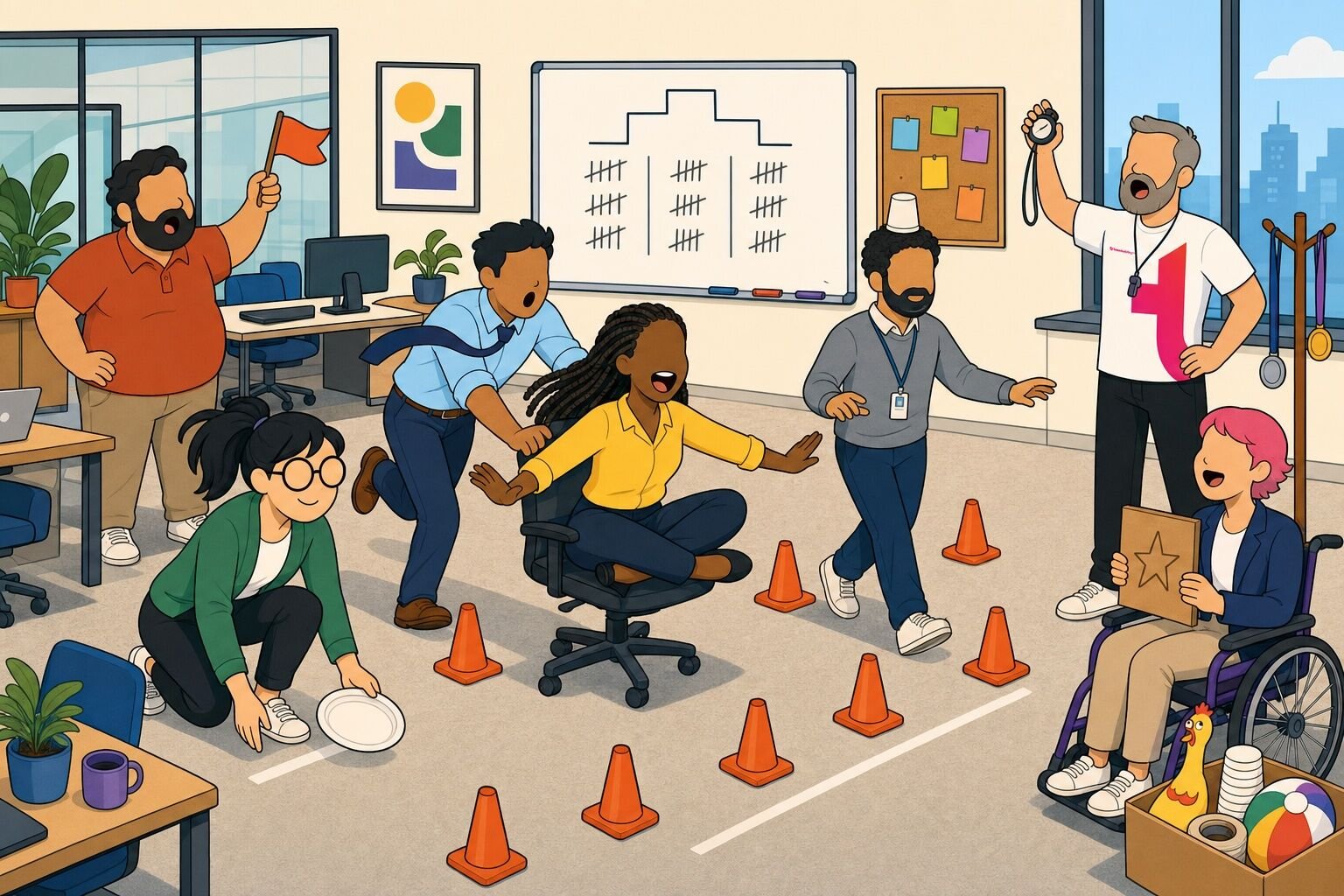
Office Olympics turns the office and its furniture into an arena: desk-chair relays, paper-plate discus, rubber-band archery and a wastebasket free-throw contest. It is loud, it is competitive, and it produces the photos people share for years.
How to run it:
Split the office into three to five "countries" with team colors and a flag made from printer paper.
Set up four to six events: a desk-chair relay through a cone course, a paper-airplane distance contest, a cup-stacking sprint, a wastebasket free throw and a "synchronized swivel" freestyle judged by a panel.
Run each event in ten minutes with a visible medal table on the whiteboard.
Hold an opening ceremony with a torch (a flashlight with orange tissue paper) and a closing podium with paper medals.
Best for: 15 to 100 people Time: 60 to 90 minutes Materials (cost): Office supplies, cones, paper medals ($20 to $50)
What we've learned: The opening ceremony matters. Two minutes of anthem and flag-waving is what convinces the skeptics in the room to take the chair relay seriously. Full event list in our Office Olympics guide.
15. Desk Decorating Contest
A desk decorating contest runs for an hour before the party and gives the whole office something to walk around and look at once the party starts. Give it a theme, a small budget and a real judging panel and people will take it embarrassingly seriously.
How to run it:
Announce the theme a week ahead ("tropical," "1980s," "your team as a movie poster") with a $20 per-desk cap and the safety rules (no open flames, nothing blocking walkways).
Give teams one hour on party day to decorate, then open the floor for a walkthrough.
Judge on a scorecard (theme, creativity, effort) with a peer vote as the fourth score.
Award a rotating trophy that lives on the winning desk until next year.
Best for: 10 to 200 people Time: 60 minutes to decorate, 20 minutes to judge Materials (cost): Decorating budget ($20 per desk or pod)
What we've learned: Judge pods or departments, not individuals. A team of five building one giant cardboard volcano beats five people each hanging one streamer. Here are more workplace competition ideas.
16. Company History Trivia
Company history trivia is a quiz where every question is about the people and the place: the year the office moved, the name of the first customer, which manager once wore a chicken costume to an all-hands. It is the one trivia format where the longest-serving employee is not automatically the winner, because the questions cut across teams and eras.
How to run it:
Collect 20 to 30 questions from managers and long-timers a week ahead, mixing company facts with harmless personal ones ("who ran a marathon last year?").
Seat people in mixed tables of four to six, with old-timers and new hires deliberately split.
Run four rounds of five to seven questions with a picture round of baby photos or old office photos.
Read the answers with the story behind each one; the stories are the entertainment.
Best for: 10 to 100 people Time: 30 to 45 minutes Materials (cost): Answer sheets and a prize (under $30)
What we've learned: New hires love this game more than veterans do, because it is the fastest way to learn the office lore nobody writes down. For general-knowledge formats, see our trivia games list.
17. Minute to Win It Stations
Minute to Win It games are 60-second challenges with household objects: stack cups, move cookies from forehead to mouth, bounce ping-pong balls into a mug. Set up five stations around the party and let people rotate at their own pace.
How to run it:
Choose five games with a clear "win" condition and buy the supplies in bulk (cups, cookies, ping-pong balls, pantyhose, tissue boxes).
Print a one-line rule card and a leaderboard at each station and assign one volunteer to time and record.
Give each guest a scorecard; the top three overall scores at the end win.
Close with a head-to-head final between the two top scorers in front of the room.
Best for: 15 to 150 people Time: 45 to 60 minutes Materials (cost): Bulk household supplies ($30 to $60)
What we've learned: Stations beat a single stage. When one person performs while 60 watch, most of the room disengages; with five stations, everyone is playing or cheering within arm's reach. Full game list in our Minute to Win It games guide.
18. Office Scavenger Hunt
An office scavenger hunt sends small teams around the building with a list of clues, photo challenges and things to collect. It gets people off their chairs, into other departments, and back in 30 minutes with a phone full of evidence.
How to run it:
Write 15 to 20 items mixing objects ("a stapler that is not yours"), photos ("your whole team in the smallest room in the office") and questions ("what year is on the plaque by reception?").
Split into teams of three to five and give each team 30 minutes and one phone for photos.
Award points for each item and bonus points for creativity in the photo challenges.
Review the photos on the projector at the end; the review is funnier than the hunt.
Best for: 10 to 100 people Time: 30 to 45 minutes Materials (cost): Printed lists, free
What we've learned: The photo review at the end is the payoff; budget ten minutes for it. Ready-made lists are in our guide to office scavenger hunts.
Annual staff party ideas
An annual staff party is the one event the whole company attends, which means it has to work for 200 people as well as it works for 20, and it has to carry some meaning beyond "we ordered food." These four formats give the year a shape: they recognize people, mark the milestone, get everyone outside, or give something back.
19. Office Awards Night
An awards night is the annual party with a purpose built in. Half the categories are real recognition and half are affectionate jokes, and the mix is what makes it work: people get to be celebrated and laughed with in the same hour.
How to run it:
Collect nominations two weeks ahead for a mix of serious categories (rookie of the year, the person who unblocked everyone) and silly ones (most creative excuse for a late reply, best snack drawer).
Keep the ceremony to 30 minutes: an emcee, a 20-second intro per award, a trophy and a photo.
Dress the room like an awards show with a red carpet, gold balloons and a step-and-repeat backdrop.
Put the awards in the middle of the party, not the end, so people are still there for them.
Best for: 20 to 300 people Time: 30-minute ceremony inside a 2 to 3 hour party Materials (cost): Trophies, decorations and a microphone ($100 to $500)
What we've learned: Make sure every team gets at least one award. Nobody remembers who won "top performer"; everyone remembers whether their department was mentioned. More categories in our guide to employee award ceremonies.
20. Company Milestone Party
A milestone party marks a number: ten years in business, the thousandth customer, a new office, a record quarter. Unlike a holiday party, it has a story to tell, and the best versions tell it with the people who were there.
How to run it:
Build a timeline wall down one corridor with photos, old products, first invoices and screenshots of the original website.
Ask five people from different eras to tell a two-minute story each; cap it strictly and have an emcee.
Serve food from the year the company started, or from the city where it started.
Bury a time capsule (a box in the storage room counts) with predictions to open at the next milestone.
Best for: 20 to 500 people Time: 2 to 3 hours Materials (cost): Printing, catering and a capsule box ($15 to $40 per person)
What we've learned: The two-minute cap on stories is the difference between a great party and a two-hour speech. Give the emcee a bell and permission to use it.
21. Company Field Day
A field day is the summer staff party: a park, a set of team games, a picnic and an afternoon out of the office. It scales to hundreds because the games run in parallel and nobody has to sit in a conference room.
How to run it:
Reserve a park pavilion or a sports field and confirm the permit, shade and restrooms.
Split into teams with colored bandanas and run five classic events: tug of war, three-legged race, water balloon toss, a relay and a dizzy-bat sprint.
Cater a picnic (barbecue, wraps, a lot of water) and set out lawn games for the people who would rather not race.
Award a trophy to the winning color and take a whole-company photo before people leave.
Best for: 30 to 500 people Time: 3 to 4 hours Materials (cost): Park permit, equipment and catering ($20 to $40 per person)
What we've learned: Plan the day in 15-minute blocks and put the loudest events first, before the heat and the food slow everyone down. Our company picnic ideas guide has a full run of show.
22. Give-Back Party
A give-back party pairs the annual party with a charity project the whole company completes in an hour: packing care kits, building bikes for a youth program, making blankets for an animal shelter, or assembling school supply bags. The party happens around the work, and the work is what people remember.
How to run it:
Pick a local nonprofit and ask what they actually need; a kit-packing project with a shopping list is easiest to run in an office.
Set up an assembly line of stations with a volunteer captain at each.
Add a light competition (most kits packed in 20 minutes, best decorated care card) to keep the energy up.
Invite someone from the charity to receive the donation at the end of the party and say a few words.
Best for: 20 to 300 people Time: 60 to 90 minutes of assembly inside a 2 to 3 hour party Materials (cost): Kit supplies ($10 to $30 per kit)
What we've learned: The handover moment at the end is the highlight. Schedule it, put it on the agenda, and make sure the people who packed the kits are in the room when they are collected.
Work party ideas for small teams
A work party for a team of six to fifteen is a different animal from a company-wide event. There is no room to hide, so the activity has to be one where everyone participates, and the venue can be somewhere a large group could never fit. These three are the ones we would pick for a small team.
23. Team Dinner With a Twist
A team dinner is the default small work party, and a twist is what stops it from being just a meal with your coworkers. Pick one: a mystery restaurant nobody knows until the taxi arrives, a progressive dinner with each course at a different place, or a "chef's choice" where the most adventurous eater orders for the table.
How to run it:
Book for the full group two weeks ahead and check dietary needs before choosing the twist.
Seat people away from their usual partners; a simple rule like "not next to anyone on your project" is enough.
Bring one table game for the wait: a round of "two truths and a lie," or a stack of question cards.
Pay the bill before dessert so nobody has to watch the manager do the math.
Best for: 4 to 16 people Time: 2 hours Materials (cost): Dinner ($40 to $80 per person)
24. Escape Room Outing
An escape room is a work party for teams that would rather solve something than sit and chat. An hour of locked-room puzzles produces more genuine collaboration than most workshops, and the debrief over drinks afterward writes itself.
How to run it:
Book a room rated for your headcount; most hold six to ten, so larger teams should book two rooms and race.
Pick a theme with a medium difficulty rating so the team has a real chance to escape.
Take the team photo with the "we escaped" or "we did not" sign; both are good.
Book a table nearby for afterward, because the best part is the argument about who missed the obvious clue.
Best for: 4 to 20 people Time: 60 minutes plus travel and drinks Materials (cost): Room booking ($25 to $45 per person)
25. Workshop Party
A workshop party brings in an instructor for a hands-on class, and the class is the party. Terrarium building, candle making, cookie decorating, pottery and cocktail mixing all work in a conference room, and everyone leaves with something they made.
How to run it:
Search your city plus the craft, or ask a local studio if they run corporate sessions at your office.
Confirm the instructor brings all materials and a cleanup plan; the plan matters for candle wax and clay.
Set the class for 60 to 75 minutes with food and drinks before it, so people can chat while their hands are busy.
Line the finished pieces up for a photo before people take them home.
Best for: 6 to 30 people Time: 90 minutes Materials (cost): Instructor and materials ($35 to $75 per person)
What we've learned: Hands-on classes are the best work party for teams with introverts. Nobody has to perform, everyone has something to look at, and the conversation happens sideways while people work.
Low budget office party ideas
A low budget office party is not a lesser party. The ideas below cost under $10 per person, most of them under $5, and they work because the money that would have gone to catering goes to a bit of planning instead. If the budget is $150 and a Tuesday afternoon, start here.
26. Potluck Party
The potluck is the original low budget office party, and it is still the best one. Everyone brings a dish, the company covers drinks and plates, and the food doubles as the conversation because every plate has a story.
How to run it:
Post a sign-up sheet by category (mains, sides, desserts, drinks, a "no cooking" column for store-bought) so the table is balanced and nobody brings the fourth pasta salad.
Ask everyone to label their dish with the name and any allergens.
Have the company supply plates, cutlery, serving spoons, ice, extension cords and slow-cooker space.
Run a "people's choice" vote for best dish with a wooden spoon trophy.
Best for: 10 to 100 people Time: 60 to 90 minutes Materials (cost): Plates, drinks and a trophy ($2 to $4 per person)
What we've learned: The "no cooking" column is what makes a potluck inclusive. The people with long commutes and small kitchens contribute chips and dip and still feel part of it.
27. Ice Cream Social
An ice cream social is a 3 p.m. party that costs about $4 a head and gets a higher turnout than most evening events. Set up a sundae bar, play some music, and give the afternoon a reason to stop.
How to run it:
Buy tubs of three flavors plus a dairy-free option, and a table of toppings: sprinkles, sauces, crushed cookies, fruit, whipped cream.
Rent or borrow a chest cooler with dry ice, or serve straight from the office freezer in two shifts.
Run a "most creative sundae" contest judged by photo.
Give it a half-hour window on the calendar so people plan around it.
Best for: 10 to 150 people Time: 30 to 45 minutes Materials (cost): Ice cream and toppings ($3 to $5 per person)
28. Board Game Afternoon
A board game afternoon asks everyone to bring the game they love and spend two hours teaching it to someone else. It costs nothing, runs itself, and it is one of the few parties where the quiet corner is the most competitive table.
How to run it:
Ask people to bring games a week ahead and post the list so nobody brings three copies of the same one.
Set up tables by game length: 15-minute party games near the door, hour-long strategy games at the back.
Rotate every 45 minutes so people try a game they have never played.
Add snacks and a "table champion" sticker for each winner.
Best for: 8 to 60 people Time: 2 hours Materials (cost): Snacks, games brought from home (under $3 per person)
What we've learned: Put a confident teacher at each table, not the person who owns the game. Explaining rules well is a skill, and a bad explanation loses the table in five minutes. More formats in our office game night guide.
29. DIY Photo Booth
A photo booth is the most-used feature of any party, and renting one costs hundreds. A do-it-yourself booth is a backdrop, a phone on a tripod and a box of props, and it produces the same photos for under $50.
How to run it:
Hang a backdrop: a sheet, a balloon arch, a wall of streamers, or a roll of colored paper.
Mount a phone or tablet on a tripod with a photo booth app and a ring light if you have one.
Fill a box with props: hats, boas, oversized glasses, speech-bubble signs, a cardboard frame.
Run a "funniest photo" contest and share the album with the whole office the next morning.
Best for: Any size Time: Runs all party Materials (cost): Backdrop, props and tripod ($30 to $50 total)
What we've learned: The next-morning album is what extends the party. A shared folder of 80 ridiculous photos gets more comments than the party invitation ever did.
30. Bad Day Party
A bad day party is the one you do not plan. The launch slipped, the client left, the week was rough: at 3 p.m. someone opens the "bad day party kit" and the office stops for 30 minutes of music, snacks and something mildly ridiculous.
How to run it:
Build the kit in advance and keep it in a cupboard: a speaker, a party playlist, punch balloons, bubble wrap, a bag of candy, a stack of motivational fortune cookies and a foam-dart blaster or two.
Agree who has the authority to call it (any manager, or a jar with a "break glass" sign).
Keep it to 30 minutes and end it with a group photo and a "back to work" cheer.
Restock the kit the next day so it is ready for the next bad day.
Best for: 5 to 50 people Time: 30 minutes Materials (cost): One-time kit ($40 to $80), restocked as needed
What we've learned: The kit is the whole idea. A bad day party that needs a shopping trip never happens; one that lives in a cupboard happens at exactly the right moment.
All 30 office party ideas at a glance
Here is the whole list in one table, so you can match an idea to your headcount, your time slot and your budget.
How to plan an office party: checklist, budget and agenda
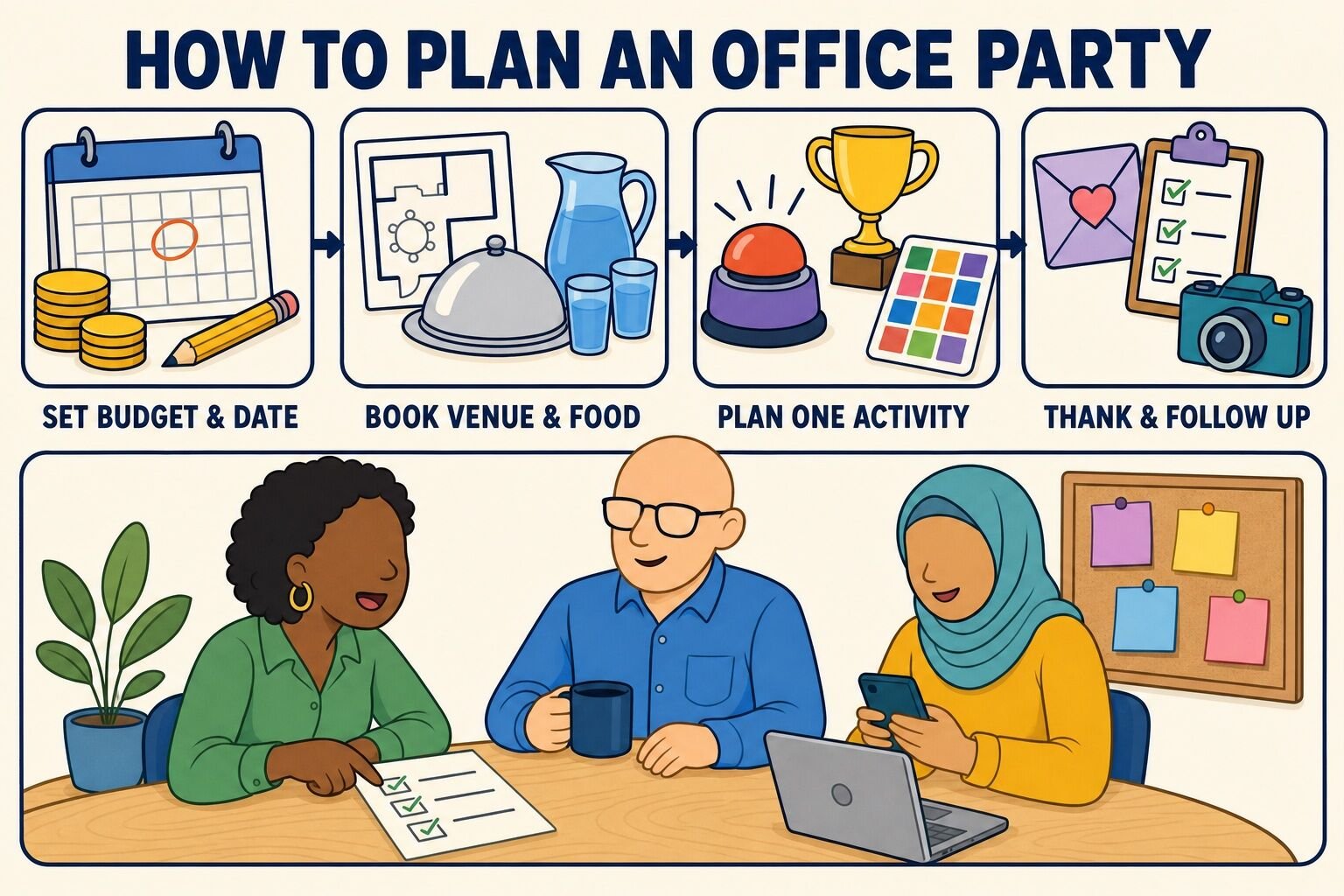
Office party planning comes down to four decisions made in the right order: budget and date, venue and food, one activity, and the follow-up. Everything else is detail. Here is the checklist we use, a budget at two levels, and a sample run of show for an evening party.
Office party planning checklist
Six weeks out: purpose, budget, date.
Decide what the party is for (a celebration, recognition, a milestone, or just morale) because that decides the format.
Set a total budget and a per-person figure, and decide whether the party is on the clock. We recommend making team socials paid work time; attendance is noticeably better when the party costs people nothing, including their evening.
Pick two or three candidate dates, check them against deadlines, school holidays and religious calendars, and survey the team. Teams book in-person events with us a median of 30 days in advance, and a party with a venue and a caterer needs at least that.
Four weeks out: venue, food, activity.
Choose the office or an outside venue and confirm capacity, layout for the activity, accessibility, and parking or transport.
Book catering with a written count of dietary needs, and plan a drinks station with as many good non-alcoholic options as alcoholic ones. If alcohol is served, use drink tickets and a published end time; our guide to holiday party etiquette covers the rest.
Choose one main activity from this list and book it, whether that is a hosted event or a colleague to emcee the game show.
Send the invitation with date, time, location, dress code, the activity and an RSVP, and ask people to flag any accommodation needs.
One week out: logistics.
Confirm headcount with the caterer and the host, and test the sound system, projector and playlist in the actual room.
Buy decorations, prizes, name tags and the props for the activity, and assign a setup crew and a cleanup crew.
Write the run of show (see below) and share it with everyone who has a job on the night.
The day after: follow-up.
Send a thank-you note with the photo album.
Run a three-question survey (what worked, what to change, what to do next time) and keep the answers for the next party.
Thank the planning committee publicly; if you run parties regularly, see our guide to running a culture committee.
Office party budget
The two budgets below are typical starting points for a party of about 40 people. Food is the biggest line at both levels; the activity is where a small increase makes the biggest difference to how the party feels.
Line item
Low budget office party
Annual staff party
Food and drinks
$5–$10 per person (potluck, pizza, snacks, soft drinks)
$50–$100 per person (catering, bar with drink tickets)
Decorations
$20–$60 (balloons, streamers, tablecloths)
$500–$1,000+ (balloon arches, lighting, backdrop)
Activity or entertainment
$0–$100 (bingo, trivia, Office Olympics, prizes)
$50–$100 per person (hosted event) or $750–$1,500 (DJ, band, photo booth rental)
Venue
$0 (the office)
$0–$3,000 (the office, or a rented room or restaurant buyout)
Extras
$0–$50 (name tags, a trophy)
$250–$500+ (favors, staff tips, transport)
Typical total for 40 people
$250–$600
$4,000–$10,000+
Sample office party agenda
This run of show is for a three-hour evening party with a hosted activity in the middle. Shrink every block by half for a 90-minute afternoon party.
Time
Block
What happens
6:00–6:30
Arrival
Check-in, name tags, bingo cards handed out, music on, drinks open, food out from the first minute.
6:30–6:40
Welcome
Two-minute welcome from the organizer, the agenda, and the one rule for the night (everyone plays).
6:40–7:20
Dinner and mixing
Food, background music, bingo running in the room. A quick icebreaker game at each table if seating is assigned.
7:20–8:20
Main activity
The hosted event, game show, cook-off or Office Olympics. Nothing else is scheduled against it.
8:20–8:40
Awards and thanks
Prizes for the activity, any recognition awards, a group photo.
8:40–9:00
Dessert and wind-down
Dessert, coffee, photo booth, last songs. Announce the end time again.
9:00
End
Party favor at the door, rides home arranged, cleanup crew starts.
Virtual office party ideas
Remote and hybrid teams throw office parties too; the office is just a video call. The same rule applies: give the room one thing to do. A hosted game show, a trivia round about the team, a virtual costume contest or an online cook-off with ingredient boxes shipped ahead all work over Zoom, and they have the advantage that everyone is in the front row. Even large companies with real offices run the remote version for distributed teams: in December 2023, The New York Times reported that Hootsuite runs its virtual holiday parties on teambuilding.com, with activities like holiday-themed trivia.
For a full set of formats and instructions, see our guides to virtual party games and virtual holiday party ideas. For a hybrid party, run the in-room activity and the online one at the same time with one shared scoreboard, rather than pointing a laptop camera at the office and hoping.
What we've learned from hosting office parties
We have run hosted events at thousands of company parties, in person and online, and the same patterns show up whether the client is a ten-person startup or a Fortune 500 division.
December is the whole game for most companies. December is the busiest month of the year for team building on our platform, with 30% of annual events held for end-of-year celebrations. Teams lock in their December events a median of 23 days ahead, and 62% of December bookings are placed in October or November. If your office party is a holiday party, the venue, the caterer and the host are all being booked by everyone else in the same six weeks; start in October, and if you are adding a gift exchange, our office gift exchange guide has the rules that keep it fair.
One activity, in the middle, with nothing against it. The parties that get the best survey scores schedule the activity after people have eaten and before they start leaving, and they do not run a speech, a raffle or a second bar opening at the same time. Food first, then the game, then the awards.
In-person parties are back, and they are more structured than before. In 2025, virtual events made up 83% of team building bookings on our platform, down from 100% in 2021, with in-person events at 17% and climbing. Most of that in-person growth is exactly this: companies that used to book a bar tab now book a cook-off or a game show and build the party around it.
Make it paid, make it optional, and make the end time real. A party on the clock with a published finish gets better attendance and better behavior than an open-ended evening event. The people who want to keep going will find the bar next door on their own.
Plan for a group of about 16, then scale. Most of the games in this guide are written for a typical team, and the table below shows what to change at either end.
Small parties (under 15)
Large parties (50+)
Best formats
Team dinner with a twist, escape room outing, workshop party, murder mystery, board game afternoon
Food truck rally, casino night, game show night, awards night, field day, hosted cook-off
Room
One table where everyone can hear everyone
Round tables of 6 to 8, a microphone, a screen everyone can see, stations around the edges
Structure
One activity and one long meal
Rotating 15-minute rounds, a visible scoreboard, co-hosts for the far tables
Budget focus
Spend on the venue or the instructor
Spend on the host and the sound system; save on decorations
Common mistake
Booking a restaurant and calling it a party
One person on a stage while 80 people talk over them
Office party ideas we don't recommend
Some of the ideas below appeared on earlier versions of this list and have since been copied across the internet. They are here now because we have watched them go wrong, either because they only work for a few people in the room, because they turn a party into a liability, or because they are a chore wearing a party hat.
The Lame List
Activity
Why skip it
Verdict
Demolition derby or "rage room" party
Handing coworkers sledgehammers and a pile of thrift-store china is an insurance claim waiting to happen, and the people who enjoy it most are the ones you least want swinging a bat. If the team needs to blow off steam, run Office Olympics.
Skip it
Spring cleaning "party"
A chore with a playlist is still a chore. People can tell when a party is a way to get free labor, and they remember it.
Skip it
Karaoke or lip-sync contest as the main event
Five people love it, and the other forty spend the hour hoping not to be called on. Fine as an optional corner late in the night; never the centerpiece.
Skip it
Open bar with no end time
Every office party story that ends badly starts here. Drink tickets, food first and a published finish get the same fun with none of the Monday-morning HR meeting.
Skip it
Mandatory after-hours party
Requiring people to give up an evening, unpaid, and then measuring their enthusiasm is the fastest way to make a party feel like work. Put it on the clock or make it genuinely optional.
Skip it
The 45-minute leadership speech
Two minutes of thanks lands. Forty-five minutes of slides about the year ahead turns the party into an all-hands with cake. Save the strategy for Monday.
Skip it
Roast the boss
It reads as brave and plays as awkward: the jokes are either too soft to be funny or too sharp to be safe, and someone always misjudges the room. Awards night gets the laughs without the risk.
Skip it
Surprise talent show
"Everyone must perform something" is a threat, not an invitation. If the team wants a stage, make it a sign-up sheet with three slots and a hard time limit.
Skip it
Final thoughts
A good office party is not a catering order. It is a couple of hours where a team gets to be a group of people rather than a set of job titles, and the ideas on this list exist to make those hours work for everyone in the room: the competitive ones, the quiet ones, the new hire who knows nobody, and the person who has to leave at eight. Pick one activity, put it in the middle of the party with nothing scheduled against it, feed people first, and publish the end time. Do that and you will throw a better party than most companies manage with a much bigger budget.
Common questions about planning themes, games and activities for a work party.
What is an office party?
An office party is a social event a company holds for its employees to celebrate an occasion, mark a milestone or simply give coworkers time together away from their desks. Office party ideas are the themes, games and formats that turn the gathering into something people want to attend, such as a guacamole cook-off, a casino night, an office awards show or Office Olympics. These events are also called work parties, staff parties, company parties and corporate parties.
What are good office party ideas?
The office party ideas we would actually run are an office cook-off, casino night, a murder mystery party, a game show night with a survey round about the team, a company tailgate, a food truck rally and a silent disco. For an annual staff party, an awards night, a milestone party, a company field day or a give-back party with a charity project all give the event a purpose. Each has step-by-step instructions, group sizes, timings and costs in the guide above.
What are fun office party games?
The most reliable office party games are office party bingo, which you hand out at the door so guests mingle to fill the card; Office Olympics with desk-chair relays and paper-plate discus; a desk decorating contest judged by department; company history trivia; Minute to Win It stations; and an office scavenger hunt with photo challenges. All of them can be explained in under a minute and most cost under $50 to run.
What are low budget office party ideas?
A potluck with a sign-up sheet and a no-cooking column, a 3 p.m. ice cream social, a bring-your-own board game afternoon, a DIY photo booth made from a backdrop, a phone on a tripod and a box of props, and a pre-stocked bad day party kit all cost under $5 per person. A typical low budget office party for 40 people runs $250 to $600 in total, with food as the largest line.
How do you plan an office party?
Make four decisions in order: budget and date, venue and food, one main activity, and the follow-up. Six weeks out, set the purpose and budget and survey the team on dates; teams book in-person events a median of 30 days ahead. Four weeks out, book the venue, the catering with dietary needs, and the activity, then send invitations with an RSVP. One week out, confirm headcount, test the sound and projector, and write a run of show. The day after, send the photo album with a thank-you and a three-question survey.
How much does an office party cost?
For about 40 people, a low budget office party in your own office costs $250 to $600: $5 to $10 per person on food and drinks, $20 to $60 on decorations and up to $100 on games and prizes. An annual staff party runs $4,000 to $10,000 or more, with $50 to $100 per person on catering and a bar with drink tickets, $500 to $1,000 on decorations, and either a hosted event at $50 to $100 per person or a DJ, band or photo booth at $750 to $1,500.











Comments (0)
Leave a Comment