30 Office Party Games for Work Events (Indoor, Large Groups & Quick)
30 office party games for work events, from five-minute energizers and classic parlor games to formats that hold a room of 200, each with step-by-step instructions, group sizes and setup costs.
Published
·
Updated
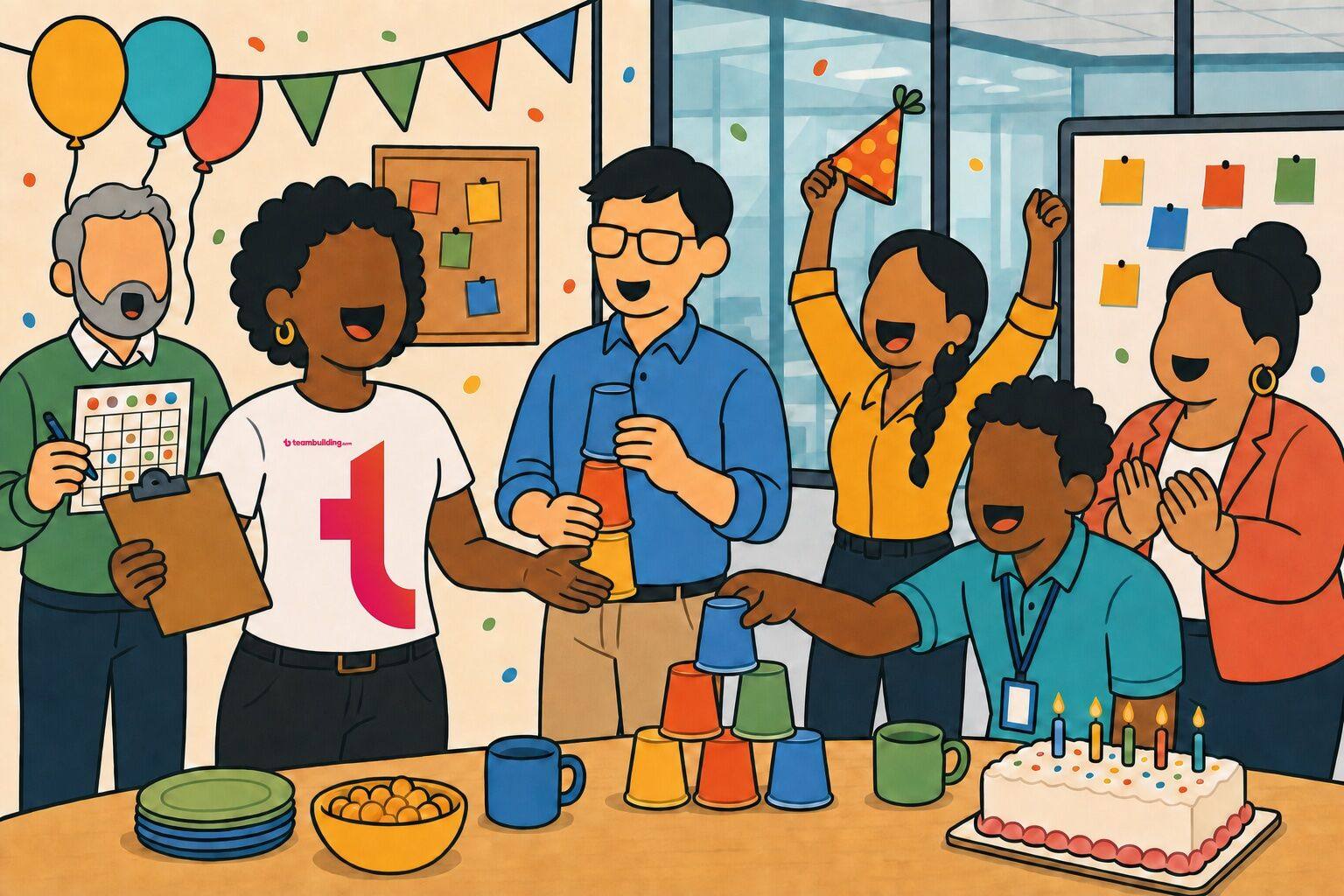
Most office parties run into the same problem. Everyone arrives, gets a plate and a drink, talks to the three people they already talk to every day, and leaves at 6:15. Nothing goes wrong. Nothing much happens either.
Games are what change that, but only the right ones. As of September 2026, we have hosted 45,000+ Originals events for more than 1,000,000 participants, earning 83,000+ reviews with an average rating of 4.96 out of 5 across Google and our verified ratings platform. A large share of those events are celebrations: holiday parties, work anniversaries, end-of-year socials and office birthdays. We have watched which party games get a room laughing in ninety seconds and which ones die on their feet.
This list collects the games we would actually run at a work party. Every entry has step-by-step instructions, the group size it fits, how long it runs, and what it costs to set up. Nothing here needs a stage, a budget approval, or a colleague willing to sing in public.
Party games for work are group games played at workplace celebrations, including holiday parties, birthdays, work anniversaries, team milestones and end-of-year socials. Examples include party bingo, a trivia showdown, and classic parlor games like Fishbowl. The purpose is social rather than instructional: these games mix people who do not normally talk, give quieter colleagues an easy way into the room, and give everyone something to remember besides the catering. These games are also called "office party games," "work party games," "staff party games," "company party games" and "fun games to play at work events."
Party games for work are the celebration branch of office party planning and a subcategory of corporate event games. They are close cousins of large group games, indoor group games and office games, and they show up inside almost every office Christmas party plan. Within the category, this guide covers quick games, indoor party games for adults, parlor games, formats for large groups and small teams, funny games, and holiday games.
All 30 party games at a glance
Here is the full list, with the group size, run time and setup cost for each game. Every activity links to its full instructions further down the page.
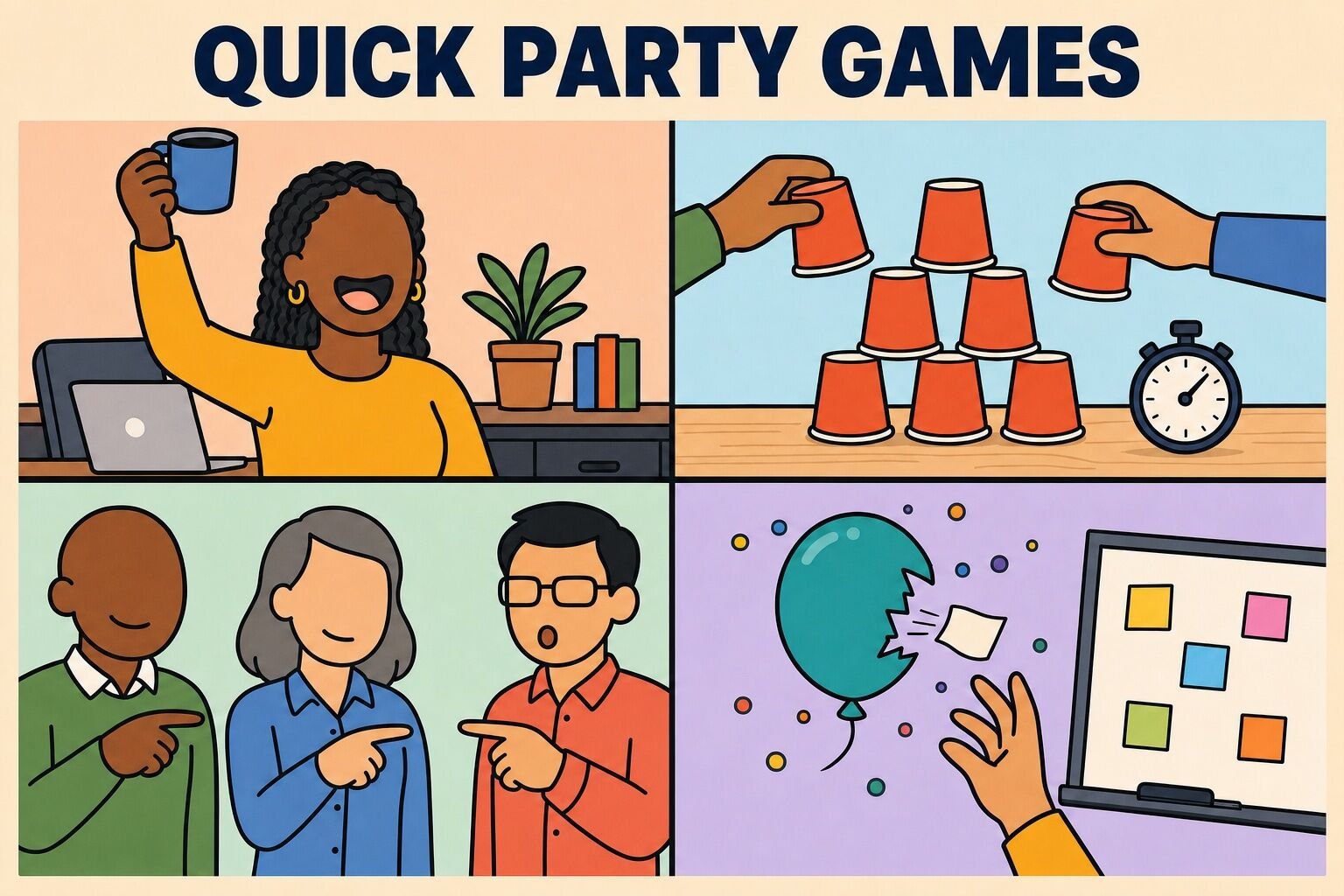
These are the games to keep in your back pocket. Each one runs in about five minutes, needs no rehearsal, and works as a reset when the room has gone quiet or when you are waiting on food to arrive. Run one, get the laugh, and let people go back to talking.
1. Lightning Scavenger Hunts
Lightning Scavenger Hunts are the fastest way to get a party moving. The host calls out a category, and everyone has 60 seconds to find an object that fits and bring it back.
Score the first three people back with a valid item: three points, two points, one point. Play three or four rounds and total the scores. Good categories include something that makes a noise, something older than you, something you would grab in a fire drill, and the strangest item in your bag.
The hunt itself takes a minute. The good part is the ten minutes afterward, when people are still explaining why they own the thing they just ran across the room with.
Best for: 5 to 100+ people Time: 5 minutes Materials (cost): Whatever is already in the room (free)
What we've learned: Category clues beat object clues. "Bring back a stapler" produces nine identical staplers, while "bring back something older than you" produces a story from everyone who found one.
2. Cup Stack Relay
Cup Stack Relay turns a sleeve of plastic cups into a five-minute tournament. Split the room into teams of four to six and give each team ten cups.
On "go," the first player builds a four-three-two-one pyramid, then collapses it back into a single stack and tags the next teammate. Each player completes one full build-and-collapse cycle. The first team whose last player finishes wins.
For a harder version, require players to use only one hand, or make the final player rebuild the pyramid on a chair instead of a table.
Best for: 8 to 40 people in teams of 4 to 6 Time: 5 minutes Materials (cost): Plastic cups, one sleeve per team (~$10)
What we've learned: Run it best of three. The first round is everyone learning the mechanics. The second round is when teammates start coaching each other, and that is the round people remember.
3. Most Likely To
Most Likely To needs no equipment and gets the biggest laugh per second of any game on this list. The host reads a prompt, such as "most likely to survive being locked in the office overnight." On the count of three, everyone points at the person they pick.
Whoever collects the most fingers takes a bow and gets ten seconds to defend themselves. Run eight to ten prompts and stop while people still want more.
Need prompts? Use the generator below.
Best for: 6 to 50 people Time: 5 minutes Materials (cost): None (free)
What we've learned: Keep every prompt flattering or absurd. "Most likely to become a competitive hot dog eater" is a compliment in disguise. "Most likely to miss a deadline" is a performance review with a party hat on, and the room feels the difference immediately.
4. Balloon Pop Countdown
Balloon Pop Countdown is loud, chaotic and over quickly, which is exactly what you want mid-party. Before the event, write a 30-second challenge on a slip of paper, tuck one slip into each balloon, and inflate them.
Scatter the balloons around the room. When the timer starts, players pop a balloon, complete the challenge inside, and move to the next one. Whoever completes the most challenges before the clock runs out wins.
Keep challenges physical and instant: do ten jumping jacks, find someone wearing the same color as you, name five countries in fifteen seconds. Our list of minute to win it games is a good source of challenges that fit inside a balloon.
Best for: 10 to 60 people Time: 5 to 10 minutes Materials (cost): A bag of balloons and paper slips (~$8)
What we've learned: Write every challenge so it can be done standing exactly where the player popped the balloon. Anything that sends people out of the room kills the momentum, and you will never get them all back.
Indoor party games for adults
These games all live indoors, which for most office parties means a conference room with the tables pushed back, or a bar or restaurant with a private area. They need a bit more setup than the five-minute games, and they pay it back by holding the room's attention for twenty minutes or more.
5. Saran Wrap Ball
Saran Wrap Ball is the most reliably chaotic game at any indoor party. Before the event, wrap a main prize, such as a gift card, in plastic wrap, then keep wrapping and tucking smaller prizes between the layers until you have a dense ball the size of a basketball.
Players sit in a circle. The first player gets the ball and unwraps as fast as they can, keeping whatever prizes they free. The player to their left rolls a pair of dice until they get doubles, and the moment they do, the ball passes to them. Play until the center prize is claimed.
For a harder version, make the unwrapper wear oven mitts.
Best for: 6 to 20 people Time: 15 to 20 minutes Materials (cost): Plastic wrap, dice, and small prizes (~$25)
What we've learned: Wrap it tighter than feels reasonable. A loose ball unravels in two turns and half the room never gets a chance. Start every new layer in a different direction and the ball will last the whole circle.
6. Jenga With a Twist
Jenga With a Twist is the best background game for a party with tables. Take a standard Jenga set and write a prompt on each block with a marker.
Players take turns pulling a block, reading the prompt aloud, and answering it before placing the block on top. Whoever topples the tower buys the next round of coffee, or simply loses with dignity. Good prompts include "name the first concert you went to," "what job did you think you would have at 30," and "which coworker would you want on your trivia team."
The set is reusable, so one afternoon of writing prompts covers every party for the next few years.
Best for: 3 to 10 people per set Time: 20 to 30 minutes Materials (cost): A Jenga set and a marker (~$20)
What we've learned: Write prompts that ask for an answer, not a performance. "Share a fun fact" gets a real story. "Sing a song" gets a block placed very carefully and an excuse.
7. Name That Tune
Name That Tune is the great equalizer at a mixed-age office party, because the intern and the VP are equally lost on each other's decades.
Build a playlist of 25 to 30 songs spread across the last fifty years. Play five seconds of each clip. Teams write their answers on a sheet: one point for the song title, one point for the artist. Run five rounds of six songs, then a final round of TV theme songs, which everyone somehow knows.
Ask each guest to submit one song when they RSVP. A playlist built by the room beats a playlist built by the host.
Best for: 8 to 80 people in teams Time: 20 to 30 minutes Materials (cost): A speaker, a playlist and answer sheets (free)
What we've learned: Spread the decades deliberately so that everybody gets one round where they are the expert. A playlist stacked with one era turns half the room into spectators within two songs.
8. Office Carnival Stations
Office Carnival Stations turn a party into a fair. Set up four to six simple games around the room, give everyone a scorecard, and let people rotate at their own pace while the food and conversation carry on around them.
Reliable stations include paper toss into a bin from three marked distances, desk bowling with water bottles as pins and a soft ball, mini-golf with a ruler and a paper cup, ring toss with tape rolls, and a marshmallow catapult built from rubber bands and spoons. Each station is worth points, and the top three scorecards win prizes.
For a bigger version of the same idea, see our office Olympics guide.
Best for: 15 to 100+ people Time: 45 to 60 minutes, running continuously Materials (cost): Office supplies plus a few props (~$30)
What we've learned: Every station needs a volunteer scorekeeper. Unstaffed stations drift within ten minutes: the rules get reinvented, the scores stop being recorded, and the station quietly becomes a place where three people stand and chat.
9. Desk Castle Build-Off
Desk Castle Build-Off is a build challenge made entirely of what is already in the office. Split into teams of three to five and give each team five minutes to gather supplies from around the workspace: paper, tape, sticky notes, rubber bands, binder clips, straws.
Then give them ten minutes to build the tallest free-standing structure they can. At the buzzer, every structure has to survive a load test by holding a full coffee mug for five seconds. Tallest surviving tower wins, with a second prize for the best-looking castle.
Best for: 6 to 40 people in teams of 3 to 5 Time: 15 minutes Materials (cost): Office supplies (free)
What we've learned: The load test is what makes the game. Without it, every team builds the same wobbly paper tower and the tallest wobble wins. With a mug on the line, teams argue about base width for a solid three minutes, which is the entire point.
Parlor games for work parties
Parlor games are the games people played in drawing rooms before screens existed: no board, no app, no equipment beyond paper, chairs and a bowl. They are quietly perfect for work parties. They need almost nothing, they scale to however many people actually show up, and they run on conversation, which is what you wanted from the party in the first place.
10. Fishbowl
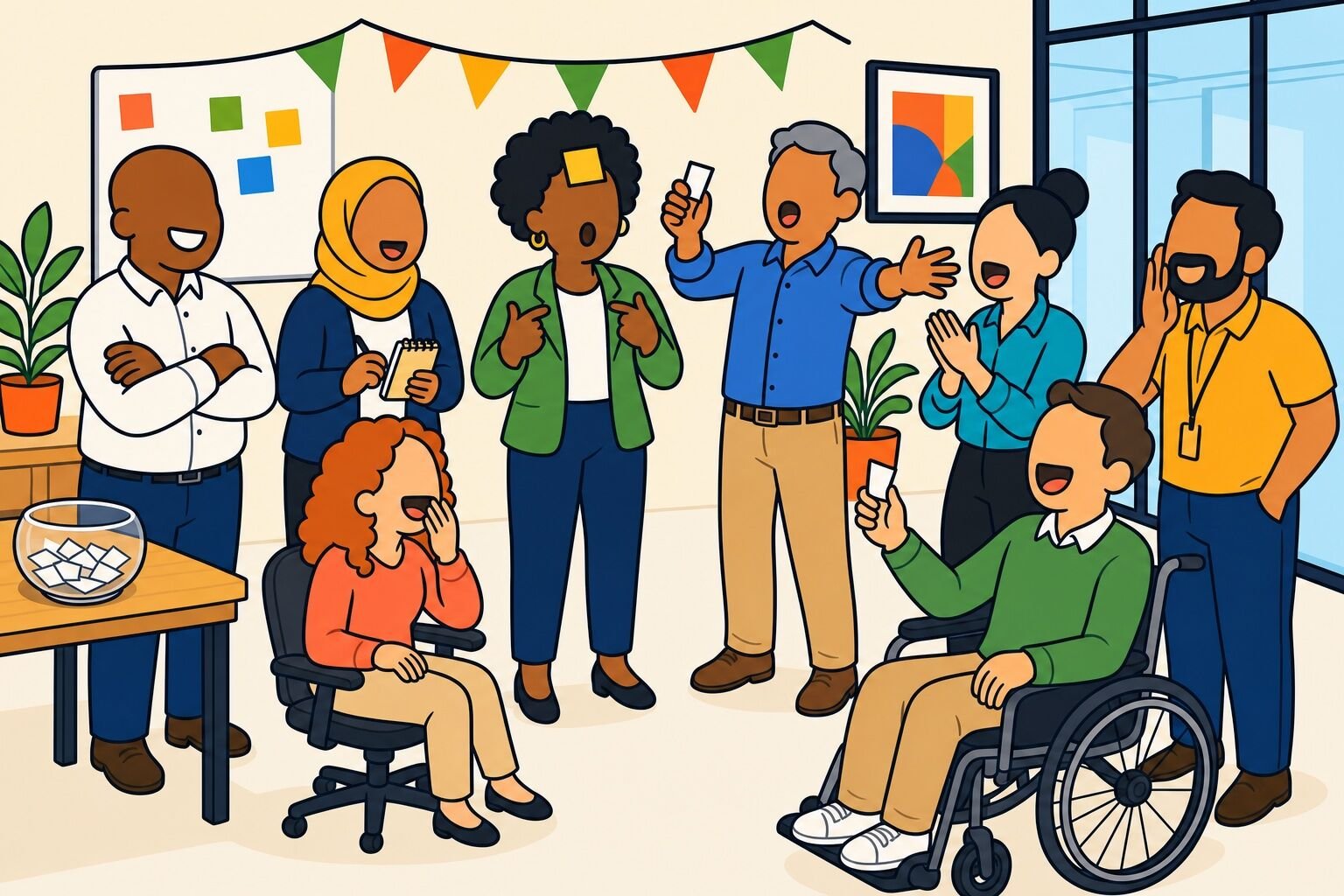
Fishbowl is three games stacked on top of each other, and it is the single best party game we know. Each player writes three names or things on separate slips of paper and folds them into a bowl. Set a category first, such as movies, famous people or things found in your office, so nothing obscure derails a turn.
Split into two teams. In round one, a player pulls slips and describes each one with words, without saying the name, while their team guesses against a 60-second clock. Every guessed slip scores a point and goes in a scored pile. When the bowl empties, return all the slips and play round two, where descriptions are limited to a single word. Then play round three, where the clue-giver can only act it out.
The joke of the game is that everyone has already heard every slip by round three, which is what makes the charades round so fast and so loud.
Best for: 6 to 30 people Time: 30 minutes Materials (cost): Paper slips, a bowl and a timer (free)
What we've learned: Set the category before people write, and make it something everyone in the room could plausibly know. One slip that only the engineering team recognizes burns a full 60-second turn and takes the energy with it.
11. Wink Murder
Wink Murder is a classic parlor game that runs in the background of a party without anyone stopping what they are doing. Prepare slips of paper, one marked with an X for the murderer, one marked with a D for the detective, and the rest blank. Everyone draws a slip in secret.
Guests mingle normally. The murderer eliminates people by catching their eye and winking. A winked player counts silently to five, then dramatically declares themselves out and sits down. The detective gets two guesses to name the murderer before everyone else is eliminated.
Play a couple of rounds, redraw slips between them, and let it run alongside the food and the conversation.
Best for: 8 to 40 people Time: Ongoing through the party Materials (cost): Paper slips (free)
What we've learned: This game does a job no other game does. It gives people a reason to cross the room and make eye contact with colleagues they have never spoken to, and the excuse holds for the whole party.
12. Who Am I?
Who Am I? is the sticky-note forehead game, and it is the best icebreaker for a party where people arrive at different times. Write a name on a sticky note and press it to each guest's forehead as they walk in, without letting them see it.
Guests then mingle and ask one yes-or-no question per person before moving on to someone else. "Am I fictional?" "Am I alive?" "Would my face be on a poster?" Once someone guesses correctly, they get a new note and play again.
Pick one tight category, such as film characters, musicians, or historical figures, so guests have a starting point.
Best for: 10 to 60 people Time: 15 to 20 minutes, or continuously as guests arrive Materials (cost): Sticky notes and a marker (free)
What we've learned: Write the names yourself. When guests write them for each other, roughly half the notes turn into inside jokes that only three people understand, and the other guests spend the game stuck.
13. The Invitation Game
The Invitation Game is a deduction game disguised as small talk. One person is the host and secretly picks a rule based on something visible, such as people wearing something blue, or people holding a drink in their left hand.
The host goes around the circle saying "you're invited to my party" or "sorry, you're not invited" according to the rule. Players who think they have worked out the rule raise a hand and guess. The first correct guess scores a point and becomes the next host with a new rule.
Best for: 6 to 25 people Time: 10 to 15 minutes Materials (cost): None (free)
What we've learned: Brief the host to pick rules about clothing and objects, never about people's bodies or appearance. Shoelaces, sleeves, glasses and drink choices are all fair game and keep the room comfortable.
14. Consequences
Consequences is a folded-paper storytelling game and the quietest activity on this list, which makes it useful for seated dinners where a loud game will not work.
Everyone gets a sheet of paper. The host calls out prompts one at a time: a person's name, then "met," then a second name, then where they met, then what the first person said, then what the second person said, then what happened next. After writing each line, players fold the paper over to hide it and pass it to the left.
At the end, everyone unfolds the sheet they are holding and reads the resulting nonsense aloud.
Best for: 5 to 30 people Time: 10 to 15 minutes Materials (cost): Paper and pens (free)
What we've learned: Read them out loud at the end, one by one, in front of everyone. Skipping the readings to save five minutes removes the only part of the game that is actually funny.
Office party games for large groups
Once a party passes about forty people, the rules change. Anything that requires one person to speak at a time stops working, because the people at the back cannot hear and stop paying attention. The games below either run simultaneously for everyone or run quietly in the background all night.
15. Trivia Showdown
A trivia showdown is the most reliable main event for a big work party. Split the room into teams of four to eight, give each team a name and an answer sheet, and run five rounds of eight questions: general knowledge, music, a picture round, a category chosen by the guest of honor, and a final wager round where teams bet their points.
Read each question twice, collect sheets at the end of every round, and post a running scoreboard so teams can see who they are chasing. Our trivia games guide has formats and question sources, and the generator below will produce questions on demand.
Best for: 10 to 150 people in teams Time: 45 to 60 minutes Materials (cost): Answer sheets, a microphone for big rooms (free)
What we've learned: Add a house round about your own company: who sits where, which product shipped first, whose desk has the most plants. It outperforms general knowledge every time, because every single person in the room has a fair shot at the answers.
16. Rock Paper Scissors Tournament
This is the best game we know for a room of 200 people with no equipment and five minutes to spare. Everyone finds a partner and plays one round of rock paper scissors. The loser does not leave. Instead, they become the winner's cheering section and follow them, chanting their name.
Winners then find other winners and play again, dragging their growing entourage behind them. The crowds double each round until the room is split into two halves, each screaming for a finalist. The whole thing takes about four minutes.
Best for: 20 to 300 people Time: 5 minutes Materials (cost): None (free)
What we've learned: The cheering rule is the entire game. Without it, this is just rock paper scissors and people wander off after round two. Announce the chanting rule loudly at the start and demonstrate it yourself, badly.
17. Pick a Side
Pick a Side gets an entire room moving and mixing without anyone having to speak in front of a crowd. The host names two options and assigns each one a side of the room. Everybody walks to the side they agree with.
Once the room has split, hand the microphone to one person on each side to defend their choice in ten seconds, then call the next pairing. Pancakes or waffles. Beach or mountains. Reply-all or a separate thread. Aisle or window.
People end up standing next to different colleagues after every question, which is the real function of the game.
Best for: 15 to 200 people Time: 10 minutes Materials (cost): None (free)
What we've learned: Always ask for the reason, not just the vote. The split is only mildly interesting. The person who explains, with total sincerity, why cereal counts as soup is the part people quote for months.
18. Office Dress-Up Challenge
The Office Dress-Up Challenge is a team competition that ends in a runway show. Split into teams of four or five and give each team five minutes to gather materials from around the office: paper, tape, markers, sticky notes, packing supplies, whatever is not nailed down.
Only after the supplies are collected do you announce the theme, such as superheroes, sea creatures or "your company's mascot." Each team picks a model and has ten minutes to dress them. Finish with a runway walk and a vote, with prizes for best construction and best commitment to the theme.
Best for: 12 to 60 people in teams of 4 to 5 Time: 20 to 25 minutes Materials (cost): Office supplies (free)
What we've learned: Announce the theme after the supplies are gathered, never before. Teams that know the theme first quietly optimize, and the results are neater and much less funny than what improvisation produces.
19. Sticker Stalker
Sticker Stalker runs underneath the entire party and costs almost nothing. Give every guest a sheet of ten stickers as they arrive, with a different design for each person.
The goal is to place your stickers on other people without being noticed. If someone catches you mid-placement, you have to hand them one of your stickers instead. The first person to offload their whole sheet wins, and at the end of the night everyone counts what they are wearing.
Best for: 10 to 80 people Time: Ongoing through the party Materials (cost): Sticker sheets (~$10)
What we've learned: Give everyone a distinct design so you can tell at a glance who placed what, and set two rules at the door: nothing in hair, and nothing on anything that looks expensive or dry-clean only.
20. Forbidden Words
Forbidden Words is the easiest background game to run at a party of any size. Pick three or four words that the event makes unavoidable, such as "cheers," "budget," "party," or the guest of honor's name.
Give each guest three tokens, clothespins or beads at the door. Whenever you catch someone saying a forbidden word, they hand you one of their tokens. Whoever holds the most tokens at the end of the night wins.
Best for: 10 to 100 people Time: Ongoing through the party Materials (cost): Clothespins or tokens (~$5)
What we've learned: Three or four banned words is the sweet spot, and they have to be words the party makes hard to avoid. Ban something obscure and nobody says it all night, so nothing happens and the game quietly dies.
Party games for work with small groups
Parties of a dozen or fewer get an advantage the big ones do not: everybody can hear everybody. That means you can play games built on conversation, argument and attention rather than on simultaneous activity.
21. That's My Line
That's My Line is a quoting game for small groups. One player says a line from a movie, in character if they are feeling brave, and everyone else races to name the film. A correct guess is worth a point, and the quoter earns a point too if somebody gets it.
Rotate through the group so everyone gets several turns. Set a category to keep it fair, such as films from one decade, animated movies, or movies that had a sequel.
Best for: 4 to 15 people Time: 15 to 20 minutes Materials (cost): None (free)
What we've learned: Set the category before the first turn. Without one, the biggest film buff in the group wins with a line nobody else has heard, and everyone else stops trying by round three.
22. Werewolf
Werewolf is a social deduction game that turns a small team into a courtroom. Players draw secret roles: a couple of werewolves, a seer, a doctor, and the rest villagers. The game alternates between a night phase, where the werewolves silently pick someone to eliminate, and a day phase, where the whole group debates who to accuse and votes.
The villagers win by voting out every werewolf, while the werewolves win by outnumbering the villagers. Pick a narrator who is not playing, and cap the first game at ten minutes so people learn the rhythm before the long game starts.
Best for: 8 to 16 people Time: 30 to 45 minutes Materials (cost): Playing cards or paper slips (free)
What we've learned: This game reveals things about a team, so set the tone early: accusations are about the game, never about the person. A narrator who keeps that boundary makes the difference between a great hour and an awkward one.
23. Guess the Baby Photo
Guess the Baby Photo works best on teams that have been together a while. Ask colleagues to send in a childhood photo the week before, and make it clearly optional. Number the photos, print them, and tape them to a wall.
Guests walk the wall with a scorecard and match each number to a name. Reveal the answers at the end of the party, one at a time, and let each person explain what was happening in their photo.
Best for: 6 to 40 people Time: 20 minutes of guessing, plus the reveal Materials (cost): Printed photos and scorecards (free)
What we've learned: Put the photos on a wall rather than in a slideshow. People drift back to the wall three or four times during the party, change their answers, and argue with each other in front of the evidence. A slideshow gives you one look and one guess.
Funny office party games
"Funny" is the most requested quality in a work party game and the hardest to deliver, because most funny games ask somebody to be funny on command. These three put the comedy in the format instead, so nobody has to perform to get the laugh.
24. Dad Joke Off
Dad Joke Off is a knockout tournament where the material is supplied. Print a stack of joke cards and draw a bracket on a whiteboard with eight or sixteen names.
Two competitors face off at a time. Each draws a card and reads their joke, deadpan, to the crowd. The louder groan wins the round, judged by the room's reaction. Winners advance until you have a champion, who gets a trophy made from office supplies.
Best for: 8 to 50 people Time: 15 minutes Materials (cost): Printed joke cards (free)
What we've learned: Supply the jokes. The moment you ask people to bring their own material, half your bracket drops out. When the card does the work, even the shyest person on the team will step up, because failing is the joke's fault.
25. Caption This
Caption This is the best game for a room that has not warmed up yet, because nobody has to speak. Put a photo on a screen: an odd stock image, or better, a photo from a past company event. Everyone writes a caption on a slip of paper and drops it in a bowl.
The host reads every caption aloud without naming the author, and the room votes for its favorite by applause. Reveal the winner, then move to the next photo. Six to ten photos is a full round.
Best for: 8 to 60 people Time: 15 to 20 minutes Materials (cost): A screen, paper slips and a bowl (free)
What we've learned: Anonymous submissions get funnier captions than named ones, and photos from your own events beat stock images every time. A picture of your own CFO holding a giant inflatable hammer writes half the captions for you.
26. The Office Awards
The Office Awards is a ten-minute ceremony that closes a party better than a speech. A week ahead, invite the team to nominate colleagues in a set of invented categories, then print certificates for the winners.
On the night, run it like an award show: walk-up music, a two-sentence citation for each winner, a handshake and a photo. Good categories celebrate contributions rather than personality, such as Best Explanation of a Spreadsheet, Most Reliable Snack Supplier, or Fastest Response to a Production Fire.
Best for: 10 to 200 people Time: 10 to 15 minutes Materials (cost): Printed certificates (~$15)
What we've learned: Invent enough categories that everybody gets one. The moment the awards become a shortlist, the ceremony stops being a celebration and turns into a ranking, and everyone who is not named notices immediately.
Holiday office party games
December is where most of these games get used. The four below are seasonal by design, and they work at any end-of-year gathering, from a catered party to an afternoon in the breakroom. For the rest of the plan, see our guide to end of year celebration ideas.
27. Costume Party Bingo
Costume Party Bingo gives guests something to do in the first fifteen minutes, which is the hardest stretch of any party. Build bingo cards where each square describes something a guest might turn up wearing or doing, then hand out cards and pens at the door.
Players mark off a square when they spot a match and have to be able to point at the person who earned it. First to a line shouts bingo, and first to a full card takes the big prize. Here is a sample card you can print:
Best for: 10 to 100 people Time: Ongoing through the party Materials (cost): Printed cards and pens (free)
What we've learned: Build the squares from what your team actually does, not from generic party clichés. "Someone wearing a sweater their kid picked" and "a group that clearly coordinated by text" get marked off within ten minutes and start conversations while they do.
28. Indoor Snowball Fight
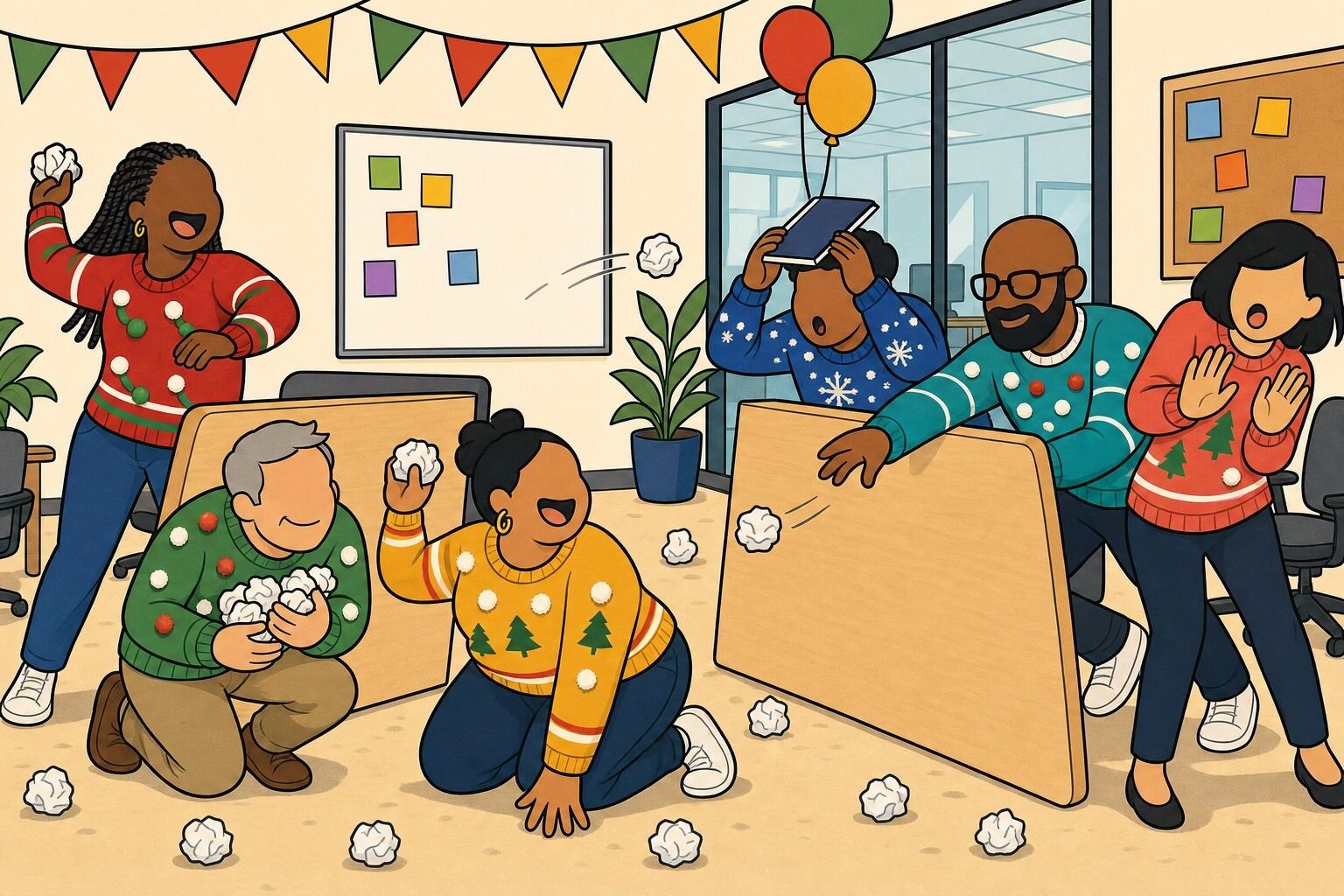
An Indoor Snowball Fight is the cheapest way to make a party loud, and it uses the recycling bin as a supply closet. Have everyone crumple scrap paper into balls, then split into two teams and mark a center line down the room.
Play three-minute rounds. In the simplest version, both teams throw at once and the team with the fewest snowballs on their side when time runs out wins. In the elimination version, anyone hit steps out until the next round. Let teams build low forts from chairs and tipped tables if you have space.
Best for: 10 to 50 people Time: 10 minutes Materials (cost): Scrap paper (free)
What we've learned: Set a no-headshots rule, keep rounds to three minutes, and clear the mugs off the tables first. The game peaks fast and ends better on a whistle than on somebody's spilled coffee.
29. Wrapping Paper Race
Wrapping Paper Race is a December classic that gets funnier the stranger the objects are. Set up a table with wrapping paper, tape, scissors and ribbon, and a pile of awkwardly shaped items: a stapler, a potted plant, a bike helmet, a banana.
Players get ten minutes to wrap as many items as they can. Award prizes for the most items wrapped, the neatest single package, and the most ambitious failure. If your team runs a gift drive, wrap the real donations and the game does your logistics for you.
Best for: 6 to 40 people Time: 10 to 15 minutes Materials (cost): Wrapping paper, tape and ribbon (~$15)
What we've learned: Odd shapes are the whole game. Boxes are a wrapping test, but a potted plant is a comedy, and the photos of the results are what circulate in the team chat the next morning.
30. Ugly Sweater Station
An Ugly Sweater Station beats an ugly sweater contest, because it includes the people who forgot. Set up a table with pom-poms, ribbon, felt shapes, buttons, tinsel, glue and safety pins, and ask guests to bring a plain sweater they do not mind modifying.
Guests decorate at their own pace through the party. Near the end, run a two-minute runway and give out awards for the ugliest, the most creative and the most structurally unsound. Keep a few thrifted sweaters at the table for anyone who arrives empty-handed. If your team is remote, here is how to run an ugly sweater party online.
Best for: 6 to 50 people Time: Ongoing, with a five-minute judging at the end Materials (cost): Craft supplies and a few spare sweaters (~$30)
What we've learned: Artistic skill actively hurts you here, and saying so out loud is what fills the table. The station only works if nobody in the room feels shut out of it, which is why the spare sweaters matter more than the glitter.
Party games for work on Zoom
If some of your team is dialing in, a few of these games move to video better than others. Most Likely To, Pick a Side, Caption This and The Office Awards all work on a call with no changes at all, because they run on voting and reactions rather than on movement. Trivia Showdown works well with breakout rooms for team huddles between rounds.
Games built on physical proximity do not translate. Sticker Stalker, Wink Murder and the Indoor Snowball Fight need a shared room, and the versions people invent for video are a pale imitation.
For a full set of formats designed for a video call rather than adapted to one, see our list of virtual party games.
What we've learned from running office parties
Party games are not a side dish at a work celebration. They are the mechanism that decides whether people mix or stay in the groups they arrived with. A few patterns hold across every party we have run.
December is the whole ball game. December is the busiest month for team building events, accounting for 30% of events held, followed by October at 11%. If your party is in December, every venue, caterer and host is competing for the same three weeks, and the good dates are gone by early November.
Match the game to the headcount before you match it to the theme. The median team building event has 16 participants, and half of all events fall between 10 and 27 people. That size fits almost anything on this list. Above about 40, the rules change, and games where one person talks at a time stop reaching the back of the room.
Group size
What changes
Games that fit
Small (up to 12)
Everyone can hear everyone, so conversation games work and nobody can hide. Turn-taking is the risk: keep rounds short.
Friendly competition does the heavy lifting. Points, buzzers, team names and a scoreboard give people a reason to lean in without asking anyone to perform. The stakes stay deliberately low, and the competition is what produces the laughing. One participant put it this way after a hosted game event run over video:
Two structured games is the right number. A party that is wall-to-wall games feels like a mandatory workshop. A party with none reverts to the same four conversations. We aim for one game early, while people are still finding their feet, and one later as a main event, with a background game like Forbidden Words running underneath the whole thing.
Pay people to be there. We recommend making team socials paid and on the clock. An unpaid party held after hours quietly selects for the colleagues with the fewest obligations at home, and the people you most want to include are the ones who cannot come.
None of this is only about morale. Michel, Tews and Allen's 2019 review of workplace-fun research in Human Resource Management Review concluded that fun has generally demonstrated benefits for individuals and organizations, and in a related field study of 195 restaurant servers, manager support for fun was associated with lower employee turnover. The evidence is mixed in places, and a party is not a retention strategy on its own, but the case for making the celebration good is stronger than "people like cake."
Plenty of party games that look great on a list play badly in an actual workplace. Some create liability, some single people out, and some are simply not games. Here is what we skip.
The Lame List
Activity
Why skip it
Verdict
Desk chair races
Office chairs are built to swivel, not to be ridden across a hard floor at speed. The reward is a ten-second laugh and the risk is an incident report.
Skip it
Desk Thief and other "steal from a colleague" games
Any game built on taking things off people's desks ends with something genuinely lost, and it asks colleagues to be sneaky with each other's belongings.
Skip it
Open-mic karaoke
It puts maximum pressure on individuals in front of their colleagues, so the same two extroverts sing and everyone else studies the floor. Name That Tune gets the music without the exposure.
Swap it
Truth or Dare
The interesting dares cross professional lines, and the workplace-safe version is so watered down that it is not a game any more.
Skip it
Drinking games
They exclude anyone who does not drink, pressure those who do, and turn the company into the host of the consequences.
Skip it
Musical chairs, limbo and Twister
All three depend on physical agility, flexibility and what people happen to be wearing, so they quietly exclude a chunk of the room before the first round.
Skip it
Two Truths and a Lie
Fine as a two-minute icebreaker for a small team, but at a party it crawls: every person needs a turn, and by person nine the room has moved on.
Usually skip
Paint-along parties
A genuinely nice activity, but it is a 90-minute quiet class, not a party game. Booking one as the entertainment stalls the social energy you came for.
Not a party game
An unstructured happy hour
Without a game or a host, everyone talks to the people they already know and leaves early. Add one background game and the same event works.
Add structure
Final thoughts
The best office party games are not the most elaborate ones. They are the ones that give people a reason to talk to a colleague they would not otherwise have spoken to, and then get out of the way. Pick one game for the first half hour, one for the middle of the night, and let the rest of the party be a party.
Start with the group size, check what you already have in the building, and resist the urge to schedule the whole evening. Two good games and a room that wants to stay is a successful party.
Common questions about running games at office parties and workplace celebrations.
What are good party games for an office party?
The most reliable office party games are Fishbowl, a trivia showdown, Most Likely To, Lightning Scavenger Hunts and party bingo. Each one runs on conversation or simultaneous play rather than on putting individuals on stage, and none of them needs more than paper, a bowl and a timer to set up.
What party games work for large groups at work?
Above about 40 people, choose games everyone plays at the same time or games that run in the background. A rock paper scissors tournament, Pick a Side, a team trivia showdown, Sticker Stalker and Forbidden Words all scale past 100 guests. Games where one person speaks at a time stop reaching the back of the room.
What are parlor games, and do they work at work parties?
Parlor games are traditional drawing-room games that need no board, app or equipment beyond paper and chairs, such as Fishbowl, Wink Murder, Who Am I?, The Invitation Game and Consequences. They work well at work parties because they cost nothing, scale to whoever turns up, and run on conversation rather than physical activity.
How many games should an office party include?
Two structured games is usually right: one in the first half hour while people are still finding their feet, and one later as a main event. Add a background game that runs all night, such as Forbidden Words or Sticker Stalker. A party that is wall-to-wall games starts to feel like a mandatory workshop.
What party games should you avoid at work?
Skip desk chair races and other games that create injury risk, drinking games, open-mic karaoke, Truth or Dare, and physical games like musical chairs, limbo and Twister that quietly exclude part of the room. Two Truths and a Lie is fine as a quick icebreaker but crawls at a party, since every person needs a turn.
Which party games work when some of the team is remote?
Most Likely To, Pick a Side, Caption This, The Office Awards and a trivia showdown with breakout rooms all move to a video call with no changes, because they run on voting and reactions. Games built on physical proximity, like Wink Murder, Sticker Stalker and an indoor snowball fight, need a shared room.

Comments (0)
Leave a Comment