
34 Fun Icebreaker Games for Adults That Actually Work (2026)
The 34 icebreaker games our professional hosts actually use — we cut the filler and upgraded what survived — plus facilitation lessons from 45,000+ events.

The 34 icebreaker games our professional hosts actually use — we cut the filler and upgraded what survived — plus facilitation lessons from 45,000+ events.
Icebreaker games are how we start nearly every event we run. Since 2013, teambuilding.com has run 45,000+ team building events for organizations like Google, Pfizer, McKinsey, Lockheed Martin and Stanford University — and almost every single one opens with an icebreaker. Our pool of 75+ professional hosts has opened rooms of every kind: sleepy Monday-morning meetings, thousand-person all-hands calls, and holiday parties where nobody knew each other yet.
This guide is the result. We started from the 42 games in the previous version of this article, cut the dozen that don't hold up in real rooms, upgraded the 30 that do, and added four games straight from our own hosted events — clearer instructions, honest time and materials estimates, and the facilitation lessons our hosts have learned about what makes an opener work and what makes a room go quiet.
Trusted by teams at






This list includes:
Icebreaker games are short activities and exercises that prompt conversation at the start of a meeting or event. Example games include Six Word Memoirs, Icebreaker Bingo and Desert Island Intelligences. The purpose of these games is to help groups get to know each other in a fun, informal setting and to warm a room up before the main agenda. These exercises are also known as "icebreaker activities" and "introduction games."
Icebreakers are a subset of team building games and indoor team building activities, and are similar to connection games, fun games for coworkers, and 5 minute team building activities. The online versions are virtual icebreakers; for question-only openers see icebreaker questions, and for big rooms see large group icebreakers. Within the category, this guide includes ice breaker games for small groups, work, and meetings, team building ice breakers, quick and easy icebreaker games, classroom icebreakers for students, and introduction games.
There is a research reason the ritual works. Google's Project Aristotle, an internal study of 180+ of its own teams, identified psychological safety — the sense that speaking up carries no social risk — as the first of five dynamics that set successful teams apart. An icebreaker is the cheapest tool a team has for building it: two minutes of low-stakes talking at the top of a meeting signals that voices are welcome before anything is at stake.
Prefer to watch? This video covers some of our favorites:
Every game on this list is summarized below — click any name to jump straight to the instructions:
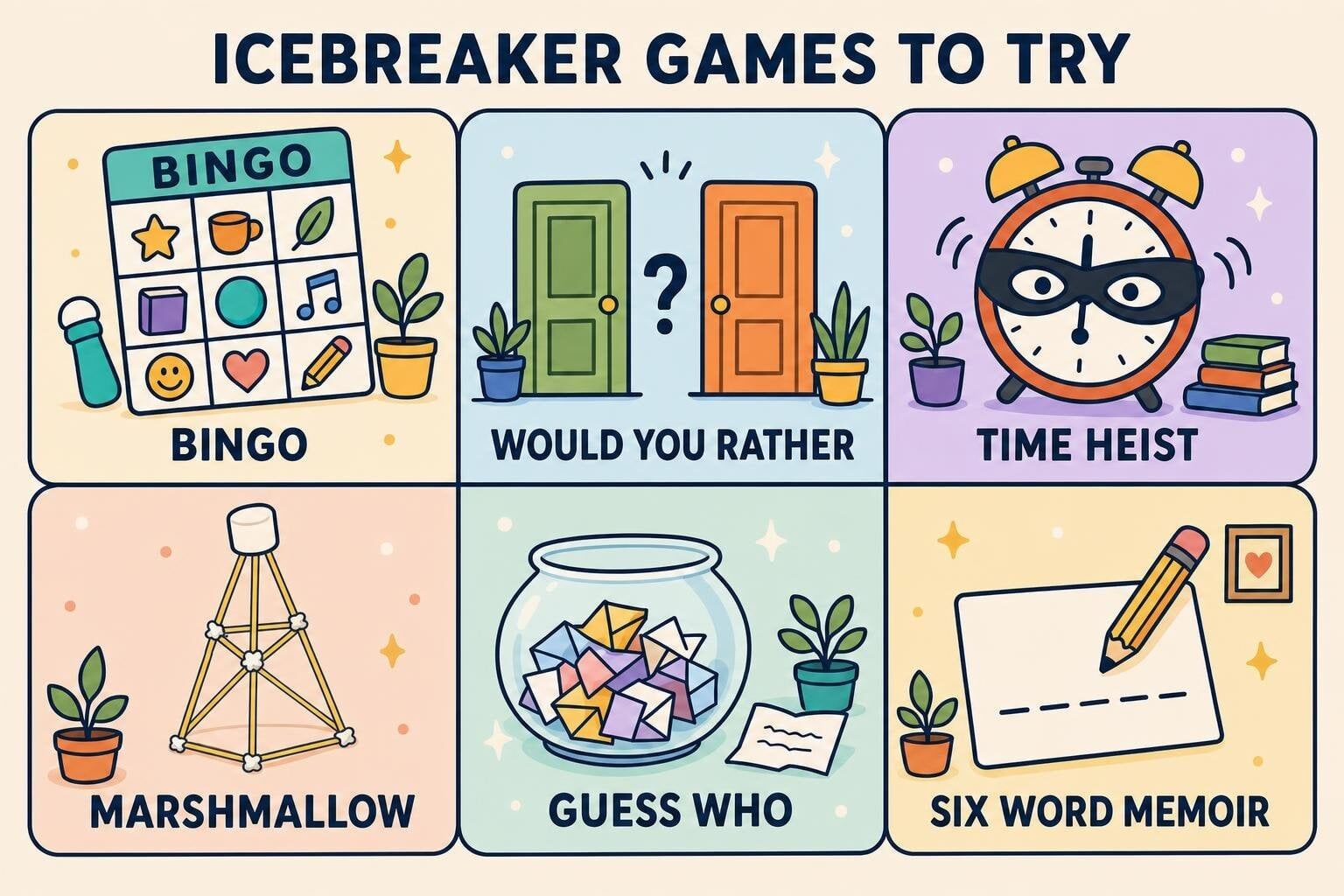
Here are icebreakers that work best in small groups of ten or less. These games are playable with more participants, but are most effective when teams have time to talk through answers.
Icebreaker Bingo is one of the best games you can play for new introductions. The format is familiar, easy to learn, and lends itself naturally to prizes and recognition.
To play:
Here is a game board you can use:
And here is a free icebreaker Bingo card template you can play with.
Best for: New introductions, 5 to 30 people
Time: 15 to 30 minutes
Materials: Printed or digital Bingo cards
What we've learned: Bingo itself is not the interesting part — the prompts are. Avoid squares where everybody already knows the answer, and write prompts likely to uncover stories.
Six Word Memoirs is a stellar icebreaker game guaranteed to spark discussions.
To play:
Because the activity limits each participant to six words, your colleagues' word choices invariably lead to questions about why those particular words stood out — which is exactly where the good conversation lives.
Best for: Reflective groups, 3 to 15 people
Time: 10 to 20 minutes
Materials: None (paper optional)
Would You Rather is one of the best icebreakers for small groups because the game can cover almost any topic. Come up with a list of questions that begin with "Would you rather…" and end with two options, then have participants take turns answering — and make sure respondents share the reasons for their choices.
Some favorites:
Check out our list of the best Would You Rather questions for work.
Best for: Any group, 3 to 20 people
Time: 5 to 15 minutes
Materials: A question list
What we've learned: The best prompts are genuine dilemmas that split the room close to 50/50. When everyone picks the same answer, skip the discussion and move to the next question — the split is where the fun is.
Pancakes vs Waffles is a debate game we run in our own hosted events, built around an unnecessarily serious question: if either pancakes or waffles had to disappear from existence forever, which would your team save?
The group debates until it reaches a decision. The surviving option then faces a new challenger nominated by a participant — if waffles survive, the next matchup might be waffles versus pizza, then pizza versus long weekends. Eventually your team is passionately debating something like dogs versus human civilization.
Best for: Groups that love a low-stakes argument, 4 to 20 people
Time: 10 to 20 minutes
Materials: None
What we've learned: Don't linger on the opening pancakes-versus-waffles round — the strange later matchups are where the fun is. Settling rounds by vote also gives quieter teammates a way to swing the outcome without debating.
Time Heist is a game where your team proposes outlandish schemes they would pull off if they could time travel.
To play:
Time Heist reveals your team's creativity and provides an amusing way to learn more about each other.
Best for: Creative groups, 4 to 15 people
Time: 10 to 20 minutes
Materials: Paper and a container
To set up Guess Who, give each team member three slips of paper and ask players to write a piece of personal trivia on each slip. Encourage unique, interesting, and surprising facts. Fold the pieces, put them in a bowl, and read them out loud one at a time. The other team members guess the fact's author; after all guesses are in, the author identifies themselves and shares the story behind the fact.
Check out more get to know you games.
Best for: Teams that half-know each other, 5 to 20 people
Time: 15 to 25 minutes
Materials: Paper slips and a bowl
What we've learned: Round two is always better than round one — once people hear which facts get the biggest reactions, they calibrate toward their most surprising material. Plan for two rounds if time allows.
Here are icebreakers that work well for offices because participants practice professional skills like decision-making, storytelling, and persuasion.
One of the most intriguing theories in psychology is Gardner's Theory of Multiple Intelligences, which proposes that people possess a variety of abilities and talents, known as intelligences. This icebreaker draws on Gardner's Theory, and asks your team to vote people off a desert island based on how useful these intelligences would be for survival.
Gardner's eight intelligences are:
In this game, eight individuals, each representing a different intelligence, are stranded on a desert island with finite resources. Your team must debate what order to eliminate the individuals in to ensure survival. The debates are wonderful for learning about your coworkers' priorities and thought processes.
For similar ideas, check out this list of problem solving games.
Best for: Teams that love a debate, 5 to 20 people
Time: 15 to 30 minutes
Materials: The list of eight intelligences on a whiteboard or slide
In the Quotes Game, colleagues pick quotes from their favorite movies, books, songs, and TV shows for teammates to guess.
To play:
You can offer bonus points to colleagues who can name the character or figure out who said the quote, and hints for anyone who needs help.
Best for: Pop-culture-loving teams, 4 to 20 people
Time: 15 to 25 minutes
Materials: Prepared quotes
One of the most prominent personality tests is the Myers-Briggs Test, which matches people with a four-letter personality type that suggests what you are like in relationships and the workplace. A Myers-Briggs Session uses this test to initiate discussions that reveal more about your coworkers' characters.
Send the Myers-Briggs test to your team to complete, then set a time where everyone gets together to discuss results. It is a fun way to get people talking about themselves and how they work best with others.
Here is the official Myers-Briggs assessment and more personality tests you can use for icebreakers.
Best for: Established teams, 3 to 15 people
Time: 30 to 60 minutes (plus taking the test beforehand)
Materials: Test access for each participant
What we've learned: Treat the types as conversation starters, not verdicts. "Does this feel accurate to you?" starts a great discussion; sorting the team into boxes does not.
I'm a Brand Manager is an icebreaker for work that tests your team's creativity.
Here's how to play:
This game is a natural fit for creative or design teams, but even for everyone else, the competition inadvertently reveals what your team members are passionate about — and may unearth previously unknown design skills.
Best for: Creative sessions, 6 to 20 people in small teams
Time: 20 to 40 minutes
Materials: Whiteboards or paper and markers
Prior to the activity, participants submit a childhood photo. Participants then receive a photo at random, and must find the person in the photo and learn about their childhood experiences. This activity is a nostalgic and heartwarming way to connect.
Best for: Mixed teams and departments, 5 to 30 people
Time: 15 to 30 minutes (collect photos in advance)
Materials: Childhood photos, printed or in a shared doc
What we've learned: Ask for toddler photos, not newborn photos. Toddler photos work much better in guessing games because recognizable features have started to develop — and unlike most guessing games, this one actually gets better as the group gets larger.
Here are easy icebreakers for calls or meetings. These games work for virtual, hybrid, or in-person meetings — and all three fit inside a 10-minute block at the top of an agenda.
The quickest icebreaker you can run anywhere is a good question. For example, "your favorite movie growing up" or "the last book you read." These questions help participants bond over shared experiences and get comfortable talking with each other.
Check out this list of icebreaker questions for more inspiration.
Best for: Any meeting, any group size
Time: 5 to 15 minutes
Materials: A question list or the generator above
What we've learned: Fact-questions ("what is your favorite…") feel easier, but playful debate prompts — is a hot dog a sandwich? — consistently do better at bringing out actual personalities. Our hosts' full advice on this is in the expert tips section below.
Bet on the Crowd is part trivia game and part social experiment, and one of the mechanics we use most in our own hosted events. Instead of testing who knows obscure facts, players predict the opinions of their coworkers.
To play:
Best for: Meetings of any size, including all-hands
Time: 10 to 20 minutes
Materials: A quick survey or poll tool
What we've learned: Mix universal questions with questions only your team would care about — people enjoy discovering the actual results almost as much as scoring points.
Rose, Bud, Thorn is a classic check-in round that turns "how is everyone?" into something people can actually answer. Going around the group, each person shares three things:
The structure keeps shares short, gives everyone the same three beats, and surfaces things a status update never would.
Best for: Recurring team meetings, 3 to 15 people
Time: 5 to 15 minutes
Materials: None
What we've learned: With new groups, keep the thorns light — "my coffee machine broke," not performance reviews. Once trust builds, the thorn round quietly becomes the most useful part of the meeting.
Firsts helps teammates share their first experiences. Create a list of firsts, share it with players, and give the group three or four minutes to answer.
For example:
Then, the group shares, compares, and contrasts answers. Keep all topics work appropriate.
Best for: Standing meetings and check-ins, 3 to 15 people
Time: 5 to 10 minutes
Materials: A prompt list
Word Association is a quick and easy way to learn more about how your teammates' minds work. You will need a list of about ten words — or use this random word generator:
Have everyone number a piece of paper, then read each word aloud. Players must write down the first thing that comes to mind. Once the lists are complete, teammates share and explain their responses. It is always interesting to see how folks make connections.
Best for: Warm-ups and workshops, 3 to 20 people
Time: 5 to 10 minutes
Materials: A word list, paper and pens
Here are icebreakers for team building that help participants show off their skills and personalities to coworkers.
The Storytelling Icebreaker pushes employees to use their imaginations: teams create a story using a set of four pictures as prompts.
To play:
To make the game more engaging, reward the winners. This brainstorming activity improves focus and gives quieter teammates a structured way to contribute.
Best for: Cross-team sessions, 6 to 20 people in teams of 3–4
Time: 20 to 30 minutes
Materials: Four printed images per team
This activity helps team members break the ice by sharing childhood masterpieces. Before the meeting, each participant finds a piece of art they created as a kid. Players take turns sharing and explaining those drawings or paintings to the group. Expect laughs, nostalgia, and stories that would never come up in a status meeting.
If participants do not have any authentic kiddie art on hand, they can share their children's artwork or create a kid-style drawing.
Best for: Relaxed team sessions, 4 to 15 people
Time: 15 to 25 minutes (collect art in advance)
Materials: Childhood artwork, photographed or original
Personality Shapes is a one-question personality test and a simple way to gain insight into your team's mindsets. On a whiteboard, draw a square, a triangle, a circle, and a squiggly line. Then ask participants which shape best matches their personality. Each shape corresponds to certain traits:
Squares:
Triangles:
Circles:
Squiggles:
Understanding how a coworker approaches a problem can be instrumental when working on a project together. For example, squares and squiggles may struggle to collaborate because one is hesitant to change while the other gets bored quickly. Visit Connie Podesta's site to learn more about the traits associated with each shape.
Best for: Project kickoffs, 4 to 30 people
Time: 10 to 15 minutes
Materials: A whiteboard
The Marshmallow Challenge is one of the most fun icebreaker games for work. Split your team into pairs and give each group 20 sticks of dry spaghetti, three feet of tape, three feet of string, and one marshmallow.
The instructions are easy, even if the task is not: each pair has 20 minutes to build the tallest freestanding structure with the marshmallow on top. Once the challenge is complete, have the group discuss what part was hardest, who failed first, how they recovered, and what they thought of the other designs.
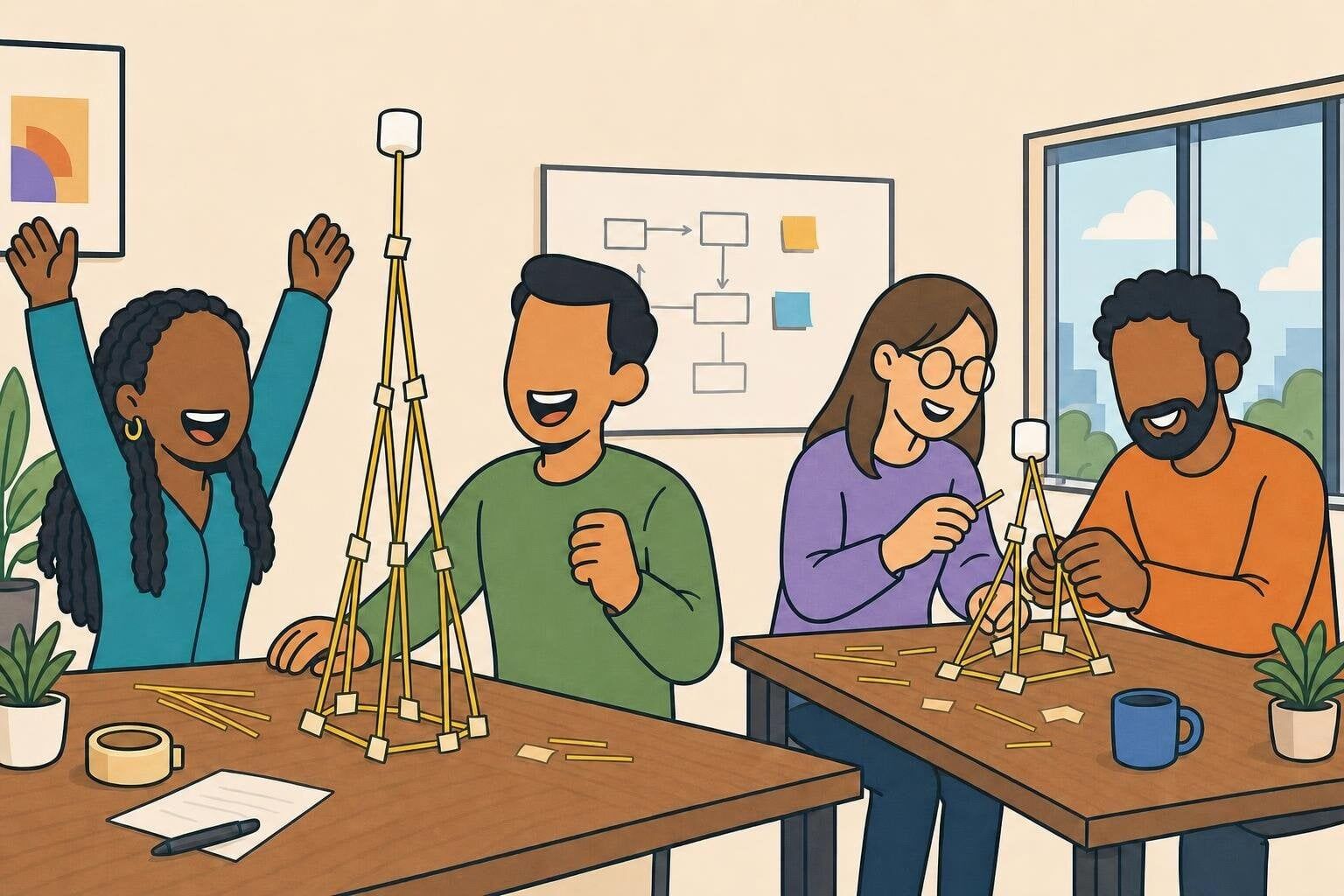
Tom Wujec's "Build a Tower, Build a Team" TED talk explains why this exercise works so well as a team building activity and icebreaker.
Best for: Hands-on teams, 4 to 30 people in pairs
Time: 25 to 40 minutes including debrief
Materials: Spaghetti, tape, string and marshmallows (roughly $15 for a whole team)
What we've learned: The debrief is half the value. As Wujec's talk shows, teams that prototype early beat teams that spend all 20 minutes planning one perfect tower — which makes for a surprisingly useful conversation about how your team actually works.
Hometown Map is an icebreaker game for work that is easy to set up. Pin a large world map to a bare stretch of wall and place a marker, small Post-It notes, and a box of push pins nearby. Then, invite your team to mark birthplaces or hometowns on the map over the next few days.
After everyone is done, you will have a lovely new piece of wall decor that shows important pieces of your employees' pasts — and the pins prompt colleagues to ask each other about growing up in different places for weeks afterward.
Best for: Offices and shared spaces, 5 to 100+ people
Time: Ongoing over a week
Materials: A wall map, push pins and Post-Its (about $30)
Here are 5-to-15-minute icebreaker activities that need little or no prep — for when you are short on time but still want the room warmed up.
Common Ground splits your team into groups and challenges each group to find a set number of things they have in common in a set amount of time.
If you want the game to be laidback, have teammates work in pairs and find three commonalities in 10 minutes. To make it harder, have the whole group find ten things everyone shares. At the end, reunite the groups to share what they learned about each other.
Best for: New teams, 4 to 30 people
Time: 10 to 15 minutes
Materials: None
What we've learned: Push for unique commonalities. "We all ate the same variety of spaghetti growing up" is more interesting than "we all breathe" — and banning easy categories like food or movies in later rounds forces much better conversations.
Each participant rolls a die and, based on the number rolled, shares a personal fact about themselves — assign a theme to each number, like "a hidden talent" for three or "a travel story" for five. The randomness adds an element of surprise to the usual sharing. Feel free to play multiple rounds and reassign the numbers as needed.
Here is a list of get to know you questions you can use as game questions.
Best for: Casual openers, 3 to 15 people
Time: 5 to 15 minutes
Materials: One die
Best Thing on My Desk is a show-and-tell we use in our own events because it works equally well in the office and on camera. Ask each participant to grab one object from their desk or bag that they like, find interesting, or that has a good story behind it — a ridiculous mug, a souvenir, a mystery object nobody can identify.
Participants hold up the object and briefly explain why they chose it, and teammates ask questions when something interesting comes up.
Best for: Office and remote teams alike, 4 to 20 people
Time: 10 to 20 minutes
Materials: None — the props are already on everyone's desk
What we've learned: Keep the initial explanations short, then spend the time following the stories that generate curiosity. This is a textbook "green-light" prompt — everyone has an object, and nobody has to reveal more than they want to.
In this simple icebreaker, teammates choose theme music to suit different situations.
For example:
You can have participants name the song, play a short clip, or add the song to a collaborative playlist.
Best for: Music-loving teams, 3 to 15 people
Time: 10 to 15 minutes
Materials: None (a speaker makes it better)
Ask all your coworkers to name an accomplishment achieved by age 18. These accomplishments can range from academic to personal, and you can play as many rounds as you like.
Each round paints a picture of teammates' childhoods and reliably leads to follow-up questions about everyone's personal triumphs. This exercise is a fun way to get to know each other, and breaks up the monotony of a slow workday.
Best for: Any group, 3 to 15 people
Time: 10 to 15 minutes
Materials: None
That Reminds Me is similar to Word Association: a leader gives a prompt, and players share the things that remind them of it.
For example, if the prompt is "home," one player might name the scent of freshly baked conchas while another describes the smell of salt air from a childhood home on the beach.
Good prompts include:
This exercise gives insight into players' backgrounds and encourages the small anecdotes that create intimacy.
Best for: Reflective groups, 3 to 15 people
Time: 10 to 15 minutes
Materials: A prompt list
Pick a theme for your game, such as hobbies, and ask each player to fill a nine-square grid with specific personal answers. Then set a five-to-ten-minute time limit while participants walk around the room and share grids. When two teammates list the same answer, they initial each other's grids. The first player to get three boxes in a row wins.
You can change the theme to cover any topic — passions, personality traits, favorite TV shows — and award prizes for diagonal, horizontal, vertical, or full-board wins.
Best for: Mingling formats, 6 to 30 people
Time: 10 to 20 minutes
Materials: Paper grids and pens
Here are icebreaker activities for teachers to use with students.
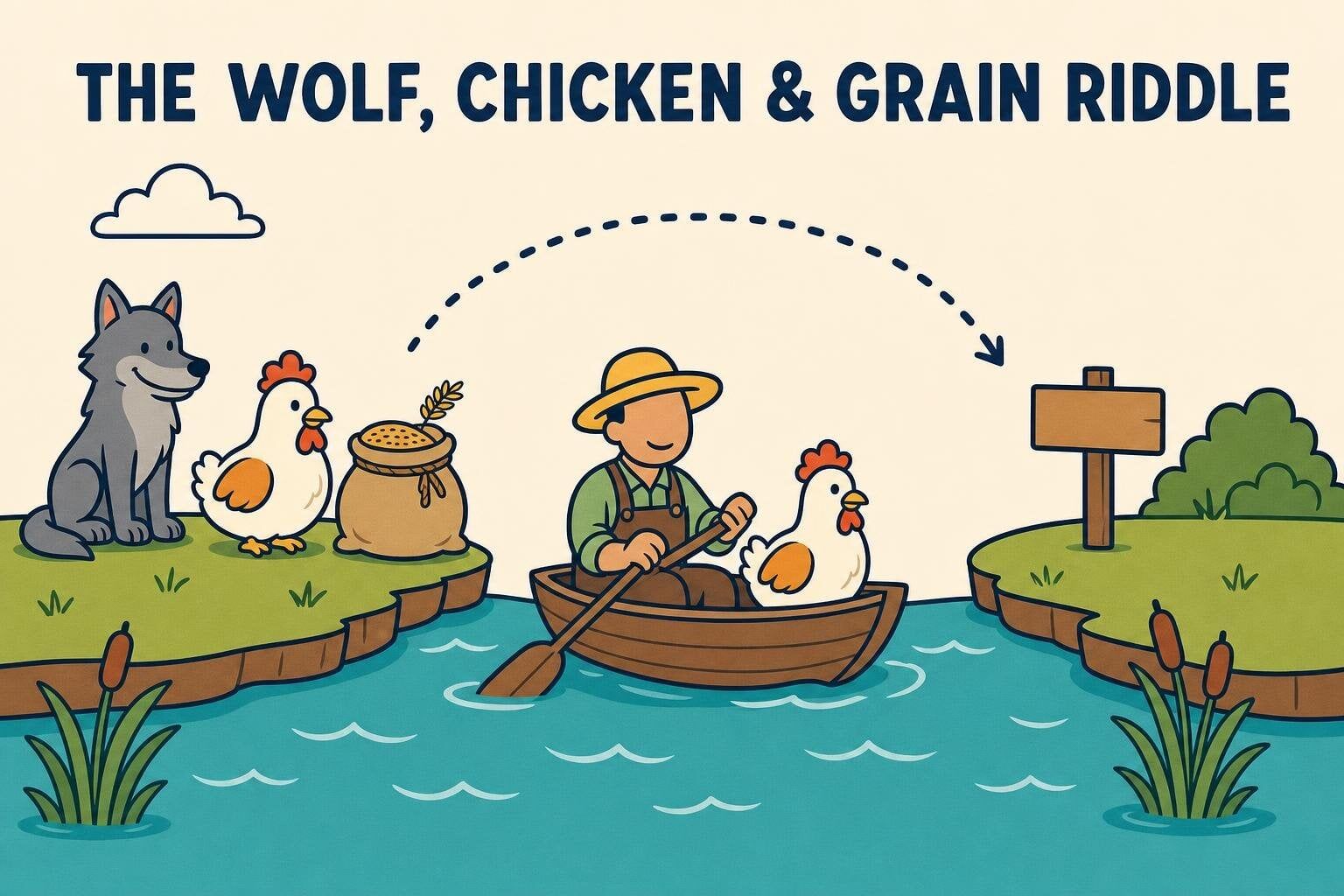
Challenge teammates to solve a riddle together. Solving a riddle requires the group to discuss potential solutions, which opens the door for communication. One classic is the Wolf, Chicken, Grain riddle:
"A farmer is traveling with a wolf, chicken and bag of grain and comes to a river they need to cross. The boat only has room for the farmer and 1 other. The farmer can't leave the wolf alone with the chicken and he can't leave the chicken alone with the grain. How can he get them all across the river safely?"
Team members must work together to agree on an answer and explain their reasoning. For larger groups, split into teams so everyone has a chance to participate.
By the way, here is the answer:
Check out more riddles to do with teams.
Best for: Classrooms and problem-solvers, 3 to 30 people
Time: 10 to 15 minutes
Materials: None
Create a list of well-known real people and fictional characters. Write the names on note cards and tape a card to each person's back. Each player's goal is to figure out who they are by asking yes/no questions.
Some example questions:
The game ends when all participants guess the name on their card. You can incorporate a theme — for example, during Women's History Month you can choose important women throughout history. Here is a list with more ideas for Women's History Month.
Best for: Classrooms and mixers, 6 to 30 people
Time: 15 to 25 minutes
Materials: Note cards and tape
Being told you cannot do something usually leads to an obsession with that thing. No Smiling plays on this instinct: have your team stand in a circle with one person in the middle, who is not allowed to smile or laugh. Participants in the circle take turns telling jokes and trying to break them. This activity lightens the mood and helps team members loosen up.
Best for: Students and playful groups, 5 to 20 people
Time: 5 to 15 minutes
Materials: None
Here are introduction activities for teammates or colleagues meeting for the first time.
Trading Cards is a fun way to encourage team communication.
To play:
To make this game even more fun, teammates can ask hilarious questions to get funny responses — for example, "Is cereal soup?"
Best for: Onboarding and first meetings, 6 to 30 people
Time: 15 to 25 minutes
Materials: Index cards and markers
In Jenga Questions, your team plays Jenga while also answering questions. Depending on whether you have a standard or giant Jenga set, either write numbers that correspond with questions or write the actual questions on each brick. As each team member withdraws a brick, they answer the question associated with it.
The element of unpredictability creates a spontaneous, easygoing way for employees to share information about themselves. Here is a list of fun this or that questions you can use for the game.
Best for: Small hangouts, 3 to 10 people
Time: 15 to 30 minutes
Materials: A Jenga set (about $20)
Speed Networking provides a fast and easy way for teams to get to know each other. Pair your team into groups of two, then give each pair icebreaker questions and a few minutes to make their way through as many questions as possible. When time is up, switch up the pairs.
With smaller groups, you can cycle through the pairs more than once so colleagues can go deeper on topics that came up in earlier rounds.
Best for: Big mixers and conferences, 6 to 100+ people
Time: 15 to 30 minutes
Materials: A timer and question list
What we've learned: Keep rotations short — two to three minutes. Ending each round while the conversation still has momentum keeps the energy up; people can always find each other afterward to finish the story.
Running your own icebreakers works great for regular meetings. For bigger moments — onboarding cohorts, offsites, all-hands, holiday parties — many teams bring in a professional host instead, so everyone (including the organizer) gets to play.
We rank our own hosted events with our Team Building Score, which combines confirmed bookings, verified reviews, ratings, and post-event survey outcomes — and we publish exactly how it works. Here are our top icebreaker-style events by that score:
| # | Event | Score | Rating | Happier | Connected | NPS | Price |
|---|---|---|---|---|---|---|---|
| 1 | 
tiny campfire
Best for: Remote teams seeking connection
More about this eventVirtual campfire games, ghost stories and real s'mores.
Perfect for: Remote teams seeking connection, Teams celebrating achievements, Groups wanting a fun evening |
248 | ★ | 97% | 95% | 85 | $79 pp |
| 2 | 
Online Office Games
Best for: Remote teams seeking fun
More about this eventA triathlon of virtual activities with 150,000+ participants to date.
Perfect for: Remote teams seeking fun, Boosting team morale, Virtual team celebrations |
245 | ★ | 97% | 93% | 81 | $40 pp |
| 3 | 
Virtual Mix n' Mingle
Best for: Remote teams seeking deeper bonds
More about this eventA guided virtual networking event with fun activities that spark real connection.
Perfect for: Remote teams seeking deeper bonds, Teams looking to enhance collaboration, Groups wanting a fun networking event |
228 | ★ | 97% | 95% | 83 | $40 pp |
| 4 | 
Margarita Making Class
Best for: Virtual happy hours
More about this eventAn online margarita making class with real cocktails.
Perfect for: Virtual happy hours, Teams wanting a fun night, Cocktail enthusiasts |
224 | ★ | 97% | 92% | 79 | $109 pp |
| 5 | 
Museum Hack Tour: Metropolitan Museum of Art
Best for: Teams seeking a creative adventure
More about this eventA wildly entertaining guided-tour of the Metropolitan Museum of Art.
Perfect for: Teams seeking a creative adventure, Groups interested in art and history, Celebrating a successful project completion |
218 | ★ | 100% | 96% | 91 | $100 pp |
| 6 | 
Getting To Know Your Team Bingo
Best for: Newly formed teams
More about this eventPerfect for teams new and old who want to foster a deeper connection together.
Perfect for: Newly formed teams, Remote team bonding, Icebreaker sessions |
189 | ★ | 97% | 94% | 78 | $30 pp |
| 7 | 
30-Minute Virtual Icebreakers
Best for: Large company conferences
More about this eventA facilitated half hour of icebreaker activities for meaningful connection.
Perfect for: Large company conferences, Remote team meetings, Teams seeking better collaboration |
170 | ★ | 97% | 92% | 80 | $20 pp |
| 8 | 
Holiday Bingo
Best for: Teams celebrating the holidays
More about this eventMingle merrily with your remote teammates.
Perfect for: Teams celebrating the holidays, Remote teams seeking connection, New teams building rapport |
162 | ★ | 99% | 94% | 80 | $30 pp |
| 9 | 
Mix n' Mingle
Best for: Teams seeking deeper connections
More about this eventA guided networking event with fun activities that spark real connection.
Perfect for: Teams seeking deeper connections, Newly formed teams, Quarterly team retreats |
153 | ★ | 97% | 97% | 85 | $60 pp |
| 10 | 
Build Your Own Game Show
Best for: Remote teams seeking interaction
More about this eventCraft your team's perfect virtual game show by choosing your games!
Perfect for: Remote teams seeking interaction, Hybrid teams building camaraderie, Celebrating a team milestone |
110 | ★ | 100% | 98% | 75 | $50 pp |
Ranked by our Team Building Score — a running points total earned through confirmed bookings, verified reviews, ratings, and listing quality, recalculated nightly. Every event shown also has at least 30 post-event survey responses per question; the happier, connected, and NPS columns are computed from the 2,889+ survey responses collected for the 10 events listed here — a subset of all post-event surveys across our catalog. Updated October 2026.
Want a quick option? Our purpose-built 30-Minute Virtual Icebreakers session is exactly what it sounds like: a host guides your group through fast-paced icebreaker questions and mini-games designed to spark conversation and laughter. As of August 2026 it is rated 4.94 / 5 across 182 reviews, at $20 per person. Prefer to get the team in one room? Our in-person icebreaker formats, like Mix n' Mingle, run in offices and venues across the country. Browse all bookable events — virtual and in-person.
The outcomes are why teams keep booking. Looking at our virtual events specifically, where we survey every participant: in post-event surveys, participants overwhelmingly report the events actually worked. Not every reviewer answers the outcome questions, but of the 18,000+ virtual participants who have, 98% said the event made them happier and 91% said they felt more connected to their teammates (as of August 2026).
Here are tips for running great icebreakers from our teambuilding.com host team — the same advice we give hosts before they open a room.
"Simple icebreaker questions ("what is your favorite xx") may FEEL easier and seem "better" for team building because you're directly learning "a fact" about colleagues, but the conversation starters and jokes (is a hot dog a sandwich?) tend to do better at bringing out actual personalities, which I would argue is a more satisfying and more deeply connecting thing to get to know about your coworkers." - Andrew Orsie, teambuilding.com Event Host
"Observe the group before the event to get a feel for their natural interaction styles, so you know which icebreaker to use." - Dilcia Stephens, teambuilding.com Event Host
"The best advice for running good icebreakers is to keep them simple and engaging. Choose activities that allow everyone to participate without feeling 'put on the spot', like a "two truths and a lie" game or a light trivia quiz. This helps ease tension and creates a relaxed atmosphere where people can connect comfortably." – Michelle Carra, teambuilding.com Event Host
"Give everyone a chance to speak. Sometimes there are Type A people that want to answer every question out the gate. While it may feel a little awkward, let a question hang in the air for juuuust an extra second. Sometimes your cautious Jim's and Janes in the background need a little pause to work up the confidence to speak. Or at least fill your awkward silence, ha!" - Sonya Stewart, teambuilding.com Event Host
"Always ask a follow-up to an icebreaker answer, especially when it sounds like someone is passionate about something! Folks will talk forever about the things they love."- Leighton Schlanger, teambuilding.com Event Host
Picking the right icebreaker for the right moment matters as much as the game itself. Here is the cheat sheet we would hand you:
| Event type | Icebreaker to run | Why it fits |
|---|---|---|
| Networking event | Speed Networking | Fast-paced, focused one-on-one connections. |
| Conference | Badge Hunt — matching symbols on badges form small groups | Gets strangers interacting with a built-in excuse. |
| New hire introduction | What's in a Name? — share the story behind your name or a nickname | Makes introductions personal and memorable. |
| Orientation | Icebreaker Bingo | Quick bonding while learning about the group. |
| Annual retreat | Human Knot | Physical, collaborative, and instantly funny. |
| Team lunch | Table Topics — question cards spread across each table | Sparks conversation during casual meals. |
| Team building day | Scavenger Hunt | Fun, movement, and team collaboration. |
| Holiday party | Snowball Questions — crumpled question "snowballs" tossed around the room | Playful conversation with a holiday twist. |
| Workshop | Word Association on the workshop topic | Warms up thinking about the subject matter. |
| Leadership meeting | Leadership Reflection — share a key learning from your career | Encourages openness among leaders. |
| Conference call | Icebreaker Questions as people join | Breaks the ice without derailing the agenda. |
| Webinar | Emoji Check-in | Adds interactivity in a low-pressure format. |
| Happy hour | Drink and Draw | Creativity and laughter in a relaxed setting. |
Between our own meetings and the events we host for clients, our team has run icebreakers tens of thousands of times — 45,000+ events across virtual and in-person formats since 2013 (as of August 2026). A few lessons come up again and again:
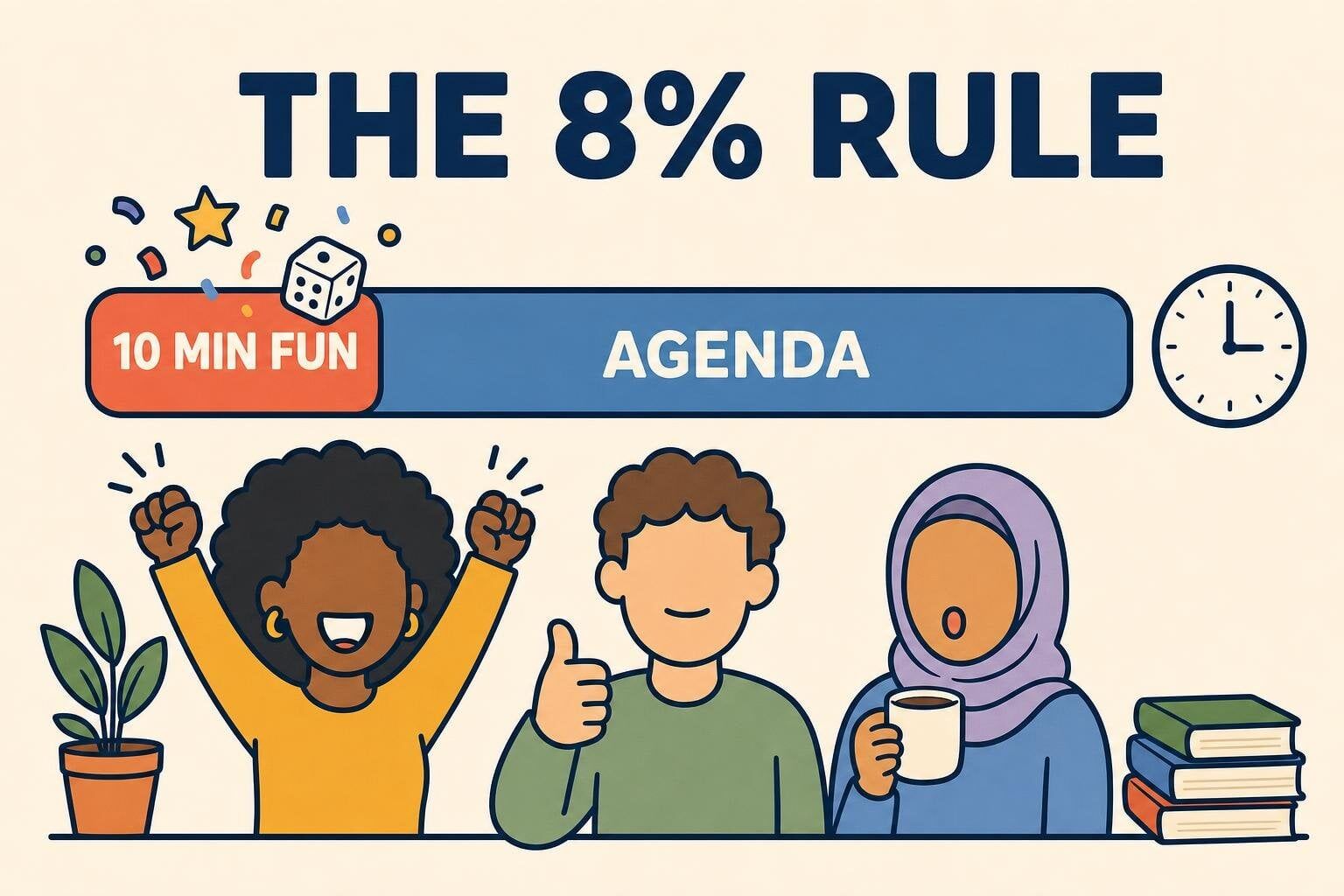
Size your icebreaker to the meeting: the 8% rule. For all-hands meetings, we recommend allocating about 8% of the meeting time to fun — for example, a 10-minute icebreaker block plus 5 minutes of recognition inside a 60-minute agenda. That is enough to genuinely warm the room up without anyone feeling like the meeting got hijacked.
Use "green-light" prompts. When we train hosts, we emphasize prompts that are unlikely to make anyone uncomfortable — and mechanics that add a layer of consent, so nobody has to publicly decline to participate. "Show us the best thing on your desk" is a green light; "tell us something embarrassing" is not. The fastest way to lose a room is to make one person visibly wish they could leave it.
About 15 people is the dividing line. Below roughly 15 participants, icebreakers can run personal and high-touch, with everyone answering out loud. Above it, you need structure: breakout groups, polls, or games like Bingo where everyone plays simultaneously. The median event on our platform is a team of 16 — right on the line, which is why so many of our formats use breakouts. For bigger groups, see our large group icebreakers.
Getting every voice in early is performance, not politeness. In a Science study of 699 people working in small groups, a group's collective intelligence was not strongly correlated with members' average IQ — but it did track with social sensitivity and how equally members took turns talking. An icebreaker that gets everyone talking in the first ten minutes is quietly setting the team up to think better together.
The facilitator matters more than the game. Roughly one in five published reviews of our virtual events mention the host by name (8,966 of 44,422 reviews as of August 2026). A mediocre game run with energy beats a brilliant game read off a script. Whoever runs your icebreaker should play too — enthusiasm is contagious.
In voting and guessing games, close is fun. A 52/48 split creates suspense; a 95/5 split does not. When writing "this or that" style prompts, aim for genuine dilemmas. Similarly, drawing-and-describing games are much harder than they sound — people give instructions based on what they already know the image looks like, which is exactly the communication gap that makes those games interesting.
If you're scheduling a bigger icebreaker event: Thursday is the most popular day for team building events (28% of events on our platform), and most start between 2 p.m. and 4 p.m. local time. Mid-afternoon, late-week slots consistently get the best attendance and energy.
Some icebreakers survive on lists like this one purely by tradition — a dozen of them were in the previous version of this very article. Having watched thousands of rooms react to openers, here are the ones we would skip — and what to run instead.
| Icebreaker | Why skip it | Verdict |
|---|---|---|
| "Go around and share a fun fact" | The cold open puts everyone on the spot with zero structure, and answers get worse as anxiety builds around the circle. A prompt with a game attached works far better. | Skip it |
| Two Truths and a Lie | Workable in a pinch for small groups, but it is the single most overused icebreaker in existence and becomes painfully slow when every participant takes a turn. | Usually skip |
| Never Have I Ever | Built around personal disclosures and traditionally a drinking game — a poor fit for most workplaces. If you like the format, use workplace-safe Never Have I Ever questions carefully. | Skip it |
| Forced performances (talent shows, karaoke intros) | Putting individuals under performance pressure creates anxiety, and on video calls latency breaks group singing entirely. | Skip it |
| Deep vulnerability prompts ("share a failure that shaped you") | Trust is the output of good team building, not the entry fee. Save depth for teams that already have rapport. | Skip it |
| Virtual charades | Body language loses its energy inside a camera frame, and only one person participates at a time. | Better in person |
| Name-memorization circle games | The tenth person has to recite nine names while everyone watches. Stressful for them, boring for the rest — Trading Cards teaches names with none of the pressure. | Skip it |
| Icebreakers longer than the meeting | A 30-minute opener on a 45-minute agenda annoys everyone who came for the agenda. Remember the 8% rule above. | Trim it |
Icebreaker games are a fast way to get to know people in a group. These games can take just a few minutes at the beginning of a meeting and provide immense value in improving communication and engagement — as long as you pick a format that fits your group's size, keep the prompts green-light, and follow up on the interesting answers.
Start with any of the 34 activities on this list, or let one of our hosts run the icebreakers for you while you play along with your team.
Next, check out our list of improv games, these question games, and our conversation starters for work meetings.
Here are some examples of commonly asked questions about icebreaker games.
Icebreaker games are activities you play with your team to help facilitate discussion among colleagues. These games are crucial for new teams that do not know each other very well, especially if team members are unaware of potential shared interests. These games are also known as "icebreaker activities", "icebreaker challenges", and "icebreaker exercises."
The benefits of playing icebreaker games include:
An easy icebreaker activity to start with is Hometown Maps because it is a low pressure activity that only requires you to prepare a blank map, Post-Its, and a box of push pins. Choosing Hometown Maps not only gives your office some new wall decor, but it is also an effortless way for coworkers to learn about each others' pasts.
Icebreakers for small groups work if you:
could you help me also to give some more team building game and strategies