30 Employee Engagement Activities & Program Ideas (From 45,000+ Events)
30 employee engagement activities that actually move engagement — fun in-office activities, games, hosted events ranked by real survey data, program examples like recognition and financial wellness, free ideas, a month-by-month engagement calendar, and formats built for frontline teams.
Published
·
Updated
Employee engagement is the difference between a team that shows up and a team that cares — and it is measurable, movable, and worth real money. We work on it for a living: teambuilding.com has run 45,000+ team building events since 2013 (as of August 2026), with confirmed events for Google, Amazon, Microsoft, Apple, and 40+ other major companies — and this guide collects what actually works.
Below are 30 employee engagement activities and program ideas: fun in-office activities, engagement games, hosted events ranked by real survey data, long-running program examples, free ideas, a month-by-month engagement calendar, and ideas for frontline and warehouse teams — plus the lessons we've learned running engagement events at scale.
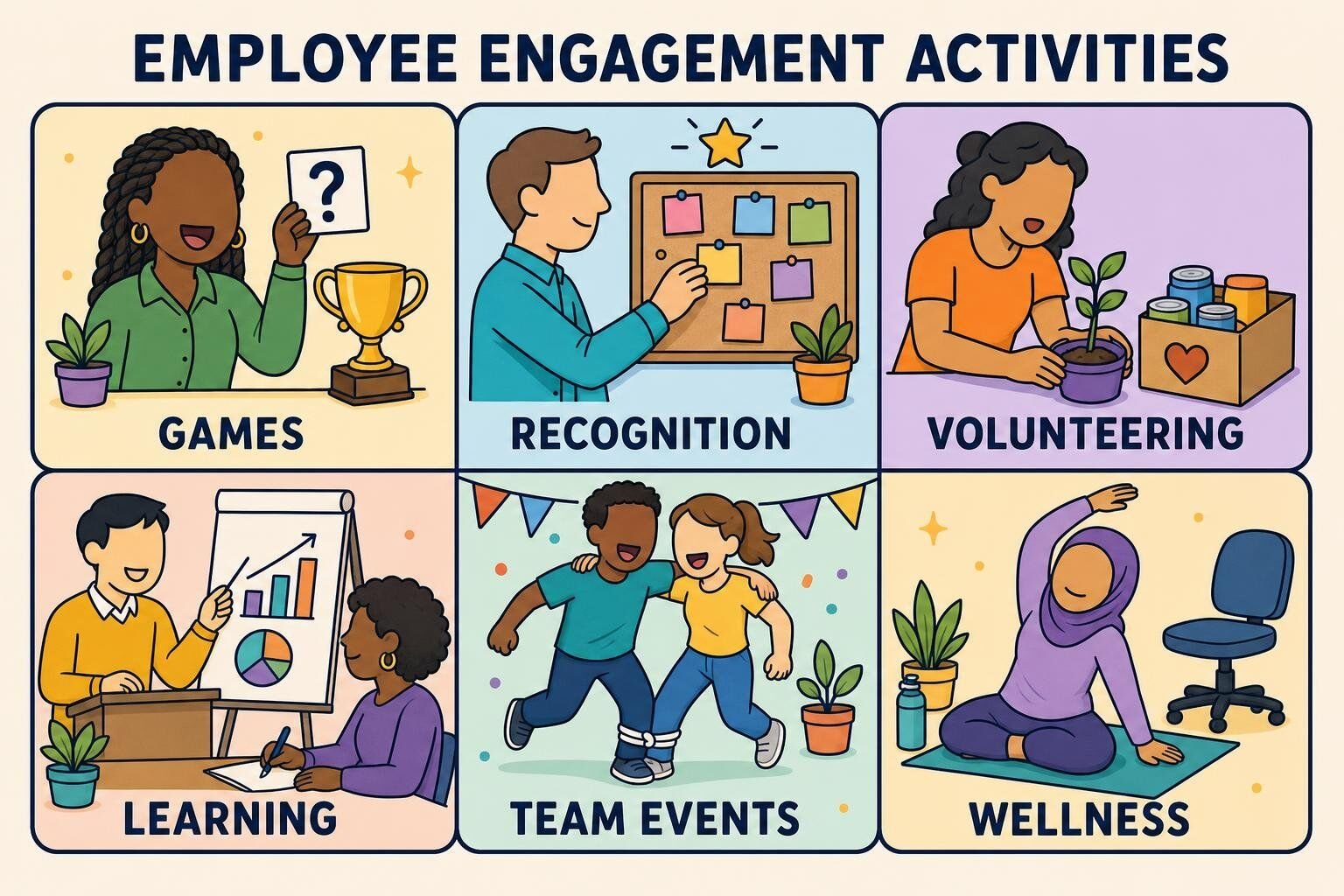
Employee engagement activities are games, events, rituals, and programs that increase how connected, motivated, and invested employees feel in their work and their team. Examples of employee engagement activities include peer recognition programs, office trivia tournaments, volunteering days, and hosted team events. These ideas are also called "team engagement activities," "staff engagement activities," and "engagement activities for employees."
Engagement itself is worth taking seriously before picking activities. Engagement is not happiness or perks — it is the degree to which employees feel their work matters, their contributions are noticed, and their team is worth showing up for. The baseline is sobering: Gallup's State of the Global Workplace: 2026 report found global employee engagement fell to 20% in 2025, and Gallup estimates low engagement costs the world economy approximately $10 trillion in lost productivity — about 9% of global GDP. In other words, four out of five employees are somewhere between coasting and actively checked out.
The upside is equally well documented. Gallup's 11th Q12 meta-analysis — covering 183,806 business units across 347 organizations in 53 industries — found business units in the top quartile of employee engagement had 23% higher profitability and 78% lower absenteeism than bottom-quartile units. Those are correlational comparisons rather than a controlled experiment, but the pattern holds across enough industries and decades that engagement is one of the best-evidenced levers in management.
Where do activities fit? Engagement is built mostly through everyday management — clear expectations, recognition, growth, and trust. Activities are how those drivers become visible and shared: a recognition program makes appreciation routine, a team event turns coworkers into people who know each other, and a volunteering day connects work to meaning. No single activity transforms a culture, and we would be suspicious of anyone who claims otherwise — but a steady rhythm of well-chosen activities is one of the few engagement levers every manager directly controls.
These fun in-office employee engagement activities are built for offices and in-person workplaces — creative ways to engage employees that break the routine without derailing the workday. Every one of them is opt-in, and most run on a volunteer organizer rather than a committee:
War of the Jars is part charity drive, part running office debate. Set out a pair of jars labeled with a pop-culture rivalry — Coke vs. Pepsi, cats vs. dogs, early bird vs. night owl — in a high-traffic spot like reception or the kitchen. Employees vote by dropping dollars into their side's jar. At the end of the week, count the money, crown the winning side, and donate everything to a charity the office picks.
Change the matchup weekly and rotate who chooses it. One thing we've learned from running thousands of voting games: close votes are the fun ones — a 52/48 split creates suspense and lunchroom lobbying, while a 95/5 blowout is over before it starts. Pick genuinely contested matchups. For prompt inspiration, here is our list of This or That questions.
Best for: Whole office, runs in the background Time: One week per matchup Materials: Two jars and a sign (free — and it raises money)
2. Museum of Failures
The Museum of Failures is a bulletin board, Slack channel, or shared gallery where teammates share funny mishaps — the text sent to the wrong person, the spatula melted into the pan, the meeting joined with the camera on and the costume still on from the weekend. Colleagues can also share work mistakes and what they learned, which quietly builds a culture where errors get surfaced instead of hidden.
Two rules make it work: people share their own failures only (never someone else's), and leaders go first. A manager posting a genuine blunder in week one signals more about psychological safety than any values poster.
Best for: Any team, especially ones that take themselves too seriously Time: Ongoing Materials: A corkboard or channel (free)
3. Office Animal Therapy
Few things reset an office's mood like a midday visit from a puppy. Plan a pet day where staff bring in well-behaved animals, or partner with a local shelter or therapy-animal group for a supervised cuddle session — many shelters run office visits as fundraisers, which turns the mood boost into a donation.
Set the logistics up front: a designated pet zone away from allergy-sensitive teammates, a sign-up so you know what is coming, and an opt-out path for colleagues who would rather admire from a distance. For more ideas, here is our guide to office pets.
Best for: Pet-friendly offices Time: 1–2 hours Materials: Shelter partnership or volunteer pets ($0–$300 donation)
4. Community Mood Ring
The Community Mood Ring gives teammates a low-effort way to signal how they are doing. Provide small desk flip-signs or magnets with states like focused, open to chat, stressed, or celebrating. Employees set their signal each morning; colleagues learn to read the room before interrupting a heads-down day or missing a chance to celebrate.
The point is not surveillance — it is normalizing the idea that energy varies and that asking for space (or company) is fine. Pair it with a weekly team check-in using a couple of real prompts; here is our list of check-in questions.
Best for: Any team, including open-plan offices Time: Ongoing, 10 seconds per day Materials: Printed flip-signs (~$20)
5. Team Lunch Roulette
Team Lunch Roulette randomly matches three to four colleagues from different departments for lunch once or twice a month. Run the draw with a spreadsheet randomizer or a Slack pairing app, and have the company cover lunch — the meal is the cheapest part of the exercise.
Shared meals are one of the oldest team rituals there is, and roulette fixes their weakness: left alone, people eat with the same four colleagues forever. Randomizing the table is how the accountant meets the designer, and how "the other department" becomes a person with a name. Give each group one icebreaker prompt to break the initial silence, then let lunch do the rest.
Best for: Offices of 20+ where departments rarely mix Time: One lunch, monthly Materials: A randomizer and a lunch budget
6. Spirit Week
Spirit Week is five themed days in a row — for example, Pajama Monday, Decades Tuesday, Twin Wednesday, Team Color Thursday, and Jersey Friday. It costs almost nothing, requires no schedule changes, and gives the office a shared joke that compounds all week as participation snowballs.
Keep every theme achievable with items people already own, post the lineup a week ahead so nobody is caught out, and let a different department pick the themes each time. A photo wall at reception doubles as the finale. Here are our favorite spirit week ideas.
Best for: Whole office, any size Time: One week Materials: Themes and a photo wall (~$100 with prizes)
7. Office Olympics
Office Olympics turns supply-closet inventory into a competition: chair-rolling relays down the hallway, paper-toss free throws into recycling bins, rubber-band archery at paper-cup pyramids, and a sticky-note speed-sort. Run four to six events over a lunch hour, score each event 3-2-1, and award medals made from binder clips and ribbon.
Draft teams across departments rather than letting departments compete as themselves — the mixing is the engagement. An emcee with a whistle and fake gravitas raises the whole event. Here is our full guide to office olympics.
Best for: Competitive teams, 10–60 people Time: 60–90 minutes Materials: Office supplies and improvised medals (~$50)
8. House Teams
House Teams borrows the boarding-school trick: sort the whole company into three or four permanent mixed-department teams, then let every activity all year — trivia nights, step challenges, food drives, work competitions — award points to the same standings. A running scoreboard in the kitchen or on the intranet keeps the season alive between events.
House Teams solve the cold-start problem of one-off activities: instead of recruiting participants from scratch every time, each event inherits a built-in rivalry and teammates who want the points. Reshuffle houses annually, and crown a champion at the year-end party.
Best for: Offices of 30+, companies that run several activities a year Time: Year-round Materials: A scoreboard and a trophy
Employee engagement games
Games for employee engagement give a gathering structure — a reason to talk, laugh, and compete that does not depend on anyone's small-talk stamina. These four run reliably in any workplace:
9. Office Trivia Tournament
Trivia is the most reliable engagement game there is: everyone knows the rules, and teams of four to six flatten skill differences so nobody is exposed. Run a monthly lunchtime tournament with four short categories — general knowledge, pop culture, industry, and a "company history" round built from your own milestones, inside jokes, and legendary Slack messages.
The company round is the one people talk about afterward; it rewards long-tenured employees and teaches new hires the lore. Keep a season-long leaderboard so the tournament builds momentum. Here is a big list of trivia questions to start from.
Best for: Any group, teams of 4–6 Time: 30–45 minutes, monthly Materials: Question list and a scoreboard
10. Coworker Bingo
Coworker Bingo turns mingling into a game. Give every employee a bingo card of colleague traits — "has worked here 10+ years," "speaks three languages," "has met a celebrity" — and challenge players to find a different coworker matching each square. First to five in a row wins; first to black out the card wins bigger.
It works at parties, all-hands meetings, and onboarding weeks, and it manufactures exactly the conversations engagement depends on: brief, low-stakes, and surprisingly revealing. Here is our guide to icebreaker bingo, including printable cards.
Best for: Mingling events, 15–100+ people Time: 20–30 minutes Materials: Printed cards and pens
11. Guess the Teammate
Guess the Teammate is a photo game: colleagues privately submit a childhood photo, then the group votes on who is who, with reveals saved for the end. It is fast, funny, and generates the origin-story conversations that turn coworkers into people.
A tip from our hosts, who run photo games constantly: ask for toddler photos, not newborn photos. Recognizable features have started to develop by toddlerhood, so guessing is genuinely possible — and genuinely hard — while newborn rounds collapse into random guessing. The same format works with pet photos, first cars, or teenage-bedroom posters. More formats in our list of get to know you games.
Best for: Teams of 8–30 Time: 15–25 minutes Materials: Submitted photos and a slide deck (free)
12. Office Scavenger Hunt
An office scavenger hunt gets people out of their chairs and into corners of the workplace they never visit. Hide 15 to 20 items or write clues that lead to locations — the oldest object in the office, the framed first invoice, the conference room nobody can name — and send teams of three to five off with a time limit.
Make a few clues office-specific inside jokes, include one photo challenge per team (recreate the company's oldest team photo), and hide a golden item worth triple points so trailing teams stay in it. Here are more scavenger hunt ideas.
Best for: Teams of 3–5, 10–60 people Time: 30–45 minutes Materials: Clue list and small prizes (~$25)
Employee engagement events, ranked by real survey data
Employee engagement events — hosted experiences a professional runs so nobody on your team has to emcee — are the fastest way to give a quarter its highlight. We rank our own hosted events with the Team Building Score, which combines confirmed bookings, verified reviews, ratings, and post-event survey outcomes. Here are our top events by that score:
Ranked by our Team Building Score — a running points total earned through confirmed bookings, verified reviews, ratings, and listing quality, recalculated nightly. Every event shown also has at least 30 post-event survey responses per question; the happier, connected, and NPS columns are computed from the 5,620+ survey responses collected for the 10 events listed here — a subset of all post-event surveys across our catalog. Updated October 2026.
Ultimate Game Show packs three nostalgic daytime-TV games into 90 hosted minutes: Office Feud, where teams guess the most popular answers to survey questions; Price Hike, where players estimate the value of oddball objects; and Final Quizardry, where point bets turn the last round into a comeback machine. The host carries all the energy, so your quietest teammates can compete without performing.
Field Day brings the classic outdoor competition to your office park, campus lawn, or local green space: a hosted 90-minute session of nostalgic games and new challenges, with all supplies delivered to your chosen location. It is the event we recommend when a team has been heads-down too long — sunlight, mild chaos, and a winning team photo for the office wall.
Activities create moments; employee engagement programs create habits. These employee engagement program examples are the structural ideas — recognition, financial wellness, volunteering, feedback loops — that keep working between events, and they are where engagement initiatives earn their budget:
15. Peer-to-Peer Recognition Program
A peer recognition program lets appreciation flow sideways instead of waiting on a manager's memory. Set up a shout-out channel or a physical recognition wall, add a monthly peer-nominated award, and — critically — make recognition specific: "Maya rebuilt the demo the night before the pitch" beats "great job, Maya" every time.
Recognition is the program with the strongest engagement evidence behind it: Gallup-Workhuman research finds employees who receive great recognition are 20 times as likely to be engaged as those who receive poor recognition, and well-recognized employees are 45% less likely to have turned over two years later. That is survey-based research rather than a controlled trial, but the size of the gap — and how cheap recognition is — makes this the first program we would build. Here is our guide to employee recognition programs.
Best for: Every team — start here Time: Ongoing, minutes per week Materials: A channel or wall, plus small awards
16. Financial Wellness Program
Money stress follows people to work, and a financial wellness program is one of the most concrete ways a company can show it cares about employees as whole humans. We built this one ourselves: our program gave every employee a personal finance book, a workshop on the basics, and a cash bonus for opening a retirement account — and when WorkLife featured the program in its reporting on employer financial wellness, about half of our then-200-person staff had used it.
A starter version costs little: one workshop with a fee-only financial educator, a book stipend, and a matched savings kickoff. The engagement payoff comes from what the program says — that the company is invested in employees' lives beyond their output.
Best for: Companies of any size, especially with early-career staff Time: Quarterly workshops plus ongoing perks Materials: Educator, books, and an incentive budget
17. Volunteer Program
Volunteering connects work to meaning — the engagement driver that games alone cannot reach. Build a lightweight program rather than a single annual outing: a set number of paid volunteer hours per employee, one team volunteering day per quarter, and a shared channel where people post causes and photos.
Group days work best when the task is hands-on and finishable in an afternoon — park cleanups, food-bank sorting, meal packing — so the team ends with visible results. Here are our guides to employee volunteer programs and group volunteer opportunities.
Best for: Purpose-driven teams, CSR programs Time: Quarterly days plus individual hours Materials: Paid volunteer time (often free otherwise)
18. Survey → Action Loop
Employee surveys engage people only when something visibly happens next — a survey with no follow-through actively damages trust. Run the loop as a program: a short quarterly pulse survey, results shared within two weeks, one or two committed changes announced with owners and dates, and a "you said, we did" recap before the next survey opens.
Keep the survey short enough to finish in five minutes, and resist fixing everything at once — two visible changes per quarter beats ten promises. Here are employee engagement survey questions to build from.
Best for: Every organization Time: Quarterly cycle Materials: Free survey tools work fine
19. Social Committee
A social committee spreads engagement work beyond one exhausted organizer — and doubles as an engagement activity itself, because planning is participation. Recruit volunteers from different departments, give the committee a real budget and real authority over the calendar, and rotate membership every six or twelve months so it stays fresh and the workload stays shared.
The committee's first job should be publishing the engagement calendar below: a visible plan beats a heroic scramble every time. Here are our ideas for work social committees.
Best for: Companies of 25+ Time: A few hours per member per month Materials: A budget and a mandate
20. Happiness Allowance
A happiness allowance is a small recurring stipend — $25 to $50 a month — that employees must spend on something purely for joy: a massage, a plant, concert tickets, the fancy coffee beans. Reimburse against receipts with deliberately loose guidelines, and invite (never require) people to share what they picked in a dedicated channel.
The sharing is where the engagement lives: the channel becomes a feed of teammates' actual personalities — the climber, the baker, the vinyl collector — and the company signals that joy is a legitimate line item.
Best for: Any team Time: Ongoing Materials: $25–$50 per employee per month
Professional development engagement activities
Growth is one of the strongest engagement drivers — employees who feel they have a future at the company behave like it. These employee engagement training activities make development social rather than solitary:
21. Knowledge Swaps
Your team already contains a faculty: the spreadsheet wizard, the amateur photographer, the person who speaks four languages. A knowledge swap turns that into programming — a weekly 20-minute lesson taught by a different employee, a classifieds board where colleagues offer and request lessons, or a "speed learning" lunch where people rotate between three mini-stations.
Teaching is the engagement trick hiding inside this one: the teacher gets visible expertise and recognition, and the audience learns colleagues are more interesting than their job titles suggest.
Best for: Any team with varied skills (all of them) Time: 20–30 minutes, weekly or monthly Materials: A sign-up sheet (free)
22. C-Suite Meet and Greets
Distance from leadership breeds disengagement; face time reverses it. Put small-format executive access on the calendar as a program: monthly small-group lunches with a rotating cast of six employees, open office hours, and a standing slot where new hires meet an executive in their first month.
Structure matters — an agenda-free "ask me anything" with six people works; a town hall where three brave souls ask questions does not. Executives should come with questions of their own, not just answers. Here are more executive team building ideas.
Best for: Companies of 50+ where leaders are becoming abstractions Time: Monthly lunches Materials: Lunch budget
23. Lunch and Learns + Learning Stipends
Pair a monthly lunch and learn — an internal expert, a customer telling their story, or an outside speaker over sandwiches — with a small annual learning stipend each employee can spend on courses, books, or conference tickets. The lunch and learn makes learning communal; the stipend makes it personal.
Ask stipend users to bring one takeaway back as a five-minute share at a future lunch, which closes the loop and feeds the calendar. Here are more professional development ideas.
Best for: Knowledge-work teams Time: One lunch per month Materials: Lunch plus a stipend ($200–$1,000/year per employee)
Free employee engagement ideas
Budget is not the barrier people assume: several of the highest-return engagement ideas are free or nearly free. Here are inexpensive employee engagement ideas that cost time instead of money:
24. Clock-It Lists
A clock-it list is a bucket list for the workday: a card of small missions to complete before clocking out. Examples: make a new work friend, eat lunch with someone from another department, learn one fact about the company's history, help a teammate with a task outside your job, give one specific compliment.
Run it as a monthly challenge with witness initials for verification, and drop completed cards into a raffle. It is a silly mechanic that reliably engineers the small interactions engagement is made of.
Best for: Any office, new-hire cohorts especially Time: Background, over a week or month Materials: Printed cards (free)
25. Engagement Newsletter with Employee Takeovers
An internal newsletter keeps wins, milestones, and upcoming activities visible — but the takeover is what makes it an engagement activity. Each month, a different volunteer writes the issue: their corner of the company, their recommendations, their questionable opinions about office snacks. Add a rotating employee spotlight so every issue introduces a person, not just projects.
Keep it short enough to read in three minutes, and let the takeover author's voice stay unsanded — the personality is the point. Here are employee spotlight ideas to include.
Best for: Companies of 30+ or distributed teams Time: A few hours per issue Materials: Email (free)
26. Gratitude Wall
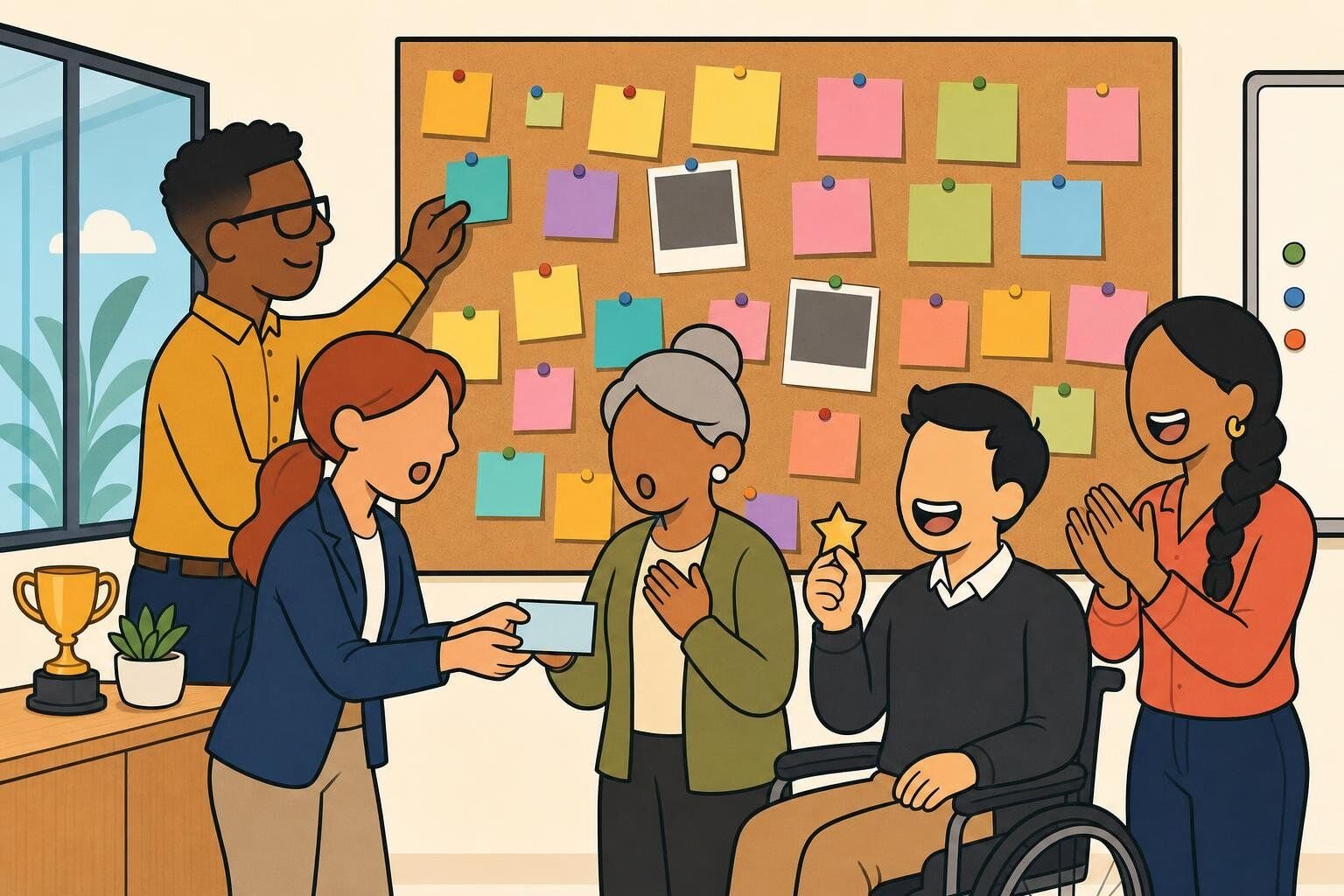
A gratitude wall is a corkboard or whiteboard where anyone can post a sticky note thanking a specific colleague for a specific thing. Seed it with five notes so it never starts empty, photograph and archive it monthly, and read a few highlights aloud at all-hands.
It is the free, analog cousin of the recognition program — and often the pilot that proves the appetite for one. Here are more gratitude activities for work.
Best for: Any office with a wall Time: Ongoing Materials: Sticky notes (free)
27. Walking One-on-Ones
Move one recurring one-on-one per week out of the meeting room and onto a walking route. Walking meetings flatten hierarchy — side by side reads differently than across a desk — and the change of scene reliably loosens conversations that had gotten stuck in status-update mode.
Keep it to two people, pick a 20–30 minute loop, and leave the laptop behind; notes can wait five minutes. This is the engagement idea with the lowest activation energy on this list: it requires exactly zero dollars and one calendar edit.
Best for: Managers and their direct reports Time: 20–30 minutes, weekly Materials: Sidewalk (free)
Employee engagement calendar: ideas for every month
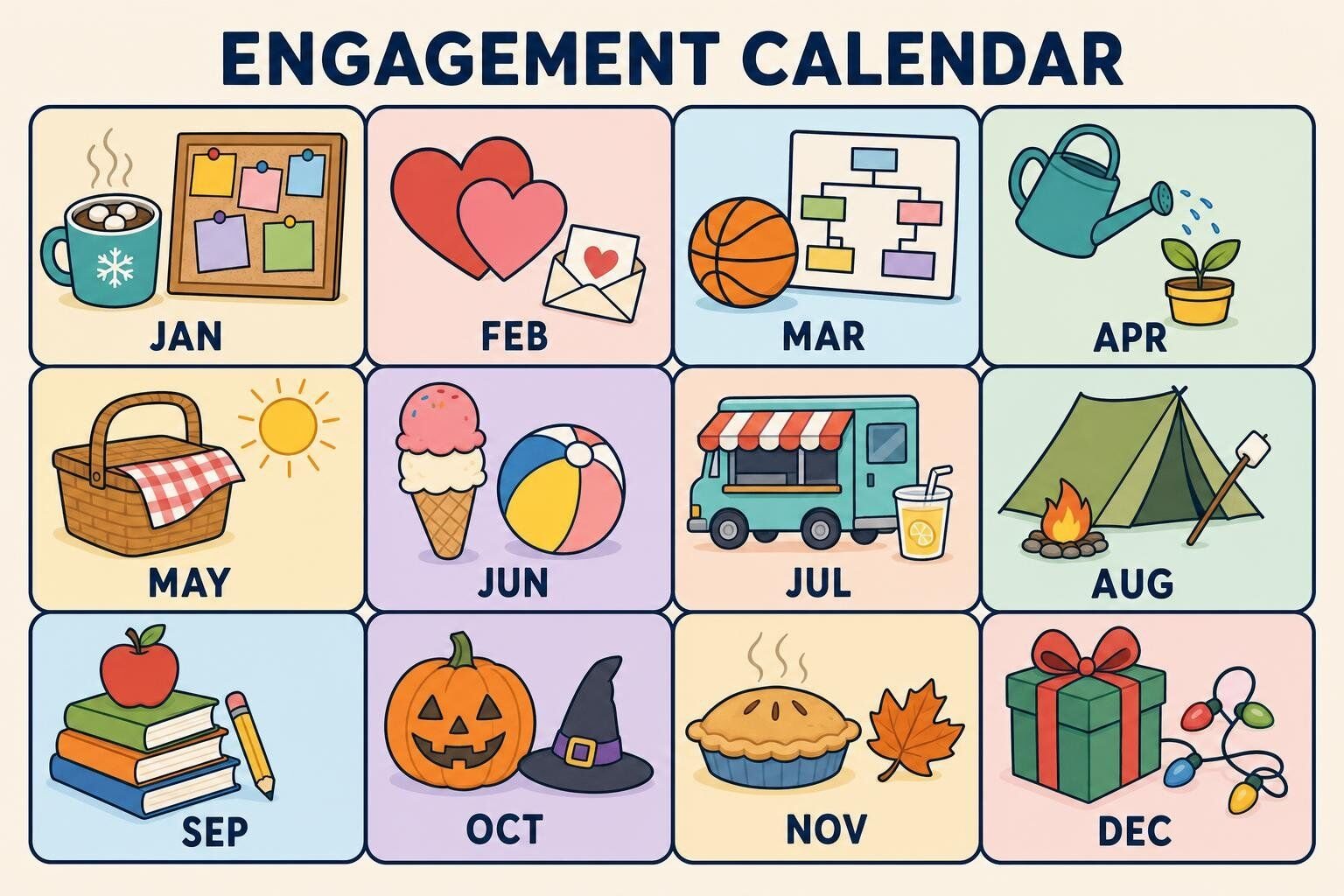
Engagement fades when it depends on one big annual gesture, so plan a rhythm instead: one anchor activity per month, sized to the season. Searches for month-specific engagement ideas spike all year — January, March, September, November — and the pattern in our own bookings is just as seasonal:
Here is a 12-month employee engagement calendar you can adapt:
First reliable outdoor month for most of the country
June
Summer kickoff social + ice cream cart
Cheap, universal, photographs well
July
Food truck day or cook-off
Mid-year morale bump when the calendar is empty
August
Office Olympics
Indoor-friendly competition beats the heat
September
Learning month: knowledge swaps + stipend push
Back-to-school instinct makes development land
October
Halloween party + costume contest
Our second-busiest event month — the rehearsal for December
November
Gratitude potluck + food drive
Thanksgiving frame makes recognition feel natural
December
Holiday party — booked early
The busiest month for events; dates and hosts go first
Two scheduling notes from our own data: book December events well ahead — that month alone is 30% of annual volume and the best dates and hosts disappear first — and consider our trick for the January slump: we hold our own company holiday party in February, when everyone's calendar is empty and the team actually has energy to enjoy it.
Engagement activities for frontline, warehouse & shift teams
Most engagement lists quietly assume everyone has a desk, a laptop, and a flexible lunch hour. Warehouse, manufacturing, retail, and healthcare teams deserve better than a Slack-based program they can't see. Three formats built for shift work:
28. Shift Huddle Games
Attach two minutes of game to a ritual that already exists: the shift-start huddle. Rotate through quick formats — a this-or-that vote by show of hands, a one-question trivia duel between lines, "two truths and a lie" from one volunteer per day — and track a lighthearted running score by team or shift on the huddle board.
The constraint is the feature: two minutes means no production time lost and no one stuck performing. Here is a big list of icebreaker questions that work as daily prompts.
Best for: Warehouse, manufacturing, retail, and clinical teams Time: 2–5 minutes per shift Materials: A whiteboard (free)
29. Break Room Upgrade Vote
Give frontline teams a real budget — even $500 — and let them vote on how to upgrade their break room: a better coffee machine, a massage chair, a dartboard, real plants. Run nominations on the break room wall, hold a week-long vote, and install the winner fast.
The upgrade is nice; the vote is the engagement. Deskless workers are the least consulted employees in most companies, and a visible, employee-controlled decision — however small — signals their voice moves real budgets.
Best for: Any site with a break room Time: Two weeks, nomination to installation Materials: $200–$1,000 budget
30. Cross-Shift Championship
Shifts that never meet can still compete. Run a month-long championship where every shift fields a team in asynchronous events: a steps challenge, a safety-streak scoreboard, a themed photo contest on the break room wall, a food-drive weigh-in. Post standings where every shift will see them, and let the winning shift pick the next month's events.
Asynchronous scoring is the unlock — day shift and night shift compete on equal terms without ever sharing a room, and the standings give co-workers on opposite schedules something in common to talk about at handoff.
Best for: Multi-shift operations Time: One month per season Materials: A scoreboard and small prizes
What we've learned from 45,000+ events
We have been running engagement events since 2013 — 45,000+ of them as of August 2026 — and the same lessons keep proving themselves:
Consistency beats intensity. One extravagant offsite per year loses to a modest monthly rhythm every time. Engagement is a habit loop, not a highlight reel — which is why the calendar above is the highest-leverage section of this article.
Opt-in is non-negotiable. The fastest way to turn a fun idea into a resentment generator is to make it mandatory. Every format here works better with volunteers, visible alternatives, and "watching counts" as a legitimate participation mode.
Structure rescues the socially exhausted. The colleagues who dread "mingling" happily play trivia. A game with rules, turns, and teams carries people who would stand silently at an unstructured happy hour — which is exactly why we lead with games and structured events rather than open-bar socials.
Scheduling is strategy. Across our platform, Thursday is the most popular day for team building events — 28% of them — and most start between 2 and 4 p.m. local time. Mid-afternoon slots respect focus hours, skip the commute conflict, and let the event flow into the end of the day. Steal that default.
Activities amplify management; they don't replace it. An engagement event works when it makes existing goodwill visible. If pay is unfair or managers don't listen, a game show will not fix it — run the survey loop first and let the findings pick your battles. Honest framing matters here: research on workplace wellbeing programs generally finds modest, real effects — not miracles — and the companies that get the most from activities are the ones that treat them as one lever among several.
Remote teammates need first-class versions, not a laptop pointed at the party. If part of your team is distributed, run dedicated online formats — here are our guides to virtual team building activities and virtual employee engagement. Our post-event survey numbers above show how well-designed virtual events land when they're built for the medium.
Engagement ideas that backfire
Some popular engagement tactics reliably produce the opposite of engagement. Here is what we would skip, and what to do instead:
Idea
Why it backfires
Do instead
Mandatory fun
Compulsory attendance converts an activity into a chore and breeds quiet resentment.
Opt-in everything, with watching as a valid mode
Pizza as a fix for real problems
A party after a brutal quarter reads as a distraction, not appreciation — employees notice the substitution.
Fix the cause first, then celebrate honestly
Rewarding mere attendance
Prizes for clocking in on time treat professionals like truants and insult the punctual majority.
Recognize contributions, not presence
Survey with no follow-through
Asking for feedback and shelving it damages trust more than never asking.
"Share your biggest fear" prompts make people perform intimacy on command.
Green-light prompts anyone can answer comfortably
Perks marketed as culture
A ping-pong table is furniture. Calling it an engagement strategy invites cynicism.
Programs over props — recognition, growth, voice
Final Thoughts
Employee engagement activities work when they run on a rhythm: pick one or two fun office activities your team genuinely enjoys, anchor each quarter with a hosted event, and put your structural effort into the programs — recognition, feedback loops, growth — that keep paying out between the fun parts. Keep everything opt-in, publish the calendar, and measure as you go so next year's plan is built on evidence instead of vibes.
Answers from the team behind 45,000+ team building events for clients like Apple, Amazon, and Google.
What are employee engagement activities?
Employee engagement activities are games, events, rituals, and programs that increase how connected, motivated, and invested employees feel at work. Examples include peer recognition programs, office trivia tournaments, team lunch roulette, volunteering days, and hosted team events. The best approach combines quick recurring activities with structural programs like recognition and feedback loops.
What are fun employee engagement activities for the office?
Fun in-office employee engagement activities include War of the Jars charity voting, a Museum of Failures board, office animal therapy, team lunch roulette, spirit week, office olympics, and year-round house teams that earn points across events. Every one works best opt-in, with a volunteer organizer rather than mandatory attendance.
What are examples of employee engagement programs?
Strong employee engagement program examples include a peer-to-peer recognition program, a financial wellness program, a volunteer program with paid volunteer hours, a survey-to-action feedback loop, a cross-department social committee, and a monthly happiness allowance. Programs outlast one-off activities because they keep working between events.
How do you measure whether engagement activities work?
Measure engagement activities with short pulse surveys before and after, participation rates over time, and event-level feedback. In our own post-event surveys of 18,000+ virtual team building participants, 98% said the event made them happier and 91% felt more connected to teammates — collecting that data per event is what lets you double down on the formats your team actually loves.
How often should you run employee engagement activities?
Run one anchor activity per month with smaller rituals in between — consistency beats intensity. Reserve one hosted event per quarter as the highlight, and plan December well ahead: it is the busiest month for team building events on our platform at 30% of annual volume, so dates and hosts disappear early.
What are free employee engagement ideas?
Free employee engagement ideas include a gratitude wall, clock-it lists, an employee-takeover newsletter, walking one-on-ones, knowledge swaps, and a Museum of Failures. Several of the highest-return engagement ideas cost time instead of money — recognition in particular is nearly free and has the strongest evidence behind it.















Comments (0)
Leave a Comment