24 Work Competition Ideas & Contest Types That Get Whole Teams Playing
Work competitions are friendly contests between coworkers, from trivia showdowns to step challenges. Here are 24 ideas by contest type, with rules, prizes and the formats we would skip.
Published
·
Updated
Most workplace contests fail for the same reason: they are built for the people who were already going to win. A public sales leaderboard is thrilling for the top three reps and quietly demoralizing for everyone else. A step challenge scored on raw totals hands the trophy to whoever already runs marathons. The contest technically works, and the office is no closer than it was before.
We run competitive formats for a living. Our hosts design and facilitate game shows, trivia matches, scavenger hunts and head-to-head challenges for teams every working day, and we read the survey comments afterward. The pattern is consistent: the contests people remember are the ones where a whole team could plausibly win, the rules fit on one screen, and the prize was small enough that nobody felt bad about losing.
This guide collects the workplace competitions we would actually run, organized by the type of contest so you can pick the one that matches your goal. Every idea includes setup instructions, a realistic time estimate, and what it costs.
Work competitions are structured contests where colleagues compete as individuals or as teams to win a friendly challenge at the office. Examples include desk decorating contests, trivia showdowns, step challenges and photo contests. The purpose is to break the routine, give coworkers a reason to talk to each other, and make a shared goal feel like a game rather than an assignment. These contests are also called "workplace contests," "employee contests," "office competitions," "team competitions" and "employee engagement contest ideas."
The case for running one is not just vibes. A 2019 review of workplace-fun research in Human Resource Management Review by Michel, Tews and Allen concluded that fun at work has generally demonstrated benefits for individuals and organizations, and in a related field study of 195 restaurant servers, manager support for fun reduced employee turnover. Contests are one of the cheapest ways to manufacture that kind of fun on a schedule.
Types of contests you can run at work
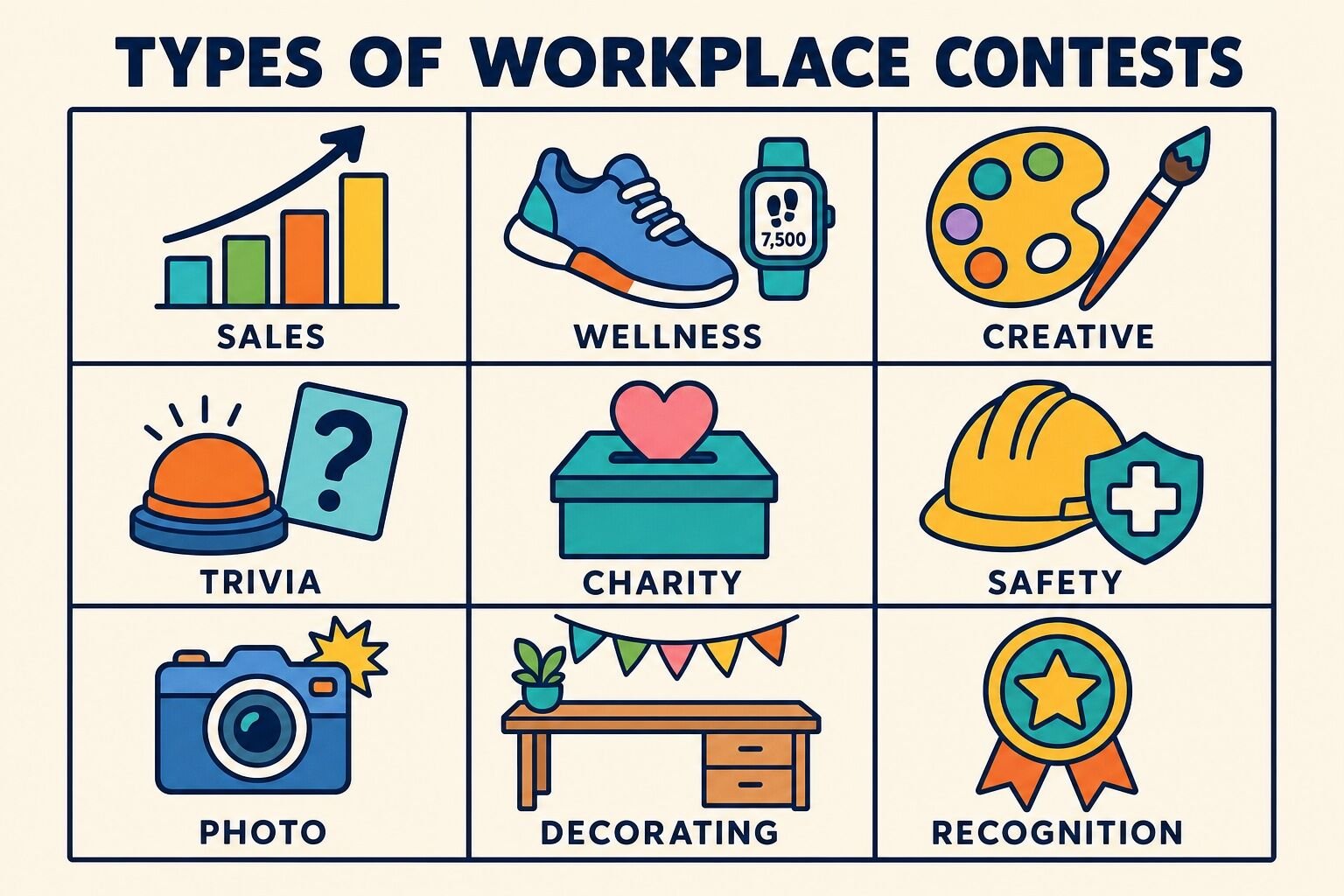
Before picking an activity, pick a category. The type of contest determines who can realistically win, how long it should run, and what can go wrong. Here are the nine types that cover almost every workplace contest worth running.
Team competitions are the safest bet in this guide, because a team can absorb a weak round and a quiet participant can still contribute. These four formats scale from a single department to a whole company.
1. Department Cup
A Department Cup is a season-long league where departments earn points across several short contests instead of one big event. It turns a scattered calendar of activities into a single storyline people follow.
How to run it:
Pick a season, usually a quarter, and announce a standings board on day one.
Schedule four to six short events across the season: a trivia match, a step challenge, a photo contest, a cook-off, a charity drive.
Award points on a fixed scale, for example 10 points for first place, 6 for second, 3 for third, and 1 point to every department that fields a team.
Score by participation rate as well as performance, so a small department is not automatically out of the running.
Update the standings the same day each event ends, and keep the board somewhere everyone passes.
Hand out one physical trophy at the end of the season that the winning department keeps until the next one.
Best for: Company-wide rivalry that lasts Time: 4 to 12 weeks, with 30 to 90 minutes per event Materials (cost): A standings board and one trophy ($30 to $80)
What we have learned: The participation point matters more than the winning points. Once a department realizes it can climb the table simply by showing up, the people who never sign up for anything start getting recruited by their own teammates.
2. Bracket Battle
A Bracket Battle compresses an entire tournament into one afternoon. Pairs or small teams face off in a quick game, winners advance, and the bracket does the storytelling for you.
How to run it:
Choose one game that resolves in under five minutes: paper airplane distance, desk chair slalom, rock paper scissors, a 10-question quiz round, or a marshmallow tower build.
Draw a bracket for 8, 16 or 32 entries and seed it randomly by drawing names.
Run each match in front of whoever is free to watch. The audience is half the fun.
Post the bracket on a whiteboard and fill in winners with a marker between rounds.
Run a consolation bracket for first-round losers so nobody's day ends after four minutes.
Best for: A single high-energy afternoon Time: 1 to 2 hours Materials (cost): A whiteboard, a marker and whatever the game needs (free to $25)
What we have learned: Rock paper scissors brackets are a reliable closer for large rooms. Eliminated players become the cheering section for whoever knocked them out, and a 64-person field can finish in under ten minutes.
3. Office Olympics
Office Olympics is a multi-event competition built from small, silly challenges staged with supplies you already own. Teams rotate through stations and collect medals.
How to run it:
Build five to eight stations that each take three to five minutes: a stapler toss, a chair race, a coffee-cup pyramid, a sticky-note shot put, a keyboard typing sprint.
Split the office into teams of four to six, mixing departments deliberately.
Give each team a scorecard and a rotation order, and put one volunteer judge at every station.
Open with a 60-second opening ceremony: team names, a lap around the floor, and a lit "torch" made from a flashlight and construction paper.
Total the scorecards at the end and award gold, silver and bronze.
Our full station list, plus remote variations, lives in the office olympics guides linked above.
Best for: Whole-office events and summer Fridays Time: Half a day Materials (cost): Office supplies, printed scorecards and medals ($20 to $60)
4. Trivia Showdown
Trivia is the most requested competitive format we host, and the team-versus-team version works far better at work than an individual quiz, because the discussion inside each team is where the bonding happens.
How to run it:
Write six rounds of six questions, and vary the categories on purpose: one general knowledge, one music, one "about our company," one picture round, one geography, one wildcard.
Build teams of four to six and require a team name. Mixed-department teams outperform intact teams for connection.
Give teams 30 seconds to confer and write an answer, rather than buzzing in, so quieter teammates can contribute.
Read answers out loud between rounds and let teams score the sheet next to them.
Include one round nobody can study for, like guessing coworkers' baby photos, to reset the standings mid-game.
For ready-made question sets, see our list of trivia games.
Best for: Mixed-department teams Time: 45 to 60 minutes Materials (cost): Answer sheets and a question list (free)
What we have learned: The "about our company" round is consistently the loudest one. Questions like which teammate has been here longest, or what the original office address was, turn institutional trivia into shared history.
Office competition ideas
These contests use the building itself. They work best for teams that share a physical space, and several of them leave the office better than they found it.
5. Deck-a-Desk
Deck-a-Desk is a desk decorating contest that turns workstations into small exhibits. It is the rare contest where the entries stay up afterward and keep paying off.
How to run it:
Pick a theme with room to interpret: under the sea, outer space, your hometown, the decade you were born, movie magic.
Set a hard budget, usually $15 to $25 per desk, and say plainly that spending more does not win.
Give people a week of lead time and a two-hour decorating window so nobody loses a workday.
Judge with a walking tour and a printed ballot, scoring on theme, creativity and use of the budget.
Let remote teammates enter with a photo or a 30-second video tour of their setup.
Best for: In-office personality Time: 1 day to 1 week Materials (cost): A capped decorating budget ($15 to $25 per entrant)
What we have learned: The budget cap is the entire game. Without one, the contest becomes a spending contest, the people who opt out feel judged, and next year's turnout drops.
6. Tidy-Up Treasure Hunt
A Tidy-Up Treasure Hunt hides clues in the places that get messy, so cleaning the office becomes a search instead of a chore.
How to run it:
Announce a cleanup day a week ahead so people can plan around it.
Hide 15 to 25 numbered tokens or printed cards in spots that need attention: the back of the supply closet, under the paper tray, behind the stack of retired monitors.
Give teams a photo checklist of the general areas rather than exact locations.
Award one point per token and three bonus points for a genuinely transformed area, judged by photo before and after.
Tell the facilities or custodial team what you are doing first. They usually know the best hiding spots.
Best for: Spring cleaning with a payoff Time: 1 day Materials (cost): Printed tokens and small prizes (free to $30)
7. Workplace Safety Bingo
Safety Bingo rewards the small habits that prevent incidents, which is a much better target than counting days without an accident.
How to run it:
Build a 5x5 card where every square is an action, not an outcome: restocked the first aid cabinet, cleaned a spill, flagged a blocked exit, ran a ladder check, reported a near miss.
Give every employee a card at the start of the month.
Ask for light evidence, usually a photo or a coworker's initials, so squares are verifiable without paperwork.
Trade a completed line for a small prize immediately, and a full card for entry into a monthly draw.
Score reported near misses as positive squares. A contest that punishes reporting is worse than no contest.
If safety is not your angle, the same mechanic works with a general office card:
Best for: Warehouses, labs, plants and any site with a safety program Time: Ongoing, usually a month per card Materials (cost): Printed cards and small prizes ($1 to $5 per person)
What we have learned: Outcome-based safety contests quietly teach people to under-report. Scoring actions instead of accident-free streaks keeps the incentive pointed the right way.
8. Cook-Off
A cook-off is a blind-tasting contest built around one dish. Chili, guacamole, cookies and mac and cheese all work, because everyone has an opinion and the barrier to entry is a slow cooker.
How to run it:
Pick one dish and cap entries at eight to twelve so tasting stays manageable.
Number the entries and hide the cooks' names until voting closes.
Give every taster three voting tokens and let them spend all three on one entry if they want.
Collect allergens and ingredient lists in advance and post them next to each entry.
Add a second award decided by the entrants, such as best name or most ambitious, so one dish does not sweep.
Best for: Food-loving offices and potluck culture Time: 2 hours, including setup Materials (cost): Tasting cups, spoons and tokens ($20 to $40)
9. Minute-to-Win-It Gauntlet
The gauntlet is a rapid sequence of 60-second challenges run back to back, scored cumulatively. It is the fastest way to raise the energy in a room that has been sitting all morning.
How to run it:
Choose six challenges that use desk supplies: stack five cups into a pyramid, move cookies from forehead to mouth, land three pencils in a mug, unroll a roll of tape into a single strip.
Run every player at once rather than in turns, so nobody waits.
Score one point per completed challenge and one bonus point for the fastest finisher.
Give a 20-second demonstration before each round so the rules never take longer than the game.
Keep the whole gauntlet under 45 minutes. The format loses its charge past that.
Best for: Short bursts of energy before or after a meeting Time: 30 to 45 minutes Materials (cost): Cups, pencils, tape and snacks (free to $25)
Employee engagement contest ideas
These contests aim at engagement rather than entertainment. They reward the behaviors most workplaces say they value and then never measure: noticing good work, improving a process, and pulling together on a number.
10. Kudos Cup
The Kudos Cup is a recognition contest where the competition is about giving recognition, not receiving it. Teams compete on how many specific, well-written shout-outs they send.
How to run it:
Open a channel or a physical board where anyone can post a kudos naming a person, an action and its effect.
Score one point per kudos, and require all three elements so "thanks Sam" does not count.
Cap the points any single person can earn per week so the contest cannot be farmed.
Read the five best out loud at the monthly all-hands and let the room vote on one to feature.
Award the cup to the team with the most qualifying kudos, and retire the board photo to a wall each quarter.
Best for: Peer recognition across departments Time: Monthly cycle, 10 minutes a week Materials (cost): Free, plus an optional trophy
What we have learned: Requiring the effect, not just the thank-you, is what makes these worth reading. "Priya rebuilt the onboarding checklist and cut our setup time in half" lands; "Priya is awesome" does not.
11. Suggestion Showdown
A Suggestion Showdown is a two-week contest for the best process improvement, judged on what actually gets implemented rather than what sounds best in a slide.
How to run it:
Post one prompt, narrow enough to act on: what should we stop doing, or what wastes an hour of your week.
Collect entries in a shared form with three fields: the problem, the proposed change, and who it affects.
Shortlist five with a small cross-functional panel, then let the whole company vote.
Commit publicly to implementing the winner within 30 days, and name an owner on the day you announce it.
Report back at the next all-hands on what changed. The follow-through is what makes next year's entries serious.
Best for: Process improvement and frontline ideas Time: 2 to 4 weeks Materials (cost): Free
12. Review Roulette
Review Roulette turns customer feedback into a weekly team ritual. Instead of rewarding whoever gets name-dropped most, which favors the most charismatic teammate, the whole team plays the odds together.
How to run it:
Once a week, pull a genuinely random recent review. Use a number generator, not a favorite.
Read it out loud to the team.
If it is positive, the team wins a small collective reward: coffee on the company, an early finish on Friday, a snack run.
If it is negative, the team takes a small shared consequence: everyone spends ten minutes on the recycling, or the break room deep-clean.
Keep consequences mildly inconvenient, never embarrassing, and never aimed at the person named in the review.
Best for: Customer-facing and support teams Time: 15 minutes a week Materials (cost): Small weekly rewards ($10 to $30)
What we have learned: Collective stakes are what make this work. When the consequence lands on the team rather than the individual named, people start helping each other earn better reviews instead of competing for mentions.
13. Sales Sprint
A Sales Sprint is a short, team-scored push on one metric. The design goal is a contest where a mid-performing rep on a good team can win, which is the opposite of the standard leaderboard.
How to run it:
Pick one metric and one to four weeks. Longer sprints lose their urgency.
Score by team, and score improvement against each person's own baseline rather than raw totals.
Draft mixed teams so the top reps are distributed, and let teams pick names.
Post standings daily, by team only. Never publish an individual ranking.
Reward the team, and add a separate award for most improved so the middle of the roster has something to chase.
Best for: Revenue and customer success teams Time: 1 to 4 weeks Materials (cost): Prize budget ($100 to $500 per team)
Workplace wellness challenges
Wellness contests have the worst reputation of any category on this list, and usually deserve it. Scored on raw output, they reward the fittest people in the building. Scored on consistency, they work for everyone.
14. Around the World in 80 Workdays
This is a step challenge with a map instead of a leaderboard. Teams convert steps into miles and race a route around the globe.
How to run it:
Pick a route with recognizable stops and print a large map, or build one in a shared doc.
Convert steps to miles at roughly 2,000 steps per mile, and let teams log manually if they do not want to connect a tracker.
Score by team average, not team total, so a five-person team can race a fifteen-person team.
Offer an equivalence table for anyone who swims, cycles, uses a wheelchair or does not track steps, so no one is scored out of the game.
Move the pins every Monday and post a photo of the map with a one-line update.
Our setup guide for this format is the step challenge article.
Best for: Long-running, low-effort participation Time: 4 to 16 weeks Materials (cost): A printed map and pins (free to $20)
What we have learned: Team average is the single change that saves step challenges. Under team totals, recruiting the office marathoner is the winning strategy; under averages, encouraging the teammate who walks at lunch is.
15. Stairwell Summit
Stairwell Summit counts flights climbed and converts them into famous landmarks, so a multi-floor office becomes a mountain.
How to run it:
Post a conversion chart at the stairwell door: 20 flights is the Statue of Liberty, 86 is the Empire State Building, and so on.
Put a clipboard or a QR-linked form at the top of each stairwell for logging.
Run it for four weeks and score by team average.
Offer a non-stair alternative worth the same points so the contest stays open to everyone.
Announce each summit reached in the company channel with a photo of the team at the top.
Best for: Multi-floor offices Time: 4 weeks Materials (cost): A printed chart and a clipboard (free)
16. Screen-Free Lunch Streak
This contest rewards taking an actual lunch break. Teams log consecutive days where every member ate away from their desk and their laptop.
How to run it:
Define the rule simply: away from the desk, screen closed, at least 20 minutes.
Track on an honor-system grid with one box per person per day.
Score the streak, not the total, so the whole team has a reason to keep each other honest.
Run it for two to four weeks and allow one "grace day" per team for genuinely impossible days.
Have managers go first and log publicly. If leadership eats at their desks, the contest dies in week one.
Best for: Offices with a break-skipping culture Time: 2 to 4 weeks Materials (cost): Free
Creative and photo contest ideas
Creative contests get the highest participation of any category we run, mostly because entering takes a minute and the entries entertain everyone who did not enter.
17. Hotshot Snapshot
Hotshot Snapshot is a rolling photo contest with no entry limit, where submissions are visible as they arrive. Seeing a good entry makes people want to beat it, which is exactly the point.
How to run it:
Choose a theme that does not require anyone to photograph their home: your commute, the view from your desk, office couture, best coffee of the week.
Open a channel or album with a contest tag and let people post as many entries as they like.
Score on reactions, and announce whether you are counting the single best photo or a photographer's total.
Run it for one to two weeks and post a daily "current leader" to keep it moving.
Reuse the winners in the company newsletter or careers page, with permission.
Best for: Distributed and hybrid teams Time: 1 to 2 weeks Materials (cost): Free
What we have learned: Visible entries beat sealed submissions for participation. A closed contest gets a flurry of entries on the deadline; an open one builds all week as people react to each other.
18. Costume Contest
Costume contests flex creativity and cost nothing to enter if you set the theme well. They also produce the best photos your company will take all year.
How to run it:
Pick a theme with a wide on-ramp: famous duos, your job title taken literally, characters from the decade you were born, office supplies.
Say explicitly that store-bought costumes and five-minute costumes are both welcome.
Judge by anonymous ballot in three or four categories rather than one overall winner: funniest, most creative, best team entry, best low-effort.
Give remote teammates a category of their own, judged on the same ballot.
Never judge on appearance. Judge the idea and the execution.
Best for: Halloween, theme days and spirit weeks Time: 1 day Materials (cost): Free to low, capped by house rule
19. Caption This
Caption This is a weekly ten-minute contest: one photo, unlimited captions, a vote on Friday. It is the lowest-effort recurring contest we know of that people actually keep playing.
How to run it:
Post one photo every Monday in a shared channel. Company event photos work best, with everyone pictured consenting.
Let people submit as many captions as they want as replies through Thursday.
Vote with reactions on Friday morning and announce the winner by lunch.
Keep a running scoreboard of weekly winners and crown a monthly champion.
Rotate who chooses the photo so the humor does not settle into one person's taste.
Best for: Sustaining participation between bigger events Time: 10 minutes a week Materials (cost): Free
Virtual work competitions
Remote contests need tighter rules than in-person ones, because you cannot read the room to see who is lost. These three are designed for a video call or a chat channel. For more formats, see our list of online team building games.
20. Lightning Scavenger Hunts
Lightning Scavenger Hunts are 60-second rounds where the host names an object and everyone races to hold one up to the camera. It is a host-designed format we run inside our own events, and it reliably fixes a flat video call.
How to run it:
Prepare a list of 8 to 12 prompts that get progressively more creative: something red, something older than you, something that makes noise, something you are weirdly proud of.
Give 60 seconds per round and score the first three people back on camera.
Add a bonus point for the most interesting version of the object, judged on the spot.
Ask for a one-sentence story on the creative prompts. That is where the connection happens.
Best for: Video calls that need energy fast Time: 10 to 20 minutes Materials (cost): Free
What we have learned: The scoring is almost irrelevant. What people remember is the story behind the weird object someone grabbed, so budget time for those rather than racing through prompts.
21. Internal Hackathon
A hackathon is a fixed-window build contest. Teams get a prompt, a deadline and a demo slot, and the constraint is what makes it work.
How to run it:
Pick a theme broad enough for non-engineers: reduce a customer's wait time, remove a manual step, make onboarding better.
Reveal the exact prompt at the start so no one can begin early.
Require every team to include at least one person who does not write code.
Set up the tools in advance: a shared whiteboard, a chat channel per team, and a demo schedule.
Cap demos at three minutes with a hard timer, and judge on feasibility as well as ambition.
Fund the winning idea, even modestly. A hackathon whose winners never ship does not get a second year.
Best for: Product, engineering and operations teams Time: 1 to 2 days Materials (cost): Tooling you already have, plus food ($0 to $500)
22. Emoji Decoder Race
An Emoji Decoder Race is a daily puzzle posted in Slack or Teams: a string of emoji that spells out a movie, a company value, a product name or a teammate's role. First correct answer wins the day.
How to run it:
Build a bank of 20 puzzles before you launch so you never miss a day in week two.
Post at the same time each morning and ask people to answer in a thread, not the channel.
Award one point for the first correct answer and one point to anyone who solves it before the next day's post, so late timezones can still score.
Let the daily winner write tomorrow's puzzle.
Run it in two-week seasons with a standings post at the end, then rest it.
Best for: Slack and Teams channels across timezones Time: 10 minutes a day Materials (cost): Free
Charity contests for work
Charity contests give a competition a point beyond bragging rights, and they sidestep the biggest risk in workplace contests, which is that winning feels zero-sum. Here, everyone's effort adds to the same total.
23. Pantry Polls
Pantry Polls is a food drive where donations double as votes. Teams vote for an outcome by dropping items into the station of their choice, and the food bank wins either way.
How to run it:
Choose a question people actually care about: the next offsite location, the theme of the holiday party, which charity gets the company match.
Set up one clearly labeled donation station per option.
Score one point per non-perishable item and two points per dollar or grocery gift card, since food banks buy more efficiently than we do.
Post a running tally so the race stays visible.
Publish the totals and the delivery photo, and honor the winning vote.
Best for: Food drives and seasonal giving Time: 1 to 3 weeks Materials (cost): Labeled bins (free to $25)
What we have learned: Weighting money above items keeps the contest honest without shaming anyone. It also avoids the donation pile of expired cans that every office drive eventually collects.
24. Do Good Dash
Do Good Dash is our own gamified giving format: teams race through a list of good deeds, each worth points, inside a fixed window. Greenspark published a case study on how we gamified giving back through the Do Good Dash, and the mechanic transfers to any company that wants a charity drive with a scoreboard.
How to run it:
Write a mission list with a range of point values: donate blood, write a thank-you note to a public servant, pick up litter for 20 minutes, donate to a local shelter, mentor someone for an hour.
Set a window, usually one day or one week, and build teams of four to eight.
Require photo proof in a shared channel, which doubles as the highlight reel.
Score missions by effort, not spend, so nobody can buy first place.
Close with a tally and a donation from the company scaled to total points earned.
Best for: Company-wide giving with a competitive frame Time: 1 day to 1 week Materials (cost): A company match or donation pool
Contest prize ideas for work
Prizes do less work than people expect. In our events the stakes are usually nothing more than bragging rights, and the competition still lands. Where prizes matter is signaling: a prize that costs almost nothing but is clearly considered beats a generic gift card of higher value.
Budget
Prize ideas
Best for
Free
A traveling trophy, the winning team's name on a wall, choice of the next team lunch spot, control of the office playlist for a week, a reserved parking spot for a month
Recurring contests and long seasons
Under $25
Coffee shop cards, a good notebook, a plant for the desk, snack boxes, custom team stickers
Weekly and single-round contests
$25 to $100
Company swag people would actually wear, headphones, a lunch delivered to the winning team, a charitable donation in the winner's name
Month-long challenges
$100 and up
A half day off, an experience for the whole winning team, a desk upgrade, a conference ticket or course budget
Quarterly cups and company-wide competitions
Three rules that matter more than the budget:
Spread the awards. Several small categories beat one grand prize. Most improved, best team name and best low-effort entry give more people a reason to stay in.
Make the prize shareable. Team prizes get talked about; a solo gift card disappears into a wallet.
Hand it over in public. The presentation is most of the value. Our employee award ceremony ideas work at any scale, and our list of gifts for employees has more prize options.
How to run a fair workplace contest
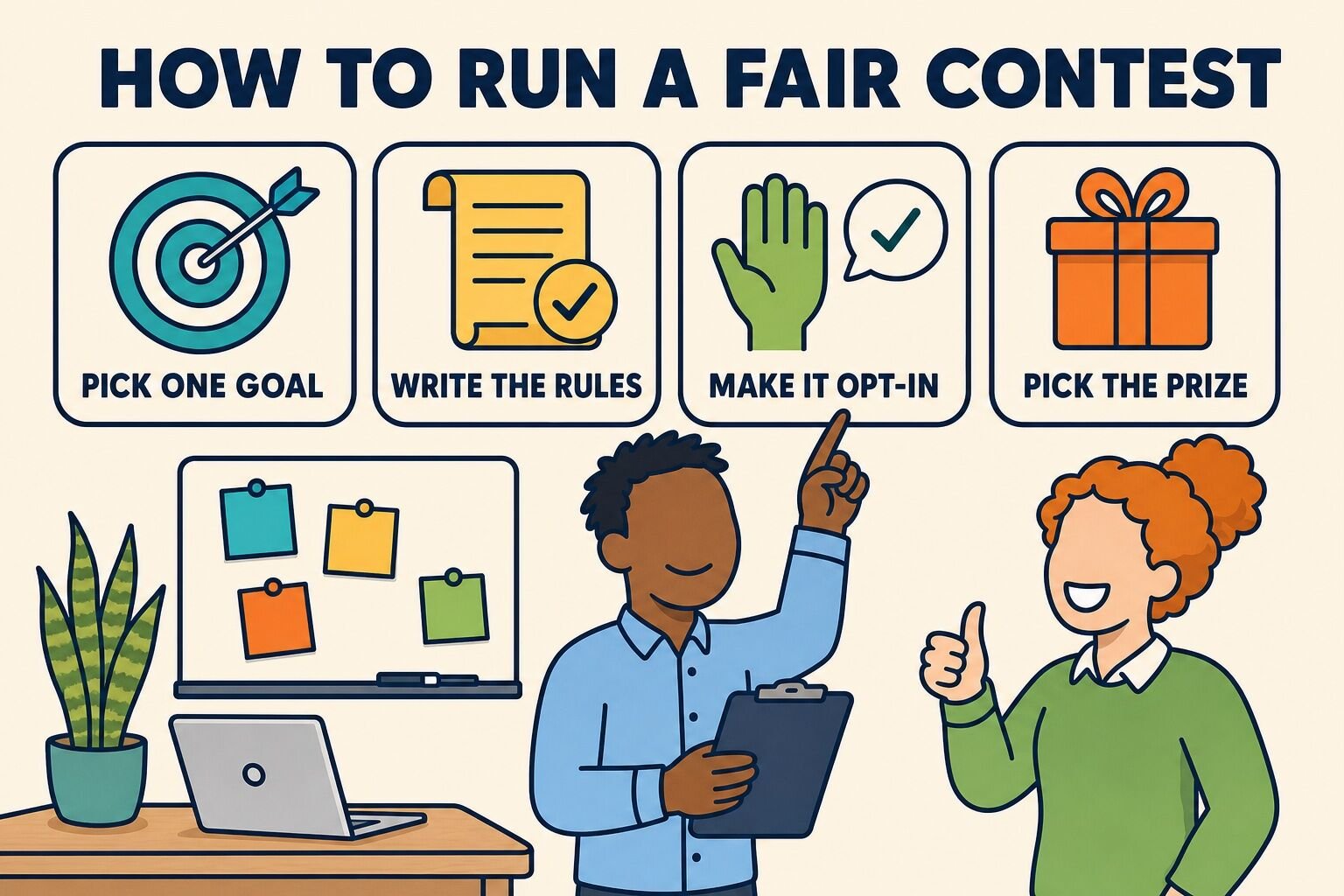
Almost every contest that goes badly goes badly for a structural reason, not a bad-luck reason. These five steps are what we check before running a competitive format for a client.
Step 1: Pick one goal
Name the single thing the contest is for: morale, safety habits, cross-department introductions, a number on a dashboard. A contest with two goals gets rules that serve neither. Write the goal down and let it decide the scoring.
Step 2: Write rules that fit on one screen
If the rules need a meeting, the contest is too complicated. Publish a short written version somewhere permanent, cover how to enter, how scoring works, when it ends and who judges, and state the edge cases you already know about. Ambiguity discovered mid-contest is the fastest way to sour one.
Step 3: Make it opt-in, then make it appealing
Mandatory fun is a contradiction. Instead of requiring participation, recruit a handful of visible early entrants, publish the prize before the launch, and give people a second way in that costs less social risk, such as voting or judging rather than competing. Run the contest during work hours and on the clock.
Step 4: Build teams deliberately
Mixed teams beat intact teams for connection, and drafting them at random beats letting people self-select, which reproduces the friendships that already exist. Balance for seniority and department, keep teams to four to six people for most formats, and have every team pick a name. If you need a fast way to generate options, our team names generator does it in a click:
Step 5: Score it so more than one team can win
Score averages rather than totals when teams are different sizes, score improvement against a baseline when skill levels vary, and award points for participation as well as results. Then close the loop publicly: announce winners the same week, show the final standings, and say what the contest was for and what it produced.
What we have learned from running competitive events
Competition is the backbone of most of the formats we host, so we have a large sample of what works and what backfires. A few patterns hold up consistently.
Low stakes raise participation. The competitions people rave about afterward are usually the ones with nothing material on the line. When the prize is real money, participation goes up among people who were already confident and down among everyone else.
Teams, not individuals. Individual contests produce one happy person. Team contests produce a group of people who spent an hour strategizing together, which is the actual outcome most managers are buying.
Short rounds keep everyone in it. A contest decided in a single long round loses anyone who falls behind early. Several short rounds with fresh scoring keep the field alive to the end.
Follow-through is the whole reputation. Contests that end without an announced result poison the next three. Publish standings, hand over the prize, and say thank you by name.
That repeat rate is the number we watch most closely, alongside client satisfaction: our Net Promoter Score among event organizers is +88, and in a 12-month survey of 3,855 clients, 97.64% said their experience met or exceeded expectations. Competitive formats make up a large share of what those teams book.
There is also a reason the fun itself is worth the calendar time. In laboratory experiments at the University of Warwick, Oswald, Proto and Sgroi found that people given a happiness-inducing treatment, such as a comedy clip, were approximately 12% more productive on a paid piece-rate task. That is a lab result about mood and effort rather than a promise about your quarterly numbers, but it is a useful counterweight to the instinct that an hour of contest is an hour lost.
Small groups versus large groups
The mechanics of a workplace contest change around the 15-person mark, which is roughly where a single conversation stops being possible.
Small groups (~15 or fewer)
Large groups (15+)
Format that works
Head-to-head games and discussion-heavy rounds
Team-scored contests with a visible standings board
Teams
Two or three teams, or everyone against the clock
Teams of four to six, drafted across departments
Scoring
Simple running total, announced out loud
Averages and participation points, posted where everyone passes
Rounds
Many short rounds so everyone gets a turn
Fewer, longer rounds so scoring stays manageable
Judging
The room can judge together
A small panel plus an open vote on a shortlist
Prizes
One shared reward is plenty
Several categories so more than one team wins something
Some contest formats are popular precisely because they are easy to organize, and they cause more damage than they are worth. These are the ones we steer clients away from.
The Lame List
Activity
Why skip it
Verdict
Public individual sales leaderboards
They motivate the top few and demoralize everyone below the midpoint, and the ranking is usually visible long after the contest ends. Score by team instead, as in Sales Sprint.
Rework it
Perfect attendance contests
They reward people for coming in sick and punish anyone with a chronic condition or caregiving duties.
Skip it
Weight-loss competitions
Body weight is health information, the format invites unhealthy behavior, and it excludes people for reasons they did not choose.
Skip it
Mandatory participation
Compulsory fun produces compliance, not engagement, and the people who resent it set the tone for everyone else.
Make it opt-in
Days-without-an-incident streaks
Streak scoring gives people a reason not to report near misses, which is the opposite of a safety program. Score actions instead, as in Workplace Safety Bingo.
Rework it
Winner-take-all grand prizes
One large prize concentrates the excitement in whoever is already ahead and ends participation for everyone else by week two.
Add categories
Prank wars
Escalation is the entire mechanic, the person on the receiving end rarely gets a vote, and it ends in a complaint.
Skip it
Eating contests
They are genuinely unsafe, they exclude anyone with dietary restrictions, and the photos age badly.
Skip it
Cross-department contests scored on raw totals
A 40-person department beats a 6-person one before anyone starts. Score per person or by average.
Rework it
Contests judged on appearance
Best hair, best dressed and similar categories rank colleagues on their bodies. Judge ideas and effort instead.
Skip it
Final thoughts
A good workplace competition is a shortcut. It gives people who would never book time with each other a legitimate reason to spend an hour together, and it gives a manager a way to say "this matters" without a slide deck. The design work is small: one goal, rules on one screen, teams drawn deliberately, scoring that leaves more than one team in the race, and a result announced in public.
Start with one contest, run it properly, and let the second one be easier because people trust that the first one finished. If you would rather have a host run the competition for you, browse our virtual and in-person team building activities.
Common questions about running contests and competitions at work.
What are the types of workplace contests?
Most workplace contests fall into nine types: sales and performance, wellness and fitness, creative, trivia and game show, charity and community, safety and compliance, photo, decorating, and recognition. The type determines who can realistically win and how long the contest should run. Trivia and game-show contests resolve in 30 to 90 minutes, decorating and photo contests run a day to two weeks, and wellness challenges usually need four to eight weeks to build a habit.
What are good work competition ideas?
The formats that work best at the office are team-scored and quick to explain. Good options include a Department Cup that runs points across a quarter, a team-versus-team trivia showdown, a desk decorating contest with a capped budget, a step challenge scored by team average, a weekly caption contest, and a charity drive where donations double as votes. Contests where an entire team can plausibly win beat contests decided by whoever was already the best at that thing.
How do you make a workplace competition fair?
Five things do most of the work: pick one goal, publish rules that fit on a single screen, keep participation opt-in, draft mixed teams rather than letting people self-select, and score averages or improvement against a baseline instead of raw totals. Departments of different sizes should be scored per person, and every format needs an equivalent alternative for anyone who cannot take part in the default activity.
What prizes work best for work contests?
Prizes matter less than the presentation. In our own events the stakes are usually nothing more than bragging rights, and the competition still lands. A traveling trophy, the winning team's name on a wall, or choice of the next team lunch costs nothing and gets talked about longer than a gift card. When there is a budget, spread it across several categories — most improved, best team name, best low-effort entry — and hand the prizes over in public.
Are competitions at work actually good for morale?
Designed well, yes. A 2019 review of workplace-fun research in Human Resource Management Review concluded that fun at work has generally demonstrated benefits for individuals and organizations, and in a related field study of restaurant servers, manager support for fun reduced turnover. Designed badly, competitions do real harm: public individual leaderboards, perfect-attendance contests and weight-loss challenges all reward the wrong behavior and exclude people who never had a chance.
How do you run a competition with a remote or hybrid team?
Remote contests need tighter rules than in-person ones, because you cannot read the room to see who is lost. Use short rounds with clear scoring, run entries in a chat thread rather than a channel, and award points in a way that works across timezones — for example, a point for the first correct answer plus a point for anyone who solves it before the next day's puzzle. Lightning scavenger hunts, emoji decoder races and photo contests all translate well to video calls and chat.


Comments (0)
Leave a Comment