
15 Theater Games for Drama Groups (Large or Small!)
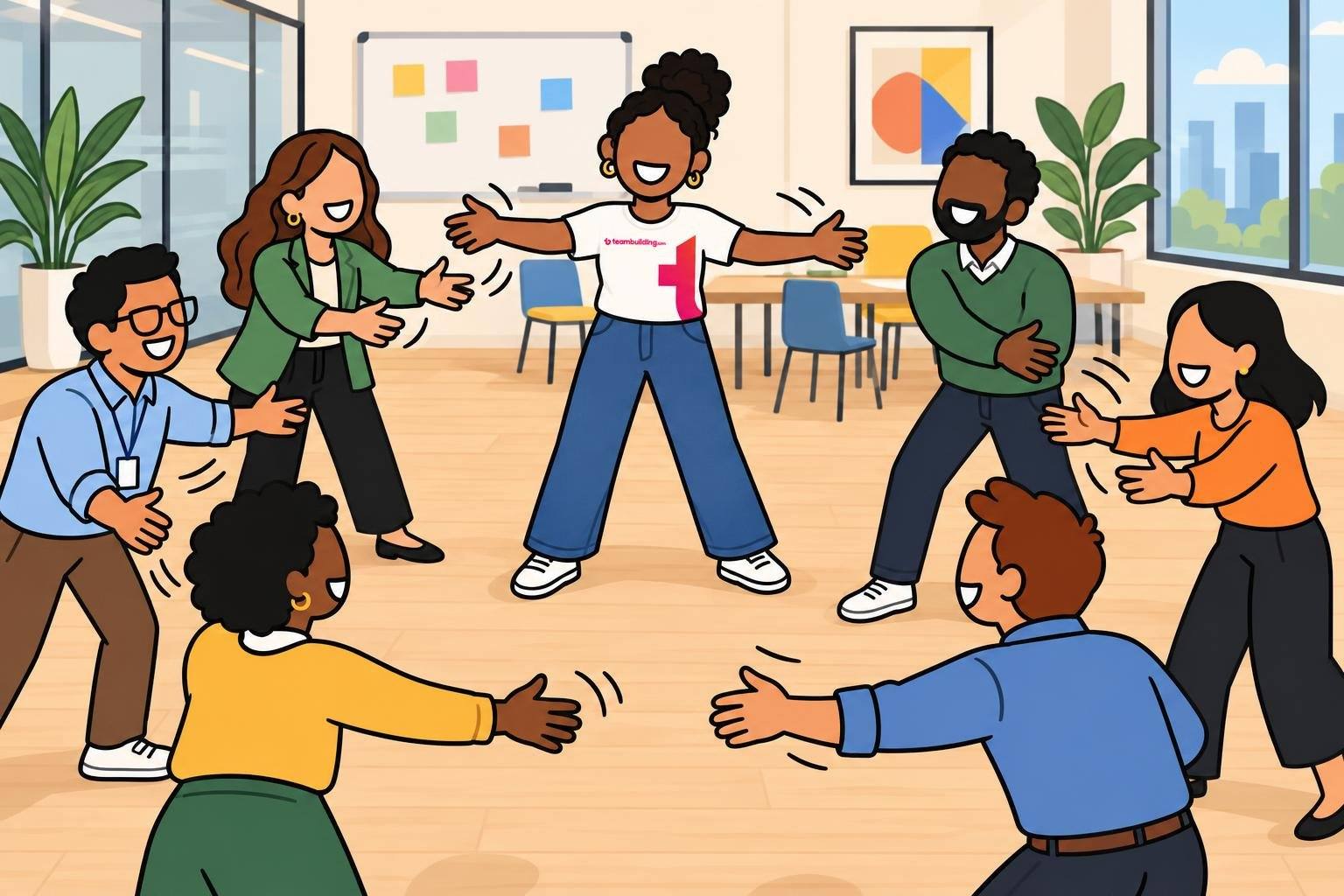
Here is our list of the best theater games for groups.
Theater games for groups are activities involving role-play that help develop essential skills like focus, listening, cooperation, and improvisation. For example, Family Portrait and Communication Chain. The purpose of these activities is to warm up participants while teaching them valuable skills and building their confidence. Outside of the US these activities are called "theatre games."
These activities are similar to improv games and can work as group icebreaker games or large group team building activities. An improv prompt generator can help with these exercises.
This list includes:
Here we go!
There are many theater games that your team can try. From Try Not To Laugh to One-Word Story, here is a list of group theater games.
Pass The Energy Circle is one of the best high-energy theater games to engage groups. The game involves synchronized sound-making.
Here is how to play:
The goal of the game is to transfer higher energy around the circle. In a round, each subsequent player should increase their pitch higher until the caller ends off with the highest pitch.
Try Not To Laugh is a super fun theater game for groups. As the name implies, the game requires players to resist laughing.
First, ask players to pretend that a particular teammate is invisible. Players will walk around, pretend to inspect an object, stare into space, or do anything besides interacting with the chosen player. The invisible player then tries to make the other players laugh. Any player that laughs has to leave the game.
The game will continue until only one player remains.
Pass The Applause is an energizing theater game where participants pass applause around a circle.
To play this game, participants gather in a circle. The leader starts the clap, and other players take turns clapping in a clockwise direction until the leader makes the final clap.
You can play this game in other variations. For instance, the participants can start the clap slowly and gradually increase the tempo over several rounds.
Drama-Freeze is one of the most interesting theater games for small groups. Here is how to play Drama-Freeze:
It is not compulsory to group the participants in twos. The supervisor can randomly call out any two participants to play the game. However, all participants get to play before the game ends.
Jump Over The Imaginary Ball is one of the best warm-up theater games for groups. The game involves leaping over a pretend ball. This exercise is great for keeping the participants energetic and active.
Here is how to play:
As a variation, the leader can call different balls with varying sizes to get the participants to jump at different heights. For example, if the leader calls basketball, then the participants will make a bigger leap than if the leader calls tennis ball.
Emotion Game is a theater game for groups to warm up and break the ice. To play this game, determine an order. Then one person acts as the caller. The caller will shout out emotions like "excited" or "moody," and the first participant will come out to act out the emotion for a few seconds. Then, other participants will take turns acting out emotions called by the supervisor.
Emotion Game is an excellent theater game that helps students develop improvisation skills and emotional intelligence.
Communication Chain is one of the best theater games for teams. The game involves participants expressing activities through gestures.
Here is how to play Communication Chain:
The fun of the game lies in misunderstanding. When players misinterpret a gesture, the message gets muddled and miscommunicated, and the final participant's guess can become hilariously off-base.
Using a charades prompt generator can help with material for the game.
Storytelling exercises like One-Word Story are great theater games for small groups. The game involves each player volunteering a word to form a meaningful story.
You can play One-Word Story in these steps:
You can make the one-word game challenging by eliminating players who take exceed a set amount of time to find a word that fits into the context. This game helps groups to improve thinking, improvisation, and listening skills.
Heads Up, Heads Down is a circle game ideal for small to medium-sized groups. The game aims to eliminate players who make eye contact. The exercise continues until a winner emerges.
Here is how to play Heads up, Heads down:
There will be one winner if three players play the last round. However, if there are just two players in the final round, then they are the winners.
Dance-Freeze is one of the most popular high-energy drama games for students, teams, and groups. You will need danceable music and participants ready to dance to play this game.
Here are the rules of the game:
To make this game more challenging, you can have the participants sing along to the song. The participants who continue singing after the music stops playing must leave the game.
Here is a list of energetic songs that work great for the game.
Call A Number is a circle game ideal for warming up and gaining energy.
You can follow these simple steps to play this game:
A player will lose and leave the game if he does not respond in time after another player calls his number. It is good to let the last two players be the winners. The game becomes very easy when only two players play it, taking forever to have a final winner.
Call A Number game is one of the better theater games that can improve players' concentration and listening skills.
Stop And Walk is one of the most high energy theater games for big groups. You can use this game to warm up a large group in a fun way.
Here is how to play Stop And Walk:
Although there is no winner in the Stop and Walk game, the game will keep your group active and engaged. The game is also good for laughs, as the struggle to remember and follow commands can be quite funny to behold.
Night Watchman is one of the most fun theater games for big groups or small groups alike. This game requires players to imitate statues under the watch of a Night watchman. The players will try to move without getting caught.
To play this game,
You can customize the game to be just a fun no-winner game. In that case, any player that the Night watchman catches becomes the new Night watchman.
Tongue Twisters are awesome theatre games for students, but other groups can also play them. A tongue twister consists of words that are difficult to articulate correctly without making mistakes. To play this game, prepare the Tongue Twisters for the game. All the participants can play individually.
Participants who successfully articulate the tongue twister will proceed to the next round. In the next round, give the participants a different tongue twister. The game will continue in rounds until there is a winner.
Here are some tongue twister ideas you can use for the game:
You can have the participants say the Tongue Twisters just once or repeat several times.
Family Portrait is one of the best theater games for groups. The game requires groups to make poses that imitate a particular type of family photo.
First, you will need to divide a big group into smaller groups. Then choose one player to be a caller who will give out commands. Each group will go on stage, and the caller will ask them to strike a pose of any random portrait. For instance:
Family Portrait helps to improve improvisation skills and create memorable moments for participants. You can also take pictures of the groups' poses and laugh about the photos later with other group members.
Theater games are great ways to equip students and employees with valuable theater and people skills. The drama games you can play are equally beneficial for groups and teams in helping participants improve focus, quick-thinking, and teamwork.
For similar activities, check out these Zoom improv games.
Here are answers to questions about theater games for groups.
Some good theater games for work include Stop And Walk, Communication Chain, Tongue Twisters, and Emotion Game. These games will keep employees engaged and help to build teams.
To play drama games with groups, decide which drama games your group would like to play. You can select the games based on group members' suggestions. After deciding, you can have fun and play following the game's rules you choose. You can further divide the group into smaller groups to make the games easier to play.
Playing drama games for team building helps team members bond over the experience. The games will help team members develop focus, listening, and improvisation skills. Also, drama games like emotion games will break the ice and allow team members to feel free with one another.
Thank you, Grace. I was only familiar with about half of these.
I just became Director of a Readers' Theatre group so this will be helpful!