
25 Improv Games & Exercises for Adults, Beginner-Friendly
A beginner-friendly list of 25 improv games and exercises for adults, with step-by-step rules, group sizes, and honest notes from hosts who run them.
A beginner-friendly list of 25 improv games and exercises for adults, with step-by-step rules, group sizes, and honest notes from hosts who run them.
Improv is the oldest team building technology we have. Long before anyone printed a workshop agenda, groups of people stood in a circle, made something up together, and found out very quickly who listens and who waits to talk.
We use improv constantly. Our events are staffed from a pool of over 75 hosts, all with performance backgrounds, and the warm-ups they run before a session are the same ones taught in improv classes. As of September 2026, we have run 45,000+ team building events across virtual and in-person formats since 2013, which is a lot of rooms in which to learn what actually loosens a group up and what makes everyone stare at their shoes.
This guide is the practical version: 25 improv games and exercises for adults, written so a non-performer can run them. Every game has step-by-step rules, a group size, a time estimate, and an honest note about what it takes to make it land. No stage, no scripts, and no experience required.
This list includes:
Here we go!
Improv games are short acting exercises with no script, where players react in real time to a scene, a prompt, or each other. Examples include Yes And, Questions Only, and One Word at a Time. The point is not to be funny on command — it is to practice listening, accepting an idea instead of blocking it, and staying calm when you have no plan. These games are also called "improvisation games," "improv exercises," "improv activities," and "improv warm-ups."
Improv games are a category of team building games and a close cousin of icebreaker games. They overlap heavily with theater games, communication games, and get to know you games, and this guide includes improv warm-up games, improv games for beginners, improv exercises for teams and work, drama and theater improv games, and improv games for large groups. For the video-call version of these exercises, see Zoom improv games.
There is a reason improv works as a team exercise rather than just a party trick. Psychologist Barbara Fredrickson's broaden-and-build theory of positive emotions, published in American Psychologist in 2001, proposes that positive emotions broaden a person's momentary thought-action repertoire and build lasting personal resources — physical, intellectual, social, and psychological. That is close to a technical description of what a good improv warm-up does to a room before a hard conversation.
The laughter matters too. A brain-imaging study by Manninen and colleagues, published in The Journal of Neuroscience in 2017, found that 30 minutes of social laughter with close friends triggered endogenous opioid release in brain regions tied to pleasure and social bonding, supporting laughter as a neurochemical pathway for forming and maintaining social bonds. The imaging sample was small, so treat it as a clue rather than a law — but it tracks with what hosts see in the room.
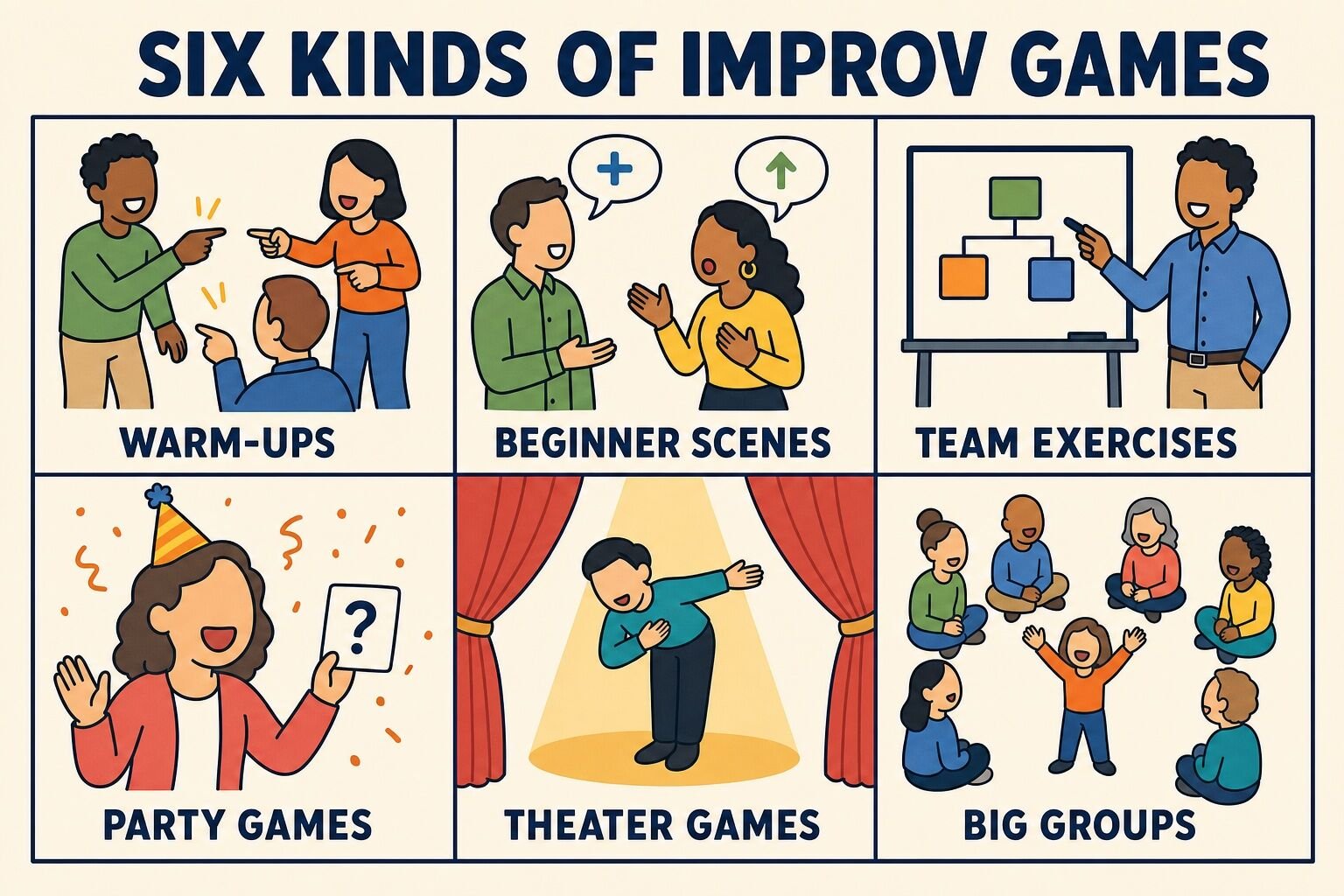
All 25 games below are free and need almost nothing beyond a room and a bit of open floor. Here is the whole list in one table so you can pick by group size and time.
| Activity | Best for | Group size | Time | Cost |
|---|---|---|---|---|
| Zip Zap Zop | Waking up a cold room | 6–25 | 5–10 min | Free |
| Sound Ball | Playfulness without pressure | 5–20 | 5 min | Free |
| Count to Twenty | Listening and group awareness | 4–30 | 5–10 min | Free |
| What Are You Doing? | Quick thinking under mild pressure | 4–16 | 10 min | Free |
| Yes, And | Learning the core improv habit | 4–20 | 10–15 min | Free |
| One Word at a Time | Storytelling and collaboration | 5–40 | 10–15 min | Free |
| Questions Only | Beginners who fear "being funny" | 4–20 | 10–15 min | Free |
| Alphabet Scene | Structure for nervous players | 4–26 | 10–15 min | Free |
| Three-Line Scenes | Teaching scene basics fast | 4–20 | 15 min | Free |
| Yes, But vs Yes, And | Meeting behavior and buy-in | 6–30 | 15–20 min | Free |
| Story Spine | Narrative structure and pitching | 5–25 | 15–20 min | Free |
| Sell It to Me | Sales and presentation practice | 4–30 | 15–20 min | Free |
| Expert Panel | Thinking on your feet in public | 6–40 | 15–20 min | Free |
| Commercial Break | Small-team collaboration | 8–60 | 20–30 min | Free |
| Party Quirks | Big laughs at a social event | 6–30 | 15–25 min | Free |
| Superheroes | Silly characters, low skill floor | 4–20 | 15 min | Free |
| Movie Dub | Pairs who want to perform together | 4–24 | 15–20 min | Free |
| Excuses | Storytelling with a competitive edge | 5–25 | 10–20 min | Free |
| Freeze | Classic drama club energy | 6–20 | 15–25 min | Free |
| Emotional Rollercoaster | Acting range and commitment | 4–20 | 10–20 min | Free |
| Genre Switch | Theater groups and confident players | 4–20 | 15–20 min | Free |
| Conducted Story | Keeping a whole room on the edge | 8–40 | 10–20 min | Free |
| Human Machine | Very large groups, no talking needed | 10–100+ | 10–15 min | Free |
| Party Hoppers | Mixing people who don't know each other | 12–100+ | 20–30 min | Free |
| Scenes From a Hat | Audience participation at scale | 10–100+ | 15–30 min | Free |
Warm-ups are not scenes. Nobody plays a character, nobody has to be funny, and no one is watching from an audience — which is exactly why they work as the first five minutes of anything. Run one or two of these before the games further down, or on their own at the top of a meeting.
Zip Zap Zop is the standard opener in improv classes because it takes fifteen seconds to explain and immediately makes a room pay attention.
Stand in a circle. One player claps their hands toward another player and says "Zip." That player passes it on to anyone else with a clap and "Zap." The next player passes with "Zop," and then the cycle starts again at "Zip." The only rules are that the words must stay in order and the pass must go to a specific person, with eye contact and a clear gesture.
When someone says the wrong word or sends it nowhere in particular, the group cheers the mistake, and play restarts. After a few minutes, speed the pace up until it falls apart.
Best for: waking up a cold room before anything else
Time: 5 to 10 minutes
Materials (cost): none (free)
What we've learned: Celebrate the first mistake loudly. Whoever fumbles first sets the tone, and if the room laughs with them rather than going quiet, everything afterward is easier.
Sound Ball is a warm-up about committing to a choice rather than picking the right one.
Players stand in a circle. The first player mimes throwing an invisible ball to someone while making a sound — a "whoop," a "bonk," a rising whistle. The catcher must repeat the exact sound they received, then invent a brand-new sound as they throw it on.
Run it for two or three minutes. For a second round, add a rule that the ball changes size and weight with each throw, so players have to adjust how they catch it.
Best for: playfulness with no verbal pressure
Time: 5 minutes
Materials (cost): none (free)
What we've learned: This is the friendliest warm-up for people who say they "aren't creative," because nonsense noises have no right answer. It is also the fastest way to spot who is watching the group and who is rehearsing their own turn.
Count to Twenty looks trivial on paper and is surprisingly difficult in practice.
The group stands in a circle or sits around a table. Together, the team counts aloud from one to twenty. Anyone may say the next number at any time, but nobody may plan an order, point at anyone, or signal a turn. If two people speak at the same time, the count resets to one.
Most groups need several attempts. Once they reach twenty, run it again with everyone facing outward so there are no visual cues at all.
Best for: listening, patience, and shared awareness
Time: 5 to 10 minutes
Materials (cost): none (free)
What we've learned: The debrief writes itself. Teams that keep colliding are usually full of people who jump into gaps, and teams that stall at four are usually waiting for permission. Ask which pattern the group recognizes from its meetings — the answers tend to be honest because the game, not a person, raised the point. For more exercises in this vein, see these active listening activities.
What Are You Doing? is a pantomime warm-up that trains quick thinking without requiring a scene.
Two players stand facing each other, and the rest of the group forms a line behind them. Player A starts miming an activity, such as brushing their teeth. Player B asks, "What are you doing?" Player A must answer with a completely different activity: "I'm juggling pineapples." Player B then mimes juggling pineapples, and Player A asks them the same question.
Whenever a player hesitates, repeats an activity, or names what they are actually doing, they rotate to the back of the line and the next person steps in.
Best for: quick thinking under light, friendly pressure
Time: 10 minutes
Materials (cost): none (free)
What we've learned: Tell players their answers are supposed to be bad. Groups get faster the moment they stop hunting for a clever response, and the funniest rounds come from the first thing that falls out of someone's mouth.
These are the games to run with a group that has never done improv and is quietly hoping it will be over soon. Each one has a rule that removes the hardest part of improvising: deciding what to say. Start here before any of the longer-form games.
Need scene suggestions on demand? Use our improv prompt generator to feed any of the games below:
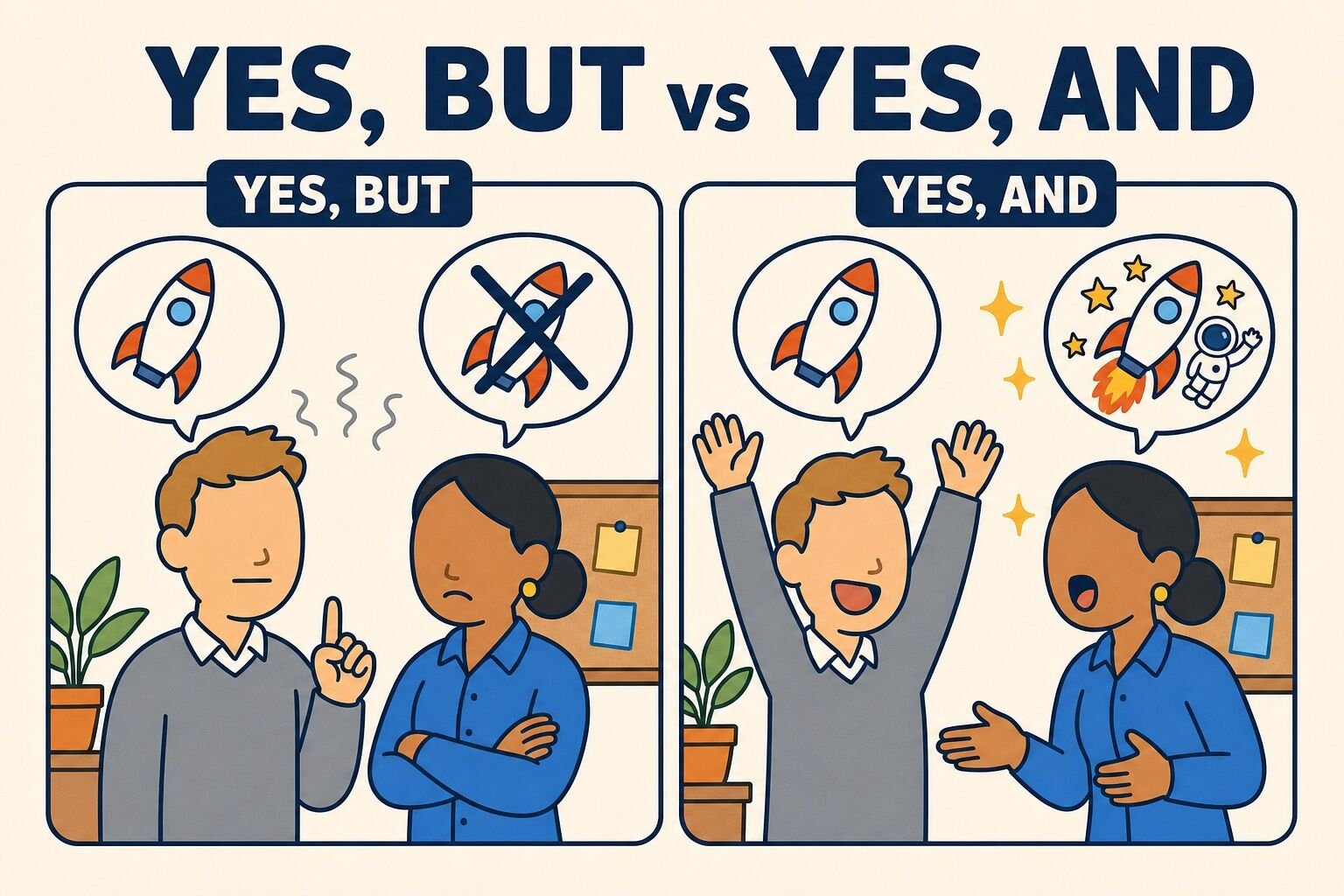
Yes, And is the foundational rule of improv and the single most useful exercise on this list.
Pair players up and give each pair a simple planning scenario, like organizing a birthday party or opening a restaurant. The first player makes a statement: "We should hold the party at the aquarium." The second player must reply with "Yes, and…" then add something that builds on the idea: "Yes, and we can get the sharks to deliver the cake."
Partners alternate for two minutes, always accepting and adding. Nothing gets rejected, questioned, or negotiated. Then swap partners and run it again with a new scenario.
Best for: teaching the core improv habit in one round
Time: 10 to 15 minutes
Materials (cost): none (free)
What we've learned: Watch for "Yes, and" used as a disguise for "no." Saying "Yes, and unfortunately the aquarium is closed" is a block wearing a costume, and calling that out kindly is the whole lesson. The goal is not agreement with everything forever — it is noticing how often a reflexive objection kills an idea before anyone has explored it.
One Word at a Time is the most common storytelling improv game, and it scales from four players to a whole department.
Players sit or stand in a circle. The group tells a single story, contributing exactly one word each, going around the circle in order. The story must stay grammatical, which means somebody eventually has to supply an unglamorous "the" or "of."
The story ends when it reaches a natural finish, at which point the player who said the first word announces "The end." For a harder version, ban the word "and" entirely, which forces the group to actually finish sentences.
Best for: collaborative storytelling with zero acting
Time: 10 to 15 minutes
Materials (cost): none (free)
What we've learned: The game gets funnier with more players, because nobody can steer the plot. With a large group, run two stories in parallel circles and have each group perform its story back — the retelling usually beats the original.
Questions Only is the easiest scene-based game for beginners, because the format guarantees that no player has to invent a plot.
Two players take a setting from the group, such as a hardware store or a customs desk. They then play the scene speaking only in questions. "Can I help you find something?" "Do you carry ladders?" "How tall do you need it to be?"
A player is out when they answer in a statement, repeat a question, or hesitate too long. A new player taps in and the scene continues. Run it as a knockout round until one player remains.
Best for: beginners who are afraid of "being funny"
Time: 10 to 15 minutes
Materials (cost): none (free)
What we've learned: Give the scene a setting with a built-in conflict — a complaints desk beats a park bench every time. If you want more prompts in this format, our list of question games has plenty to borrow.
Alphabet Scene adds a rigid structure to an open-ended scene, which is oddly freeing for nervous players.
Two to four players get a scenario. The first line must begin with the letter A, the second with B, the third with C, and so on through the alphabet. For example: "Ahoy, what are you looking for?" / "Buried treasure, obviously." / "Can you read a map?" / "Don't insult me."
The scene ends when the group reaches Z. Play it competitively by starting on a random letter and eliminating anyone who stalls or uses the wrong letter.
Best for: nervous players who want a rule to hold onto
Time: 10 to 15 minutes
Materials (cost): none (free)
What we've learned: Assign a speaking order for groups larger than six. Free-for-all versions collapse into two confident people trading lines while everyone else watches.
Three-Line Scenes is a training drill that teaches the whole anatomy of a scene in under a minute.
Two players get a location. In exactly three lines, they must establish who they are to each other, where they are, and what is going on. Line one names the relationship: "Dad, I told you not to bring the ferret to my graduation." Line two grounds the setting or activity. Line three raises the problem.
Then they stop, whether or not it felt finished, and the next pair steps up. Run eight or ten scenes back to back so the pattern sinks in.
Best for: teaching scene fundamentals quickly
Time: 15 minutes
Materials (cost): none (free)
What we've learned: The hard stop is the point. Ending at three lines removes the fear of having to sustain a scene, and beginners who know there is an exit commit far harder to the first line.
These improv exercises have a second job. They are still games, but each one maps onto something a team actually does — pitching, planning, presenting, or building on a colleague's half-formed idea. Run them at an offsite, a training day, or as the opening act of a workshop.
This exercise is the most direct translation of improv into meeting behavior we have found.
Split into pairs and give every pair the same task: plan a team offsite. In the first round, every response must start with "Yes, but." Run it for two minutes. Then run the identical task again with every response starting with "Yes, and," for another two minutes.
Afterward, ask each pair two questions: which round produced more ideas, and which round felt better. Then ask which round sounds more like a typical meeting at your company.
Best for: workshops on collaboration, feedback, or buy-in
Time: 15 to 20 minutes
Materials (cost): none (free)
What we've learned: The "yes, but" round is uncomfortable within about 40 seconds, and that discomfort is the entire teaching moment — no facilitator has to explain it. Keep the debrief to five minutes and let the contrast do the work.
Story Spine gives a group a reusable narrative skeleton, which is useful well beyond improv.
Write the frame where everyone can see it: "Once upon a time… Every day… Until one day… Because of that… Because of that… Until finally… And ever since then…" Going around the circle, each player says the next line of the story, filling in one prompt.
Run the first story with something silly, like a heist at a garden center. Then run a second round where the story is the team's own project, product, or year.
Best for: storytelling structure, pitches, and retrospectives
Time: 15 to 20 minutes
Materials (cost): a whiteboard or paper for the frame (free)
What we've learned: The second round is the one that matters. Teams that can narrate their own quarter in seven lines usually discover they disagree about which "until one day" moment actually happened.
Sell It to Me flexes persuasion and improvisation at the same time, which makes it a favorite for sales and customer-facing teams.
Give players ten seconds to grab any object within reach — a stapler, a shoe, a half-empty water bottle. Each player then has 60 seconds to pitch that object to the group as if it were a revolutionary product, complete with a name, a target customer, and a price.
The audience scores each pitch out of five, or simply votes on the winner at the end. Slot pitches between other games to keep the surprise.
Best for: sales, marketing, and presentation practice
Time: 15 to 20 minutes
Materials (cost): objects already in the room (free)
What we've learned: The best pitches name a problem first and the object second. Point that out after two or three rounds and the quality of every later pitch jumps — it is the same note you would give in a real pitch review, landing with a stapler instead of a deck.
Expert Panel is the friendliest public-speaking drill we know, because the expertise is fake and everyone knows it.
Seat three or four players at the front as a panel of world experts on an absurd subject: competitive napping, the history of the traffic cone, underwater architecture. The rest of the group asks the panel serious journalist-style questions.
Panelists must answer with total confidence, and must build on what the previous expert said rather than contradicting them. After five minutes, swap the panel and pick a new field of expertise.
Best for: speaking with confidence when you have no script
Time: 15 to 20 minutes
Materials (cost): chairs at the front of the room (free)
What we've learned: Panels beat solo turns for anxious speakers, because there are two other people to hand the question to. If you want more exercises like this, see these presentation games.
Commercial Break is our go-to improv exercise for teams, because every person has a job and no one has to carry a scene alone.
Split the group into teams of four or five and give each team a random household object. Teams get five minutes to create a 30-second television commercial for it, with a jingle, a tagline, and a role for every member — spokesperson, skeptical customer, sound effects, product.
Each team performs its commercial for the room. Award silly categories at the end, such as most convincing jingle and least believable science.
Best for: collaboration in small teams, scales to a big room
Time: 20 to 30 minutes
Materials (cost): one random object per team (free)
What we've learned: Five minutes of prep is the sweet spot. Give teams fifteen and they write a script, over-rehearse it, and perform something stiffer and less funny than what they had at minute three.
These are the improv games for adults that work at a party, a team social, or the back half of an offsite — bigger characters, faster laughs, and a bit more willingness to look ridiculous. They work best once a group is warmed up and nobody is still checking their phone.
Party Quirks is a classic for a reason: it gives every performer a single, specific thing to play.
One player is the host of a party. Everyone else secretly receives a quirk on a slip of paper — a character trait, an identity, or an obsession. Guests arrive one at a time and play their quirk without ever naming it. The host greets each guest, plays along, and tries to guess what each one is.
Some prompts that consistently land:
Play several rounds so different people get a turn as host.
Best for: the loudest laughs at a social event
Time: 15 to 25 minutes
Materials (cost): slips of paper and a pen (free)
What we've learned: Write the quirks in advance rather than crowdsourcing them live. Audience-suggested quirks skew toward inside jokes about specific coworkers, which is fun for four people and awkward for everyone else.
Superheroes is a party game with an extremely low skill floor — the character does all the work.
The group invents a crisis, ideally a mundane one: the office coffee machine is broken, or a teammate has lost a shoe. One player enters as a superhero with a useless power, announced by name: "Never fear, Mild Inconvenience Man is here."
That hero then calls in a second hero, inventing their name and power on the spot: "I need the help of Slightly Damp Woman!" That player enters and plays exactly that. Keep adding heroes until the crisis is resolved, absurdly.
Best for: silly characters with no acting experience required
Time: 15 minutes
Materials (cost): none (free)
What we've learned: The trick is that you name the next player's power, not your own. Nobody has to invent a character for themselves under pressure, which is the part that scares most beginners.
Movie Dub splits a scene between four people so that nobody has to do everything at once.
Two players stand at the front as the bodies. Two more stand to the side as the voices. The audience supplies a setting, such as a first date or a bank robbery. The voice actors speak all the dialogue while the body actors mime the action and mouth the words.
The bodies must physically commit to whatever the voices say, and the voices must justify whatever the bodies do. Swap roles after each scene.
Best for: pairs who want to perform without going solo
Time: 15 to 20 minutes
Materials (cost): none (free)
What we've learned: Pair a talker with a mover on purpose. The quietest person in the room is often a terrific body actor, and getting a laugh without saying a word tends to change how they approach the next game.
Excuses turns everyday awkwardness into a storytelling competition.
One player poses a simple accusation to another: "Why were you two hours late?" or "Why is there a canoe in the parking lot?" The accused invents an excuse on the spot, and it must be extraordinary but told with a straight face.
Other players then corroborate the story, adding details that make it more elaborate: "I was there, and honestly she's underselling the part with the geese." The round ends when the story collapses under its own weight, and the group votes on the most committed liar.
Best for: storytelling with a light competitive edge
Time: 10 to 20 minutes
Materials (cost): none (free)
What we've learned: Keep the accusations fictional. The moment a prompt references a real missed deadline or a real meeting, the room goes quiet — the same reason debate-style games work better on inconsequential topics than on anything anyone actually has a stake in.
These are the drama improv games you would recognize from a theater class or a short-form comedy show. They ask more of the performers, so save them for a group that has already warmed up, a drama club, or a team that has done improv before.
Freeze is the most-played short-form game in the world, and it scales to any number of watchers.
Two players start a scene based on an audience suggestion. At any point, anyone in the group can shout "Freeze!" The players stop instantly, holding their exact physical positions. The person who called it taps out one player, assumes their precise pose, and starts a completely new scene justified by that shape.
Play continues indefinitely. Encourage physical, unusual positions, since interesting shapes make better launching points.
Best for: drama clubs and groups with some improv experience
Time: 15 to 25 minutes
Materials (cost): open floor space (free)
What we've learned: Set a rule that everyone must tap in at least once. Without it, three extroverts will happily run the entire game while the rest of the room becomes an audience.
Emotional Rollercoaster trains commitment and range, and it is genuinely funny to watch.
Two players begin a scene with an ordinary premise, such as assembling flat-pack furniture. A host calls out an emotion — grief, suspicion, giddy joy, boredom — and the players must instantly play the same scene in that emotional register without changing the plot.
Switch emotions every 30 to 45 seconds, ideally to something jarring. End the scene on whichever emotion the room finds funniest.
Best for: acting range and full commitment to a choice
Time: 10 to 20 minutes
Materials (cost): none (free)
What we've learned: Call the emotion switches faster than feels comfortable. Slow switches let players think, and thinking is what makes this game look like acting homework instead of comedy.
Genre Switch is the same mechanic as Emotional Rollercoaster, aimed at style rather than feeling, and it rewards groups who watch a lot of film and television.
Players start a scene in a neutral setting. The host calls out a genre — film noir, nature documentary, telenovela, horror, infomercial, Shakespeare — and the performers continue the identical storyline in that style, adopting its clichés wholesale.
Call a switch every minute or so. For an advanced round, have the audience call the genres instead of the host.
Best for: theater groups and confident performers
Time: 15 to 20 minutes
Materials (cost): none (free)
What we've learned: Pre-agree a list of six genres and post it where the players can see it. Freewheeling audience suggestions drift toward genres half the room cannot imitate, and the scene stalls while everyone works out what an "arthouse western" sounds like.
Conducted Story is the theater-game version of collaborative storytelling, and it keeps an entire room alert. It is also known as Story Story Die.
Line five or six players up at the front. A conductor stands facing them and points at one player, who begins telling a story. Whenever the conductor's finger moves, that player stops instantly — mid-sentence, mid-word — and the newly pointed player picks up exactly where the sound stopped.
Players are eliminated for hesitating, repeating, or failing to continue the word cleanly. The last storyteller standing has to end the story properly.
Best for: keeping a whole line of performers on edge
Time: 10 to 20 minutes
Materials (cost): none (free)
What we've learned: Cut players off mid-word, not mid-sentence. It sounds cruel and it is the entire game — finishing someone else's word is what makes the audience gasp and laugh in the same second.
Large rooms break most improv games, because a format built for two performers leaves 40 people watching. These improv games for large groups either give everyone something to do at once, or run many small scenes in parallel. For more options at scale, see these large group icebreakers.
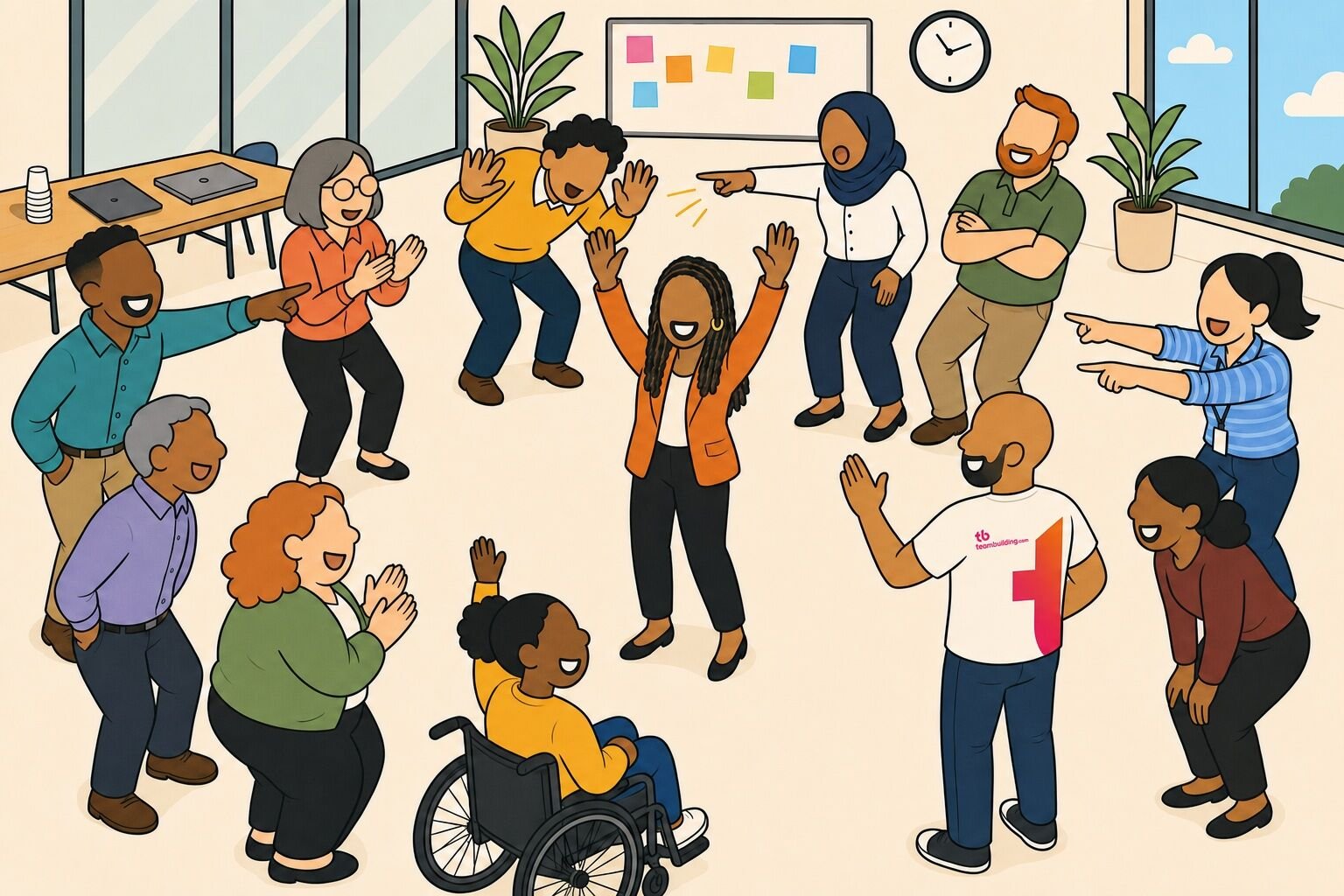
Human Machine is the rare improv game that gets better the more people you add, and nobody has to say a word.
One player steps into the center and begins a simple repetitive movement with a matching sound — a piston arm and a "chunk," for instance. A second player joins and adds a movement that connects to the first. Then a third, a fourth, and so on, until everyone who wants to be in the machine is part of it.
Once assembled, the host can speed the machine up, slow it to a crawl, or announce that it is malfunctioning. Build a second machine with a theme — a Monday-morning machine, a machine that makes bad decisions.
Best for: very large groups and people who dread speaking
Time: 10 to 15 minutes
Materials (cost): open floor space (free)
What we've learned: Let people opt into the machine rather than assigning turns. Everyone joins eventually once they can see how simple the first three movements were, and nobody has to publicly decline.
Party Hoppers is a mixer built as an improv game, which makes it useful for a room where people don't know each other yet.
Divide the group into four corners of the room, each assigned a party theme: a retirement party for a pirate, a networking event for time travelers, a surprise party nobody planned. Each player invents a character that fits their corner and mingles in character for five minutes.
Then reshuffle everyone so each corner holds a mix of characters from the different parties. The new group must improvise a scenario that explains how these mismatched people ended up in the same room. Repeat once more with a final shuffle.
Best for: mixing large groups who haven't met
Time: 20 to 30 minutes
Materials (cost): a room with space to split up (free)
What we've learned: The shuffle is the whole value. One round is a costume party; the second round is where people actually talk to colleagues they would never have sat next to.
Scenes From a Hat is the best way we know to let 100 people contribute to a show that only a few of them perform in.
As people arrive, hand out slips of paper and ask everyone to write a scene suggestion: "things you can say to your dog but not your coworker," "the worst possible time to sneeze," "rejected slogans for this company." Collect them in a hat or bowl.
A host draws a slip, reads it aloud, and two or three volunteers perform a blackout scene of 10 to 20 seconds. The host ends each one with a clap and immediately draws the next slip. Speed is the format — aim for 15 to 20 scenes rather than four good ones.
Need prompts fast when the hat runs dry? This generator supplies random acting prompts on demand:
Best for: audience participation at full company scale
Time: 15 to 30 minutes
Materials (cost): paper slips, pens, and a container (free)
What we've learned: Screen the slips before you read them. Five minutes of sorting removes the two suggestions that would have made the room wince, and nobody ever notices the ones that did not get drawn.
Improv shows up in a lot of our work. Our hosts design new game concepts on an ongoing cycle — each one is play-tested internally with staff as the beta group, run live with client teams, then reworked based on post-event surveys and reviews, with timers, prompts, and rules adjusted until the format holds up in a real room. Improv mechanics survive that process more often than most, because they need no equipment and scale from six people to six hundred.
There is also research pointing the same way. Lehmann-Willenbrock and Allen studied 54 videotaped real team meetings in a 2014 paper in the Journal of Applied Psychology, and found that patterns of humor and laughter — humor sequences, where one joke builds on another, rather than isolated jokes — were positively related to team performance both immediately and roughly two years later. The link is correlational and held under a low job-insecurity climate, so it is not a promise. Still, building on someone else's joke is, more or less, the entire skill improv teaches.
A few things we would tell anyone running improv with a work group:
The first five minutes decide the next fifty. Groups that start with a scene game go badly; groups that start with a nonsense warm-up like Sound Ball will play almost anything twenty minutes later. Warm-ups are not optional filler, they are the mechanism.
Never make a participant the punchline. Our hosts are trained in group dynamics, participant engagement, and inclusive facilitation, and the single rule underneath all of it is that the game is the source of the comedy, not a person in the room. Prompts that invite the group to riff on a specific colleague are the fastest way to lose people.
Give a real way out. Some people will not perform, and forcing them produces resentment rather than growth. Build in roles that are not performing — conductor, scorekeeper, prompt reader, judge — and let people move into performing when they are ready.
Match the game to the size of the room. Group size changes which games work more than anything else does.
| What changes | Small groups (up to 15) | Large groups (16+) |
|---|---|---|
| Format that works | Everyone plays in one circle, many short rounds | Parallel small teams, or a few performers with an active audience |
| Turn length | 1–3 minutes per player is fine | Keep turns under 30 seconds or the room disengages |
| Host role | Light touch — set the rule and join in | Firm emcee with visible time limits and a clear signal to stop |
| Best picks here | Three-Line Scenes, What Are You Doing?, Sell It to Me | Human Machine, Scenes From a Hat, Commercial Break |
| Biggest risk | One person dominating every round | Most of the room becoming a passive audience |
For reference, the median team building event we run has 16 participants, and half of all events fall between 10 and 27 people (as of September 2026) — which is right on the line where the left column stops working and the right column takes over.
Debrief briefly or not at all. A two-minute "what did you notice?" after Count to Twenty or Yes, But vs Yes, And is worth a lot. A twenty-minute debrief undoes the goodwill the games just created.
Not every improv game belongs at work, and a few popular ones are not really improv at all. These are the formats we have either retired or never used.
| Activity | Why skip it | Verdict |
|---|---|---|
| Two Truths and a Lie | It gets filed under improv constantly, but nothing is improvised — players prepare three statements in advance and take turns. It is a fine icebreaker and a slow game once everyone in a big room needs a turn. | Not improv |
| Charades billed as improv | Charades is a guessing game with a fixed answer. One person acts, everyone else shouts, and there is no scene to build on. Enjoyable, just not the skill improv teaches. | Not improv |
| Rhyming scenes | Requiring every line to rhyme puts so much cognitive load on players that the scene stops moving. Even experienced performers mostly stall, and beginners freeze outright. | Usually skip |
| Musical improv and freestyle rap | The skill floor is far higher than any other game here. One person is great at it, everyone else has a bad two minutes, and the room learns that improv is for naturally talented people. | Skip it |
| Gibberish accent games | Improvised "foreign language" bits slide toward mocking accents almost every time, and the risk is not worth the laugh on a diverse team. | Skip it |
| Hot Seat and interrogation games | Putting one person in front of the group to field rapid personal questions is not improvisation, it is exposure. It reliably produces the one story someone regrets sharing. | Skip it |
| Improv drinking games | Alcohol-based rules exclude anyone who is not drinking and push scenes past what is appropriate at a work event, usually right at the point where nobody is judging well. | Skip it |
| Long-form sets with beginners | A 25-minute improvised piece built from a single suggestion is a wonderful thing to watch and a brutal thing to attempt on day one. Start with games that end on a timer. | Not for beginners |
| Mandatory improv with no alternative | Requiring every employee to perform in front of colleagues turns a fun exercise into a performance review. Offer non-performing roles instead. | Add an opt-out |
| Roasts and "friendly" insult games | Improvised teasing works between close friends and almost never across a reporting line. Someone always takes it home with them. | Skip it |
Improv games look like comedy and behave like communication training. Every game on this list is a rehearsal for the same small habits: listen to what was actually said, accept the offer, add something, and keep the scene alive rather than winning it.
Start smaller than you think. A five-minute warm-up before a meeting will do more for a team than a two-hour workshop that people brace for a week in advance. Run Zip Zap Zop on Monday, try Yes, And the following week, and save the scene games for a group that has already laughed together.
And if you would rather have an experienced host run the games, browse our virtual and in-person team building activities.
Next, check out these 5 minute team building activities, this list of teamwork games, and these quick team building activities.
Answers to common questions about running improv games with adults.
Improv games are short acting exercises with no script, where players react in real time to a scene, a prompt, or each other. Examples include Yes And, Questions Only, and One Word at a Time. The purpose is to practice listening, accepting an idea instead of blocking it, and thinking clearly without a plan. These games are also called improvisation games, improv exercises, and improv warm-ups.
The best improv games for beginners are the ones with a rule that removes the hardest decision, which is what to say next. Yes And, Questions Only, Alphabet Scene, and Three-Line Scenes all supply that structure, and warm-ups like Zip Zap Zop and Sound Ball require no scene work at all. Run two warm-ups before any scene game so nobody's first improv moment happens in front of an audience.
Five to ten minutes is plenty for a warm-up at the top of a meeting, and 45 to 60 minutes is enough for a full session with five or six games. Most of the improv games in this guide run 10 to 25 minutes each, so a session is really a question of how many games you stack. Longer sessions work better when you alternate formats rather than extending any single game.
Large groups need games that give everyone something to do at once, or that run many short scenes in parallel. Human Machine, Scenes From a Hat, Commercial Break, and Party Hoppers all work at scale. Keep individual turns under 30 seconds with a big group, since a format built for two performers leaves everyone else watching.
Yes, because the underlying skills are the ones teams use daily: listening closely, accepting a colleague's offer, and adding to an idea instead of shutting it down. Research on 54 videotaped team meetings found that patterns of humor and laughter were positively related to team performance, and improv is structured practice at exactly that. Keep it optional, keep the comedy aimed at the game rather than at any person in the room, and debrief briefly.
Give them a real role that is not performing. Conductor, prompt reader, scorekeeper, and judge are all genuine jobs in these games, and people usually move into performing on their own once they have watched a few rounds. Starting with nonsense warm-ups also helps, since noises and gestures have no right answer and nobody can be bad at them.
this was so much fun and my students loved them