
16 Indigenous Peoples Day Ideas, Games & Activities

You found our list of the best Indigenous Peoples Day ideas, activities and games.
Indigenous Peoples Day is a holiday that recognizes the culture and achievement of Indigenous communities. The holiday is on October 11 in the US, June 21 in Canada, and August 9 internationally. The purpose of the occasion is to educate the public about Indigenous culture and to honor the social and cultural contributions Indigenous people have made. The activities on this list are ways to celebrate the occasion at work, school, or community events. This occasion is similar to National Native American Heritage Month.
This holiday is similar to Black History Month, Asian Heritage Month, Arab American Heritage Month, and Latinx History Month. The day and can be a cause for virtual team celebration and to share indigenous heritage quotes.
This article includes:
Here we go!
From land acknowledgements to care packages to performances, here is a list of activities for Indigenous Peoples Day to honor and celebrate the culture and its extraordinary individuals.
Word searches are one of the easiest Indigenous Peoples Day activities. Simply give the group the word search and set a time limit for solving it. If your group is playing the word search online, then you can share the screen during a video call and turn on annotation tools so that players can circle words as they spot them.
You can also give out a prize to the first players who complete the puzzle.
Here is a template you can use.
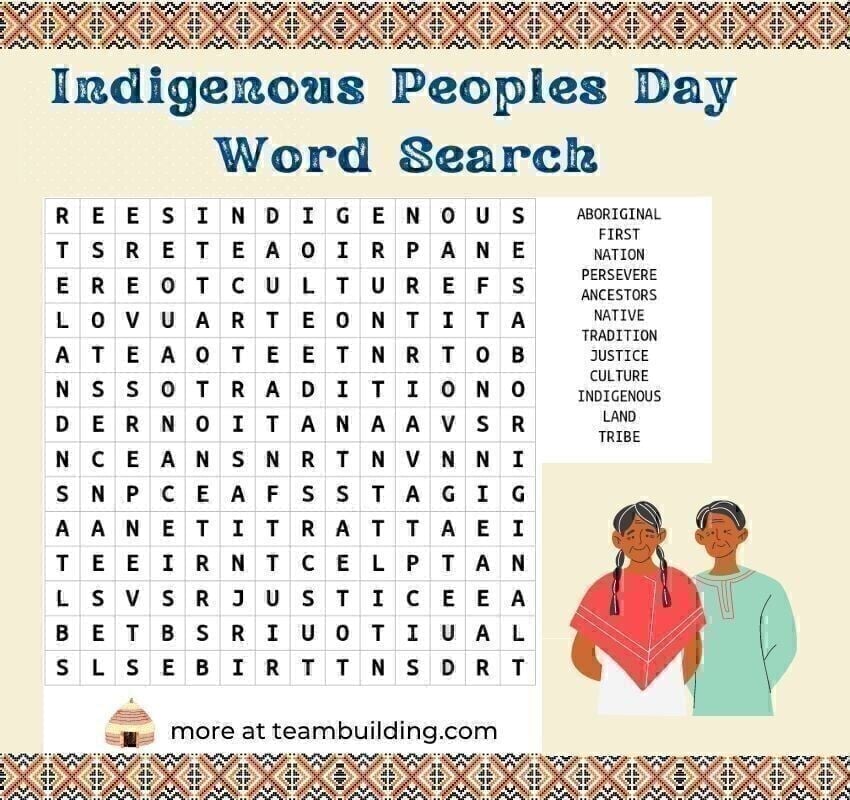
Simple word searches are also a fun interactive activity for social media posts.
Word scrambles make good warmups for classes or meetings. For this activity, players must decode jumbled Indigenous-themed words. To do this exercise, either give the group all words at once, or show words one at a time and give points or prizes to the first player or team who answers correctly.
Here is a template we made for your game:
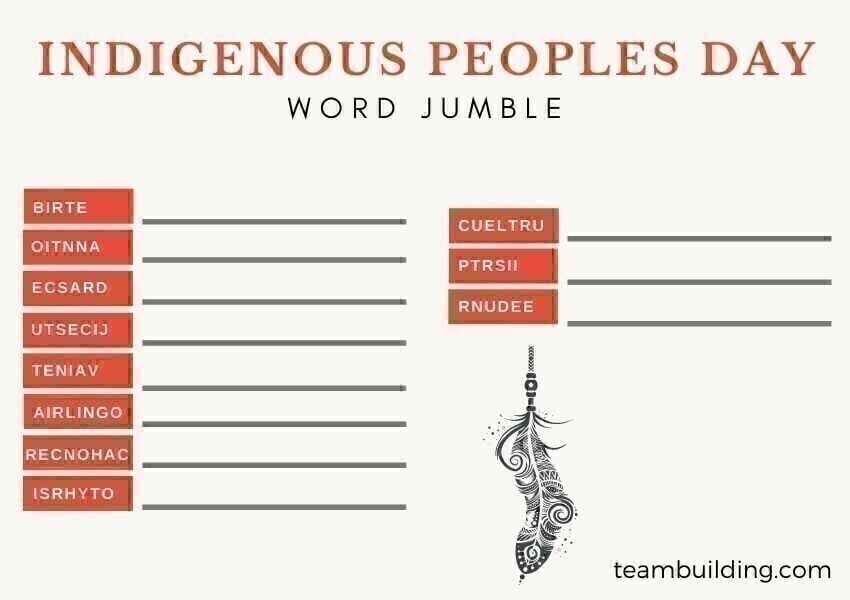
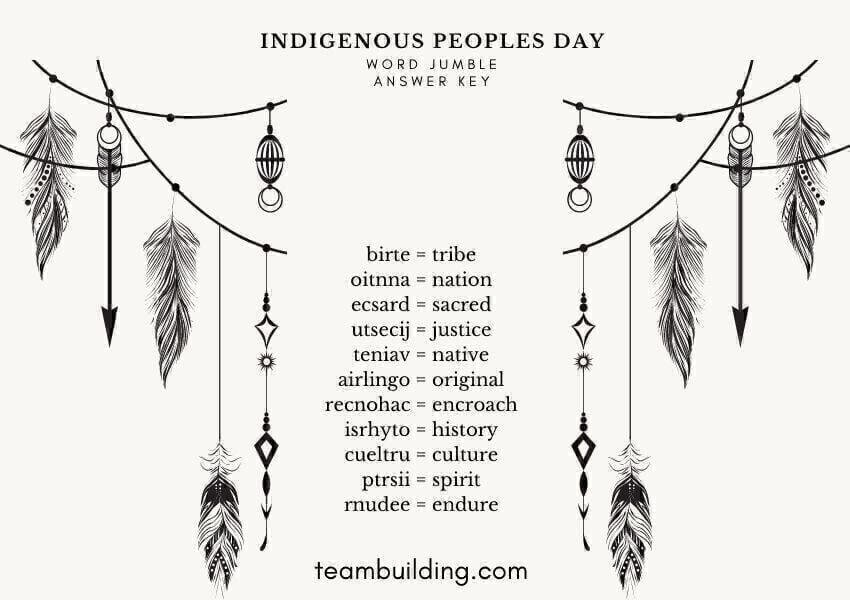
Check out more word games to play with groups.
Trivia is one of the best Indigenous Peoples Day games. Trivia competitions provide players with a way to work together, have fun, and learn more about the subject. To play trivia with employees or students, simply split the group into teams, and ask the teams to answer quests related to Indigenous communities. You can either ask the questions one by one, or have the groups complete a quiz in full each round. Be sure to score the responses, keep track of points, and reveal the correct answers.
Here is a set of starter questions we made for your game:
Q1 - What Indigenous language is spoken in the movie Dances With Wolves?
A1 - Lakota
Q2 - What is the name of the character who narrates One Flew Over the Cuckoo's Nest?
A2 - Chief Bromden (nicknamed Chief Broom)
Q3 - This Shawnee chief was a leader of the First Nations in the War of 1812, and resisted American encroachment on Indigenous land until his death a the Battle of Thames in 1814
A3 - Tecumseh
Q4 - Wupatki National Monument is a Native American Heritage site. In the Hopi language, Wutpaki means what?
A4 - Tall House
Q5 - The Cherokee Nation is located within which US State?
A5 - Oklahoma
There are many more interesting facts you can use as a basis for trivia questions. We recommend researching famous Indigenous figures and history to make the game even more informative.
Here are more questions to use in team trivia.
For more information, check out this guide to virtual trivia and this list of trivia night ideas.
Care packages are great ways to celebrate Indigenous Peoples Day. You can support Indigenous communities and entrepreneurs directly by filling your goodie boxes with products from Indigenous small businesses such as snacks, cups or mugs, artwork, office supplies, and self care products. Unexpected presents are a hit with employees, especially gifts that make the workday more pleasant.
For inspiration, here is a list of Indigenous-owned businesses from Matador Network, and a collection of employee gift suggestions.
Lunch and learns provide ways for employees to learn more about a specific subject. In this case, you can plan a themed lunch and learn about Indigenous people and culture. For example, you can invite a philanthropy to talk about the current challenges to the community and their group's work, have a historian talk about Indigenous figures and events' effect on modern day society, or host a critic to point out accuracies and inaccuracies in pop culture references. Or, for a less academic and more hands-on approach, you can gather curious guests to look at Indigenous artwork, learn basic phrases in the language, and get a glimpse into Indigenous community life via photo slideshow.
You may be able to recruit a speaker or special guest by reaching out to a local Indigenous group for suggestions.
Movies are one of the most low-maintenance team building ideas for Indigenous Peoples Day. You can choose to watch a film made by an Indigenous filmmaker and crew, or a movie that depicts Indigenous culture authentically.
To prepare your movie night either set up a screen and projector, or send attendees Zoom links and watch the movie online together. For maximum impact, follow the movie with a group discussion.
Some suggestions of movies to watch for Indigenous Peoples Day:
Here are more movies to watch with teams.
One of the simplest ways to celebrate Indigenous Peoples Day virtually is to make digital assets employees can use for meetings and messages. These assets can include Slack emojis, Zoom backgrounds, special signatures, and digital photo frames for online profiles. Designs might include flags, artwork and common patterns, and famous figures. Be sure that you explain the significance of the symbols to avoid appropriation, and steer clear of sacred imagery.
Literature is a reliable way to gain more knowledge, insight, and empathy about Indigenous peoples. Books can give a window into the lived experience of the community. Highlighting Indigenous authors or reading books about the Indigenous experience during book club meetings is an especially good way to honor the occasion.
Here are some book suggestions for Indigenous Peoples Day:
For more reading recommendations, check out our lists of books to read.
Making donations to nonprofits is one of the most meaningful ways to celebrate Indigenous Peoples Day. First, choose a charity, preferably via vote. Next, collect contributions. The class or company can do a fundraiser, or the organization can either offer to either match donations or provide a contribution on behalf of the group.
Here are a few suggestions for Indigenous nonprofits:
The list above is by no means exhaustive. There are many more Indigenous nonprofits that could use your support, local groups especially.
For more charity ideas, check out this list of online volunteering opportunities.
Employee spotlights are one of the best ways to celebrate Indigenous Peoples Day at work. You can use the holiday to highlight extraordinary Indigenous employees on your blog, social media, internal emails, or all of the above. For best results, put out an open call for submissions instead of signaling out staff. If you do approach or invite employees to share, then be sure your subject knows that answering is optional so that they are not uncomfortable. Also, do not focus solely on the Indigenous identity, and include other aspects of your employee's personality.
Most land was originally Indigenous ground. One of the most powerful Indigenous Peoples Day ideas is to acknowledge that fact. You can begin meetings and events with reflections that the area you and your group currently inhabits was once the native home of Indigenous people and pay respects. It helps to get hyper local and tell the story of the specific group that lived on the land as well as how, when, and why they were forced to leave.
Many cities host celebrations in honor of Indigenous Peoples Day. If there is a nearby gathering, or a virtual gathering, then you and your team can tune in or show up and watch the ceremonies, lectures, parades, and performances. This option is a more low maintenance way to observe the occasion, since you will not need to plan or prepare for any of the activities, and will only be responsible for sending your group the attendance information.
One of the easiest ways to observe Indigenous Peoples Day at work is to share playlists and podcasts. You can include these resources in a team email or a Slack thread, or play a portion of the audio during meetings.
Here are some podcast suggestions:
And here is a sample playlist of songs by Indigenous artists on Spotify.
Indigenous cultures are full of art and storytelling traditions. Scheduling performances is one of the best Indigenous Peoples Day event ideas. Not only do your people get a taste for Indigenous music, dance, theatre, and writing, you will also be supporting Indigenous artists directly by booking their services. Plus, you can also stream these performances for virtual attendees, as long as you have permission from the performer.
Scavenger hunts are one of the best games for Indigenous Peoples Day. You can use these activities as a way to encourage participants to research and learn about Indigenous communities.
Simply give participants a list of prompts, set a time limit, and give a prize to any player who turns in a completed form.
Here is a starter template we made for your game:
For more ideas, check out this guide to virtual scavenger hunts, and these treasure hunt clues.
Jigsaw puzzles are one of the most fun virtual Indigenous Peoples Day ideas. You can create an online puzzle using an image of Indigenous artwork or a historical photo. Then, give your team members a link to the puzzle URL, and participants will be able to move pieces and assemble the picture in real time. To end the activity, once the image is complete, discuss the significance of the picture.
Here is a tool to create your own puzzle online, and a list of fun puzzle games.
Here are some best practices for celebrating Indigenous Peoples Day in offices or schools.
There are very few pieces of land that were not at one point Indigenous territories. One of the most impactful ways to celebrate the occasion is to learn more about local Indigenous communities that once inhabited or are still local to your region. You can study the specifics of these groups, donations to local philanthropies, and join nearby celebrations.
As with almost any cultural group, there are tropes and assumptions that are well-known to the public yet not authentic to members of the community. Sometimes, even well-meaning tributes can draw too much on stereotypes. To avoid this pitfall, educate yourself and seek to educate your group. Avoid appropriating the culture without knowing or explaining significance behind symbols, costumes, or rituals, and opt instead to learn and teach lesser-known facts.
Indigenous culture is not a homogeneous culture. There are thousands of Indigenous groups, languages, and traditions around the world, and there is no one unified experience. Indigenous Peoples Day is a time to recognize and celebrate the nuances in these different cultures.
History is only one part of the celebration. When acknowledging Indigenous cultures, there tends to be an instinct to look to the past. While it is important to acknowledge the history of these groups, especially because much of that history has been ignored or erased by historians, it is equally important to pay attention to the present. Indigenous people are by no means a relic of the past or a bygone civilization. These communities still exist and have evolved. Celebrating current Indigenous culture and achievements is just as important as looking to the past.
In the US, Indigenous Peoples Day can be a sensitive subject because some people take offense to calls for the holiday to replace Columbus Day. Some folks think it better to ignore Columbus completely, yet this may not be the best tactic. You do not need to erase the mainstream history to appreciate the occasion. In fact, acknowledging the human cost of Columbus' exploration and other colonization efforts honors the Indigenous experience by spotlighting their pre-explorer existence. This approach requires a gentle touch, however you can steer the conversation towards education and acknowledgement instead of outright debate.
Indigenous Peoples Day is a holiday that has been around for decades, and is starting to gain more attention in the US and other countries. This occasion is an opportunity to celebrate the contributions of Indigenous people and make Indigenous employees feel more seen and valued. Many folks are unsure of how to observe the holiday. However, if you are culturally sensitive and try to meaningfully educate and connect participants with the meaning of the holiday, then your celebration will likely be a success.
Next, check out this guide to employee resource groups and these books on diversity and inclusion.
Here is a list of common questions about Indigenous Peoples Day.
Indigenous Peoples Day is a holiday that celebrates the history and culture of native populations. This celebration takes place on October 11 in the US and June 21 in Canada. International Day of the World's Indigenous Peoples takes place August 9.
Some good Indigenous Peoples Day ideas include puzzles, film festivals, trivia, and cafe packages.
To celebrate Indigenous Peoples Day at work, set aside designated time on the day where employees can participate in activities and learn more about the subject. Be sure to advertise your events during the weeks leading up to the holiday via internal emails and meeting memos. Some good Indigenous Peoples Day celebration ideas for work include lunch and learns, employee spotlights, nonprofit donations, and digital assets.
Comments (0)
Leave a Comment