How to Host a Trivia Night People Remember: 30 Themes & 16 Game Ideas
How to host a trivia night from start to finish: a ready-made 90-minute format, rules and scoring, 16 trivia night games and round ideas, 30 themes with sample categories, a movie quiz night plan, and the hosted trivia events our participants rate highest.
Published
·
Updated
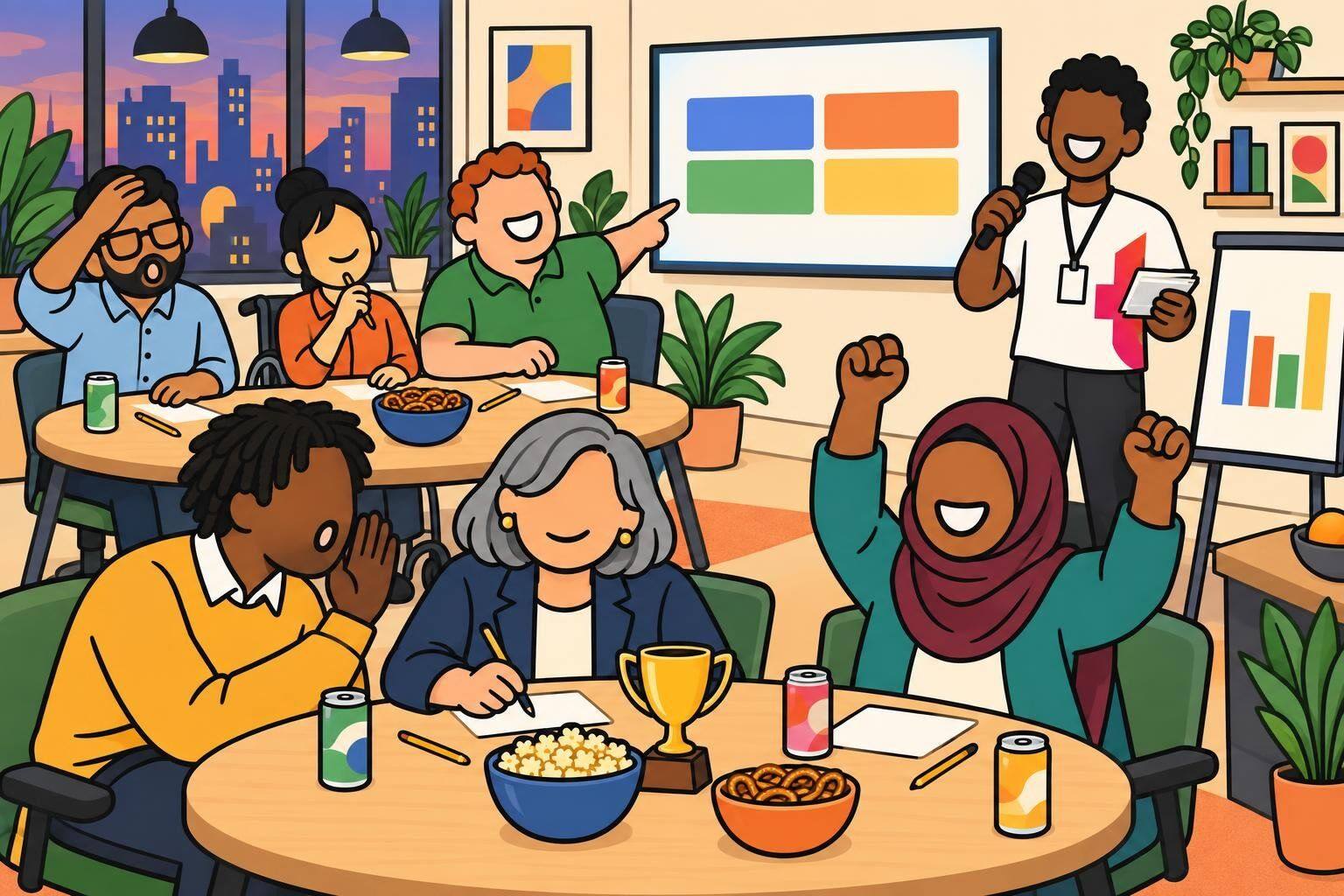
To host a trivia night, split the room into teams of four to six, run five rounds of eight to ten questions plus a final wager question, and post the scores after every round. The whole thing takes about 90 minutes and works in a bar, a conference room or on Zoom. Done well, it gets the quiet analyst, the loud salesperson and the new hire leaning over the same answer sheet, arguing about whether Wyoming or New Jersey let women vote first.
This guide has the full hosting plan: a 90-minute format, rules and scoring, 16 trivia night games and round ideas, 30 trivia night themes with sample categories, and a step-by-step plan for a movie quiz night. The hosted trivia events our participants rate highest, and other places to book one, come after the do-it-yourself material.
Team trivia is one of the formats we host most often, online and in person, among the 45,000+ team building events we have run since 2013 (as of September 2026). The advice below comes from running it, including what to do when two tables dispute an answer.
A trivia night is a social event where small teams compete to answer general-knowledge or themed questions over several rounds, while a host reads the questions, keeps score and announces a winner at the end. The meaning does not change with the venue. In a pub, a school gym, a conference room or on Zoom, it is teams of four to six, a set number of rounds, written answers, and bragging rights (sometimes a prize) for the top table. It is also called a quiz night, a pub quiz, a trivia party, a quiz evening, or team trivia.
The questions matter less than most first-time hosts expect. Pacing, the mix of people on each team and one or two twist rounds decide whether people ask for another one, and the rest of this guide covers each.
How to host a trivia night
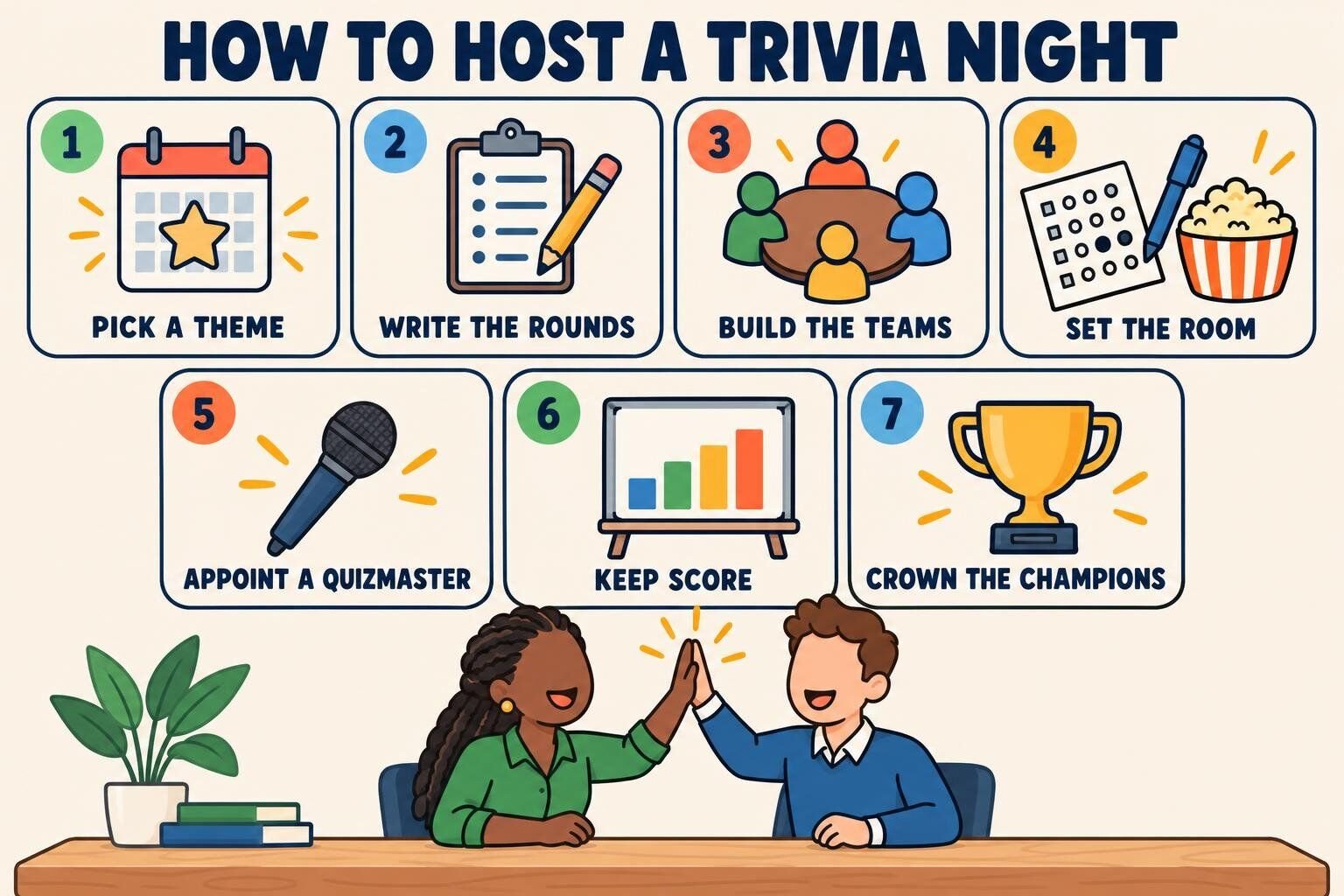
You do not need a buzzer system or a professional emcee. A night for 12 coworkers in a conference room and a night for 150 people in a rented bar follow the same seven steps.
Pick a date, a venue and a theme. A conference room with a screen, a reserved section of a bar, or a Zoom call all work. Choose a general-knowledge night or one of the trivia night themes below.
Write the rounds. Plan five rounds of eight to ten questions plus one final question. Put two or three easy questions in every round so each team scores something, and write three or four spares for tiebreakers and for anything you have to throw out.
Build the teams. Aim for four to six players per team. At a work event, mix departments on purpose so people do not sit with their usual crew (see the department draft below). Ask each team for a name at the start; it is the first laugh of the night, and our list of team name ideas helps the stuck tables.
Set the room. Every team gets answer sheets (one per round), pens and a clear view of the screen or host. Put snacks on every table, not one buffet across the room, so nobody misses a question in the food line.
Appoint a quizmaster. The host reads each question twice, keeps time and rules on disputes. Pick someone with a loud voice and a sense of humor, not necessarily the most senior person in the room.
Keep score where everyone can see it. Collect sheets after each round, mark them while the next round starts, and update a whiteboard or a shared slide. A visible leaderboard is what keeps trailing teams trying.
Crown the champions. End with an all-in final question, announce the winners, and hand out a prize plus a joke award for last place.
Trivia night format and rounds
The most reliable trivia night format is five rounds and a final question in about 90 minutes. Shorter nights feel rushed; longer ones lose the room. This is the run of show we recommend for a work trivia night:
Phones away. Phones stay face down for the whole game, and any team caught searching loses the round. Say it at the start, with a smile, and you will rarely need to enforce it.
One answer per question. Crossed-out answers count as wrong unless the host can clearly read the final choice.
The quizmaster decides. Spelling counts only when the question is about spelling. Partial credit is the host's call, and the host's call is final.
Answers are revealed after each round, so teams can argue (cheerfully) while it is fresh.
Ties are broken with a number question: the team closest to the right answer wins.
Scoring, tiebreakers and prizes
Give one point per correct answer in every round. Flat scoring is quick to mark and leaves nothing to argue about. The exception is the final question, which is a wager: announce the category, let each team write down how many of its points it will risk, then read the question. For prizes, a trophy that lives on the winning team's desk until the next trivia night beats a gift card, because people walk past it for months. Add a joke prize for last place; it tends to get the biggest cheer of the night.
Running a trivia night fundraiser
Schools, charities and workplace giving campaigns use the same format with three additions: charge a per-team entry fee, sell "mulligans" (a second guess on one question) for a small donation, and ask a local business to donate the grand prize. Announce the running total between rounds; it pushes teams to buy one more mulligan.
Trivia night games
The eight trivia night games below change how the whole evening is played. Pick one as the backbone of your night, then add two or three of the round ideas further down.
1. Classic Pub Quiz
The format every other idea on this list builds on: teams at tables, a host with a microphone, rounds of written answers and a leaderboard after each round. It works because everyone already knows the rules.
To run it:
Book a back room at a bar or set up the office with tables of four to six.
Run the five rounds and final question from the format above, with one round on the night's theme.
Read every question twice, collect the sheets, and post scores between rounds.
Best for: 12 to 150 people · Time: 90 minutes · Materials: answer sheets, pens, a microphone for more than 30 people (free to $)
What we've learned: The pub quiz rises or falls on the host. Reading the scores in reverse order with a pause before first place ("and by a single point...") gets a bigger reaction than any question you wrote.
2. Jeopardy-Style Board
Teams pick a category and a point value from a grid, and the answer appears; they reply in the form of a question ("What is the Taj Mahal?"). Higher values mean harder clues, so teams have to decide when to gamble.
To run it:
Build a grid of five categories with five clues each, worth 100 to 500 points, in slides or a free online board template.
Teams take turns choosing a square, but any team can answer: the first hand up gets the first try. A wrong answer loses the points and opens the clue to the other teams.
Finish with a final round where every team writes down a wager before seeing the last clue.
Best for: 8 to 60 people · Time: 45 to 60 minutes · Materials: a screen and a board template (free)
What we've learned: Give someone other than the host the job of judging whose hand went up first. A host who is reading the clue cannot also watch eight tables. Our team building Jeopardy guide has the full walkthrough.
3. Backwards Trivia
The host gives the answer and a category, and teams write the question. If the answer is "Shirley Temple" and the category is "Politics," the best question is "Which child star became U.S. Ambassador to Czechoslovakia?"
To run it:
Choose answers that have one well-known fact and one surprising one, so teams can aim for the clever question.
Give a point for any question the answer fits and a bonus point for the most specific or funniest.
Read the best two or three questions out loud before revealing yours.
Best for: 8 to 40 people · Time: 15 to 20 minutes as one round · Materials: answer sheets (free)
4. Scavenger Trivia
The questions are hidden around the office or venue, not read out. Teams solve a clue to find each question card, answer it on their sheet, and move on.
To run it:
Write 10 to 15 questions and tape each one in a hiding spot.
Give each team a different order of clues so they do not travel in a pack. Our scavenger hunt clues are a good starting point.
Call time after 30 minutes and score the sheets together.
Best for: 10 to 60 people · Time: 30 to 45 minutes · Materials: printed clue and question cards, tape (free)
What we've learned: Hide the last card somewhere central so every team finishes in the same room. Otherwise you spend ten minutes rounding people up before you can score.
5. Know Your Coworkers Trivia
Every question is about someone in the room: whose first job was at a theme park, who has visited the most countries, who once met a president. Teams guess the coworker behind each fact.
To run it:
A week before, send a short survey asking for one surprising, work-safe fact from each person.
Turn the best answers into multiple-choice questions with four names each.
After each reveal, give the person 30 seconds to tell the story behind it.
Best for: 8 to 40 people who already work together · Time: 20 to 30 minutes · Materials: a survey form and slides (free)
What we've learned: Include exactly one question about every person who filled in the survey. Leaving someone out stings more than any wrong answer.
6. Department Draft
The host deals out the teams so that each one mixes departments, and nobody chooses their own table. It takes ten minutes and changes who talks to whom for the rest of the night.
To run it:
Before the event, write every guest's name on a card and sort the cards into piles by department.
Choose one captain per team, ideally people who do not usually lead. Captains take turns drawing a card blind from each pile until the piles are empty.
Seat the new teams together and give them two minutes to agree on a team name before round one.
Best for: 20 to 100 people · Time: 10 minutes before the first round · Materials: name cards (free)
What we've learned: Do not let captains pick players by name. A public pick order means someone is chosen last in front of their coworkers. A blind draw gets the same mixed teams without that.
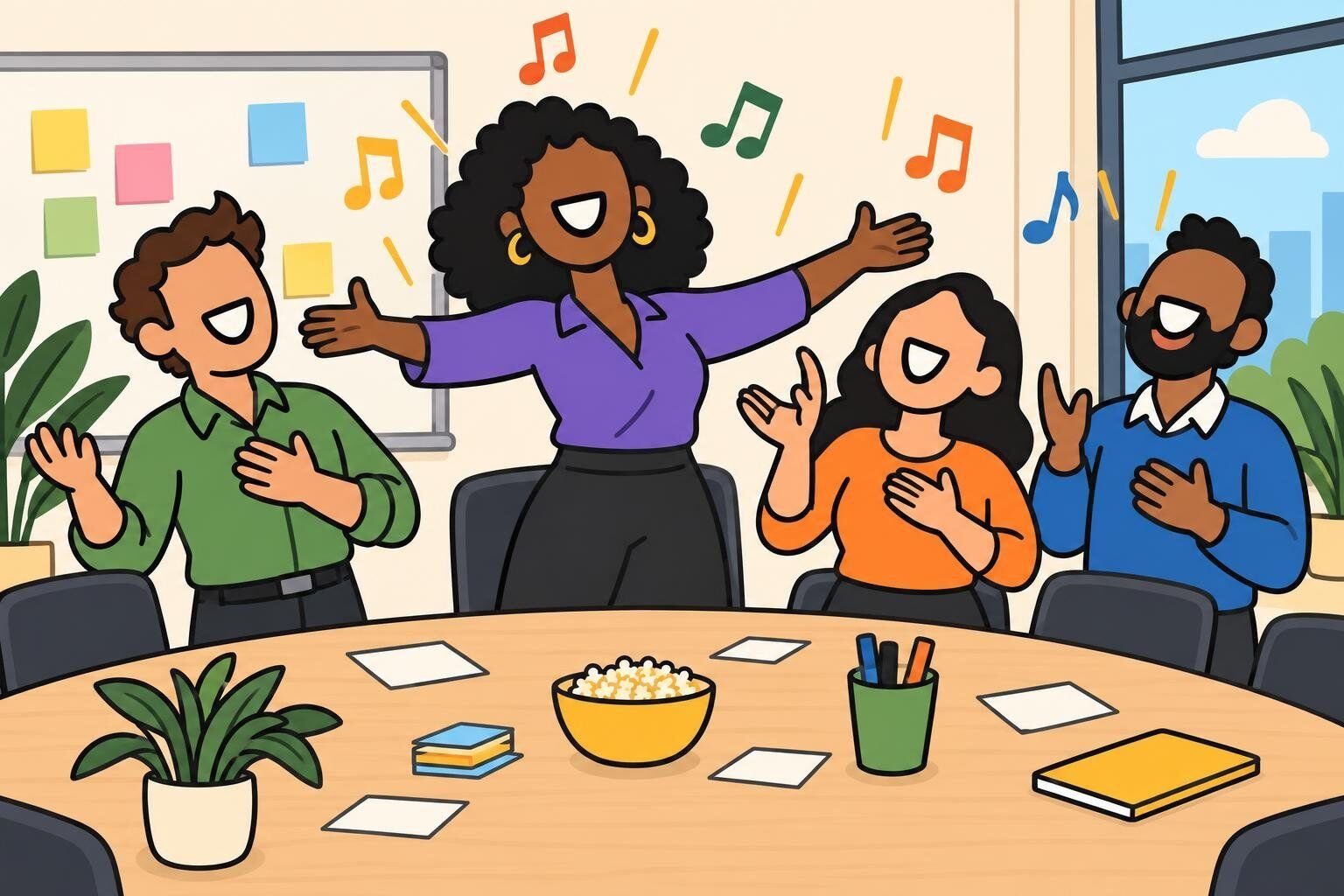
7. Triviopera
Part trivia, part karaoke: teams must sing every answer. If the question is "What is the Italian word for love?", the right answer is a chorus of "That's Amore."
To run it:
Write questions whose answers appear in well-known song lyrics or titles.
Teams get 60 seconds to agree on a song, then perform at least one line of it.
Award one point for the right answer and a bonus point for commitment (harmonies, choreography, a solo).
Best for: 10 to 40 people · Time: 15 minutes as one round · Materials: none (free)
What we've learned: Make singing optional for individuals but required for teams, so the shy player can hum along while a teammate takes the solo.
8. Edible Trivia
Each question arrives with a small bite of food. Teams taste, then answer: "This is the national dish of which country?" (a cup of ropa vieja, Cuba) or "Which author wrote a famous passage about this cake?" (a madeleine, Marcel Proust).
To run it:
Pick six to eight bites that each have a clear fact behind them: a national dish, a regional specialty, or an ingredient to identify.
Serve one tasting portion per team at a time, numbered to match the question.
Check dietary needs in advance and label every dish with its allergens.
Best for: 8 to 40 people in person · Time: 20 to 30 minutes · Materials: 6 to 8 tasting dishes ($$)
What we've learned: Run this round before the main food comes out. Nobody tastes carefully on a full stomach.
Fun trivia round ideas
These trivia round ideas slot into any format. Two or three per night is enough to surprise people without turning the quiz into a string of gimmicks.
9. Picture Round
Teams get a sheet or slide of 10 images: famous logos with the name removed, landmarks from unusual angles, close-ups of everyday objects, or celebrities as children.
Best for: any size · Time: 10 minutes · Materials: printed sheets or slides (free)
What we've learned: With more than 40 people, hand the picture sheet out during the welcome and collect it at the break. Marking takes longer with more teams, and the sheet gives tables something to work on while you tally.
10. Finish the Quote
The host reads the start of a famous line, and teams complete it: "Ask not what your country can do for you..." (ask what you can do for your country, John F. Kennedy). Add a bonus point for naming who said it.
Best for: any size · Time: 10 minutes · Materials: answer sheets (free)
What we've learned: Mix movie lines, song lyrics and famous speeches so each generation at the table gets a turn to carry the team.
11. Closest Number Wins
Every answer is a number: the height of the Eiffel Tower in metres (330), the number of member states in the United Nations (193), the year the first text message was sent (1992). The team closest to the right answer wins the point, so no team is ever completely stuck.
Best for: any size · Time: 10 minutes · Materials: answer sheets (free)
What we've learned: Choose numbers people can estimate but few will know exactly. That keeps every team in the round, and it is why these questions make the best tiebreakers.
12. Time Machine Round
The host reads three clues from the same year (a hit song, a news headline, the price of a stamp), and teams guess the year. Score two points for the exact year and one point for within two years.
Best for: mixed-age groups · Time: 10 to 15 minutes · Materials: answer sheets (free)
What we've learned: Spread the years across five or six decades. A round that only covers the 1990s quietly hands the win to one age group.
13. Odd One Out
Teams see four answers and must find the one that does not belong, and say why. "Mercury, Venus, Earth, Pluto": Pluto, because it is no longer classed as a planet.
Best for: any size · Time: 10 minutes · Materials: slides (free)
What we've learned: Tell teams before the round that any connection they can defend in one sentence earns the point. If you insist on your own answer, you will spend the round ruling on alternatives.
14. Lightning Lists
Teams get 60 seconds to write as many answers as they can to a single prompt: U.S. states that start with "M," Pixar films, or countries in South America. One point per correct answer.
Best for: any size · Time: 5 to 10 minutes · Materials: blank sheets and a visible timer (free)
What we've learned: Print the complete answer list before the night. Marking "countries in South America" from memory, with six teams watching, is how hosts lose arguments. For more prompts, borrow from our Scattergories lists.
15. Joker Card
Each team gets one joker card at the start of the night. They play it before a round of their choice to double their points for that round, so they have to bet on their own strengths.
Best for: any size · Time: no extra time · Materials: one printed card per team (free)
What we've learned: Announce the round topics at the start of the night so teams can plan their joker. The strategy talk around the tables starts immediately.
16. All-In Final Question
Before the last question, the host announces only its category. Each team writes down how many of its points it wants to wager, then hears the question. Right answers win the wager; wrong answers lose it. A team in third place can still win.
Best for: any size · Time: 5 minutes · Materials: wager slips (free)
What we've learned: Make the final question hard but fair, with one answer you can source. A disputed final answer is the argument people take home.
Trivia night themes
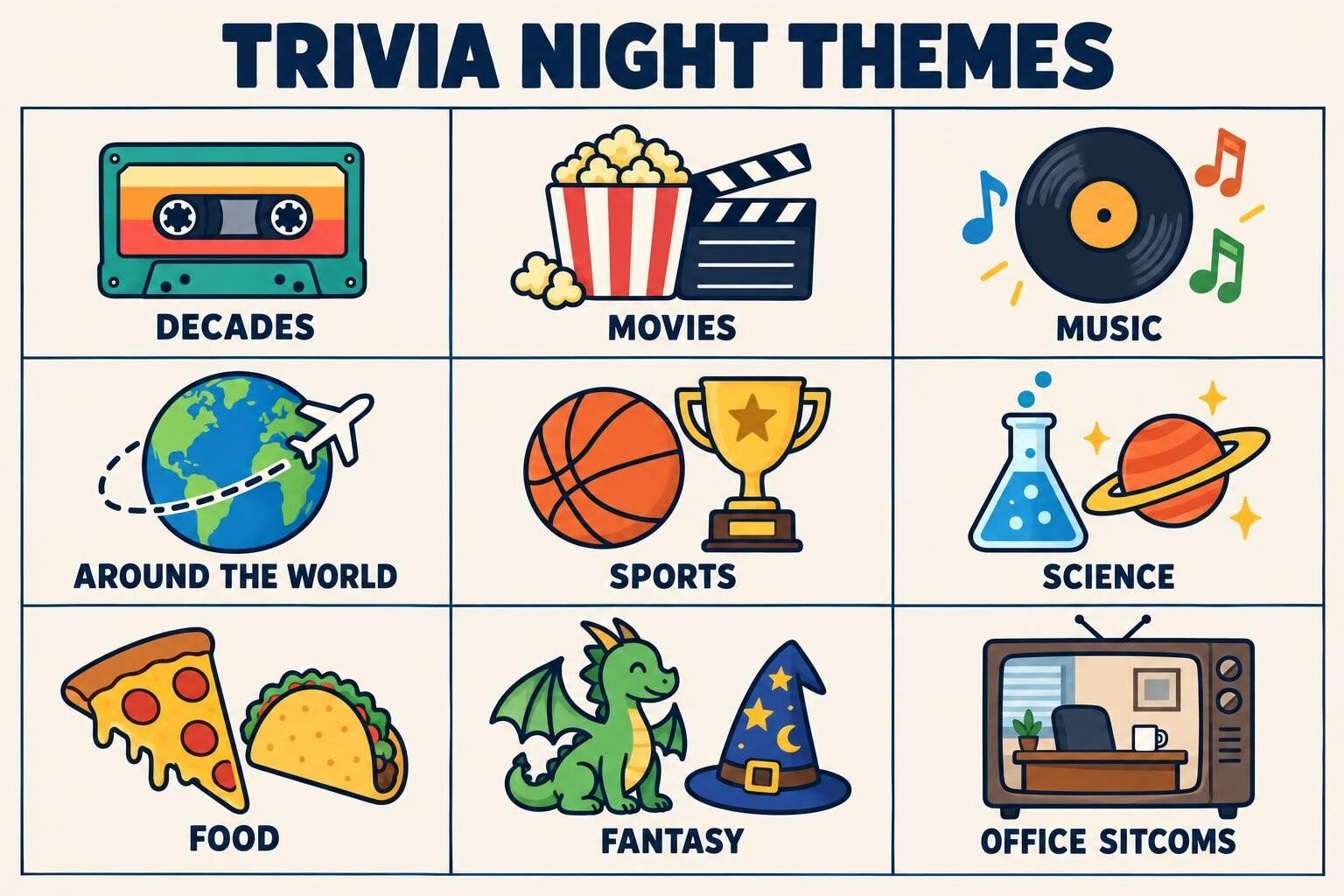
A theme decides more than the questions. It sets the playlist, the snacks and whether anyone turns up in costume. Below are 30 trivia night themes we would run ourselves, grouped by audience, each with sample categories to build your rounds around. In December, our Christmas trivia questions make an easy theme round.
Trivia night themes for adults
Theme
Sample categories
Flashback to the '90s
Sitcoms, boy bands, early internet, toys
Time Traveler (one round per decade)
Headlines, prices, hit songs, fashion
Broadway or Bust
Musicals, show tunes, Tony winners
Saturday Morning Cartoons
Theme songs, catchphrases, voice actors
Famous Heists and Mysteries
Art thefts, unsolved cases, famous detectives
History's Mysteries
Lost cities, odd inventions, myths vs. facts
Around the World
Capitals, flags, national dishes, landmarks
Sounds Fake but True
Strange true facts from science, history, law
Fun Facts About Fiction
Famous books, authors, first lines
Spectacular Sports
Olympics, records, mascots, famous upsets
Fantasy Worlds
Wizards, dragons, maps of fictional lands
Jukebox Heroes
One-hit wonders, cover songs, misattributed hits
Trivia themes for work
Theme
Sample categories
Know Your Company
Founding story, products, office lore, milestones
Our City
Local history, famous residents, landmarks, food
Logos and Slogans
Brand logos, ad jingles, taglines
Tech Through the Ages
Old gadgets, first websites, famous launches
Office Sitcoms
Workplace TV shows, famous bosses, quotes
Food Around the World
Dishes, spices, street food, origins
Space Race
Missions, astronauts, planets, firsts
Oscars Night
Best Picture winners, speeches, snubs
Inventions and Inventors
Everyday objects, patents, happy accidents
Board Game Night
Classic games, rules, famous pieces
Funny trivia themes
Theme
Sample categories
They Didn't Teach Us That in School
Odd history, surprising science
I Saw It on the Internet
Viral moments, memes, famous videos
Misheard Lyrics
Teams sing the real line
Fake or Real Product
Strange gadgets, odd snack flavors
Weird Laws Around the World
True or false rounds (check each one; many viral "weird laws" are myths)
Animal Oddities
Strange abilities, record holders
Movie Mistakes and Bloopers
Famous goofs, unscripted scenes
Famous Typos and Blunders
Costly misprints, misspelled signs
What we've learned: Themes that reward broad curiosity (Around the World, Sounds Fake but True) play better at work than deep-fandom themes, where one superfan can win a round alone. Save the fandoms for a single theme round.
At what temperature do the Celsius and Fahrenheit scales show the same number?
−40 degrees
History
Which U.S. territory was the first to give women the right to vote, in 1869?
Wyoming
Space
What was the name of the first dog to orbit Earth, in 1957?
Laika
Music
The Beatles' song "Yesterday" had what working title?
"Scrambled Eggs"
Food and drink
Hawaiian pizza was invented in which country?
Canada
Language
A "murder" is the collective noun for a group of which birds?
Crows
Movies
Which 1997 film became the first to earn more than $1 billion at the worldwide box office?
Titanic
Sports
In which athletics event would you perform a "Fosbury Flop"?
High jump
Business
Which car company introduced the three-point seat belt, in 1959?
Volvo
Games
In the classic U.S. edition of Monopoly, how much does it cost to pay your way out of jail?
$50
Nature
What is the only mammal capable of true flight?
The bat
How to organize a movie quiz night
A movie quiz night is the easiest themed trivia night to organize: everyone has seen at least some of the films, and most of the questions can be pictures or sound. The steps:
Pick a scope. Movies in general, one genre (comedy, horror, animation), one decade, or one franchise. General movies work best for mixed groups.
Build five rounds from the six round ideas below, mixing visual, audio and written questions.
Prepare the media. Take screenshots and trim audio clips in advance, and test them on the room's screen and speakers before anyone arrives.
Set the scene. Popcorn in paper bags on every table, a red carpet (a red tablecloth on the floor works), and a soundtrack playlist during the breaks.
Award Oscars. Give a gold trophy to the winners and joke awards for Best Wrong Answer and Best Team Name.
Movie quiz round ideas:
Freeze frame. Show a still with the actors' faces covered; teams name the film.
Quote round. Read a famous line; teams name the film and the character.
Soundtrack round. Play five seconds of a score or theme song.
Release year. Teams guess the year each film came out, with points for being within two years.
Best Picture round. Questions about Academy Award winners and famous upsets.
Plot in one sentence. The host reads a deliberately dull summary ("A man gets stuck on a business trip and makes friends with a volleyball"), and teams name the film (Cast Away).
Trivia night for work and team building
Trivia suits introverts and extroverts at the same event. The questions give everyone something to say, nobody is put on the spot alone, and the only thing at stake is bragging rights. BetterUp's research on the value of belonging at work links high workplace belonging to a 56% increase in job performance, a 50% reduction in turnover risk, and 75% fewer sick days. A trivia night will not build belonging on its own, but it is an easy way to get people from different teams laughing at the same table.
To make a work trivia night do some team building:
Add one round about the company or the people in it (Know Your Coworkers), but keep it to one round so new hires are not shut out.
Keep it to 60 to 90 minutes. Almost nine in ten of the virtual events our clients book run that long, and a work trivia night holds attention for about the same time.
Run it during working hours, or right at the end of the day, so it does not take over someone's evening.
Trivia for large groups
Trivia scales better than most team games, with a few changes. Keep teams at four to six people and add teams, not seats. Past 60 people, use a microphone and a projected leaderboard, and recruit two or three volunteers to collect and mark sheets so the host can keep talking. Past 150, have teams answer through a phone-based quiz app so scoring is instant. Our guide to team building for large groups covers more formats at that scale.
Virtual trivia night
The same format works on Zoom or Microsoft Teams. Put each team in a breakout room to confer, share questions on screen, and have one person per team submit answers through a form. Keep rounds a little shorter than in person, because screen fatigue sets in sooner. Our large group games list has more formats that run in breakout rooms.
Best hosted trivia nights, ranked
Writing 50 good questions takes an evening. A hosted trivia night brings the questions, a professional host and the scoring. These are the trivia and game show events on our platform ranked by Team Building Score, a points total each event earns from confirmed bookings, participant reviews and ratings. Only events with at least 30 post-event survey responses per question qualify.
Ranked by our Team Building Score — a running points total earned through confirmed bookings, verified reviews, ratings, and listing quality, recalculated nightly. Every event shown also has at least 30 post-event survey responses per question; the happier, connected, and NPS columns are computed from the 1,111+ survey responses collected for the 7 events listed here — a subset of all post-event surveys across our catalog. Updated November 2026.
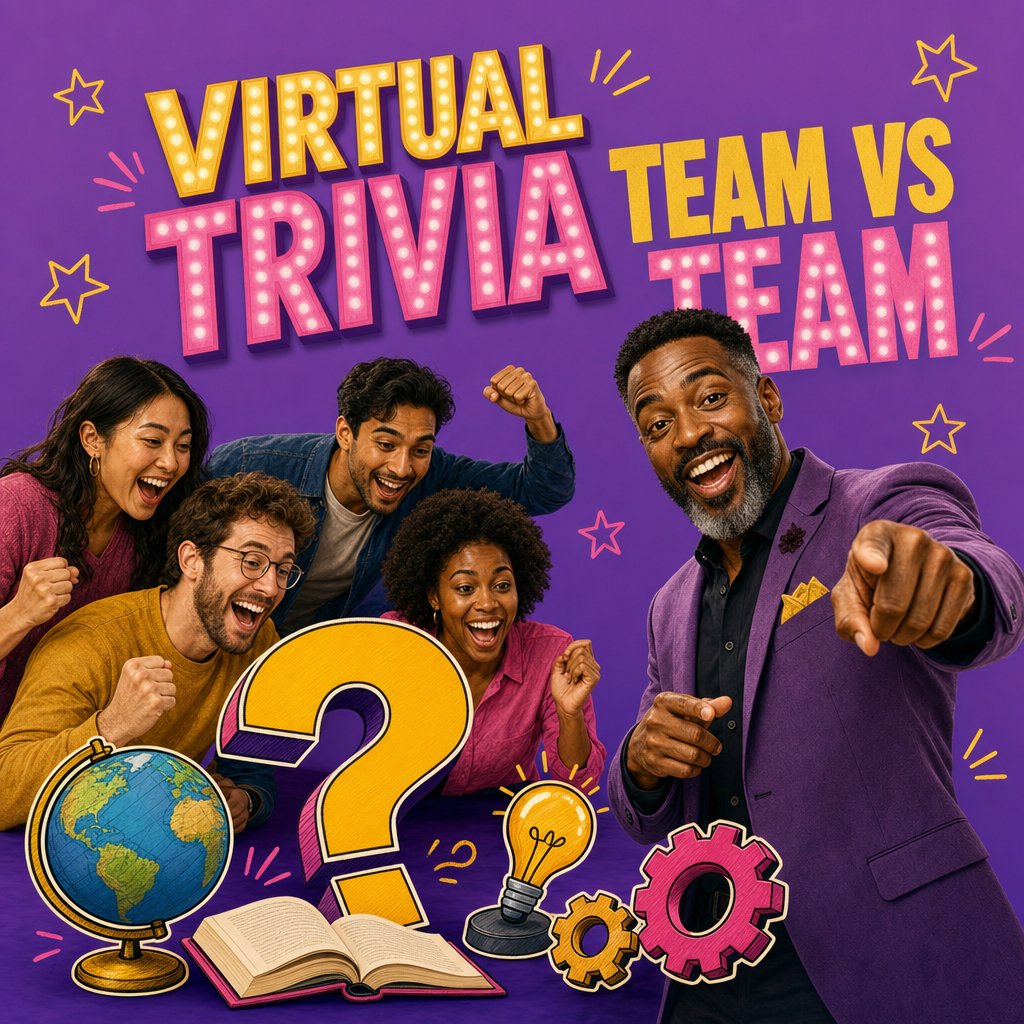
Virtual Trivia: Team vs Team is our most-reviewed trivia event, with 1,780 reviews and a 4.97 out of 5 average rating, and it runs for 10 to 1,000 people. For an in-person night, the Ultimate Game Show brings a hosted game show to your venue for 15 to 1,000 guests, and the city-themed Ultimate Trivia Showdown events (such as New York Sports Ultimate Trivia Showdown) add local sports trivia.
Where to book a trivia night
We are a team building company, so weigh our opinion accordingly. Work trivia nights are usually booked in one of five ways:
Weekly trivia delivered by email, Slack or Microsoft Teams
Per-user subscription
Ongoing, low-effort trivia between events
A local trivia host or bar
Freelance quizmaster or a venue's weekly quiz
Flat fee or table booking
Small teams who want a night out
DIY with a quiz app such as Kahoot!
Self-hosted with an app for answers and scoring
Free tier for small groups; paid plans for larger games
Teams with a confident in-house host
Whoever runs it, the host matters more than the platform. About one in five published reviews of our virtual events mention the host by name.
What we've learned from hosting trivia
Four patterns show up at every size of trivia night we host:
Competition is the point. Participants consistently name friendly competition as the highlight of our virtual events. A leaderboard and a little trash talk supply the energy, and low stakes keep it friendly.
Every team should score in every round. Write each round with two or three easy questions. A team that scores zero in round two checks out for the rest of the night.
Smaller teams play better. The median event on our platform has 16 people. For trivia, that is three or four teams of four or five, small enough that every player gets to argue for an answer. If your group is bigger, add teams, not seats.
Short and often beats long and rare. We would rather see a 60-minute trivia night every quarter than a three-hour marathon once a year. People come back to the short one.
If you are planning a holiday trivia night, book the date early. December slots go first.
Trivia night ideas we don't recommend
Skip this
Why
Do this instead
Questions about the boss or inside jokes
Only a few people can answer, and everyone else feels like an outsider
The formula is short: small mixed teams, five well-paced rounds, a theme, and a host who reads the scores like they matter. Pick one game from this list as your backbone, add two twist rounds, and people will ask when the next one is.
Answers to the questions planners ask most often before hosting a trivia night at work.
What are good trivia night themes?
Broad themes that reward curiosity work best for mixed groups: decades nights, Around the World, Sounds Fake but True, movie nights and music nights. For work events, Know Your Company, Our City and Logos and Slogans are popular. Funny themes like Misheard Lyrics or Fake or Real Product make good single rounds.
How do you organize a movie quiz night?
Choose a scope (movies in general, one genre or one decade), then build five rounds from freeze frames, famous quotes, soundtrack clips, release years, Best Picture questions and one-sentence plots. Prepare screenshots and audio in advance, test the screen and speakers, and finish with Oscar-style trophies for the winners and the best wrong answer.
Can you host a trivia night virtually?
Yes. Share questions on screen in Zoom or Microsoft Teams, send each team to a breakout room to confer, and collect answers through a form so scoring stays quick. Keep rounds a little shorter than in person, or book a hosted virtual trivia event, which runs for 60 minutes and suits groups of 10 to 1,000.
What is a trivia night?
A trivia night is a social event where small teams compete to answer general-knowledge or themed questions over several rounds. A host reads the questions, keeps score and announces the winning team at the end. It is also called a quiz night or a pub quiz, and it works in a bar, an office, a school or on a video call.
How do you host a trivia night?
Pick a date, venue and theme, write five rounds of eight to ten questions plus a final question, and split guests into teams of four to six. Give each team answer sheets, appoint a quizmaster to read questions and rule on disputes, post scores after every round, and finish with a wager question and prizes. Plan for about 90 minutes in total.
How many rounds and questions should a trivia night have?
Five rounds of eight to ten questions plus one final wager question is the most reliable format. With a welcome and a short break, that fills about 90 minutes. Write three or four spare questions as tiebreakers, ideally number questions where the closest answer wins.






Comments (0)
Leave a Comment