33 Halloween Team Building Activities & Office Games for Work
33 Halloween team building activities that actually work — office games with real instructions, contest ideas, party stations, team outings, and hosted events, plus lessons from our second-busiest event month of the year.
Published
·
Updated
Halloween might be the easiest team building win on the calendar: the decorations are half up already, the candy budget is tiny, and most of your team secretly wants an excuse to compete over costumes. We see it in our own numbers — October is our second-busiest month of the year for team building events, behind only December.
This guide collects 33 Halloween team building activities that actually work — office games with real instructions, contest ideas, party stations, team outings, and hosted events — plus what we've learned running Halloween events for teams at companies like Amazon, Procore, and Raymond James.
Halloween team building activities are group games, contests, and outings that bring coworkers together during spooky season. Examples include Halloween trivia, costume contests, pumpkin decorating, and murder mystery parties. The purpose of these activities is to give teams a low-stakes reason to laugh together in October — no trust falls required, just a shared excuse to be a little silly at work.
Teams celebrate Halloween at work in three main ways: contests that build anticipation across a week or a month, a party or game session that anchors the celebration, and outings that get the group offsite. The best plans combine at least two of the three — and keep every scare strictly optional.
These ideas are also called “Halloween team building games,” “Halloween activities for employees,” “Halloween-themed team building,” and “Halloween group games” — this guide covers all of those.
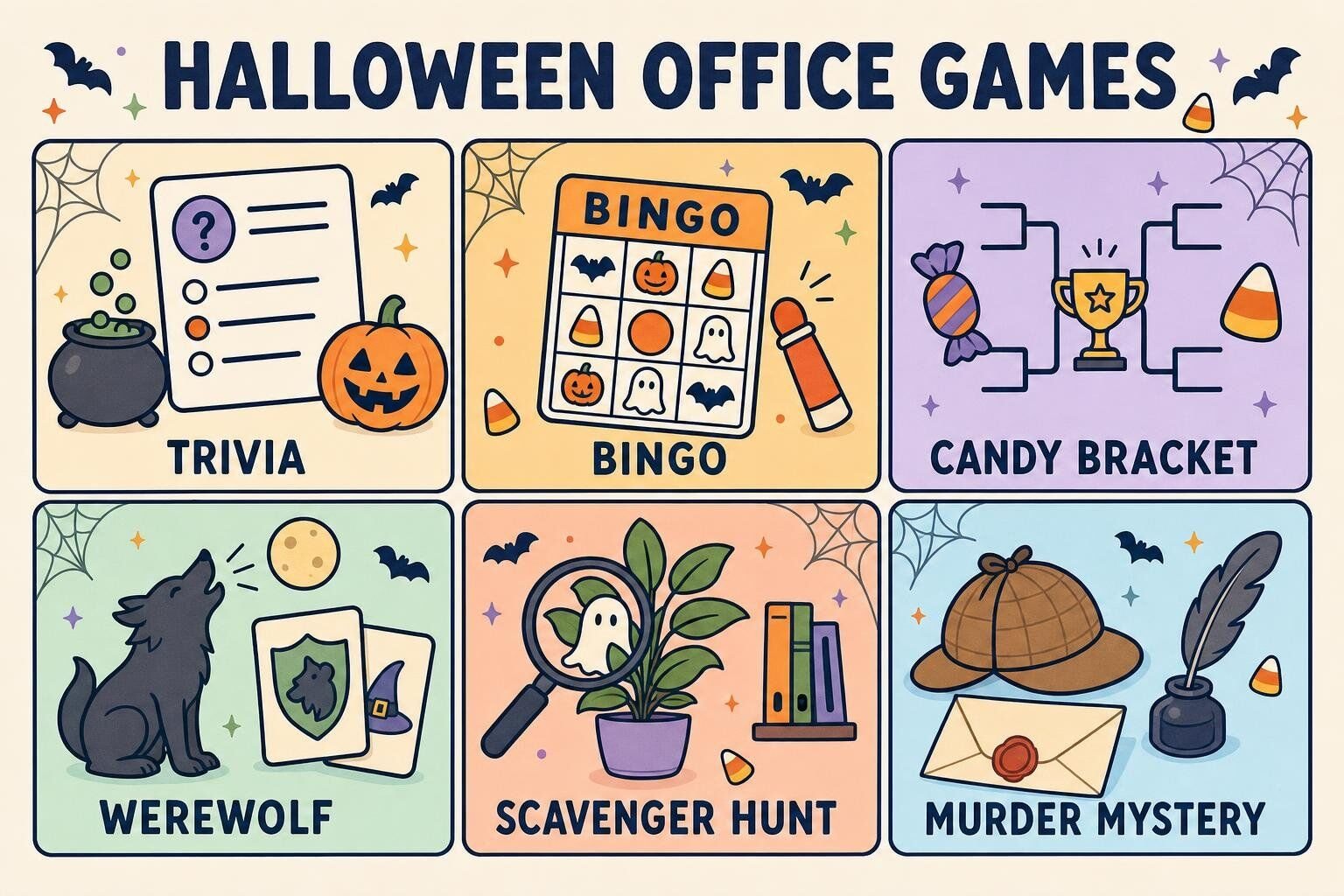
Games are the fastest way to turn "we put out a candy bowl" into an actual celebration. These Halloween party games for adults work in conference rooms, on video calls, or both — here are the thirteen we would actually run, each with a quick setup guide:
Halloween Trivia is the easiest Halloween office game to run, because everyone already knows how trivia works — you just need spookier questions. Split attendees into teams of four to eight and challenge them to answer Halloween-themed questions.
Categories can include:
Horror movies
Monsters and mythology
Halloween history and traditions
Candy
Famous witches, vampires, and ghosts
Spooky songs
To play, teams can write down and submit answers, or buzz in to respond first. You can also run the game on an app like Kahoot, where players answer on their phones and the app tracks scores automatically. Multimedia rounds are a fun upgrade: play five-second horror movie theme clips as a "name that tune" round, or show ultra-zoomed-in photos of candy and have teams guess the sweet.
What we've learned from hosting trivia: mix difficulty deliberately. A round everyone can answer keeps casual players in the game, and one or two genuinely hard questions give the horror-movie buffs their moment.
Best for: Any group, teams of 4–8 Time: 30–45 minutes Materials: Question list, buzzers or phones
2. Halloween Team Bingo
Halloween Team Bingo is a social game that gets folks mingling instead of clustering with their usual lunch group. Give each player a randomized card of Halloween-themed prompts, then send them off to talk to coworkers. Players mark squares with the names of colleagues who fit each description — for maximum interaction, rule that no name can appear twice in the same line. The first player to mark five consecutive squares and yell "Bingo" wins.
Here is a template you can use:
You can play this game during a Halloween party or stretch it across a whole workday, with the reveal at an afternoon break.
Best for: Mingling formats, 10–100+ people Time: 20–30 minutes Materials: Printed or digital bingo cards
3. Guess the Ghoul
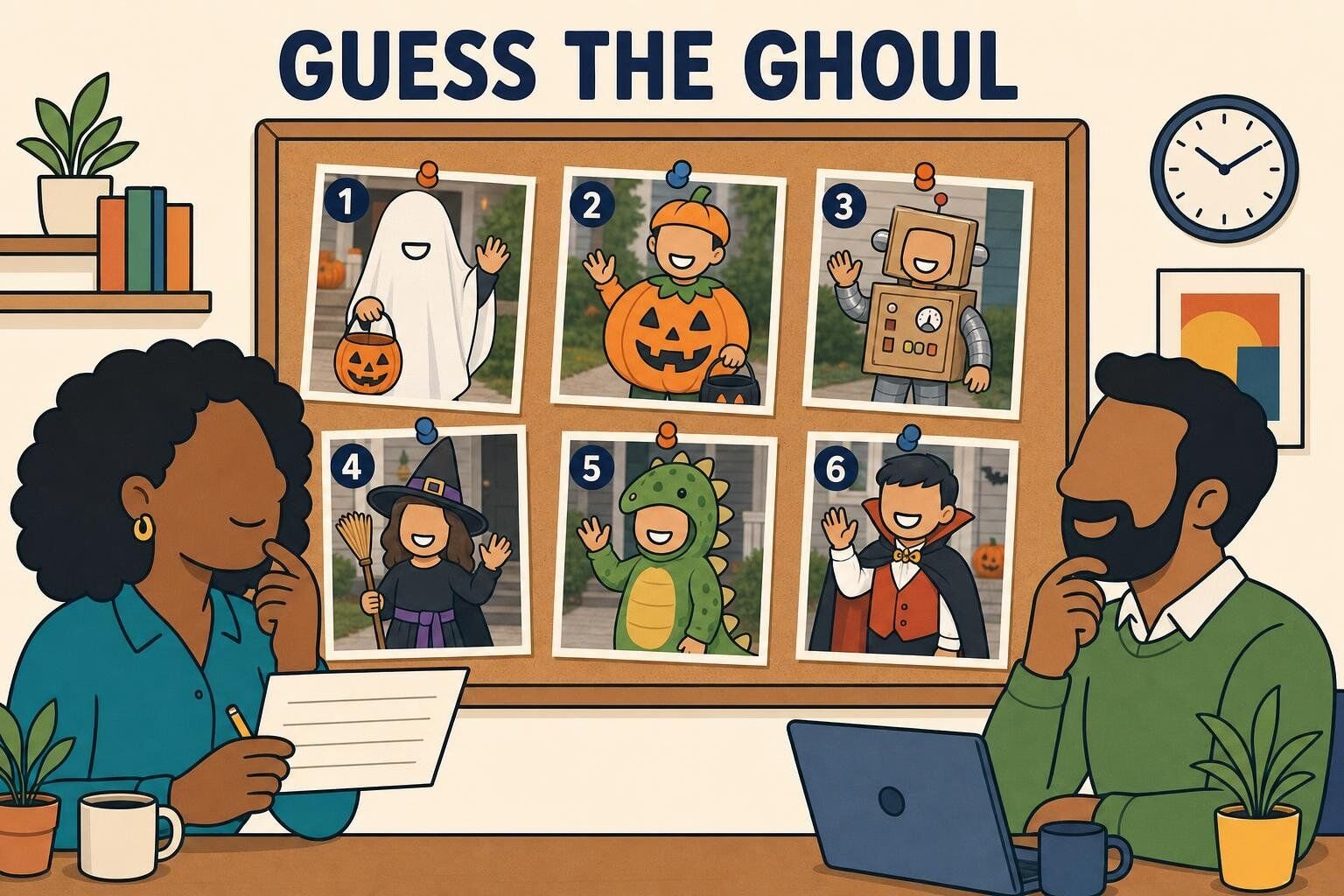
Guess the Ghoul is a nostalgia game built on your coworkers' old Halloween photos — and it reliably produces the best conversations of the month.
To play:
Have employees privately submit a photo of a past Halloween costume — childhood pictures work best.
Assign each photo a number.
Post the photos on a bulletin board, around the party venue, or in a slideshow.
Give participants a card to guess the coworker behind each costume.
Award prizes for the most correct guesses — and a "Sneakiest Ghoul" prize for the coworker fewest people identified.
Full-body childhood costumes are the hardest to guess, which makes them the most fun. The reveal is the highlight, so do it live rather than over email.
Best for: Mixed teams, 8–50 people Time: Runs in the background, 15-minute reveal Materials: Submitted photos, guess cards, prizes
4. Halloween Candy Bracket
A Halloween Candy Bracket is a March-Madness-style tournament that decides your office's definitive best Halloween candy. Seed 16 classic trick-or-treat candies into a bracket, then run one head-to-head poll per day in Slack, Teams, or on a breakroom whiteboard. The winner of each matchup advances until one candy reigns supreme.
The debates are the real game: as the bracket narrows, invite teammates to make thirty-second impassioned pleas for their favorites before the final votes. Then stock the breakroom with the champion on October 31.
Best for: Any size, remote-friendly Time: One poll per day for two weeks Materials: A bracket graphic and a poll tool
5. Werewolf
Werewolf is a social deduction classic and a perfect fit for Halloween. Players take secret roles as werewolves or villagers, and the village tries to root out the monsters before the monsters pick everyone off.
Here are the roles:
Moderator: Knows every player's identity, narrates "night" and "day," and keeps the game moving
Werewolf: Secretly picks a villager to attack each night
Seer: May ask the moderator about one player's identity each night, then must steer the village without exposing themselves
Medic: Chooses one player to protect each night
Villagers: Everyone else — they debate, accuse, and vote to eliminate one suspect each day
The game continues until the werewolves are eliminated or the werewolves outnumber the villagers. The fun is in the accusations: quiet coworkers turn out to be brilliant liars, and confident ones get voted out on day one for no reason at all.
Best for: Discussion-loving groups, 7–20 people Time: 30–60 minutes Materials: Role cards (or a moderator with a list)
6. Two-Sentence Horror Stories
Two-Sentence Horror Stories is a low-prep writing game that turns your coworkers into horror authors for twenty minutes. The format comes from the internet's favorite micro-fiction challenge: tell a complete scary story in exactly two sentences.
To play:
Give everyone five minutes to write a two-sentence horror story — office-themed stories strongly encouraged ("The calendar invite said 'quick sync.' There was no agenda.").
Collect the stories anonymously in a shared doc or a bowl.
Read them aloud in your best campfire voice.
Vote on categories: scariest, funniest, and most painfully relatable.
The office-themed entries always win the room. This game needs zero materials, works identically on a video call, and gives your quietest teammates a way to be hilarious without performing.
Best for: Creative teams, 5–40 people Time: 20–30 minutes Materials: None
7. Halloween Never Have I Ever
Never Have I Ever is an icebreaker that gets players confessing to past deeds — and a Halloween version keeps the confessions seasonal. Players hold up ten fingers, take turns reading "never have I ever…" statements, and lower a finger for each deed they are guilty of. Last player with fingers up wins.
Here are some Halloween prompts to start you off:
Regifted Halloween candy I didn't like
Raided my kid's trick-or-treat haul
Screamed inside a haunted house
Worn the same costume two years in a row
Kept the porch light off to skip trick-or-treaters
Best for: Relaxed groups, 5–20 people Time: 15–25 minutes Materials: None
8. Halloween Most Likely To
Halloween Most Likely To asks teammates to nominate each other for spooky superlatives — a fast way to surface how well your team actually knows each other. The leader reads a prompt, everyone points at (or types) the coworker who fits best, and the most-nominated player owns the title.
Here are some examples:
Most likely to spend $300+ on a Halloween costume
Most likely to survive a slasher movie
Most likely to hide a zombie bite from the group
Most likely to befriend the ghost haunting the office
Most likely to give out full-size candy bars
Most likely to fall asleep during the scary movie
Keep the prompts flattering or silly — superlatives should crown people, never roast them. Check out more work-friendly Most Likely To questions and other question games.
Best for: Teams that know each other, 5–25 people Time: 15–20 minutes Materials: Prompt list
9. Impromptu Costume Challenge
The Impromptu Costume Challenge is a design sprint disguised as a party game — and it works even when nobody remembered to dress up. Gather a pile of random office supplies and oddities: bubble wrap, sticky notes, string lights, lab coats, foil, markers, an umbrella.
To play:
Split the group into teams of three to six.
Give each team sixty seconds to grab materials from the pile.
Set a twenty-minute timer to design and build a costume on one volunteer model.
Hold a runway reveal where each team presents and explains their creation.
Judges award the win for creativity and commitment to the bit.
The presentation round matters as much as the build — teams that name their monster and give it a backstory always score higher.
Best for: High-energy groups, teams of 3–6 Time: 30–40 minutes Materials: A bin of random supplies
10. Scary Taste Test
A Scary Taste Test is a Fear-Factor-inspired challenge that crowns your office's bravest eater — with snacks that are strange, not gross. Good candidates include unusual pumpkin-spice products, cricket lollipops, extremely sour candy, ghost-pepper chips (in tiny doses), and mystery jelly beans. Avoid anything genuinely unsafe or stomach-turning; the goal is scrunched faces, not casualties.
Fun formats: spin a wheel to assign snacks, blindfold tasters and have them guess the food, or run it tournament-style until one iron-stomached champion remains. Always collect allergy information first and keep every round opt-in — spectating is half the fun anyway.
Best for: Playful groups, 6–30 people Time: 20–30 minutes Materials: Weird snacks (~$30), blindfold, wheel
11. Spooky Scavenger Hunt
A Spooky Scavenger Hunt sends teams racing to complete Halloween-themed tasks and retrieve unlikely objects before time runs out. Split the group into teams of three to six, hand each a task list, and set a timer — twenty minutes for an office-only hunt, up to an hour if teams can roam a neighborhood.
Here are starter prompts:
Find a coworker who owns a black cat
Produce something pumpkin-flavored
Snap a team photo in your best zombie poses
Write a one-sentence scary story about the office printer
Capture video of the whole team doing the "Thriller" dance
Find a receipt for Halloween candy
Build a ghost from a sheet and photograph it haunting a desk
Award points for speed, but reserve bonus points for creativity — the judging slideshow afterward is the best part. Here are more scavenger hunt ideas for adults.
Best for: Teams of 3–6, 10–60 people Time: 20–60 minutes Materials: Task list, phones for photos, prizes
12. Murder Mystery Party
Murder mysteries are the strongest Halloween team building format we know: costumes, a plot, teamwork, and betrayal, all in one package. Every player gets a character, the group hunts for clues, and someone at the table is lying.
You have three ways to run one:
DIY kit: Buy a boxed mystery or download a script, assign roles in advance, and let players ham it up. Best for 6–15 people who love theater.
Dinner theater outing: Book a local murder mystery dinner — zero prep, and the meal is built in.
Hosted event: Book a professional host to run the mystery for your team, in person or over video — the host handles pacing, clues, and stage fright so everyone just plays.
Whichever route you choose, send character assignments a few days early so players can plan a costume — half the fun is watching your quietest analyst commit fully to playing a suspicious countess. Here is a guide to virtual murder mystery games.
Best for: Story-loving teams, 6–100+ people Time: 60–90 minutes Materials: A mystery kit, or a booked host
13. Harmless Halloween Pranks
Halloween pranks at work can be great fun — if they are aimed at the whole team, telegraphed as a bit, and impossible to take personally. The rule of thumb: prank the office, never a person.
Safe classics:
Googly-eye infestation: Every object in the breakroom grows eyes overnight — the fridge, the mugs, the fruit bowl.
The new hire: A plastic skeleton appears at an empty desk with a name badge, a lanyard, and a calendar full of meetings. It relocates daily.
Pumpkin multiplication: One mini pumpkin appears on a shelf. Then three. By Halloween there are forty.
Haunted meeting rooms: Room signs get temporary spooky names — "The Crypt," "Bat Cave," "Room 13."
Skip anything that involves genuine startles, realistic spiders or snakes (real phobias are not entertainment), personal property, or singling out one victim. If the target would not laugh hardest, it is not a prank — it is a problem.
Best for: Any office, all month Time: Background Materials: Googly eyes, a skeleton, mini pumpkins
Halloween contest ideas for work
Contests are the highest-leverage Halloween format because they build anticipation for days before anyone competes. Announce categories early, recruit judges, and keep entry genuinely optional — then let the office trash talk carry you to the finale.
14. Costume Contest
The costume contest is the anchor of most office Halloween celebrations, and a few structural choices make the difference between "three people dressed up" and a real show. Announce it at least two weeks out, and publish categories so there are multiple ways to win:
Best overall
Funniest
Best DIY / handmade
Best work-appropriate scare
Best last-minute effort
Voting works best with stickers — give every attendee three, and let them vote on costume photos posted on a wall or a channel. Our sister brand, Museum Hack, runs a yearly contest where employees dress up as famous works of art and pose accordingly; a theme like that gives creative teammates a canvas beyond "scary."
Group costumes turn the contest into a team building exercise, because a good group costume requires actual coordination. Challenge departments to enter as a themed set — a Tetris block that assembles on stage, a full deck of tarot cards, the seven stages of a Monday morning, or every character from one movie.
Judge groups separately from individuals, and score for cohesion and commitment rather than budget. The planning thread is where the bonding happens; the runway walk is just the receipt.
16. Kid & Pet Costume Contest
A kid and pet costume contest lets teammates show off the family members who actually wear costumes with no self-consciousness at all. Dedicate a Slack channel or bulletin board for photo entries, run separate divisions for kids and pets (a corgi in a hot dog bun cannot fairly compete with a toddler dinosaur), and award bonus points for handmade costumes.
This contest is a gift for remote teams: it takes five minutes a day, requires zero scheduling, and reliably becomes the most active channel in the workspace by October 31.
17. Pumpkin Decorating Contest
Pumpkin decorating is the craft contest with the lowest barrier to entry — no artistic skill required, and mini pumpkins keep the budget tiny. Set up a decorating session with paint, markers, ribbon, googly eyes, and craft scraps, then display the finished gourds for a week of office voting.
Structure options:
Individual: Everyone decorates a mini pumpkin at their desk.
Team build: Small teams get one large pumpkin and a theme, such as "movie villains" or "our department as a pumpkin."
Carve-off: For in-office groups with drop cloths and nerve, a classic jack-o-lantern contest — judged after dark, candles lit.
An office decorating contest turns your floor into a haunted attraction one cubicle cluster at a time. Assign zones to teams, set a budget cap so it stays a creativity contest rather than a spending contest, and give everyone a week to build. Themes sharpen the results: zombie apocalypse, retro monster movie, haunted library, "the server room at midnight."
Tour the entries together as a group — the walkthrough, with each team presenting their haunted corner, is a better bonding activity than the decorating itself. Announce winners at the Halloween party.
19. Halloween Spirit Week
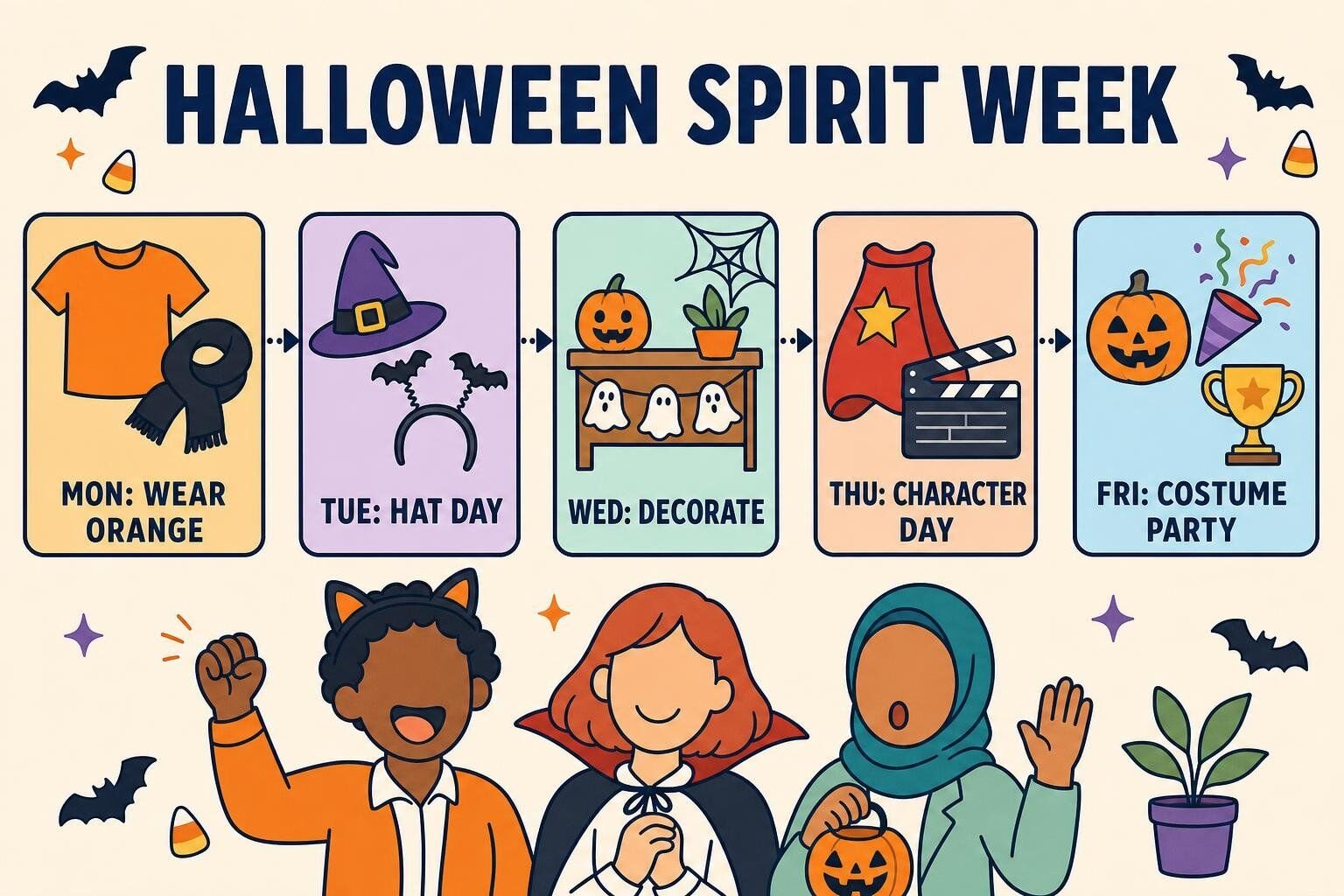
Halloween spirit week stretches the holiday across five days of low-effort themes, so even teammates who skip costumes get a way to play. A structure that works:
Monday: Orange and black day — wear the colors, that's it
Tuesday: Spooky hat or headband day
Wednesday: Decorate your desk (or virtual background)
Thursday: Dress as a movie or TV character
Friday: Full costume day + the party
Each day takes under a minute of effort to join, which is exactly why participation climbs across the week. Post a daily photo thread, and let the momentum peak at Friday's costume contest.
Office Halloween party ideas & activity stations
Beyond the games and contests, these office Halloween ideas give the celebration texture — things to sip, make, watch, and photograph between rounds.
20. Office Halloween Party
The office Halloween party is the container for everything else on this list, and the parties that work share a spine: an opener, one or two anchor games, stations to drift between, and a defined ending. Cocktails plus a candy bowl is not a party — it is a waiting room with better snacks.
A 90-minute structure that works:
Arrival (15 min): Music, drinks, Halloween Team Bingo cards handed out at the door
Anchor game (30–45 min): Trivia, a game show, or the costume contest runway
Stations (30 min): Photo booth, taste test table, crafts — people choose their own adventure
Finale (10 min): Contest winners announced, prizes awarded, group photo
Schedule it during work hours — late October calendars are crowded, and an on-the-clock party signals the celebration is a gift, not an obligation. Here are more office party ideas.
21. Trick-or-Treat Trail
An office trick-or-treat trail turns departments into stops on a candy route. Give each team a station to theme and stock, then set a window where everyone roams the floor collecting treats and comparing decorations. Inviting employees' kids for an afternoon hour turns it into a beloved family event — and gives parents a safe, dry, well-lit trick-or-treat option.
For a grown-up version, make it a tasting trail instead: each stop serves one seasonal bite or drink, from candy-corn cookies to hot cider.
22. Halloween Photo Booth
A Halloween photo booth gives the party a gravity well — people orbit back to it all event long. Rig a backdrop from black fabric, string lights, and paper bats, then stock a prop table: witch hats, vampire capes, skeleton hands, picture frames to pose inside, and a "WANTED" sign.
A phone on a tripod with a timer works fine; a mini photo printer is a worthwhile upgrade so people leave with a physical print. The photos double as decoration for November and content for your next recruiting page — with permission, always.
23. Potion-Making Class
Potion-making classes elevate a drinks station to theater. Book a bartender to teach two or three Halloween cocktails — think blackberry "witch's brew," smoking dry-ice punch, or a candy-corn-layered mocktail — or DIY it with cauldron bowls, printed "spell book" recipe cards, and a fog machine.
Make the mocktail track a first-class citizen, not an afterthought: name the drinks, garnish them equally, and nobody has to explain why they are not drinking. The shared skill is the team building; the potions are the excuse.
24. Cider & Candy Tasting Table
A tasting table is the lowest-effort station with the highest dwell time. Lay out a flight of local ciders (alcoholic and non-alcoholic), a lineup of unusual seasonal candy, and scorecards so tasters can rate each entry. Crown a "people's choice" cider and candy at the end of the party.
Pair it with a homemade round: invite bakers on the team to enter a Halloween treat, potluck-style, and let the office vote. The recipe swap that follows is the kind of small connection that outlasts the party.
25. Scary Movie Marathon
A scary movie screening is the low-pressure social option every Halloween plan needs — present, together, and nobody has to perform. Poll the team on tolerance first: a room split between horror devotees and the easily-spooked does better with a crowd-pleaser like Ghostbusters, Beetlejuice, or The Nightmare Before Christmas than with a true slasher.
Set up a projector, dim the lights, and serve popcorn with orange-and-black sprinkles. For distributed teams, a watch-party extension plus a live chat thread recreates most of the couch energy — the running commentary is the point.
26. Halloween Crafts
A craft session is the Halloween activity for teammates who cannot stomach scary stuff and would rather make something. Strong projects: ghost garlands, custom trick-or-treat tote bags, mini wreaths, painted candle jars, and Day of the Dead masks — paired with an instructor (or a confident volunteer) demonstrating step by step.
Put out snacks, play a seasonal playlist, and let conversation do the team building. Encourage everyone to display their creations at their desks — a floor full of handmade ghosts in November beats any motivational poster.
Halloween team outing ideas
October is the rare month with a full calendar of ready-made team outings — attractions do the planning, you just book. Four favorites:
27. Haunted House Trip
A haunted house trip is the classic Halloween team outing: getting scared together is a shortcut to feeling closer, and finding out which stoic manager screams first is priceless team lore.
Scare levels vary enormously — from family-friendly to "actors touch you" — so check reviews and match the intensity to your group. Make attendance genuinely optional, offer a nearby cafe as a parallel plan for non-participants, and warn anyone with heart conditions or anxiety to sit it out without ceremony. Book for a weeknight: October weekends sell out weeks ahead and the lines triple.
28. Ghost Walk
Ghost walks are guided evening tours of a city's reportedly haunted spots — history with a spine-tingle, and the best fit for teams that prefer real stories over jump scares. A guide leads the group between locations telling documented tales of the buildings' pasts, which gives coworkers built-in conversation between stops.
These tours run rain or shine in most cities through October, handle groups well, and end conveniently near restaurants — book a table for afterward and let the debrief become the second half of the event.
29. Pumpkin Patch & Hayride
A pumpkin patch trip is the wholesome daytime option: golden hour, cider donuts, and a tractor-pulled hayride through the fields. Let every teammate pick a pumpkin on the company tab, then bring the haul back for the decorating contest — one outing feeding a second activity.
Many farms add corn mazes, which make a natural team challenge: split into groups, race for the exit, and settle bragging rights by time. This outing is the easiest to make family-friendly, and scheduling it on a workday afternoon makes it feel like a proper escape.
30. Escape Room Outing
Escape rooms are team building in its purest form — a locked door, a ticking clock, and no way out except collaboration — and October is when venues run their best horror-themed rooms. Book adjacent time slots for multiple rooms and race teams head-to-head, then compare completion times over dinner.
Rooms fit four to ten players, so a big group needs several bookings — reserve two to three weeks ahead in October. Prefer to stay in? Here is a guide to DIY escape room puzzles you can run in a conference room.
Hosted Halloween events, ranked by real survey data
If you would rather celebrate with your team than emcee for them — or you need Halloween games that work for large groups — bring in a professional host. Hosted formats scale where DIY games strain: teams, co-hosts, and a scoreboard keep 40 or 400 people in the same game. We rank our own hosted events with our Team Building Score, which combines confirmed bookings, verified reviews, ratings, and post-event survey outcomes. Here are our top Halloween events by that score:
Ranked by our Team Building Score — a running points total earned through confirmed bookings, verified reviews, ratings, and listing quality, recalculated nightly. Every event shown also has at least 30 post-event survey responses per question; the happier, connected, and NPS columns are computed from the 1,007+ survey responses collected for the 8 events listed here — a subset of all post-event surveys across our catalog. Updated October 2026.
Virtual Halloween Party is a fully hosted celebration for remote and hybrid teams: an expert host leads your group through spooky icebreakers, Halloween games, and a costume showcase over Zoom, Teams, or Google Meet. You bring the team; the host brings the structure, the energy, and the permission to be silly.
Our virtual Halloween events have real third-party pedigree, too — when BizBash rounded up its "16 Halloween-Themed Virtual Team-Building Ideas," two of the sixteen featured events were ours, including this party. See the BizBash roundup.
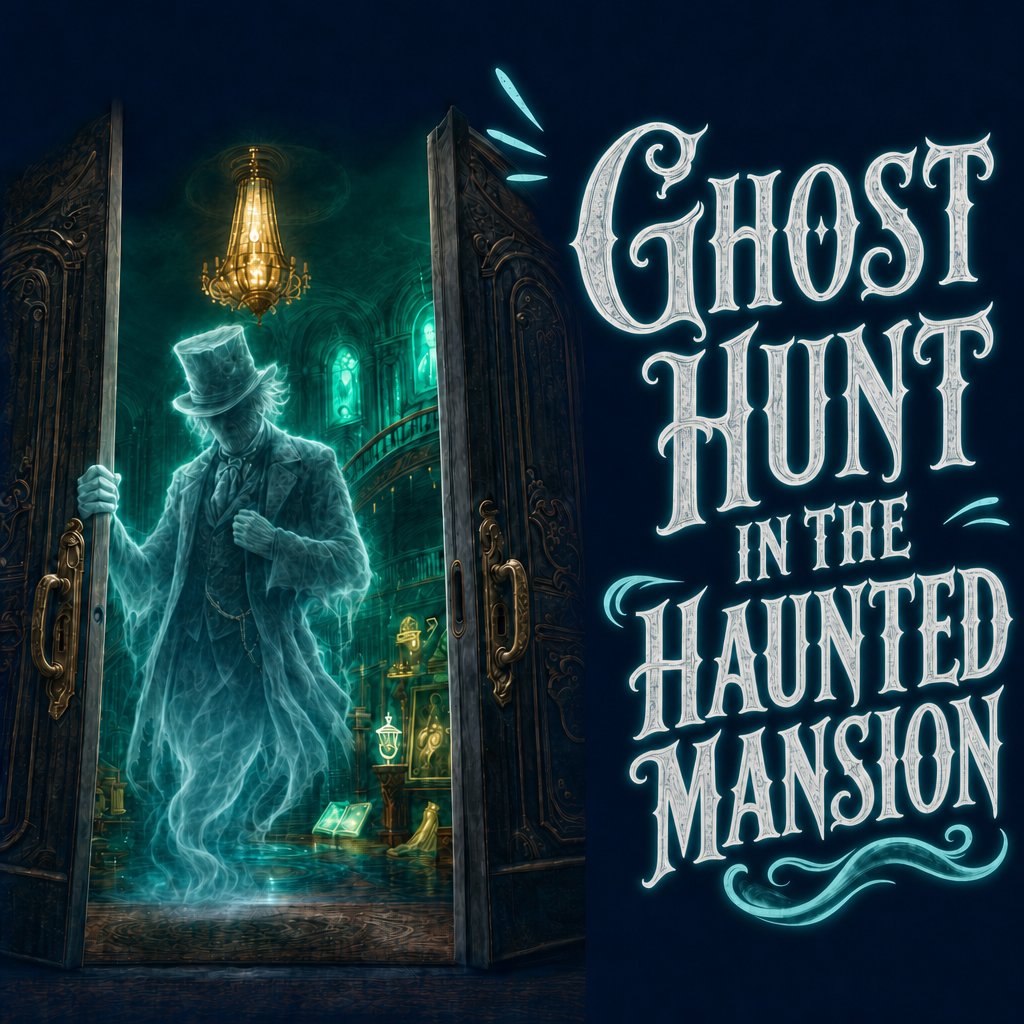
Ghost Hunt in the Haunted Mansion sends your team on a virtual expedition through the Winchester Mystery House's legend — a 90-minute hosted adventure of eerie storytelling, Ouija-board encounters, and collaborative puzzles, with an escape to earn at the end. It is the closest thing to a haunted house your remote team can attend in slippers.
More details:
90 minutes with a professional host
Story-driven: mysteries, dark secrets, and jump-scare moments
Collaborative puzzles and clues that need the whole team
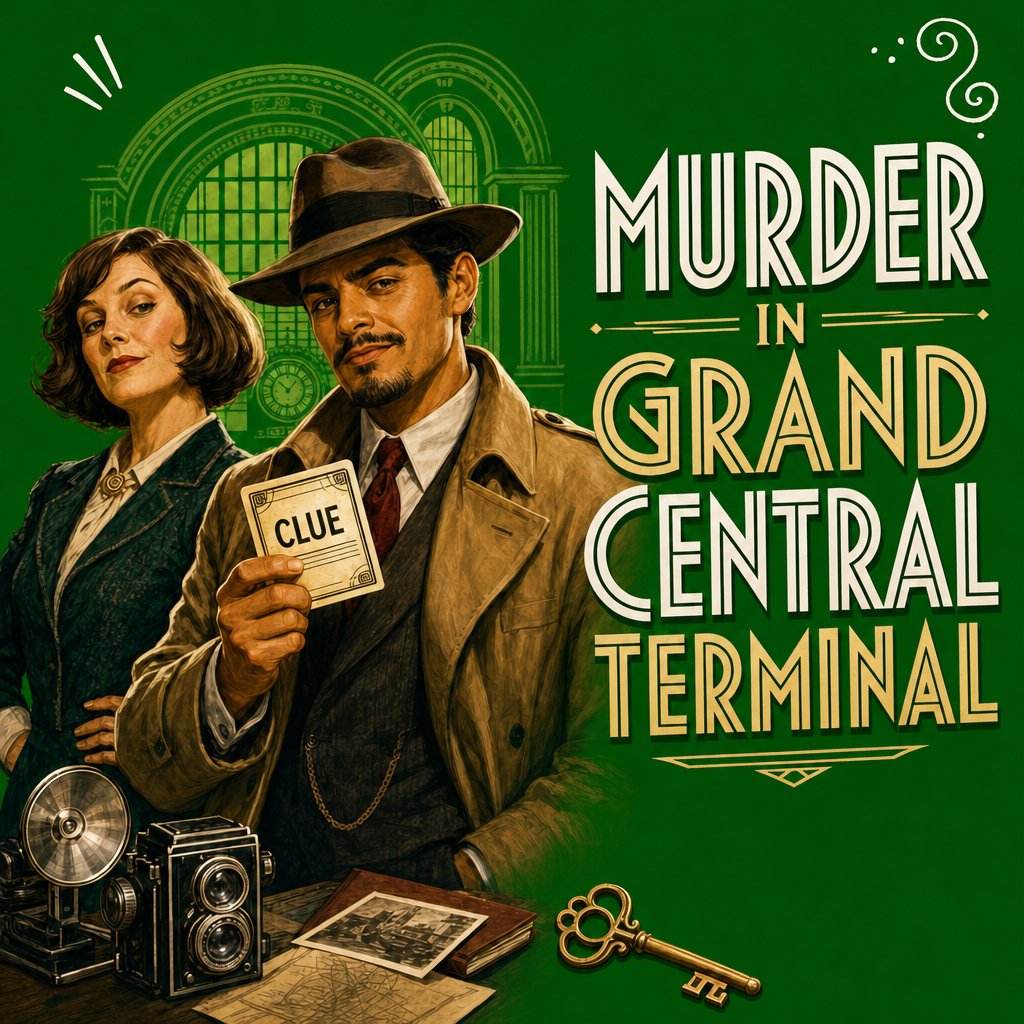
For New York teams who want their Halloween team building in person, Murder in Grand Central Terminal turns one of the city's most iconic buildings into a crime scene. A professional host briefs your teams on the case, then sends them through the terminal following clues, interrogating the evidence, and racing rival squads to name the killer.
The event blends a murder mystery with a scavenger hunt, runs about 90 minutes, and needs nothing from your team but comfortable shoes and healthy suspicion. It is our pick for NYC Halloween team building — atmospheric, competitive, and genuinely puzzling.
Halloween is not a novelty week for us — it is peak season. The lessons below come from the October events we've hosted and the post-event surveys behind them:
Book by late September. Because October is peak season, hosts, haunted attractions, and escape rooms book out — weekend slots go first, and last-minute planners end up with a candy bowl and regrets. Lock your date and format by the end of September; run contests the last week of October, when costume enthusiasm peaks.
Competition is the engine. Participants consistently name friendly competition as the highlight of our virtual events — points, buzzers, and leaderboards give a session energy while the stakes stay at bragging rights (a theme across 394 competition-mentioning reviews of our virtual events, averaging 4.93 out of 5). Our hosts see the same thing in the room: groups that start the event half-engaged open up fast once there is a scoreboard to fight over. Halloween makes this easy — every contest on this list ships with built-in stakes.
Shared laughs do real bonding work. There is science under the silliness: a 2017 brain-imaging study in the Journal of Neuroscience by Sandra Manninen and colleagues found that 30 minutes of social laughter with close friends triggered endogenous opioid release in brain regions linked to pleasure and social bonding — evidence for laughter as a neurochemical pathway to social connection. Read the study. An hour of costume-contest laughing is not wasted work time; it is the bonding mechanism itself.
Scares are a spectrum — let people choose their spot on it. Every team has horror devotees and people who genuinely hate being frightened, and both are right. Program in layers: a craft table and a movie for the gentle end, trivia and contests in the middle, haunted houses strictly opt-in at the far end. Nobody should have to publicly decline a scare.
Costumes are opt-in, always. The fastest way to sour a Halloween celebration is to make dressing up feel mandatory. Spirit-week formats fix this — orange-and-black day takes zero effort, so everyone participates at the level they choose. Judge enthusiasm, never absence.
Halloween is the low-stakes rehearsal for December. Teams that run a great October — a contest, a party, a game — walk into holiday-party season with formats tested and a planning committee that already works. Treat it as the warm-up for the busiest month, and steal what worked. For year-round formats, browse our full list of team building games.
Halloween office ideas we don't recommend
A few Halloween traditions survive on momentum alone. Having watched a lot of October events, here is what we would skip:
Idea
Why skip it
Verdict
Mandatory costumes
Requiring costumes turns a treat into a compliance exercise. Spirit-week themes give everyone a low-effort way in.
Make it opt-in
Pranks that target one person
A prank with a single victim is hazing with decorations. Prank the office — googly eyes, skeleton coworker — never a colleague.
Redirect it
Genuinely terrifying surprises
Jump-scaring unsuspecting coworkers (or hiring an actor to) ignores real phobias and heart conditions. Scares belong where people opted into them.
Skip it
Costume contests judged on spend
When the $400 rented costume beats the brilliant cardboard robot, you have taxed creativity and rewarded budget. Add a "best DIY" category and judge commitment.
Fix the categories
Unlabeled boozy treats
Spiked cider and bourbon caramels need clear labels — surprise alcohol is never funny. Label everything and keep great zero-proof options.
Label it
Costume policies announced after the fact
Publish simple guidelines up front (work-appropriate, no impersonating coworkers, skip culturally appropriative costumes) rather than disciplining someone on the day.
Plan ahead
Final Thoughts
Halloween earns its place on the team calendar because it asks so little and returns so much: a bag of candy, a costume rack, one afternoon — and in exchange, your quietest engineer wins the costume contest and the whole floor talks about it until Thanksgiving. The teams that do October well treat it as a season, not a day: contests building through the month, one anchor event, and every scare optional.
Pick two or three ideas from this list, put them on the calendar by late September, and let the office's natural competitiveness do the rest.
Answers from the team behind thousands of October events for clients like Amazon, Procore, and Raymond James.
What are Halloween team building activities?
Halloween team building activities are group games, contests, and outings that bring coworkers together during spooky season. Examples include Halloween trivia, costume contests, pumpkin decorating contests, murder mystery parties, and haunted house trips. The best plans combine week-long contests with one anchor party or game session — and keep every scare optional.
What are good Halloween office games?
Reliable Halloween office games include Halloween trivia, Halloween team bingo, a Halloween candy bracket, Werewolf, two-sentence horror stories, and murder mystery parties. For groups over 40 people, hosted game-show formats with teams and a scoreboard keep everyone playing at once.
How do you celebrate Halloween at work?
Celebrate Halloween at work in three layers: contests that build through the month (costume, pumpkin decorating, desk decorating), a party or game session that anchors the celebration, and optional outings like haunted houses or escape rooms. Schedule the party during work hours, keep costumes opt-in, and use spirit-week themes so low-effort participation still counts.
What are good Halloween contest ideas for work?
The best Halloween contest ideas for work are costume contests with multiple categories (best overall, funniest, best DIY), group costume contests judged on coordination, kid and pet costume photo contests, pumpkin decorating contests, office decorating contests, and a five-day Halloween spirit week ending in the costume finale.
When should you plan Halloween team building?
Book by late September. October is our second-busiest month of the year for team building events — 11% of annual volume, behind only December — and hosts, haunted attractions, and escape rooms book out, with October weekend slots going first. Run costume and decorating contests in the last week of October, when enthusiasm peaks.












Comments (0)
Leave a Comment