157 Icebreaker Questions for Work, Meetings and Every Group (+ Random Generator)
157 icebreaker questions organized by setting and tone — work, team meetings, question of the day, fun, funny, quick, and weird — with a random generator, facilitation advice from our host team, and the inappropriate questions to skip.
Published
·
Updated
You found our list of the best icebreaker questions for work. Icebreaker questions are short prompts that open a meeting or event with quick introductions and easy conversation. For example, "Share your name, your role, and what you usually eat for breakfast." The goal of these questions is to create points of connection between participants and warm up the room before the main agenda. Other common spellings for these prompts are "ice breaker questions" and "ice breakers questions."
Since 2013, teambuilding.com has run 45,000+ team building events, and our hosts open nearly every one of them with an icebreaker — so we have strong opinions about which questions actually work. For this update we read every prompt in the previous version of this article, cut the duds and duplicates, sharpened the wording of the survivors, and added the questions our hosts reach for in real rooms. These prompts pair naturally with icebreaker games and are similar to get to know you questions.
Icebreaker questions are also called "ice breaker questions," "icebreakers for work," "team icebreaker questions," and "questions to break the ice" — this list covers all of those.
These are the questions we recommend for offices, onboarding, and mixed groups of coworkers — professional enough for any room, personal enough to start a real conversation.
How would you describe your job to a five-year-old?
What was your first job ever?
What do your family and friends think you do all day?
What did you want to be when you grew up — and how close did you land?
What is your standard office lunch?
What surprised you most in your first week at this job?
Would you rather live close to work or at work?
Is it better to be late for work or to leave early?
What is the most unusual job you have ever heard of?
Would it be better to start work five years later or end five years earlier?
Pitch a new national work holiday. What are we celebrating?
What is something you did at work that you are proud of, but nobody noticed?
Do you prefer working from home or the office?
What is the one tab always open in your browser?
What snack fuels your best work?
Do you take your PTO in one big trip or spread it out?
Describe your commute in three words.
Best Icebreaker Questions for Team Meetings
Meetings are where most icebreaker questions get asked, and where most of them die of boredom. The fix is a question with a specific, surprising answer — and a time limit. For recurring and all-hands meetings, we recommend the 8% rule: allocate about 8% of meeting time to icebreakers and social connection, such as a 10-minute icebreaker block plus five minutes of recognition inside a 60-minute agenda. For more ways to upgrade your agenda, see these team meeting ideas.
What is the best piece of advice you have ever gotten at work?
Imagine you no longer have to work. How would you spend a Tuesday?
Which person from history would you add to Mount Rushmore?
What show are you currently binge-watching?
If you could be great at any Olympic sport, which would it be?
What was the worst job you ever had?
What would it take for you to give up your smartphone for a month?
Where is your favorite vacation spot?
Do you speak more than one language? Say hello in one.
Who is the most famous person you have ever met?
Which instrument do you play — or wish you could?
What is the most unique pet you have ever had or met?
What is the worst advice anyone has ever given you?
What is your favorite mythical creature?
Team Icebreaker Questions
These questions get groups talking about teamwork itself — favorite teams, team wins, and the eternal debate about lone wolves. They are a natural warm-up before workshops and planning sessions.
Which fictional team is the best team of all time?
Which real team is the best team of all time?
Would you rather be an Avenger or a Power Ranger?
Would you rather join Metallica or the Backstreet Boys?
Were the Spice Girls a good team?
What was the first team you were ever part of?
What is something you accomplished as part of a team?
Would you rather do a big project independently or as part of a team?
Can lone wolves be part of a team?
What is the best team name you have ever been part of?
A question of the day is an icebreaker on a schedule — one light prompt at the top of a standup, posted in a team channel, or added to a recurring agenda. The trick is rotation: small and consistent beats occasional and elaborate. These prompts are designed to be answered in under 30 seconds and repeated without wearing out.
What is one small win from the past 24 hours?
What are you most looking forward to this week?
In one word, how is your week going?
What is something new you learned this week?
What song is on repeat for you right now?
What would make today great?
Who helped you out recently, and how?
What is the view from your desk right now?
What was the best part of yesterday?
What are you having (or dreaming of having) for lunch?
If you run these daily or weekly, our check-in questions list gives you months of extra material.
Fun Icebreaker Questions
Fun icebreaker questions are the all-purpose middle of the deck: light, a little silly, and answerable by anyone. These are the prompts our hosts use to warm up a room that has never met before.
Do you fold your pizza?
What fictional family would you most like to join?
Would you rather be reincarnated as a cat or a dog?
Pull out your phone and show us your most-used emoji.
Who was your famous childhood crush?
You are walking up to bat in the big leagues. What is your walk-up song?
What celebrity do most people say you look like?
What movie do you wish you could watch again for the first time?
You can only eat one food for the rest of your life. What is it?
What is your go-to karaoke anthem?
Is a hot dog a sandwich? Defend your answer.
Pick your favorite decade. Why that one?
You are stranded on a desert island: alone, or with your worst enemy?
What is the best thing you have bought so far this year?
Who is the most interesting Disney character?
What dog breed would you be?
What bucket list item do you most want to check off in the next six months?
If you could instantly learn any language, which would you choose?
Show us your phone background and tell the story behind it.
Show us the weirdest thing within arm's reach right now.
Funny Icebreaker Questions
Funny icebreaker questions trade facts for laughs. The best ones give people permission to be a little ridiculous — which, our hosts will tell you, reveals more personality than any resume fact.
Does your car have a name? What is it?
Pick one famous person from history for your zombie apocalypse team.
What was the most unique fashion trend you ever embraced?
Tell us about your worst haircut ever.
What discontinued fashion trend would you bring back?
What simple food will you never eat?
Which actor would play you in the movie of your life?
Did you have an imaginary friend as a kid? Would you want one today?
What is your favorite knock-knock joke?
Would you rather have a pet sloth or a pet parrot?
Which trap in Home Alone was the best?
What movie made you laugh the hardest?
What is the best romantic comedy?
What is the most obscure superpower you would want?
Which superpower would you give to your archenemy?
Good icebreaker questions are the reliable ones — easy to answer, hard to answer identically. Every prompt here passes our hosts' bar: anyone in the room can respond, and no two answers sound the same.
What was your best class in school?
Which author would you read anything by?
What is something interesting about you that we would not know just by looking?
What is your most-used phone app?
If you could live anywhere in the world, where would you pick?
What is your #1 recommendation in this city — restaurant, sight, or hidden gem?
What is the best kitchen gadget?
Which song could you listen to over and over?
You can visit any fictional time or place. Where do you go?
Which show do you remember most from your childhood?
What is your favorite season?
What is your favorite seasoning?
What is your favorite movie genre?
Which of your teachers was most memorable, and why?
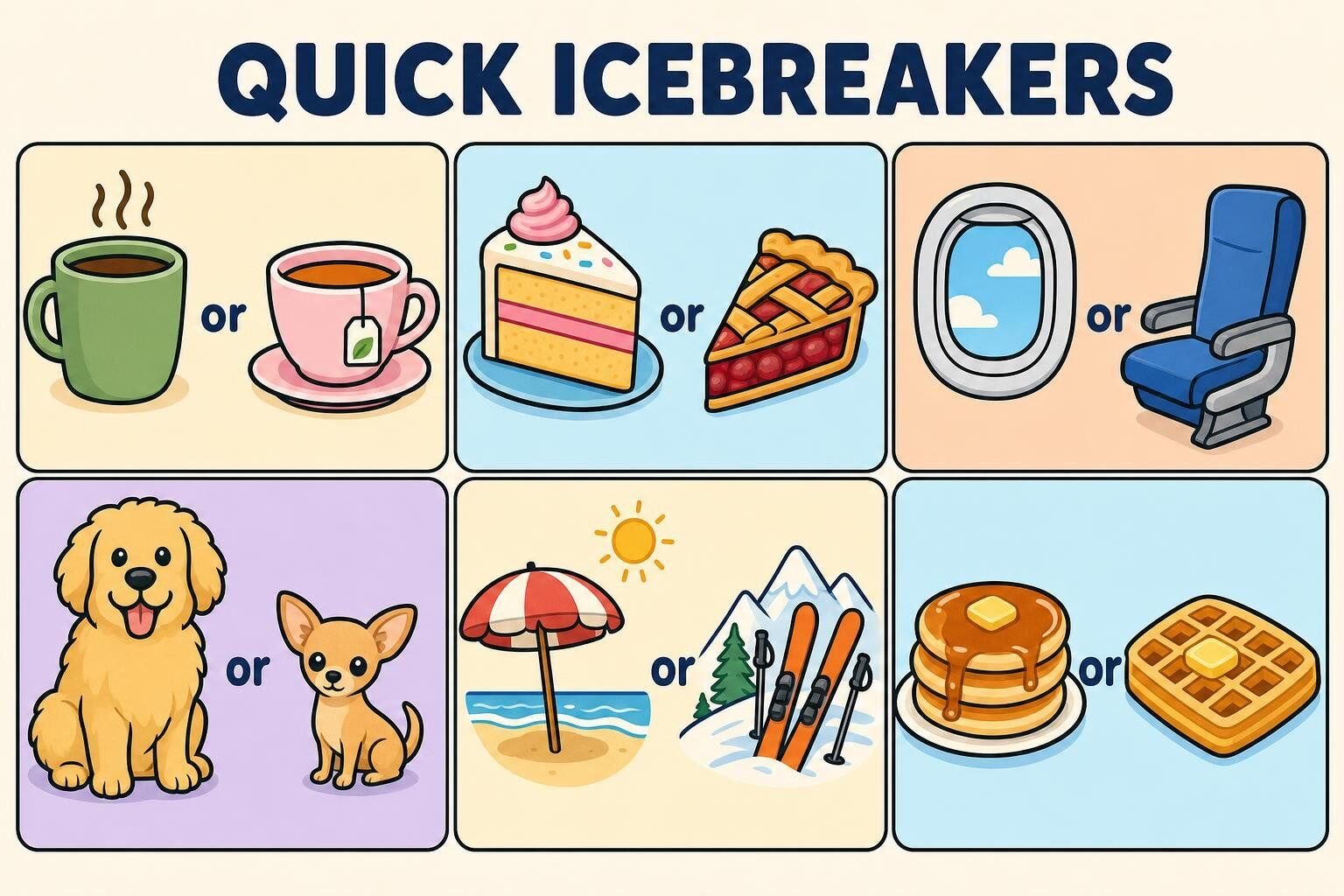
Quick icebreaker questions have one-word answers, so you can hear from twenty people in two minutes. Ask for a show of hands, run them as a lightning round, or let each person answer and immediately name who goes next. For full rapid-fire rounds, see our this or that questions and these 5 minute team building activities.
Coffee or tea?
Big dogs or small dogs?
What did you have for breakfast?
Sweet or salty?
Cake or pie?
What is the best dessert?
What is your favorite holiday?
Hotel or Airbnb?
Window seat or aisle?
Beach vacation or ski trip?
City or small town?
Texting or calling?
Early bird or night owl?
Pancakes or waffles?
Icebreaker Questions for Adults
These questions lean on the one thing adult groups have that student groups don't: decades of material. Expect generational debates, "when I was your age" stories, and at least one passionate defense of a dead technology.
What was the first way you ever made money?
Which beverage goes best with pizza?
How do you top your burgers?
What is your best "When I was your age..." story?
What is a current trend you just don't understand?
What advice would you give your younger self?
Which movie defined your generation?
Which song do you remember most from your school dances?
When you are alone in the car, how loud is the music?
What hobby could you talk about for an hour with zero prep?
What is the strongest opinion you hold about a completely trivial thing?
What skill did you have at 15 that you wish you still had?
Unique and Weird Icebreaker Questions
Unique icebreaker questions are the memorable ones — nobody has a rehearsed answer to "what vegetable is best with cheese?" Save these for groups with a little familiarity, where an unexpected question lands as fun instead of confusing.
What is the weirdest food you have tried? Would you eat it again?
If you could have an unlimited supply of one thing, what would you pick?
Would you let aliens beam you up if they landed tomorrow?
What simple dance move can you just not do?
What vegetable is best with cheese?
You are the world's best criminal mastermind. What crime do you commit, knowing you would get away with it?
What reality show would you want to be on?
There is a free round-trip shuttle to Mars, but the trip costs one year of your life. Are you in?
You can teleport anywhere right now. Where do you go?
Would you want a personal assistant following you around all day?
Would you rather live 100 years in the past or 100 years in the future?
What is a weird fact you know that nobody asked for?
What is the most useless talent you have?
Icebreaker Questions for Students and Kids
Classroom icebreakers work best when they stay concrete — favorite things, funny memories, and choices between two good options. The first ten questions suit high school and college groups; the last five work for younger kids.
Which class is both difficult and fun?
Which class do you wish your school offered?
What was the best childhood gym activity?
What do you miss most about kindergarten?
If you had to write a textbook, what would it be about?
Pop quiz or end-of-year exam?
What is your "I almost missed the exam" story?
How did you choose your college?
What do people not understand about being a student?
Online classes or in-person?
What is your favorite color, and why?
Cookies or brownies?
What is your favorite type of ice cream?
What do you call your grandparents?
If your pet could talk, what would it say?
Inappropriate Icebreakers to Avoid
Some questions end conversations instead of starting them. When teambuilding.com trains hosts, we emphasize "green-light" prompts — questions that are unlikely to make anyone uncomfortable — and mechanics that add a layer of consent, so nobody has to publicly decline to participate. These prompts fail that test:
"How much money do you make?" — salary talk creates instant tension between teammates.
"Who is your office crush?" — a question no HR team wants asked at an official event.
"What was the most difficult thing about your childhood?" — therapy-session territory, not icebreaker territory.
"Have you ever seen a therapist?" — private health information is never icebreaker material.
"How did you get your worst scar?" — for some people the story is funny; for others it is a trauma you just asked them to relive.
"What is your mother's maiden name?" — besides being dull, this is literally a bank security question.
A simple test: if a question would be out of line in a job interview, it is out of line as an icebreaker. When in doubt, choose a prompt about preferences and stories rather than hardships and identities — the fun sections above are full of them.
How to Run Icebreaker Questions
Running good icebreakers is harder than it looks — everyone has sat through a limp "say your name and what you hope to get from this session." There is also a research reason to get this right: in a study of 51 work teams, Harvard's Amy Edmondson found that team psychological safety — a shared belief that the team is safe for interpersonal risk-taking — enables team learning behavior, which in turn drives team performance. A low-stakes question at the top of a meeting is the cheapest psychological-safety tool a team has: it gets every voice in the room before anything is at stake. Here is the process our hosts use.
1. Answer first, then name who goes next
Start with a fun or interesting question so people actually want to hear the answers. The facilitator asks the question, gives their own answer as a demo, and then names who goes next. In a circle, continue around; on video calls, have each person nominate the next speaker after answering. Knowing exactly when your turn comes removes most of the anxiety of speaking up.
2. Choose open-ended questions — and always follow up
Yes/no prompts are useful for lightning rounds, but conversation comes from questions with specific, unique answers. The real magic is in the follow-up:
"Always ask a follow-up to an icebreaker answer, especially when it sounds like someone is passionate about something! Folks will talk forever about the things they love."
- Leighton Schlanger, teambuilding.com Event Host
3. Give everyone a chance to speak
"Give everyone a chance to speak. Sometimes there are Type A people that want to answer every question out the gate. While it may feel a little awkward, let a question hang in the air for juuuust an extra second. Sometimes your cautious Jim's and Janes in the background need a little pause to work up the confidence to speak. Or at least fill your awkward silence, ha!"
With more than about 15 people, split into pairs or small breakout groups so everyone answers, then ask a few volunteers to share highlights when the full group reconvenes. Our guide to large group icebreakers covers formats built for big rooms.
4. Match the question to the room
Factors to weigh: how well the group knows each other, the setting, how much time you have, and your goals. New groups get green-light questions about preferences and stories; established teams can handle the weird section. If you are in doubt, choose a unique question over a common one — and for remote meetings, lean on show-and-tell prompts (phone backgrounds, desk views), which our virtual icebreakers guide explores in depth.
5. Keep it short, and let the team pick
One strong question, answered by everyone, beats three rushed ones. If you ask icebreakers regularly, rotate who picks the question — the choice of prompt reveals as much personality as the answer, and the room invests more in a question one of their own chose.
Hosted Events That Do the Icebreaking for You
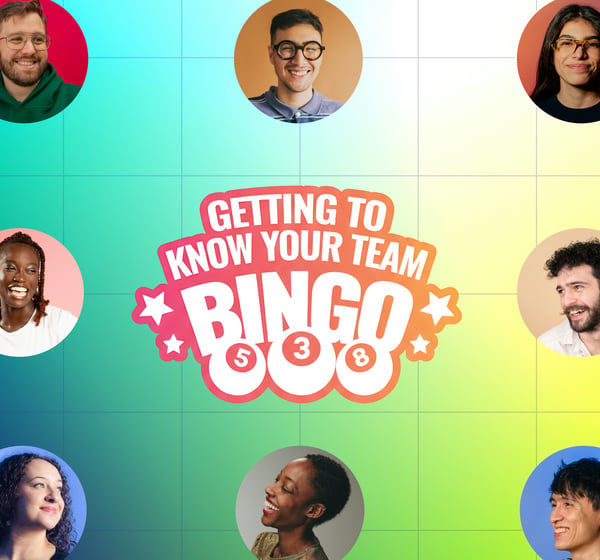
Asking your own questions works great for regular meetings. For bigger moments — onboarding cohorts, offsites, all-hands, holiday parties — many teams bring in a professional host to run question-based formats like trivia, game shows, and get-to-know-you bingo, so everyone (including the organizer) gets to play.
We rank our own hosted events with our Team Building Score, which combines confirmed bookings, verified reviews, ratings, and post-event survey outcomes — and we publish exactly how it works. Here are our top icebreaker-style events by that score:
Ranked by our Team Building Score — a running points total earned through confirmed bookings, verified reviews, ratings, and listing quality, recalculated nightly. Every event shown also has at least 30 post-event survey responses per question; the happier, connected, and NPS columns are computed from the 2,867+ survey responses collected for the 10 events listed here — a subset of all post-event surveys across our catalog. Updated September 2026.
Our hosts have asked hundreds of thousands of icebreaker questions across 45,000+ events since 2013. A few lessons that survive contact with every kind of room:
Specific beats generic. "Tell us a fact about yourself" produces silence; "what is a weird fact you know that nobody asked for?" produces a queue. The narrower the prompt, the easier it is to answer — people freeze at open canvases and light up at strange, specific ones.
Small talk is not wasted time — there is research on this. A 2021 Academy of Management Journal study by Jessica Methot and colleagues tracked employed adults daily for three weeks and found workplace small talk enhanced positive social emotions — boosting citizenship behaviors and end-of-day well-being — even though it could also briefly disrupt focus. The authors call small talk "uplifting yet distracting." An icebreaker question is the structured version: the uplift, on a timer, with the meeting agenda intact.
Work friendships are a business metric, not a perk.Gallup reports only two in 10 U.S. employees strongly agree they have a best friend at work — and estimates that moving that ratio to six in 10 could mean 36% fewer safety incidents, 7% more engaged customers, and 12% higher profit. Coworkers cannot become friends without knowing each other, and a good question is the lowest-cost first step.
The answer matters less than the follow-up. Connection rarely happens during the icebreaker itself — it happens two hours later, when someone references your karaoke anthem in a hallway conversation. The question's job is to plant those hooks.
Final Thoughts
Icebreaker questions are the smallest unit of team building: five minutes, zero budget, and a real payoff in how comfortable people feel speaking up. Keep a shortlist from this page in your meeting notes, rotate who picks the prompt, and always ask the follow-up — that is where the connection actually happens. And when the moment calls for more than a question, a hosted event puts the whole thing on rails.
Answers from the team behind 45,000+ hosted events — and the hosts who open them with these exact questions.
What are icebreaker questions?
Icebreaker questions are short prompts asked at the beginning of a meeting or event to facilitate introductions and easy conversation. For example, "Share your name, your role, and what you usually eat for breakfast." The tone can be fun, silly, or thoughtful, and the goal is to create points of connection between participants before the main agenda starts. You can use them in work meetings, classrooms, and any group setting.
What are good icebreaker questions for work?
Good icebreaker questions for work are professional but personal, such as "How would you describe your job to a five-year-old?", "What was your first job ever?", "What did you want to be when you grew up?", and "Pitch a new national work holiday." The best work questions let anyone answer comfortably in under a minute while revealing something coworkers did not know.
How do you ask icebreaker questions in a meeting?
Ask the question, give your own answer first as a demo, then name who goes next — in a circle, continue around; on video calls, have each person nominate the next speaker. Keep it to about 8% of the meeting: roughly a 10-minute icebreaker block inside a 60-minute agenda. Always ask a follow-up to the most interesting answers, because that is where real conversation starts.
How many icebreaker questions should you ask?
One strong question that everyone answers beats three rushed ones. For a small team meeting, a single question takes five to ten minutes. For recurring meetings, rotate one question of the day rather than running long sessions — small and consistent builds more connection than occasional and elaborate. With groups larger than about 15 people, split into breakout groups so everyone still gets to answer.
What icebreaker questions should you avoid?
Avoid questions about salary, office crushes, childhood hardship, health and therapy, and anything resembling a security question, like your mother's maiden name. When teambuilding.com trains event hosts, we emphasize "green-light" prompts — questions unlikely to make anyone uncomfortable — plus mechanics that let people participate without being put on the spot. A simple test: if it would be out of line in a job interview, it is out of line as an icebreaker.
What makes an icebreaker question good?
A good icebreaker question is specific, open-ended, and answerable by anyone in the room in about 30 seconds. Specific beats generic: "what is a weird fact you know that nobody asked for?" reliably outperforms "tell us a fact about yourself," because people freeze at open canvases and light up at narrow, unexpected prompts. Unique answers also give teammates hooks for follow-up conversations after the meeting ends.
Comments (3)
Barb L
We had an awesome time celebrating and competing with the teambuilding group!
Françoise Estève
Carly, your long, imaginative list of icebreakers appears infinite; as such, I'd like to add the following:
What's the difference between an idiot and a savant? Can you think of an idiot? If so, who? Can you think of a savant? if so, who? (no need to think deeply; do you think our political landscape will offer a quick response?)
What is an idiot savant? Have you ever encountered one? What were his/her attributes?


















We had an awesome time celebrating and competing with the teambuilding group!
Carly, your long, imaginative list of icebreakers appears infinite; as such, I'd like to add the following:
What's the difference between an idiot and a savant? Can you think of an idiot? If so, who? Can you think of a savant? if so, who? (no need to think deeply; do you think our political landscape will offer a quick response?)
What is an idiot savant? Have you ever encountered one? What were his/her attributes?
Thanks a lot for sharing your terrific web-site.