24 Secret Santa Games & Ideas With a Twist (Rules, Themes & Large Groups)
The Secret Santa games, twists, themes and reveal ideas that hold a room, each with step-by-step rules, a group size, a time and a real cost, from the team that hosts thousands of holiday parties every December.
Published
·
Updated
Secret Santa is the one holiday tradition almost every office already runs, which is exactly why it goes stale. Names in a hat, a $20 cap, a mug with a pun on it, and a reveal that takes four minutes. The fix is not a bigger budget. It is a twist on the rules, a theme that makes shopping fun, or a reveal that turns a gift handoff into a game.
We host holiday parties for thousands of teams every year, virtual and in person, and December is our busiest month by a wide margin. This guide collects the Secret Santa games, twists, themes and reveal ideas that we have seen hold a room, each with step-by-step rules, a group size, a time and a real materials cost. Nothing here needs more than wrapping paper and a name draw.
A Secret Santa game is a gift exchange where every participant secretly draws the name of one other person, buys or makes a gift for that person within a set budget, and hands it over anonymously at a party or reveal. Examples include Secret Santa Dice, Stealth Santa, Secret Santa Tasks and Guess Your Santa. The purpose is to give a whole team one cheap, low-pressure reason to think about a coworker for a week, and then one shared moment of surprise. Secret Santa is also called Kris Kringle, Secret Friend, Secret Snowflake, and, in some offices, simply the name draw or the gift swap.
Secret Santa games are a subcategory of office gift exchange ideas and one of the most common Christmas games teams play. They are similar to virtual White Elephant exchanges, which are open swaps with stealing rather than assigned gifts, and pair well with Christmas icebreakers and holiday party themes. This guide includes Secret Santa games with a twist, Secret Santa game ideas for work, Secret Santa tasks and reveal ideas, funny Secret Santa ideas, Secret Santa themes, Secret Santa for large groups, virtual Secret Santa, and a Secret Santa questionnaire. Most teams run them as part of an office Christmas party.
The difference between Secret Santa and a White Elephant or Dirty Santa exchange matters when you choose a game. In Secret Santa, each gift has one intended recipient and the giver is anonymous; the fun is the guessing and the thoughtfulness. In White Elephant, gifts go in a pile and players steal from each other; the fun is the chaos. The games below keep the assigned-recipient rule, because that is what makes Secret Santa Secret Santa. If your team would rather steal, the swap games live on the gift exchange page linked above.
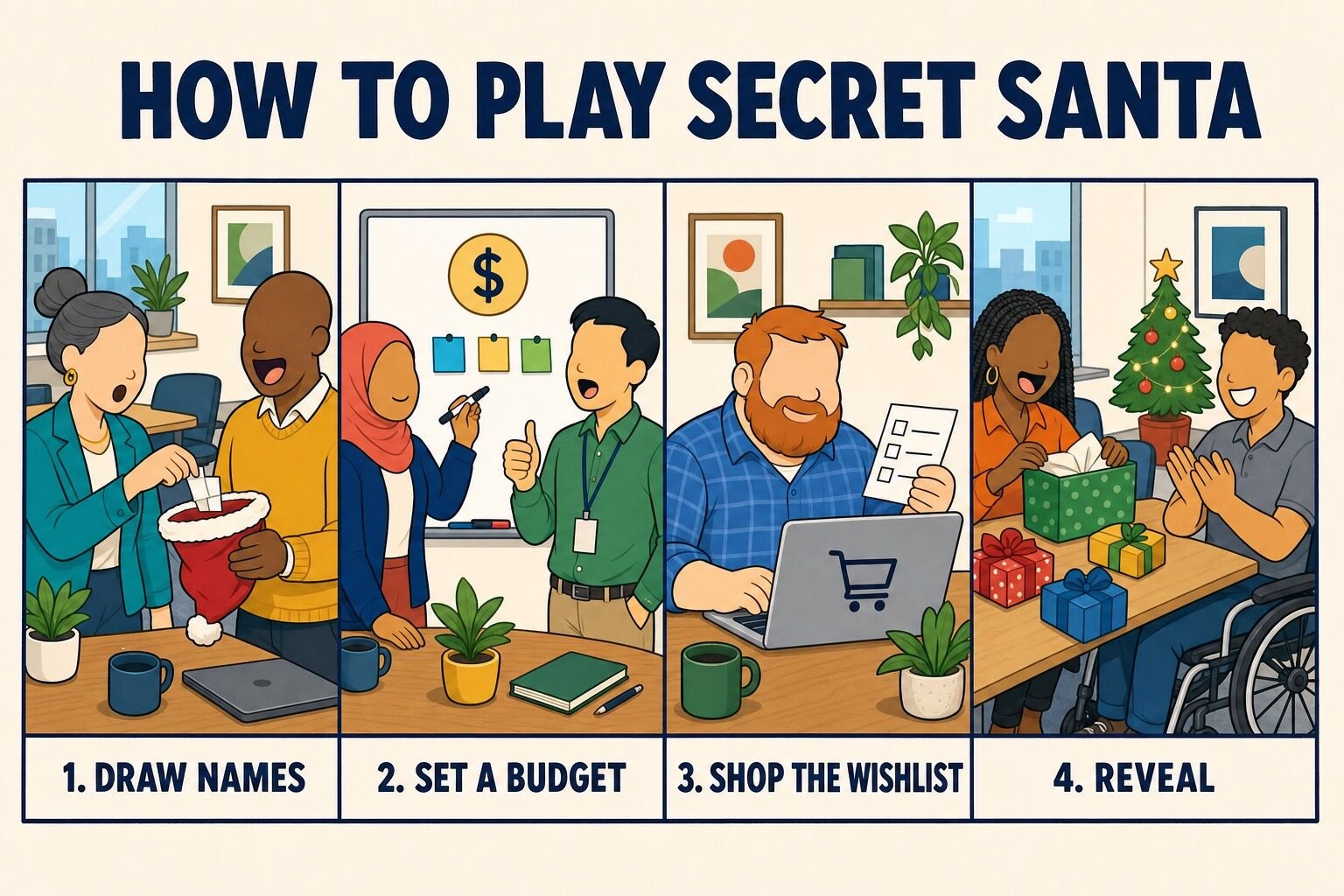
How to play Secret Santa: rules and steps
Every twist in this article starts from the same base game, so here is the classic version in full. If you have never organized one, this takes about ten minutes to set up and two to three weeks to run.
Get a headcount. Ask who wants in, and make opting out easy and unremarkable. A Secret Santa with 12 happy players beats one with 20 where three people resent it. Set the exchange date now so everyone knows the deadline.
Set the budget. Pick one number, not a range. $20 to $25 is the most common cap we see for office exchanges; $10 to $15 works for large or junior teams. Say "spend $20" rather than "up to $20" so nobody feels cheap for hitting the cap.
Collect wishlists. Before the draw, have each person answer three or four questions (see the questionnaire below). This step is the difference between a thoughtful gift and a scented candle.
Draw names. Fold each name into a hat and draw in turn; anyone who draws their own name redraws. For remote teams, or to avoid the redraw shuffle, use a free name-draw site that emails each person their match and their match's wishlist.
Shop in secret. Each Santa buys or makes one gift for their person, within budget, using the wishlist. Wrap it and label it with the recipient's name only.
Drop off gifts. Set a drop zone, such as a box in the break room or a corner of the conference room, and a drop deadline the day before the party. Anonymous drop-off keeps the secret intact.
Reveal. At the party, hand each gift to its recipient. Open one at a time so everyone sees every reaction, then have each person guess their Santa before the giver confirms. A dozen players takes 20 to 30 minutes.
Best for: 6 to 30 people, any office Time: 10 minutes to set up, 20 to 30 minutes to reveal, two to three weeks in between Materials (cost): Name slips and wrapping paper, plus the gift budget per person
What we've learned: The two rules that quietly rescue a Secret Santa are "one number, not a range" for the budget and "gifts open one at a time" at the reveal. The first stops the $8 mug next to the $40 headphones; the second turns a pile of simultaneous unwrapping into a show everyone watches.
24 Secret Santa games at a glance
Every game below keeps the assigned-recipient rule and works on top of the classic setup. Each one lists a best use, a group size, a time and a cost so you can match it to your team and your budget.
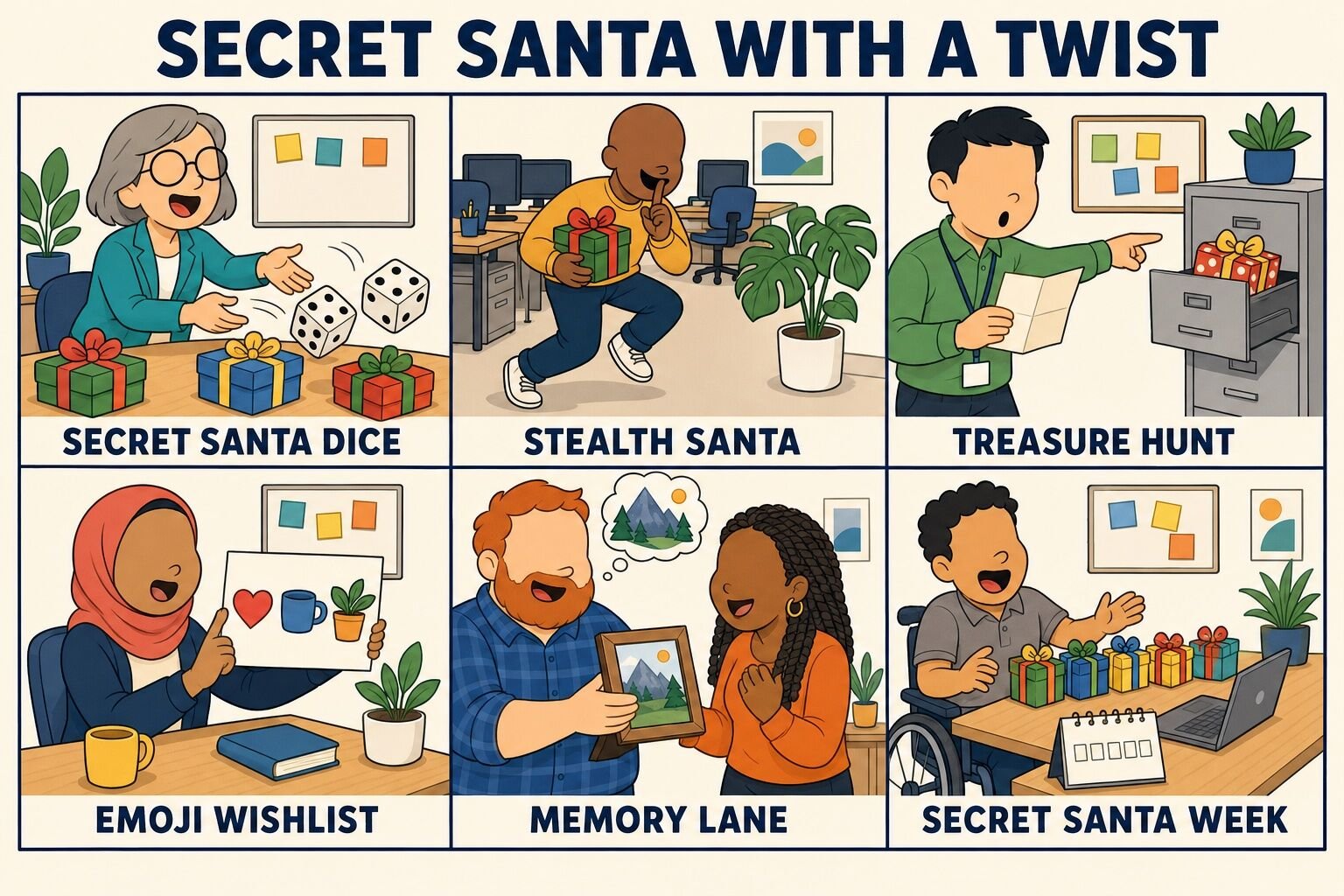
Secret Santa games with a twist (Kris Kringle ideas)
These twists change one rule of the classic game: how names are drawn, how gifts are delivered, or what happens at the reveal. Pick one; stacking three twists on a single exchange turns a party into a briefing. If your office calls the game Kris Kringle, every idea here works the same way.
1. Secret Santa Dice
Secret Santa Dice adds a round of luck after the reveal. Everyone opens the gift their Santa chose for them, and then the dice decide whether they keep it. It is the closest a Secret Santa gets to a White Elephant without losing the assigned-gift rule, and it produces the loudest five minutes of any holiday party.
Run the classic exchange first: every person opens the gift bought for them and guesses their Santa.
Sit in a circle with gifts in hand. Write the dice rules on a whiteboard: 1 = swap with the person on your left; 2 = swap with the person on your right; 3 = swap with anyone you choose; 4 = everyone passes one gift to the left; 5 = everyone passes one gift to the right; 6 = keep what you are holding and roll again.
Go around the circle once, each person rolling a single die and following the rule. A timer of five minutes or one full round, whichever comes first, ends the game.
Optional final rule: a Santa can veto one swap of the gift they bought, once, to keep a very personal gift with its intended person.
Best for: 6 to 20 people who like a little chaos Time: 20 to 30 minutes including the reveal Materials (cost): One or two dice, a whiteboard for the rules (free)
What we've learned: Announce the dice round before anyone shops. When people know their gift might travel, they buy things anyone would enjoy, which means fewer inside-joke gifts stranded with the wrong person. If your team would hate to lose a thoughtful gift, keep the veto rule.
2. Stealth Santa
Stealth Santa moves the game into the week before the party. Each Santa must deliver their gift to their person's desk without being seen, and recipients try to catch a Santa in the act. It turns the office into a low-stakes spy movie for five days.
Set a delivery window, such as Monday to Thursday of party week, and a rule that gifts must land on the recipient's desk or chair, not in a communal box.
Santas plan their drop: early mornings, lunch breaks, a decoy errand, or a courier (a coworker who is not the Santa can be recruited for one delivery).
Anyone who sees a delivery in progress may call it out. If a Santa is caught red-handed, they owe the office a plate of cookies or a coffee run, and the exchange still stands.
At Friday's party, each recipient opens their gift and states one theory about who delivered it before the Santa is revealed.
Best for: 6 to 40 people who share a physical office Time: One working week, plus a 20-minute reveal Materials (cost): Free beyond the gift budget
What we've learned: Ban deliveries during meetings and after hours, or the game quietly becomes a competition to arrive at 6 a.m. The fun is in the daytime near-misses.
3. Secret Santa Treasure Hunt
In a Secret Santa Treasure Hunt, Santas hide their gifts around the office and write a short trail of clues that leads their recipient to it. The reveal becomes a race, and the clue-writing is a second chance for the Santa to be clever.
Give each Santa a hiding rule: gifts must be inside the office, reachable without a ladder, and not in anyone's personal desk drawer.
Each Santa writes three to five clues, one leading to the next, with the first clue handed to the organizer in a sealed envelope marked with the recipient's name. Rhyming is optional; being solvable in under five minutes per clue is not.
At the party, hand out the first envelopes and start everyone at once. Recipients hunt while the room watches and heckles.
When everyone is back with a gift, open in turn and guess Santas. Award a small prize for the fastest hunter and another for the best clue trail, voted by the room.
Best for: 6 to 20 people in one office Time: 30 to 45 minutes Materials (cost): Envelopes and index cards (free)
What we've learned: Ask Santas to test their own trail once, end to end, before they seal it. A clue that makes sense to the writer and to nobody else stalls the whole room. For inspiration, see our lists of treasure hunt ideas and scavenger hunt clues.
4. Emoji Wishlist Secret Santa
An Emoji Wishlist Secret Santa replaces the written wishlist with a row of emoji, and the Santa has to decode it. It is a tiny change that makes the shopping stage a puzzle and gives the reveal a built-in story.
Before the draw, each person submits a wishlist of exactly five emoji and nothing else. A coffee cup, a book, a mountain, a cat and a headphone set is a full list.
Match names as usual and send each Santa their person's five emoji.
Santas shop to their interpretation. Literal is fine; creative is better.
At the reveal, show the emoji list on a screen before each gift is opened, so the room can judge how well the Santa cracked the code. The recipient scores the Santa out of five for accuracy.
Best for: 6 to 50 people, especially teams that live in chat Time: Adds 10 minutes to the reveal Materials (cost): Free
What we've learned: Five emoji is the number. Three leaves the Santa guessing at everything; ten turns into a normal wishlist with pictures.
5. Memory Lane Secret Santa
Memory Lane Secret Santa swaps the wishlist for a memory. Instead of listing things they want, each person writes a short story about a moment that mattered to them this year, and their Santa buys a gift that connects to it.
Ask each participant to write three to five sentences about one memory from the year, work or personal, that they are happy to share with the room. A first hike, a finished project, a new pet, a trip home.
Draw names and send each Santa their person's memory.
Santas choose a gift that references the memory: a print of the trail map, a framed photo of the launch, a treat from the hometown bakery.
At the reveal, the Santa reads the memory aloud before the gift is opened, and explains the connection afterward.
Best for: 6 to 20 people who know each other reasonably well Time: Adds 15 minutes to the reveal Materials (cost): Free
What we've learned: Give an example memory in the invitation, and make it a light one. Without a model, half the team submits something too personal to read aloud and the other half writes "I got promoted."
6. Balloon Pop Name Draw
Balloon Pop Name Draw gamifies the least exciting step of Secret Santa: the draw itself. Every name goes inside a balloon, and the team pops their way to their assignments in a two-minute frenzy that doubles as a kickoff for the whole exchange.
Write each participant's name on a slip, roll it up, and drop one into each balloon before inflating. Use one balloon per player, all the same color.
Scatter the balloons across the conference room or open-plan floor.
On "go," each person grabs one balloon and pops it, keeping the slip inside. Anyone who draws their own name trades unopened slips with the nearest person before reading again.
Read slips privately, then announce the budget, the deadline and the reveal date while everyone is still in the room.
Best for: 8 to 40 people who want a loud start Time: 10 minutes Materials (cost): One balloon per person, paper slips (under $10)
What we've learned: Warn the office next door, and have a backup hat with a full set of names in case a slip tears. Popping balloons near a wall of blank sticky notes also makes a great photo.
7. Secret Santa Week
Secret Santa Week spreads the exchange across five days. Santas leave one small anonymous gift a day from Monday to Thursday, then deliver the main gift and reveal themselves on Friday. The office spends a week speculating, which is most of the fun.
Keep the usual total budget, but split it: four small gifts at $2 to $5 each (a favorite snack, a sticker, a handwritten note, a coffee voucher) and one main gift with the remainder.
Each Santa delivers the daily gift to their person's desk before the day starts, or via the organizer for remote teammates.
Recipients post a daily photo of their gift in the team chat with one guess about who their Santa might be. Wrong guesses are free; correct guesses are kept secret until Friday.
Friday's party is the reveal: main gifts are opened one at a time, and every Santa confirms whether the week's guesses were right.
Best for: 6 to 30 people, in-office or hybrid Time: Five working days, plus a 30-minute reveal Materials (cost): Same budget as a normal exchange, split five ways
What we've learned: Publish a daily gift idea list with the rules, or Monday's snack becomes everyone's gift all week. A short list of 20 cheap ideas, from a mini plant to a scratch-off lottery ticket, keeps the days varied.
Secret Santa game ideas for work
These formats are built for the office. They solve the problems that make work Secret Santas awkward: uneven budgets, coworkers who barely know each other, and the pressure of buying the right thing for someone in another department.
8. Compliment Secret Santa
Compliment Secret Santa pairs every gift with an anonymous note of appreciation, read aloud at the reveal. The gift is still the gift, but the note is what people keep. This one works especially well as a year-end exchange, when the team has a full twelve months of work to draw on.
When names are drawn, tell each Santa that the gift must come with a card describing one specific thing their person did this year that they admired. Specific means a project, a moment or a habit, not "you're great."
Santas write the note anonymously and attach it to the wrapped gift.
At the reveal, the recipient reads the note aloud first, then opens the gift, then guesses their Santa. The room can help guess based on who would have noticed that particular thing.
Collect the cards afterward and photograph them for a team channel post.
Best for: 6 to 50 people, especially teams that do not get much recognition Time: Adds 10 minutes to the reveal Materials (cost): Cards or sticky notes (free)
What we've learned: Reading the note before the gift, not after, is the whole trick. Once the wrapping comes off, nobody listens to the card.
9. Charity Secret Santa
In a Charity Secret Santa, the gift is a donation. Each Santa gives to a cause their person cares about, in that person's name, and the reveal is the story of why the cause matters. It removes the shopping problem entirely and suits teams that already have more mugs than they need.
On the questionnaire, ask each person to name one or two causes or nonprofits they care about, and to say why in one sentence.
Draw names. Each Santa donates the budget amount to one of their person's causes and prints or screenshots the receipt with the personal note field filled in.
At the reveal, hand each person a card with the donation inside. The recipient reads the cause aloud and says why it matters to them, then guesses their Santa.
Optional: the company matches every donation, and the total is announced at the end of the party.
Best for: 6 to 100+ people, values-led teams, remote teams Time: 20 minutes at the reveal Materials (cost): The normal gift budget, redirected
What we've learned: Let people add one small physical token if they want, such as a $5 treat alongside the donation card. A reveal where nobody unwraps anything is meaningful but oddly quiet.
10. Gift-of-Time Secret Santa
Gift-of-Time Secret Santa is a zero-budget exchange where every gift is a coupon for something the Santa will do. Cover a Friday afternoon shift, teach a spreadsheet trick, bring coffee for a week, take the meeting notes for a month. It works for teams with no budget and for teams that are tired of stuff.
Set the rule: gifts must be a service or skill the Santa personally provides, written on a coupon, redeemable by a date in January or February.
On the questionnaire, ask each person what they would love help with and what skill they wish they had.
Santas write two or three coupons for their person, wrapped in an envelope. Keep them realistic; a coupon nobody can cash is not a gift.
At the reveal, recipients read their coupons aloud, the room rates the generosity, and Santas confirm. Managers must honor the rule that a coupon is a real commitment.
Best for: 6 to 30 people, tight budgets, teams that work closely together Time: 20 minutes at the reveal Materials (cost): Envelopes and paper (free)
What we've learned: Put an expiry date on every coupon and post a redemption tracker in the team channel. Coupons without a deadline are still in a drawer in June.
11. Desk Elf Secret Santa
Desk Elf Secret Santa adds a decorating mission. Before the party, each Santa secretly decorates their person's desk or workspace, and the team walks the floor to admire the results before gifts are opened.
Set a decorating window, such as before 9 a.m. on party day or the evening before, and a cap of $10 in decorations. Tinsel, paper chains, a mini tree, a printed banner and a bowl of candy go a long way.
Santas decorate their person's desk in their own style, leaving the wrapped gift in the middle.
When the office arrives, everyone tours the desks. Each person guesses who decorated theirs and writes the guess on a sticky note.
At the reveal, open gifts desk by desk and confirm the Santas. Vote on the best-decorated desk, with a small prize for the elf responsible.
Best for: 6 to 40 people who share an office Time: One morning, plus a 30-minute tour and reveal Materials (cost): Under $10 in decorations per desk
What we've learned: Agree on a "nothing that needs scissors to remove" rule and a cleanup time. The decorations are charming on party day and less charming on the following Tuesday.
Secret Santa tasks and reveal ideas
The reveal is the only part of Secret Santa the whole team experiences together, and in most offices it is over in minutes. These ideas stretch it into a game, and Secret Santa Tasks starts the fun a week early.
12. Secret Santa Tasks
Secret Santa Tasks, sometimes called Secret Mission or Secret Friend tasks, gives each Santa the power to assign their person small anonymous dares in the week before the party. Recipients complete the tasks in public, the office tries to work out who is pulling the strings, and the gift arrives at the end as the reward.
Each Santa writes one task per day for their person, four or five in total, and hands them to the organizer, who delivers them anonymously each morning by note or chat message.
Tasks must be harmless, doable at work in under ten minutes, and fun to watch. Examples: wear something red today; compliment three colleagues before lunch; sign every message with a holiday pun; bring the team a snack; do your standup update as a rhyme; change your video-call background to a snowy scene; draw a reindeer on the whiteboard; learn one fact about a coworker's hometown and share it.
Recipients earn a point for each completed task, and one bonus point at the party if they correctly guess their Santa from the style of the tasks.
At the reveal, open gifts one at a time, announce each person's task score, and crown the most committed task-completer.
Best for: 6 to 30 people who enjoy a bit of theater Time: One working week, plus a 30-minute reveal Materials (cost): Free
What we've learned: Have the organizer screen every task. One clumsy dare, such as anything involving singing alone or a manager's inbox, is enough to make people quietly stop playing. Silly and public beats embarrassing and personal.
13. Guess Your Santa
Guess Your Santa turns the reveal into a points game. Instead of the Santa stepping forward, the recipient has to deduce them, and the rest of the room bets on the outcome. It works with every twist in this list and costs nothing.
Give everyone a scorecard. As each gift is opened, the recipient gets 30 seconds to examine the wrapping, the gift and the card, then names one suspect. A correct guess scores three points.
Before the Santa is revealed, every other player writes their own guess. Correct guesses score one point each.
Santas can drop one true hint before the recipient guesses, such as "I sit within ten feet of you," and earn a point if the recipient still guesses wrong.
Track the tally on a whiteboard. The highest scorer at the end wins a small prize; the Santa who fooled the most people wins the title of Master of Disguise.
Best for: 6 to 30 people at any Secret Santa reveal Time: 20 to 40 minutes Materials (cost): Scorecards and a whiteboard (free)
What we've learned: The 30-second limit matters. Without it, the first recipient deliberates for four minutes and the last six gifts are opened in a rush. If you want a warm-up before the guessing starts, run two or three quick icebreaker games while people settle in.
14. Santa's Toast
Santa's Toast is a reveal format for the end of the year. When a Santa is revealed, they give a 30-second toast to their person: one thing they appreciated about working with them this year. It takes a gift exchange and makes it the team's annual thank-you.
Tell Santas when names are drawn that they will be asked to say a few words at the reveal, so nobody is ambushed.
At the party, open gifts one at a time. After the recipient guesses, the real Santa stands, raises a glass or a mug, and gives their 30 seconds. Set a visible timer.
Keep the toast about the person, not the gift: a project they carried, a moment they helped, a habit the team relies on.
End the round with a group toast to the team, then move on to food.
Best for: 6 to 20 people, especially at a year-end party Time: Adds 15 minutes to the reveal Materials (cost): Free
What we've learned: Have the organizer or a manager go first and model the length. The first toast sets the tone for every one after it; a two-minute speech at the top turns a 15-minute round into 40.
Funny Secret Santa ideas and games for adults
A funny Secret Santa still has one recipient per gift, so the joke has to land with a specific person rather than a whole room. That is a higher bar than a White Elephant gag, and it is why these three formats set rules about what kind of funny is allowed.
15. Gag Gift Secret Santa
Gag Gift Secret Santa caps the budget low and asks every Santa to buy the funniest gift they can for their specific person. The room votes on the winner, which keeps Santas aiming for laughs from the recipient rather than at them.
Set a $10 cap and one rule: the gift has to be funny to the person receiving it. A joke about their coffee habit is in; a joke about their age or their last performance review is out.
Use the questionnaire to collect ammunition: a harmless habit, a famous office quote, the thing they always complain about.
At the reveal, open gifts one at a time. The recipient rates the gift out of ten for laughs and out of ten for "would actually use it."
Tally both scores on a whiteboard. Award a prize for the funniest gift and a second, larger prize for the gift that scored well on both.
Best for: 6 to 30 people who already joke with each other Time: 20 to 30 minutes Materials (cost): $10 cap per gift
What we've learned: The "would actually use it" score is what keeps this from becoming a pile of plastic. The best gag gifts we have seen were a real thing, well chosen, with a joke on the tag.
16. Inside Joke Secret Santa
Inside Joke Secret Santa requires every gift to reference a moment from the team's year: the outage, the offsite, the client who kept calling the product by the wrong name. It is a year-in-review disguised as a gift exchange, and it only works for teams that have actually shared a year.
A week before the draw, start a shared document of the team's memorable moments from the year. Anyone can add; the organizer trims anything that touches on a real conflict.
Draw names. Each Santa picks one moment from the list that involves their person and finds or makes a gift that references it, within the normal budget.
At the reveal, the recipient opens the gift and has to name the moment before the Santa confirms. The room fills in the story.
Close by reading the moments list aloud as the team's unofficial year in review.
Best for: 6 to 20 people who have worked together for at least a year Time: Adds 15 minutes to the reveal Materials (cost): Normal gift budget
What we've learned: New hires need a moment too. Ask the team to seed the list with something from the newest person's first month so their Santa has material.
17. Regift Roulette
Regift Roulette is a zero-budget Secret Santa where every gift is something the Santa already owns and genuinely wants gone, chosen with their specific person in mind. The rule that makes it funny is the tag: each gift must come with the true story of how the Santa ended up with it.
Set the rules: nothing purchased, nothing broken, nothing that has been in a fridge. Books, mugs, gadgets, decor, unopened gift sets and questionable kitchen tools are all fair game.
Draw names. Santas choose the item from their own home that best fits, or best misfits, their person.
Each gift is wrapped with a card telling the origin story in two or three sentences, without naming the Santa.
At the reveal, the recipient reads the story aloud, opens the gift, and guesses the Santa. Vote on the best origin story.
Best for: 6 to 30 people, zero budget, teams that find clutter funny Time: 20 minutes Materials (cost): Free
What we've learned: Say up front that regifted gifts may be regifted again, so nobody feels obliged to keep the ceramic rooster. Half the fun is watching it reappear next year.
Funny Secret Santa gift ideas under $20
If the game is a normal Secret Santa but you want the gift to get a laugh, these are the reliable categories. The trick is to pair the funny item with something small and useful, so the joke does not go straight into a drawer.
Gift idea
Why it works
Pair it with
A mug printed with their most-used phrase
Everyone in the office already knows the line
Their actual favorite coffee or tea
A "World's Okayest" trophy for a real skill
Praise and teasing in one object
A handwritten note that is sincere
Desk-sized nameplate with an absurd job title
Sits on their desk all year as a running joke
A good pen
A framed screenshot of a legendary team chat message
Inside jokes age well when they are on the wall
Nothing; this one stands alone
Emergency snack kit labeled for their 3 p.m. slump
Everyone has a slump; naming it is the joke
One genuinely good snack
A tiny plant with an aggressive name tag
Cheap, alive, and funny for months
A card with care instructions in their voice
Socks printed with their pet, their car, or their spreadsheet
Custom socks are cheap and always worn
A hot chocolate sachet
A "meeting survival" kit: stress ball, sticker set, mint tin
Universal office humor that still gets used
A coffee shop gift card
A children's book on their area of expertise
Gently teasing an expert never fails
A bookmark with a real compliment
A calendar of the team's worst stock-photo poses
Requires a photo shoot at the party, which is its own game
Push pins to hang it
Secret Santa themes
A theme narrows the shopping, which sounds limiting and is actually a relief. "Buy Maya something for $20" is hard; "buy Maya something for $20 from a thrift store" is a Saturday errand with a story attached. These four themes are the ones that produce the best reveals, followed by a table of quick alternatives.
18. Homemade Gift Challenge
In the Homemade Gift Challenge, nothing can be bought ready-made. Santas bake, knit, build, paint, cook, code or write their gift, and the reveal is as much about the making as the thing itself.
Announce the theme with the draw and set a materials cap, usually $10 to $15, so nobody "makes" a gift out of $60 of supplies.
Use the questionnaire to learn what each person would actually use: a snack they love, a playlist, a plant, a recipe, a print for their desk.
Give at least two weeks. Handmade takes longer than a checkout page.
At the reveal, each Santa gets 60 seconds after the guess to explain how they made it. Vote on a "most ambitious" and a "most useful" award.
Best for: 6 to 20 people, creative teams, teams on a budget Time: Adds 15 minutes to the reveal Materials (cost): Supplies only, capped
What we've learned: Offer a safety net for the self-declared uncrafty: a jar of layered cookie mix, a curated playlist with a hand-drawn cover, or a framed photo they took. The theme should lower the pressure, not add a new kind.
19. Thrift Store Challenge
The Thrift Store Challenge sends every Santa to a secondhand shop with a $5 to $10 cap and one goal: find the most perfect, or most perfectly strange, item for their person. It is cheap, sustainable and produces the best stories of any theme.
Set the cap and the rule that every gift must be secondhand: thrift shops, charity stores, vintage markets, or a garage sale. Online resale sites count if the team is remote.
Draw names and share wishlists. Encourage Santas to shop for a vibe rather than an item, since thrift shopping is unpredictable.
Santas keep the price tag on, or write the price on the card, as proof and as part of the joke.
At the reveal, the recipient guesses the price before opening, then guesses the Santa. Award prizes for the best find under $3 and the most unexpectedly useful gift.
Best for: 6 to 30 people, budget-conscious and sustainability-minded teams Time: 20 minutes at the reveal Materials (cost): $5 to $10 cap per gift
What we've learned: Say "clean and complete" out loud. A vintage board game with all its pieces is a great gift; one missing a die is a chore.
20. Retro Decade Secret Santa
Retro Decade Secret Santa picks one decade, and every gift has to fit it. Eighties gifts are neon and cassette-shaped, nineties gifts come with a Tamagotchi or a scrunchie, and the reveal turns into a nostalgia trip the whole team shares.
Choose the decade by vote, or assign a different decade to each Santa for variety. Decades that most of the team remembers produce the best reactions.
Draw names. Santas shop for something the recipient would like that fits the era: a reissued toy, a retro candy box, a vinyl record, a themed t-shirt, a playlist on a "mixtape" card.
Ask everyone to dress the decade at the party. Even one accessory each changes the mood.
At the reveal, play a song from the decade as each gift is opened. Recipients guess the year before they guess the Santa.
Best for: 6 to 30 people, mixed-age teams Time: 20 minutes at the reveal Materials (cost): Normal gift budget
What we've learned: If the team spans three generations, assign decades rather than voting for one. A 2000s theme lands very differently for the person who was in college and the person who was in kindergarten.
21. Hometown Secret Santa
Hometown Secret Santa asks every Santa to give something from where they are from: a snack, a craft, a recipe, a small souvenir. It fits distributed and multicultural teams especially well, because the gift comes with a piece of the giver, and it makes the guessing easy in the best way.
Ask each Santa to source a gift from their hometown, home country, or the place they currently live, within the budget. Remote teammates ship directly or through the organizer.
Each gift includes a short card explaining what the item is, how it is used, and why the Santa chose it, without naming them.
At the reveal, the recipient reads the card, opens the gift, and guesses first the place and then the Santa. Show the place on a map on screen as each gift opens.
End with a tasting table if the gifts are edible. Most of them will be.
Best for: 6 to 50 people, distributed and multicultural teams Time: Adds 15 minutes to the reveal Materials (cost): Normal gift budget plus shipping for remote players
What we've learned: Ask about allergies and dietary rules on the questionnaire before the theme is announced. A box of regional sweets is a wonderful gift right up until it is not.
More Secret Santa theme ideas
Theme
The rule
Best for
A to Z Secret Santa
Each Santa draws a letter and the gift must start with it
Teams that like a puzzle
Foodie Secret Santa
Everything edible or for the kitchen; end with a tasting
Offices with a snack culture
Book Swap Secret Santa
One book the Santa loved, with a note on why this person should read it
Readers and quiet teams
Ornament Exchange
One ornament that says something about the recipient
Secret Santa scales badly past about 30 people: the draw is a mess, the reveal takes an hour, and most Santas draw someone they have never spoken to. The fix is structure, not a bigger hat.
22. Secret Santa Pods
Secret Santa Pods split a large company into groups of 8 to 12, each running its own complete exchange with its own reveal, all at the same party. Everyone gets a Santa who knows them, and the reveal takes 20 minutes instead of 90. The same structure works for a large family gathering: one pod per household.
Form pods of 8 to 12 by team, floor or a deliberate cross-team mix. Name a pod captain to run the draw and collect wishlists.
Each pod draws names within itself, shops on the company-wide budget, and drops gifts with its captain.
At the party, pods gather at their own table. Captains run the reveals simultaneously using one shared format, such as Guess Your Santa, with a company-wide timer on the screen.
Bring the room back together for a two-minute highlight from each captain: the best gift, the best guess, the biggest surprise.
Best for: 30 to 300 people Time: 30 minutes for all reveals in parallel, plus highlights Materials (cost): Free beyond the gift budget
What we've learned: Give captains a one-page script and a whiteboard each. Twelve tables running twelve different versions of the rules is the most common way a big-company exchange goes sideways.
23. Team-to-Team Secret Santa
Team-to-Team Secret Santa has whole departments draw each other. Each team pools its budget, builds one gift basket for the department it drew, and presents it on stage at the party, so a 200-person company has ten reveals instead of 200.
List every team and draw team names, so that no team draws itself. Publish the budget per team, such as $10 per member pooled.
Each team learns about its recipient team: what they do, what they complain about, what they would love. A short survey sent to that team's manager works well.
Teams build one gift basket or one experience for their recipient department. Themes like Desk Upgrade or Foodie work well here.
At the party, each team presents its basket on stage with a 60-second speech, and the recipient team guesses who drew them before the reveal.
Best for: 40 to 500 people across multiple departments Time: 20 minutes of presentations Materials (cost): Pooled budget per team
What we've learned: Cap the presentations hard at 60 seconds and put a timer on the screen. Every team believes its basket deserves three minutes, and none of them do.
Virtual Secret Santa
Remote teams can run every game in this list with two adjustments: a name-draw tool that emails matches and wishlists, and a shipping or e-gift plan. Our full guide to virtual Secret Santa covers the tools and logistics; here is the format that makes the reveal work on a video call.
24. Virtual Secret Santa Unboxing
A Virtual Secret Santa Unboxing is a hosted 30-to-45-minute video call where gifts are opened one at a time on camera, with a Guess Your Santa poll running in the chat. The structure replaces the energy a physical room provides for free.
Use a free name-draw site that emails each Santa their match, and set a ship-by date two weeks before the call so every gift arrives. For international teams, allow e-gift cards or local-delivery gifts within the budget.
Ask everyone to keep the gift wrapped and unopened until the call, on camera.
Appoint a host. The host calls one name at a time, the recipient unboxes on camera, and everyone else votes in the chat or a poll on who the Santa is. The recipient guesses last, then the Santa unmutes to confirm.
Keep a scoreboard in a shared doc. Award a small e-gift card to the top guesser and to the Santa who fooled the most people.
Best for: 4 to 40 people on Zoom, Teams or Google Meet Time: 30 to 45 minutes Materials (cost): Shipping or e-gift costs on top of the budget
What we've learned: Cap the call at about 40 unboxings, roughly 60 to 90 seconds each. Above that, split into breakout rooms of 10 to 12 with a captain in each, the virtual version of Secret Santa Pods. If the exchange is the centerpiece of a larger virtual holiday party, schedule it in the first half while attention is highest.
Secret Santa questionnaire and wishlist
The questionnaire is the step most offices skip and the one that prevents most bad gifts. Send it before the draw, keep it under a minute to fill in, and forward each person's answers to their Santa with the match. Here is the version we recommend.
What is a small treat you buy yourself when you have had a good week?
Name two things you are into right now (a hobby, a show, a sport, a food).
Coffee, tea, or neither?
What is something you would never buy for yourself but would love to receive?
What is one thing you definitely do not want (allergies, dietary rules, scents, clutter)?
Sweet or savory?
Is there a color or style you avoid?
Finish the sentence: "My desk would be better with…"
What did you do last weekend?
Optional: a link or two to things around the budget that you would genuinely like.
Questions 4 and 5 do the most work. Question 4 gives the Santa permission to buy something slightly indulgent; question 5 saves the Santa from the one mistake that would spoil the gift. For a ready-made set of conversation starters for the party itself, see our holiday icebreaker questions.
The wishlist rule embarrasses some people, who feel a gift they asked for is less of a gift. In practice the opposite is true. The Santa who knows their person wants a specific tea and a puzzle book buys the tea and the puzzle book and spends the leftover attention on the wrapping and the note, which is the part people remember. The exchanges that produce a drawer of unused candles are the ones where nobody asked.
What we've learned from hosting holiday parties
Office holiday parties have been declared endangered more than once, including in The New York Times' December 2023 piece "Did the Grinch Come for the Office Holiday Party?", which featured teambuilding.com. Our bookings tell a different story: December is our busiest month, and for many of the teams we host, the Secret Santa reveal is the centerpiece of the party. Here is what that volume has taught us.
Opt-in beats mandatory. Secret Santa runs on goodwill, and goodwill cannot be scheduled. Announce it as open to anyone who wants to play, make opting out invisible, and the people who join will actually shop. A mandatory exchange produces a table of gas station chocolate.
The wishlist is not optional. Every Secret Santa complaint we hear traces back to a Santa who did not know their person. A one-minute questionnaire fixes almost all of it. The teams that skip it are the ones asking for "Secret Santa with a twist" the following year, because the base game disappointed them.
One number, one date, one drop zone. "Spend $20," "gifts in the box by Thursday," and "reveal at 3 p.m. Friday" is a complete rulebook. Ranges, rolling deadlines and gifts handed over in hallways are how exchanges fizzle.
The reveal is the event. Opening gifts one at a time, in front of everyone, with a guess before each Santa is confirmed, is the single upgrade that makes the most difference. It costs nothing and turns four minutes of unwrapping into a 30-minute game. Everything in the tasks and reveal ideas section builds on it.
Small rituals are worth the effort. Martin Seligman's PERMA theory of well-being, developed at the University of Pennsylvania, holds that well-being consists of five measurable elements, with relationships fundamental among them. A $20 gift exchange is a very cheap way to have every person on a team spend a week thinking about one colleague, and then to put the whole team in one room for a shared moment. That is the outcome to protect when you choose a twist; a game that makes the reveal longer, louder or more personal is worth it, and a game that makes it more efficient usually is not.
Themes reduce stress; stacked rules add it. One theme or one twist per exchange. Thrift Store plus A to Z plus a daily task is a project, and the people who were lukewarm about Secret Santa will quietly drop out.
Small groups vs large groups
Factor
Small groups (under 20)
Large groups (30 to 300+)
Name draw
Slips in a hat, or a Balloon Pop Name Draw
A name-draw tool, or pods that draw internally
Budget
$20 to $25 is typical
$10 to $15, or pooled per team
Wishlists
A short questionnaire forwarded to each Santa
The same questionnaire, collected by pod captains
Reveal
One at a time, whole room watching, 20 to 30 minutes
Parallel pod reveals, or team-to-team baskets on stage
Reveal runs an hour; cap it with timers and captains
If you would rather have a host run the reveal, the games and the rest of the party, our hosts lead virtual and in-person team building activities, including holiday parties, for groups from five to several thousand.
Secret Santa ideas we don't recommend
An earlier version of this article included a few ideas that read well and play badly, and the wider internet has plenty more. Here is what we would skip, and why.
The Lame List
Activity
Why skip it
Verdict
Mandatory participation
Secret Santa is a favor colleagues do each other. Forced favors produce resentful shopping and a reveal nobody enjoys.
Make it opt-in
"Up to $50" budgets
A range is an invitation to compare. The $12 gift next to the $50 gift embarrasses two people at once.
One number, $20 to $25
Hot Potato gift pass
Passing gifts to music until it stops is a random swap, not Secret Santa; the gift someone chose for their person ends up with whoever the song picked. We had this on a previous version of this list.
Cut from our list
Gift auction with play money
Turns thoughtful assigned gifts into lots and rewards whoever bid most aggressively. It is a fine gift exchange game, but it undoes everything a Secret Santa is for.
Save it for a White Elephant
Steal-and-swap "Trading Places"
Three steals per gift is a White Elephant with extra steps. Run it as one or the other; hybrids confuse everyone.
Cut from our list
Identical mystery bags
Everyone shops for nobody in particular, then draws at random. Nobody gets a gift chosen for them, which is the only reason Secret Santa exists.
Cut from our list
Tasks that single people out
Solo singing, prank calls, anything involving a manager's calendar. One uncomfortable dare ends the game for the quiet half of the office.
Screen every task
Reveal by email
Sending "your Santa was Priya" in a message skips the one moment the whole team shares.
Reveal in the room
A 200-person single-circle reveal
Two hours of watching strangers open mugs. Attention is gone by gift 25.
Use pods
Alcohol-only gifts
Excludes people quietly, and at work it is an HR question waiting to happen.
Skip it
Final thoughts
The best Secret Santa we have seen was not clever. It was 14 people, a $20 cap, a one-minute questionnaire, and a reveal where every gift was opened in front of everyone with a guess before the Santa stood up. Every twist in this guide is a variation on that shape, and the shape is what makes them work.
Pick one twist or one theme, not three. Send the questionnaire before the draw. Open the gifts one at a time. Then run it again next year, because a Secret Santa that happens every December becomes a tradition, and traditions are the thing teams remember.
Answers to the questions teams ask us most about running Secret Santa at work.
What is the Secret Santa game?
Secret Santa is a gift exchange where each participant secretly draws the name of one other person, buys or makes a gift for that person within a set budget, and gives it anonymously at a party or reveal. The recipient usually guesses who their Santa was before the giver is confirmed. The game is also called Kris Kringle, Secret Friend or Secret Snowflake, and it differs from White Elephant, where gifts go in a pile and players steal from each other.
How do you play Secret Santa at work?
Get an opt-in headcount and set the exchange date, pick one budget number (about $20 to $25 is typical), collect a short wishlist questionnaire from each player, draw names with slips in a hat or a free name-draw tool, shop in secret, drop wrapped gifts in a shared box by a deadline, and open them one at a time at the party with each recipient guessing their Santa before the giver is revealed. Setup takes about ten minutes and the reveal 20 to 30 minutes for a dozen people.
What are some Secret Santa games with a twist?
Popular twists include Secret Santa Dice, where dice rolls decide whether players keep or swap gifts after the reveal; Stealth Santa, where gifts must be delivered to desks without being seen; Secret Santa Tasks, where Santas assign small anonymous dares in the week before the party; Guess Your Santa, which scores the reveal as a guessing game; and Emoji Wishlist, where each wishlist is five emoji the Santa has to decode. Pick one twist per exchange.
What are Secret Santa tasks?
Secret Santa tasks, also called Secret Mission or Secret Friend tasks, are small anonymous dares a Santa assigns to their person each day in the week before the exchange, delivered through the organizer. Good tasks are harmless, doable at work in under ten minutes and fun to watch, such as wearing something red, complimenting three colleagues before lunch, or giving a standup update as a rhyme. Recipients earn a point per completed task and a bonus for guessing their Santa.
How do you do Secret Santa with a large group?
Split the company into pods of 8 to 12 people that each run a complete exchange with their own captain and reveal, all at the same party, or have whole departments draw each other and present one pooled gift basket per team on stage. Both formats keep every reveal under 30 minutes, which a single circle of 100 or more cannot do.
What is a good Secret Santa budget?
For office exchanges, $20 to $25 per gift is the most common cap we see, with $10 to $15 for large or junior teams and zero-budget formats like Gift-of-Time or Regift Roulette when money is tight. State one number rather than a range, so nobody feels cheap for spending the cap and nobody overspends.



Comments (0)
Leave a Comment