30 Office Gift Exchange Ideas & Games (Rules, Themes & Twists for 2026)
Thirty office gift exchange ideas and games, from Secret Santa and white elephant to Santa's Casino and the Dice Game, with a six-step organizing plan, written rules and budgets, twelve themes, large-group formats and virtual versions.
Published
·
Updated
Here is our list of the best office gift exchange ideas and games for 2026, with the rules, budgets, themes and twists that make each one work in a real workplace.
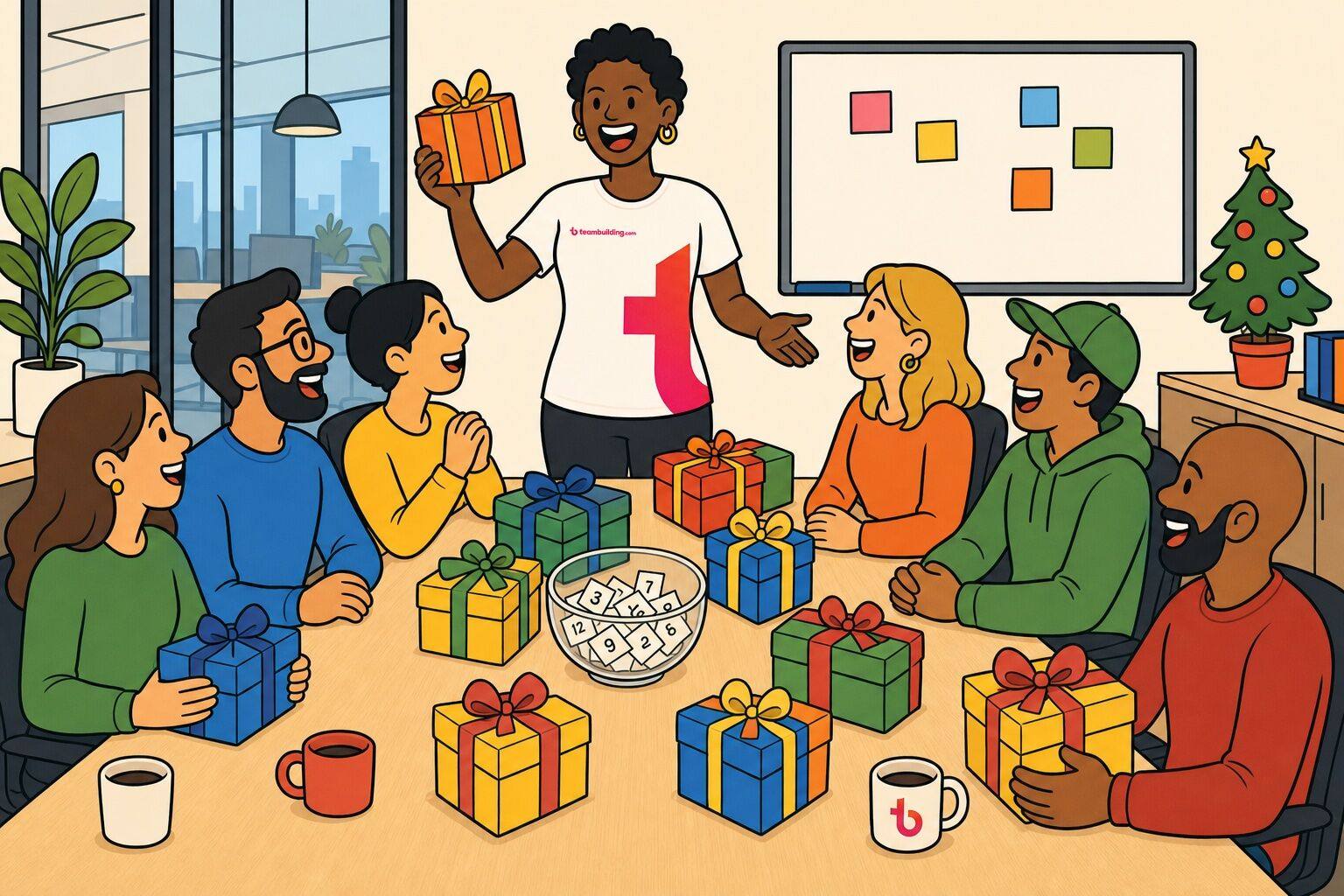
Office gift exchanges are holiday traditions where coworkers swap presents under a shared set of rules, usually a spending limit and a game that decides who ends up with which gift. Examples include Secret Santa, white elephant, Yankee swap, Santa's Casino and gift auctions. The purpose of these events is to celebrate the end of the year together, give every teammate a small moment of being thought of, and get people laughing in the same room. These activities are also called "office Christmas gift exchange ideas," "holiday gift exchange games," "work gift exchange ideas," "gift swap games" and "present games."
We have a lot of practice with this season. December is the busiest month of the year for team building on teambuilding.com, with 30% of annual events held for end-of-year celebrations, and we have hosted 6,000+ virtual holiday parties as of September 2026 for clients like Apple, Amazon and Google. Our CEO also anchored The Washington Post's 2020 column on how office holiday parties were transformed, back when every gift exchange suddenly had to happen on Zoom. The games below are the ones that survived thousands of parties, in person and online.
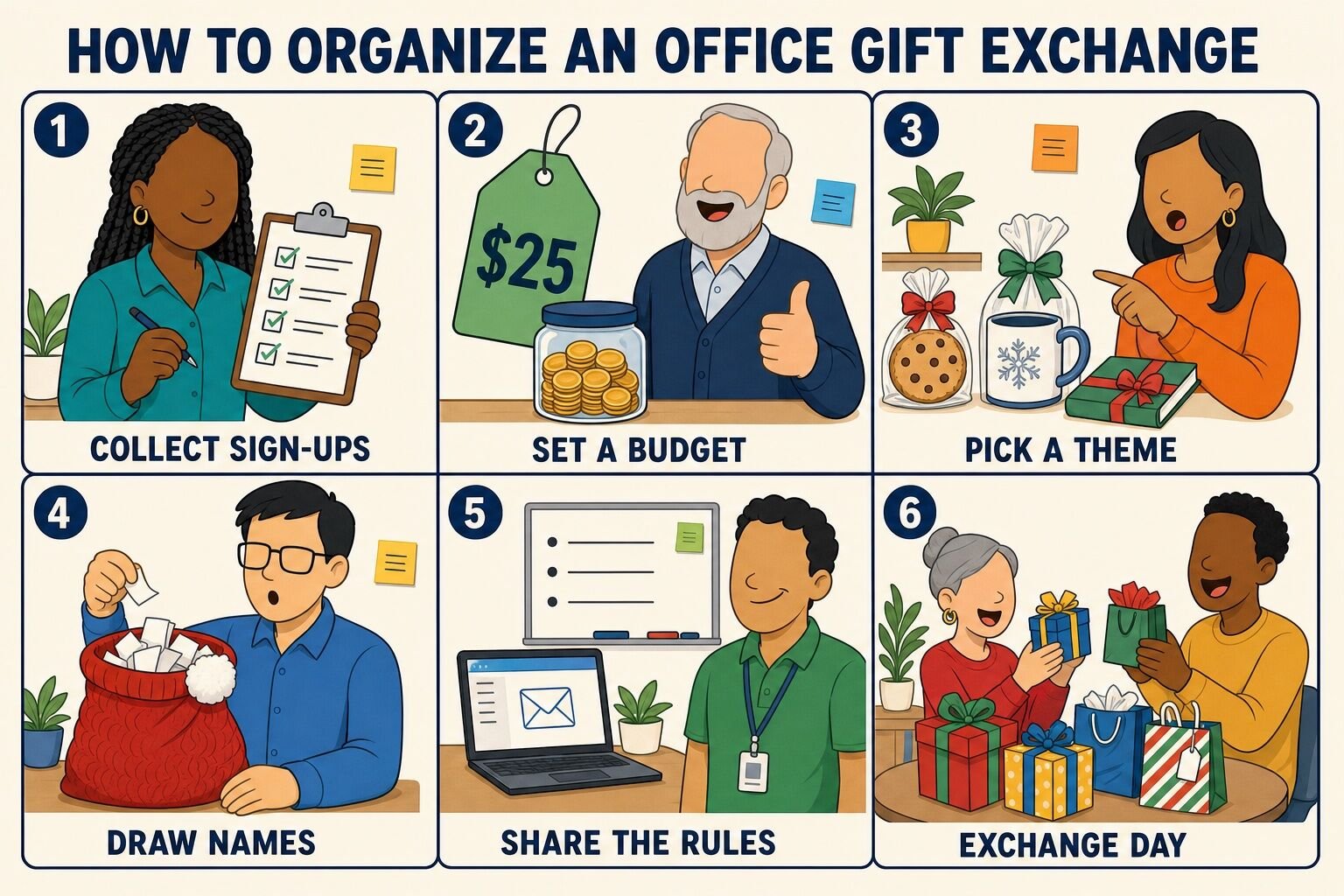
Every game on this page runs on the same six-step plan. Get these right and the game itself is the easy part.
Step 1: Collect sign-ups
Send a short form three to four weeks before the party asking who wants to take part, plus two or three gift hints (a favorite snack, a hobby, a color they like). A form means nobody has to opt out in front of the room, and gift-givers who barely know their match still have something to work with. Close sign-ups a week before you draw names so the count is final.
Step 2: Set the budget
Announce one spending limit for everyone. $20 to $30 is the range most offices settle on; $15 works for large groups and $50 for small senior teams. State it as a ceiling, not a target, so a $12 gift never feels like a failure next to a $30 one.
Step 3: Pick a format and theme
Choose one of the three base formats (Secret Santa, white elephant or Yankee swap; see the comparison below) and, optionally, one theme that narrows what people buy. A theme does more work than any other decision on this list: "something you can eat" turns a room of nervous shoppers into a room of people who know exactly what to do.
Step 4: Draw names or numbers
Secret Santa needs matches: names in a hat, or an online name-draw tool so nobody draws themselves. Stealing games need a turn order: numbered slips in a bowl on the day. For hybrid teams, draw names online so remote coworkers are in the same pool.
Step 5: Share the rules in writing
One message with the date, the budget, the theme, the steal limit and a "keep it professional" line. Send it when names are drawn, again one week out, and once the day before. Late gifts are almost always a reminder problem, not a people problem.
Step 6: Run exchange day
Set the gifts on one table, put a host in charge of turn order, and plan 30 to 45 minutes for a group of 15 to 20 (about two minutes per gift). Have two spare wrapped gifts under the table for the coworker who forgot, and end with a group photo of everyone holding what they got.
Office gift exchange rules and budget
Most gift exchange arguments trace back to a rule nobody wrote down. Here are the ones worth stating out loud before the game starts.
Rule
What we recommend
Why it matters
Spending limit
$20 to $30 per gift, stated as a ceiling
Keeps the exchange fair and stops anyone from feeling outspent
Steal limit
A gift can be stolen at most three times; the third owner keeps it
Ends the endless loop over one popular gift
No immediate steal-back
You cannot steal the gift that was just taken from you
Prevents two people trading the same gift all night
Gift content
Nothing personal (clothing, fragrance), nothing gender-coded, no alcohol unless the office allows it, no inside-joke gags
You do not know who ends up with your gift
Managers and reports
Managers play in the same pool as everyone else at the same limit, or the team pools for one group gift instead
Gifts flowing upward feel like favors, not fun
Participation
Always optional, and opting out is done on a form, not in the room
The holidays are not the same for everyone
Employer contribution
The company adds three to five extra gifts to the pile and covers the food
A padded pile means nobody goes home empty-handed
That last row is the one most organizers skip, and it comes from a principle our CEO writes about in his life lessons: managers win by giving employees more than they ask for. Nobody asks the company to top up the gift pile. Do it anyway, and the exchange stops feeling like a tax on employees' December budgets. For the company-funded side of the table, see our lists of gifts for employees and group gift ideas, and if your team wants to chip in for a leader, gifts for bosses covers how to do it without awkwardness. For the wider etiquette questions (plus-ones, alcohol, who gets invited), read our guide to holiday party etiquette.
Secret Santa vs white elephant vs Yankee swap
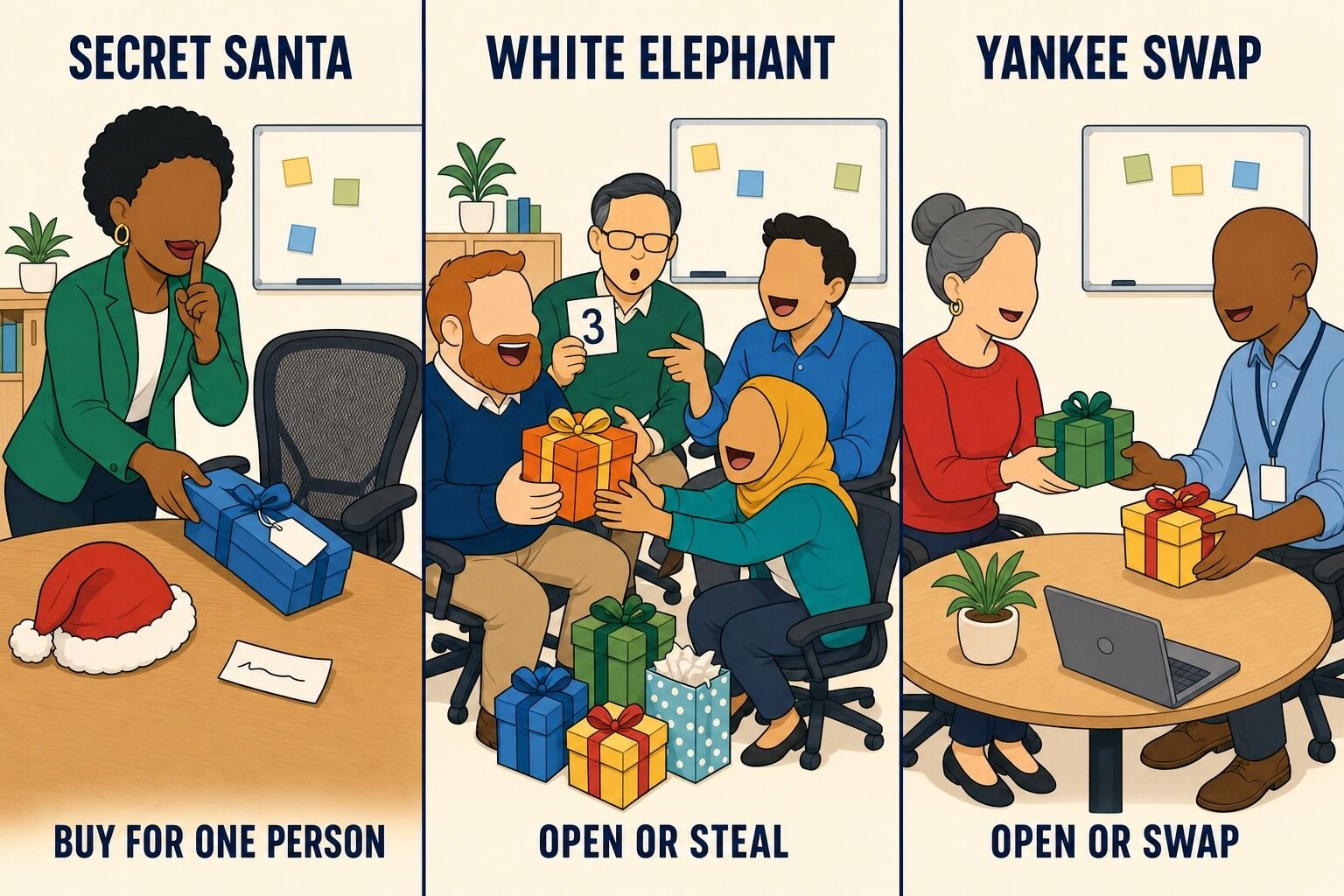
These three formats get mixed up constantly, and the mix-up matters because they call for different gifts. Secret Santa is a one-to-one match where you buy for a specific person. White elephant is a stealing game where gifts are anonymous, often silly, and everyone fights over the good ones. Yankee swap is white elephant's polite cousin: same numbered turns, but the emphasis is on swapping rather than stealing, and gifts are usually things people genuinely want.
Format
How gifts are assigned
Gift style
Best group size
Time
Pick it when
Secret Santa
Each person draws one name and buys for that person; the giver stays anonymous until the reveal
Thoughtful, personal within professional limits
5 to 30
20 to 40 minutes on the day, plus a few weeks of shopping
You want people to think about a specific coworker
White elephant
Everyone brings one wrapped gift; players draw numbers and either open a new gift or steal an opened one
Funny, quirky, universally usable; gag gifts allowed if the rules say so
8 to 25 per circle
30 to 60 minutes
You want the loudest, most competitive 45 minutes of the party
Yankee swap
Same numbered turns, but the player may open a gift or swap with any opened gift; the first player gets a final swap at the end
Practical, things people would actually buy for themselves
8 to 25 per circle
30 to 60 minutes
Your office finds "stealing" a bit aggressive but still wants the game
Our take: if the team is new or mixed-seniority, start with Yankee swap. If the team already teases each other, run white elephant. Save Secret Santa for groups of 15 or fewer who genuinely know each other, and pair it with a wishlist so the gifts land.
These six are the formats most offices actually run, written out with the rules that stop them going sideways.
1. Secret Santa with a Wishlist
Secret Santa is the classic office gift exchange: each person draws a coworker's name, buys a gift for that person within the limit, and stays anonymous until the reveal. The wishlist version fixes the one thing that goes wrong with it, which is buying for someone you barely know.
Collect sign-ups with three wishlist lines per person: a small thing they want, a snack or drink they love, and something they are into outside work.
Draw names (hat or online tool) and send each Santa their match's three lines.
Set the limit at $20 to $30 and a deadline one week before the party.
On the day, gifts go on the table labeled with the recipient's name only.
Each recipient opens their gift in front of the group and gets one guess at who their Santa is; the Santa then stands up.
Best for: 5 to 30 people who know each other Time: 20 to 40 minutes on the day Materials (cost): One gift per person ($20 to $30)
What we've learned: "Anything from Store X under $25" is not a wishlist. The three-line format works because the snack line is the safety net: even a Santa who ignores the other two ends up with a gift that lands.
2. Classic White Elephant
White elephant is the stealing game. Every player brings one anonymous wrapped gift, and the fun comes from the turn where someone takes the good gift away from you.
Pile the wrapped gifts on a table. Each player draws a number from a bowl.
Player 1 opens any gift and shows it to the room.
Player 2 either opens a new gift or steals Player 1's. A player whose gift is stolen immediately opens a new one or steals from someone else (not from the person who just stole from them).
Continue in number order. A gift is "frozen" after its third steal and stays with its current owner.
After the last gift is opened, Player 1 gets one final swap with any unfrozen gift.
Best for: 8 to 25 players per circle Time: 30 to 60 minutes Materials (cost): One gift per person ($20 to $30), numbered slips
What we've learned: Decide in the invitation whether gifts are "good" or "gag." A room with 20 nice gifts and one novelty toilet-shaped mug is fine; a room split 50/50 leaves half the players quietly disappointed. Our hosts run white elephant almost exclusively with real gifts.
3. Yankee Swap
Yankee swap uses the same numbered turns as white elephant, but with swapping instead of stealing: you trade the gift you opened for one you like better, so nobody is ever left holding nothing.
Everyone brings one wrapped gift and draws a number.
Player 1 opens a gift. Player 2 opens a gift, then may keep it or swap it for Player 1's.
Each following player opens a gift, then may swap it with any already-opened gift. The other person keeps what they receive; swaps are final for that turn.
When every gift is open, Player 1 gets one last swap with anyone.
Best for: 8 to 25 players, mixed-seniority teams Time: 30 to 60 minutes Materials (cost): One gift per person ($20 to $30), numbered slips
4. Gift Auction
A gift auction turns the exchange into a bidding war with play money, which means the loudest, most theatrical coworker in the room finally has a job.
Everyone brings a wrapped gift. Give each player the same stack of play money (say, $1,000 in fake bills).
The host holds up one wrapped gift at a time, describes its shape and weight, and opens bidding.
Highest bidder pays the pot and opens the gift in front of everyone.
Continue until every gift is sold. Players who have spent everything can still win a leftover gift in a closing raffle.
Best for: 10 to 100+ people Time: 30 to 60 minutes Materials (cost): One gift per person ($20 to $30), play money, a gavel if you have one
What we've learned: Let the host open one gift a few lots in so the room can see the quality. Bidding on unknown boxes goes quiet fast; bidding after seeing that the last one was a nice French press does not.
5. Grab Bag
The fastest exchange on this list. Gifts go into one giant bag or box, and players reach in blind.
Ask each person to wrap their gift to disguise its shape: a mug in a shoebox, a gift card taped inside a paper towel tube.
Put every gift into a large sack or lidded bin.
In number order, each player reaches in without looking and pulls one gift. If it is their own, they put it back and draw again.
Everyone unwraps at the same time on the host's count of three.
Best for: 6 to 40 people, quiet groups Time: 10 to 20 minutes Materials (cost): One gift per person ($15 to $25), one big sack
6. Guess the Gifter
Guess the Gifter adds a detective round to any Secret Santa: after opening, the recipient has to work out who bought the gift.
Run Secret Santa as usual, but ask each Santa to include one written clue in the gift ("I sit within 20 feet of you," "we were on the same project in March").
Each recipient opens their gift, reads the clue aloud, and gets two guesses.
A correct guess earns the recipient a point; a wrong guess earns the Santa a point.
Highest score at the end wins a small prize from the company pile.
Best for: 6 to 25 people Time: 20 to 40 minutes Materials (cost): One gift per person ($20 to $30), clue cards
Christmas gift exchange games
These are the games you play once the gifts are on the table. Each one replaces the plain "take a number and open a box" with a mechanic that decides who ends up with what, and the best ones make luck do the work so nobody has to be the person who stole the good gift.
7. The Dice Game
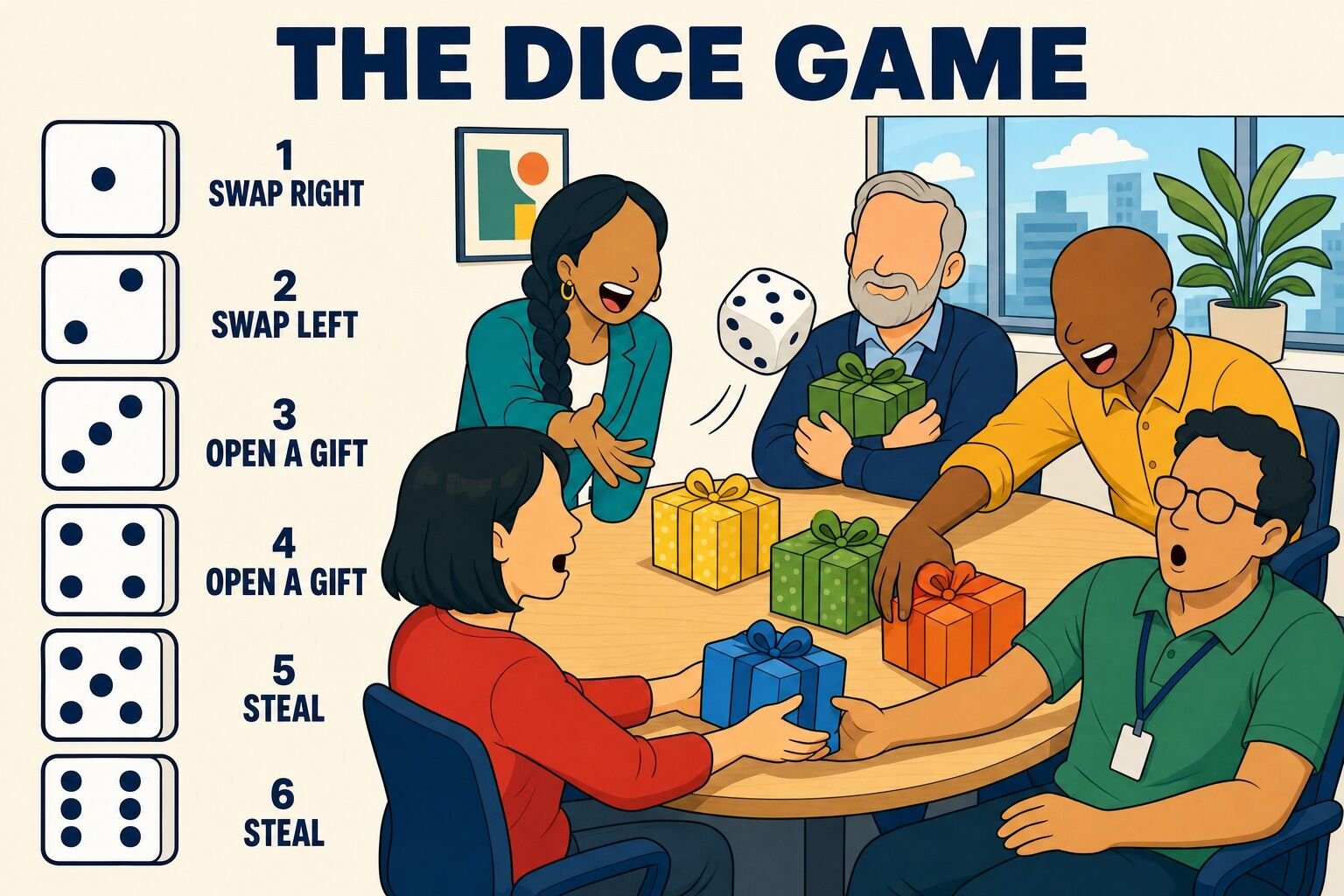
The Dice Game is the most-requested gift exchange game we know of, because the die makes every decision and the players just react.
Everyone sits in a circle with one wrapped gift in front of them.
Write the roll table on a whiteboard: 1 = swap with the person on your right, 2 = swap with the person on your left, 3 or 4 = unwrap your gift (if it is already open, pass the die), 5 or 6 = steal any gift in the circle.
Players take turns rolling. Stolen-from players roll immediately to recover.
Set a timer for 15 minutes. When it rings, everyone keeps whatever is in front of them and opens anything still wrapped.
Best for: 6 to 20 people Time: 20 to 40 minutes Materials (cost): One gift per person ($15 to $25), one or two large dice
What we've learned: Use a timer, not "until everyone has a gift." Without an ending, the game runs until one gift has been stolen eleven times and the room has stopped laughing. The clock is what keeps it fun.
8. Left, Right, Left
Left, Right, Left is a story game: the host reads a short holiday tale packed with the words "left" and "right," and every time one is spoken, the gifts move that way around the circle.
Everyone sits in a circle holding a wrapped gift.
The host reads a story ("Mrs. Wright left the office, turned right at the elevator, and left her badge behind…"). On "left," pass your gift left; on "right," pass right.
When the story ends, you keep the gift in your hands and open it.
Best for: 8 to 60 people, all ages Time: 10 to 15 minutes Materials (cost): One gift per person ($10 to $20), a story with 25+ left/right cues
What we've learned: Write the story about your own office (the copier, the one meeting room that is always double-booked). Recognition gets bigger laughs than a generic Santa story, and the "right" and "left" cues sneak up on people when they are laughing.
9. Musical Gifts
Musical Gifts is musical chairs with presents. A gift travels around the circle while a playlist runs; when the music stops, whoever is holding it keeps it.
Pile the gifts to one side and seat everyone in a circle.
Start the music and hand one gift to the first player, who passes it clockwise.
Stop the music at random. The player holding the gift keeps it and steps out of the circle.
Repeat with the next gift until everyone has one, then unwrap together.
Best for: 8 to 30 people Time: 15 to 25 minutes Materials (cost): One gift per person ($15 to $25), a speaker and a holiday playlist
10. Hot Gift Potato
Hot Gift Potato is Musical Gifts with a timer instead of a playlist, and with the gift thrown rather than passed, which makes it faster and sillier.
Stand in a loose circle. The host sets a kitchen timer to a random 10 to 40 seconds without showing anyone.
Toss a soft-wrapped gift around the circle (no straight lines, no holding).
When the timer rings, whoever is holding the gift keeps it and sits down.
Repeat with a new gift and a new random time until everyone is seated.
Best for: 8 to 30 people Time: 10 to 20 minutes Materials (cost): One soft, unbreakable gift per person ($15 to $25), a timer
11. Rock-Paper Switch
Rock-Paper Switch is white elephant with a defense. To steal a gift, you have to beat its owner at rock-paper-scissors, so the person being robbed has a fighting chance.
Play white elephant as usual with numbered turns.
When a player declares a steal, the current owner may accept or challenge.
On a challenge, the two play best-of-three rock-paper-scissors. The winner keeps the gift; the loser opens a new one.
Three-steal freeze and no-immediate-steal-back rules still apply.
Best for: 8 to 20 people Time: 30 to 45 minutes Materials (cost): One gift per person ($20 to $30)
12. Heads or Tails
Heads or Tails is the zero-prep version of the stealing game: a coin flip decides whether you open or steal.
Everyone draws a number and sits in a circle around the gift pile.
On your turn, flip a coin. Heads: open a new gift. Tails: steal an opened gift.
If tails comes up and nothing is open yet, open a gift instead.
Continue until every gift is opened; the stolen-from player flips next.
Best for: 6 to 20 people Time: 20 to 30 minutes Materials (cost): One gift per person ($15 to $25), a coin
13. Pick a Card, Any Gift
In Pick a Card, Any Gift, each turn starts with an instruction card, and the card decides what happens to the gift in your hands.
Before the party, write 25 to 30 instruction cards: "Swap with anyone wearing red," "Steal from the person who arrived last," "Unwrap your gift," "Trade with the person across from you," "Everyone passes left."
Everyone picks a wrapped gift from the pile and sits down.
In number order, each player draws a card, reads it aloud and does what it says.
After two full rounds, everyone unwraps what they are holding.
Best for: 8 to 25 people Time: 30 to 45 minutes Materials (cost): One gift per person ($20 to $30), index cards
What we've learned: Make a quarter of the cards "everyone" cards ("everyone passes two to the left"). They reset the room every few turns and stop one lucky person from sitting on the best gift.
Gift exchange games for large groups
A 20-person white elephant takes 45 minutes. A 100-person white elephant takes a whole afternoon and loses the room by gift 30. These five formats scale, because they either run several exchanges in parallel or replace turn-taking with a game everyone plays at once.
14. Santa's Casino
Santa's Casino gives every player a choice between a sure thing and a gamble, and the gamble is what makes 80 people lean forward at once.
Everyone brings a wrapped gift within the limit plus a $5 or $10 stake for the cash pot.
Gifts go on a long table; stakes go in a jar. The company adds five to ten extra gifts.
Each player chooses one of three options and writes their name on the matching slip: (A) take any gift from the table now, (B) enter the draw for the entire cash pot, or (C) enter the draw for every gift left on the table at the end.
Option A players choose gifts in a random order until they are done.
Draw one name from jar B for the cash and one from jar C for the leftover pile. Everyone else in B and C picks one remaining gift so nobody leaves empty-handed.
Best for: 20 to 150 people Time: 30 to 45 minutes Materials (cost): One gift per person ($20) plus a $5 to $10 stake, three jars
What we've learned: The company's extra gifts are not optional here. If the leftover pile is three sad boxes, option C is a joke; if it is fifteen good gifts, a third of the room takes the gamble and the final draw is the loudest moment of the party.
15. Trivia Gift Swap
Trivia Gift Swap uses a quiz to decide the order in which people claim gifts, which means everyone is playing the whole time rather than waiting for their number.
Set the gifts on a table at the front and seat players in teams of four to six.
Ask 15 to 20 holiday or office trivia questions (our list of Christmas trivia questions is a good start). First team to buzz in with the right answer sends one member to claim any gift.
A team member who has claimed a gift sits out the buzzer until the rest of their team has one.
Once every gift is claimed, unwrap together.
Best for: 20 to 200 people Time: 30 to 60 minutes Materials (cost): One gift per person ($15 to $25), a question list, buzzers or raised hands
16. Gift Bingo
Gift Bingo is our large-group fallback because it needs no turn order at all: 200 people can play, and the room stays quiet enough to hear the caller.
Print bingo cards with holiday squares (snowflake, gift, candy cane, reindeer, and so on).
Pile the wrapped gifts at the front.
Call squares. Each bingo winner walks up and claims any gift, then keeps playing for a second line but cannot claim again until everyone has one.
Speed up the calling as the pile shrinks; the last few gifts go to the last players standing.
Best for: 20 to 200 people Time: 20 to 40 minutes Materials (cost): One gift per person ($15 to $25), printed bingo cards
17. The Numbers Game
The Numbers Game pairs each gift with a fun fact about a coworker, so the exchange doubles as a get-to-know-you round for large or newly merged teams.
Each participant writes one surprising fact about themselves on a slip with a number; the matching number goes on a gift from the company pile.
The host reads a fact aloud. The first person to correctly shout who it describes wins that numbered gift.
Winners sit out further guessing so the gifts spread around the room.
The person the fact was about gets 30 seconds to tell the story behind it.
Best for: 15 to 60 people Time: 30 to 45 minutes Materials (cost): Company-funded gifts, numbered slips
What we've learned: Fund the gifts from the company for this one. People will not bring a $25 gift to a game where they might go home with nothing, but they will happily play for prizes someone else paid for.
18. Pod White Elephant
Pod White Elephant is how we run stealing games for very large groups: several small circles play at once, then the best gifts from each circle meet in a final round.
Split the room into pods of 8 to 12, each with its own table, gift pile and a volunteer host with the rules on a card.
All pods play a standard white elephant at the same time (about 25 minutes).
Each pod votes for its "most stolen" gift. That gift and its owner come to the front.
Run one final white elephant round among the pod champions, with everyone else watching and cheering for their table.
Best for: 40 to 300 people Time: 45 to 60 minutes Materials (cost): One gift per person ($20), a rules card per pod
What we've learned: The final round is the whole reason to do this. Without it, pods finish at different times and the room dissolves; with it, every table has a champion to root for and the party ends on one shared moment.
Gift exchange games for adults
"For adults" at work does not mean edgy; it means the game rewards opinions, wit and a little performance instead of luck. These four give grown-ups something to do besides wait for their number.
19. Majority/Minority
Majority/Minority is a this-or-that vote where guessing the room correctly earns you a steal, so the people who know their coworkers best win the best gifts.
Everyone picks a wrapped gift and sits in a circle. Prepare 20 this-or-that prompts (coffee or tea, mountains or beach, early meetings or late ones).
On your turn, read a prompt. Everyone else votes with a raised hand.
Before the count, you predict which side is the majority. Guess right and you may steal any opened gift; guess wrong and you unwrap your own.
Play until everyone has had two turns, then unwrap whatever is still closed.
Best for: 8 to 25 people Time: 30 to 45 minutes Materials (cost): One gift per person ($20 to $30), a prompt list
20. Gift Guessing
Gift Guessing is 20 Questions with a present on the line: the giver holds up their wrapped gift, the room asks yes-or-no questions, and whoever names it first takes it home.
Each giver takes a turn at the front holding their wrapped gift.
The room asks yes-or-no questions ("Is it edible?" "Would I use it at my desk?"). The giver answers honestly.
Anyone may guess at any time; a wrong guess sits out until the next gift. The first correct guess wins the gift.
If nobody guesses in 15 questions, the giver picks the closest guess.
Best for: 6 to 15 people Time: 20 to 40 minutes Materials (cost): One gift per person ($20 to $30)
21. Regift Roulette
Regift Roulette is a zero-budget exchange for teams that are tired of buying candles for each other: everyone brings something from home they no longer want, still in good condition, and tells its story.
Set the rule in writing: clean, working, something you would be fine receiving. No junk.
Each player wraps their regift and writes a two-sentence "origin story" on a card ("Bought for a hiking trip that never happened").
Play white elephant rules, but each opener reads the origin story aloud before deciding whether to keep or steal.
Award a small prize for the best story.
Best for: 6 to 25 people Time: 30 to 45 minutes Materials (cost): Free
What we've learned: The origin-story card is what keeps this from feeling cheap. Half the fun is the confession; a regift with no story is just clutter changing hands.
22. Gift Pitch
Gift Pitch flips the stealing dynamic: after unwrapping, you have 30 seconds to sell your gift to the room, and the best pitch earns the right to steal.
Play white elephant with numbered turns.
Each opener gives a 30-second pitch for the gift they just unwrapped, as if trying to sell it on a shopping channel.
The room votes by applause. The pitcher who gets the loudest response in each round of five earns one guaranteed steal at the end.
Finish with the steals, then a final Player 1 swap.
Best for: 8 to 20 people, sales and marketing teams Time: 30 to 45 minutes Materials (cost): One gift per person ($20 to $30), a timer
Gift exchange ideas with a twist
A twist changes what people bring, not how the game runs. Any of these can sit on top of Secret Santa, white elephant or Yankee swap.
23. Funniest Gift Wrap Contest
The gift matters less than the wrapping. Each player wraps their gift as creatively or absurdly as possible, and the room votes before anything is opened.
Announce the contest with the invitation: any wrapping goes, as long as it is office-appropriate.
Line up the wrapped gifts on a table with numbers, no names.
Everyone votes for their favorite wrap with a sticky note.
The winning wrapper gets first pick in the exchange; then play any game on this list.
Best for: 6 to 40 people Time: 15 to 30 minutes before the main game Materials (cost): One gift per person ($15 to $25), wrapping supplies
What we've learned: The wraps people remember are the ones built from office material: a gift inside a nest of shredded quarterly reports, a box wrapped in the company's own printed branding guidelines, a present disguised as a stack of expense receipts.
24. Ornament Exchange
An ornament exchange caps the budget at a single tree ornament, bought or handmade, which keeps costs low and gives everyone a keepsake that comes out every December.
Set a $5 to $15 limit and a simple rule: it must hang on a tree.
Wrap the ornaments in small boxes so shapes are hidden.
Play Yankee swap rules; swaps are fast because the gifts are small.
Hang every ornament on the office tree for a photo before people take them home.
Best for: 6 to 40 people Time: 20 to 30 minutes Materials (cost): One ornament per person ($5 to $15)
25. 12 Days of Gifting
12 Days of Gifting stretches the exchange across the last two working weeks of the year: one tiny gift per day, so the season feels like a countdown rather than a single afternoon.
Draw Secret Santa names at the start of December.
Each Santa leaves one small item ($1 to $5) on their match's desk each working day for 12 days: a candy cane, a sticky-note doodle, a coffee-shop card on the last day.
Keep a shared board where people post photos of what they found.
Reveal Santas at the holiday party on day 12.
Best for: 6 to 30 people who share an office Time: 5 to 10 minutes per day for 12 days Materials (cost): $1 to $5 per day per person
26. Cookie Swap
A cookie swap replaces bought gifts with homemade (or bakery) treats, and turns the exchange into a tasting.
Each participant brings two dozen cookies in a labeled container, with allergens listed on the label.
Set the containers on a table with numbers, no names.
Everyone tastes and votes for a favorite, then tries to guess who baked which.
Each person fills a take-home box from the table; the top-voted baker gets a small prize.
Best for: 6 to 40 people Time: 20 to 30 minutes Materials (cost): Ingredients only, take-home boxes
27. Thrift Store Challenge
The Thrift Store Challenge sets a $10 limit and one rule: the gift must be secondhand. It is cheaper, lower-waste, and produces far stranger gifts than any store-bought exchange.
Announce the $10 secondhand rule three weeks out so people have time to hunt.
Each player attaches a card with where they found it and why it "chose" them.
Play white elephant rules, reading the card aloud on opening.
Vote for "best find" and "most confusing find" at the end.
Best for: 6 to 30 people Time: 30 to 45 minutes Materials (cost): $10 per person
28. Ugly Sweater Swap
The Ugly Sweater Swap is a gift exchange where the gifts are the sweaters. Everyone comes in a terrible sweater, then trades it away.
Ask everyone to arrive in an ugly sweater they are willing to give up (thrifted or decorated from a plain one).
Hold a quick contest for ugliest sweater; the winner picks first.
Run a Yankee swap where the "gifts" are the sweaters on people's backs, swapped over a plain t-shirt.
Take the group photo in the new sweaters.
Best for: 6 to 40 people Time: 20 to 30 minutes Materials (cost): One sweater per person ($10 to $20)
A theme is the cheapest upgrade on this page. It narrows the shopping problem, makes the gifts funnier or more useful, and gives the reveal a running joke. Pick one and put it in the invitation.
Theme
The rule
Suggested budget
Best with
Snack Attack
Everything must be edible or drinkable
$15 to $20
White elephant, Grab Bag
Desk Upgrade
Something that lives on a desk and makes work nicer
$20 to $30
Yankee swap
Something Blue (or any color)
Gift and wrapping must match one color
$20
Any format
Local Favorites
Made or sold within 20 miles of the office
$20 to $30
Secret Santa
Cozy Season
Socks, mugs, blankets, tea: anything for a cold evening
$20
Musical Gifts, Hot Gift Potato
Book Swap
A book you loved, with a note inside the cover
$15 to $20
Yankee swap, Regift Roulette
Gift Card Roulette
Every gift is a gift card to a different place
$25 flat
Grab Bag, Heads or Tails
Game Night
A board game, card game or puzzle
$20 to $30
White elephant
Re-Gift Only
Nothing bought new
Free
Regift Roulette
Handmade
Made by the giver
Materials only
Ornament Exchange, Cookie Swap
Kid at Heart
Something you loved at age ten
$15
Left, Right, Left
Plants and Pots
Something alive or something to keep it in
$15 to $25
Secret Santa
For themes that cover the whole party rather than just the gifts, the holiday party themes guide linked in the intro has dozens more.
Virtual gift exchange games
Remote and hybrid teams can run almost everything above on a video call; the two changes are that gifts ship ahead of time (or are digital) and that a host manages the turn order on screen. These two formats are the ones we run most.
29. Virtual White Elephant
Virtual white elephant keeps the stealing but swaps physical boxes for a shared list of gifts, which makes it work for a team spread across time zones.
Each player submits one gift (a gift card, a subscription, a small shippable item) to the host by a deadline, with a one-line teaser and no name.
The host lists the gifts by number in a shared document, teasers only.
On the call, players take numbered turns choosing to "open" a listed gift (the host reveals it) or steal an opened one. Three-steal freeze applies.
The host records final owners and sends or ships each gift afterward.
Best for: 6 to 30 people on Zoom, Microsoft Teams or Google Meet Time: 30 to 60 minutes Materials (cost): One gift per person ($20 to $30), a shared document
What we've learned: Reveal with a photo on screen, not just a name. "Gift 7 is a $25 coffee subscription" gets a polite nod; a screenshot of the actual bag of beans gets stolen three times.
30. Virtual Secret Santa Reveal
The Virtual Secret Santa Reveal is a standard Secret Santa where gifts ship directly to recipients and the unwrapping happens live on camera, one at a time, with the room guessing the Santa.
Draw names online and share each match's mailing address and wishlist with their Santa only.
Set a ship-by date ten days before the call. Gifts arrive wrapped and stay unopened.
On the call, the host calls each recipient in turn to unwrap on camera. The room guesses the Santa in the chat before the reveal.
Close with a group screenshot of everyone holding their gift.
Best for: 5 to 30 people Time: 20 to 40 minutes Materials (cost): One gift per person ($20 to $30), shipping
What we've learned: Ten days is not overkill for the ship-by date. Every year a few gifts get stuck in December shipping, and a recipient with nothing to unwrap on camera is the one thing that sours the call.
What we've learned from 6,000+ holiday parties
The holiday season is our peak. December accounts for 30% of the events we run all year, and the teams that book them lock in their December dates a median of 23 days ahead, with 62% of December bookings placed in October or November. In other words, the gift exchanges that go smoothly are mostly planned in the fall, and the ones organized on December 15 are the ones we get the panicked emails about.
A few things hold true across the thousands of holiday parties we have hosted, in person and on Zoom:
The game is the party, not a break from it. When a gift exchange is scheduled as a ten-minute add-on after dinner, half the room has left before the stealing starts. When it is the centerpiece with a host, turn order on a board and a clear ending, it is the part people talk about in January. Give it 45 minutes and a name.
Somebody has to be the host. Every game above needs one person who is not playing: reading the story, calling numbers, enforcing the three-steal rule, moving things along. That person cannot also be opening a gift. Assign the role before the day, or the game runs itself and games that run themselves stall.
Luck-based games protect the quiet people. Stealing games reward the coworkers who are comfortable taking something from a colleague in front of 20 people. Dice, coins, timers and story games hand the same outcomes out by chance, so nobody has to be the villain. For a team that is new, remote or shy, start there.
The company should put more on the table than it asks for. Extra gifts in the pile, the food covered, a prize for the wrap contest. The exchanges that feel generous are the ones where the employer visibly gave more than the $25 it asked each person to spend.
Group size changes the format. The same rules that make a 12-person white elephant electric make a 90-person one unbearable. Here is how we adjust.
Consideration
Small groups (5–20)
Large groups (40–300)
Best formats
Secret Santa with a Wishlist, The Dice Game, Rock-Paper Switch, Gift Guessing
Santa's Casino, Trivia Gift Swap, Gift Bingo, Pod White Elephant
Turn structure
One circle, one turn at a time, everyone watches every reveal
Parallel pods or all-play mechanics; one final shared moment
Time
30 to 45 minutes
45 to 60 minutes, hard stop
Hosting
One host, no microphone needed
One lead host on a mic plus a volunteer per pod or table
Budget
$20 to $30 per gift
$15 to $20 per gift, plus a company-funded extras pile
Common failure
One gift stolen endlessly; use the three-steal freeze
Pods finish at different times and the room drifts; schedule the final round
Gift exchange games we don't recommend
Some gift exchange ideas read well in a listicle and play badly in an office. We have cut several from our own earlier version of this article. Here is what to skip and why.
The Lame List
Activity
Why skip it
Verdict
Never Have I Ever gift swap
The game runs on personal disclosures and is associated with drinking, which is the wrong fuel for a workplace exchange. The swap mechanic on top does not fix the prompts.
Skip it
Gag-gift-only white elephant
A room full of novelty gifts means everybody goes home with something they will throw away. One or two gags in a pile of real gifts is funny; twenty is landfill.
Mix in real gifts
Unlimited steals
Without a three-steal freeze, one popular gift circles the room for 20 minutes while everyone else waits. The game has no ending and the energy leaks out.
Add a steal limit
Gifts for the boss from the team
Money flowing upward creates pressure to contribute and guesses about who gave the most. If the team wants to, pool once, anonymously, with a fixed small amount.
Usually skip
Guess the Favorite Christmas Carol
Nobody knows their coworkers' favorite carols, so the game collapses into random guessing with a gift as the prize. The Numbers Game does the same job with facts people can actually deduce.
Play The Numbers Game instead
Board game swap
Trading board games and playing them mid-party takes an hour per game and leaves most of the room watching. Save it for a game night, or make "Game Night" the gift theme.
Not a gift exchange
Mandatory participation
Requiring people to spend money and take part in a holiday tradition is the fastest way to make a fun event resented. Opt-in on a form, always.
Skip it
Custom wrapping paper with a coworker's face
It reads as a joke in a blog post and lands as a prank in a real office. Keep wrap contests to materials, not people.
Skip it
Final thoughts
An office gift exchange is a small event with an outsized effect. Done well, it is the 45 minutes of the year where the finance team steals a mug from engineering and everyone laughs about it until spring. Done badly, it is a budget people resent and a game that never ends.
The difference is almost never the gifts. It is a written spending limit, a theme in the invitation, a steal rule, a host who is not playing, and a company that puts a little more on the table than it asked for. Pick one of the six base formats, add a game from the list, and plan it in October.
If you would rather have a professional host run the holiday party, our virtual and in-person holiday events come with the host, the games and the turn order handled for you.
An office gift exchange is a holiday tradition where coworkers swap presents under a shared set of rules, usually a spending limit and a game that decides who ends up with which gift. The three base formats are Secret Santa (you buy for one drawn name), white elephant (anonymous gifts, numbered turns, stealing allowed) and Yankee swap (numbered turns with swapping instead of stealing). Most offices layer a game or theme on top, such as the Dice Game, Santa's Casino or a Snack Attack theme.
How do you organize a Christmas gift exchange at work?
Send a sign-up form three to four weeks out with two or three gift hints per person, set one spending limit ($20 to $30 is typical) and state it as a ceiling, pick a format and optionally a theme, draw names or numbers, and send the rules in writing when names are drawn, one week out and the day before. On the day, put the gifts on one table, assign a host who is not playing, and plan about two minutes per gift. Keep two spare wrapped gifts under the table for anyone who forgot.
What are the best gift exchange games for large groups?
For 40 or more people, avoid a single white elephant circle, which stalls by gift 30. Santa's Casino gives everyone a choice between taking a gift now or gambling on the cash pot or the leftover pile; Trivia Gift Swap and Gift Bingo let the whole room play at once and claim gifts as they win; Pod White Elephant runs several 8 to 12 person circles in parallel and finishes with one final round among each table's most-stolen gift. All four scale to 150 to 300 people.
What are some fun exchange games with a twist?
The Dice Game (each roll decides whether you swap, open or steal), Left, Right, Left (gifts move around the circle every time the host's story says left or right), Rock-Paper Switch (you must beat the owner at rock-paper-scissors to steal), Pick a Card, Any Gift (instruction cards decide each turn) and Gift Pitch (the best 30-second sales pitch for your gift earns a steal) are the twists our hosts see requested most. For what people bring, try a Funniest Gift Wrap Contest, an Ornament Exchange, a Thrift Store Challenge or a Cookie Swap.
What is a good budget for an office gift exchange?
$20 to $30 per gift is the range most offices settle on. Drop to $15 for large groups or junior teams, or $5 to $15 for an ornament exchange, and go up to $50 only for small senior teams that agree on it. Announce the limit as a ceiling so a cheaper gift never feels like a failure, and have the company add three to five extra gifts to the pile plus the food, so the exchange does not read as a tax on employees' December budgets.
What is the difference between Secret Santa and white elephant?
Secret Santa is a one-to-one match: you draw a coworker's name, buy a gift for that specific person and stay anonymous until the reveal. White elephant is a group stealing game: everyone brings one anonymous gift, players draw numbers, and each turn you either open a new gift or steal an opened one. Secret Santa suits groups of 15 or fewer who know each other; white elephant suits 8 to 25 players who enjoy a little competition. Yankee swap is white elephant with swapping instead of stealing.

Comments (0)
Leave a Comment