24 Corporate Party Entertainment Ideas by Budget: Acts, Games and Activities for Corporate Events
24 corporate party entertainment ideas, from roaming magicians and casino tables to hosted game shows and music bingo, each with the group size it suits, where it fits in the evening, a rough cost and the questions to ask before you book.
Published
·
Updated
The best corporate party entertainment gives guests something to do or something to talk about: a roaming magician during cocktails, casino tables or a hosted game show after dinner, a cover band or silent disco to close the night, and on a small budget a coworker open mic or a round of music bingo. This list has 24 corporate event entertainment ideas, each with the group size it suits, where it fits in the evening, a rough cost and what to ask before you book.
We host games and competitions at company parties, so that is the part of this list we know first-hand. For the acts we do not sell, such as magicians, bands and comedians, we stick to how they work, roughly what they cost and the questions that prevent the usual problems.
Corporate party entertainment is any act, game or activity a company arranges so that guests at a work event have something to watch or do. It covers performers such as bands, comedians and magicians, interactive setups such as casino tables and photo booths, and hosted games such as trivia and game shows. You will also see it called corporate entertainment, corporate event entertainment, company party entertainment and business event entertainment, and the people you hire are corporate entertainers.
Entertainment is one piece of a larger plan. The party itself is covered in our office party ideas, and both sit under the wider family of corporate events. Two neighboring guides overlap with this one: event entertainment ideas looks at events of every kind, and conference entertainment covers multi-day programs with a stage. If you would rather keep guests busy with games you run yourself, start with corporate event games. The look of the night is a separate decision, and corporate event themes has that list.
Is entertainment worth a line in the budget? A 2015 study from the University of Warwick, published in the Journal of Labor Economics, found that people shown a short comedy clip were about 12% more productive on a paid task afterward. That is a lab result about mood. It does not prove that a magician raises revenue. It is a fair argument for giving colleagues a reason to laugh in the same room.
Corporate entertainment ideas at a glance
The costs below are our rough U.S. estimates for a single booking in 2026. They are not quotes: rates move with the city, the day of the week and how well known the act is. The three hosted events from our own catalog show their listed per-person price.
Live entertainment for corporate events: corporate entertainers to hire
A professional act is the simplest way to change the mood of a room, and the riskiest if you book it on a showreel alone. For every performer below, ask to see an unedited video of a full set in front of a company audience before you sign.
1. Roaming Magician or Mentalist
A close-up magician works the room during cocktail hour, stopping at each cluster of guests for five minutes of card and coin magic performed a foot from their faces. It suits the awkward first half hour because it gives strangers a shared reaction and a reason to keep standing together. A mentalist does the same job for a seated crowd with a 30 to 45 minute stage show of apparent mind reading.
To book it:
Decide between strolling and stage. Strolling magic needs no stage, sound or setup. A stage show needs a microphone, lights on the performer and a room that is seated and quiet.
As a rule of thumb, book one strolling magician for every 100 to 150 guests, for one to two hours.
Give the performer a list of the tables or guests to visit first, such as the client table or the new hires.
Ask how they choose volunteers and what happens when a guest says no.
Best for: 30 to 500 people Party slot: cocktail hour for strolling magic, after dinner for a stage show Cost (estimate): $600 to $2,000 for strolling sets; $2,500 to $10,000 for a mentalist stage show
2. Clean Corporate Comedian
A stand-up comic who works company events performs a 20 to 30 minute set written for a mixed audience of colleagues, partners and executives. A good one asks for a briefing call and folds a few safe inside references into the set, which is the part people quote on Monday.
To book it:
Watch a full, unedited recording of a set for a corporate audience. A highlight reel hides the ten minutes that did not work.
Put the content rules in the contract: no politics, religion or sexual material, and no picking on individual guests.
Send five harmless facts about the company, such as the parking garage, the coffee machine or the product nobody can pronounce.
Schedule the set after the plates are cleared and before the dance floor opens. Turn the house music off and keep servers out of the room.
Best for: 50 to 1,000 people, seated Party slot: right after dinner Cost (estimate): $1,500 to $7,500 for a working corporate comic; touring names cost several times that
3. Cover Band or DJ
Music is the default evening entertainment because it scales to any crowd and fills the hours after the program ends. A cover band of four to eight players brings a show and a reason to watch the stage. A DJ takes less space, changes direction faster and can drop to conversation volume during dinner.
To book it:
Ask the venue for its sound limit and curfew before you request quotes.
Request a quiet dinner set followed by dance sets, and agree on the volume for each.
Send a request list of no more than ten songs and a do-not-play list.
Ask about breaks. Bands usually play sets of about 45 minutes, so arrange a playlist for the gaps.
Confirm stage size, power and load-in time with the venue.
Best for: 50 to 1,000+ people Party slot: background during dinner, then the last 90 minutes Cost (estimate): $800 to $2,500 for a DJ; $3,000 to $12,000 for a cover band
4. Dueling Pianos
Two pianists face each other and play requests from the audience, trading songs and getting the room to sing the choruses. The requests are what make it work for a company crowd: guests choose the songs, so the set fits the room in a way a fixed playlist cannot.
To book it:
Put request slips and pens on every table before guests sit down.
Seed the first five requests yourself so the show starts with songs everyone knows.
Ask whether the act brings its own pianos and sound system.
If you want a fundraising angle, attach a small donation to each request and name the charity from the stage.
Best for: 75 to 500 people Party slot: after dinner through the end of the night Cost (estimate): $2,500 to $6,000
5. Caricature Artists
A caricature artist draws a cartoon portrait of a guest or a pair of guests in three to five minutes, and the drawing goes home with them. Digital caricaturists draw on a tablet connected to a screen, so a small crowd watches each portrait appear.
To book it:
Do the arithmetic first. One artist draws about 10 to 15 people an hour, so two artists over a two-hour reception reach 40 to 60 guests.
Place the artists near the bar or the entrance, where a line can form without blocking service.
Ask for paper pre-printed with the event name and date.
Ask the artist to keep the portraits kind.
Best for: 30 to 200 people Party slot: cocktail hour Cost (estimate): $125 to $250 an hour per artist, usually with a two-hour minimum
6. Improv Comedy Troupe
An improv troupe performs a 30 to 45 minute show of short scenes and games built from audience suggestions. Because the material comes from the room, the show can be about your company without anyone writing a script.
To book it:
Ask whether the troupe uses a pre-show questionnaire, and fill it with details that are funny and safe: office rituals, product names, the annual chili contest.
Ask how volunteers are chosen. The better troupes take suggestions from the whole audience and bring up only people who raise a hand.
Provide a clear stage area, stage lighting and two to four handheld microphones.
Seat the audience close. Improv dies when the first row is 20 feet from the stage.
Best for: 40 to 400 people, seated Party slot: after dinner Cost (estimate): $2,000 to $6,000
To run a few scenes with your own team at no cost, borrow from our list of improv games.
Interactive corporate event entertainment ideas
Interactive entertainment puts guests in the act. It suits a crowd that does not all know each other, because a shared task starts conversations that small talk does not.
7. Casino Tables With Dealers
A casino rental company brings blackjack, roulette, craps and poker tables with professional dealers who teach as they deal. Guests play with chips that have no cash value, and at the end of the night they trade chips for raffle tickets.
To book it:
Order enough seats for about half the guests to play at once. A blackjack table seats seven, and a craps table holds 12 to 16 standing players.
Keep real money out of it: no cash buy-ins and no cash prizes. Paying to play for prizes can count as gambling in many states, so give every guest the same starting chips and raffle the prizes.
Ask the dealers to run beginner-friendly tables and to explain each game for the first 15 minutes.
Close the tables 20 minutes before the raffle so everyone has time to cash in.
Best for: 40 to 500 people Party slot: two to three hours after dinner Cost (estimate): $300 to $700 per table for three hours, dealer included
8. Photo Booth or 360 Booth
An open-air photo booth is a camera, a backdrop and a box of props, with prints or text-message delivery in seconds. A 360 booth puts a few guests on a small platform while a camera arm circles them and produces a slow-motion video. Both give guests something to do while they wait for a drink.
To book it:
Place the booth where people already gather, near the bar or the entrance. A booth in a side room goes unused.
Ask for a custom overlay with the event name, an attendant, and a shared online gallery after the party.
Check the space and power it needs. An open-air booth takes about 10 by 10 feet, and a 360 booth needs more room and clear ceiling height.
Choose props you would be happy to see in the company newsletter.
Best for: 30 to 500 people Party slot: all night Cost (estimate): $600 to $1,500 for three hours; $800 to $2,000 for a 360 booth
At a silent disco, guests wear wireless headphones and switch between two or three music channels, each marked by a color on the headset. Take the headphones off and the room is quiet enough to talk. That solves two common party problems at once: the venue's sound limit, and the colleagues who leave when the music gets loud.
To book it:
Rent headsets for most of the room. Not everyone dances at once, and the rental company can advise on the count.
Program the channels by decade or genre so different age groups each have a home channel.
Run a check-out table and record who took each headset. Lost headsets are billed to you.
Open the dance floor after dinner and announce the channel colors from the stage.
Best for: 40 to 1,000 people Party slot: the last 90 minutes Cost (estimate): $5 to $12 per headset, plus a few hundred dollars for transmitters and DJs
10. Table-Team Game Show
A game show turns the dinner tables into teams and the room into a studio audience. A host runs the rounds, keeps score and plays the room, which leaves the organizer free to be a guest. Our in-person Ultimate Game Show is listed at $60 per person for 15 to 1,000 guests, runs 60 or 90 minutes, and is rated 4.97 out of 5 across 228 reviews as of October 2026.
Make each table a team of six to eight and mix departments in the seating chart.
Write four rounds of about ten minutes: quick trivia, a picture round, a "guess the survey answer" round and one physical challenge per table.
Give each table one answer sheet and name an emcee and a scorekeeper who do not play.
Finish with one final question every team answers at once, worth enough points to change the winner.
Best for: 15 to 1,000 people Party slot: after dinner Cost: $60 per person for our hosted version; free to run yourself
What we've learned: Announce the scores after every round. When the standings stay hidden until the end, the tables in last place stop playing by round three.
Teams get the same ingredients and a short clock, make a dish that needs no heat, and present it to judges. Guacamole, salsa and mocktails all work, and the judging is a show in itself. Our hosted version is The Great Guac Off, an in-person guacamole competition listed at $80 per person for 15 to 1,000 guests. It runs 60 or 90 minutes and is rated 4.97 out of 5 across 1,825 reviews as of October 2026.
To run it yourself:
Set one station per team of four to six with a cutting board, a bowl, safe knives and identical ingredients.
Add a table of optional extras, such as mango, bacon or hot sauce, that teams can spend "points" on.
Give teams 20 minutes to prepare and 30 seconds each to present their dish and its name.
Score on taste, presentation and team name, and announce the criteria before the clock starts.
Collect allergies in the invitation and label every bowl.
Best for: 15 to 100 people if you run it yourself; larger with a hosted event Party slot: early, as the appetizer course Cost: $80 per person for our hosted version; about $8 to $15 per person in groceries for a DIY contest
12. Hosted Mixer Games
When half the room has never met the other half, a host can run short rounds that move people between groups and give them something specific to talk about. It works best in the first hour, before circles of friends have formed. Our in-person Mix n' Mingle is listed at $60 per person for 15 to 1,000 guests and runs 90 minutes. It is rated 5 out of 5 across 52 reviews as of October 2026.
To book or run it:
Schedule it at the start of the party, while people are still arriving in ones and twos.
Tell guests in the invitation that the first hour has a hosted activity, so nobody arrives late on purpose.
Keep the bar open during the rounds. Mixers stall when the activity competes with the drinks line.
Best for: 15 to 1,000 people who do not all know each other Party slot: the first hour Cost: $60 per person for our hosted version
A seated dinner gives you a captive audience and a kitchen schedule to work around. Entertainment here has to fit in the gaps between courses and stop when the food arrives. Themes, seating and menus are covered in our corporate dinner guide.
13. Table Trivia Between Courses
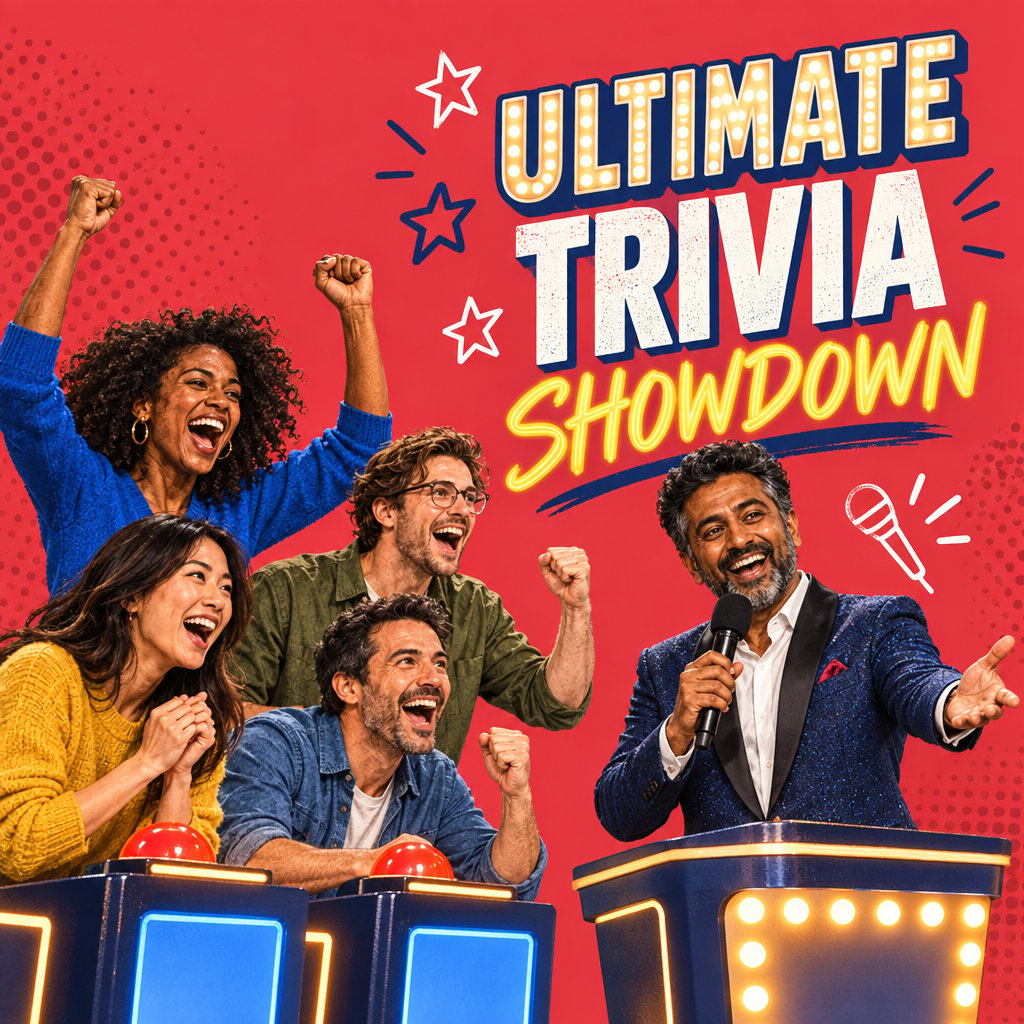
Each table plays as a team, and an emcee reads a short round of questions in each gap between courses. It keeps tables talking to each other instead of to their phones, and it costs nothing but an hour of question writing. For a hosted version with a professional quizmaster, our in-person Ultimate Trivia Showdown is listed at $50 per person.
To run it:
Write three rounds of five questions: general knowledge, a picture round printed on a sheet, and a round about the company.
Put one answer sheet and one pen on each table, and have volunteers collect sheets after each round.
Read each question twice and allow 30 seconds. Phones stay face down.
Announce the standings before dessert and give the winning table a prize they can share.
Best for: 20 to 500 people at tables of six to ten Party slot: between courses, about 25 minutes in total Cost: free to run yourself
What we've learned: Keep each round to five questions. A ten-question round outlasts the salad course, and the kitchen will start serving over your emcee.
Our trivia night guide has round formats, scoring and tiebreakers.
14. Dinner Theater Mystery
Actors or a host stage a whodunit across the courses of the meal. A crime is announced with the starters, suspects visit the tables during the main course, and each table hands in its accusation before dessert. It gives a long dinner a plot, and every table has a job.
To book it:
Choose between a troupe of actors, who perform the story around the room, and a hosted game, where guests play the suspects.
Give the troupe the dinner timings so scenes land between courses.
Ask for a version with no gore and no jokes at the expense of real colleagues.
Keep groups to about 150. Beyond that, the back tables cannot hear the clues.
Best for: 20 to 150 people Party slot: through dinner Cost (estimate): $1,500 to $5,000 for a troupe
A 15-minute awards segment between the main course and dessert mixes real recognition with light superlatives that colleagues nominate in advance, such as "most likely to fix the printer." Done well, it is the part of the night that is about the people in the room.
To run it:
Collect nominations with a short form two weeks ahead, and choose ten to twelve awards.
Apply one test to each: would the winner repeat it proudly at home? Cut anything about appearance, age, habits or personal life.
Have one emcee read every award. Presenters get one sentence each.
Print certificates or buy small trophies, and take a photo of each winner.
Best for: 20 to 500 people Party slot: before dessert Cost: under $200 for certificates and trophies
What we've learned: Announce the 15-minute limit from the stage. Awards run long because each presenter adds a speech, and a stated limit gives the emcee permission to move on.
Evening entertainment for corporate events
After the plates are cleared, the question is how to keep people in the room. Evening entertainment works when there is one main thing to do and somewhere comfortable for the people who are not doing it.
16. Live Band Karaoke
Guests sing lead with a live band behind them. The band supplies a song list, puts lyrics on a screen and covers weak moments with backing vocals, which makes it far more forgiving than a karaoke machine. A good bandleader will also turn a nervous solo into a group number.
To book it:
Circulate the band's song list a week ahead and sign up five or six confident singers to open.
Encourage group numbers. Teams of four are braver than soloists.
Limit everyone to one song until the list is empty.
Put the sign-up sheet near the bar and name someone to manage it.
Best for: 50 to 300 people Party slot: the last 90 minutes Cost (estimate): $2,500 to $6,000; a karaoke host with a machine runs $400 to $1,000
17. Lawn Games and Arcade Corner
A corner of giant Jenga, cornhole, table tennis, pop-a-shot basketball and a rented pinball machine gives non-dancers and non-drinkers a place to spend the evening. Add a bracket on a flip chart and it becomes a tournament.
To run it:
Rent enough games that nobody waits long, about four to six for 100 guests, and check ceiling height for anything that involves throwing.
Post a sign-up bracket for one game and name a commissioner to run it.
Keep the corner inside the main room. In a separate room it becomes a second, smaller party.
Skip inflatables indoors. They need more space and power than most venues allow.
Best for: 20 to 300 people Party slot: all night Cost (estimate): $75 to $400 per game for the day; lawn games cost less to buy than to rent twice
18. Blind Tasting Station
A guide pours four or five unlabeled samples of chocolate, cheese, coffee, whiskey or zero-proof cocktails, and guests guess which is which on a scorecard. It is food and drink doing the work of entertainment, and it suits a standing reception where a stage act would be ignored.
To run it:
Choose one product and four or five versions that differ in an obvious way, such as price, origin or age.
Print a scorecard with one question per sample: which is the most expensive, which is from the supermarket.
Always offer an alcohol-free flight at the same station, so nobody has to ask for it.
Reveal the answers at a set time and give a prize for the best palate.
Best for: 20 to 200 people Party slot: cocktail hour Cost (estimate): $15 to $50 per person depending on the product; more with a hired sommelier or guide
Corporate cocktail party entertainment ideas
A standing reception has no seats, no stage and no moment when everyone is looking the same way, so choose entertainment that comes to the guests. The roaming magician, caricature artists, typewriter poets, the photo booth and the tasting station all work without interrupting conversation. Leave the comedian and the game show for a night with chairs. For shorter after-work gatherings, our happy hour ideas has games sized for an hour.
Unique corporate entertainment ideas
These three are less common at company events, which is the reason to book them. Each produces something guests take home or photograph.
19. Live Event Painter or Speed Painter
A live event painter sets up an easel in a corner and paints the party as it happens, finishing a canvas in three to four hours that the company can hang in the office. A speed painter is a stage act: a large portrait or logo painted in five to ten minutes to music, sometimes painted upside down and flipped for the reveal.
To book it:
For an event painter, choose the scene in advance, such as the dinner tables, the dance floor or the venue's facade.
Place the easel where guests can walk up and watch, with good light.
For a speed painter, agree on the subject and who keeps the painting. Many companies auction it for charity.
Ask about drop cloths and venue rules on paint.
Best for: any size Party slot: all night for an event painter; a ten-minute stage slot for a speed painter Cost (estimate): $1,500 to $4,000 for an event painter; $3,000 to $10,000 for a speed-painting show
20. Typewriter Poets
Poets sit at manual typewriters and write a short poem for each guest on any subject the guest names: a dog, a retiring colleague, the quarter's sales target. Each poem takes a few minutes and goes home on a card. The sound of the typewriters draws a crowd on its own.
To book it:
A poem takes about five minutes, so one poet writes around a dozen an hour. Book a second poet for more than 100 guests.
Give the poets a small table near the entrance and a sign that explains the offer in one line.
Ask for cards printed with the event name.
Best for: 30 to 300 people Party slot: cocktail hour Cost (estimate): $200 to $400 an hour per poet
21. Ambient Acts: Stilt Walkers, Living Statues and LED Drummers
Ambient performers set the tone without asking for attention. Stilt walkers greet guests at the door, living statues hold a pose until someone walks past, and a drumline with lit drums leads the crowd from the reception into the ballroom. They work best at arrivals and transitions, when you need to move several hundred people or fill a large space.
To book it:
Use them for a purpose: the welcome, the call to dinner or the opening of the dance floor.
Book two sets of 20 to 30 minutes instead of one long one.
Check ceiling height for stilt walkers, and ask the venue about certified rigging points and insurance before booking any aerial act.
Agree on costumes that fit the theme and the dress code.
Best for: 100 to 1,000+ people in a large venue Party slot: arrival and transitions Cost (estimate): $500 to $1,500 per strolling performer; $2,000 to $8,000 for a drumline or aerial act
Company party entertainment ideas on a small budget
None of these three needs a vendor. Each needs an emcee who is comfortable with a microphone and about two hours of preparation.
22. Coworker Open Mic
Colleagues sign up in advance for a three-minute slot: a song, a poem, a card trick, a story. Six to eight acts fill half an hour, and an open mic of people the audience knows gets a warmer reception than most hired acts.
To run it:
Recruit the first two acts yourself before you announce it, so the sign-up sheet never starts empty.
Cap the list at eight acts and three minutes each, and hold a timer at the side of the stage.
Check the microphone and any music files before guests arrive.
Make performing strictly voluntary and give the audience a job, such as voting for the crowd favorite.
Best for: 20 to 150 people Party slot: after dinner Cost: free
Our talent show ideas has acts for people who say they have no talent, and a full run of show.
23. Music Bingo
Music bingo swaps numbers for song titles. The emcee plays 20 to 30 seconds of a song, and anyone with that title on their card marks it. People sing along without being asked, which is most of the appeal.
To run it:
Build a playlist of 50 to 75 well-known songs and paste the titles into a free online bingo card generator to print a different card for every guest.
Play about 25 songs per round, mixed across decades so every age group knows some.
Start with one line to win, then play a second round for a full card.
Check the winner's card against the songs played before you hand over the prize.
Best for: 15 to 300 people Party slot: after dinner, about 30 minutes for two rounds Cost: free
24. Slide Karaoke
In slide karaoke, a volunteer presents a slide deck they have never seen, with full confidence, for two minutes. The slides advance on a timer and have nothing to do with each other. It is improv with a safety net, and office workers are already trained for it.
To run it:
Build six to eight decks of five slides each from stock photos, odd charts and diagrams, and set them to advance every 20 seconds.
Give each presenter a made-up title, such as "Q3 Results for the Moon Division."
Take volunteers only, and sign them up before the party.
Keep real colleagues, clients and competitors off the slides.
Let the audience pick the winner by applause.
Best for: 15 to 150 people Party slot: after dinner, about 25 minutes Cost: free
Entertainment for large corporate events
Headcount changes what works more than budget does. A close-up magician is perfect for 60 people and invisible to 600, and a comedian needs a room large enough to laugh. Use this as a starting point.
Guests
What works
What breaks
Under 50
Strolling magician, caricature artist, table trivia, slide karaoke, tasting station
Stage shows that need a crowd to laugh, and dance floors
50 to 150
Comedian, improv troupe, casino tables, murder mystery dinner, hosted game show
A single photo booth or a single artist as the only activity
150 to 500
Band, dueling pianos, silent disco, game show with table teams, several roaming acts at once
Anything guests must hear without a professional sound system
500 and up
Headline band or comic with screens, ambient acts, multiple booths and stations, a hosted game played from the tables
Close-up acts, open mics and anything with a single line
Two rules hold at every size above 150. Rent a professional sound system and a technician, because an act that half the room cannot hear is not entertainment for that half. And multiply the stations: a single photo booth or a single artist means a long line at 400 guests, so add a second booth or a second kind of activity. Our in-person hosted games are listed for groups of 15 to 1,000, and our guide to team building for large groups covers formats that scale.
Corporate holiday party entertainment
The December party is the one most companies book entertainment for, which makes it the hardest date to get.
Three adjustments make the ideas on this page work in December. Ask every act for a holiday version: a band's seasonal set, a game show with holiday rounds, a tasting flight of hot chocolate. Keep the content broad, since not everyone on your team celebrates the same holiday. And if your first-choice act is taken, ask about a weekday, since Fridays and Saturdays fill first.
When the party is on a video call, entertainment has to be something people play, because watching a performer through a laptop for an hour is television. Hosted games work best. Our virtual Ultimate Game Show is listed at $45 per person for 10 to 1,000 guests, and the virtual mystery Murder in the Speakeasy is listed at $40 per person. Magicians, mentalists and comedians also perform on video, and the good ones build the act around the chat and the camera.
Hybrid parties are harder. The usual failure is a room full of people having a party while remote colleagues watch a wide shot of it. Choose one activity both groups can play as equals, such as trivia where remote teams answer on the same form as the tables in the room, and give the remote group its own host. The full list of online formats is in our guide to virtual corporate events.
How to choose and book corporate entertainment
Choosing well comes down to three decisions: where in the evening the entertainment goes, what the budget can buy, and what you ask before you sign.
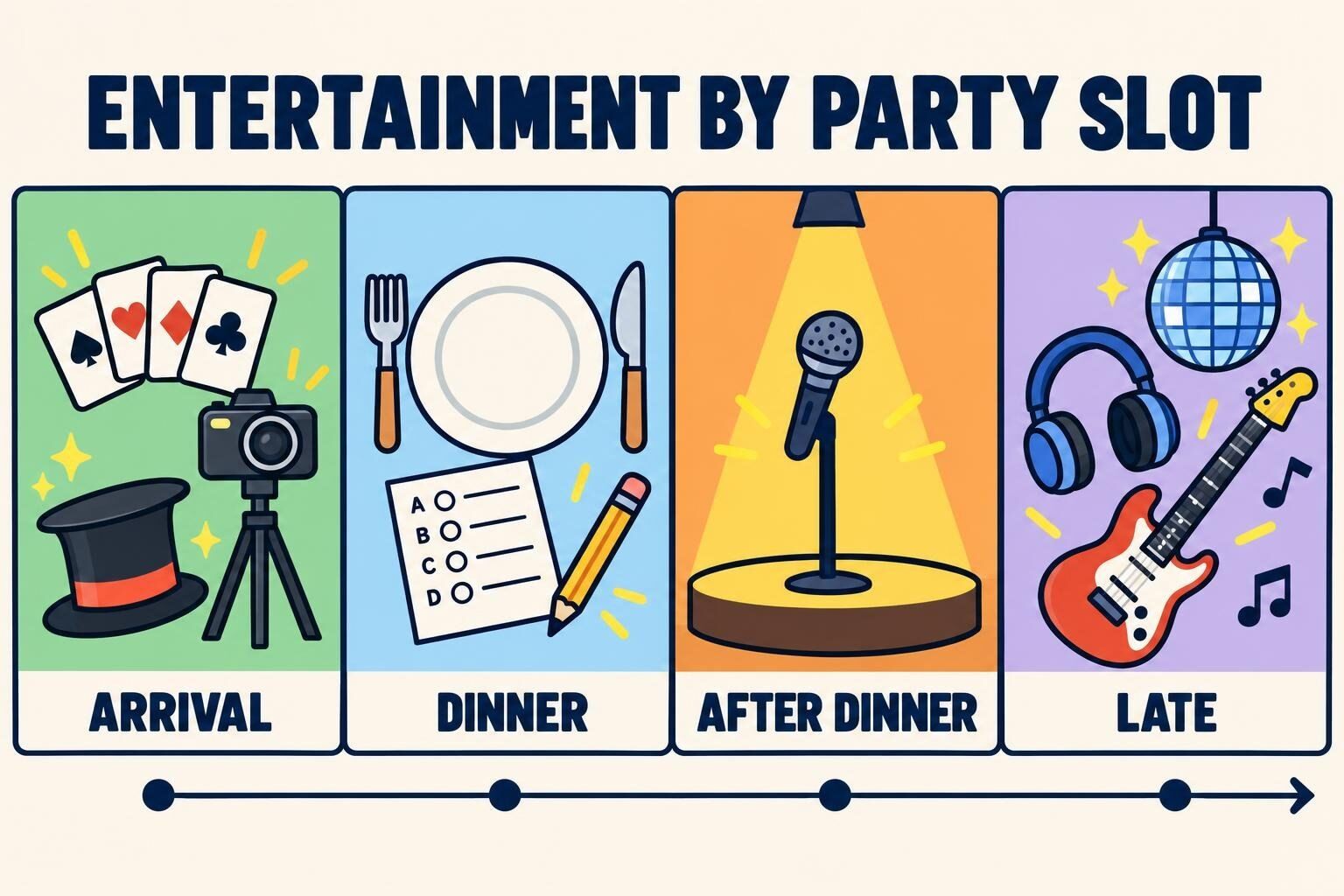
Where entertainment goes in the run of show
Match the act to the part of the night. A good act in the wrong slot still fails.
Part of the evening
What guests are doing
Entertainment that fits
Arrival and cocktail hour
Standing, arriving in ones and twos, looking for people they know
Table trivia, murder mystery, awards, quiet background music
After dinner
Seated, fed and facing the stage
One main act of 30 to 45 minutes: comedian, improv troupe, mentalist, game show, open mic
Late
Up from their seats, choosing between dancing, talking and leaving
Band, dueling pianos, silent disco, live band karaoke, casino tables, games corner
Corporate entertainment by budget
These tiers are our rough estimates for the entertainment alone, before venue, food and sound.
Entertainment budget
What it buys
Under $500
A self-run program: music bingo, slide karaoke, table trivia, an awards segment, an open mic
$500 to $2,000
One professional element for two to three hours: a strolling magician, two caricature artists, a photo booth, a DJ, or a few casino tables
$2,000 to $7,500
A headline act, such as a comedian, improv troupe, dueling pianos or a band, or a hosted game for a mid-size group
$7,500 and up
A headline act plus ambient entertainment during arrival, or several acts across the evening for a large event
Booking timeline
Eight to twelve weeks out: fix the date, headcount and entertainment budget. Ask the venue for its sound limit, curfew, load-in rules, power and any ban on open flame or rigging.
Six to eight weeks out: request quotes from three acts with the same details: date, times, guest count, audience and venue. Watch full videos and call one reference for your first choice.
Four to six weeks out: sign the contract, pay the deposit and book any sound or lighting the act does not bring.
Two weeks out: send the run of show, final headcount, parking details and the name of one on-site contact.
On the day: hold the sound check before the doors open, feed the performers and have the balance ready.
A month is enough for most of the year. For a December date, start in early October.
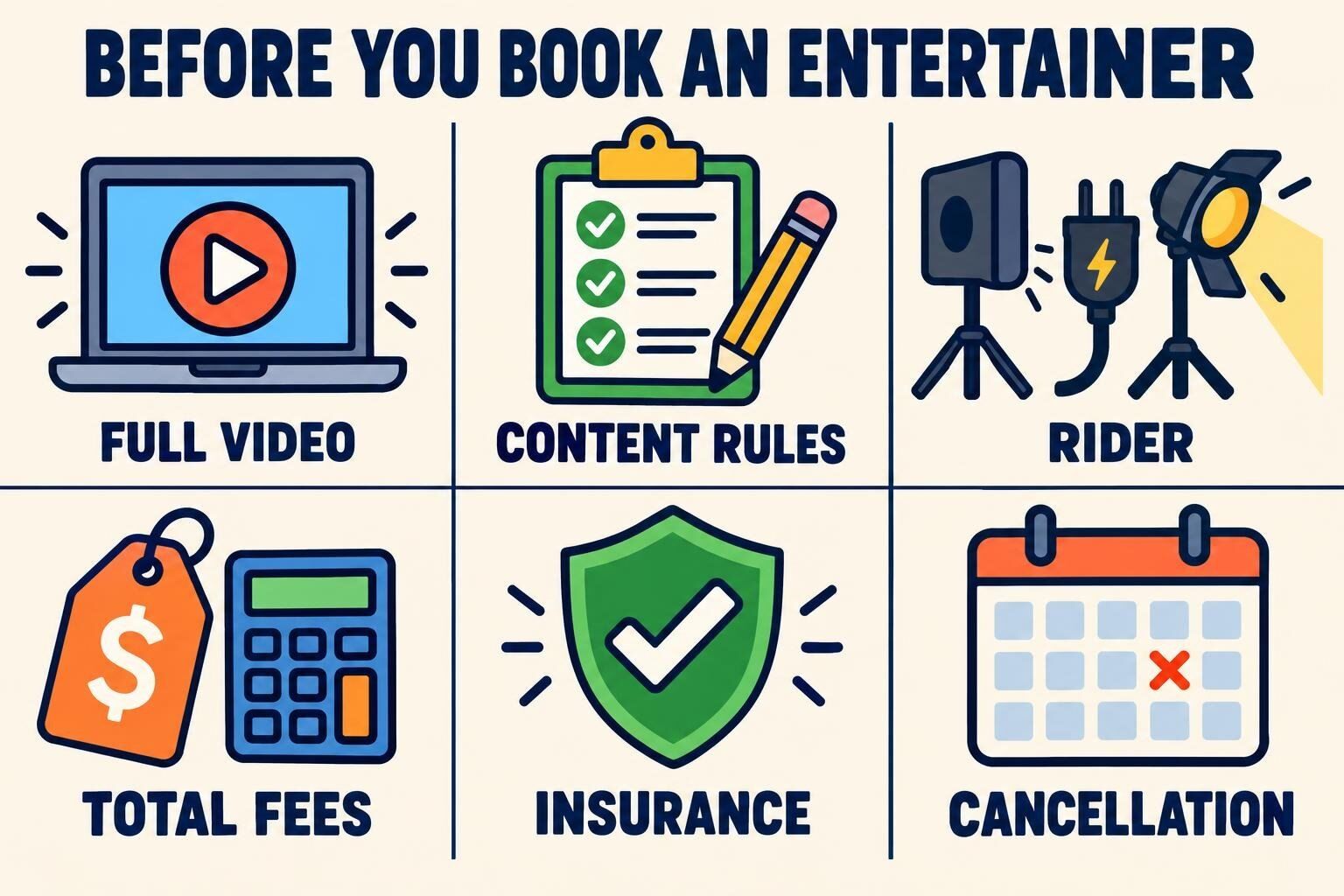
Questions to ask a corporate entertainer before you book
Have you performed for a company audience of this size, and can I watch an unedited video of a full set?
What is in the act? Will you agree to our content rules in writing and send the set list or script outline for approval?
What do you need from us? Ask for the rider: stage size, power, sound, lighting, a changing room, parking and meals.
Who supplies the sound system, and does your fee include a technician?
What is the total price, including travel, lodging, setup time and overtime if the program runs late?
What are the deposit, cancellation and rescheduling terms, and who covers the date if you are ill?
Do you carry liability insurance, and can you send a certificate of insurance that names the venue?
How much audience participation is there, how do you choose volunteers, and what happens when someone declines?
When do you arrive, how long is the set, and how long do you need to load out?
The best hosted corporate party entertainment, ranked
If you want someone else to run the room, these are the hosted games from our catalog that suit a company party, in person and virtual. They are ranked by our Team Building Score, a points total each event earns from confirmed bookings, participant reviews and ratings. To appear in the table, an event also needs at least 30 post-event survey responses per question, and the survey columns show what participants said afterward.
Ranked by our Team Building Score — a running points total earned through confirmed bookings, verified reviews, ratings, and listing quality, recalculated nightly. Every event shown also has at least 30 post-event survey responses per question; the happier, connected, and NPS columns are computed from the 4,977+ survey responses collected for the 10 events listed here — a subset of all post-event surveys across our catalog. Updated November 2026.
The full catalog lists every virtual and in-person event with its price.
Where to book corporate entertainment
We sell hosted games, so read our opinion with that in mind. There are four sensible ways to book entertainment for a company party, and the right one depends on whether you want a performer, a game or a full program.
Online marketplace of performers and event services
Free quote requests; each performer sets a price
Finding a local magician, caricature artist, band or DJ and comparing quotes
A practical way to see who is available in your city. Payments made through the site are covered by its guarantee, so book there and not by side arrangement.
Team building company with in-person and virtual events
Custom quotes
Companies that want another quote for a hosted game or a charity activity
A long-established provider with a broad catalog. A sensible second quote for a large event.
The performer or a local entertainment agency
Direct booking, or an agent who represents several acts
Custom quotes; agencies add a fee or commission
Headline acts, large events and programs with several performers
Go direct when you already know the act. Use an agency when you need three acts, a sound company and one contract.
What we've learned about entertaining a work crowd
Our hosts run games at company parties and team events. These five lessons apply to any entertainment on this list, hired or homemade.
Book one main thing. A party with a band, a magician, a casino and a photo booth all running at once has no moment when the room is together. Choose one headline for after dinner and let everything else be background.
Start when the room is ready, not when the schedule says. An act that begins while servers are clearing plates loses its first five minutes, and a comedian never gets them back. Give the stage manager or emcee the authority to hold the start.
Protect the right to watch. Any act that takes volunteers should take them from raised hands. For games, create jobs for people who would rather not play, such as judge, scorekeeper or photographer. Guests who feel safe from being picked sit closer to the stage.
Plan for the people who are not drinking. If the bar is the only activity after 9 p.m., a share of the room goes home. A games corner, a tasting station with a zero-proof flight or a silent disco gives them a reason to stay.
Put the entertainment where the people are. A booth, a poet or a caricature artist in a side room is a rumor. The same act beside the bar has a line all night.
Corporate entertainment we don't recommend
An earlier version of this page listed body painting and balloon-popping games. Those belong at a corporate family fun day, where there are children to enjoy them. The acts below are booked for adult company parties every year and cause most of the stories people tell afterward for the wrong reasons.
The Lame List
Entertainment
The problem
Book this instead
Stage hypnotist
The act depends on colleagues doing embarrassing things in front of their managers, and the videos outlast the party.
By then the room has been sitting for two hours, and every added speaker costs you guests from the back tables.
One toast before dinner, and awards capped at 15 minutes
Final thoughts
Good corporate party entertainment fits the part of the evening it is booked for, gives every guest a way to take part or sit back, and is confirmed in writing weeks before the date. Start with the at-a-glance table, pick one headline act for after dinner and one thing for the first hour, and send the nine booking questions before you sign anything. If you want guests playing instead of watching, browse our virtual and in-person team building events.
Answers to the questions planners ask most often about booking entertainment for company events.
What is corporate party entertainment?
Corporate party entertainment is any act, game or activity a company arranges so guests at a work event have something to watch or do. It includes performers such as bands, comedians and magicians, interactive setups such as casino tables and photo booths, and hosted games such as trivia and game shows. It is also called corporate entertainment or corporate event entertainment.
What is the best entertainment for a corporate event?
The best entertainment for a corporate event is one main act that fits the crowd and the part of the evening. After a seated dinner, book a comedian, an improv troupe or a hosted game show. For a standing reception, choose a roaming magician, caricature artists or a photo booth. To close the night, a band, dueling pianos or a silent disco keeps people in the room.
How much does corporate entertainment cost?
Corporate entertainment costs anywhere from nothing for a self-run program to $10,000 or more for a headline act. As rough U.S. estimates, a strolling magician or a photo booth runs $600 to $2,000, a DJ $800 to $2,500, a corporate comedian $1,500 to $7,500 and a cover band $3,000 to $12,000. Hosted games are usually priced per person, and our in-person events on this page are listed at $50 to $80 per person. These are our estimates, not quotes.
How far in advance should you book corporate party entertainment?
Book most entertainment four to eight weeks ahead, and December dates by early October. On teambuilding.com, in-person events are booked a median of 30 days in advance, and 62% of December bookings are placed in October or November. Headline acts and Friday or Saturday dates go first.
What entertainment works for a corporate dinner?
Entertainment that fits between courses works best at a corporate dinner: table trivia in three short rounds, a murder mystery that unfolds across the meal, or a 15-minute awards segment before dessert. Keep background music quiet enough for conversation, and save the main act for after the plates are cleared.
What should you ask a corporate entertainer before booking?
Ask for an unedited video of a full set for a company audience, written agreement to your content rules, the rider (stage, power, sound and lighting needs), the total price including travel and overtime, the cancellation terms, proof of liability insurance, and how volunteers are chosen. Get the answers in the contract before you pay a deposit.










Comments (0)
Leave a Comment