
175 Get to Know You Questions for Work, Friends & New Teams
175 get to know you questions in eleven categories, from basic starters to deep prompts and a curated 20, with the games our hosts use to turn a list into an activity.
175 get to know you questions in eleven categories, from basic starters to deep prompts and a curated 20, with the games our hosts use to turn a list into an activity.
Here is our list of the best get to know you questions, sorted by how well you already know the person and how much time you have.
We have opened tens of thousands of team building events with some version of "tell us something about yourself," and the difference between a room that lights up and a room that stares at the table is almost always the question. This list keeps the prompts that work in a real room and cuts the ones that never did.
This list includes:
We close with what we have learned asking these questions, the questions we do not recommend, and final thoughts.
Get to know you questions are prompts that reveal personal history, tastes, opinions, and fun facts about the person answering. For example, "What is your earliest memory?" or "What skill would you most like to learn next?" People use these questions to start conversations with new coworkers, classmates, friends, and dates, and at work they are the fastest way to turn a room of job titles into a team. These prompts are also called getting to know you questions, get to know me questions, questions to ask to get to know someone, get to know each other questions, and GTKY questions.
Get to know you questions are a subcategory of icebreaker questions and team building questions. They are similar to get to know you games, random questions, rapid fire questions, this or that questions, and question games. Within the category, this list includes basic get to know you questions, fun get to know you questions, get to know me questions, getting to know each other questions, deep get to know you questions, and 20 questions to get to know someone. The prompts are the raw material for icebreaker games and team bonding questions sessions.
There is a reason these questions matter more at work than they look. In a nationally representative survey of 1,095 U.S. working adults, neuroscientist Paul Zak found that people at high-trust companies reported 74% less stress, 106% more energy at work, 50% higher productivity, and 40% less burnout than people at low-trust companies (Harvard Business Review, 2017). Trust is built in small doses, and learning that the person across the table collects vinyl or grew up on a dairy farm is one of the smallest, cheapest doses there is.
A few ground rules that hold across every category below. Ask for a story or a choice rather than a favorite, because "What is your favorite color?" ends a conversation and "What is the best meal you have eaten this year?" starts one. Keep questions about taste, history, and opinion, and away from money, health, family status, and relationships unless the other person goes there first. And answer your own question first: the person asking sets the depth, so a manager who gives a real answer gets real answers back.
Use this table to pick a category based on how well the group already knows each other and how much time you have. Every question on this page is free to use.
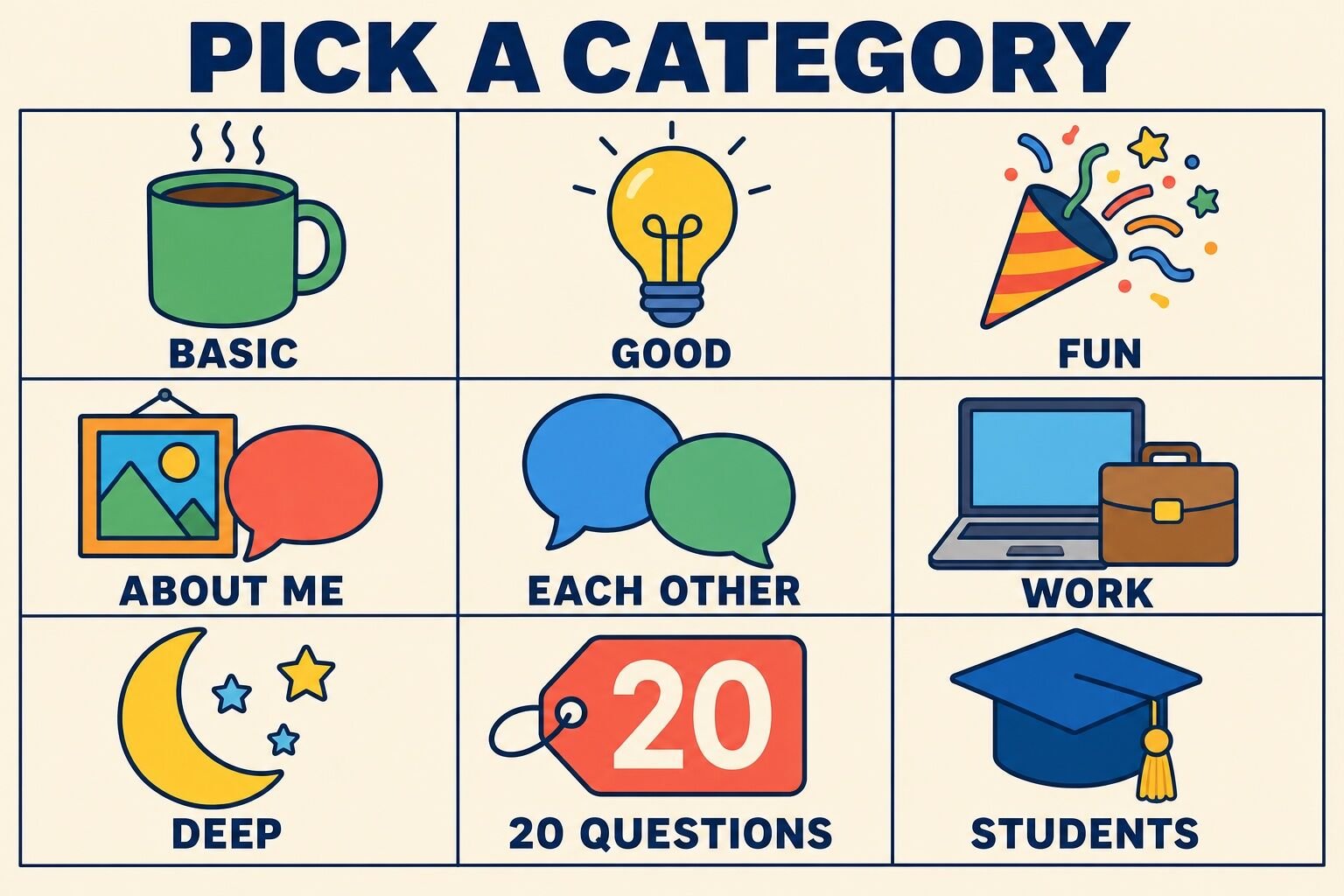
| Category | Best for | Group size | Time | Cost |
|---|---|---|---|---|
| Basic get to know you questions | Strangers and first meetings | 2–100+ | 1 min per question | Free |
| Good get to know you questions for adults | Any group that has covered the basics | 2–30 | 2 min per question | Free |
| Fun get to know you questions | Parties, happy hours, meeting openers | 4–100+ | 1–2 min per question | Free |
| Get to know me questions | Introductions, Q&A rounds, new hire posts | 1–30 | 3–5 min per person | Free |
| Who knows me best questions | Teams and friends who think they know each other | 4–20 | 10–20 min | Free |
| Getting to know each other questions for teams | Pairs, new teams, one-on-ones | 2–20 | 2–3 min per question | Free |
| Get to know you questions for work | Onboarding, meeting openers, offsites | 2–50 | 1–2 min per question | Free |
| Deep get to know you questions | Small groups that already trust each other | 2–8 | 5 min per question | Free |
| 20 questions to get to know someone | One person you want to know well | 2 | 20–40 min | Free |
| Questions to get to know someone new | New friends, first dates, neighbors | 2–6 | 2 min per question | Free |
| Get to know you questions for students | Classrooms, clubs, orientation | 5–40 | 1 min per question | Free |
| Get to know you games | Turning any list above into an activity | 4–100+ | 5–30 min | Free |
Press the button to get a random question from this list. We use the generator for one-question meeting openers: whoever is sharing their screen spins it, answers first, then picks the next person.
Basic get to know you questions are the simple questions to ask someone you have just met. They are low-stakes on purpose: nobody has to be clever or vulnerable to answer, which makes them the right opener for a room of strangers. Ask two or three, then move to a livelier category.
Good get to know you questions ask for a story instead of a fact. These are the ones our hosts reach for once a group has covered the basics, because every answer has a follow-up question hiding inside it. They work for adults at work, at dinner, or on a long drive.
Fun get to know you questions trade depth for laughs, which is exactly what a happy hour or the first five minutes of a meeting needs. Funny answers travel: the "strangest food combination" answer from a kickoff call will still be coming up in the team chat months later. If a group wants even faster laughs, would you rather questions are the natural next step.
Get to know me questions flip the direction: instead of interviewing someone else, you answer these about yourself. They are the prompts for an "ask me anything" Q&A, a new hire introduction post, an all about me slide, or a team channel thread where everyone answers the same three questions. Pick the ones with answers that would surprise the people who only know your job title.
Who knows me best questions turn the get to know me list into a quiz. One person writes down their answers privately, then teammates or friends guess, and the closest guesser wins. The quiz format is a favorite of ours for teams that assume they know each other well, because the misses are funnier than the hits. For a longer version, see our list of how well do you know me questions.
Getting to know each other questions are built for two people, or a small team, to answer about each other rather than about themselves. They work in new hire one-on-ones, buddy programs, and the first month of a newly formed team, because each answer says as much about the person asking as the person answering. Both people should answer every question.
Get to know you questions for work stay on the professional side of personal: how people like to work, what they are proud of, and what they do when they are not working. These are the questions to ask coworkers during onboarding, at the top of a team meeting, or on the first night of an offsite. For recurring meetings, rotate one question a week rather than running ten at once, and see our check-in questions for prompts built for that rhythm.
Deep get to know you questions are the interesting questions to ask once a group already trusts each other. Save these for small groups, long dinners, and the second half of a retreat, and never make anyone answer one cold in front of thirty coworkers. The rule we use: the asker answers first, and "pass" is always an acceptable answer.
These 20 questions to get to know someone are a curated set for one conversation with one person, ordered from easy to personal. Start at the top and skip anything the conversation has already covered. This is not the 20 questions guessing game, although it borrows the same idea that twenty good questions are enough to know someone.
These questions to get to know someone new are for friends you just made, first dates, new neighbors, and the person you keep running into at the gym. They stay curious without getting personal too fast. If you want an even softer opening, start with a few conversation starters and move here once you are both laughing.
Get to know you questions for students work for the first day of class, club orientation, and dorm floor meetings, from middle school through college. Keep the questions about the student's interests rather than their grades or their family, and let students answer in pairs before sharing with the room.
A list of questions is only half the activity; the other half is the format that gets a whole group answering. teambuilding.com staffs events from a pool of over 75 hosts, all with performance backgrounds, and the five formats below are the ones they use most often to turn a question list into a game. Every one is free and works in a conference room or on a video call, and our get to know you games guide linked above has a longer list.
Bet on the Crowd is a prediction game we run in our hosted events, and it is the strongest format we know for a group that already knows names but not much else. Instead of answering a question about yourself, you bet on how the group will answer.
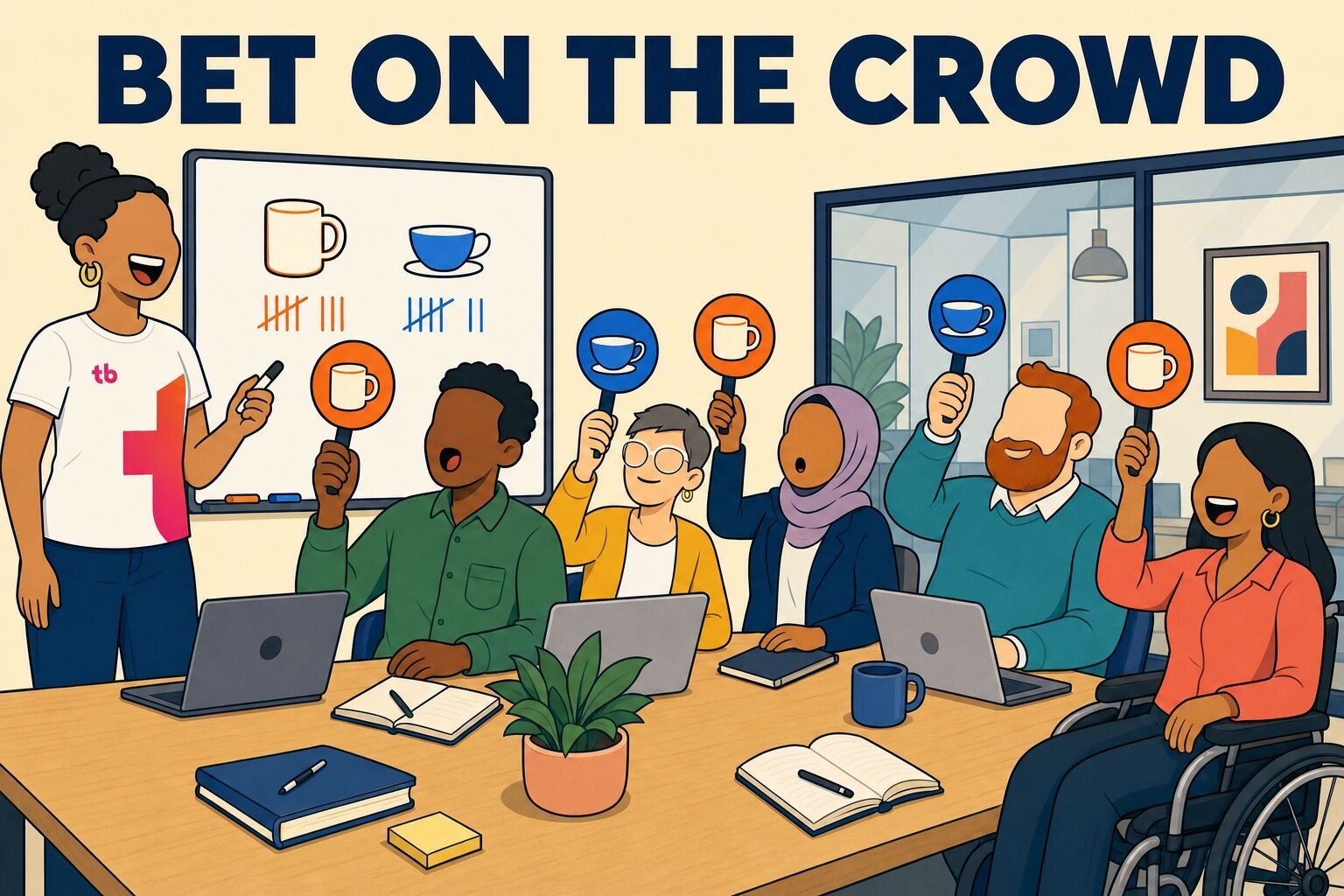
How to play:
Best for: teams of 8 to 100+ that need a low-pressure way to hear from everyone
Time: 15–30 minutes
Materials (cost): a question list and a way to vote, hands or a poll tool (free)
What we've learned: the prediction step is what makes the game work. Asking "how will this group answer?" forces people to think about their coworkers rather than themselves, and the reveal of a 50/50 split on something everyone assumed was obvious is a reliable laugh.
Question Roulette is the simplest way to use the random generator above, and it is how we recommend opening a recurring meeting: one spin, one answer, one minute.
Best for: the first five minutes of a standing meeting, 4 to 15 people
Time: 5–10 minutes
Materials (cost): the generator on this page (free)
What we've learned: a hard stop matters more than a good question. Five minutes a week compounds into a team that knows each other; a 25-minute icebreaker gets cut from the agenda after two weeks.
Something in Common uses get to know you questions as a search tool: small groups race to find things every member shares, and the obvious answers do not count.
Best for: mixing departments at an offsite or kickoff, 6 to 100+ people
Time: 10–20 minutes
Materials (cost): none (free)
What we've learned: the ban on obvious answers is the whole game. Without it, groups stop at "we all work in marketing"; with it, they discover that three of the four people at the table had a paper route.
Teammate Trivia turns the get to know me questions into a guessing game where the answers come from the team itself.
Best for: teams of 8 to 40 that have worked together for at least a month
Time: 20–30 minutes
Materials (cost): a survey form and a host (free)
What we've learned: ask for answers that are specific and unusual. "A surprising past job" produces better rounds than "favorite food," because nobody can guess the person who once worked as a lighthouse tour guide, and everyone wants to hear about it.
Speed Meet runs the questions as rotating two-minute conversations, which is the fastest way for a large group to meet everyone.
Best for: new cohorts, conferences, and all-hands with 10 to 100+ people
Time: 15–25 minutes
Materials (cost): a timer and a question list (free)
What we've learned: put the question on the screen, not on paper. Pairs who have to remember the prompt spend their two minutes negotiating what to talk about instead of talking.
As of September 2026 we have run more than 45,000 team building events, virtual and in-person, and nearly every one starts with a question. A few patterns hold up across all of them.
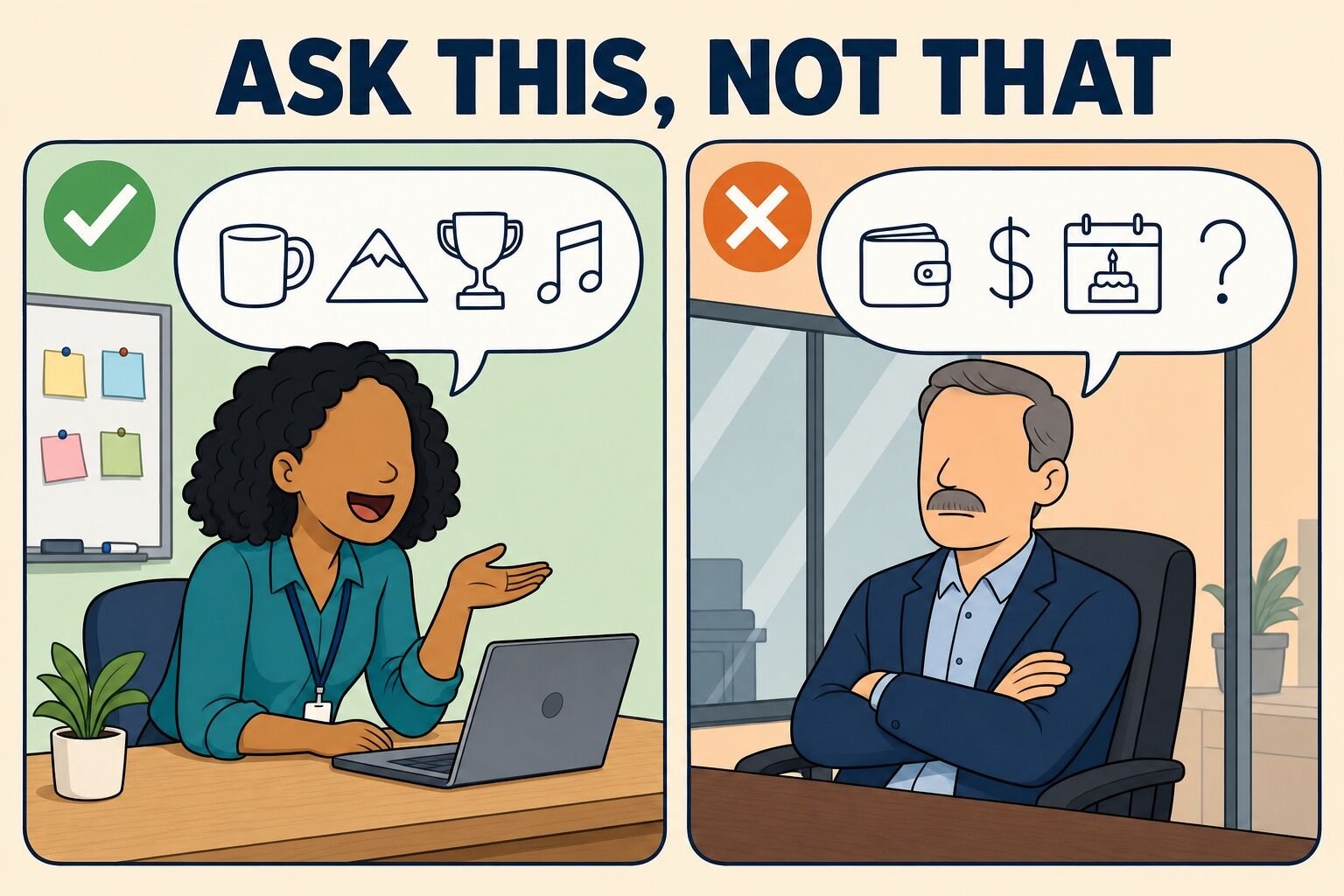
Ask this, not that. The best prompts are about taste, history, and opinion, which people enjoy sharing. The worst ones are about status, money, family situations, and health, which people feel obligated to answer. The test is simple: could the honest answer embarrass someone in front of their manager? If yes, it belongs in the Lame List, not the meeting.
Whoever asks, answers first. The person who introduces the question sets the depth of every answer that follows. A manager who says "my first job was scooping ice cream and I was fired in a week" gets real stories back; a manager who says "let's go around" gets job titles. Our founder Michael Alexis puts it more bluntly, and it applies to hosting a question round as much as anything else at work.
Make it comfortable for the quiet half of the room. As Michael also notes, introversion is not inferior to extroversion, and the introvert/extrovert split oversimplifies what is really a spectrum. In practice that means three things: show the question before calling on anyone so people can think, accept written answers in the chat or on a sticky note alongside spoken ones, and build a visible pass into the rules so declining is never a public act.
Connection is the outcome that pays for everything else. We survey participants after our hosted events, and the virtual results make the case for spending ten minutes on questions instead of skipping straight to the agenda.
Retire questions that stop working. Every prompt in this article earned its place by getting a real answer in a real room. The ones we cut had one of four problems: they were bland, they were presumptuous, they had a single correct answer, or they had been asked so often that people had a rehearsed response ready. "Tell us a fun fact about yourself" is the classic example of the last one.
The biggest predictor of whether a question round works is the headcount. Our hosts put the dividing line at about 15 people. Below it, everyone can answer out loud and follow-up questions are the point. Above it, questions need a format from the games section so that answering is simultaneous rather than sequential.
| Small groups (about 15 or fewer) | Large groups (more than 15) | |
|---|---|---|
| Best categories | Good, deep, getting to know each other | Basic, fun, who knows me best |
| How people answer | One at a time, out loud, with follow-ups | All at once: hands, paddles, polls, chat |
| Questions per session | 2 to 4, with time to go deeper | 6 to 10, one to two minutes each |
| Best format | Question Roulette, Teammate Trivia | Bet on the Crowd, Speed Meet, Something in Common |
| Who runs it | Any team member, rotating weekly | A dedicated facilitator with a visible timer |
The first version of this article, like most lists on the internet, included a few questions that read fine on a page and land badly in a room. We have asked enough of them to know which ones to retire. The following prompts are either too personal for a mixed group, too bland to start anything, or simply not questions.
| Question | Why skip it | Verdict |
|---|---|---|
| "How old are you?" | Age is protected information at work for a reason, and nobody enjoys answering it in front of colleagues. | Skip it |
| "Do you have a significant other?" / "Do you have kids?" | Relationship and family status are private, and the questions put single people and people going through hard seasons on the spot. | Skip it |
| "What is your favorite color?" | A one-word answer with no follow-up. It signals that the asker did not think about the question. | Skip it |
| "Tell us a fun fact about yourself." | Asked so often that people either have a rehearsed answer or panic. Ask for something specific instead. | Skip it |
| "What are you allergic to?" | Medical information dressed up as small talk. Useful for the caterer, not for an icebreaker. | Skip it |
| "Whose death hit you hardest?" | Grief is not an icebreaker topic. Deep questions belong in trusted small groups, and this one rarely belongs anywhere at work. | Skip it |
| "What is the grossest thing you would do for $100?" | Plays as a dare, not a question, and the answers age badly in a work chat. | Skip it |
| "What would your drag queen name be?" | A punchline that borrows from a culture many people in the room are not part of; it tends to produce awkward silence rather than laughs. | Skip it |
| "Show me your best dance move." | Not a question, and a demand for a performance from people who did not sign up for one. | Skip it |
| "Where do you think we go when we die?" | Religion and mortality in one prompt. Fine between old friends at 1 a.m., a problem at a team kickoff. | Skip it |
| "Did you go to college, and what was your major?" | Sorts the room by credentials on day one. Ask what someone learned in their first job instead. | Skip it |
The best get to know you questions ask for a story or a choice, stay on the safe side of personal, and are answered first by the person who asked them. Pick a category that matches how well the group already knows each other, run two or three questions rather than twenty, and use one of the game formats once the headcount passes fifteen. Do that for five minutes a week and the "tell us about yourself" dread disappears on its own.
If you would rather have a host run the questions and the games, browse our virtual and in-person team building activities.
Next, check out our list of fun facts for work, these most likely to questions, and our unusual icebreaker questions.
Answers to the questions we hear most often about using these prompts with a group.
Get to know you questions are prompts that reveal personal history, tastes, opinions, and fun facts about the person answering, such as "What is your earliest memory?" or "What skill would you most like to learn next?" People use them to start conversations with new coworkers, classmates, friends, and dates. They are a subcategory of icebreaker questions and are also called getting to know you questions, get to know me questions, and questions to ask to get to know someone.
Good questions ask for a story or a choice rather than a fact. Strong examples include "What is the best piece of advice you have ever received?", "What is a story you love to tell but rarely get the chance to?", "What do you like that everyone else seems to dislike?", and "What is a small thing you are unreasonably good at?" Each one has a follow-up question hiding inside the answer, which is what keeps a conversation going.
A good set of 20 moves from easy to personal: start with name, hometown, and what the person wanted to be at age ten, move through their weekday evenings, their favorite way to be active, and a place they would go back to tomorrow, then finish with a habit they are building, something they have changed their mind about recently, and one thing they hope is true about their life in five years. The full ordered list is in the 20 questions section of this article.
Work questions stay on the professional side of personal: "What was your very first job, and what did it teach you?", "Do you prefer heads-down solo work or working out loud with a group?", "What is your funniest work story?", "How do you like to be recognized when you do good work?", and "What do you hope your coworkers say about you at your retirement party?" Rotate one question a week at the top of a recurring meeting rather than running ten at once.
Past about 15 people, going around the room stops working, so switch to a format where everyone answers at once. Bet on the Crowd has players predict the majority answer before a vote, Speed Meet rotates two-minute pairs through one question per round, and Something in Common sends small groups hunting for three non-obvious things they share. All three run free in a conference room or on a video call.
Avoid questions about age, relationship status, kids, health, money, and religion, which people feel obligated to answer and which can embarrass someone in front of their manager. Also skip one-word prompts like "What is your favorite color?" and the overused "Tell us a fun fact about yourself," which most people either dread or have a rehearsed answer for.
I want what is your favourite questions Please
I do this to get my friends to know me
I'm entertaining for a small intimate gathering, I would love have a wonderful icebreaker or meet and greet for my guests to do while I'm setting up!