
26 Get to Know You Games for Adults, Picked by Event Hosts
A host-picked list of 26 get to know you games for adults, with step-by-step instructions, group sizes, timings, and the ten formats we would skip.
A host-picked list of 26 get to know you games for adults, with step-by-step instructions, group sizes, timings, and the ten formats we would skip.
Most teams skip this step. Someone joins, a project kicks off, a department reorganizes, and everyone gets straight to the work without ever learning who they are actually working with.
We run team building events for a living, and the first ten minutes of an event are almost always the same: a room of people who have shared a calendar for years and still cannot tell you where their teammates grew up. The games below are the ones our hosts reach for to fix that, plus the classics that have earned their place after being run thousands of times.
As of September 2026, we have run 45,000+ team building events across virtual and in-person formats since 2013, and every game here has been play-tested with real teams rather than invented for a blog post. We have also cut the ones that never worked, and listed those at the bottom so you can skip them too.
This list includes:
Here we go!
Get to know you games are structured activities that help a group learn personal, non-work facts about each other quickly. Examples include Meet Me Bingo, This or That, Confess and Guess, and Show and Tell. The purpose is to give people a low-pressure reason to share something real, so that a room of colleagues turns into a group of people who actually know each other. These games are also called "getting to know you games," "get to know each other games," "getting acquainted games," "get to know me games," and, in classrooms and onboarding decks, "GTKY activities."
Get to know you games are a subcategory of icebreaker games and team building games, with one narrower job: icebreakers warm up a room for whatever comes next, while these games exist specifically to trade personal information. They are similar to connection games, name games, and conversation games. Most of them run on a prompt bank, so the category includes get to know you questions, icebreaker questions, and team bonding questions, which you can drop into almost any format below.
The case for spending meeting time this way is stronger than it looks. In a three-week daily study of employed adults published in the Academy of Management Journal, Methot and colleagues found that workplace small talk enhanced employees' positive social emotions, boosting citizenship behaviors and end-of-day well-being, even though it could also briefly disrupt cognitive engagement with work. In other words, the chitchat is not wasted time, though it does cost something, which is a good argument for containing it in a ten-minute game rather than letting it leak through the day. Underneath that sits a much older finding: in a landmark Psychological Bulletin review, Baumeister and Leary concluded that the need to belong is "a powerful, fundamental, and extremely pervasive motivation."
The practical version of that research is simpler. People do better work with people they know something about, and they will not get there on their own.
Every game below is free to run with what is already in your office or on your laptop. Here is the whole list with the details you need to choose one.
| Activity | Best for | Group size | Time | Cost |
|---|---|---|---|---|
| This or That | Warming up a quiet room | 3–100+ | 3–5 min | Free |
| Would You Rather | Revealing how people think | 3–40 | 5 min | Free |
| Rapid Fire Round | Very short meetings | 3–15 | 1 min per person | Free |
| Top Five | Finding shared taste | 3–25 | 5 min per category | Free |
| If I Were… | Creative, story-friendly groups | 4–20 | 5 min | Free |
| Best Thing on My Desk | Storytelling with zero prep | 4–15 | 1 min per person | Free |
| Teammate Trivia | Established teams | 8–100+ | 20–30 min | Free |
| Something in Common | Mixing departments | 6–100+ | 10–20 min | Free |
| Bet on the Crowd | Competitive teams | 6–60 | 15–20 min | Free |
| Get to Know Me Board | New hires and onboarding | 2–30 | 5 min per person | Free |
| The Expert | Teams that have plateaued | 4–30 | 2 min per person | Free |
| Confess and Guess | Quieter groups | 5–20 | 15–25 min | Free |
| Deal a Question | Dinners and small tables | 3–12 | 15–30 min | Free (a deck of cards) |
| Show and Tell | Depth over speed | 4–20 | 3 min per person | Free |
| Twenty Questions | Two or three people | 2–10 | 10–15 min | Free |
| Pancakes vs Waffles | Debate-friendly groups | 4–30 | 10–20 min | Free |
| Meet Me Bingo | Rooms where nobody knows anybody | 15–200+ | 15–25 min | Free (printed cards) |
| Arrange Yourself | Getting a big room moving | 10–150 | 10–15 min | Free |
| Stand Up If… | Auditoriums and all-hands | 15–500 | 5–10 min | Free |
| Team Crest | Offsites and workshops | 10–100 | 30–45 min | Paper and markers |
| Bring Me | Energy on a video call | 5–100+ | 10–15 min | Free |
| Who Da Baby? | Teams that have met before | 8–50 | 15–20 min | Free |
| Photo Roll Roulette | Remote teams in a hurry | 4–25 | 10–15 min | Free |
| Speed Meet | Mixers and new cohorts | 10–100 | 20–30 min | Free |
| Guess the Playlist | Parties and long drives | 5–40 | 20–30 min | Free |
| Map Pin | Company-wide gatherings | 10–300 | Runs all event | Map and pins |
The most common failure with these games is scheduling. A 30-minute activity gets cut when the agenda runs long, while a five-minute one survives, and five minutes at the top of a recurring meeting adds up faster than one big session ever will. These are the formats our hosts use when the clock is the constraint, and they pair well with other 5 minute team building activities.
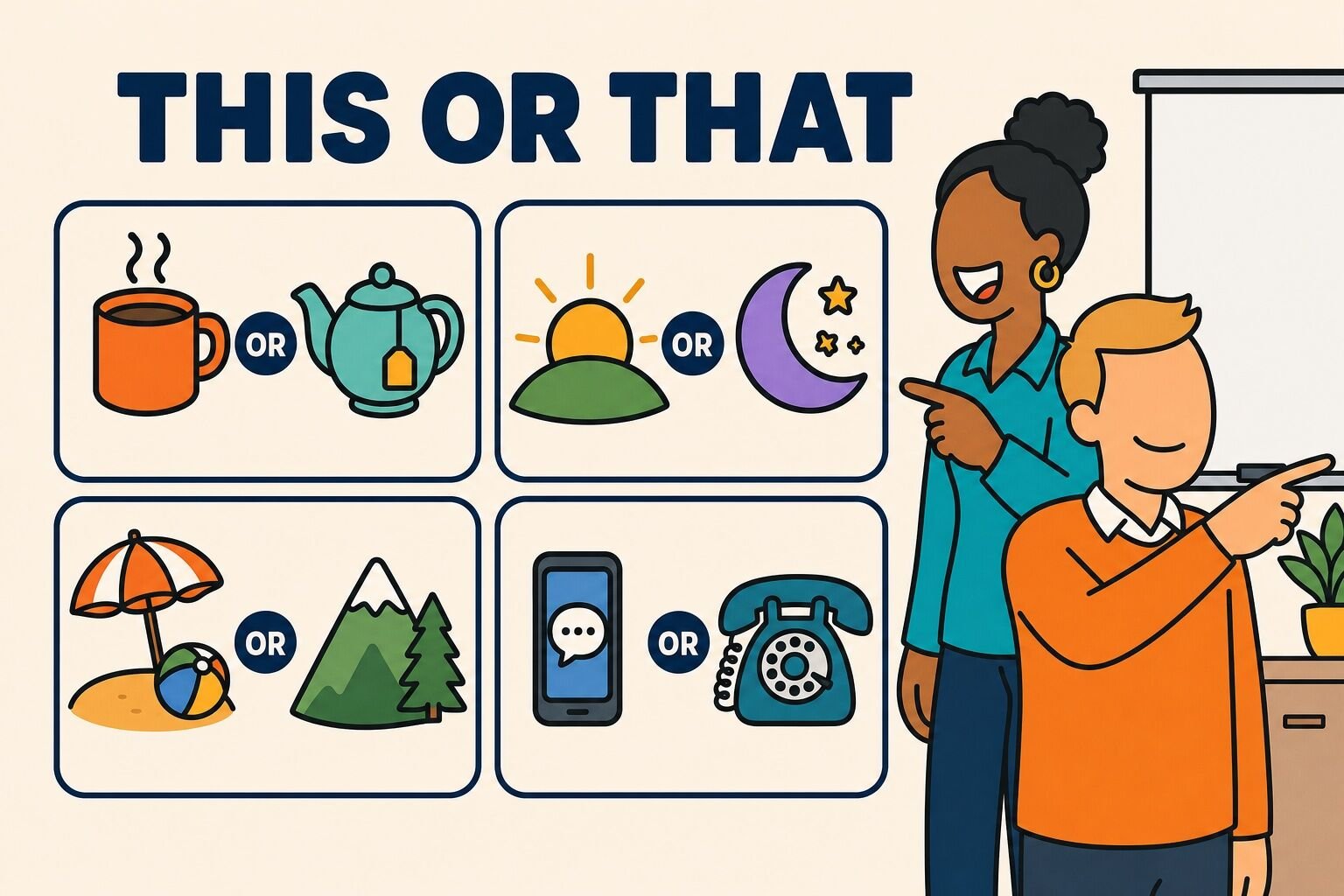
This or That asks people to choose between two options with no explanation required. It is the lowest-effort game on this list, which is exactly why it works on a group that has not spoken yet.
Good pairs to start with:
Our list of this or that questions has hundreds more pairs to draw from.
Best for: Warming up a quiet room
Time: 3–5 minutes
Materials (cost): A list of prompts (free)
What we've learned: The follow-up question is the whole game. The choice itself tells you nothing, but "why?" turns a show of hands into a story about someone's childhood beach vacations.
Would You Rather forces a choice between two awkward or improbable options. Unlike This or That, both answers are supposed to be a little bit bad, which is what makes people explain themselves.
Workplace-safe prompts that reliably start an argument:
For more prompts in this format, see our list of would you rather questions.
Best for: Revealing how people think
Time: 5 minutes, about a minute per prompt
Materials (cost): A prompt list (free)
What we've learned: Keep the stakes hypothetical. Prompts that touch real workplace tradeoffs, like choosing between two teammates or two managers, stop being a game immediately.
Rapid Fire Round gives each person 60 seconds of one-word answers. The speed is the point: there is no time to craft an impressive response, so people answer honestly.
Sample question list: first job, current hometown, breakfast this morning, last thing you watched, hidden talent, worst subject in school, dream vacation, go-to karaoke song, most-used app, favorite holiday.
Best for: Very short meetings
Time: 1 minute per person
Materials (cost): A timer (free)
What we've learned: Use the same questions for everyone. Custom questions per person feel like an interview, while a shared list turns into a comparison people keep referencing later. Pair it with other one minute games when the agenda is tight.
Top Five asks everyone to name their five favorites in a category. Rankings produce more conversation than single answers, because people defend an order.
Categories that work better than the obvious ones: comfort meals, concerts you have actually attended, apps on your home screen, movies you would rewatch on a plane, things you would put in a time capsule.
Best for: Finding shared taste
Time: 5 minutes per category
Materials (cost): Paper or a chat window (free)
What we've learned: Specific categories beat broad ones. "Top five movies" gets a polite list, while "top five movies you would never watch with your parents" gets a story.
If I Were asks people to describe themselves as something else. The metaphor gives shy participants a place to hide, which is why it often draws out the quietest person in the room.
Prompts worth using: a city, a season, a breakfast food, a household appliance, a song, a sport, a weather forecast, a font.
Best for: Creative, story-friendly groups
Time: 5 minutes, about 90 seconds per prompt
Materials (cost): A prompt list (free)
What we've learned: The reason matters more than the answer, so make it mandatory. "I would be a toaster" is a dead end, while "I would be a toaster, because I have exactly one setting and everyone knows it" is the whole person in one line.
Best Thing on My Desk asks everyone to hold up the most interesting object within arm's reach and explain it. This is one of our favorite formats because it requires zero preparation and works identically in a conference room or on a video call.
Best for: Storytelling with zero prep
Time: 1 minute per person
Materials (cost): Whatever is already on the desk (free)
What we've learned: The boring objects produce the best stories. A stapler nobody has replaced since 2014 gets a bigger reaction than a trophy, because the explanation is always stranger than the object.
Games for a working team have a different constraint than games for strangers: everyone already knows each other's names and job titles, so surface-level questions land flat. These formats are built to surface the things a year of status meetings never covers, and they slot neatly into a recurring agenda alongside other team meeting games.
Teammate Trivia turns your own colleagues into the trivia category. It takes the most prep of any game here and gets the biggest reaction, because the answers are people everyone sees every day.
For question formats and scoring ideas, see our collection of trivia questions.
Best for: Established teams
Time: 20–30 minutes, plus a week of collecting answers
Materials (cost): A form and a quiz tool (free)
What we've learned: Collect more facts than you need, then use only the ones that make you ask a follow-up question. "Has two cats" is filler; "once appeared in a music video" is a round of the game.
Something in Common challenges small teams to find a trait every member shares, and it is the fastest way we know to connect people from different departments.
Best for: Mixing departments
Time: 10–20 minutes
Materials (cost): None (free)
What we've learned: Ask for three shared traits instead of one. Teams find the first in 30 seconds and then have to actually interview each other to find the other two, which is where the game earns its time.
Bet on the Crowd is a guessing game about the group itself. Instead of answering a question, players predict how everyone else answered it.
Best for: Competitive teams
Time: 15–20 minutes
Materials (cost): A poll tool or a show of hands (free)
What we've learned: Close votes are what make this fun, so test your questions for a real split. A question where 95% of the room agrees is a dead round, while a 50/50 answer produces an argument that lasts the rest of the meeting.
Get to Know Me Board is a three-slide personal introduction. It is the most useful onboarding format on this list, and it solves the problem of a new hire being introduced by their job title and nothing else.
Best for: New hires and onboarding
Time: 5 minutes per person
Materials (cost): A slide template (free)
What we've learned: Have an existing teammate present theirs first. Asking the newest person in the room to go first sets the bar at "safe," and everyone after them copies it.
The Expert gives each person two minutes to teach the group something they genuinely know about, whether that is sourdough, transit maps, or competitive dog grooming.
Best for: Teams that have plateaued socially
Time: 2 minutes per person
Materials (cost): A timer (free)
What we've learned: Sign-ups beat volunteers-on-the-spot by a wide margin. Given three days of notice, people pick a subject they are quietly obsessed with, and the team learns more about them in two minutes than in a year of standups.
Under about a dozen people, everyone can hear everyone, so the mechanics can slow down and go deeper. These are the formats we use for teams of three to fifteen, and more options live in our list of team building activities for small groups.
Confess and Guess collects anonymous answers and asks the group to match each one to its author. Because the writing is private and the guessing is public, it works with groups that would never volunteer a story out loud.
Prompts that produce good answers: your go-to comfort meal, the job you wanted at age ten, the strangest place you have slept, a skill you abandoned, the last thing that made you laugh out loud.
Best for: Quieter groups
Time: 15–25 minutes
Materials (cost): Paper slips or a chat window (free)
What we've learned: Guessing wrong is the best part, so do not rush past it. The moment someone says "that is definitely Priya" and it turns out to be the CFO is the moment the group stops performing.
Deal a Question turns an ordinary deck of playing cards into a question bank, which makes it the easiest game to run at a dinner table or in a room with no technology.
If you want a ready-made bank instead of writing your own, our check in questions work well for the hearts suit.
Best for: Dinners and small tables
Time: 15–30 minutes
Materials (cost): A deck of cards (free or a few dollars)
What we've learned: Build in the passes. A visible, generous opt-out means nobody has to publicly decline, and in practice almost nobody uses more than one.
Show and Tell has survived since kindergarten for a reason. One person brings one object and explains why it matters, and the group learns more from the explanation than from any list of favorites.
Best for: Depth over speed
Time: 3 minutes per person
Materials (cost): One object per person (free)
What we've learned: A theme beats an open invitation. Without one, half the group brings a coffee mug; with "something you inherited," you get a grandfather's compass and a story nobody at work had heard.
Twenty Questions works as a get to know you game when the secret is a fact about the person rather than an object.
See our guide to 20 questions for prompt ideas and variations.
Best for: Two to ten people
Time: 10–15 minutes
Materials (cost): None (free)
What we've learned: Ask the subject to pick something they would happily explain for two minutes. The game is not the guessing, it is the story that comes after the reveal.
Pancakes vs Waffles is a group elimination debate, and it is one of the games our hosts run most often because it gets an entire room arguing within 60 seconds.
Best for: Debate-friendly groups
Time: 10–20 minutes
Materials (cost): None (free)
What we've learned: Banning the vote is what makes this work. The moment a group has to talk its way to consensus, you find out who negotiates, who concedes, and who has strong opinions about breakfast.
Past roughly 15 people, any format that needs everyone to take a turn falls apart. Large-group games have to let people answer simultaneously, move around, or play in parallel teams. For more formats at this scale, see our list of large group games.
Meet Me Bingo, also called human bingo, hands everyone a card of descriptions and sends them out to find the people who match. It is the standard opener for a room where most people have never met.
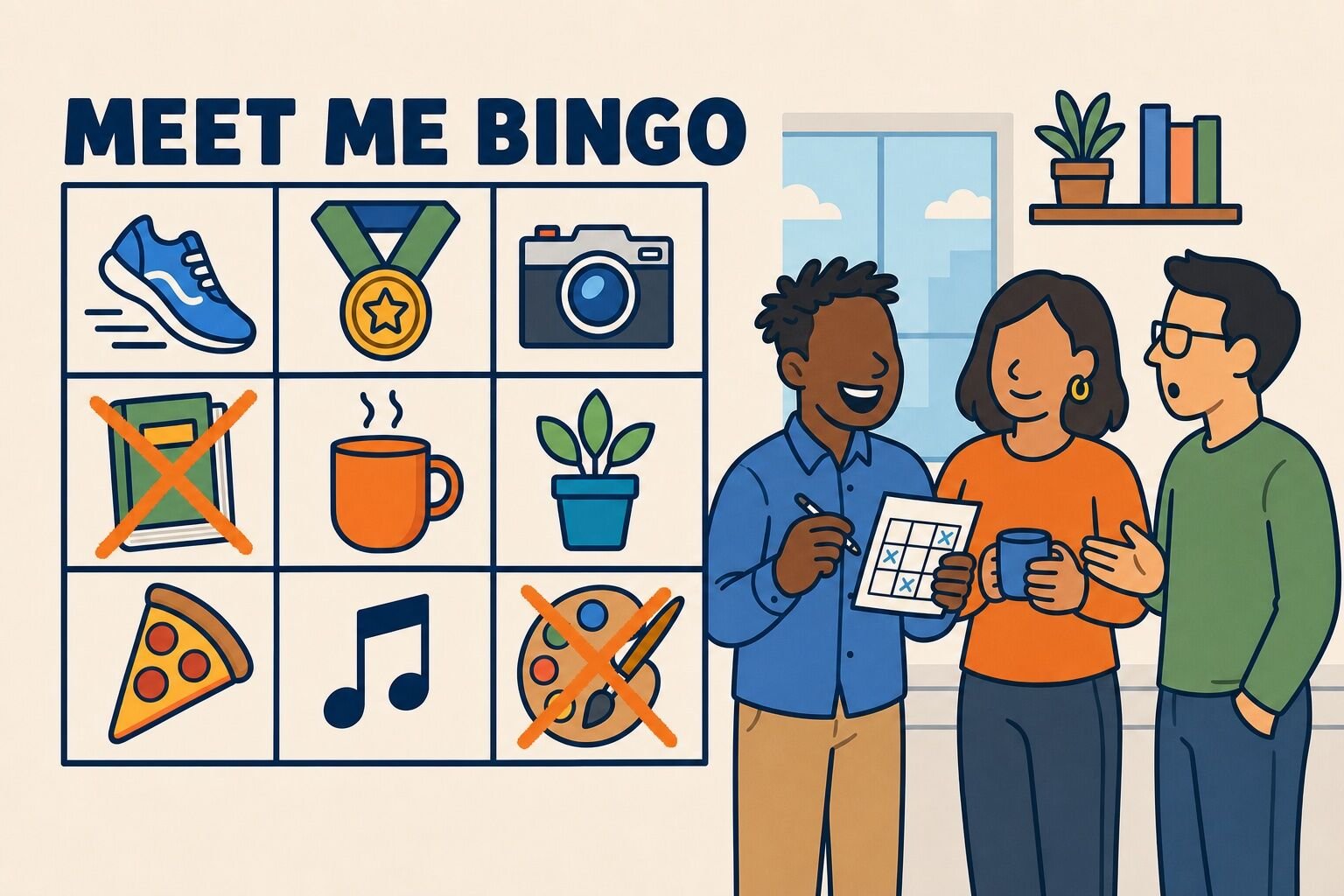
For printable cards and more square ideas, see our icebreaker bingo guide.
Best for: Rooms where nobody knows anybody
Time: 15–25 minutes
Materials (cost): Printed cards and pens (free)
What we've learned: Write squares that only a handful of people can fill. A card full of "likes coffee" gets signed in two minutes with no conversation, while "has been on live television" forces players to actually ask around.
The mechanic is the same one we use in our hosted bingo event, and this is the reaction it usually gets:
Arrange Yourself asks a whole room to sort itself into a line along some dimension, without talking. The silence forces improvised communication and the line itself becomes a map of the group.
Best for: Getting a big room moving
Time: 10–15 minutes
Materials (cost): Floor space (free)
What we've learned: Run the birthday round first. It is the one where the line is almost always wrong somewhere, and the correction is where people start talking to strangers on either side of them.
Stand Up If reads a series of statements, and anyone the statement is true of stands up. It scales to an auditorium, takes no materials, and gives a large group a picture of itself in about five minutes.
Start with these: you have lived abroad, you have a sibling who works in the same field, you have played in a band, you have worked in food service, you are the oldest child, you commute more than an hour, you have met someone famous.
Best for: Auditoriums and all-hands meetings
Time: 5–10 minutes
Materials (cost): None (free)
What we've learned: Offer a seated version out loud at the start, such as raising a hand instead of standing. It costs one sentence and means nobody has to opt out in front of 200 people.
Team Crest gives everyone a blank shield to fill with four symbols that represent them, then assembles the shields into one wall-sized group mural. It is the best option on this list for people who would rather draw than talk.
If your group is naming itself at the same offsite, our list of team names pairs well with this one.
Best for: Offsites and workshops
Time: 30–45 minutes
Materials (cost): Paper and markers (a few dollars)
What we've learned: Skip the presentations. Asking 40 people to explain their crest takes an hour and loses the room, while taping them to a wall and letting people wander produces more conversations per minute than any turn-taking format.
On a video call, silence is louder and turn-taking is slower, so the formats that survive are the ones where everyone acts at once. These three are built for remote teams, and our full guide to virtual team building activities covers the longer formats.
Bring Me is a lightning scavenger hunt through your own home or desk. A host names an object, everyone races to find their version of it, and the explanations are the real content.
For more clue ideas you can borrow, see our scavenger hunt ideas.
Best for: Energy on a video call
Time: 10–15 minutes
Materials (cost): Whatever is nearby (free)
What we've learned: Categories beat specific objects. "Bring me a spoon" is a race, while "bring me something you would grab in a fire" is a game people talk about for the rest of the week.
Who Da Baby? collects childhood photos and asks the team to match each one to a colleague. It is a reliably loud fifteen minutes and needs a facilitator who is not playing.
Best for: Teams that have already met
Time: 15–20 minutes
Materials (cost): One photo per person (free)
What we've learned: Strip the filenames before you share anything. One photo called "jess-1994.jpg" on screen ends the round, and the person collecting the photos has to sit out the guessing for the same reason.
Photo Roll Roulette uses the camera roll everyone already has. The randomness is what makes it honest, because nobody gets to choose their best photo.
Best for: Remote teams in a hurry
Time: 10–15 minutes
Materials (cost): A phone (free)
What we've learned: Always give the screening step. Naming a random photo without a beat to check it is the fastest way to make someone regret joining the call, and 30 seconds of preview costs the game nothing.
At a party, people arrive at different times, hold drinks, and leave conversations whenever they like, so the games that work are the ones that run in the background or in short bursts. These pair well with our list of party games for work.
Speed Meet runs short, timed one-on-one conversations with a prompt, then rotates. Everyone in a room of 60 can have a real conversation with eight people in half an hour, which no group format can match.
Our list of networking icebreaker questions is a good source for the prompts.
Best for: Mixers and new cohorts
Time: 20–30 minutes
Materials (cost): A timer and prompt cards (free)
What we've learned: Four minutes is the number. Two minutes ends before anyone gets past their job title, and anything over five leaves pairs sitting in silence waiting for the bell.
Guess the Playlist collects one song from every person and plays them back for the group to match to their owners. It doubles as the party's soundtrack, which is why we like it for offsites.
It works well as one activity in a larger evening, alongside other office game night ideas.
Best for: Parties and long drives
Time: 20–30 minutes
Materials (cost): A streaming account and a speaker (free)
What we've learned: Ask for the song that gets them through a bad day rather than their favorite song. Favorites get curated for the audience, while the bad-day answer is the honest one.
Map Pin puts a large map by the door and asks arrivals to pin where they are from. It costs almost nothing and gives people something to stand next to and talk about, which is the hardest problem at any mixer.
For more activities that work at this scale, see our list of large group activities.
Best for: Company-wide gatherings
Time: Runs for the whole event
Materials (cost): A printed map and pins (a few dollars)
What we've learned: Put the map where the food line forms. A map in a quiet corner stays empty, while a map beside the queue fills up in the first twenty minutes and gives everyone standing there something to say.
Most of the formats above are containers, and the prompts you pour into them decide whether the game produces a fact or a conversation. Our hosts have strong opinions about this.
“Simple icebreaker questions ("what is your favorite xx") may FEEL easier and seem "better" for team building because you're directly learning "a fact" about colleagues, but the conversation starters and jokes (is a hot dog a sandwich?) tend to do better at bringing out actual personalities, which I would argue is a more satisfying and more deeply connecting thing to get to know about your coworkers.”— Andrew Orsie, teambuilding.com Event Host
Three rules follow from that. Ask for a choice or an opinion rather than a favorite, and treat the prompt as a conversation starter rather than a survey question. Keep the subject away from money, health, family status, and anything that reads as an evaluation. And always have a follow-up question ready, because the second question is where the answer gets interesting.
If you need prompts on demand, this generator produces them one at a time:
For more banks to draw from, see our lists of question games, what if questions, and unusual icebreaker questions. If you want a random prompt with no theme at all, try this one:
Nearly every event we have run since 2013 opens with some version of the games above, because a room has to be introduced to itself before anything else works. A few patterns hold up across all of them.
The group is almost always smaller than you plan for. The median team building event on our platform has 16 participants, and half of all events fall between 10 and 27 people. That is a room where every single person can speak, which is why turn-taking formats keep working at this size and collapse the moment you double it.
Structure beats spontaneity every time. "Let's all go around and share something about ourselves" is not a game, it is an ambush, and the people who need the most encouragement to speak are the ones it fails first. A game with a timer, a prompt, and a defined order gives everyone the same amount of runway.
Games have a shelf life, so test and retire them. Our hosts design new game concepts on an ongoing cycle: each is play-tested internally with staff as the beta group, run live with client teams, iterated on with post-event surveys and reviews, retired if it never finds its energy, and refreshed regularly. Several of the games in this article are here because they survived that process, and the ones in the next section are here because they did not.
Personal does not mean private. The best prompts are about taste, history, and opinion, which people enjoy sharing. The worst ones are about status, money, and relationships, which people feel obligated to answer. The line is easy to find once you ask whether an answer could embarrass someone in front of their manager.
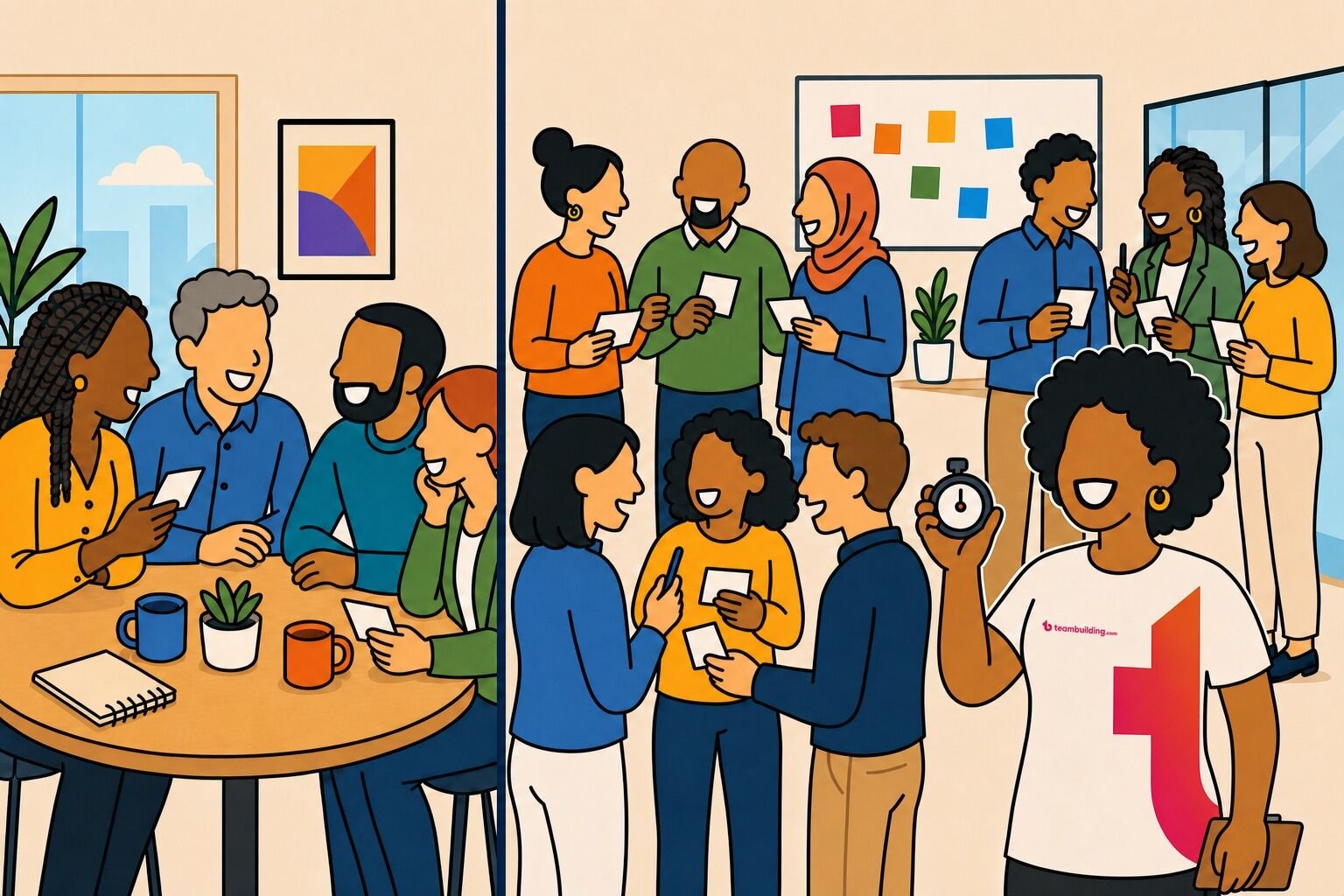
The single biggest predictor of whether one of these games works is the headcount. In virtual events specifically, our hosts put the practical dividing line at about 15 people: below it, events run personal and high-touch with many short rounds, and above it they need structured hosting, breakout rooms, polls, and fewer, longer rounds so everyone participates. The same split holds in a conference room.
| Small groups (about 15 or fewer) | Large groups (more than 15) | |
|---|---|---|
| How people answer | One at a time, out loud | All at once, by hand, movement, or poll |
| Rounds | Fewer, longer, with follow-up questions | Many, shorter, with a visible timer |
| Facilitation | A light host, or none | A dedicated host plus helpers or breakout leads |
| Best formats | Confess and Guess, Show and Tell, Deal a Question | Meet Me Bingo, Stand Up If…, Speed Meet |
| Main risk | One person dominating the airtime | Most of the room spectating |
| Fix | A timer per speaker and an explicit pass | Break into parallel groups of six to eight |
If you are building a longer agenda around one of these, our list of employee engagement activities covers what to put on either side of it.
We wrote some of these into our own articles years ago, and then watched them land badly in real rooms. The following formats show up on every list of get to know you games, and we would skip all of them.
| Activity | Why skip it | Verdict |
|---|---|---|
| Two Truths and a Lie | It is the most overused game in the category, and it asks every player to invent a convincing lie on the spot, which is a creative writing exercise disguised as an icebreaker. It also gets slow fast, because every person needs a full turn. | Usually skip |
| Never Have I Ever | The game is built on admitting to things you have done, and it carries a drinking-game association that makes it a poor fit for work. Most likely to questions get the same laughs without asking anyone to confess. | Skip it |
| Truth or Dare | The interesting dares cross professional boundaries and the workplace-safe ones are not fun. If you want the format anyway, a blackout variant with pre-written prompts from a truth or dare generator is the only version we would run. | Skip it |
| Spill It or Eat It | Answering a personal question or eating something disgusting is a false choice that pressures people into disclosure, and food-based dares create real problems with allergies and dignity. | Skip it |
| Speed dating formats at work | The mechanic is fine, but the framing is not. Speed Meet does the same thing without the romantic connotation. | Rename it |
| Hot seat | Putting one person in front of the group to field questions is the definition of an ambush, and the volunteers are always the people who least need the airtime. | Skip it |
| Personality quiz reveals | Sharing test results can be fun, but it replaces a person's actual story with a four-letter code, and people start explaining each other's behavior with it for months afterward. | Not team building |
| Unstructured "getting to know you" mixers | An hour of open mingling is an advantage for the people who already know everyone. Give the room a prompt, a card, or a map, and the same hour works for everybody. | Add structure |
| Trust falls | A physical trust exercise asks for a bigger leap than a group of new colleagues has earned, and it introduces injury risk for no informational payoff. | Skip it |
| Compulsory fun with no opt-out | Any game where declining is visible turns into a loyalty test. Build a pass into the rules and the same game becomes voluntary. | Add an opt-out |
Get to know you games are not about the games. They are a socially acceptable excuse to ask a colleague a question you would never ask cold, and the good ones make that trade feel easy for the person answering.
Pick one format that fits your headcount, give it a timer and a prompt bank, and run it at the top of a meeting you already hold. Five minutes a week beats one awkward afternoon, and the second time you run it, people will arrive with an answer ready.
If you would rather have a professional host run one for you, browse our virtual and in-person team building activities.
Next, check out our lists of indoor group games, morning meeting games, and communication games.
Answers to the questions we get most often about running these games at work.
Get to know you games are structured activities that help a group learn personal, non-work facts about each other quickly. Examples include Meet Me Bingo, This or That, Confess and Guess, and Show and Tell. They are a subcategory of icebreaker games with a narrower job: icebreakers warm up a room for whatever comes next, while these games exist specifically to trade personal information. They are also called getting to know you games, get to know each other games, getting acquainted games, and GTKY activities.
For a working team of adults, the formats that hold up best are Teammate Trivia, Confess and Guess, Something in Common, Best Thing on My Desk, and Meet Me Bingo. All five give people a reason to share an opinion or a story rather than a fact, which is what separates a real conversation from a round of favorites. Each one runs free with what is already in the office.
Past roughly 15 people, any game that needs everyone to take a turn falls apart. Use formats where the whole room answers at once or plays in parallel: Meet Me Bingo, Arrange Yourself, Stand Up If, Team Crest, and Speed Meet. Large groups also need a dedicated facilitator, a visible timer, and breakout groups of six to eight so nobody spectates.
Five to twenty minutes for most formats. A short game placed at the top of a meeting you already hold survives a packed agenda, while a 30-minute activity gets cut, and five minutes a week compounds faster than one long session a quarter. Only setup-heavy formats like Team Crest or Teammate Trivia are worth 30 minutes or more.
Keep prompts on taste, history, and opinion, and away from money, health, family status, and anything that could embarrass someone in front of their manager. Build a visible pass into the rules so declining is never a public act, give people a beat to screen what they are about to share, and offer a seated or hands-up version of any game that asks people to stand.
We would skip Two Truths and a Lie, which is overused and asks everyone to invent a convincing lie on the spot, along with Never Have I Ever and Truth or Dare, which carry party-game baggage that does not belong at work. Also avoid hot seat formats, food-based dare games, trust falls, and unstructured mingling, which mostly advantages the people who already know everyone in the room.
Comments (0)
Leave a Comment