
28 Breakout Session Ideas, Topics & Games for Work Meetings
The breakout session ideas, discussion topics and small-group games our hosts actually run, with a three-step structure, timings and group sizes for meetings, workshops and conferences.
The breakout session ideas, discussion topics and small-group games our hosts actually run, with a three-step structure, timings and group sizes for meetings, workshops and conferences.
A breakout session is the part of a meeting, workshop or conference where the big room stops and the small rooms start. Done well, it is the most productive 30 minutes on the agenda: people who would never speak to 80 colleagues will happily argue a point with five. Done badly, it is six people staring at a blank flip chart wondering what they were supposed to be doing.
We have run team events for thousands of companies, and breakout groups are the engine inside most of them: our hosts split, brief, time and regroup small teams dozens of times a week, in conference rooms and in Zoom breakout rooms. This guide collects the breakout session ideas, discussion topics and games we actually use, each with step-by-step instructions, a group size, a time and a real materials cost.
This list includes:
Let's get started!
A breakout session is a short, structured block inside a larger meeting or event where participants split into small groups to discuss, build, decide or play, then return to the main room to share what they found. Examples include roundtable discussions, lightning talks, a pre-mortem exercise, and small-group games like Something in Common. The purpose is to get every person talking instead of the same three, to generate ideas a big room never would, and to give long agendas a change of pace. These sessions are also called breakout groups, breakout meetings, breakout activities, team breakouts, and, when they happen on a video call, breakout rooms.
Breakout sessions are a subcategory of team meeting ideas and a core building block of corporate workshop ideas. They are similar to conference breakout sessions and Zoom breakout room ideas, which each have their own guide linked in the sections below, and to large group energizers and large group icebreakers. Within the category, this guide includes breakout session ideas for work, breakout session topics, breakout room ideas for meetings, team breakout games, breakout activities for conferences, virtual breakout room ideas and breakout sessions for large groups. Event planners use the same formats inside virtual conference ideas and group retreat activities.
There is a lot of meeting to break up. Organizational psychologist Steven Rogelberg, in The Surprising Science of Meetings (2019), reports an estimate of 55 million meetings per day in the United States, and notes earlier work suggesting senior managers sit through nearly 23 hours of them every week. Most of those hours are spent in one big room with one person talking. A breakout session is the cheapest fix we know of: same agenda, same people, but for 20 minutes everyone is a participant instead of an audience.
Before the ideas, the shape. Almost every breakout session that fails does so for one of three reasons: the brief was vague, nobody was watching the clock, or the groups never reported back so the work evaporated. Our hosts run breakouts on a three-part structure, and it scales from a six-person team meeting to a 400-person conference.
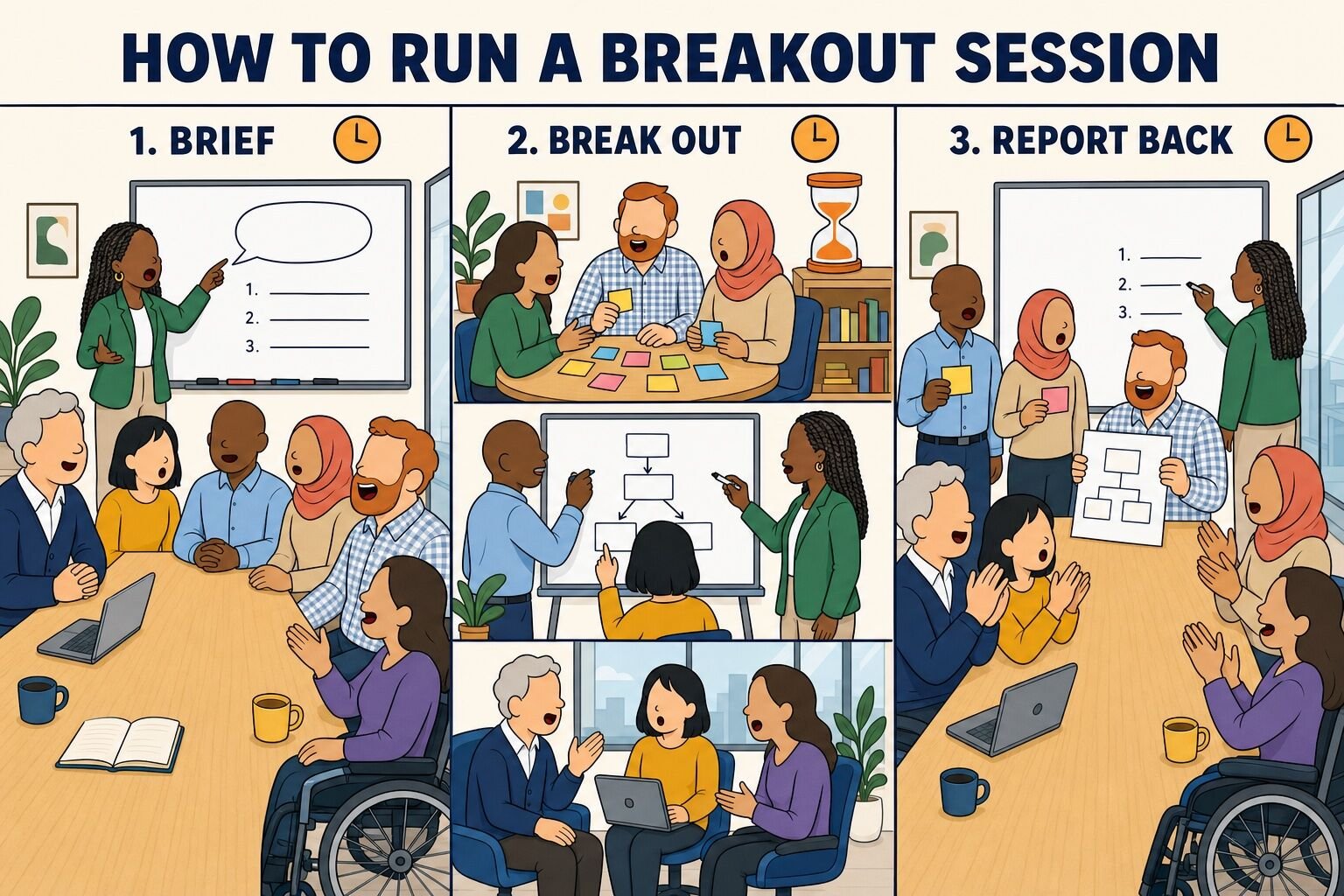
That structure lines up with the meeting research. A review by Mroz, Allen, Verhoeven and Shuffler in Current Directions in Psychological Science (2018) recommends that leaders call a meeting only when necessary, keep it small, circulate an agenda in advance, start on time, and actively encourage participation from all attendees. A well-run breakout is the part of a big meeting that does all five.
Here are the formats you will see throughout this list, with the timings we use for each.
| Format | Example | Group size | Typical time | Output |
|---|---|---|---|---|
| Discussion breakout | Roundtables, 1-2-4-All | 4 to 8 per group | 15 to 30 minutes | Top-three list or a headline per group |
| Working breakout | Pre-Mortem, Goal-Setting Workshop | 4 to 6 per group | 25 to 45 minutes | A draft, a plan or a ranked list |
| Presentation breakout | Lightning Talks, Ask Me Anything | 10 to 40 in a room | 20 to 45 minutes | Shared knowledge, questions answered |
| Networking breakout | Speed Networking, Human Bingo | Pairs, rotating | 15 to 30 minutes | New contacts, a warmed-up room |
| Game breakout | Something in Common, Team Trivia | 3 to 8 per team | 10 to 30 minutes | Energy, laughter, a winner |
| Reset breakout | Walking Session, Guided Reset | Any | 10 to 20 minutes | A room that can concentrate again |
Every idea below is free or close to it, and each one lists a best use, a group size, a time and a cost so you can match it to the slot you actually have.
| Activity | Best for | Group size | Time | Cost |
|---|---|---|---|---|
| Lightning Talks | Sharing knowledge fast | 10 to 40 | 25 to 45 min | Free |
| Speed Networking | Meeting many people quickly | 12 to 100+ | 15 to 30 min | Free |
| Roundtables | Focused discussion | 5 to 10 per table | 20 to 30 min | Free |
| Teach Me Something | Peer learning | 4 to 8 per group | 20 to 30 min | Free |
| Problem Swap | Crowdsourced advice | 8 to 30 | 15 to 25 min | Free (paper) |
| Skills Exchange Board | Cross-team collaboration | 15 to 100+ | 15 to 20 min | Under $10 (sticky notes) |
| Goal-Setting Workshop | Planning and accountability | 4 to 6 per group | 30 to 45 min | Free |
| Ask Me Anything | Leadership access | 10 to 200 | 20 to 30 min | Free |
| 1-2-4-All | Hearing every voice | 8 to 100+ | 15 to 20 min | Free |
| Brainwriting | Generating many ideas | 4 to 6 per group | 15 to 20 min | Free (paper) |
| Pre-Mortem | Risk spotting on a plan | 4 to 8 per group | 25 to 40 min | Free |
| World Cafe Rotation | Many topics, one room | 15 to 60 | 30 to 45 min | Under $20 (flip charts) |
| Pancakes vs Waffles | Decision-making practice | 4 to 8 per group | 10 to 20 min | Free |
| Fishbowl Discussion | Debating a hard topic | 10 to 30 | 20 to 30 min | Free |
| Something in Common | Real connection | 3 to 6 per group | 10 to 15 min | Free |
| Bet on the Crowd | Getting to know the team | 10 to 100+ | 15 to 25 min | Free |
| Team Trivia | Friendly competition | 3 to 8 per team | 20 to 30 min | Free |
| Two Truths and a Lie | Quick icebreaker | 4 to 8 per group | 10 to 15 min | Free |
| Birthday Line-Up | Silent communication | 8 to 40 | 5 to 10 min | Free |
| Question Jenga | Conversation with tension | 4 to 8 per set | 15 to 25 min | $15 to $25 per set |
| Lightning Scavenger Hunt | Energy and movement | 5 to 100+ | 10 to 15 min | Free |
| Blind Drawing | Communication skills | Pairs | 10 to 15 min | Free (paper) |
| Walking Session | Reset between sessions | Any, in pairs | 15 to 20 min | Free |
| Silent Disco | High-energy reset | 30 to 500 | 15 to 20 min | Headphone rental |
| Guided Reset | Calm before a heavy session | Any | 10 to 15 min | Free |
| Unconference Hour | Attendee-led topics | 30 to 300 | 45 to 60 min | Under $20 (flip charts) |
| Breakout Scoring Tournament | Very large groups | 100 to 1,000+ | 30 to 60 min | Free to moderate (AV) |
| Human Bingo | Mixing a big room | 30 to 500 | 10 to 15 min | Free (printed cards) |
These are the workhorse formats for team meetings, offsites and all-hands: sessions where the goal is to share knowledge, solve something, or get people who work in parallel actually talking to each other.
Lightning talks are five-minute presentations on a topic the speaker cares about, delivered back to back. They turn a passive audience into a room full of experts, and they surface the person in accounting who happens to know everything about beekeeping.
Best for: 10 to 40 people, sharing knowledge fast
Time: 25 to 45 minutes
Materials (cost): A screen and a timer (free)
What we've learned: The hard stop is the whole format. The first time you let a speaker run to seven minutes, every following speaker will too, and the session ends 20 minutes late with the audience checking email. For more speaking-based formats, see our list of presentation games.
Speed networking rotates people through short one-on-one conversations, so in 20 minutes each participant has met eight to ten colleagues instead of the two they sat next to.
Best for: 12 to 100+ people, especially cross-team groups
Time: 15 to 30 minutes
Materials (cost): Chairs, a bell or timer, prompt list (free)
What we've learned: Two minutes feels short and works better than five. The rounds where people run out of things to say are the ones they remember as awkward. If you want more mixer formats, our list of networking event ideas has plenty.
Roundtables give each small group one specific question and a fixed time to work it, then bring the answers back to the main room. This is the classic breakout session, and most of the failures come from skipping the specific question.
Best for: 5 to 10 people per table, focused discussion
Time: 20 to 30 minutes
Materials (cost): Question cards, flip chart or shared doc (free)
What we've learned: Ask for a ranked top three, not "your thoughts." Ranking forces the table to debate, and the debate is where the useful conversation lives.
In Teach Me Something, each person in a small group teaches the others one skill in five minutes. It can be a spreadsheet shortcut, a negotiating phrase, how to fold a fitted sheet, or how to say hello in their first language.
Best for: 4 to 8 people per group, peer learning
Time: 20 to 30 minutes
Materials (cost): None (free)
What we've learned: Non-work lessons land better than work lessons. The person who teaches a card trick becomes approachable in a way a pivot-table tutorial never achieves.
Problem Swap crowdsources solutions anonymously. Everyone writes down a real problem, the papers get mixed up, and the room solves each other's problems without knowing whose is whose.
Best for: 8 to 30 people, crowdsourced advice
Time: 15 to 25 minutes
Materials (cost): Paper and pens (free)
What we've learned: Insist on one sentence. Long problem statements turn into venting, and the anonymity only works if the handwriting is the only clue. If you want more structured versions, see our problem solving games.
A Skills Exchange Board is a wall with two columns, "I can help with" and "I need help with", that fills up during a break and turns into collaborations after the event.
Best for: 15 to 100+ people, cross-team collaboration
Time: 15 to 20 minutes
Materials (cost): Sticky notes and markers (under $10)
What we've learned: Seed the board with three notes from leaders before the room arrives. An empty wall stays empty; a wall with the CEO's "I need help with" on it fills in minutes.
A goal-setting breakout gives each person 30 minutes to write down goals for the next quarter and test them against a small group who will actually remember them.
Best for: 4 to 6 people per group, planning and accountability
Time: 30 to 45 minutes
Materials (cost): Worksheet or shared doc (free)
What we've learned: The 45-day check-in is what separates a workshop from a wish list. Schedule it in the room, while everyone is watching. More structures live in our list of goal setting activities.
An Ask Me Anything session puts a leader, a guest expert or a long-tenured colleague in front of a group with no slides and no agenda, just questions. It works in person and on video, and it is one of the few breakout formats where the audience sets the topic.
Best for: 10 to 200 people, leadership access
Time: 20 to 30 minutes
Materials (cost): A question form and a moderator (free)
What we've learned: Anonymous questions are the difference between "What is the vision for next year?" and "Why did we cancel the bonus?" The second kind is the reason to run the session. If the guest is new to the team, warm up with a few get to know you questions first.
The format matters less than the question. A good breakout topic is specific enough to answer in 20 minutes, open enough that reasonable people disagree, and worded so the group produces something the main room can use. Here are topics we have seen work, grouped by the kind of meeting they belong in.
| Category | Breakout session topic | Ask the group to produce | Best for |
|---|---|---|---|
| Strategy | If a competitor launched tomorrow, what would they do better than us? | Three weaknesses, ranked | Leadership offsites |
| Strategy | Which one thing should we stop doing this year? | One "stop" per group with a reason | Planning meetings |
| Customers | What do customers complain about that we have normalized? | Top three complaints and a fix for one | All-hands, product teams |
| Customers | Walk through the first week as a new customer. Where does it hurt? | A timeline with three pain points marked | Cross-functional workshops |
| Culture | What is something a great teammate here does that is not in any job description? | Five behaviors to recognize | Team meetings, onboarding |
| Culture | Which meeting on our calendar could be an email? | One meeting to cut or shorten | Team meetings |
| Leadership | Describe the best manager you ever had in three words. What did they do that we could copy? | A list of copyable habits | Leadership training, leadership icebreakers |
| Leadership | What decision are we avoiding, and what would it take to make it? | The decision, the owner, the date | Executive retreats |
| Skills | What is one tool or shortcut you use that most of the room does not? | A "teach in 5 minutes" list | Training days |
| Skills | What is the last mistake we learned the most from? | One lesson per group, written as a rule | Retrospectives |
| Wellbeing | What is one thing that would make the hardest week of the quarter easier? | A ranked list of small fixes | Team meetings, HR sessions |
| Remote and hybrid | What do we lose when we are not in the same room, and how do we get it back? | Three habits to adopt | Hybrid team offsites |
| Fun | Design the worst possible team offsite. Now flip each element. | A surprisingly good offsite plan | Any meeting that needs a laugh |
| Fun | Pitch a company product we would never actually make. | A two-minute pitch per group | Conferences, retreats |
When a topic needs to be lighter, or the goal is conversation rather than output, pull from our lists of discussion topics and would you rather questions instead. For all-hands agendas, see our guide to all hands meetings.
These are small-group formats for the breakout rooms inside a regular meeting or workshop, in person or on a call. Each one gives a group of four to eight something concrete to do with the room, and each ends with an output the main meeting can use.
1-2-4-All is a structure for getting every person's answer to one question, with no group large enough for anyone to hide in. It comes from the Liberating Structures family of facilitation methods and works just as well on Zoom as at a table.
Best for: 8 to 100+ people, hearing every voice
Time: 15 to 20 minutes
Materials (cost): A timer and a board (free)
What we've learned: Enforce the minute of silence at the start. Groups that skip it converge on the first loud idea instead of the best one.
Brainwriting is a silent brainstorm. Instead of shouting ideas at a whiteboard, each person writes ideas on a sheet, passes it on, and builds on what the previous person wrote. Groups routinely produce three times the ideas of a spoken brainstorm, and the quiet people contribute as much as the loud ones.
Best for: 4 to 6 people per group, generating many ideas
Time: 15 to 20 minutes
Materials (cost): Paper and pens, or a shared doc (free)
What we've learned: Do the writing rounds in complete silence, including the facilitator. One "ooh, good one" from the front breaks the spell.
A pre-mortem takes a plan that has not launched yet and asks the group to imagine it has already failed. Then everyone explains why. It surfaces the risks people are politely not mentioning, and it is the most useful working breakout on this list.
Best for: 4 to 8 people per group, risk spotting
Time: 25 to 40 minutes
Materials (cost): The plan, paper, a board (free)
What we've learned: Ban the word "but" during the listing round. The moment the plan's owner starts defending it, the honest reasons stop coming.
A World Cafe rotation runs several topics at once. Each table hosts one question, groups rotate between tables every 12 to 15 minutes, and a table host carries the conversation forward so each new group builds on the last one.
Best for: 15 to 60 people, many topics in one room
Time: 30 to 45 minutes
Materials (cost): Flip charts and markers (under $20)
What we've learned: Three rounds is the sweet spot. Round four is where people start repeating what the previous group said and the flip charts stop changing.
Pancakes vs Waffles is a decision game we use in our own events. The group must eliminate one of two options from existence, forever, and the winner faces a new challenger. It is silly on purpose, and it is a fast way to watch how a group argues, negotiates and decides.
Best for: 4 to 8 people per group, decision-making practice
Time: 10 to 20 minutes
Materials (cost): None (free)
What we've learned: Make the choices increasingly absurd. "Waffles or the internet?" produces better arguments and more laughter than anything work-related, and the decision habits transfer anyway.
A fishbowl puts a hard topic in the middle of the room. Four or five chairs form an inner circle where the discussion happens, everyone else sits in an outer ring and listens, and anyone can tap in by taking an empty inner chair. It lets a large group have a small-group conversation without the shouting.
Best for: 10 to 30 people, debating a hard topic
Time: 20 to 30 minutes
Materials (cost): Chairs (free)
What we've learned: Seed the inner circle with two people who disagree. A fishbowl that starts with four people nodding at each other never gets going.
Not every breakout needs an output. Sometimes the job is to wake the room up, mix people who do not normally talk, or give a long day a laugh. These are the games our hosts reach for, most of them pulled straight from the events we run.
The laughter is not a distraction from the work. In a study of 54 videotaped real team meetings published in the Journal of Applied Psychology (2014), Lehmann-Willenbrock and Allen found that patterns of humor and laughter, humor sequences rather than isolated jokes, were positively related to team performance both immediately and roughly two years later. A ten-minute game before the working breakout is how you get the sequence started.
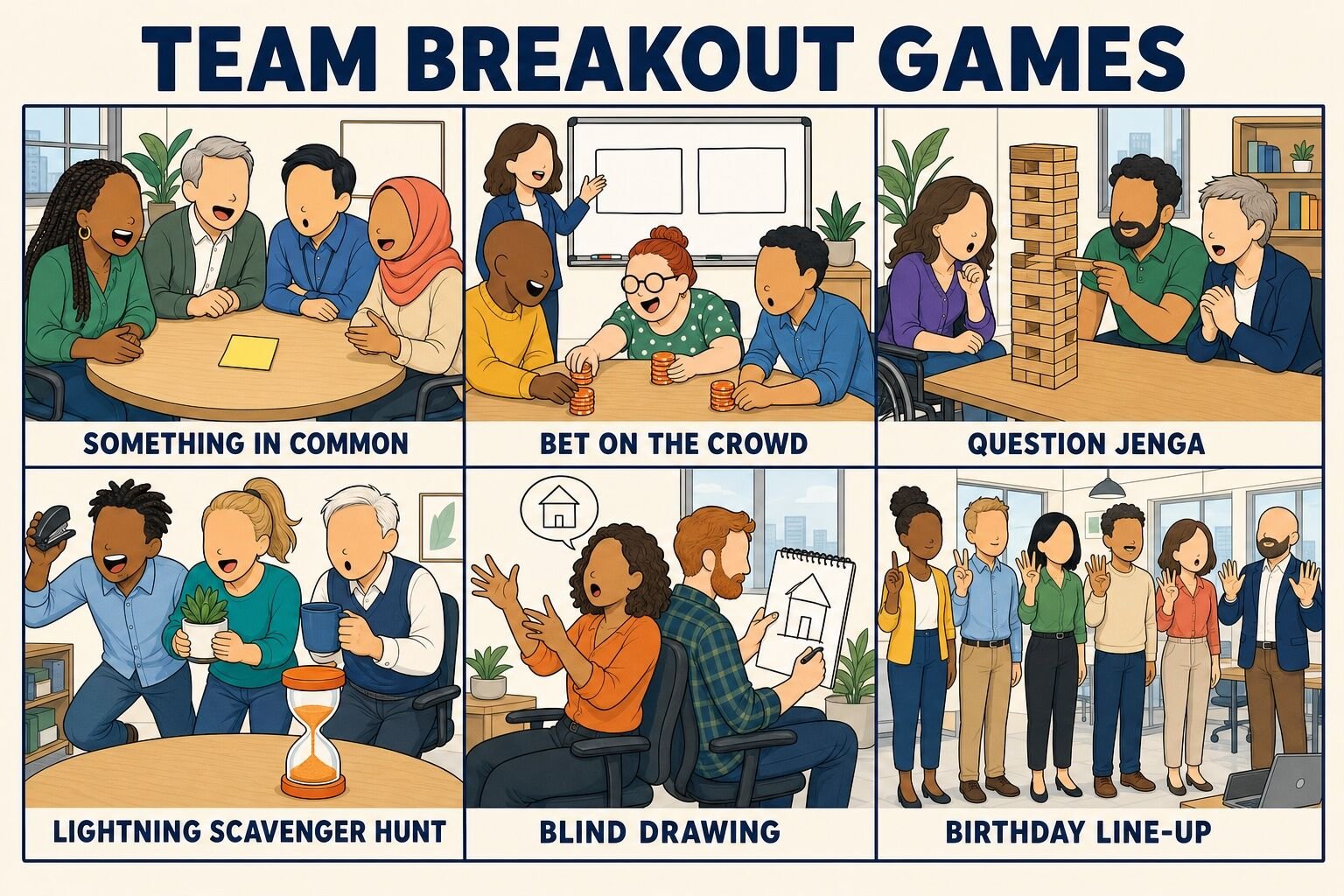
Something in Common is the breakout room game we run most often, because the breakout room is the point. Small groups race to find the most unusual things every member shares, and the search forces exactly the kind of conversation a team meeting never has time for.
Best for: 3 to 6 people per group, real connection
Time: 10 to 15 minutes
Materials (cost): None (free)
What we've learned: Ask for the most unusual, not the most. Groups chasing quantity list "coffee" and "Netflix"; groups chasing unusual find out two people were born in the same small town.
Bet on the Crowd is a guessing game from our events where teams wager on what the whole room will answer. It is a quick way to learn about a big group at once, and it produces reliably loud reactions when the answer is revealed.
Best for: 10 to 100+ people, getting to know the team
Time: 15 to 25 minutes
Materials (cost): A poll tool or hands, a scoreboard (free)
What we've learned: Close votes are the fun ones. Test your questions in advance and keep the ones where the room genuinely splits; a question everyone answers the same way is a wasted round.
Team trivia is a reliable breakout game because everyone already knows how it works. The trick is to write the questions about the company, the team and the room, not general knowledge, so that every table has a shot.
Best for: 3 to 8 people per team, friendly competition
Time: 20 to 30 minutes
Materials (cost): Question list and answer sheets (free)
What we've learned: The "about us" round is the one people talk about afterwards. Collect one surprising fact per person a few days ahead and turn them into "Who on this team has skydived twice?" questions. For general rounds, borrow from our bank of trivia questions.
Two Truths and a Lie is the standard small-group icebreaker: each person shares three statements about themselves, one false, and the group guesses the lie. It is overused in big rooms and still works well in a breakout group of four to eight.
Best for: 4 to 8 people per group, quick icebreaker
Time: 10 to 15 minutes
Materials (cost): None (free)
What we've learned: Keep it in the breakout, never the main room. Twelve people is the point at which the twelfth person's turn arrives after the audience has stopped listening.
Birthday Line-Up asks a group to arrange themselves in order of birthday, January to December, without speaking. It takes five minutes, needs nothing, and shows a group how it communicates when the usual tools are gone.
Best for: 8 to 40 people, silent communication
Time: 5 to 10 minutes
Materials (cost): None (free)
What we've learned: Run it twice with a different sort, such as distance travelled to the office, and time both rounds. The second round is almost always faster, which is the whole lesson.
Question Jenga is a tower-block game with a conversation prompt written on every block. Pull a block, answer the question, place it on top. The tension of the tower makes people answer faster and more honestly than they would around a table.
Best for: 4 to 8 people per set, conversation with tension
Time: 15 to 25 minutes
Materials (cost): A block tower set per group ($15 to $25 each)
What we've learned: Write the questions on the blocks yourself rather than buying a pre-printed set. The best prompts reference the team, and a stranger's questions never will.
A Lightning Scavenger Hunt is a burst of movement. The host calls a clue, everyone races to find something that matches and bring it back, and the first person back scores. It works at a table, across an office, or in a video call where people run off camera.
Best for: 5 to 100+ people, energy and movement
Time: 10 to 15 minutes
Materials (cost): A clue list (free)
What we've learned: Slow down for one round. When someone comes back with a genuinely odd object, ask about it. The race brings the energy, and the story behind the object is what people remember.
Blind Drawing pairs people back to back. One describes a picture, the other draws what they hear, and the comparison at the end is both funny and a precise lesson in how instructions go wrong.
Best for: Pairs, communication skills
Time: 10 to 15 minutes
Materials (cost): Printed images, paper and pens (free)
What we've learned: Use images with three or four elements at most. A detailed picture produces frustration; a simple one produces a wildly wrong drawing and a room full of laughter.
Conference breakouts have a different job. Attendees have been sitting for hours, most of them do not know each other, and the room can be several hundred people. These formats reset the energy or hand the agenda to the audience. For a full conference-planning treatment, including how to schedule tracks, see our guide to conference breakout sessions.
A walking session moves a discussion outdoors. Pairs walk a set loop for 15 minutes talking through one question, and they come back having met someone and having stretched their legs.
Best for: Any size, in pairs, reset between sessions
Time: 15 to 20 minutes
Materials (cost): A route map (free)
What we've learned: Send people out in pairs, not groups. Trios walk single file on narrow paths, and the third person stops talking. For more open-air formats, see our list of outdoor team building activities.
A silent disco hands every attendee wireless headphones and plays two or three channels of music. It is a 15-minute energy reset for a big conference room that does not disturb the session next door, and watching 200 people dance to different songs is funnier than it sounds.
Best for: 30 to 500 people, high-energy reset
Time: 15 to 20 minutes
Materials (cost): Headphone rental, typically priced per headset
What we've learned: Lights up, always. A darkened ballroom at 2 p.m. turns a break into a nap. Our list of songs for conferences is a good starting playlist.
A guided reset is a ten-minute breathing or mindfulness break led from the stage before a demanding session. It is the lowest-effort breakout on this list, and it visibly changes the room's attention.
Best for: Any size, calm before a heavy session
Time: 10 to 15 minutes
Materials (cost): A microphone (free)
What we've learned: Skip the yoga mats and the word "meditation" on the agenda. Call it a reset, keep it short, and the skeptics will join. Longer-term ideas belong in an employee wellness program.
An unconference hour lets the attendees propose the breakout topics on the day. Anyone can pitch a session in 30 seconds, the room votes with its feet, and the most-wanted conversations get a table. It works because the topics people actually want to discuss are rarely the ones on the printed agenda.
Best for: 30 to 300 people, attendee-led topics
Time: 45 to 60 minutes
Materials (cost): Sticky notes, flip charts (under $20)
What we've learned: Have three leaders ready to pitch first. The first pitch is the hardest, and once three topics are on the wall the rest of the room follows.
Almost every format above runs on a video call, because Zoom, Microsoft Teams and Google Meet all have breakout rooms built in. We have hosted 34,000+ virtual team experiences on Zoom as of August 2026, and breakout rooms are how our hosts turn a grid of 80 faces into rooms of five where people actually talk. A few virtual-specific adjustments:
For a full list of platform-specific games and setups, including how to create and manage rooms, see our guide to Zoom breakout room ideas.
Above about 100 people, breakouts stop being a facilitation problem and become a logistics problem. Rooms of five still work; what changes is how you brief 20 rooms at once, how you get the results back, and how you keep every table feeling like part of the same event. The formats below are built for that scale, and every other idea in this guide can be adapted with the same three tools: table numbers, table captains, and a central scoreboard.
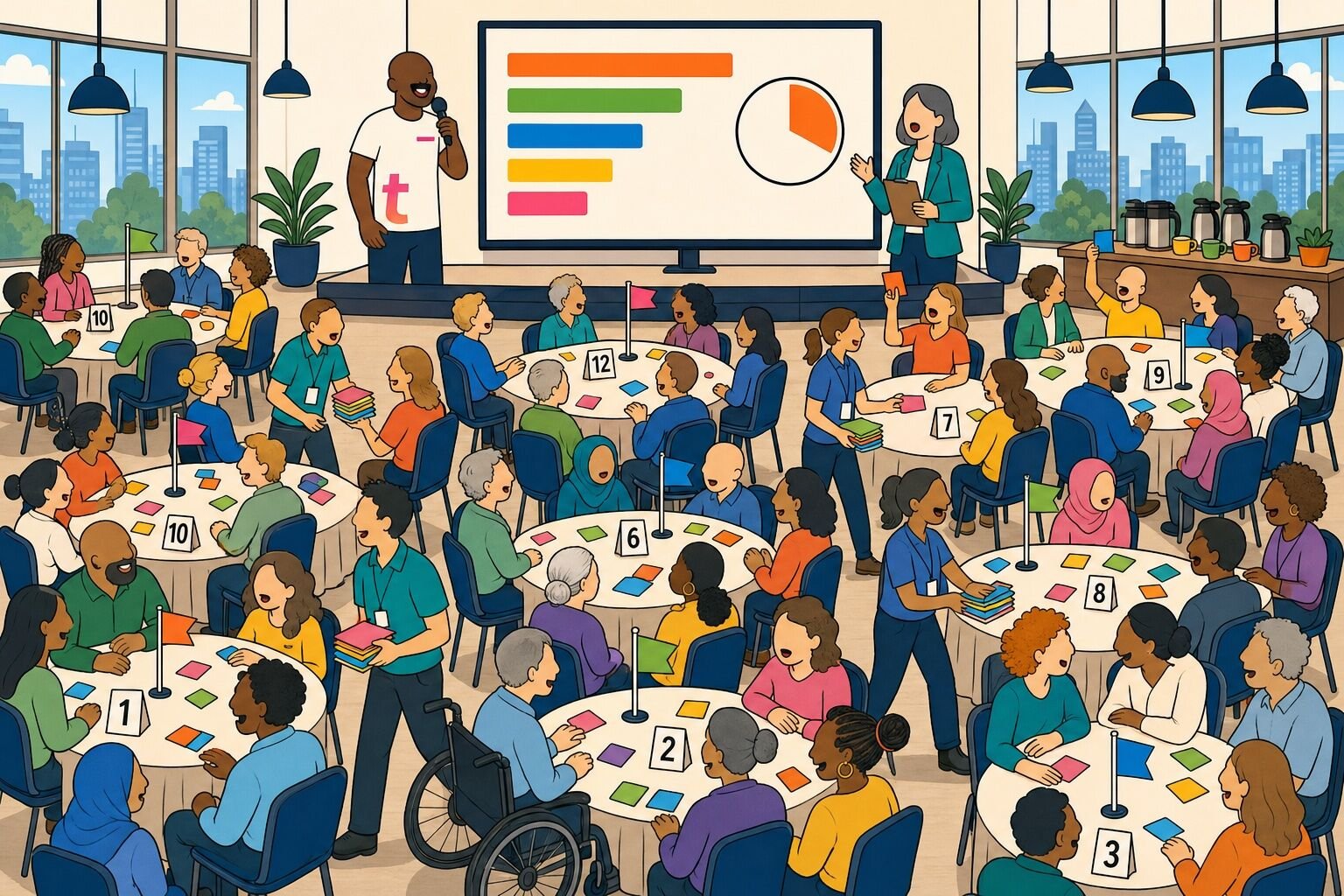
A breakout scoring tournament turns the whole room into one game. Every table is a team, every round is a short breakout challenge, and a central scoreboard aggregates the results so 300 people are competing in the same event at the same time. This is the structure behind our biggest hosted events, and it works for company kickoffs, sales conferences and all-hands days.
Best for: 100 to 1,000+ people, very large groups
Time: 30 to 60 minutes
Materials (cost): Numbered tables, answer cards, a screen and a scorer (free to moderate, depending on AV)
What we've learned: Two hosts minimum: one on the mic and one running the score. The energy of a big room comes from the leaderboard changing between rounds, and it stops changing the moment the scorer falls behind.
Human Bingo is the fastest way to mix a large room. Each attendee gets a card of squares such as "has run a marathon" or "speaks three languages," and they have ten minutes to find a different person for each square. It sends 300 people into the aisles talking to strangers with a built-in excuse.
You can generate a card for your group below:
Best for: 30 to 500 people, mixing a big room
Time: 10 to 15 minutes
Materials (cost): Printed cards and pens (free)
What we've learned: Put two or three squares on the card that only a leader can sign, such as "has been here more than 15 years." It gives everyone a reason to walk up to the executives, which is often the point of the whole event.
Breakout groups sit inside almost every event we host. A virtual game show for 200 people is really 40 rooms of five with a scoreboard on top; an in-person offsite is a series of briefs, splits and report-backs with lunch in the middle. Here is what that repetition has taught us.
The brief is the session. When a breakout fails, we can usually trace it back to the 30 seconds before the split. A group told "discuss the roadmap" spends its first five minutes negotiating what that means. A group told "rank these six roadmap items, you have 12 minutes, the scribe reads the top three back" starts working immediately. Say the question, the output and the time, and write all three down.
Four to six is the size. Three is a conversation, ten is a meeting. In a group of five, every person speaks within the first two minutes without being asked, which is the effect you split the room to get. When the math does not divide evenly, make groups of four rather than groups of seven.
Mix the rooms on purpose. Left to choose, people sit with the colleagues they already talk to every day. Assign groups by counting off, by badge color, or by a rule like "nobody from your own team," and say why. The mild discomfort of a new group lasts about 90 seconds and is the reason the session is worth running.
A visible timer changes behavior. A countdown on the screen or a sand timer on the table does more for pace than any amount of "two minutes left" from the front. Groups self-regulate against a clock they can see and ignore one they cannot.
Report back or it did not happen. The work groups do in a breakout evaporates unless it is captured within minutes. Sixty seconds per group, one output, one board, and a photo of the board sent out the same day. Skip this and the next session's attendees will, reasonably, stop trying.
Games earn the working sessions. We run a ten-minute game before the serious breakout, not after. A group that has just laughed together in Something in Common argues a pre-mortem more honestly than a group of polite strangers. The fun is the setup, not the reward.
| Factor | Small groups (under 30 total) | Large groups (100+) |
|---|---|---|
| Splitting | Count off or self-select with one rule | Pre-assigned numbered tables or pre-built video rooms |
| Briefing | Spoken plus a whiteboard | On the main screen and in a printed or chat card at every table |
| Roles | One scribe per group | A table captain per group and a floor team of one facilitator per eight tables |
| Timing | Flexible; extend a good conversation | Hard stops; a single late table delays 300 people |
| Report-back | Every group, 60 seconds each | Sampled: three tables read out, the rest submit cards or a form |
| Best formats | Roundtables, Pre-Mortem, Something in Common | Breakout Scoring Tournament, 1-2-4-All, Human Bingo |
If you would rather have a host run the split, the brief and the scoreboard, our hosts lead virtual and in-person team building activities for groups from five to several thousand.
Earlier versions of this article included a few ideas that read well and play badly, and the wider internet is full of others. Here is what we would skip, and why.
| Activity | Why skip it | Verdict |
|---|---|---|
| Unbriefed "discuss among yourselves" time | No question, no output, no clock. Groups spend the time deciding what to talk about, then talk about lunch. | Add a brief |
| Spelling bee | One person spells while 40 people wait, and being eliminated in front of colleagues is nobody's idea of a break. We had this on a previous version of this list. | Cut from our list |
| Book club breakout | It requires a month of reading before a 30-minute session, so half the group arrives unprepared and the other half is annoyed about it. | Cut from our list |
| Photo booth "session" | A photo booth is a lobby fixture, not a breakout. Scheduling it as a session gives 200 people a 20-minute queue. | Move it to the lobby |
| A 45-minute lecture in a breakout room | If one person talks the whole time, it is a smaller main stage. The point of breaking out is that the audience becomes participants. | Rename it a talk |
| A "quick" escape room or murder mystery | Puzzle formats need time to build stakes. Compressed into 20 minutes, players get the setup and the frustration without the payoff. | Book the full session |
| Trust falls | A physical-risk exercise with real liability, built on a metaphor that does not survive contact with an actual workplace. | Skip it |
| Random Zoom rooms with no host and no timer | Six strangers, a silent room and no idea when it ends. Half the participants leave the meeting before the rooms close. | Brief, time, and re-shuffle |
| Personality-test share-outs | Twenty minutes is enough time to label colleagues and not nearly enough to discuss what the labels mean. | Needs a full workshop |
The best breakout session we have ever seen was not clever. It was a specific question, five people, a timer everyone could see, and 60 seconds each to report back. Every idea in this guide is a variation on that shape, and the shape is what makes them work.
Pick one format for the conversation you need, one game to warm the room up first, and one topic from the table above that your team would actually argue about. Then run the same structure at your next three meetings before you change anything. Groups get better at breakouts fast, but only if the breakouts keep happening.
Next, check out our lists of small group games, company offsite ideas and executive retreat ideas.
Answers to the questions meeting planners ask us most about breakout sessions.
A breakout session is a short, structured block inside a larger meeting, workshop or conference where participants split into small groups to discuss, build, decide or play, then return to the main room to share what they found. Examples include roundtable discussions, lightning talks, a pre-mortem exercise, and small-group games like Something in Common. On video calls the same thing is called a breakout room.
Most breakout sessions run 20 to 45 minutes in total: two to five minutes for the brief, 10 to 30 minutes of small-group work, and five to ten minutes of report-back. Games and energizers run shorter, around 10 to 15 minutes, while working sessions such as a pre-mortem or goal-setting workshop need 25 to 45 minutes.
Four to six people per group works best. Three is a conversation and ten is a meeting; at five, every person speaks within the first two minutes without being asked. When the numbers do not divide evenly, make groups of four rather than groups of seven.
Good breakout session topics are specific enough to answer in 20 minutes and open enough that reasonable people disagree. Examples include "Which one thing should we stop doing this year?", "What do customers complain about that we have normalized?", "What decision are we avoiding, and what would it take to make it?", and, for a lighter session, "Design the worst possible team offsite, then flip each element." Always pair the topic with a concrete output, such as a ranked top three.
Fun breakout ideas that still fit a work meeting include Something in Common, where small groups race to find their most unusual shared traits; Bet on the Crowd, where teams wager on how the room will answer a poll; Question Jenga; a Lightning Scavenger Hunt; Blind Drawing in pairs; and a silent Birthday Line-Up. Each takes 10 to 25 minutes and needs little or no equipment.
For groups of 100 or more, pre-assign numbered tables or video rooms, put the brief on the main screen and on a card at every table, appoint a table captain per group, and keep hard time limits. Sample the report-back rather than hearing every table: three groups read out and the rest submit answer cards or a form. A breakout scoring tournament with a central leaderboard keeps the whole room in one game.
Comments (0)
Leave a Comment