
30 Group Retreat Activities & Ideas for Corporate, Team & Wellness Retreats
The retreat activities we run for clients and the free ones you can facilitate yourself, organized into an agenda that alternates working blocks with active ones.
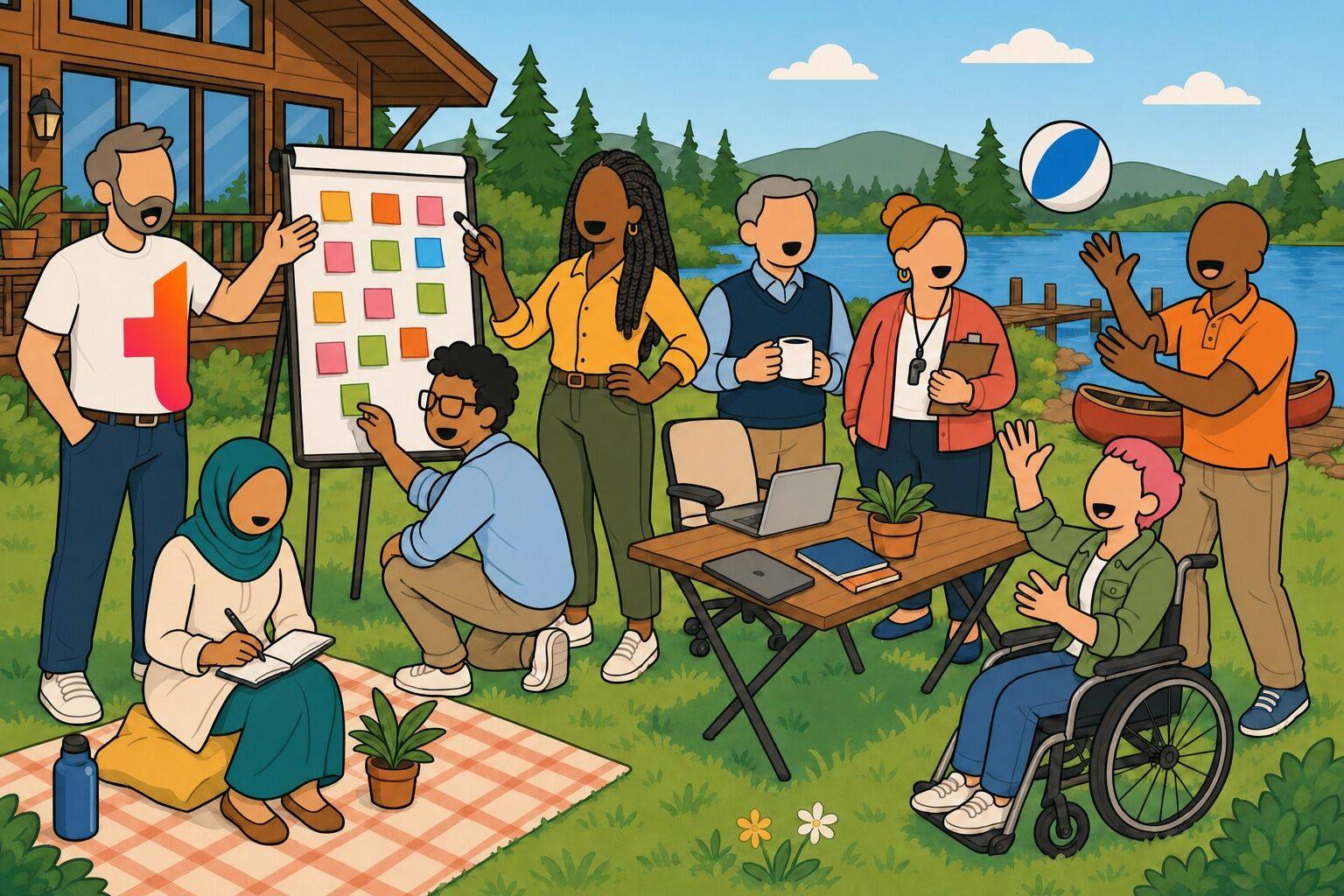
The retreat activities we run for clients and the free ones you can facilitate yourself, organized into an agenda that alternates working blocks with active ones.
A retreat is the rare week of the year when a whole team is in one room, off email, and actually available to each other. The agenda is what decides whether that turns into a year of momentum or an expensive sleepover with slide decks.
We plan and run retreat activities for a living. Our hosts travel to lodges, conference centers, hotel ballrooms and rented lake houses to run the games, competitions and workshops that sit between the strategy sessions, and our roots in this work go back to 2013 with Museum Hack, which led unconventional team building tours at world-class museums for companies like Google, Johnson & Johnson and Chipotle. This guide is the agenda we would build for your group, including the activities we run ourselves and the free ones you can facilitate without hiring anybody.
Trusted by teams at






Below you will find hosted retreat activities ranked by our post-event survey data, 20 free activities with step-by-step instructions, a sample one-day agenda, and an honest list of the retreat traditions we think you should cut.
Group retreat activities are the games, workshops, excursions and rituals that fill the non-working hours of an offsite retreat. Examples include an icebreaker round at the opening session, a guided hike between strategy blocks, a hosted competition after dinner, and a closing gratitude circle. Their job is to turn a group of people who mostly know each other over video into a group that trusts each other in person. These activities are also called “retreat games,” “retreat ideas,” “corporate retreat activities,” “company retreat activities,” “staff retreat activities” and “things to do on a retreat.”
Retreat activities are the on-the-ground half of a team building retreat and one of the building blocks of a company offsite. They are similar to outdoor team building, large group activities and team building activities, and they get planned alongside corporate retreat locations and the wider company retreat agenda. Within the category, this guide covers corporate retreat activities you can book, free retreat games for adults, and separate sections for team, outdoor, wellness and spiritual retreats. For leadership groups, see executive retreats and leadership retreat ideas, and if your group cannot travel, the online version is a virtual retreat.
This list includes:
Here we go!
Most retreat agendas have one or two blocks that nobody on the planning committee wants to facilitate personally: the first night, when nobody has loosened up yet, and the post-dinner slot on day one. Those are the blocks worth handing to a professional host, because they set the tone for everything that follows.
The table below ranks our in-person Originals by our Team Building Score, which combines overall satisfaction, participant recommendation scores, organizer reviews, engagement ratings and other post-event feedback from tens of thousands of surveys. Every event listed travels to your retreat venue with its own host and materials.
| # | Event | Score | Rating | Happier | Connected | NPS | Price |
|---|---|---|---|---|---|---|---|
| 1 | 
The Great Guac Off™
Best for: Teams seeking fun competition
More about this eventThe world's #1 guacamole-making competition for team building.
Perfect for: Teams seeking fun competition, Building camaraderie through cooking, Celebrating team milestones |
222 | ★ | 98% | 96% | 86 | $80 pp |
| 2 | 
Museum Hack Tour: Metropolitan Museum of Art
Best for: Teams seeking a creative adventure
More about this eventA wildly entertaining guided-tour of the Metropolitan Museum of Art.
Perfect for: Teams seeking a creative adventure, Groups interested in art and history, Celebrating a successful project completion |
218 | ★ | 100% | 95% | 90 | $100 pp |
| 3 | 
The Art of Storytelling Workshop
Best for: Teams seeking better communication
More about this eventLearn to tell better stories in a professional (and fun) workshop.
Perfect for: Teams seeking better communication, Groups wanting to enhance creativity, Organizations aiming for deeper connections |
215 | ★ | 97% | 96% | 88 | $100 pp |
| 4 | 
Ultimate Trivia Showdown
Best for: Teams seeking friendly competition
More about this eventA hosted mashup of classic trivia challenges we bring to your space.
Perfect for: Teams seeking friendly competition, Strengthening employee bonds, In-person team-building events |
215 | ★ | 99% | 95% | 89 | $50 pp |
| 5 | 
Museum Hack Scavenger Hunt at The Metropolitan Museum of Art
Best for: Art-loving teams seeking adventure
More about this eventExperience NYC's The Met in a fresh and unexpected way.
Perfect for: Art-loving teams seeking adventure, Teams building communication skills, Cultural enthusiasts looking for fun |
215 | ★ | 98% | 96% | 85 | $100 pp |
| 6 | 
Espionage!
Best for: Teams seeking a thrilling challenge
More about this eventA social deduction game with puzzles, challenges and sabotage.
Perfect for: Teams seeking a thrilling challenge, Groups wanting to enhance problem-solving, Building trust under pressure |
194 | ★ | 94% | 89% | 81 | $60 pp |
| 7 | 
Ultimate Game Show
Best for: Teams seeking a fun challenge
More about this eventLive out your team's game show dreams with fan favorites like Coworker Feud & Price Hike.
Perfect for: Teams seeking a fun challenge, Groups wanting to bond, Celebrating team achievements |
179 | ★ | 97% | 96% | 86 | $60 pp |
| 8 | 
Field Day
Best for: Teams seeking outdoor adventure
More about this eventAn updated take on the childhood classic that gets your team to enjoy friendly outdoor competition.
Perfect for: Teams seeking outdoor adventure, Building team camaraderie, Breaking the office routine |
162 | ★ | 95% | 95% | 90 | $80 pp |
| 9 | 
Superhero Academy
Best for: Teams seeking adventure
More about this eventOur comic-book-themed competition with mini-challenges and secret-sabotage!
Perfect for: Teams seeking adventure, Enhancing team collaboration, Office team building events |
159 | ★ | 100% | 97% | 90 | $60 pp |
| 10 | 
Gingerbread Games
Best for: Holiday office parties
More about this eventCrown your office's Gingerbread Games champion as you join us for an exciting end-of-year celebration that re-energizes and brings together your team.
Perfect for: Holiday office parties, Teams seeking festive fun, Creative team bonding |
154 | ★ | 96% | 93% | 89 | $80 pp |
Ranked by our Team Building Score — a running points total earned through confirmed bookings, verified reviews, ratings, and listing quality, recalculated nightly. Every event shown also has at least 30 post-event survey responses per question; the happier, connected, and NPS columns are computed from the 2,789+ survey responses collected for the 10 events listed here — a subset of all post-event surveys across our catalog. Updated October 2026.
Two of these come up again and again on retreat agendas, for opposite reasons.
Ultimate Trivia Showdown is the after-dinner slot. It scales from 15 people to a ballroom, it needs nothing from your group except chairs, and the competitive structure means the quiet half of the room participates without having to perform. Rounds mix general trivia with physical challenges, and you can send us company-specific questions to drop in.
A hosted mashup of classic trivia challenges we bring to your space.
Mix n' Mingle is the opposite job: the opening block, when half the room has never met in person. It is 90 minutes of structured introductions, small collaborative challenges and curated icebreakers, designed so that by dinner everyone has had a real conversation with someone outside their department.

A guided networking event with fun activities that spark real connection.
That 30-day median is the single most useful planning number in this article. Retreat venues get locked in months out, but the activities inside the retreat are usually booked only a few weeks before, which is why good hosts and the most popular formats disappear first during peak season. Book the entertainment when you book the rooms.
Browse all in-person team building events →
We are obviously biased here, since running these events is our business. But retreat planning usually involves comparing a few providers, so here are the companies we would actually put on a shortlist, including our competitors.
| Company | Type | Typical price | Best for | Our take |
|---|---|---|---|---|
| teambuilding.com | Team building company | $25–$100 per person | Hosted games, competitions and workshops that travel to your retreat venue | Our pick for the entertainment blocks of a retreat. 95% of our Original hosts are employees rather than gig facilitators, which is the main reason event quality holds up across hundreds of venues. |
| TeamBonding | Team building company | Custom quotes | Organizations that want one established vendor for a multi-day agenda | Decades in the corporate team building industry and a broad catalog covering charity builds, culinary challenges and game shows. |
| Outback Team Building | Team building company | Custom quotes | Outdoor and city-wide formats such as scavenger hunts and charity bike builds | Strong coverage of the outdoor, get-the-group-moving end of the retreat agenda across North America. |
| The Go Game (Weve) | Team building company | Custom quotes | Highly produced, game-show-style evening entertainment | A good fit when the retreat has a big stage, a big group and a production budget to match. |
| Your venue or conference center | Venue add-on | Varies by property | Low-effort extras like ropes courses, bonfires and boat rentals | Worth asking about, because it is already on site. Venue activities entertain people but rarely mix departments, so treat them as filler rather than the main event. |
Booking a host is one option, and a good one for the blocks that matter most. But most of a retreat agenda can and should be run by your own people, which brings us to the free list.
These are the activities we would put on a retreat agenda that has no entertainment budget at all. Most come out of formats our hosts run professionally, stripped down to the version a committee member can facilitate with a flip chart and a timer. They are grouped by the kind of retreat you are running, and the table below is the quick view.
| Activity | Best for | Group size | Time | Cost |
|---|---|---|---|---|
| Hopes and Fears Wall | Opening the retreat | 8–100+ | 20–30 min | Free |
| Retreat Icebreaker Rounds | Breaking the ice | 6–60 | 15–30 min | Free |
| Lightning Talks | Learning about each other | 8–40 | 30–60 min | Free |
| Retreat Bingo | Mingling across days | 10–200+ | Runs all retreat | Free (printing) |
| Working Agreements Workshop | Turning the retreat into habits | 5–40 | 45–60 min | Free |
| Group Hike and Walking Sessions | Fresh air and real conversation | 4–100+ | 45–120 min | Free |
| Photo Scavenger Hunt | Exploring the venue or town | 8–200+ | 45–90 min | Free |
| Team Sports Tournament | Friendly competition outdoors | 10–100+ | 60–120 min | Free–$50 |
| Campfire Story Circle | Evening wind-down | 6–40 | 45–60 min | Free–$30 |
| Guided Tour or Excursion | Getting off the property | 8–100+ | 90–180 min | Free–$40 per person |
| Sunrise Stretch Session | Morning energy | 5–60 | 20–45 min | Free |
| Cooking or Mixology Class | Hands-on bonding | 6–40 | 60–120 min | $15–$40 per person |
| Long-Table Meal with Table Topics | Cross-department conversation | 8–150+ | 60–90 min | Cost of the meal |
| Analog Game Night | Phone-free evenings | 6–60 | 60–120 min | Free–$40 |
| Gratitude Circle | Closing the retreat | 5–30 | 20–40 min | Free |
| Solo Reflection Walk | Quiet thinking time | Any | 30–60 min | Free |
| Guided Meditation or Breathwork | Resetting between sessions | 5–100+ | 15–30 min | Free |
| Field Day Minigames | Very large groups outdoors | 30–300+ | 90–120 min | $50–$150 total |
| Rock Paper Scissors Tournament | Ten-minute energizer | 15–500+ | 10–15 min | Free |
| Speed Mingle Rounds | Meeting everyone quickly | 20–200+ | 30–45 min | Free |
These are the agenda items that do the structural work of a team retreat: opening the room, getting people talking across departments, and turning the week's conversations into something the team keeps after everyone flies home.
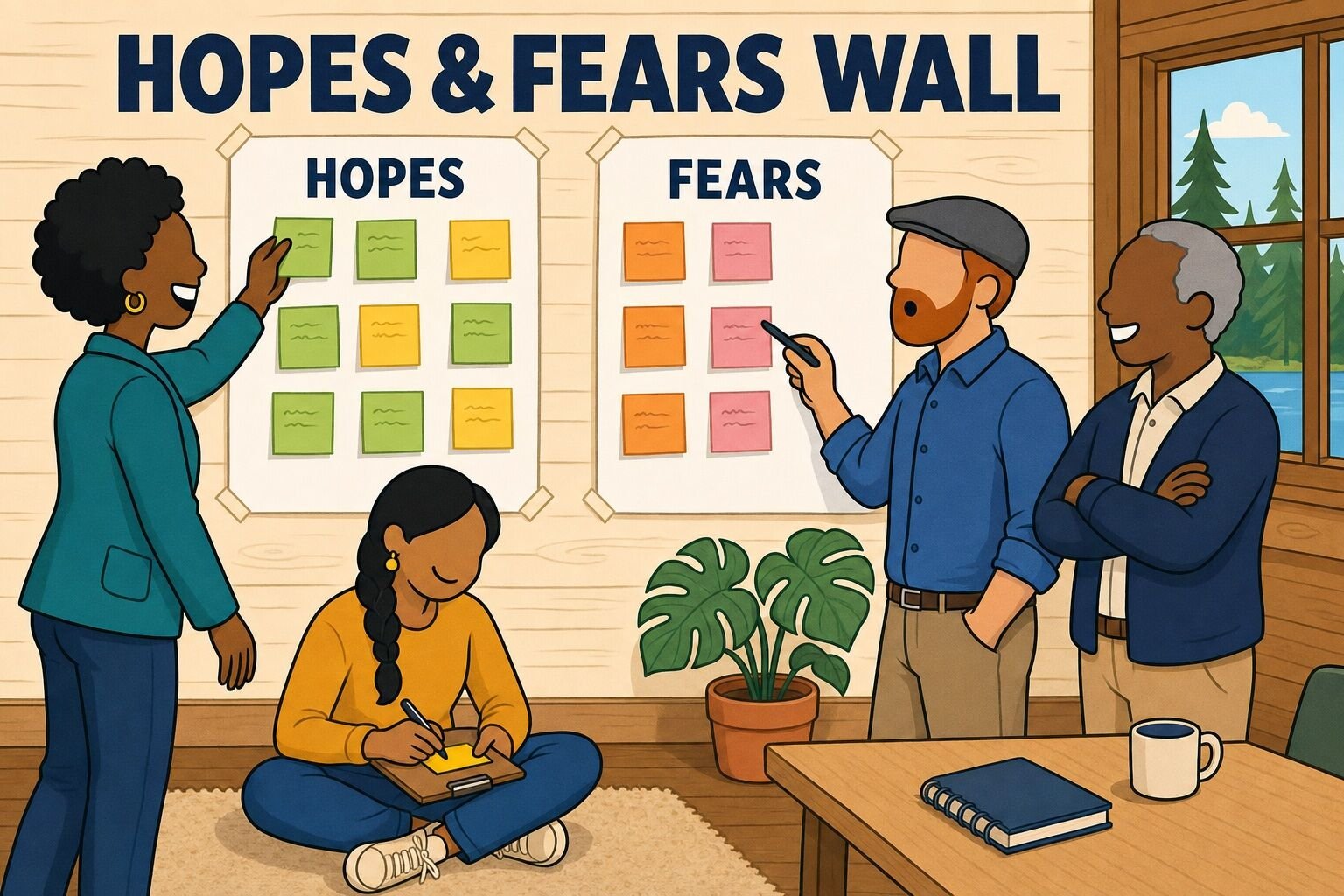
Hopes and Fears is the opener we reach for when a group arrives carrying different expectations of what the retreat is for. It surfaces those expectations in 20 minutes instead of letting them leak out on day three.
To run it:
Leave the wall up for the whole retreat and revisit it in the closing session. Crossing off a fear in public is a satisfying way to end.
Best for: Opening session, day one
Time: 20–30 minutes
Materials (cost): Flip-chart paper, sticky notes, markers (free if the venue supplies them)
What we have learned: Ask for the fears in writing, not out loud. In a round-robin, the first person sets the ceiling for honesty and everyone after them stays under it. Anonymous notes routinely surface the one concern the leadership team most needed to hear.
Icebreakers are the most-used retreat activity and the most-botched one. The fix is structure: short rounds, small groups, and a prompt that is easy to answer but hard to answer boringly.
To run icebreaker rounds:
Good retreat prompts include: the best thing that happened to you outside work this year, a skill you have that nobody here knows about, the job you thought you would have at 18, and the one thing you would change about how this team works. For more, browse our icebreaker games and team bonding questions.
Best for: The first hour of any retreat
Time: 15–30 minutes
Materials (cost): A printed prompt list and a timer (free)
What we have learned: Groups of four or five beat a full-room circle every time. Six people can find something genuinely surprising in common; 40 people in a circle mostly listen to 39 answers and wait for their turn.
Lightning Talks give every teammate five minutes and a microphone to teach the group something they care about that is not their job. We have seen talks on beekeeping, competitive Scrabble, restoring motorcycles and the history of a hometown bridge, and they change how people see each other more than any structured exercise.
To run Lightning Talks:
Best for: Mid-retreat, when the group needs a change of pace
Time: 30–60 minutes
Materials (cost): A screen, a clicker and a timer (free)
What we have learned: Cap the slides. The five-slide rule is what keeps a personal talk personal instead of turning it into a presentation, and it gets hesitant people to volunteer because the prep is 20 minutes, not an evening.
Retreat Bingo runs quietly in the background for the whole event. Each square is a small social action, such as “ate breakfast with someone from another team” or “learned a coworker's middle name,” and the card gives shy attendees a reason to start conversations they would otherwise skip.
Here is a card you can use:
To play, hand out cards at check-in, explain that squares are marked by doing the thing rather than by chance, and set the prize deadline for the closing session. You can also build a custom card with our free icebreaker bingo generator so the squares reference your own venue and in-jokes.
Best for: Multi-day retreats where people cluster with their own team
Time: Runs across the whole retreat
Materials (cost): Printed cards and a small prize (free to $25)
What we have learned: Bingo works best when at least a third of the squares require another human. Cards full of solo tasks turn into a checklist; cards full of conversations turn into a retreat.
This is the session that stops a retreat from evaporating on the flight home. Instead of abstract values, the group writes down a handful of concrete behaviors it commits to when everyone is back at their desks.
To facilitate it:
Best for: The final morning of a team retreat
Time: 45–60 minutes
Materials (cost): Flip charts, markers, dot stickers (free)
What we have learned: Cap the list at eight. Teams that leave a retreat with 20 agreements follow none of them, because nobody can hold 20 new behaviors in their head at once.
Most retreats happen somewhere worth walking around in, and the agenda should use that. These are the outdoor retreat activities we schedule between working sessions, plus the excursion formats that get a group off the property entirely. For a longer menu, see our ORTBO outdoor retreat format and these fun group activities.
A hike is the cheapest retreat activity that reliably produces real conversation, and you can double it as a working session.
To organize one:
There is decent evidence for the walking-session version. Stanford experiments by Oppezzo and Schwartz (2014) found that walking boosted creative idea generation by an average of around 60% compared with sitting, and in their first experiment 81% of participants were more creative while walking. If one block of your agenda is open-ended brainstorming, that is the block to move outside.
Best for: Mid-morning, or as a brainstorming session
Time: 45–120 minutes
Materials (cost): Water, sunscreen, first aid kit, printed map (free)
What we have learned: Reshuffling pairs on a timer is the whole trick. Left alone, a walking group sorts itself into the same clusters that sit together at lunch, and you get a nice walk instead of a team activity.
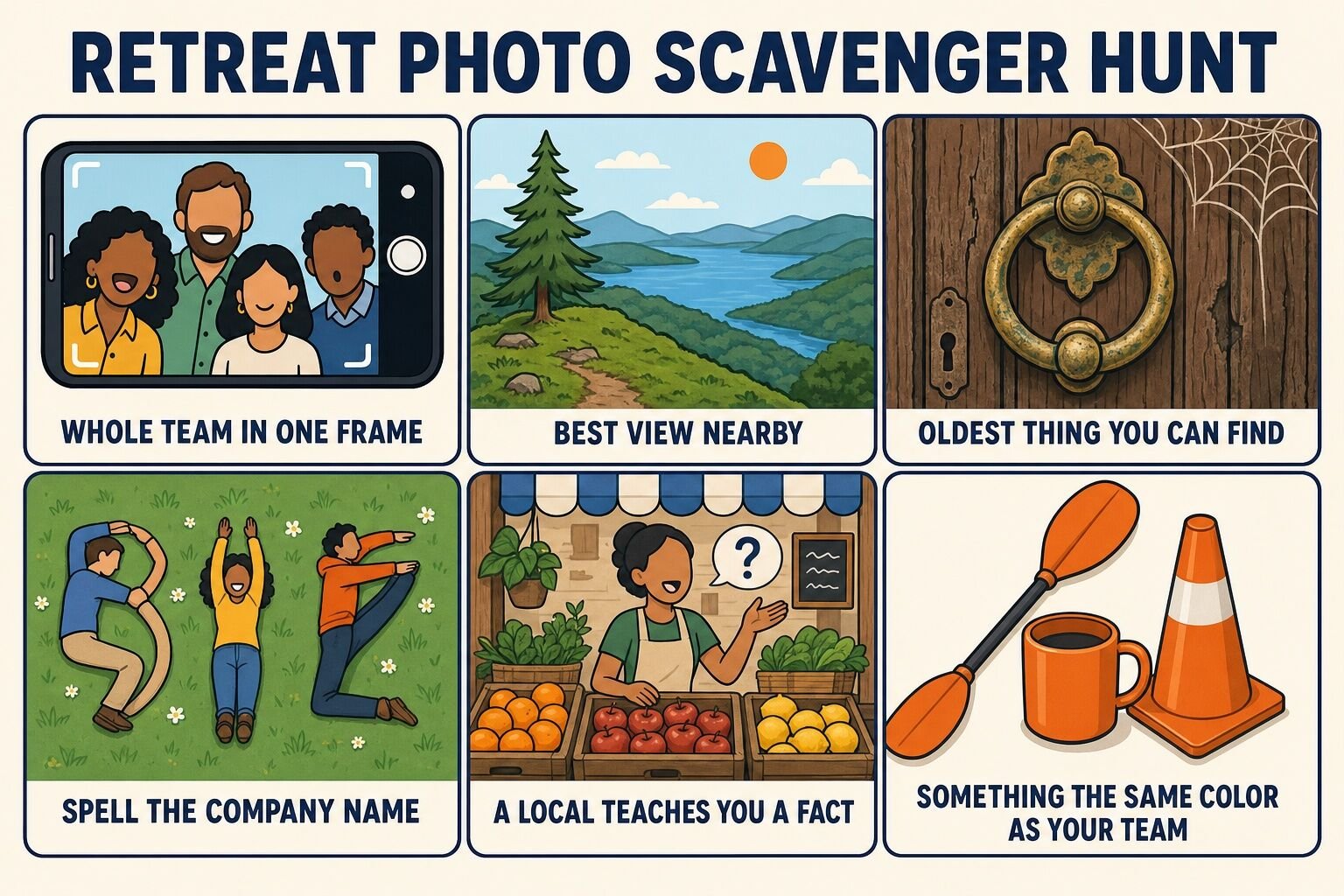
A photo scavenger hunt is our single most-requested in-person format, and the DIY version travels anywhere: a resort property, a downtown block, a conference center, a state park.
To run one:
Good retreat prompts: the whole team inside something, a recreation of your company logo using people, the oldest object you can find, a stranger teaching you a local fact, the best view within 10 minutes of here. Our scavenger hunt clues list has more if you want riddles rather than photo prompts.
Best for: Afternoon block on day one, any group size
Time: 45–90 minutes
Materials (cost): Phones and a printed prompt sheet (free)
What we have learned: The slideshow at the end is the activity. Teams that hunt without a public reveal come back flat; teams that know the photos will be projected in front of everyone compete much harder and go much sillier.
A tournament beats a pickup game, because brackets give people who are not athletic a role and a reason to stay. Volleyball, kickball, spikeball, cornhole and soccer all work on a retreat lawn.
To organize it:
Our outdoor group games list has lower-intensity options if your group would rather not run.
Best for: Late afternoon, before dinner
Time: 60–120 minutes
Materials (cost): Sports equipment, cones, a whistle (free to $50 if the venue supplies gear)
What we have learned: Publish the intensity level in the agenda. “Casual kickball, sneakers fine, sitting out is fine” gets far more participation than “team sports,” which quietly reads as a fitness test to anyone who has a bad knee or hated gym class.
The evening slot needs something low-key, and a fire is the most reliable structure we know for getting people to talk honestly without a facilitator in the middle of the circle.
To run a story circle:
Add s'mores, and if you want structured games instead of open storytelling, our campfire games list covers those.
Best for: Evening, day one or two
Time: 45–60 minutes
Materials (cost): Fire pit or lanterns, s'mores supplies (free to $30)
What we have learned: One prompt is enough. Hosts who bring a list of ten questions end up interviewing the group; hosts who ask one good question and then shut up get the conversation everybody remembers.
Getting the group off the property once is worth the logistics. A museum, a brewery, a historic district, a working farm or a boat tour gives people shared references for the rest of the retreat, and it puts everyone in the position of beginner at the same time.
To plan one:
Best for: Day two, as the break in the middle of the agenda
Time: 90–180 minutes
Materials (cost): Tickets and transport (free for a walking tour, up to $40 per person for a guided venue)
What we have learned: The guide matters more than the destination. We built an entire company on this, and our own tours are still judged by whether the guide had genuinely researched stories, not by which museum they were in.
Wellness retreat activities are the blocks that give people back some energy rather than spending it. On a packed agenda they are the difference between a group that is still thinking clearly on day three and a group that is running on coffee. If your team is remote and cannot gather, our virtual wellness activities cover the online equivalents.
A gentle 20- to 45-minute movement session before breakfast sets a completely different tone for the day than a 9 a.m. slide deck.
To run it:
Best for: Early morning, day two or three
Time: 20–45 minutes
Materials (cost): Mats or towels, a speaker (free if you use an in-house instructor)
What we have learned: Optional means optional. The fastest way to sour a wellness block is for a senior leader to note who showed up, and word of that travels through a retreat within hours.
A class puts everyone at the same skill level, gives them something to do with their hands, and ends with something to eat. That combination is hard to beat for a mixed group that does not know each other well.
To organize one:
For a version your team can run with no instructor at all, a guacamole cook-off works with three tables, a crate of avocados and a blind taste test.
Best for: Late afternoon into dinner
Time: 60–120 minutes
Materials (cost): Ingredients and instructor fee ($15–$40 per person)
What we have learned: Always add the judging round. Cooking together is pleasant; competing over whose dish wins is what gets the room loud and gets strangers arguing about cilantro.
Meals are the largest unstructured block on any retreat agenda, and by default people sit with the coworkers they already eat lunch with. A little structure turns three meals into three team activities.
To set it up:
Our conference food ideas list covers catering formats that keep a group mingling instead of queuing.
Best for: Every meal of a multi-day retreat
Time: 60–90 minutes
Materials (cost): Printed prompt cards and a seating chart (cost of the meal)
What we have learned: Assigned seating is unpopular for about 90 seconds and then nobody mentions it again. The retreats where people tell us they met someone new are almost always the ones that shuffled the tables.
An evening with no screens is a wellness activity disguised as a party. Board games, card games and puzzles give people a reason to sit together for two hours without anyone checking Slack.
To run one:
For more, see our indoor group games list.
Best for: Evening, especially on a rainy retreat
Time: 60–120 minutes
Materials (cost): Borrowed or bought games (free to $40)
What we have learned: Put a puzzle table in the corner. It is the landing spot for people who want company without a game they have to be good at, and it is usually the table still going at midnight.
Spiritual and reflective retreats run on a different rhythm: less competition, more quiet, and space for people to think about something other than the next quarter. These three activities work for a faith-based retreat, a personal-growth retreat, or as the reflective bookends of a corporate one.
A gratitude circle is the best closing activity we know. It takes 30 minutes and it is what people quote back to each other months later.
To facilitate it:
Best for: The closing session
Time: 20–40 minutes
Materials (cost): Chairs in a circle (free)
What we have learned: Warn people at the start of the retreat that this is coming. A few minutes of quiet thinking beforehand is the difference between specific thanks and a lap of “what he said.”
Retreat agendas are usually so full that nobody gets ten consecutive minutes to think. A scheduled solo hour, with prompts, fixes that, and it is the only activity on this list where the whole point is that nobody talks to you.
To run it:
Best for: Mid-retreat, before any planning session
Time: 30–60 minutes
Materials (cost): Notebooks, pens, a printed prompt card (free)
What we have learned: Put the solo hour immediately before the session where you need real input. The quality of what people say in a planning session goes up dramatically when they have already had a quiet hour to figure out what they think.
A short guided session is a practical reset between two heavy agenda blocks, and it works for groups who would never sign up for anything labeled wellness.
To run it:
Best for: After lunch, when the agenda hits its low point
Time: 15–30 minutes
Materials (cost): A speaker and a recorded session (free)
What we have learned: Name it for the outcome, not the practice. “Fifteen quiet minutes before the afternoon block” gets the skeptics in the room; “guided meditation” sends them to the coffee station.
Past about 40 people, activities that work beautifully for a team start to break. Everyone has to hear the instructions, everyone has to have something to do, and any activity that depends on going around the room is finished. These three scale to a few hundred people without losing energy. For more options at that size, see our guides to team building for large groups and large group energizers.
A field day breaks a big group into small teams that rotate through stations, which is the only structure we have found that keeps 200 people busy at once outdoors.
To run one:
Our field day games list has station-by-station instructions, and we run a hosted Field Day version for groups that would rather not manage the logistics.
Best for: Large groups with a lawn and a free afternoon
Time: 90–120 minutes
Materials (cost): Station supplies, cones, whistles, medals ($50–$150 total)
What we have learned: Staff every station with a volunteer whose only job is that game. Unstaffed stations collapse within two rotations, because nobody wants to be the person reading rules aloud to a group of strangers.
This is the best ten-minute energizer we know for a big room, because it turns 300 individual games into one loud shared story with a champion at the end.
To play:
Best for: Waking up a room before or after a long session
Time: 10–15 minutes
Materials (cost): A microphone and a trophy (free)
What we have learned: The cheering rule is what makes this work. A straight bracket eliminates people and leaves them standing around on their phones; the cheering version means the people who lost first are the loudest people in the room by the end.
At a large retreat, most people leave having spoken to about twelve colleagues. Speed mingling fixes that in 30 minutes.
To run it:
Our large group icebreakers guide has more prompts built for this format.
Best for: Day one of a retreat with multiple departments
Time: 30–45 minutes
Materials (cost): A bell, a timer, a printed prompt list (free)
What we have learned: Three minutes is the sweet spot. Two minutes cuts every conversation just as it gets interesting, and five minutes means two rounds in, people run out of things to say and start checking the clock.
The most common planning mistake we see is a retreat agenda that is either wall-to-wall working sessions or wall-to-wall fun, when the version that works alternates between the two. Here is the shape we would use for a single-day retreat, which you can stretch across two or three days by repeating the pattern.
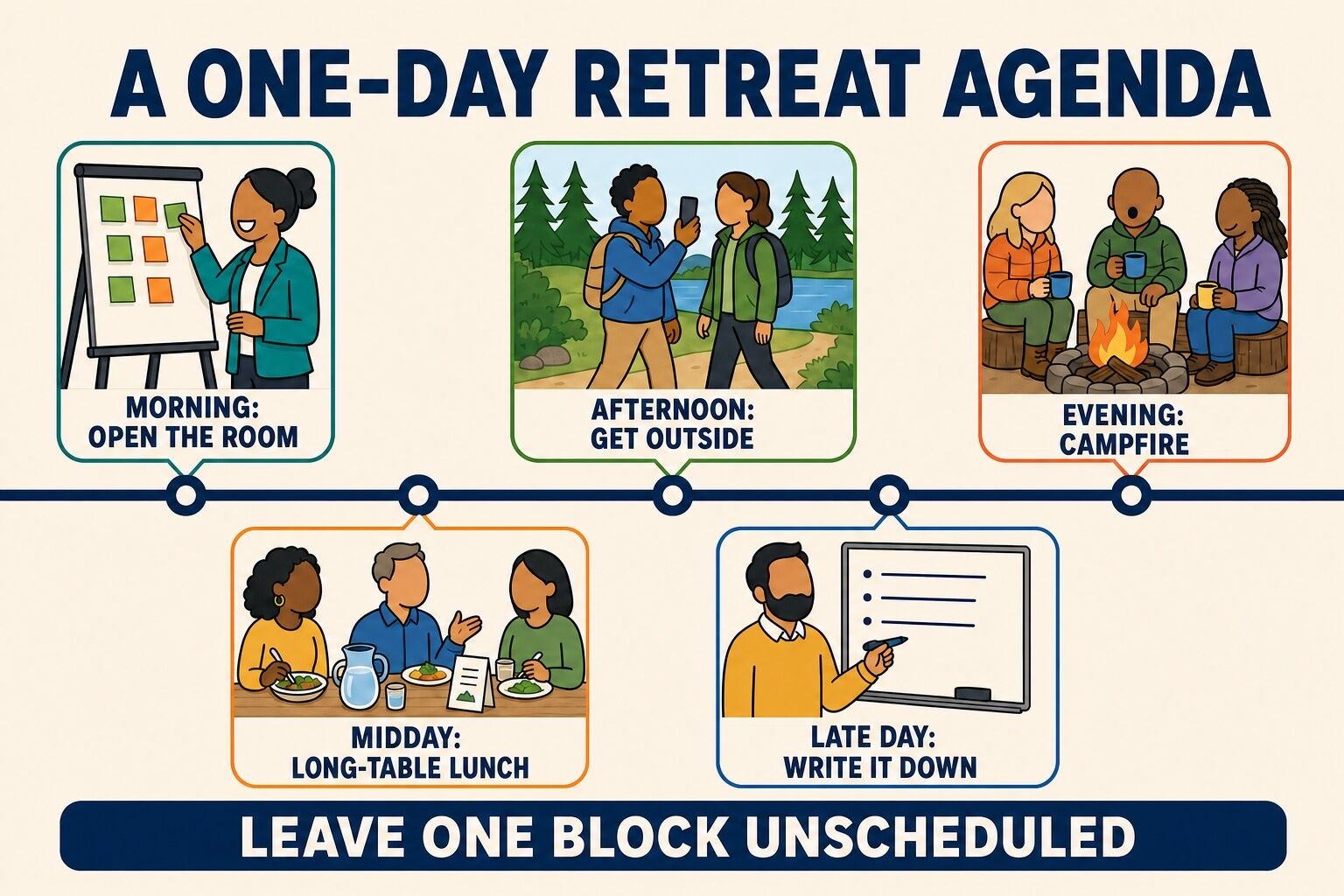
| Time | Block | Why it is there |
|---|---|---|
| 9:00–9:30 | Hopes and Fears Wall | Surfaces expectations before the agenda commits to anything |
| 9:30–10:00 | Retreat icebreaker rounds | Mixes departments while people still have morning energy |
| 10:00–12:00 | Working session | The heaviest thinking goes in the freshest block |
| 12:00–13:00 | Long-table lunch with table topics | Keeps the mixing going through the meal |
| 13:00–14:00 | Walking session | Moves the open-ended brainstorm outside, past the post-lunch slump |
| 14:00–15:30 | Photo scavenger hunt or field day | The big shared-memory block of the day |
| 15:30–16:30 | Working agreements workshop | Converts the day's conversations into specific commitments |
| 16:30–17:00 | Gratitude circle | Ends on connection rather than logistics |
| Evening | Hosted event or campfire story circle | The unstructured evening is where the real bonding happens, with just enough structure to start it |
Two rules we would not break. Never schedule the biggest activity of the day immediately after lunch, and always leave at least one unscheduled 90-minute block. Retreat feedback forms complain about crammed agendas far more often than they complain about downtime. If you need to fill a gap on short notice, our quick team building activities work with no setup.
We have run these events in hotel ballrooms, barns, museum galleries, rented lake houses and one memorable parking lot. A few patterns hold across all of them.
Retreat season is real, and it is September. Across our platform data, December is the busiest month for team building overall at 33% of annual volume, but that is driven by virtual holiday parties. In-person events follow a completely different curve and peak in September, as teams come back from summer and run their fall offsites. If your retreat lands in that window, book hosts, venues and travel earlier than feels necessary.
The first two hours decide the retreat. Groups that open with a working session stay in meeting posture all week. Groups that open with something participatory, even 20 minutes of it, talk differently for the rest of the retreat. This is the block we would spend budget on if we could only spend it once.
Mixing beats bonding. Almost every retreat brief we get asks for team bonding, but the teams already bond; they work together daily. The value of getting everyone in one place is the connections that do not happen otherwise, which is why nearly every activity above shuffles groups on purpose.
Group size changes what works. The activity that has a 12-person retreat in tears of laughter can die in a ballroom of 200, and vice versa.
| Consideration | Small retreats (under 30) | Large retreats (30+) |
|---|---|---|
| Best formats | Story circles, gratitude circles, long-table meals, workshops | Station rotations, bracket tournaments, speed mingling, hosted game shows |
| Instructions | Explain once, conversationally | Explain with a microphone, a slide and a demo round |
| Group structure | One group, or pairs | Fixed teams of 8–10 with names and colors |
| Whole-room turns | Fine, and often the best part | Avoid entirely; nothing that goes around the room |
| Facilitation | One person can run the day | One lead plus a volunteer per station or table |
| Biggest risk | Activities feel too intense or exposing | People drift to the edges and disengage |
People rate the host, not the activity. When an organizer tells us an event went well, they almost always tell us about the person who ran the room before they tell us about the game. Our own Net Promoter Score among event organizers is +88, and in a 12-month survey of 3,855 clients, 97.64% said their overall experience met or exceeded expectations. Whether you hire us or hand the flip chart to a colleague, pick the facilitator as carefully as you pick the activity.
Retreat agendas accumulate traditions that nobody enjoys but everybody assumes are required. Here are the ones we would cut, based on watching them land badly in real rooms.
| Activity | Why skip it | Verdict |
|---|---|---|
| Trust falls | The exercise asks for physical vulnerability from people who did not consent to it, carries a real injury risk, and has become shorthand for corporate cringe. | Skip it |
| Personality-test readouts | Spending an hour having people announce their four-letter type flattens teammates into stereotypes and rarely changes how anyone works the following week. | Skip it |
| Open mic confession sessions | Asking people to share something deeply personal in front of colleagues who control their promotions is not vulnerability, it is pressure. Use a solo reflection walk instead. | Skip it |
| Bar night as the only evening plan | It excludes anyone who does not drink, splits the group into the same cliques as always, and guarantees a rough morning for a group that paid for flights. | Add structure |
| Karaoke as the whole evening | Fine for 40 minutes at the end of a night, painful as a headline activity: a few people sing and everybody else scrolls their phone waiting for it to end. | Cameo only |
| Cruise or resort retreats with no agenda | Booking a spectacular location and letting people do as they please produces a nice holiday and zero team outcomes. The venue is not the activity. | Add an agenda |
| All-day strategy marathons | Eight hours of working sessions with a working lunch is the fastest way to send a group home exhausted and no closer to each other than when they arrived. | Break it up |
| Mandatory talent shows | Performing is a genuine fear for a lot of people, and “mandatory” turns an optional bit of fun into the thing an attendee dreads for the entire retreat. | Make it optional |
| Fishing or golf as the group activity | Both are pleasant for the people who already do them and long, quiet afternoons for everyone else, and neither mixes the group. | Offer as a side option |
A retreat agenda is a budget for attention. Every hour you spend on slides is an hour you are not spending on the thing you flew everyone in for, which is the group itself.
Our advice after years of running these: open with something participatory, alternate working blocks with active ones, shuffle the groups constantly, protect one unscheduled block, and close with gratitude. The activities in this list all serve one of those jobs, and you can run most of them with a flip chart and a whistle.
If you would rather hand the biggest blocks to a professional host, you can browse every in-person event we run, including all of the retreat activities ranked above.
Next, check out our list of team building games, these company picnic ideas, and our guide to employee engagement activities.
Answers to the questions planners ask us most when they are building a retreat agenda.
The best retreat agendas mix three kinds of activity: an opener that gets everyone talking (icebreaker rounds or a Hopes and Fears Wall), one big shared-memory block during the day (a photo scavenger hunt, a field day or a guided excursion), and a low-key evening (a campfire story circle, a game night or a hosted trivia competition). Close with a gratitude circle so the retreat ends on connection rather than logistics.
For groups over about 40 people, choose formats that break into small fixed teams and run in parallel. Field day minigames with rotating stations, a rock paper scissors tournament where everyone who loses joins their winner's cheering section, and speed mingle rounds in two concentric circles all scale to several hundred people. Avoid anything that requires going around the room, since whole-room turns stop working past a dozen or so people.
Plan energizers at 10 to 15 minutes, icebreaker and workshop blocks at 30 to 60 minutes, and the main daily activity at 90 minutes. Most of our hosted in-person events run 60 to 90 minutes for the same reason: past that window, attention drops no matter how good the activity is. Leave at least one unscheduled 90-minute block per day, because retreat feedback complains about crammed agendas far more often than about downtime.
Earlier than most planners do. Across 22,000+ confirmed bookings on teambuilding.com, in-person events are booked a median of 30 days ahead, while venues are usually locked in months earlier. In-person team building peaks in September as teams run their fall offsites, so if your retreat falls between late August and October, book hosts and activities at the same time you book the rooms.
Skip trust falls, mandatory talent shows, personality-test readouts and open-mic confession sessions, all of which ask people to be vulnerable in front of colleagues who did not opt in. Also avoid the two structural mistakes: a spectacular venue with no agenda, which produces a nice holiday and no team outcomes, and an all-day strategy marathon with a working lunch, which sends everyone home exhausted.
Wellness retreat activities give energy back rather than spending it: a sunrise stretch session, a cooking or mixology class, a phone-free analog game night, and meals structured with conversation prompts. Spiritual and reflective retreats run on a quieter rhythm, built around a gratitude circle, a solo reflection walk with written prompts, and a short guided meditation or breathwork session between heavier blocks. Both work best when attendance is genuinely optional and everyone knows it.
Comments (0)
Leave a Comment