
30 One Minute Games for Work, Parties & Classrooms
Sixty-second challenges you can run in a meeting, at a party or in a classroom, with the rules, supplies and timings for each one.
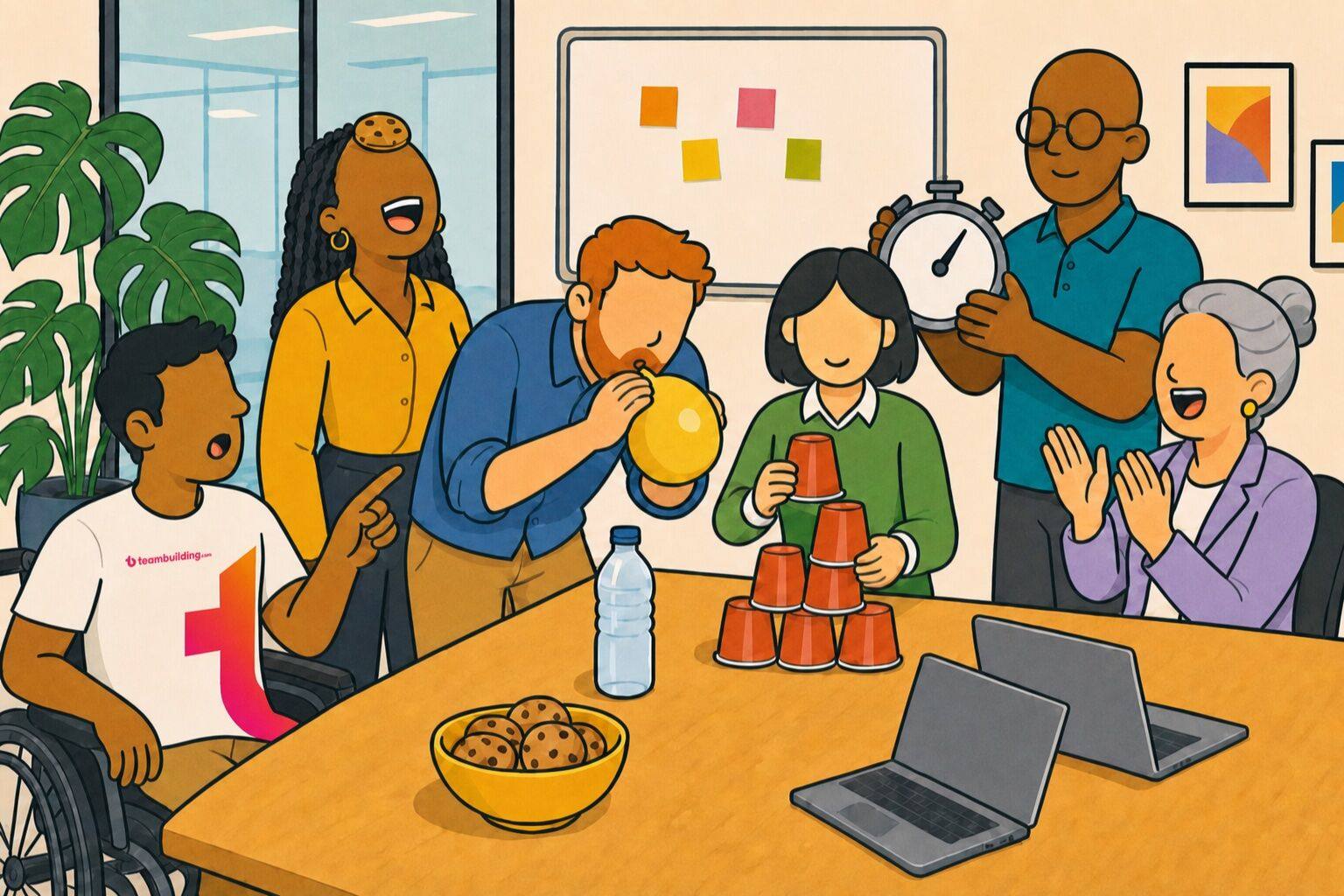
Sixty-second challenges you can run in a meeting, at a party or in a classroom, with the rules, supplies and timings for each one.
Sixty seconds is the smallest useful unit of team building. It is short enough to drop into a staff meeting without asking permission, short enough that nobody can hide, and long enough for a room to go from quiet to loud. That is why one minute games show up everywhere: in team meetings, at birthday parties, in classrooms after lunch, and in the warm-up rounds of the events our hosts run.
We design and run games for a living. New concepts get play-tested internally with our own staff first, then run live with client teams, then tuned round after round based on post-event surveys and reviews. Timers get shortened, prompts get swapped, scoring gets simplified, and the games that never find their energy get retired. A surprising number of the survivors are one minute long.
This list includes:
Here we go.
One minute games are short challenges that players must finish, or score as highly as possible in, within sixty seconds. Examples include stacking cups, matching socks from a pile, and naming as many items in a category as a player can before the buzzer. The rules are simple enough to explain in one sentence, the supplies are usually already in the room, and the clock does the work of creating pressure, laughter, and a clear winner.
One minute games are the shortest format of quick team building activities and a subcategory of team building games. They are close cousins of minute to win it games, 5 minute team building activities, and team meeting games, and the video-call version of the format is virtual minute to win it. Within this guide you will find one minute games for adults, for work, for parties, and for classrooms, plus a set that needs no supplies at all. These games are also called "1 minute games," "60 second games," "one minute challenges," and "quick games to play."
The format holds up because it removes every excuse. There is no equipment to buy, no facilitator script to learn, and no scheduling conversation to have. If you can find a timer and a table, you can run one.
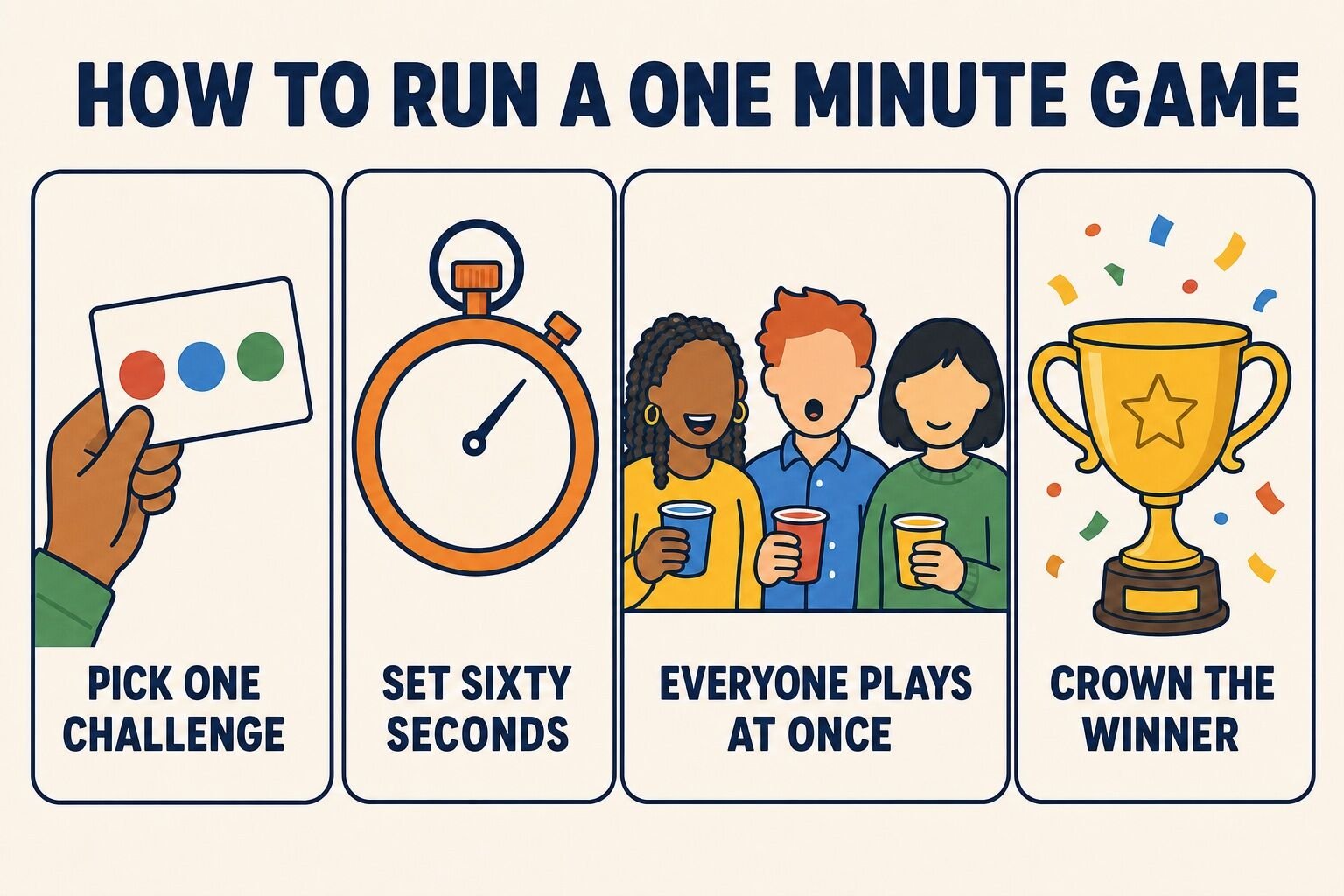
The two terms overlap, and plenty of games belong to both lists. The difference is mostly one of staging. Minute to Win It is a television format built on physical stunts with household props, played one contestant at a time while everyone else watches. One minute games are broader: the category includes stunts, but also word games, memory rounds, appreciation rounds, and question games that the whole room plays simultaneously.
That distinction matters when you are choosing for a real group. A stunt played by one person at a time is great entertainment for ten people and a slow afternoon for fifty. If your group is large, pick the games below that everyone can play at once, and save the single-contestant stunts for a finale round.
These games need nothing but a timer and a group. They are the ones worth memorizing, because you will use them when a meeting ends early, a session runs long, or the supplies you ordered do not show up.
Players race an invisible clock. Everyone stands up, the host starts a hidden timer and says "go," and each player sits down at the moment they believe sixty seconds have passed. No counting out loud, no watches, no phones.
How to play:
Best for: 5 to 100+ people, any setting
Time: Two minutes including the reveal
Materials (cost): A phone timer (free)
What we've learned: Run this one first. It calibrates the whole room to how long a minute actually feels, which makes every game after it more competitive. Most people sit down around the forty-second mark on their first try.
The host names a category and a player has sixty seconds to name as many items in it as possible while a teammate keeps count. Good categories are specific enough to be hard and broad enough to be fair: breakfast cereals, countries in Africa, movies with a number in the title, things in this building that are blue.
For teams, run it as a relay. Each player gets ten seconds before passing to the next teammate, and repeats do not score.
Best for: 4 to 40 people
Time: One minute per round, five to ten minutes total
Materials (cost): None (free)
What we've learned: Write your categories in advance. Hosts who improvise categories on the spot tend to pick ones that are either impossible or endless, and both kill the round.
A knockout tournament with one twist: when you lose, you do not leave. You become a cheerleader for the person who beat you, chanting their name for the rest of the bracket. By the final duel, the room is split into two roaring halves.
Players pair off, play a single round, and losers join the winner's fan club. Winners find a new opponent and repeat until two players remain.
Best for: 10 to 200+ people, in person
Time: Sixty seconds per bracket stage, two to three minutes total
Materials (cost): None (free)
What we've learned: The cheering rule is the entire game. Without it, this is a quiet tournament that eliminates most of the room in the first thirty seconds. With it, the people who lost immediately have the loudest job.
The group counts from one to twenty out loud. Anyone may say the next number at any time, but nobody may plan an order, and if two people speak at once, the count resets to one. The group gets sixty seconds to get as high as it can.
Players should look at the floor or close their eyes. Taking away eye contact removes the shortcut of signalling to each other, and forces the group to listen for rhythm instead.
Best for: 5 to 25 people
Time: One to three minutes
Materials (cost): None (free)
What we've learned: This is the quietest game on the list and one of the best debrief prompts we know. Teams that succeed usually stop trying to lead and start leaving space, which is a conversation worth having for two minutes afterward.
One player says a word. The next player must say a word starting with the final letter of that word, and so on around the circle. The team counts how many links it can make in sixty seconds. Repeats break the chain and the count starts over.
To make it harder, restrict the chain to a theme such as food, cities, or job titles. To make it easier for younger or mixed-language groups, allow two seconds of thinking time per player before the clock penalizes them.
Best for: 4 to 20 people
Time: One minute per attempt
Materials (cost): None (free)
The host calls out a scramble of seven to nine letters. Players have sixty seconds to build the longest real word they can from those letters, using each letter only once. Longest word wins, and ties go to whoever raises a hand first.
You can pull letter sets from our generator:
Best for: 3 to 50 people
Time: One minute per round
Materials (cost): None, or pen and paper (free)
What we've learned: Award a point for the longest word and a separate point for the funniest word. The second prize is what keeps players who are never going to win the first one in the game.
These are the versions we reach for in a workplace, where the goal is a jolt of energy that leaves the agenda intact. Each one fits inside the first or last two minutes of a meeting, and several double as actual work. For longer formats, see our list of office games.
One teammate sits in the hot seat and answers as many quick questions as possible in sixty seconds. Questions should be light and answerable in three words: window or aisle, first concert, best meal this month, the app you would delete first.
The host reads questions at speed and the player may pass twice. Count the answers, then rotate to the next volunteer in the next meeting rather than doing the whole team in one sitting.
Use the generator below to pull questions without prep:
Best for: 3 to 30 people
Time: One minute per person
Materials (cost): None (free)
What we've learned: Speed is the safety feature. A slow round of personal questions feels like an interview, while a fast one feels like a game, and the pace gives anyone an easy exit by simply saying "pass."
The host announces one clue and players have sixty seconds to come back with a matching object from their desk, bag, or the kitchen. This is the one minute version of our lightning scavenger hunts, and it works identically in an office or on a video call.
Clues that work well:
Best for: 5 to 100+ people
Time: One minute per clue
Materials (cost): None (free)
What we've learned: The race creates the energy, but the stories are the payoff. When someone comes back holding a strange souvenir, spend fifteen seconds asking about it before starting the next clue.
Give everyone a stack of sticky notes and a marker. In sixty seconds, each person writes as many ideas as they can on the prompt of the day, one idea per note, then slaps them on the wall. No discussion, no editing, no judging.
The prompt can be playful ("names for the office plant") or real ("everything slowing down our release"). Either way, the group ends with a wall of material and a warmed-up room.
Best for: 4 to 40 people, in person
Time: One minute to write, two to three minutes to cluster
Materials (cost): Sticky notes and markers (about $10)
What we've learned: Quantity instructions beat quality instructions here. When we tell a group to write ten notes in a minute, we get better ideas than when we ask for their best three, because nobody censors the strange ones.
Set a timer and let the team call out as many specific thank-yous as it can before it runs out. The only rule is that a shout-out must name a person and a thing they did. "Thanks to Priya for rewriting the onboarding doc" counts. "Great work everyone" does not.
Count them, then try to beat the number the following week.
Best for: 5 to 50 people
Time: One minute
Materials (cost): None (free)
What we've learned: Making it a race is what fixes the awkwardness. Recognition rounds usually stall because nobody wants to go first, and a running counter turns the silence into a scoreboard problem rather than a social one.
Split into teams of three to five. Each team gets one sheet of paper and sixty seconds to design, fold, and launch a plane from a marked line. Longest flight wins. Run a second round and teams almost always double their distance.
For a harder version, give each team a second sheet and require that every teammate touches the plane during construction.
Best for: 6 to 60 people, in a room with space to throw
Time: One minute per round, five minutes for two rounds
Materials (cost): Paper and tape (under $5)
What we've learned: Group challenges get chaotic when everybody starts acting immediately. The teams that win usually spend their first ten seconds deciding on a design and assigning who folds and who throws, which is exactly the lesson to point out in the second round.
Each player gets a stack of twenty-five identical plastic cups with one odd-colored cup at the bottom. In sixty seconds, players must move cups one at a time from the top of the stack to the bottom until the odd cup rises to the top, without knocking the stack over.
It sounds trivial and it is genuinely hard, because speed is what makes the stack fall.
Best for: 2 to 30 people
Time: One minute per round
Materials (cost): Plastic cups (about $5 for a pack)
These are the props-required classics: dexterity challenges that look easy from a chair and fall apart the moment the clock starts. Everything here can be bought at a corner store, and most of it is probably already in the office kitchen.
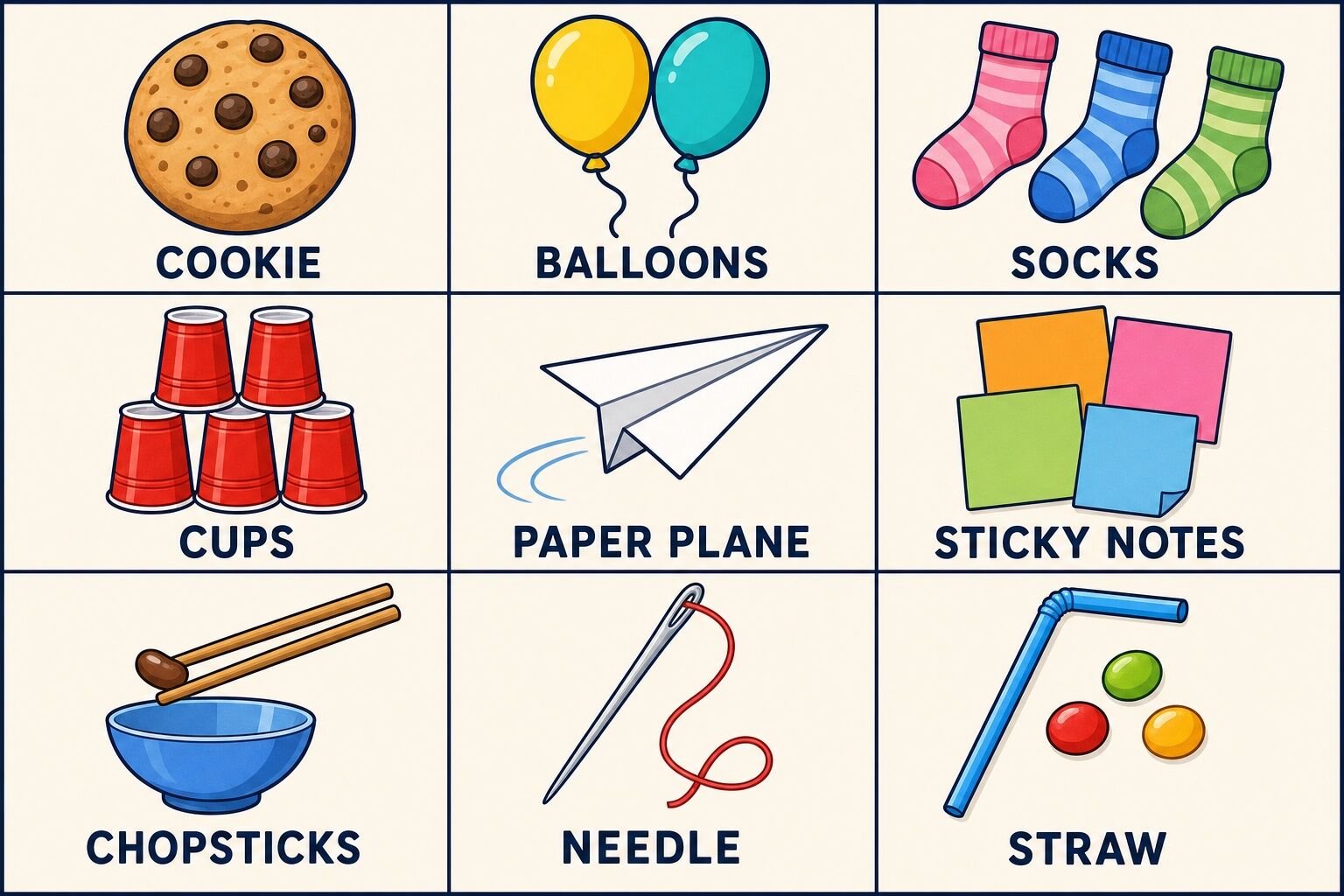
Each player balances a cookie on their forehead and has sixty seconds to move it into their mouth using only their facial muscles. No hands. If the cookie hits the floor, the player may restart with a fresh one while the clock keeps running.
Round cookies work best, and a shorter person-to-cookie ratio matters less than a flat, dry forehead, so hand out napkins first.
Best for: 2 to 30 people
Time: One minute per round
Materials (cost): A pack of round cookies (about $5)
What we've learned: This is the most reliable photo of the whole event. Assign somebody to take pictures before you start, because it is over in a minute and nobody wants to repeat it.
Fill a container with fifteen to twenty unmatched socks plus three matching pairs hidden among them. Players have sixty seconds to find all three pairs. With a big group, run it as a relay where one teammate searches at a time.
Patterned socks make the game harder and funnier than plain colors, since players have to check heels and toes rather than glancing at the pile.
Best for: 2 to 40 people
Time: One minute per round
Materials (cost): A bag of mismatched socks (free from home, or about $10 new)
Give each player five needles and a length of thread. In sixty seconds, thread as many needles as possible. Most people get one. Somebody in the room will get four, and nobody will see it coming.
Use large-eye embroidery needles for mixed-ability groups, and keep the needles in a shallow tray so nothing ends up on the carpet.
Best for: 2 to 20 people
Time: One minute per round
Materials (cost): Needles and thread (about $6)
What we've learned: Quiet, fiddly games like this one are a useful counterweight in a session full of loud ones. They give a different set of people a chance to be the champion, which is the entire reason to vary the game types in a lineup.
Line up water bottles on a long table, one per player, a hand's width from the edge. Each player inflates a balloon, then has sixty seconds to push their bottle across the table using only the escaping air. No touching the bottle, and no touching the table with the balloon.
Mark a finish line with tape. Whoever pushes their bottle furthest wins, and empty bottles make the game too easy, so leave a couple of inches of water in each.
Best for: 4 to 30 people
Time: One minute per round
Materials (cost): Balloons and water bottles (about $8)
Tie an empty tissue box loaded with eight ping pong balls around a player's waist so the box sits behind them. In sixty seconds, they must shake every ball out without using their hands.
Cut the opening of the box wider for an easier version, narrower for a nearly impossible one. Two players going head to head is far better than one player performing alone.
Best for: 2 to 20 active players plus an audience
Time: One minute per pair
Materials (cost): Tissue boxes, ping pong balls, and string (about $12)
What we've learned: Always make this one optional and never make it the finale. It is the most physical game on the list, and a lineup that ends on a dance-adjacent challenge leaves the least confident people in the room sitting out the last thing they remember.
Party crowds are bigger, looser, and less patient than meeting groups, so the games here are built for an audience: quick to explain, fun to watch, and easy to run back-to-back. They suit birthdays, farewells, retirements, and any celebration where you need structure without turning the room into a workshop. For a full evening's worth of ideas, see our lists of party games for work, office birthday ideas, and farewell party ideas.
Give each player two inflated balloons. On "go," they must keep both balloons in the air for sixty seconds without using their hands. Forearms, elbows, heads, and knees are legal. A balloon touching the floor ends that player's run.
Add a third balloon for anyone still standing at thirty seconds, and clear a wide space, because this game moves.
Best for: 4 to 60 people
Time: One minute per round
Materials (cost): A bag of balloons (about $5)
Teams of three to five get wrapping paper, tape, scissors, and one awkward object such as a stapler, a football, or a house plant. In sixty seconds, wrap it. Judges score on coverage first and neatness second.
The chaotic variant, which works especially well at farewells, is wrapping a volunteer teammate instead of an object. Keep it to arms and torso, and stop at the neck.
Best for: 6 to 50 people
Time: One minute per round
Materials (cost): Wrapping paper and tape (about $10)
Play six clips of five to ten seconds each inside a single minute. Teams write down the song titles and score one point per correct answer, with a bonus point for naming the artist.
Build the playlist from the decades your group actually grew up in, and include one song from the guest of honor's favorite band if the party is for a specific person.
Best for: 6 to 100+ people
Time: One minute per round
Materials (cost): A speaker and a playlist (free)
Place a bowl of ping pong balls at one end of a table and an empty bowl a foot away. Each player holds a spoon in their mouth and has sixty seconds to move as many balls as they can, no hands allowed. Most balls moved wins.
Give every player their own spoon, and use cotton balls instead of ping pong balls if you want a quieter, less bouncy version.
Best for: 2 to 30 people
Time: One minute per round
Materials (cost): Spoons, bowls, and ping pong balls (about $10)
Each volunteer gets exactly one minute to toast the person the party is for. When the timer ends, they stop mid-sentence, which is the joke and also the mercy rule. Give speakers thirty seconds of prep and one prompt to anchor the toast: the first day you met them, the thing they always say, or the favor they did that nobody saw.
Line up three or four speakers and run them back to back so the tribute lands as one four-minute segment rather than an open-ended speech slot.
Best for: Any size audience, 3 to 5 speakers
Time: One minute per speaker
Materials (cost): A timer, and a microphone for big rooms (free)
What we've learned: A hard time limit produces better speeches than an open invitation. The cap forces people to pick one story instead of listing accomplishments, and one specific story is what the guest of honor actually remembers.
Classroom groups need games that are visual, low-cost, and repeatable, because a teacher is running them dozens of times rather than once at an offsite. Everything below scales to a full class with one set of supplies per table. For more options, see our lists of interactive student games and online classroom games.
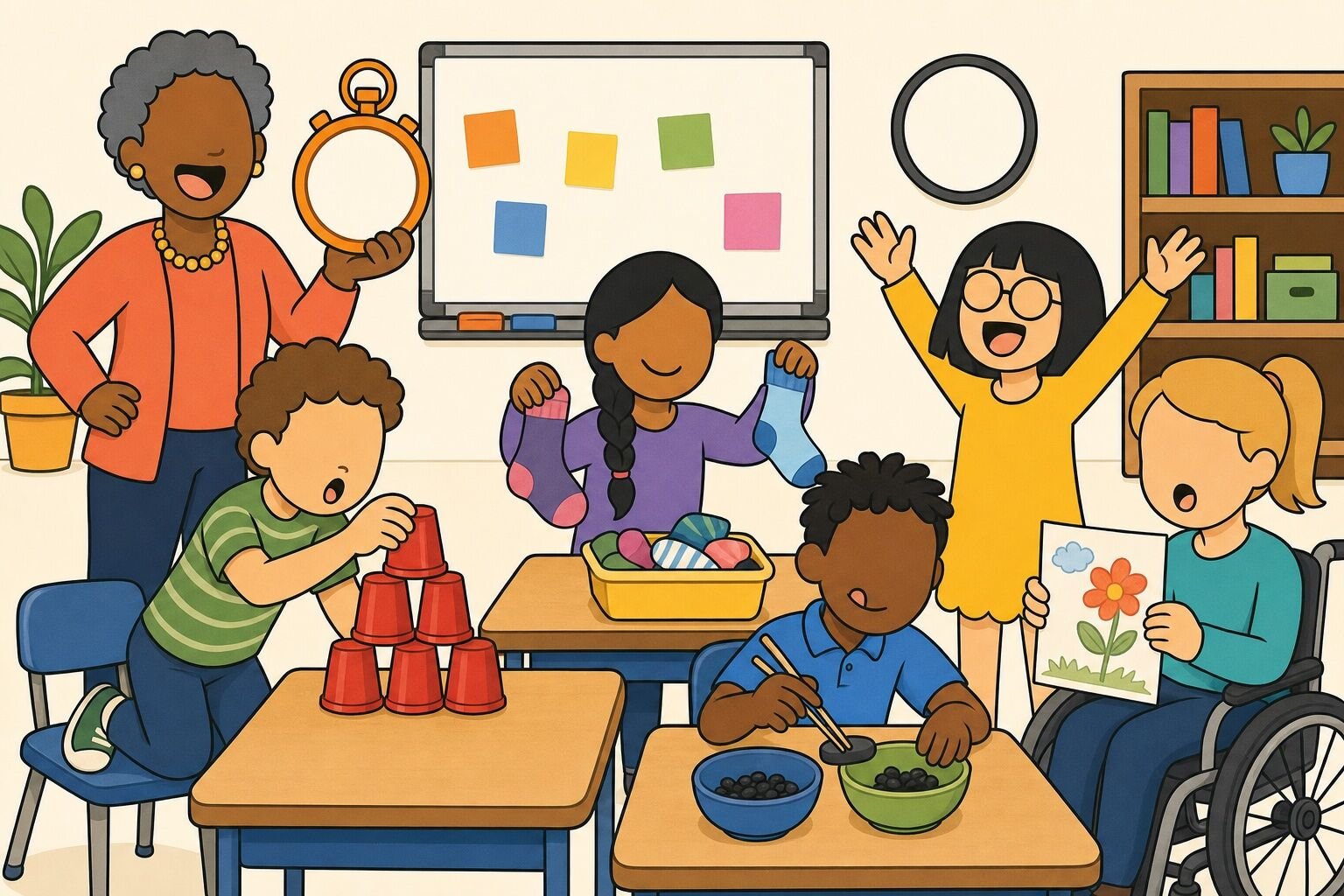
Give each player a drinking straw, a plate of small candies or paper dots, and an empty cup. In sixty seconds, they must move as many pieces as possible by picking them up with suction from the straw. Dropped pieces do not count and cannot be retrieved by hand.
Paper dots from a hole punch are the cheapest and most allergy-friendly version, and they work exactly as well as candy.
Best for: 4 to 30 players
Time: One minute per round
Materials (cost): Straws, cups, and paper dots (under $5)
Players use chopsticks to move dried beans, marbles, or cotton balls from one bowl to another in sixty seconds. Count what lands in the second bowl.
Scale the difficulty by changing the object: cotton balls for younger kids, dried beans for a middle level, and uncooked rice for anyone who wants to be humbled.
Best for: 4 to 30 players
Time: One minute per round
Materials (cost): Chopsticks, bowls, and dried beans (about $8)
Call out a prompt and give everyone one minute to draw it. Prompts that produce the best results are specific and slightly absurd: a dog driving a bus, our classroom in a hundred years, the worst possible sandwich.
Post every drawing on the wall afterward and vote on categories rather than picking a single winner. Most creative, most realistic, and most confusing all deserve a prize.
Best for: Any group size
Time: One minute to draw, two minutes to share
Materials (cost): Paper and markers (about $5)
Assign each table a run of five letters. In sixty seconds, the team must find or name one object in the room for every letter it was given. Objects have to be visible and pointed at, which keeps the game honest.
Rotate the letter sets between rounds so that a table that drew the easy stretch gets a harder one next.
Best for: 6 to 40 players
Time: One minute per round
Materials (cost): None (free)
Each player gets thirty-six plastic cups and sixty seconds to build a pyramid and then collapse it back into a single stack. Both halves of the task count, so the fastest builder does not automatically win.
For a team version, give one set of cups to a group of four and require that players take turns placing a single cup at a time.
Best for: 4 to 40 players
Time: One minute per round
Materials (cost): Plastic cups (about $5 per pack)
What we've learned: Running two rounds instead of one is the single easiest upgrade to any of these games. Scores jump on the second attempt, and that improvement is the part players talk about afterward.
Video calls swallow the things that make one minute games work in a room: the shared timer, the peripheral vision, the noise. The three below are built for the constraints of a grid rather than adapted to it. For longer virtual formats, see our lists of Zoom games and video call games.
The host asks a question and everyone types an answer into the chat without pressing enter. On the count of three, the whole group sends at once and a wall of answers cascades down the screen.
It works because everyone answers, not just the three people fastest to unmute. Good prompts are concrete: the best meal you ate this month, your first job, the app you check first in the morning.
Best for: 5 to 200+ people
Time: One minute per question
Materials (cost): Any video call platform (free)
What we've learned: Read two or three answers out loud afterward. Without that, the waterfall scrolls past and nobody feels heard, which defeats the point of getting everyone to answer.
One teammate has a minute to hold up an object within arm's reach and explain why it is on their desk. When the timer ends, they stop and nominate the next person for the following meeting.
The constraint is what makes it good. A minute is long enough for a real story and short enough that nobody prepares slides.
Best for: 3 to 40 people
Time: One minute per person
Materials (cost): Whatever is on the desk (free)
Send the group into breakout rooms of two with a single question on screen. After sixty seconds, pull everyone back and immediately send them out again into new pairs. Four rounds takes about six minutes and gets every participant talking four times.
Keep the question the same across rounds so nobody has to re-read instructions, and warn the group that the rooms will close abruptly.
Best for: 8 to 100+ people
Time: One minute per round
Materials (cost): A platform with breakout rooms (free)
What we've learned: Sixty seconds is the right length for a first pairing precisely because it is too short. People skip the small talk, and the abrupt ending leaves conversations unfinished, which is what makes teammates pick them back up later.
Every game on the list, with what it needs and who it suits.
| Activity | Best for | Group size | Time | Cost |
|---|---|---|---|---|
| Countdown to Sixty | Opening a session | 5–100+ | 2 min | Free |
| Categories Sprint | Quick thinking | 4–40 | 1 min per round | Free |
| Rock Paper Scissors Lightning Round | Big rooms and energy | 10–200+ | 2–3 min | Free |
| Count to Twenty | Listening and teamwork | 5–25 | 1–3 min | Free |
| Word Chain | Seated groups | 4–20 | 1 min per round | Free |
| Longest Word | Word game fans | 3–50 | 1 min per round | Free |
| Rapid Fire Questions | Getting to know teammates | 3–30 | 1 min per person | Free |
| Desk Scavenger Sprint | Energy and movement | 5–100+ | 1 min per clue | Free |
| Sticky Note Storm | Brainstorm warm-ups | 4–40 | 3–4 min | ~$10 |
| Sixty-Second Shout-Out | Recognition | 5–50 | 1 min | Free |
| Paper Airplane Sprint | Team coordination | 6–60 | 5 min for two rounds | Under $5 |
| Move It Up | Focus under pressure | 2–30 | 1 min per round | ~$5 |
| Face the Cookie | Laughs and photos | 2–30 | 1 min per round | ~$5 |
| Lonely Socks | Relay play | 2–40 | 1 min per round | Free–$10 |
| Thread the Needles | Quiet, steady hands | 2–20 | 1 min per round | ~$6 |
| Blow It Away | Head-to-head races | 4–30 | 1 min per round | ~$8 |
| Junk in the Trunk | Spectator laughs | 2–20 plus audience | 1 min per pair | ~$12 |
| Defying Gravity | Parties with space | 4–60 | 1 min per round | ~$5 |
| Gift Wrap Race | Birthdays and farewells | 6–50 | 1 min per round | ~$10 |
| Guess the Song | Mixed-age crowds | 6–100+ | 1 min per round | Free |
| Scoop It Up | Table-top competition | 2–30 | 1 min per round | ~$10 |
| The Sixty-Second Toast | Farewells and retirements | Any, 3–5 speakers | 1 min per speaker | Free |
| Suck It Up | Classrooms | 4–30 | 1 min per round | Under $5 |
| Chopstick Challenge | Kids and teens | 4–30 | 1 min per round | ~$8 |
| Sixty-Second Sketch | Creative groups | Any | 3 min | ~$5 |
| Alphabet Hunt | Table teams | 6–40 | 1 min per round | Free |
| Stack Attack | Classic stunt play | 4–40 | 1 min per round | ~$5 |
| Chat Waterfall | Large video calls | 5–200+ | 1 min per question | Free |
| Sixty-Second Show and Tell | Remote check-ins | 3–40 | 1 min per person | Free |
| Sixty-Second Breakouts | Virtual mixers | 8–100+ | 1 min per round | Free |
One minute rounds are the connective tissue of the events we host. They open sessions, reset the room between longer challenges, and give us a way to bring energy back up when a group has been thinking hard for twenty minutes. A few patterns hold up almost every time.
A minute of laughter is not time lost. In laboratory experiments at the University of Warwick, individuals given a happiness-inducing treatment such as a comedy clip were approximately 12% more productive on a paid task, as reported by Oswald, Proto and Sgroi in the Journal of Labor Economics. That is a lab result about effort rather than a promise about your quarterly numbers, but it is a reasonable answer to the manager who thinks sixty seconds of cookie-balancing is sixty seconds stolen from the agenda.
Group size changes the game more than the topic does. The median team building event we run has 16 participants, and half of all events fall between 10 and 27 people. That is the size these games were built for. Above it, the mechanics have to change or most of the room becomes an audience.
| Group size | What changes | Formats that work | Host tip |
|---|---|---|---|
| 5 to 15 people | Everyone can play individually and still be seen | Dexterity stunts, hot-seat questions, quiet fiddly games | Run more rounds with different game types so different people win |
| 16 to 40 people | One-at-a-time stunts stall; you need parallel play | Table teams, relays, simultaneous challenges, sticky note rounds | Split into teams of four to six before you explain the rules |
| 40+ people | Explaining and scoring take longer than the game | Whole-room games with one instruction, plus a finale stunt on stage | Demo the game instead of describing it, and appoint team scorekeepers |
Two rounds beat one. The first round is a rules explanation that happens to have a timer attached. The second round is the actual game, because now everyone knows what they are doing and has a score to beat. If you only have time for one game, run it twice rather than running two games once.
The timer has to be visible. A host counting down from memory produces arguments. A phone timer projected on a screen, or a big countdown on a laptop turned toward the room, produces a countdown chant in the last ten seconds, which is free energy.
Tiny prizes work better than real ones. A sticker, a paper crown, or naming rights to the office plant all outperform gift cards, because the moment a prize has real value, people start arguing about the rules. For larger rooms that need more structure than a prize can provide, our list of large group energizers covers formats built for scale.
Search for one minute games and you will find the same handful of ideas copied between sites, several of which we would never run in front of a paying client. Some are unhygienic, some are dull once the novelty wears off, and a few quietly exclude people. Here is what to skip.
| Activity | Why skip it | Verdict |
|---|---|---|
| Nose Drive | Players smear petroleum jelly on their noses to carry cotton balls between bowls. It is messy, unhygienic in a shared space, and asks adults to do something faintly humiliating in front of colleagues. | Skip it |
| Sticker Search | Players drink from a row of identical cups to find the one with a sticker underneath. Shared drinks are a hygiene problem and the mechanic borrows its structure from a drinking game. | Skip it |
| Mobile Tomato | Pushing groceries across a table with your nose wastes food and reads as a dare rather than a game. The dexterity challenge is better served by Scoop It Up. | Swap it |
| Marshmallow Munch | Eating contests exclude anyone with dietary restrictions, make a lot of people uncomfortable, and have no team building content at all. | Skip it |
| Edible Nut Stacking | Stacking hazelnuts is a fine physical challenge, but bringing loose nuts into a group setting is an avoidable allergy risk. Stack cups instead. | Skip it |
| Penny Hunt | Fishing coins out of a pair of tights takes more setup than the payoff justifies, and the prop makes the whole thing strange in a workplace. | Skip it |
| Toothpick Word Spelling | Laying out words in toothpicks is slow, invisible from more than three feet away, and boring to watch. Longest Word tests the same skill with more energy. | Swap it |
| Any blindfolded race | Blindfolds plus a sixty-second timer plus office furniture is how people get hurt. If you want a trust exercise, run one with a proper brief rather than a countdown. Our icebreaker games list has safer options. | Skip it |
The best thing about one minute games is that they are almost impossible to get wrong. A game that flops takes sixty seconds and everyone moves on. A game that lands gives a team a shared reference that outlives the meeting it interrupted, which is a strange return on a minute of cups and balloons.
Pick three from this list, keep the supplies in a drawer, and run one whenever a meeting ends early or a room needs waking up. That drawer will do more for a team's mood over a year than most of the things that get scheduled.
Next, check out our lists of indoor group games, large group icebreakers, and fun games to play with friends and coworkers.
Answers to the questions we get asked most often about sixty-second games.
One minute games are short challenges that players must complete, or score as highly as possible in, within sixty seconds. Examples include stacking plastic cups, matching pairs of socks from a pile, and naming as many items in a category as possible before the buzzer. The rules are simple enough to explain in a sentence, and the clock does the work of creating pressure, laughter and a clear winner.
Countdown to Sixty, Categories Sprint, a Rock Paper Scissors lightning round, Count to Twenty, Word Chain and Longest Word all need nothing but a timer and a group. These are the ones worth memorizing, because you will reach for them when a meeting ends early or the supplies you ordered do not arrive.
Two or three games is usually the right number for a meeting, and five or six for a party segment. We would rather run one game twice than two games once: the first round is really a rules explanation with a timer attached, and the second round is when the group actually competes and scores jump.
They do, but the mechanics have to change. The median team building event we run has 16 participants, and half fall between 10 and 27 people, which is the size most of these games are built for. Past about 40 people, drop the one-at-a-time stunts and use games the whole room plays simultaneously, such as Chat Waterfall, Categories Sprint or a Rock Paper Scissors lightning round, with a single stunt saved for a finale.
Minute to Win It is a television format built on physical stunts with household props, played one contestant at a time while everyone else watches. One minute games are broader: the category includes those stunts, but also word games, memory rounds, question games and appreciation rounds that the whole group plays at once. Many games belong to both lists.
Suck It Up, the Chopstick Challenge, Sixty-Second Sketch, Alphabet Hunt and Stack Attack all scale to a full class with one set of supplies per table, and each costs under ten dollars to equip. Paper dots from a hole punch are a cheaper and more allergy-friendly substitute for candy in any transfer game.
Comments (0)
Leave a Comment