
30 Indoor Group Games for Adults (Party, Office & At Home)
Thirty indoor group games for adults, each with step-by-step rules, a group size, a time and a real materials cost, from a team that has hosted 45,000+ events.
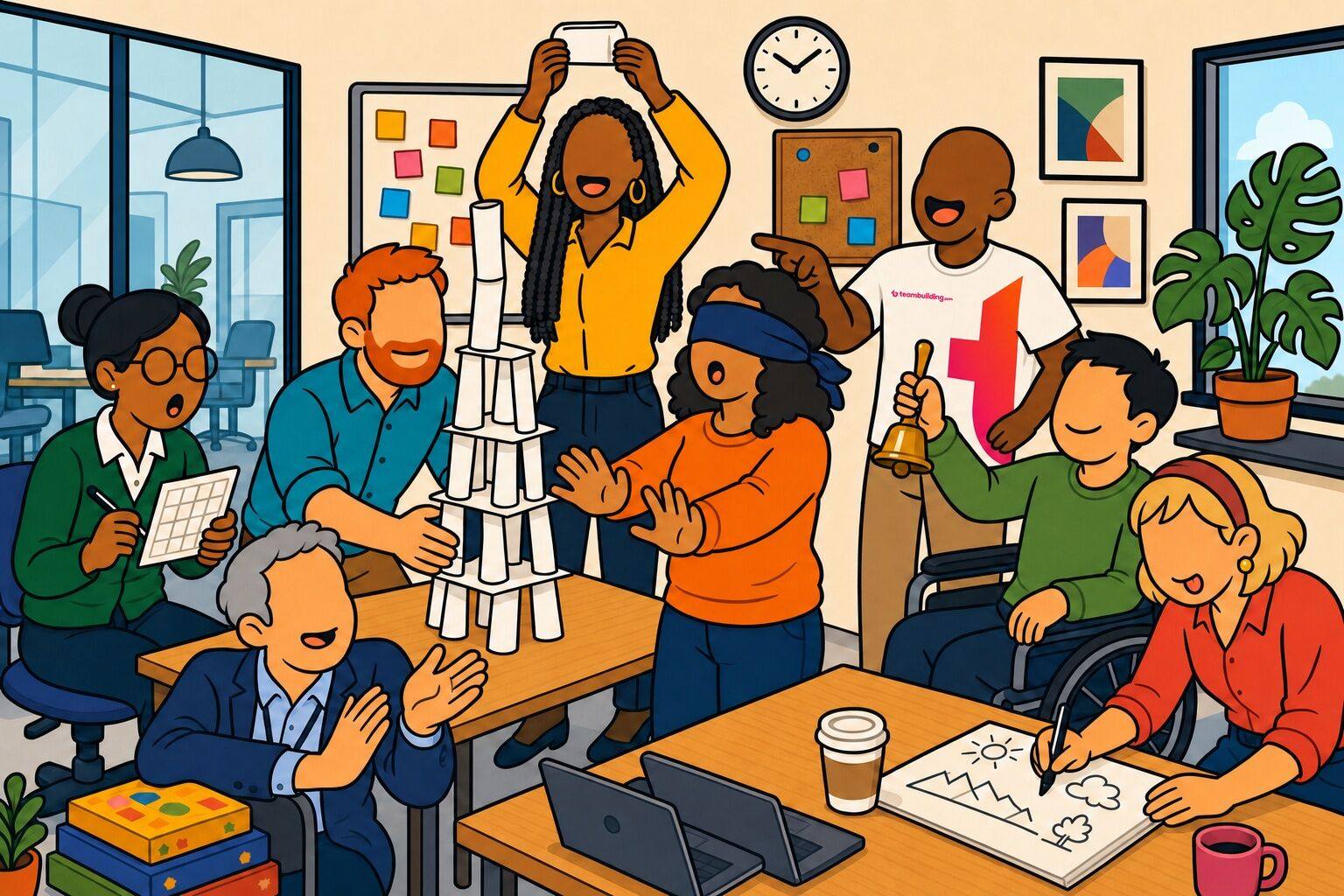
Thirty indoor group games for adults, each with step-by-step rules, a group size, a time and a real materials cost, from a team that has hosted 45,000+ events.
Some of the best team moments we have seen did not happen on a ropes course or a rooftop. They happened in a conference room with the chairs pushed back, a stack of printer paper on the table, and twenty minutes on the clock.
We run indoor games for a living. As of September 2026, teambuilding.com has hosted 45,000+ Originals events for 1,000,000+ participants, earning 83,000+ reviews with an average rating of 4.96 out of 5 across Google and our verified ratings platform. A good share of those events happen inside offices, hotel ballrooms, and breakout rooms, which means our hosts have watched the same games land, flop, and land again across thousands of rooms.
This guide is the result. Every game below is one we would actually run, with real instructions, a group size, a time, and a materials list you can price out before you commit.
Indoor group games are structured activities that a group of adults can play inside a normal room, using furniture, paper, phones, or nothing at all. Examples include charades tournaments, trivia rounds, blindfold obstacle courses, and circle games like Mail Call. The point is to get people talking, laughing, and solving something together without needing a field, a bus, or good weather. They are also called indoor group activities, indoor games for adults, inside games, and parlor games.
Indoor group games are the indoor branch of team building games and sit inside the wider category of indoor team building. They are similar to large group games, party games for work, and office games, and the weather-permitting version is outdoor group games. Within the category, this guide covers indoor party games for adults, parlor games, indoor games for large groups, games for the office, games to play at home with friends, and quick games that need no supplies. Planners usually reach for these lists while building fun office activities, an office party agenda, or a broader set of group activities for adults.
This list includes:
Here we go!
Thirty games, sorted by what they are good at. Costs assume you already own a printer and a phone, which is usually the difference between a free game and a $30 game.
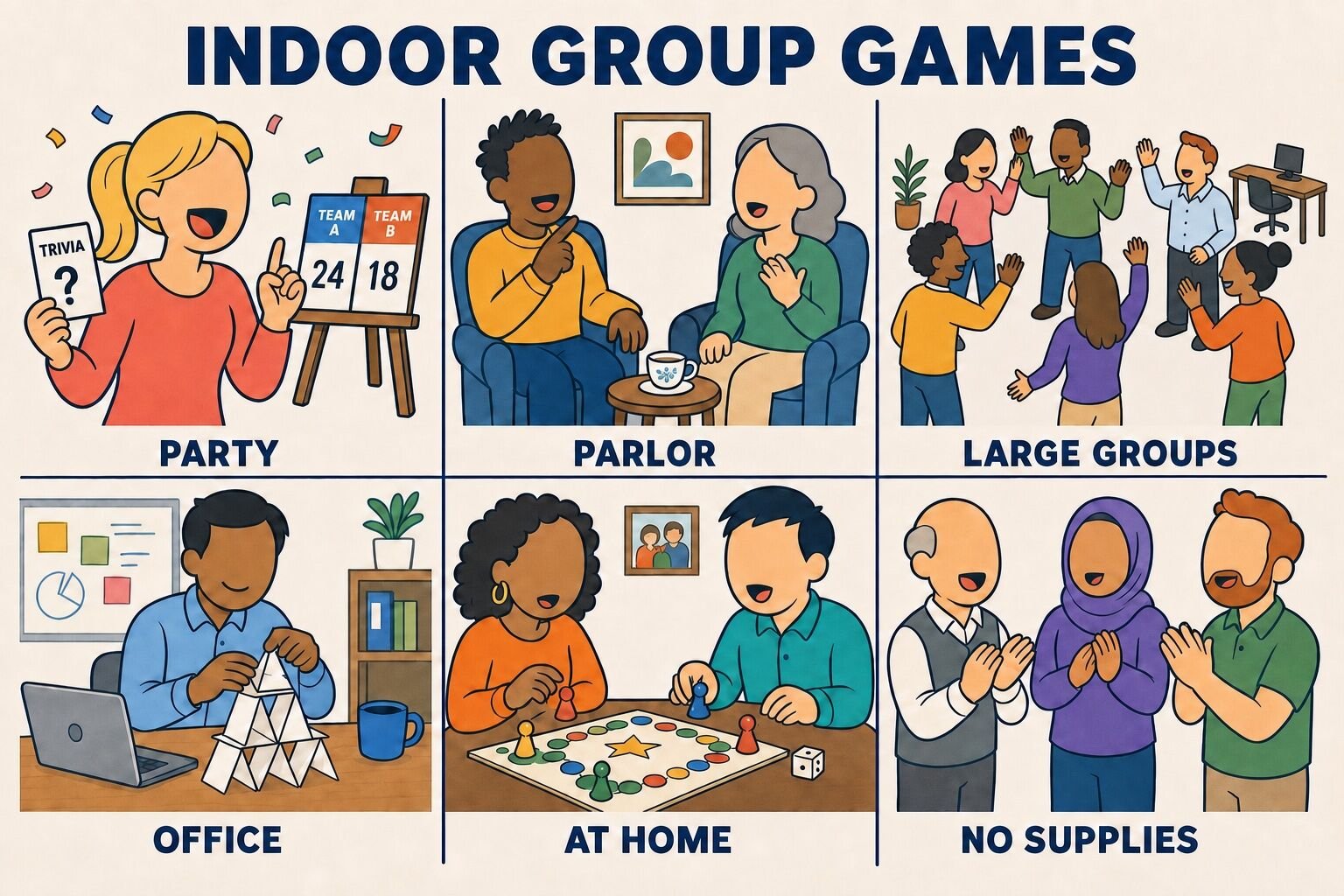
| Game | Best for | Group size | Time | Cost |
|---|---|---|---|---|
| Team Trivia Showdown | Friendly competition | 8–100+ | 30–45 min | Free |
| Charades Tournament | Laughing out loud | 8–40 | 20–40 min | Free |
| Werewolf | Social deduction | 8–20 | 30–60 min | Free–$15 |
| Camera Hot Potato | Breaking the ice fast | 6–20 | 10 min | Free |
| Straight Face | Pure silliness | 6–20 | 15–20 min | Free |
| Blind Taste Test | Party energy | 6–40 | 20–30 min | $20–$60 |
| Wink Murder | Suspense and theatrics | 8–30 | 15–25 min | Free |
| Celebrity | A full game night centerpiece | 8–24 | 30–45 min | Free |
| Twenty Questions | Filling an awkward gap | 3–20 | 5–15 min | Free |
| Consequences | Creative writing and reveals | 6–30 | 15–20 min | Free |
| Mail Call | Mixing a seated group | 10–40 | 10–15 min | Free |
| Human Snakes | Trust and coordination | 12–60 | 20–30 min | Free–$20 |
| Rock Paper Scissors Tournament | Instant energy at scale | 15–200+ | 10 min | Free |
| Lightning Scavenger Hunt | Waking up a tired room | 10–100+ | 10–20 min | Free |
| Office Bingo | A game that runs in the background | 10–100+ | All day | Free |
| Office Scavenger Hunt | Getting people off their chairs | 6–40 | 20–30 min | Free |
| Paper Tower | Problem-solving under pressure | 8–40 | 10–15 min | Free |
| Minefield | Communication and trust | 6–30 | 20–30 min | Free–$20 |
| Pancakes vs Waffles | Debate and decision-making | 5–30 | 15–30 min | Free |
| Board Game Tournament | A long, relaxed evening | 8–32 | 60–120 min | $0–$150 |
| Tabletop Escape Room | Puzzle-solving in teams | 4–24 | 60–90 min | $25–$40 per box |
| Survey Says | Big laughs with mixed ages | 8–40 | 20–30 min | Free |
| Blind Drawing Duos | Exposing communication gaps | 4–30 | 15–20 min | Free |
| Broken Telephone | A five-minute laugh | 8–40 | 5–10 min | Free |
| One-Word Story | Creative warmups | 5–25 | 5–10 min | Free |
| Zip Zap Zop | Post-lunch energy | 6–30 | 5–10 min | Free |
| Count to Twenty | Focus and group awareness | 5–30 | 5–10 min | Free |
| This or That Lightning Round | Seated icebreaking | 5–100+ | 10–15 min | Free |
| Six Word Memoirs | Quiet, meaningful sharing | 4–30 | 15–25 min | Free |
| Hot Seat | Getting to know one teammate well | 5–20 | 10–20 min | Free |
Party games need to work while people are holding a drink and half-listening. That rules out anything with long rules, and it favors games where latecomers can join mid-round without ruining anything.
Trivia is the most reliable indoor party game we know, because everyone knows how to play and nobody has to perform. The upgrade is playing in teams instead of solo, so the quiet folks contribute answers through the group rather than in front of the room.
How to run it:
Need questions? Pull them from our trivia games guide, or generate a fresh set:
Best for: Friendly competition
Time: 30–45 minutes
Materials (cost): Question list, scrap paper, whiteboard (free)
What we've learned: Keep the standings visible and keep the gap small. A final wager round means the team in last place can still win, and that single rule does more for engagement than any question you could write.
Charades struggles on video calls because a camera frame crops out most of the body language. In a room, it is one of the best games there is. A tournament format keeps it moving.
How to play:
Use this generator for prompts so nobody has to write a list:
Best for: Laughing out loud
Time: 20–40 minutes
Materials (cost): Prompt list or generator, timer (free)
Werewolf is a social deduction game where a hidden pair of werewolves eliminates one villager each night, and the villagers argue their way toward voting the werewolves out during the day. It is loud, it is dramatic, and it makes coworkers accuse each other of lying for an hour.
Setup and play:
Best for: Social deduction
Time: 30–60 minutes
Materials (cost): A deck of cards or a $15 role-card set (free–$15)
What we've learned: The moderator makes or breaks this one. Give the role to someone theatrical who will narrate the deaths with flair, and cap debate at three minutes per day phase so the game does not stall in analysis.
A fast, silly opener that needs one phone and produces a photo album nobody will forget.
Best for: Breaking the ice fast
Time: 10 minutes
Materials (cost): One smartphone (free)
Players write absurd phrases, then take turns reading them aloud while trying not to laugh. It is the rare game that gets funnier as people get worse at it.
Best for: Pure silliness
Time: 15–20 minutes
Materials (cost): Paper, pens, a hat or bowl (free)
A tasting game turns snacks into a competition. It works especially well at an office party because it gives people something to do with the food that is already in the room.
Best for: Party energy
Time: 20–30 minutes
Materials (cost): Snacks, numbered cups, scorecards ($20–$60)
What we've learned: Ask about allergies and dietary restrictions before you shop, not while you are pouring. One unlabeled peanut item can turn a fun game into a serious problem, and a quick message to the group a day earlier solves it.
Parlor games are the old-fashioned living-room games that need nothing but people, a room, and a rule everyone agrees to. They predate boards and screens, and they still hold up. These four are the ones we see actually work with grown adults.
One player is secretly the murderer and eliminates others with a wink, while the group tries to catch them in the act. It is the simplest possible social deduction game, and it works in a room where a full murder mystery party kit would be overkill.
Best for: Suspense and theatrics
Time: 15–25 minutes
Materials (cost): None (free)
Celebrity, sometimes called Fishbowl, is three games stacked on one set of names, and it is the best hour of party gaming you can build from scrap paper.
Best for: A full game night centerpiece
Time: 30–45 minutes
Materials (cost): Paper, pens, a bowl, a timer (free)
What we've learned: Set the naming rule up front or half the slips will be unguessable. We ask for names that at least three people in the room would recognize, which keeps the deep-cut obscure picks out of the bowl.
Twenty Questions earns its place because it needs zero setup and fills any gap: a delayed start, a slow elevator, or the ten minutes before lunch arrives.
Best for: Filling an awkward gap
Time: 5–15 minutes
Materials (cost): None (free)
Consequences is a folded-paper storytelling game. Each player writes one line of a story, folds the paper to hide it, and passes it on. The reveal is the whole payoff.
Best for: Creative writing and reveals
Time: 15–20 minutes
Materials (cost): Paper and pens (free)
Big rooms break most games. A format that charms twelve people can leave sixty standing around waiting for a turn. These four scale because everyone plays at once, or because turns are measured in seconds. For more options at this size, see our large group energizers.
Mail Call is musical chairs with a get-to-know-you twist, and it reshuffles a seated group without anyone having to volunteer.
Best for: Mixing a seated group
Time: 10–15 minutes
Materials (cost): One chair per player, minus one (free)
What we've learned: Give the first caller three example descriptors to choose from. Left to improvise in front of forty people, most people freeze, and one awkward first round can sink the whole game.
Teams line up, hands on the shoulders of the person ahead, everyone blindfolded except the player at the back. That last player steers the whole line through a course using taps.
Best for: Trust and coordination
Time: 20–30 minutes
Materials (cost): Blindfolds or bandanas, obstacles (free–$20)
Also called Evolution or Rock Paper Scissors Cheer, this is the fastest way we know to get 200 people playing one game together.
Best for: Instant energy at scale
Time: 10 minutes
Materials (cost): None (free)
What we've learned: This is our go-to opener for a room that walked in cold. It takes under a minute to explain, nobody can be eliminated out of the fun, and by the final match a room of strangers is chanting one person's name.
A host calls out a prompt, and everyone races to bring back a matching object from the room or their bag. We designed this format for our own events, and it is the one we reach for when a group's energy is flagging. Our lightning scavenger hunt guide has full prompt lists.
Best for: Waking up a tired room
Time: 10–20 minutes
Materials (cost): A prompt list (free)
What we've learned: The interpretive prompts beat the literal ones every time. "Something red" gets you ten red pens. "The most sentimental thing you own right now" gets you a story, and the story is the actual team building.
Office games have an extra constraint: they have to fit in a workday and survive the fact that attendance is at least partly mandatory. The five below run inside a meeting slot, need almost nothing, and do not force anyone to perform alone. If you would rather hand out something on paper, we have printable team building activities too.
Office Bingo runs quietly in the background of a normal workday. Everyone gets a card of common office moments and marks them off as they happen.
Best for: A game that runs in the background
Time: All day
Materials (cost): Printed cards (free)
A scavenger hunt turns a familiar office into a search grid, and it gets people out of their chairs and into parts of the building they normally ignore.
Our office scavenger hunt templates and indoor scavenger hunt lists have ready-made item lists.
Best for: Getting people off their chairs
Time: 20–30 minutes
Materials (cost): An item list and phones (free)
Teams get 20 sheets of paper and five minutes to build the tallest freestanding tower they can. No tape, no glue, no scissors. It is the cleanest problem-solving game we know, and it costs nothing.
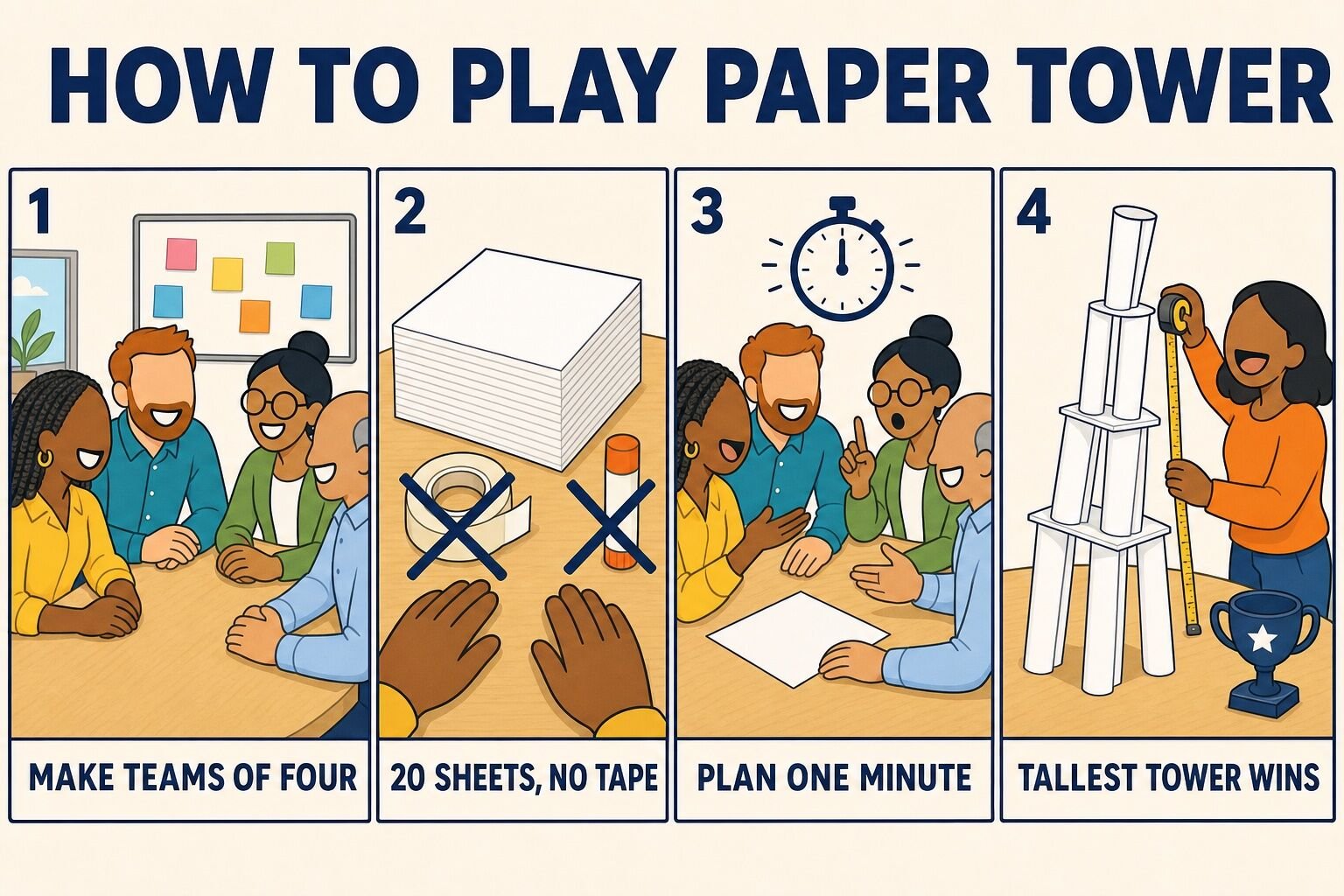
Best for: Problem-solving under pressure
Time: 10–15 minutes
Materials (cost): 20 sheets of paper per team (free)
What we've learned: Group challenges get chaotic if everybody starts acting immediately. The teams that win almost always pause first, settle on a structure, and assign who folds and who stacks before touching the paper. The mandatory planning minute exists to make that lesson visible.
One partner is blindfolded, the other guides them through a floor scattered with obstacles using only their voice. Minefield is a staple of communication games for a reason: the failure modes are hilarious and instructive.
Best for: Communication and trust
Time: 20–30 minutes
Materials (cost): Blindfolds and soft obstacles (free–$20)
What we've learned: Run several pairs at once rather than one at a time. With a single pair the room goes quiet and watches, which is far more nerve-wracking for the blindfolded player than the obstacles are.
The group has to eliminate one of two options and reach consensus, over and over. Start with pancakes versus waffles, then take the winner against a new challenger.
Best for: Debate and decision-making
Time: 15–30 minutes
Materials (cost): None (free)
What we've learned: Inconsequential topics are better than serious ones for debate games. People can argue about waffles with ridiculous conviction without dragging politics or an actual workplace disagreement into the room.
At home the constraints flip. You have more time and a kitchen, but fewer people and no whiteboard. These four are built for a living room with six to twelve adults in it.
A bracket turns a pile of board games into an evening with a shape. The trick is picking games that finish fast.
Our team building board games and office game night guides have more picks.
Best for: A long, relaxed evening
Time: 60–120 minutes
Materials (cost): Three to four board games ($0–$150 if you buy them)
Boxed escape room kits give a group an hour of genuine puzzle-solving for the price of a couple of pizzas, and they play at a kitchen table.
Best for: Puzzle-solving in teams
Time: 60–90 minutes
Materials (cost): One kit per team ($25–$40)
What we've learned: Puzzles plus a team scoreboard is a combination participants call out by name. Here is how one guest described the same mechanic in our hosted 1920s mystery event:
A homemade version of the classic survey game show. The prep is a few polls, and the payoff is a room shouting answers at each other.
Best for: Big laughs with mixed ages
Time: 20–30 minutes
Materials (cost): A free survey tool and index cards (free)
One partner describes an image they can see, the other draws it without looking. The gap between the two is the entire point.
Best for: Exposing communication gaps
Time: 15–20 minutes
Materials (cost): Paper and pens (free)
What we've learned: Blind drawing is much harder than it sounds, because people describe what they already know the image looks like instead of what the listener actually needs to hear. That is exactly the communication gap the game exists to expose, and the second round with questions allowed usually makes the lesson land.
Every one of these takes under ten minutes and needs nothing but the people already in the room. They are what we run when a session starts late or a meeting ends early. If you have a few more minutes, our minute to win it games fill the same slot with props.
A sentence goes around the room one whisper at a time and comes out the other end unrecognizable.
Best for: A five-minute laugh
Time: 5–10 minutes
Materials (cost): None (free)
The group builds a story together, one word per person, and the sillier it gets the better it works.
Best for: Creative warmups
Time: 5–10 minutes
Materials (cost): None (free)
A rhythm and focus game borrowed from theater warmups. It is one of the best improv games for waking up a post-lunch room.
Best for: Post-lunch energy
Time: 5–10 minutes
Materials (cost): None (free)
The group counts to twenty out loud, with no order and no plan. If two people speak at once, it starts over. It sounds trivial and it is genuinely hard.
Best for: Focus and group awareness
Time: 5–10 minutes
Materials (cost): None (free)
What we've learned: Resist the urge to let the group strategize. Teams that agree on an order finish in 30 seconds and learn nothing. The value is entirely in the listening that happens when nobody is allowed to organize.
Not every group can or wants to move around. Seated games matter for long meetings, mixed-mobility groups, and rooms where the furniture cannot be moved. These three work entirely from a chair.
Rapid-fire binary choices, answered by raised hands or by leaning left and right. It is the fastest seated icebreaker we run.
Best for: Seated icebreaking
Time: 10–15 minutes
Materials (cost): A prompt list (free)
What we've learned: The follow-up question is where the value is. The vote itself takes four seconds, and asking one person in the smaller group to defend their answer is what turns a poll into a conversation.
Everyone writes their life, their week, or their current project in exactly six words. It is the quietest game on this list and often the most memorable, which is why it shows up in our connection games guide too.
Best for: Quiet, meaningful sharing
Time: 15–25 minutes
Materials (cost): Paper and pens (free)
One person takes questions from the group for two minutes. Done carelessly it is an interrogation, so we run a green-light version where the questions are pre-approved and the player can pass.
Best for: Getting to know one teammate well
Time: 10–20 minutes
Materials (cost): A question list (free)
What we've learned: When we train hosts, we emphasize green-light prompts, meaning prompts that are unlikely to make anyone uncomfortable, plus a mechanic that adds a layer of consent. The free pass is that mechanic here. It means nobody has to publicly decline to participate.
A few patterns show up again and again across the events our hosts run.
Fun is not the opposite of productive. In laboratory experiments at the University of Warwick, Oswald, Proto and Sgroi found that people given a happiness-inducing treatment, such as a short comedy clip, were approximately 12% more productive on a paid piece-rate task. Effort rose without any drop in quality. That is a lab result rather than a promise about your quarter, but it is a reasonable answer to the manager who calls a game a waste of an hour.
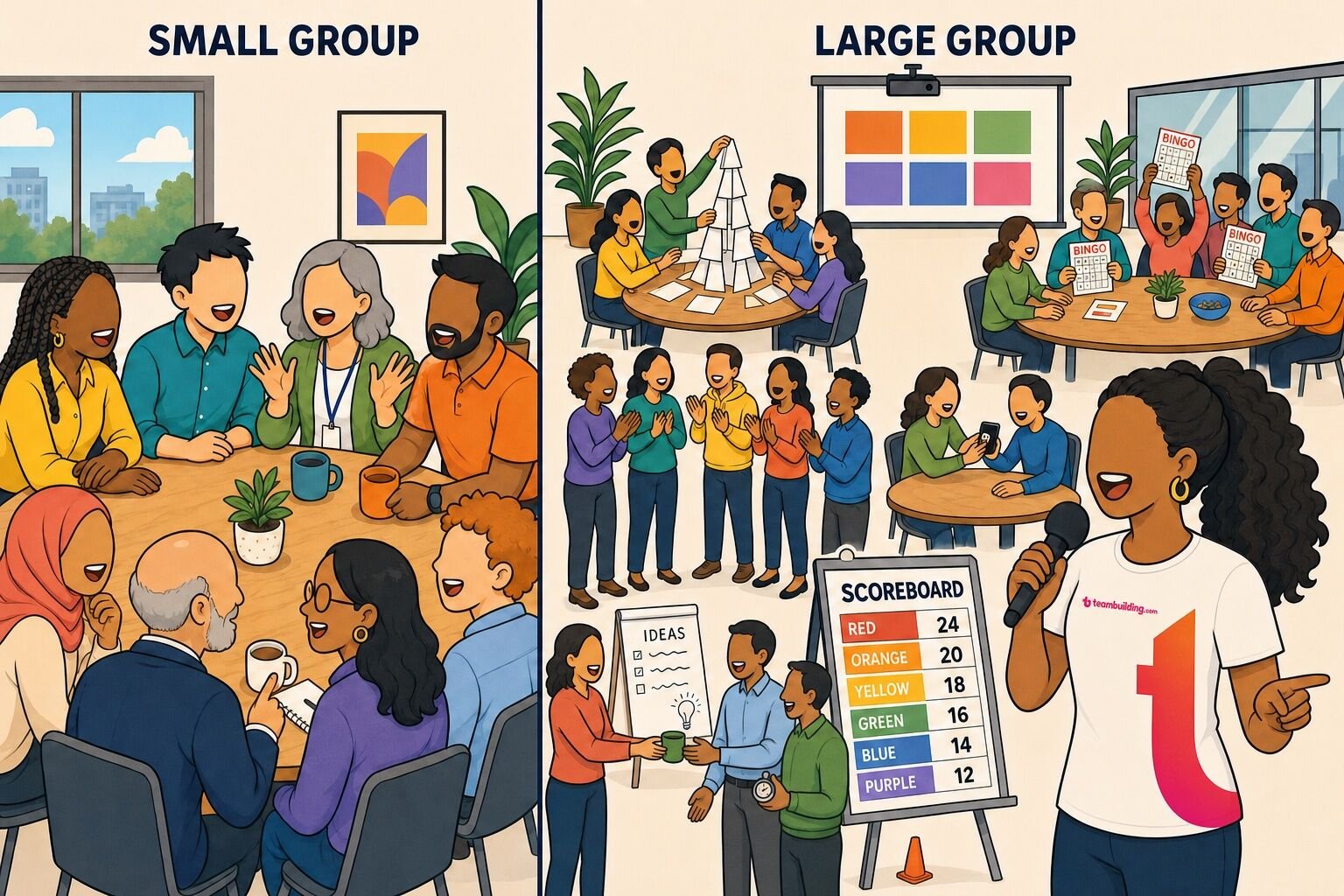
Group size changes the game more than the room does. The median team building event on our platform has 16 participants, and half of all events fall between 10 and 27 people. Games written for that range often break at 60 and feel thin at 6, so we pick the mechanic to fit the headcount first and the theme second.
| Factor | Small groups (under 15) | Large groups (15+) |
|---|---|---|
| Best mechanic | Conversation games where every person speaks | Simultaneous play or team relays, so nobody waits for a turn |
| Turn structure | Many short rounds, everyone in the same circle | Fewer, longer rounds inside breakout teams of four to six |
| Facilitation | One person can run it while playing | A dedicated host plus a timekeeper, and visible scoring |
| Rules | Can be explained as you go | Must be explained once, in under 60 seconds, before anything starts |
| Our picks | Six Word Memoirs, Blind Drawing Duos, Twenty Questions | Rock Paper Scissors Tournament, Lightning Scavenger Hunt, Team Trivia Showdown |
For more at either end of that range, see our small group games and large group activities lists.
Scoring is the cheapest upgrade available. When we mine our reviews for what participants actually loved, competition comes up again and again: points, buzzers, leaderboards, and team names. Adding a visible scoreboard to a game you were going to play anyway costs nothing and changes the room. Our competitive team building games guide leans into this.
Book the room before you plan the game. In-person events on our platform peak on Tuesdays, and rooms that hold 30 people get claimed early in the week. Locking the space first saves you from redesigning a floor game for a room with a fixed conference table in the middle.
Not every game needs to be new. Groups do not mind repeats nearly as much as facilitators assume. Running the same trivia format monthly with fresh questions builds a small ritual, and the second time around the rules explanation takes 15 seconds instead of two minutes.
If you would rather have a trained host run the whole thing, you can browse in-person team building activities.
We have tried plenty of games that read well on a list and land badly in a room. Here are the ones we have retired, and why.
| Activity | Why skip it | Verdict |
|---|---|---|
| Never Have I Ever | The game is built on personal disclosures and is traditionally tied to drinking, which is a poor fit for most workplace groups. The workplace-safe version is so watered down it stops being interesting. | Skip it |
| Two Truths and a Lie | Fine as a quick icebreaker game for six people, but it is heavily overused and grinds to a halt once every person in a group of 30 needs a turn. | Usually skip |
| Most Likely To | Pointing at colleagues to label them is a social risk with no upside, and the funny prompts are exactly the ones that sting. | Skip it |
| Fort building with cardboard and sheets | An hour of setup and cleanup for about ten minutes of actual play, and most offices do not have the materials or the floor space. | Not worth the prep |
| Mr. Freeze and other all-day background pranks | Games that interrupt people at their desks annoy whoever is actually trying to work, and the people not playing become collateral. | Skip it |
| Musical chairs | Physical scrambling for seats excludes anyone with mobility limits and has an injury risk that is not worth a five-minute game. Mail Call gets the same mixing effect at a walking pace. | Play Mail Call instead |
| Trust falls | Catching a falling adult is a liability, and the exercise asks for physical trust that most coworkers have not agreed to give. Minefield builds trust without anyone leaving their feet. | Skip it |
| Unstructured "mingle and chat" hours | With no game and no host, people talk to the three colleagues they already know, which is the opposite of what the hour was for. | Add structure |
| Long personality-test workshops | An hour of quizzes produces four-letter labels and very little shared experience. Save the assessment for a training day with a facilitator. | Not a game |
The best indoor group games are not the most elaborate ones. They are the ones you can explain in under a minute, run with what is already in the room, and repeat next month without anybody groaning. Pick two from this list, one loud and one quiet, and you have a session.
Start small. Add a five-minute game to a meeting you already have on the calendar, watch what the room does with it, and build from there.
Next, check out our guides to team building activities, team bonding ideas, and whiteboard games.
Common questions about running indoor games with groups of adults.
The best indoor group games for adults are the ones you can explain in under a minute and run with what is already in the room. Our picks are Team Trivia Showdown for friendly competition, Celebrity for a full game night, Paper Tower for problem-solving, and Rock Paper Scissors Tournament when you need to energize a big room in ten minutes.
Games where everyone plays at once, or where turns last seconds rather than minutes. Rock Paper Scissors Tournament scales past 200 people, Lightning Scavenger Hunt works at 100+, and Mail Call mixes a seated group of 40. Above roughly 15 people, plan on breakout teams of four to six, a dedicated host, and visible scoring.
Broken Telephone, One-Word Story, Zip Zap Zop, Count to Twenty, Twenty Questions and Pancakes vs Waffles all run with nothing but the people in the room. Each one fits in a 5 to 15 minute window, which makes them useful when a meeting ends early.
Plan for 10 to 20 minutes per game inside a meeting and 30 to 60 minutes for a session built around games. Rules explanations should take under 60 seconds. If a game needs longer than that to explain, it will lose a large room before it starts.
Parlor games are traditional drawing-room games that need no equipment beyond people and an agreed set of rules. Classic examples that still work with adults include Wink Murder, Celebrity, Twenty Questions and Consequences.
Avoid Never Have I Ever and Most Likely To, which rely on personal disclosure or labeling colleagues in public. Skip musical chairs and trust falls, which carry injury risk and exclude anyone with mobility limits. Two Truths and a Lie is fine for six people but stalls once 30 people each need a turn.
Comments (0)
Leave a Comment