27 Team Bonding Activities, Games & Events That Bring Teams Closer
27 team bonding activities that actually build relationships — quick bonding games with real instructions, low-cost ideas for work, corporate team bonding activities, everyday bonding exercises, and hosted events ranked by real survey data.
Published
·
Updated
You found our list of fun team bonding activities for work. Team building teaches a group to work together; team bonding makes them actually like working together — and it is the half most offices skip. We plan connection for a living: teambuilding.com has run 45,000+ team building events across virtual and in-person formats since 2013 (as of August 2026), for teams at Google, Amazon, Microsoft, and 40+ other major companies.
This guide collects 27 team bonding ideas that actually build relationships: quick bonding games with real instructions, low-cost ideas for work, corporate team bonding activities for bigger milestones, everyday bonding exercises, and hosted events ranked by real survey data — plus what thousands of post-event surveys tell us about which of these work.
Team bonding is the process of coworkers forming personal connections by spending relaxed, non-work time together — sharing meals, playing games, swapping stories, and celebrating wins. The purpose of team bonding is camaraderie and trust: colleagues who know each other as people communicate more honestly and back each other up under pressure. These ideas are also called "employee bonding activities," "group bonding activities," and "bonding ideas for teams."
Team bonding and team building overlap, but they aim at different outcomes. Team building activities develop how a group works — communication, problem solving, collaboration under a clock. Team bonding develops whether the group likes working together — the friendships and inside jokes that make the collaboration feel easy. A rope course is team building; the pizza afterward, where everyone relives the wobbly bridge, is team bonding. Strong teams schedule both.
The relationship half is not the soft half. In a meta-analysis of 148 studies covering 308,849 participants, Holt-Lunstad, Smith and Layton found that people with stronger social relationships had a 50% greater likelihood of survival over the study periods — an effect the authors rank above obesity and physical inactivity. Most adults spend the bulk of their waking hours with coworkers, which makes the workplace one of the biggest social environments in our lives — worth investing in on purpose.
Best team bonding events, ranked by real survey data
Sometimes the strongest bonding move is to stop being the event planner and join your own team. A professional host runs the energy, the rules, and the shy-person problem, and you get to laugh with everyone else. We rank our own hosted events with the Team Building Score, which combines confirmed bookings, verified reviews, ratings, and post-event survey outcomes. Here are the current top team bonding events by that score:
Ranked by our Team Building Score — a running points total earned through confirmed bookings, verified reviews, ratings, and listing quality, recalculated nightly. Every event shown also has at least 30 post-event survey responses per question; the happier, connected, and NPS columns are computed from the 5,605+ survey responses collected for the 10 events listed here — a subset of all post-event surveys across our catalog. Updated October 2026.
Ultimate Game Show packs three fast game-show formats into 90 hosted minutes — Family Feud-style surveys, price-guessing showdowns, and rapid trivia — with your coworkers as the contestants. The survey rounds are the bonding engine: half the fun is discovering what your own team actually answered. It is one of our highest-scoring events of any kind, with 2,600+ reviews averaging 4.97 / 5 as of August 2026.
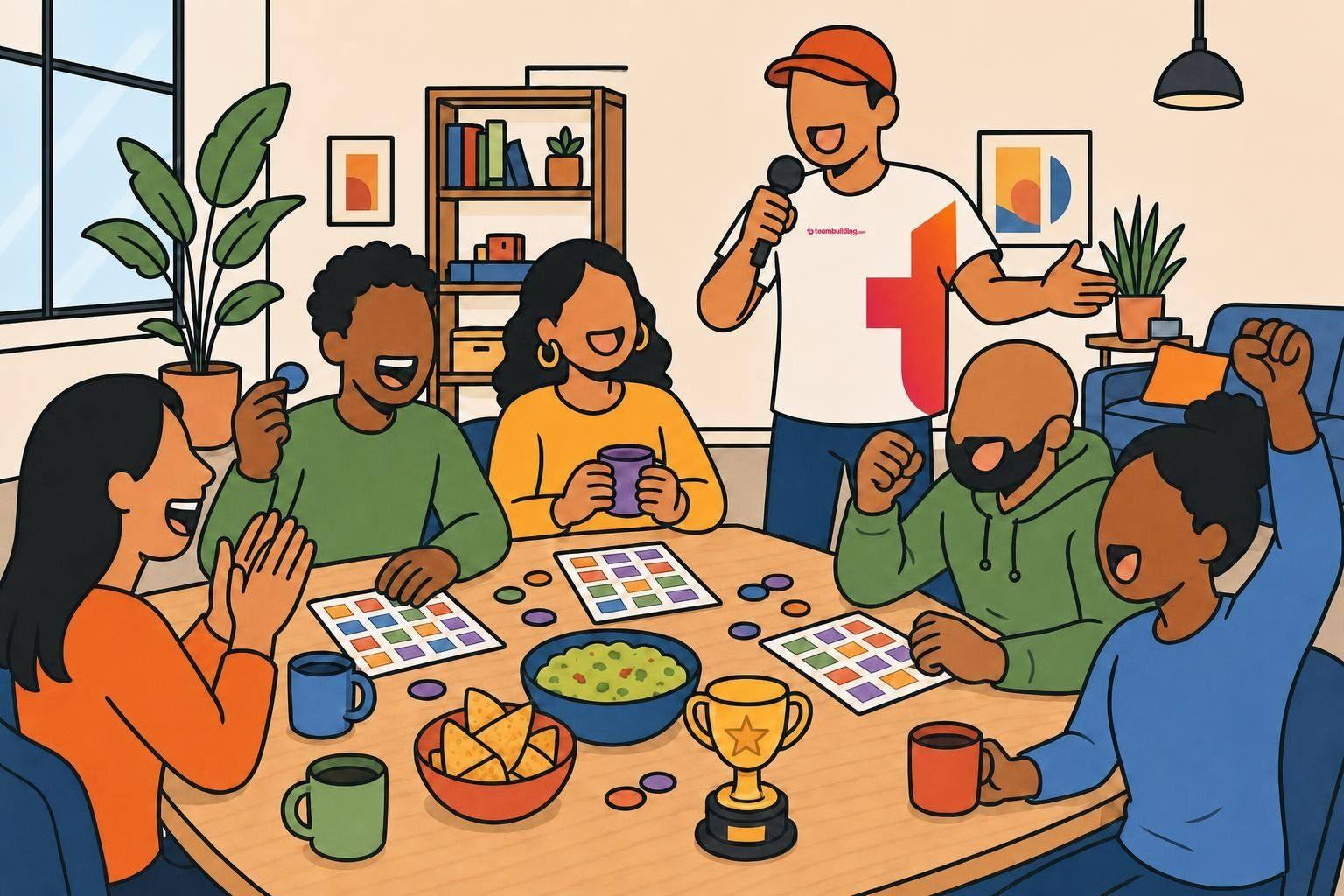
The Great Guac Off™ is our flagship in-person bonding event: teams race through guacamole trivia, avocado games, and a fiercely judged guac-making competition, then eat their contest entries together. Food, competition, and a shared table in one event — the three most reliable bonding ingredients we know. Hosts bring everything to your office or venue.
Virtual Mix n' Mingle is the event we built specifically for connection: a host rotates your group through quick small-group rounds of conversation games, prompts, and challenges, so everyone talks with teammates they never normally meet. It is the closest thing to a facilitated version of watercooler serendipity, and it works especially well for onboarding cohorts and distributed teams.
Team bonding games give coworkers a reason to talk that is not the quarterly roadmap. Every game here runs on ordinary office supplies, scales from a team of six to a full department, and comes with real instructions:
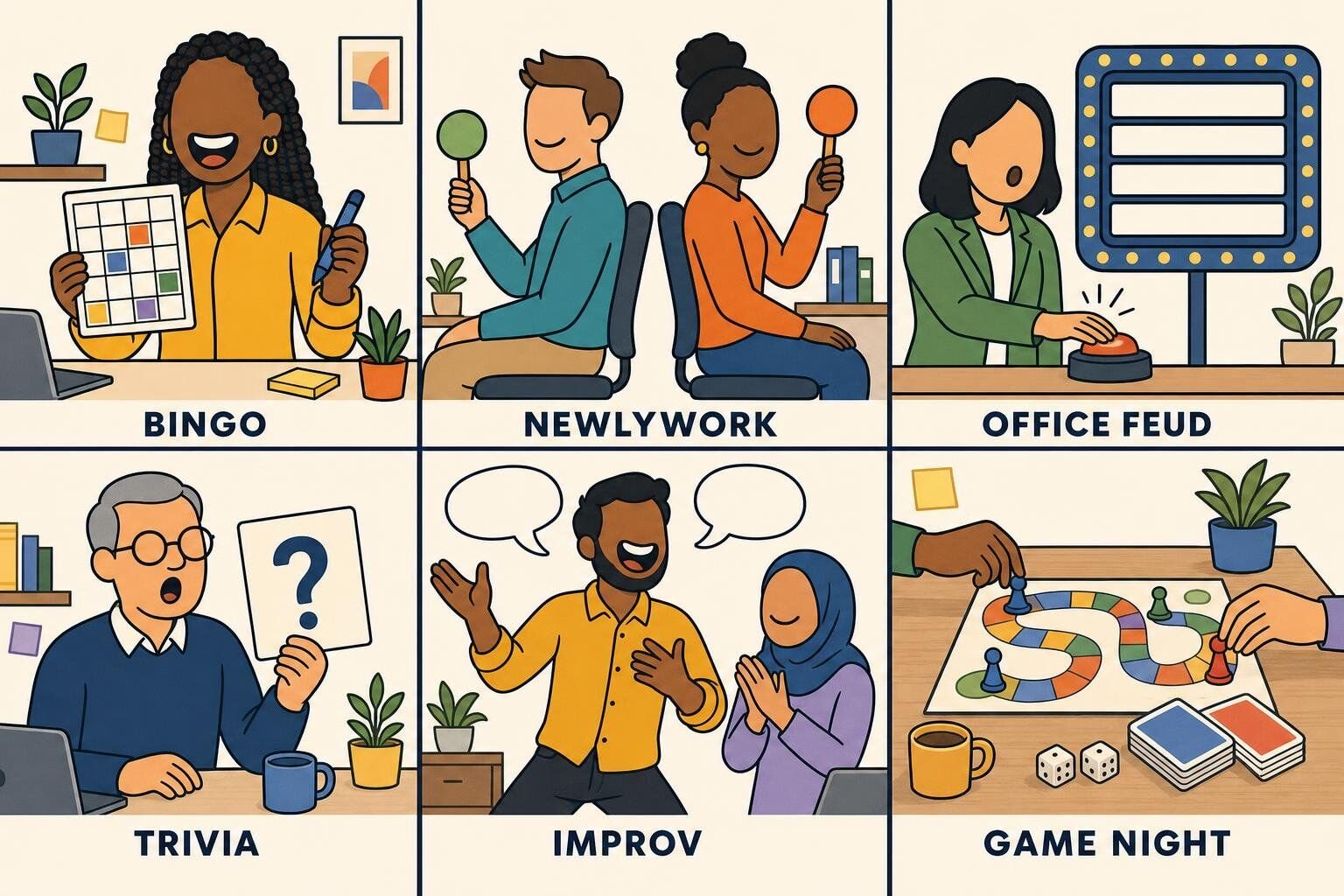
Team Bonding Bingo turns mingling into a race. Each player gets a card of personal facts — "has met a celebrity," "speaks three languages," "once had a truly weird job" — and hunts for coworkers who match each square, writing a different name in every box. The first player to connect five in a row wins.
Here is a Team Bonding Bingo card generator we made for your game:
To make the game do more bonding work, add one rule: you can only claim a square after the coworker tells you the story behind it. The stories, not the signatures, are the point. We also have an icebreaker Bingo generator for new groups.
Best for: Mingling formats, 10–100+ people Time: 20–30 minutes Materials: Printed cards and pens (free)
5. The Newlywork Game
The Newlywork Game is the office version of the Newlywed Game: pairs of close collaborators compete to prove who knows their work partner best. One partner writes an answer; the other tries to match it. Matching answers score a point, and the highest-scoring duo wins.
Example questions:
What was the first project we ever worked on together?
What is my go-to lunch order?
What would I do with a surprise day off?
Which meeting am I secretly fond of?
Who on the team is most likely to break out into song at work?
Run three or four rounds of five questions each, and let the audience vote on disputed matches — the arguments are better than the answers. Here is a list of most likely to questions you can borrow for the game.
Best for: Teams with long-running work pairs, 6–30 people Time: 30–45 minutes Materials: Question list, paper or whiteboards
6. Office Feud
Office Feud is a survey-says game show played with your own office's opinions. In the week before game day, send the whole team a two-minute anonymous survey — "name something that always disappears from the office fridge," "name the best hour of the workweek" — and tally the top answers. On game day, two teams face off to guess the most popular responses, revealed one by one on a slide.
Playing with your own survey data is what makes this a bonding game rather than a trivia game: every reveal teaches the room something true about itself, and the outlier answers get quoted for months. We run a fully hosted version of this format year-round, so we can report with confidence: the "survey says" pause never stops being funny.
Best for: Competitive groups, 10–60 people Time: 30–45 minutes plus a pre-game survey Materials: Survey form and a slide deck (free)
7. Coworker Trivia
Coworker Trivia replaces pub-quiz questions with questions about your own team. Collect one surprising fact from each participant in advance — first concert, strangest skill, childhood ambition — then run a quiz where teams match facts to coworkers or answer multiple-choice questions built from the submissions.
Steps to run it:
Send a short form asking for two fun facts nobody at work knows
Write 15–20 questions from the responses
Split the group into teams of four to six
Reveal the real person after each question and let them tell the story
Step four is the whole game: the 30-second story behind "played accordion on national TV" is worth more bonding than the point. For classic rounds to mix in, here is a big list of trivia questions.
Best for: Teams of 8–50, including hybrid groups Time: 30 minutes Materials: A form and a quiz deck (free)
8. Improv Games
Improv is speed-bonding: because scenes demand instant responses, there is no time to be self-conscious, and the group ends up laughing at shared inventions within minutes. Start with low-stakes formats — "Yes, and" story circles, one-word-at-a-time storytelling, or Sound Ball — before anything resembling a performance. Improv also doubles as trust practice, since every scene only works when partners accept and build on each other's ideas.
Best for: Small groups ready to be silly, 6–20 people Time: 20–40 minutes Materials: None
9. Board Game Night
Board game nights work because the game supplies the structure and the table supplies the talk. Set up three or four tables with different games — one party game like Codenames or Wavelength, one classic, one quick card game — plus snacks, and let people drift between tables. Nostalgia does half the icebreaking, and the light competition gives quieter teammates a way to participate without small talk.
One upgrade from our event hosts' playbook: seat people by mixing departments at each table, then reshuffle tables between games. Check out this list of board games to play with teams.
Best for: Any size, split across tables Time: 60–120 minutes Materials: 3–4 games (~$60 once, reusable forever)
Team bonding ideas for work
These fun team bonding activities fit inside a normal workday and a normal budget — most cost nothing, and every one can become a repeatable ritual rather than a one-off:
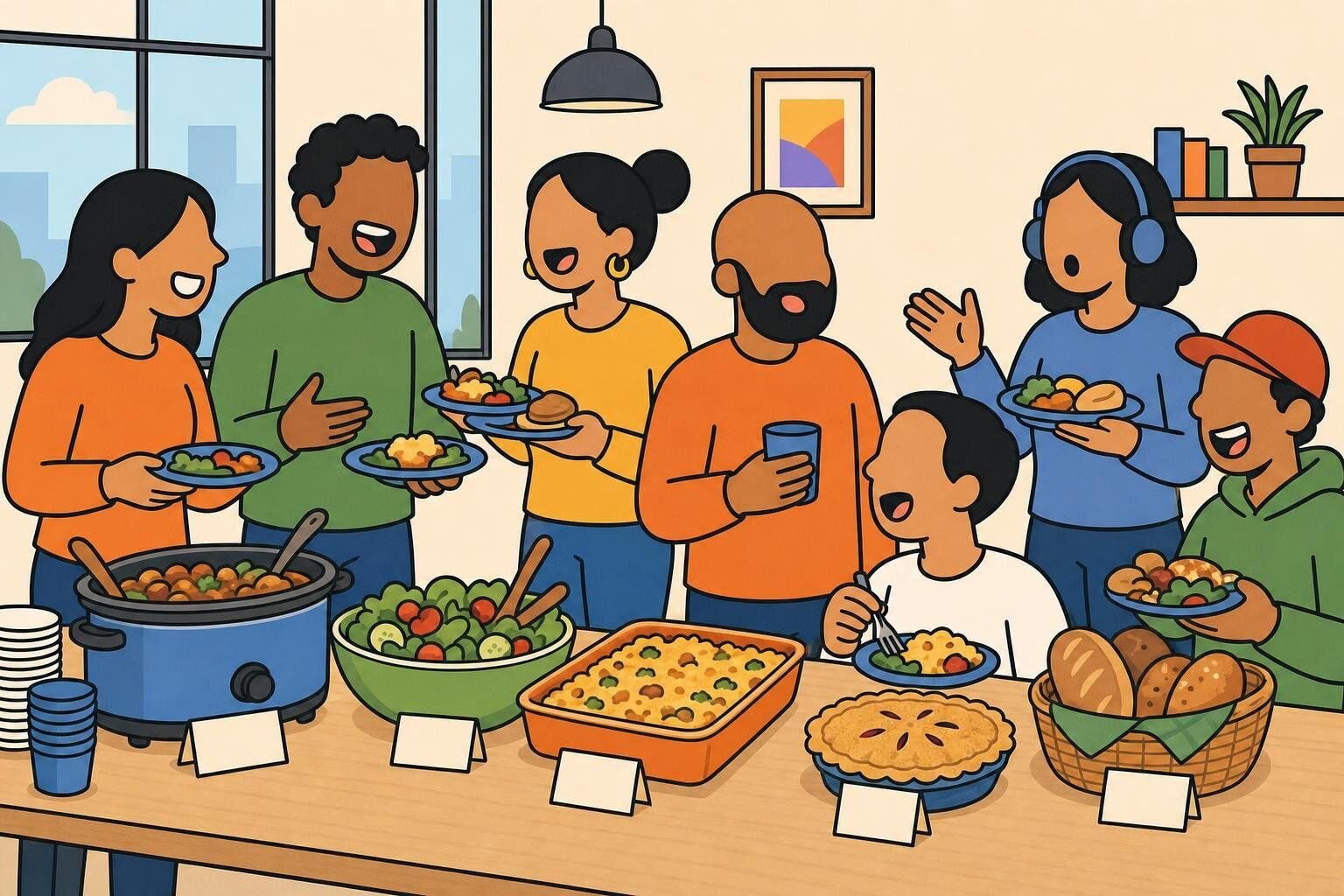
Potlucks remain one of the best team bonding experiences because a shared table does what no agenda can. The recipes are the conversation: the dish someone's grandmother taught them, the debated regional chili, the ambitious dessert that did not survive the commute.
To run one well: post a sign-up sheet at least a week out with categories (mains, sides, desserts, drinks) so you don't get eleven bags of chips, ask contributors to add ingredient cards for allergies, and schedule a real 60-to-90-minute window so people sit and talk instead of grazing at their desks. Award a paper crown for Best Dish and it becomes an institution.
Pro tip: bring extension cords and power strips for the crock pots — the potluck veterans always ask. For outdoor versions, here is a list of company picnic ideas.
Best for: Whole offices and departments Time: 60–90 minutes Materials: Sign-up sheet, plates, utensils (cost shared)
11. Team Mixtape
A team mixtape is a collaborative playlist that doubles as a personality reveal. Pick a theme — "songs that get me through a deadline," "first album I ever bought," "one song from my hometown" — and have everyone add two tracks to a shared playlist. Play it in the office or during socials, and let people guess who contributed what.
Music shortcuts intimacy in a way slide decks never will: sharing a song you love is a small act of trust, and discovering a coworker's taste gives you something to talk about that has nothing to do with work. For inspiration, check out this list of team building songs.
Best for: Any team, including remote Time: Runs in the background Materials: A shared playlist (free)
12. Movie Night
Movie nights are one of the easiest large-group bonding formats: a conference room, a projector, and popcorn is the whole setup. The bonding upgrades are in the framing — put the film to an office vote, or collect everyone's favorite movies anonymously, screen one, and let the room guess whose pick it was. Add a concession table and a ten-minute debrief argument afterward about whether the ending held up.
Best for: Large groups, low-energy weeks Time: 2–3 hours Materials: Screen, projector, snacks
13. Buddy Dates
Buddy dates are randomized one-on-ones with no agenda: each round, match pairs of teammates and give them 30 minutes for a coffee, a walk, or a lunch during the workweek. Rotate matches monthly for small teams or weekly for large ones, and deliberately pair across departments — the entire value is talking to someone outside your daily orbit.
One-on-one formats are where the deepest workplace connections form. In Nectar's 2025 State of Workplace Connection report, our People and Culture Director Grace He recommends exactly this kind of intentional one-on-one time — creating "a space where coworkers feel seen, heard, and respected."
Best for: Teams of any size, especially cross-department Time: 30 minutes per round Materials: A pairing spreadsheet or matching app (free–$)
14. Story Slam
A story slam is an open-mic hour for true five-minute stories on a theme: "my worst first day," "the time a plan actually worked," "the strangest thing I've ever been paid to do." Announce the theme a week ahead, recruit four to six volunteer tellers, and let everyone else vote for a winner with sticker ballots.
We run storytelling workshops as hosted events, and the pattern is consistent: a team that has heard each other's stories treats each other differently on Monday. Nobody is "the person who owns the spreadsheet" once you know about the llama farm summer.
Best for: Teams of 8–40, in person or on a call Time: 45–60 minutes Materials: A theme and a volunteer emcee (free)
15. Desk Show & Tell
Show & tell survives from kindergarten because it works. Once a week or once a sprint, one teammate gets ten minutes to present anything they love: a hobby, a collection, a photo from a trip, a sourdough starter with a name. The audience asks questions; that's the whole format.
It is the cheapest deep-dive into a coworker's actual personality that exists, and it gives your specialists a stage for expertise nobody at work ever sees. Keep a rotating sign-up so the enthusiasm is opt-in.
Best for: Standing meetings, teams of any size Time: 10–15 minutes Materials: None
16. Team Photo Challenge
A photo challenge is a slow-burn bonding game played in a shared album or channel. Post a weekly prompt — "your view right now," "ten years ago," "my happy place," "the most chaotic corner of my home" — and let teammates drop photos in as the week goes on. The album becomes a running group memory, and the comment threads do the actual bonding.
This format is quietly the best one on this list for hybrid teams, because it includes remote teammates identically and asynchronously.
Best for: Hybrid and distributed teams Time: Runs in the background Materials: A shared channel or album (free)
17. Gratitude Round
End one meeting a week with a gratitude round: each person names one specific thing a teammate did that made their week better. Specific is the rule — "Priya rewrote my messy ticket at 5 p.m. Friday" bonds; "everyone's great" doesn't. Ten minutes, no budget, and it compounds: recognition begets recognition, and teams that feel seen stick together.
Best for: Any recurring meeting Time: 10 minutes Materials: None
Corporate team bonding activities
Corporate team bonding activities are the bigger swings — organized events, offsites, and projects that mark milestones and give the team a shared story. These carry more logistics than the workday ideas above, and they pay for themselves in the retelling:
Volunteering together is bonding with a purpose attached: a team that spends a day building, packing, planting, or serving shares both the effort and the meaning. Coworkers also get to see each other in new roles — the quiet analyst who turns out to be a natural crew lead is a volunteer-day classic.
Pick the cause as a team rather than by decree, choose work where people move and cooperate (food banks, trail cleanups, Habitat builds), and close the day with a shared meal to let the experience settle into stories. Here is a list of ways to volunteer as a group and a list of charity team building ideas.
Best for: Whole teams and departments Time: Half day to full day Materials: Depends on project (often free)
19. Build Something Together
Making a physical thing as a group is one of the most satisfying corporate bonding formats, because the result outlives the afternoon. Book a workshop-style session — pasta from scratch, pottery, terrariums, candle mixing, a paint-and-sip — or set a build challenge in the office, like team birdhouses judged on ambition over craftsmanship.
The craft is a Trojan horse: hands busy, stakes low, conversation flowing. Display the results in the office afterward; a shelf of lopsided team pottery is a better culture artifact than any poster.
Best for: Teams of 5–30 Time: 90 minutes to a half day Materials: Workshop fee or supplies (~$15–$50 per person)
20. Group Workout Club
Shared effort bonds fast, and it doesn't need to be extreme: a lunchtime walking club, a weekly yoga session, a couch-to-5K crew training for the same race, or a Friday pickup basketball game. The repetition is the point — a standing workout is a standing hangout, with endorphins doing the icebreaking.
Keep it multi-level so nobody is excluded by fitness: walkers welcome at the run club, chairs offered in the yoga room. Here is our guide to team building yoga to start gently.
Best for: Recurring weekly rituals Time: 30–60 minutes per session Materials: Free–$ (instructor optional)
21. Outdoor Adventure Day
Take the team somewhere with a horizon. A group hike, a kayak or canoe day, a ropes course, or an afternoon of lawn games in a park strips away the office context — no meeting rooms, no laptops — and gives the group a light shared challenge instead. Fresh air lowers everyone's guard, and the mild logistics (who has the trail map, who carries the cooler) create tiny moments of teamwork all day.
Pick routes and activities with an easy option so all fitness levels can join, and build in unstructured time — the best conversations happen on the walk back. Here is a full list of outdoor team building activities.
Best for: Teams of 5–50, spring through fall Time: Half day to full day Materials: Venue or park fees ($–$$)
22. Camping Trip
Camping is the maximal version of outdoor bonding: cooking together, setting up tents together, and the campfire — still the best conversation technology ever invented. Phones lose signal, hierarchies flatten, and by breakfast the team has a stack of shared stories no meeting could produce.
Keep it to one night for a first trip, make attendance genuinely optional with a day-trip alternative, and assign meal crews in advance — shared cooking is half the bonding. For distributed teams, our hosted virtual campfire formats bottle a surprising amount of the same magic, s'mores kits included.
Best for: Close-knit teams of 5–25 Time: Overnight Materials: Campsite and gear ($$)
23. Team Retreat
A retreat is the annual deep investment: a few days offsite where the team works loosely, plays a lot, and rebuilds the relationship capital it will spend all year. The classic retreat mistake is over-scheduling — wall-to-wall workshops with bonding penciled in at 9 p.m. Flip the ratio: one working block a day, one organized activity, and generous unstructured time around meals.
Groups bond over shared novelty, so even a modest destination works if it is new to everyone. Day-trip versions — a winery, a state park, a cooking school — deliver a surprising share of the value at a fraction of the cost. Here is our full guide to planning a company retreat.
Best for: Annual whole-team gatherings Time: 1–4 days Materials: Venue, travel, catering ($$$)
Team bonding exercises for everyday work
Team bonding exercises are the small, repeatable habits that keep connection alive between events. None of these require a calendar invite longer than 15 minutes:
24. Email & Chat Icebreakers
End team emails or start channel threads with one light prompt: "what music gets you through a deadline?", "drop a GIF that describes your week," "best thing you ate this weekend?" Teammates reply when they want to, busy people mute the thread guilt-free, and over a year the answers add up to a surprisingly complete portrait of the team.
Best for: Async and distributed teams Time: 2 minutes Materials: None
25. Personal Polls & Surveys
Quick personal polls turn dead meeting minutes into bonding minutes: "first concert you attended?", "toppings that belong on pizza — go," "which fictional office would you survive longest in?" Post results in the channel or open the next meeting with the reveal, and let people guess who answered what.
Best for: Meetings and channels of any size Time: 5 minutes Materials: Any poll tool (free)
26. Walking One-on-Ones
Take any one-on-one that doesn't need a screen and walk it instead. Side-by-side conversation is measurably easier than across-a-desk conversation — no eye-contact pressure, a shared direction, and a natural end point. Pairs return with better talks and, often, the actual issue that the meeting was supposed to surface.
Set a standing route and make it invitation-default: "walk or room?" is an easy question to normalize.
Best for: One-on-ones and pair check-ins Time: 25–30 minutes Materials: Sidewalk
27. Monthly Team Lunch
A standing team lunch is the simplest bonding ritual in this entire guide, and among the most effective: same week every month, no laptops, no status updates, work talk allowed but never required. Rotate who picks the restaurant or cuisine so the choice itself becomes a small monthly reveal of someone's taste.
The standing part matters more than the lunch part — connection compounds when it is scheduled, and dies when it waits for a special occasion. Here is a list of team lunch ideas to keep the rotation fresh.
Best for: Every team, forever Time: 60 minutes monthly Materials: Lunch budget (or brown bags)
What we've learned about team bonding
We have watched more teams bond — and fail to bond — than almost anyone: 45,000+ events' worth as of August 2026. The same lessons keep coming back:
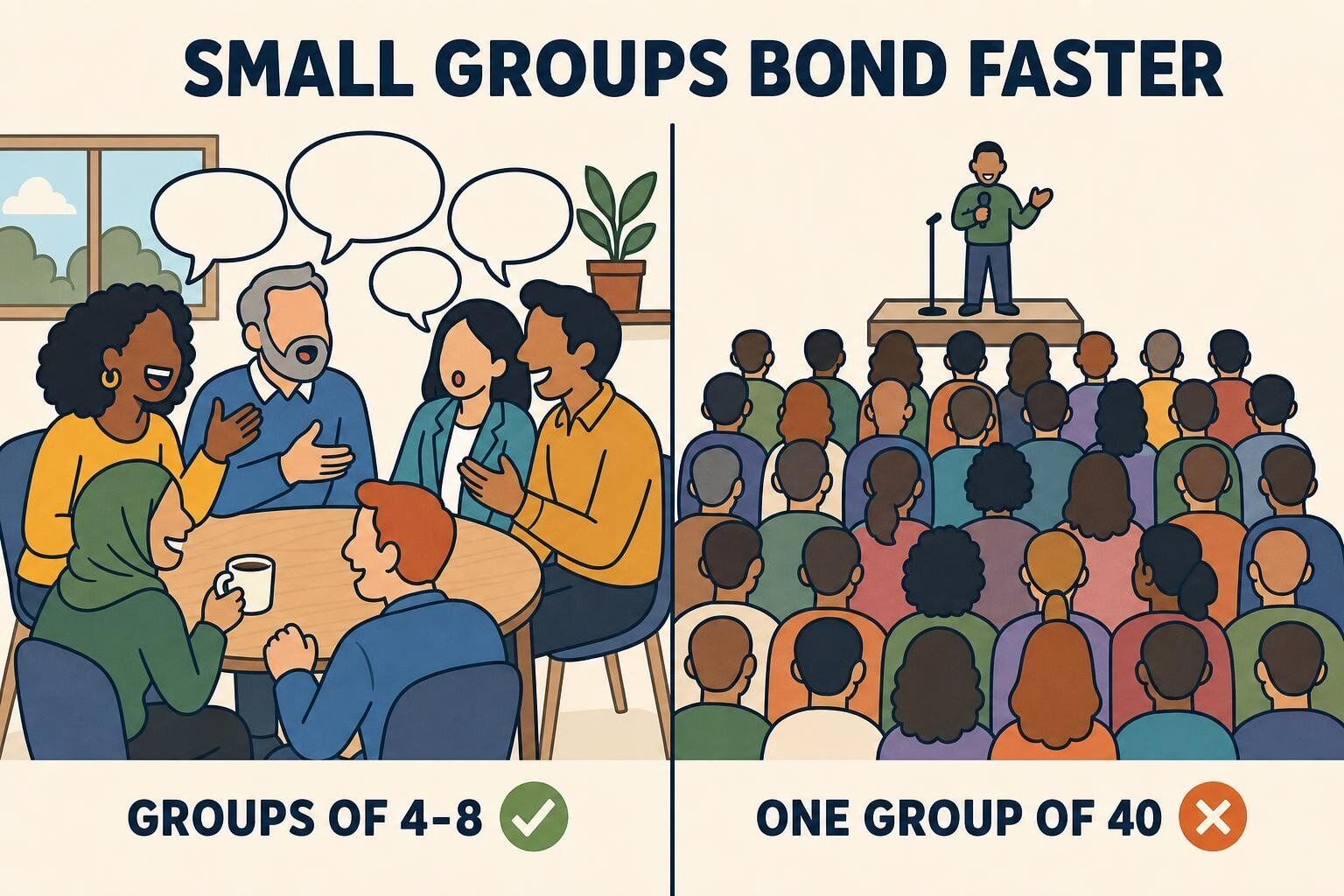
Small groups bond; big groups watch. Six people can discover something unusual they share; sixty people usually cannot. Whatever the headcount, engineer the small moments: breakout rounds, tables of six, pairs. Here is how we scale formats by group size:
Group size
What works
What to avoid
4–8
Story slams, buddy dates, improv, deep-dive dinners
Formats with an audience — everyone should play
8–20
Newlywork, coworker trivia, potlucks, workshops
One-conversation dinners (the table splits anyway)
20–60
Office Feud, bingo, volunteer days, game nights in tables
Anything unstructured — mingling defaults to cliques
60+
Stations, photo challenges, hosted game shows with breakouts
Single-thread activities where 55 people spectate
Rituals beat events. The teams that feel closest are almost never the ones with the biggest annual party — they are the ones with a potluck the first Friday of the month and a gratitude round every sprint. Frequency builds familiarity; familiarity is what bonding actually is. Book the big event for milestones, and let a small ritual carry the weeks between.
The relationships pay off in hard business currency.Gallup reports that only two in 10 U.S. employees strongly agree they have a best friend at work — and estimates that moving that ratio to six in 10 could mean 36% fewer safety incidents, 7% more engaged customers, and 12% higher profit. And in a nationally representative survey of 1,095 U.S. working adults, neuroscientist Paul Zak found people at high-trust companies reported 74% less stress, 106% more energy at work, and 40% less burnout than those at low-trust companies. Bonding is how trust gets built between the org-chart lines.
Food is a cheat code. Across our highest-rated events, the formats built around making and sharing food punch far above their production value. A shared table is the oldest team ritual there is — when in doubt, add a meal to whatever you planned.
Opt-in beats mandatory, every time. The fastest way to kill a bonding activity is to make it compulsory, after-hours, and performance-shaped. Participation soars when people can choose their level: play, help run it, or watch with snacks. Watching is participating.
Team bonding ideas we don't recommend
Some classics of the genre reliably backfire. Having watched thousands of teams, here is what we would skip:
Idea
Why skip it
Verdict
Trust falls
The punchline of team bonding for a reason: physical, awkward, and it builds a story about the exercise, not the team.
Retire it
Mandatory after-hours "fun"
Claiming evenings and weekends turns bonding into unpaid overtime and breeds quiet resentment — especially for parents and caregivers.
Keep it on the clock
Company sleepovers
Sleeping near your manager is intimacy nobody requested. A camping trip with private tents and a true opt-out is the defensible version.
Skip it
Alcohol as the whole plan
An open bar with no activity splits the room into cliques and excludes non-drinkers. Anchor with a game first; make drinks the side dish.
Add structure
Forced oversharing icebreakers
"Tell us your biggest fear" on day one produces performances, not connection. Keep prompts light and let depth arrive on its own schedule.
Lower the stakes
Forced desk rotation
Reassigning seats to manufacture serendipity mostly manufactures grumbling. Buddy dates and mixed game tables move people without moving their monitors.
Use opt-in mixing
One offsite carrying the whole year
A single annual event cannot sustain twelve months of connection. Pair the big day with small recurring rituals.
Add rituals
Final Thoughts
Team bonding is not the dessert course of team development — it is the part that makes everything else digestible. Colleagues who genuinely know each other communicate faster, forgive more readily, and stay longer. The formula that works is unglamorous: one small ritual on the calendar every week or two, one bigger event each quarter, food whenever possible, and everything opt-in.
Start with one game from this list this month. Or, if you would rather join your team than host them, book a hosted event — virtual and in-person — and let a professional run the room.
Answers from the team behind 45,000+ team building events for clients like Google, Amazon, and Microsoft.
What is team bonding?
Team bonding is the process of coworkers forming personal connections by spending relaxed, non-work time together — sharing meals, playing games like team bingo or coworker trivia, swapping stories, and celebrating wins. The goal is camaraderie and trust: colleagues who know each other as people communicate more honestly and support each other under pressure.
What is the difference between team bonding and team building?
Team building develops how a group works together — skills like communication, problem solving, and collaboration — while team bonding develops whether the group likes working together, through friendships, shared meals, and shared stories. A ropes course is team building; the pizza afterward is team bonding. Strong teams schedule both.
What are good team bonding activities for work?
Good team bonding activities for work include team bonding bingo, Office Feud played with your own office's survey answers, coworker trivia, team potlucks, story slams, buddy dates, and a monthly team lunch. The best ones are opt-in, fit inside the workday, and repeat on a schedule rather than happening once a year.
What are fun team bonding ideas for small groups?
Small groups bond fastest — six people can discover something unusual they share, while sixty usually cannot. For groups under ten, try a story slam, improv games, the Newlywork Game, buddy dates, or a build-something workshop. For larger teams, recreate the small-group effect with breakout rounds, tables of six, and rotating pairs.
How often should teams do team bonding activities?
Small rituals should run weekly or biweekly — a gratitude round, an icebreaker thread, a walking one-on-one — with a bigger activity like a potluck, game night, or hosted event each month or quarter, and an offsite annually. Frequency matters more than scale: connection compounds when it is scheduled and fades when it waits for a special occasion.
What are corporate team bonding events?
Corporate team bonding events are professionally hosted experiences — game shows, guacamole-making competitions, mixers, and trivia — run for teams by a facilitator, virtually or in person. In teambuilding.com post-event surveys of 18,000+ virtual participants, 91% said they felt more connected to their teammates.

















Comments (0)
Leave a Comment