
25 Thirty-Minute Team Building Activities (One Slot a Week)
A host-tested list of 25 team building games, exercises and mini workshops that start, land and finish inside half an hour, built around one weekly slot.
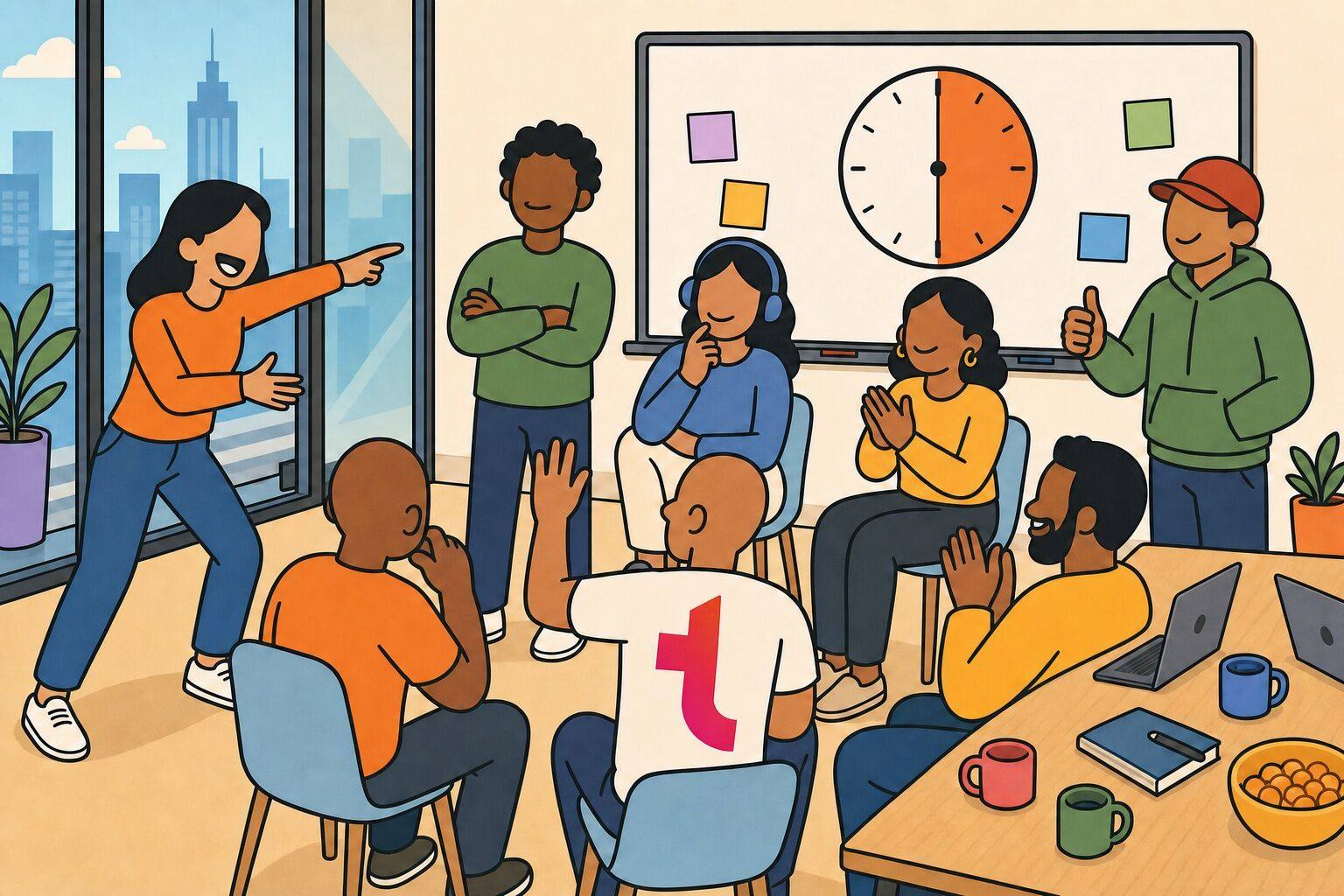
A host-tested list of 25 team building games, exercises and mini workshops that start, land and finish inside half an hour, built around one weekly slot.
Thirty minutes is the slot that actually exists on a work calendar. An hour-long event has to be booked, approved and rescheduled twice; 15 minutes is over before a quiet group warms up. Half an hour is long enough for a game to build stakes, a discussion to get somewhere, or a tower to fall over, and short enough to hold every single week.
We have been designing and hosting team experiences since 2016, and 30 minutes a week is the cadence we recommend to managers who ask where to start. So this guide is built around that habit: 25 activities that run cleanly inside a half-hour block, in a conference room or on a video call, each with step-by-step instructions, a group size and a real materials cost.
This list includes:
Let's get to it!
30-minute team building activities are games, exercises and structured discussions that a team can set up, play and debrief inside half an hour, usually attached to an existing meeting rather than booked as a separate event. Examples include Reverse Charades, the Marshmallow Challenge, and a 30-minute pre-mortem. The purpose is to give a team a regular, low-cost dose of the things longer events do in depth: talking to each other, solving something together, and laughing at work. These activities are also called 30-minute team building games, 30-minute team building exercises, half-hour team activities, 30-minute icebreakers, and 30-minute team meeting activities.
Thirty-minute sessions are the long end of quick team building and a subcategory of team building activities. They are similar to 15-minute team building activities, team building activities for small groups, and team meeting games, and this guide includes 30-minute team building games, 30-minute virtual team building activities, 30-minute team building exercises for work, and 30-minute workshop-style activities. Managers most often use these sessions as the weekly building block of employee engagement activities.
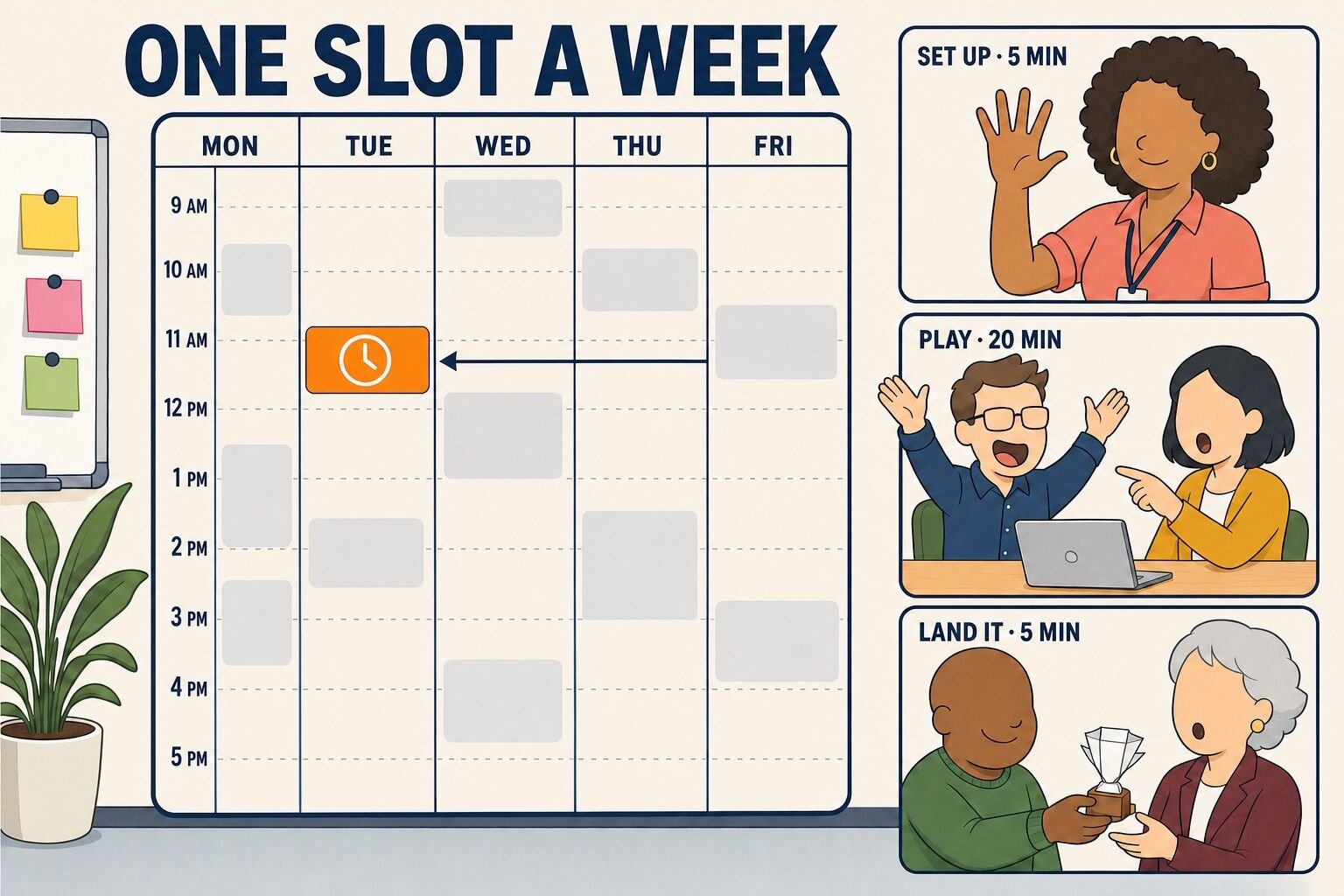
The most useful thing we can tell you about 30-minute team building is not which game to pick. It is to put one slot on the calendar and keep it there. A single big event is a spike; a weekly half hour is a habit, and the habit is what changes how a team talks to each other on the other four and a half days.
Here is the shape our hosts use for a half-hour block. It is deliberately front-loaded, because the failure mode of 30-minute sessions is spending 12 of the minutes explaining rules and waiting for stragglers.
Two more rules of thumb. Put the activity at the start of a meeting or in its own slot, never at the end, because the end of a meeting is the first thing cut when the agenda runs long. And rotate who runs it. When the manager always facilitates, the session reads as a management initiative; when it rotates, people start bringing their own games, and that is the point at which it becomes the team's thing.
The research supports spending the half hour this way. A meta-analysis in Small Group Research by Klein and colleagues (2009), covering 60 effect sizes, found that team building has a moderate positive effect on team outcomes overall, with the strongest effects on affective and process outcomes, meaning how a team feels about itself and how it works together, and with goal setting and role clarification the most effective components. That is a useful map for the sections below: the games build the affective side, and the workshop-style activities at the end of the list do the goal and role work.
Every activity in this guide is free or close to it and fits a half-hour block. Use the table to pick one for the group you actually have, then jump to the instructions.
| Activity | Best for | Group size | Time | Cost |
|---|---|---|---|---|
| Reverse Charades | Big laughs, whole-team participation | 6–30 | 25–30 min | Free |
| Pictionary Relay | Fast competitive rounds | 6–24 | 25–30 min | Free with a whiteboard |
| Team Trivia | Any group, in person or virtual | 6–100+ | 30 min | Free |
| Category Countdown | Quick thinking, zero prep | 4–30 | 20–30 min | Free |
| Minute-to-Win-It Circuit | Energy and movement | 8–40 | 30 min | $10–$20 for props |
| Bet on the Crowd | Getting to know the whole team | 10–100+ | 20–30 min | Free |
| Virtual Scavenger Hunt | Waking up a remote team | 5–100+ | 20–30 min | Free |
| Show and Tell | Storytelling on camera | 4–15 | 25–30 min | Free |
| Tree or Bob Ross | Creative thinking | 4–20 | 20–30 min | Free |
| What Would You Do? | Discussion and decision-making | 5–50 | 25–30 min | Free |
| Breakout Room Roulette | Large remote teams | 12–200 | 30 min | Free |
| Hot Seat | Small teams getting to know each other | 4–10 | 25–30 min | Free |
| Story Round | Connection through personal stories | 4–10 | 30 min | Free |
| Six-Word Memoirs | Reflection with a creative twist | 4–15 | 20–30 min | Free |
| Venn Diagram Trios | Finding common ground fast | 6–30 | 25–30 min | Free |
| Marshmallow Challenge | Hands-on problem solving | 6–40 | 30 min | $10–$15 for supplies |
| Blind Drawing Challenge | Communication | 4–30 | 25–30 min | Free |
| Helium Stick | Coordination and patience | 6–12 per stick | 20–30 min | $5 for a dowel or tent pole |
| Lost at Sea | Consensus and decision-making | 6–30 | 30 min | Free |
| Walking Meeting | Idea generation, one-on-ones | 2–12 | 30 min | Free |
| Team Charter in 30 | New teams and new projects | 4–15 | 30 min | Free |
| Podcast Club | Learning together | 4–20 | 30 min | Free |
| Lightning Talks | Knowledge sharing | 6–50 | 30 min | Free |
| Pre-Mortem | Kicking off a project | 4–15 | 30 min | Free |
| Start, Stop, Continue | Monthly team reset | 4–20 | 30 min | Free |
These are the crowd-pleasers: competitive, loud, and forgiving of a group that has never done anything like this before. Each one runs as a series of short rounds, which is what makes it fit the clock, and each one gets the whole room participating rather than watching. For the full catalog of formats, see our list of team building games.
Classic charades has one actor and a room of spectators. Reverse Charades flips it: the whole team acts out a word together while one teammate guesses, which means nobody is stuck watching and the shy people are hidden inside a crowd of flapping arms.
Here is how to play:
The one-minute rounds are what make this a 30-minute game rather than a two-hour one. Keep the timer visible and do not let a team argue a call for more than ten seconds.
Best for: Big laughs and whole-team participation, 6–30 people
Time: 25–30 minutes
Materials (cost): Word cards and a timer (free)
What we have learned: Pick the first guesser yourself and choose someone senior. When the manager is the one flailing at "penguin," the rest of the room relaxes instantly.
Pictionary is a good 30-minute game already. Turning it into a relay makes it a great one, because every player draws, every player guesses, and the clock never stops.
Here is how to play:
Mix easy words (cat, house, coffee) with a few brutal ones (deadline, quarterly review, Wi-Fi) so the fast teams still stumble.
Best for: Fast competitive rounds, 6–24 people
Time: 25–30 minutes
Materials (cost): Whiteboards or flip charts, markers, word cards (free with what you have; about $10 for a flip-chart pad)
What we have learned: Ban the word "pass." Skipping a hard card is where relay games leak time, and a team that has to draw "synergy" for 40 seconds will laugh harder than the team that wins.
Trivia is the most portable 30-minute game there is. It works in a conference room, on a video call, and for a group of six or 600, and it needs nothing but questions and a way to score.
Here is how to play:
For ready-made questions, see our list of trivia questions and answers.
Best for: Any group, in person or virtual, 6–100+ people
Time: 30 minutes
Materials (cost): Questions, paper or a chat thread (free)
What we have learned: Twenty questions is the right number for 30 minutes. Hosts who write 40 either rush the room or run over, and the second half of a long trivia set is where energy dies.
A Scattergories-style word game with no board and no prep. Give the room a letter and a list of categories, start a timer, and watch a quiet team start arguing over whether "kale" counts as a snack.
Here is how to play:
The unique-answer rule is what makes the game. Obvious answers cancel out, so the winners are the people who thought sideways.
Best for: Quick thinking with zero prep, 4–30 people
Time: 20–30 minutes
Materials (cost): Paper and pens (free)
What we have learned: Let the room vote on borderline answers with a thumbs up or down. The 30-second debates over whether "Xbox" is a toy are the best part of the game, and letting the group rule on them keeps the host out of the referee role.
Minute-to-win-it games are 60-second physical challenges built from household props. A circuit of five stations turns them into a 30-minute team event with a lot of movement and a scoreboard.
Here is how to play:
Best for: Energy and movement, 8–40 people
Time: 30 minutes
Materials (cost): Cups, balloons, ping-pong balls, cookies, tape ($10–$20)
What we have learned: Test every station yourself the day before. A challenge that turns out to be impossible kills the energy at that table for the whole rotation, and the fix is usually as simple as moving the mug closer.
A prediction game we use in our own hosted events, and a favorite because it gets people thinking about their teammates instead of themselves. Everyone answers a poll, then bets on how the room answered.
Here is how to play:
The reveals are the game. A team that assumed it was full of coffee drinkers and discovers it is 60% tea has something to talk about for the rest of the day.
Best for: Getting to know the whole team, 10–100+ people
Time: 20–30 minutes
Materials (cost): A polling tool or a show of hands (free)
What we have learned: Close votes are far more fun than lopsided ones. A 52/48 split creates suspense, so if your practice run produces a 95/5 answer, swap the question out.
Half an hour is a good length for a remote team, and a hard one. A gap in a conference room fills itself with chatter; a gap on a video call is silence and someone checking email. Every activity in this section keeps the whole grid busy at once, uses the chat and breakout rooms rather than fighting them, and needs nothing shipped to anyone. For longer formats and hosted options, see our guide to virtual team building activities.
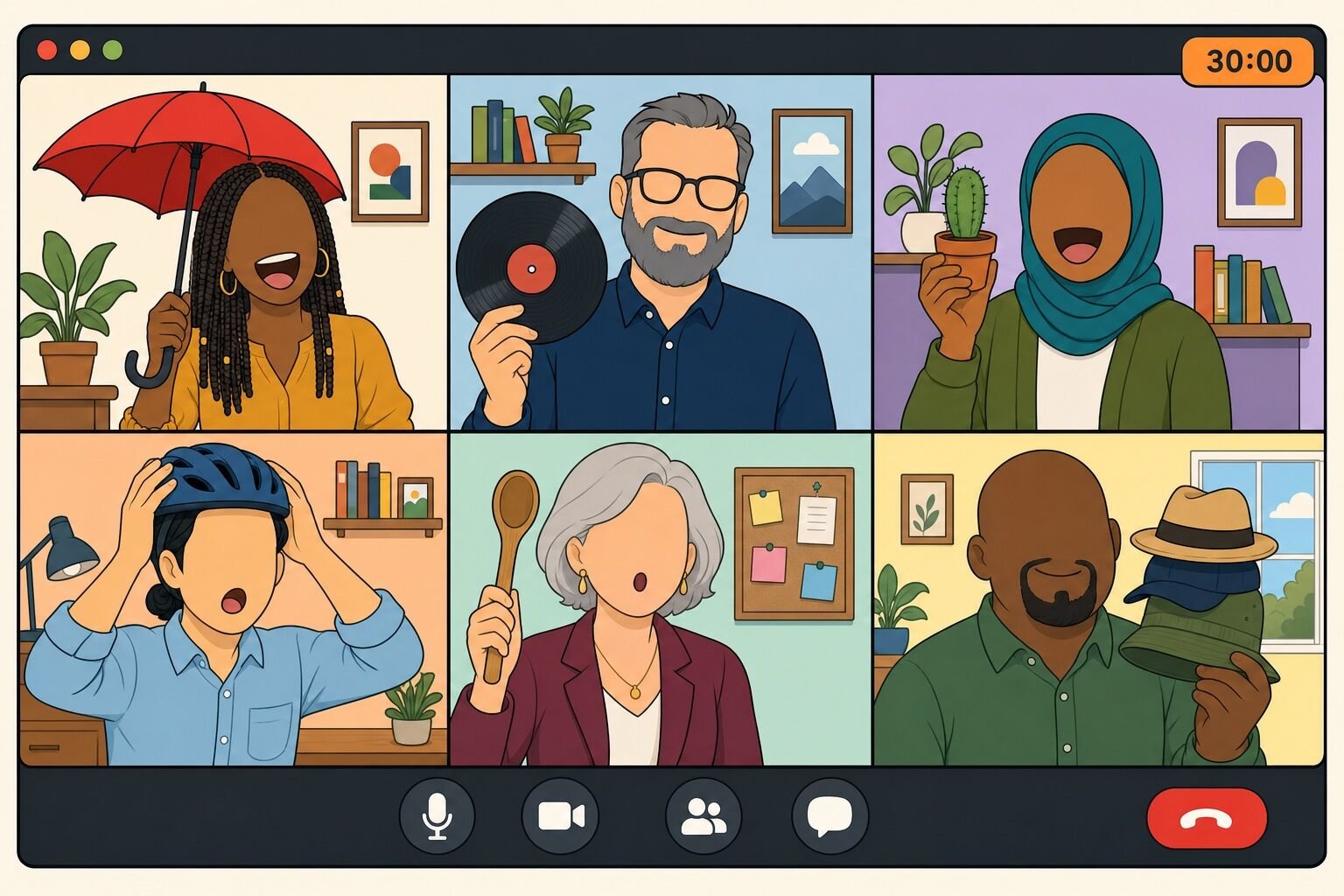
The remote version of a scavenger hunt: players race around their own homes to find objects and hold them up to the camera. It gets people out of their chairs, which is the single hardest thing to do on a video call.
Here is how to play:
For ready-made prompts, see our virtual scavenger hunt sample lists.
Best for: Waking up a remote team, 5–100+ people
Time: 20–30 minutes
Materials (cost): A prompt list and a timer (free)
What we have learned: The interpretive prompts are the ones people remember. "Find a pen" is a race; "find something older than you" is a story, and the stories are why you are doing this.
Show and Tell is one of the few kindergarten activities that gets better with age. Each teammate brings one object to the call and explains why it matters, and a remote team learns more about each other in 30 minutes than in six months of status updates.
Here is how to run it:
Best for: Storytelling on camera, 4–15 people
Time: 25–30 minutes
Materials (cost): One object per person (free)
What we have learned: The two-minute limit is not a suggestion. Without it the first two speakers take eight minutes each and the last four people get cut, which is worse than not doing the activity.
A drawing game from our hosted events with a scoring twist that rewards ambition. Everyone draws the same prompt in the same amount of time, and the room votes on which drawings were a "tree" (they tried) and which were a "Bob Ross" (they went for it).
Here is how to play:
Best for: Creative thinking and laughs, 4–20 people
Time: 20–30 minutes
Materials (cost): Paper and pens (free)
What we have learned: Prompts about the team itself ("draw our last project as a weather map") produce the best drawings and the best conversation, because every drawing is secretly a piece of feedback.
A discussion game built on hypotheticals. Small groups get a scenario with no clean answer, have to agree on a plan, and then defend it to the room.
Here is how to play:
Good discussion scenarios have no obvious correct answer. The point is not to solve the hypothetical, it is to hear how teammates think, negotiate, disagree, and eventually make a decision together, and a five-minute clock forces all of that to happen out loud.
Best for: Discussion and decision-making, 5–50 people
Time: 25–30 minutes
Materials (cost): Scenario list, breakout rooms (free)
What we have learned: Keep the stakes inconsequential. A scenario about a stolen lunch produces a better argument than one about layoffs, because nobody is protecting a real position.
A speed-networking format for large remote teams, and the fastest way we know to get 60 people who have never spoken to have three real conversations each.
Here is how to run it:
For more ways to use breakout rooms, see our Zoom breakout room ideas.
Best for: Large remote teams, 12–200 people
Time: 30 minutes
Materials (cost): A video platform with breakout rooms (free)
What we have learned: Rooms of three beat rooms of two and rooms of five. Pairs stall when one person is quiet; five is a meeting. Three always has a conversation.
With four to ten people, everyone can take a real turn, so the best 30-minute formats here are the ones that go deep rather than wide: one story at a time, one person in the spotlight, one whiteboard that everyone can reach. For more formats built for this size, see our list of small group games.
One person takes the seat, the rest of the group asks questions for four minutes, and then the seat rotates. It sounds like an interrogation and plays like a conversation, because the questions are chosen to be fun to answer.
Here is how to play:
Stuck for questions? Pull some from our generator, or see our list of team building questions.
Best for: Small teams getting to know each other, 4–10 people
Time: 25–30 minutes
Materials (cost): A chair and a timer (free)
What we have learned: Always ask a follow-up. The first answer to any question is the practiced one; the second question is where you find out something real.
A themed storytelling round where each person tells one true, short story from their own life. Teams that do this monthly end up knowing each other in a way no icebreaker produces.
Here is how to run it:
Best for: Connection through personal stories, 4–10 people
Time: 30 minutes
Materials (cost): None (free)
What we have learned: Themes with a built-in ending ("the day I…") produce better stories than open topics ("my childhood"). Give people a shape and they will fill it.
Everyone writes a memoir in exactly six words, then reads it to the group. The constraint is what makes it work: six words is too few to hide behind, so people say something true.
Here is how to play:
Best for: Reflection with a creative twist, 4–15 people
Time: 20–30 minutes
Materials (cost): Paper and pens (free)
What we have learned: Read every memoir twice. The first read gets the laugh; the second read is where the room hears what the person actually said.
A whiteboard version of "find what we have in common," with a picture at the end. Groups of three draw a three-circle Venn diagram and fill in every region, including the one in the middle.
Here is how to play:
Best for: Finding common ground fast, 6–30 people
Time: 25–30 minutes
Materials (cost): Whiteboard or flip-chart paper and markers (free)
What we have learned: The center region is the hard one and the good one. Trios that fill the outer circles first and run out of time have missed the point, so tell them to start in the middle.
These are the exercises with a lesson attached: build something, communicate under a constraint, reach a decision as a group. Each one produces a moment the team will reference later ("remember the spaghetti tower"), and each ends with a short debrief, which is where an exercise turns into team building. For more in this vein, see our list of problem solving games.
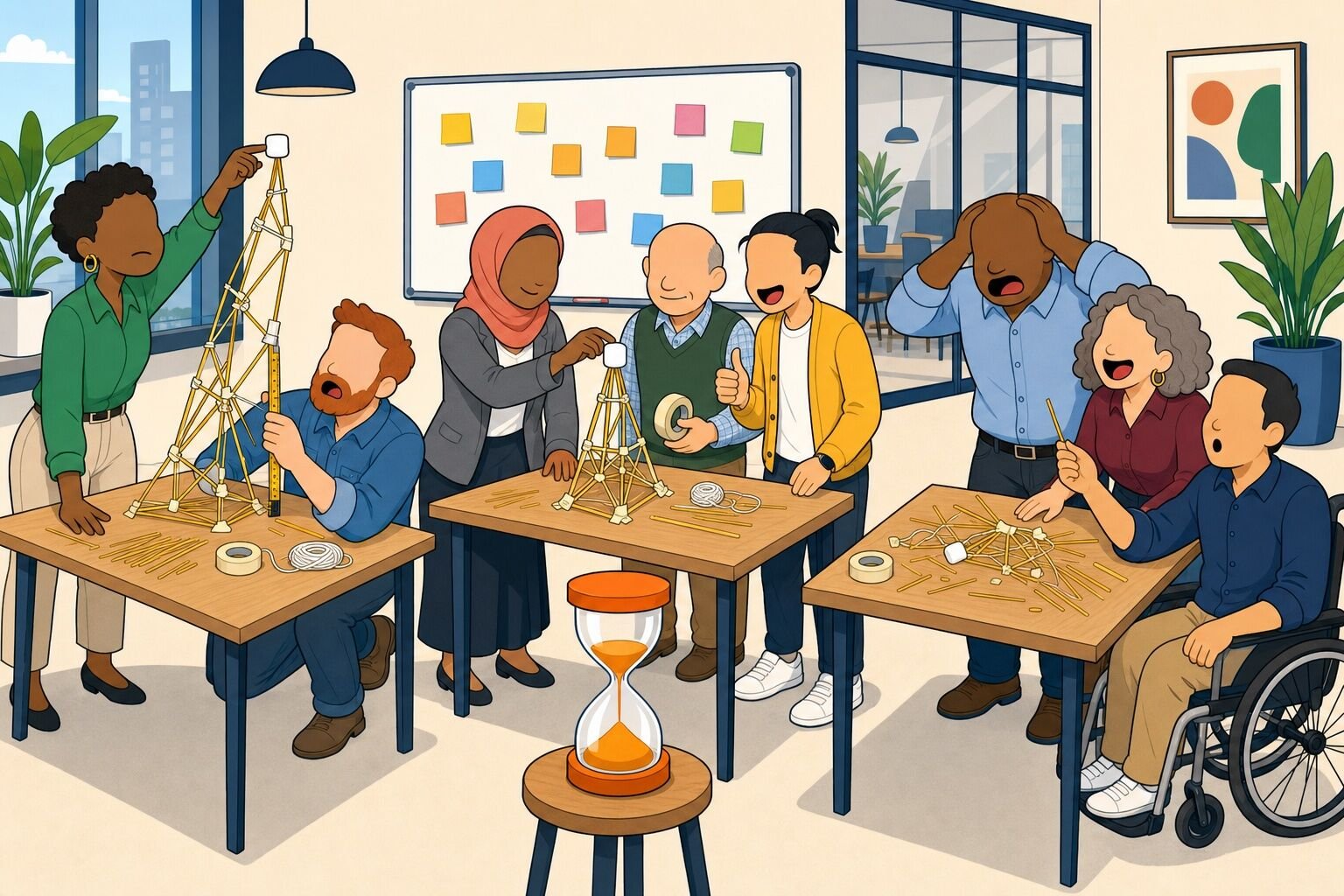
The best-known 30-minute team exercise in the world, for good reason: 18 minutes of building, a tower that either stands or does not, and a debrief that writes itself.
Here is how to play:
Best for: Hands-on problem solving, 6–40 people
Time: 30 minutes
Materials (cost): Spaghetti, tape, string, marshmallows ($10–$15 for eight kits)
What we have learned: Do not explain the lesson before the build. The teams that test early and iterate discover it themselves in the debrief, and a lesson people discover sticks in a way a lesson people are told does not.
Pairs sit back to back. One describes a picture, the other draws it, and neither can see the other's page. The gap between what was said and what was drawn is the whole lesson.
Here is how to play:
For more exercises built on this idea, see our list of communication games.
Best for: Communication, 4–30 people
Time: 25–30 minutes
Materials (cost): Paper, pens, printed images (free)
What we have learned: Make the describer someone senior in at least one pair. It lands much better when the person discovering that their perfectly clear instructions were ambiguous is the person who writes the briefs.
A group has to lower a light stick to the ground while every person keeps one finger touching it. The stick rises instead. It is the funniest failure in team building and takes about 90 seconds to demonstrate why coordination is harder than effort.
Here is how to play:
Best for: Coordination and patience, 6–12 per stick
Time: 20–30 minutes
Materials (cost): A dowel or tent pole ($5)
What we have learned: Do not warn people that the stick will rise. The surprise, and the 30 seconds of everyone accusing everyone else of lifting, is the part they will talk about for months.
A classic consensus exercise. Your yacht is sinking, you have 15 items, and the group must agree on their order of importance. The scoring reveals whether the group did better together than its best individual, which is the real question.
Here is how to play:
Best for: Consensus and decision-making, 6–30 people
Time: 30 minutes
Materials (cost): Printed item lists (free)
What we have learned: The debrief question that matters is "whose good idea got overruled, and why?" Every group has one person who ranked the mirror first and got talked out of it.
Take a meeting that does not need a screen and hold it on foot. Thirty minutes is the right length: long enough to get somewhere, short enough that nobody needs to change shoes.
Here is how to run it:
Best for: Idea generation and one-on-ones, 2–12 people
Time: 30 minutes
Materials (cost): None (free)
What we have learned: Walking meetings work best for topics with no right answer yet. Anything that needs a document on screen goes back inside.
Not every half hour has to be a game. These five formats borrow the structure of a workshop and shrink it to fit a weekly slot: one question, one whiteboard, one output the team can point to afterward. They are the activities to reach for at the start of a project, after a rough month, or when a team has played enough trivia and wants the time to produce something. For longer formats, see our corporate workshop ideas.
One caution before you swap every game for a workshop. A meta-analysis of 72 controlled teamwork-training studies published in PLoS ONE by McEwan and colleagues (2017) found that experiential methods such as workshops, simulations and team debriefs improved teamwork behaviors, while purely didactic classroom education showed no significant effect. That is teamwork training in the broad sense rather than recreational team building, but the lesson transfers: the formats below work because people do something, not because they listen to something.
A fast working-agreements session for a new team or a new project. The output is a one-page charter the team wrote itself, which is worth more than any values poster.
Here is how to run it:
Best for: New teams and new projects, 4–15 people
Time: 30 minutes
Materials (cost): Whiteboard, sticky notes, markers (free)
What we have learned: Five sentences is the limit. A charter with 15 rules is a policy document nobody reads; five that the team wrote in its own words get quoted in meetings.
A book club that fits in a lunch break. The team listens to one short episode together, then talks about it, and the conversation is usually better than the episode.
Here is how to run it:
Best for: Learning together, 4–20 people
Time: 30 minutes (15 listening, 15 discussion)
Materials (cost): A speaker or screen share (free)
What we have learned: Shorter episodes with more discussion beat longer episodes with less. A 25-minute episode leaves five minutes to talk, and five minutes is not a club.
Three teammates each give a five-minute talk on something they know and the rest of the team does not, followed by questions. It is knowledge sharing with a clock, and the clock is what makes it fun.
Here is how to run it:
Best for: Knowledge sharing, 6–50 people
Time: 30 minutes
Materials (cost): A screen and a timer (free)
What we have learned: Mix one non-work talk into every session. The marathon talk is the one that makes the quiet engineer volunteer to explain billing next month.
A project kickoff exercise that runs the post-mortem before the project starts. The team imagines it is six months later and the project has failed, then works backward to explain why. It surfaces risks that nobody would raise in a normal planning meeting.
Here is how to run it:
Best for: Kicking off a project, 4–15 people
Time: 30 minutes
Materials (cost): Sticky notes, markers, dot stickers (free)
What we have learned: The premise has to be "it failed," not "it might fail." Asking what could go wrong gets polite answers; asking why it went wrong gets the real ones.
The simplest retrospective there is, and the one worth running monthly. Three columns, one round of sticky notes, and a team that has actually said what is working.
Here is how to run it:
Best for: Monthly team reset, 4–20 people
Time: 30 minutes
Materials (cost): Whiteboard and sticky notes (free)
What we have learned: Read the Continue column first, every time. It sets the tone, it is the column people skip when they are frustrated, and it is the one that tells a manager what not to break.
We host team events for a living, and the honest version is that 30 minutes is a different tool than an event, not a smaller one. 88% of the virtual events we run are 60 to 90 minutes long, and that length is not an accident: a group needs time to warm up, a story needs time to develop, and a competition needs time to build stakes. Half an hour cannot do all of that.
What half an hour is very good at is frequency and reach. A team that plays something every week walks into its next big event already warmed up, and a 30-minute slot is short enough that people who would never sign up for an "event" will show up for it. A few things we have found true of the format specifically:
Same slot, same day. Teams that put the half hour on the calendar at a fixed time keep it. Teams that run one "when there is time" do it twice and stop. Tuesday or Wednesday late morning tends to survive rescheduling better than Monday morning or Friday afternoon.
Alternate games and workshops. Three weeks of games followed by one workshop-style session is a rhythm that holds. All games and the slot starts to feel like a distraction; all workshops and it starts to feel like another meeting.
Match the format to the group size. This is the most common mistake we see, and the easiest to fix.
| Group size | What changes | What to run in 30 minutes |
|---|---|---|
| 4–10 people | Everyone can take a real turn, so formats with one person in the spotlight work and the conversation can go deep. | Hot Seat, Story Round, Team Charter in 30 |
| 11–30 people | Turn-taking starts eating the clock. Split into teams of four to six and have only the teams report back. | Reverse Charades, Marshmallow Challenge, Lost at Sea |
| 31+ people | Nobody can take a turn. Everyone plays simultaneously, with a handful of voices sampled aloud. | Team Trivia, Bet on the Crowd, Breakout Room Roulette |
Land it. The last five minutes are the difference between a game and team building. One question ("what did that show us about how we work?"), two answers, and a thank-you by name. Skip the debrief and you ran a fun half hour; keep it and you built something.
Not everything that can be squeezed into half an hour should be. Some formats need more room, some need a different room, and a few appeared on earlier versions of this list and did not earn their place. Here is what we would skip.
| Activity | Why skip it | Verdict |
|---|---|---|
| Virtual paint night | We had this on a previous version of this list. Shipping kits, explaining brushes and painting anything at all takes 60 to 90 minutes; in 30 you get wet canvases and a rushed goodbye. | Book the full slot |
| Virtual karaoke | Also cut from our earlier list. Audio latency makes singing together impossible, and solo karaoke puts enormous pressure on one person while everyone else mutes. | Skip it |
| Card games with a rulebook | A new card game spends the first 12 minutes on rules and the next ten on "wait, can I do that?" Save boxed games for a lunch hour and keep the weekly slot for formats you can explain in three sentences. | Cut from our list |
| Mock interviews | An earlier version of this list had teammates interviewing each other about their skills and experience. In practice it feels like a performance review with an audience. | Cut from our list |
| A "quick" escape room or murder mystery | Puzzle formats need time to build stakes. Compressed into 30 minutes, players get the setup and the frustration without the payoff. | Book the full slot |
| Two Truths and a Lie | It works for five or six people, but it is the most overused icebreaker in the world and gets slow the moment 20 people each need a turn. | Usually skip |
| Trust falls | A physical-risk exercise with real liability, built on a metaphor that does not survive contact with an actual workplace. | Skip it |
| A 30-minute personality test debrief | Half an hour is enough time to label colleagues and nowhere near enough to discuss what the labels mean, which is how a team ends up with nicknames instead of insight. | Needs a workshop |
| Open-floor "anyone want to share something fun?" | With no structure, the same two people fill the silence every week. Any activity on this list takes the same 30 minutes and beats it. | Add structure |
The activity matters less than the slot. Pick one game from the table above, put 30 minutes on the calendar at the same time next week, and run it. Then run a different one the week after, and a workshop-style session the week after that. In two months you will have a team that opens meetings talking instead of waiting, and the big event you eventually book will go better because of it.
If you would rather have someone else run the half hour, our hosts lead virtual and in-person team building activities for teams of every size.
Next, check out our lists of last-minute team building ideas, office games, and team bonding ideas.
Answers to the questions managers ask us most about half-hour team building sessions.
30-minute team building activities are games, exercises and structured discussions that a team can set up, play and debrief inside half an hour, usually attached to an existing meeting rather than booked as a separate event. Examples include Reverse Charades, the Marshmallow Challenge, and a 30-minute pre-mortem.
We recommend at least 30 minutes of team building per week as a starting point. One fixed weekly slot, ideally late morning on a Tuesday or Wednesday, survives rescheduling far better than an activity run whenever there happens to be time.
The formats that hold up on video keep the whole grid busy at once: a Virtual Scavenger Hunt, Tree or Bob Ross, a What Would You Do? discussion in breakout rooms, and Breakout Room Roulette for large calls. Avoid turn-taking games on calls larger than about a dozen people, and skip anything that depends on shared audio, such as karaoke.
Shape the block 5 / 20 / 5: five minutes to explain the rules in three sentences and split the group, twenty minutes of play in short timed rounds, and five minutes to name a winner, ask one debrief question and end on time. Put the activity at the start of the meeting, not the end, so it is not the first thing cut when the agenda runs long.
Yes, as long as nobody has to wait for a turn. Above roughly 30 people, choose formats where everyone plays simultaneously and only a few voices are sampled aloud, such as Team Trivia, Bet on the Crowd, or Breakout Room Roulette in rooms of three.
Very few. Most of the activities on this list need only a whiteboard, sticky notes, paper and pens, or the chat panel on a video call. The most expensive items in our summary table are the Marshmallow Challenge and a Minute-to-Win-It circuit, at roughly $10 to $20 in supplies for a whole team.
Comments (0)
Leave a Comment