
40 Outdoor Games for Adults & Groups (Yard, Lawn & Park)
A sorted list of 40 outdoor games for adults and groups, from no-equipment field games to yard games, party games and quick 10-minute fillers, with full rules for each.
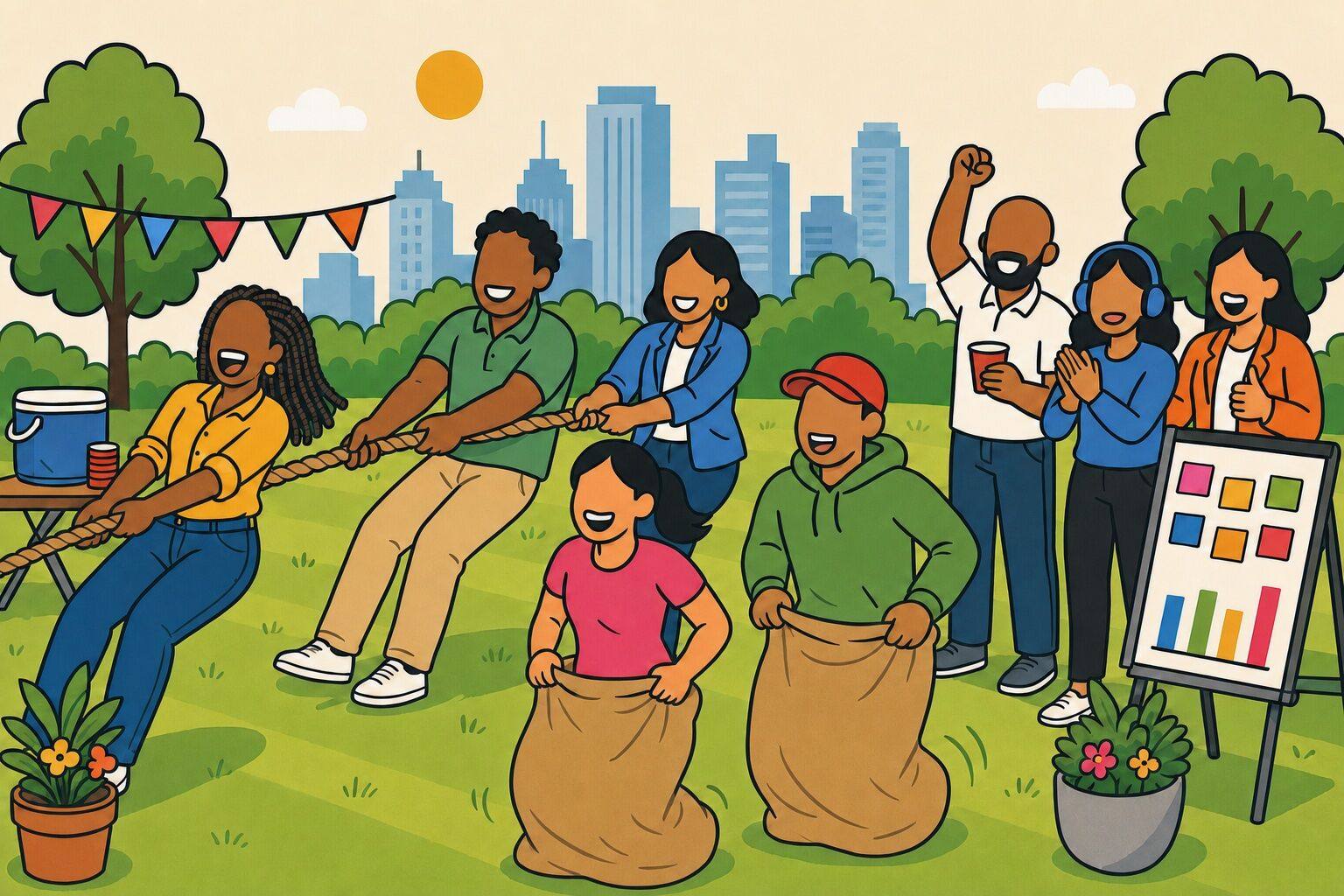
A sorted list of 40 outdoor games for adults and groups, from no-equipment field games to yard games, party games and quick 10-minute fillers, with full rules for each.
Outdoor games are the easiest win in group entertainment. Move a gathering onto a lawn, a field, or a stretch of park, and the things that make indoor events hard — cramped seating, low energy, people checking their phones — mostly solve themselves.
We run team events for a living, so we have watched a lot of groups play outside: office game days, company picnics, retreat afternoons, and full field day competitions. Some games earn their spot every single time. Others look great on a list and fall apart the moment 40 adults are standing in the grass waiting for instructions.
This guide is our sorted version. Every game below includes how to play it, what it costs, how many people it works for, and where it tends to go wrong. There are no-equipment options for when you show up empty-handed, yard and lawn games for backyards and patios, party games for bigger celebrations, and a short list of the outdoor games we think you should skip.
This list includes:
Here we go!
Outdoor games are group activities played in open-air spaces like yards, parks, fields, beaches, and campgrounds, using the extra room and the fresh air as part of the fun. Examples include an outdoor scavenger hunt, capture the flag, tug-of-war, cornhole, and a water balloon toss. The purpose of outdoor games is to get people moving, talking, and competing in a setting that lowers everyone's guard. These games are also called "outdoor group games," "outside games," "yard games," "lawn games," "garden games," and "outdoor games for adults."
Outdoor games are the open-air branch of large group games and the recreational half of outdoor team building. They are similar to backyard games for adults, field day games, campfire games, and summer team building activities, and the opposite of indoor group games. Within the category, this guide covers no-equipment games, yard and lawn games, party games, quick games, and low-impact options. Outdoor games show up most often inside company picnics and ORTBOs, which are offsite retreat days built around them.
Here are all 40 games, with the group size, run time, and cost for each. Pick a row and jump straight to the instructions.
| Game | Best for | Group size | Time | Cost |
|---|---|---|---|---|
| The Human Knot | Problem-solving | 8–16 per knot | 10–15 min | Free |
| Camouflage | Observation and stealth | 8–25 | 15–20 min | Free |
| Sardines | Big parks and wooded sites | 10–40 | 15–30 min | Free |
| Evolution | Icebreaking and laughter | 12–100+ | 10 min | Free |
| Shipwreck | Energy and movement | 15–80 | 10–15 min | Free |
| Silent Line-Up | Nonverbal communication | 8–50 | 5–10 min | Free |
| Ninja | Reflexes and silliness | 6–20 per circle | 10 min | Free |
| Walking Brainstorm | Creative thinking | 4–30 | 20–30 min | Free |
| Capture the Flag | Strategy and competition | 20–100+ | 20–40 min | $–$$ |
| Tug-of-War | A big finish | 20–100+ | 10–20 min | $$ |
| Field Day Relay Circuit | Whole-group competition | 25–150 | 60–90 min | $$ |
| Outdoor Scavenger Hunt | Exploring a park or campus | 10–100+ | 30–60 min | Free–$ |
| Amazing Race Course | All-day offsites | 16–120 | 90+ min | $$ |
| Kickball | Casual sport everyone knows | 12–30 | 45–60 min | $ |
| Ultimate Frisbee | Active groups | 10–28 | 30–60 min | $ |
| Group Juggle | Learning names | 10–30 per circle | 10–15 min | $ |
| Egg Drop Challenge | Creative problem-solving | 10–60 | 30–45 min | $ |
| Cornhole | Tournament brackets | 4–40 | 20–60 min | $$ |
| Giant Jenga | Low-pressure mingling | 2–12 at a time | 10–20 min | $$ |
| Ladder Toss | Backyards and patios | 4–16 | 15–30 min | $ |
| Bocce | Slower, conversational play | 4–12 | 20–40 min | $$ |
| Kan Jam | Pairs competition | 4–24 | 20–30 min | $ |
| Spikeball | Fast, athletic play | 4–16 | 20–40 min | $$ |
| Giant Four in a Row | Head-to-head strategy | 2–10 | 10–20 min | $$ |
| Water Balloon Toss | Hot days | 10–60 | 15–20 min | $ |
| Sack Race | Picnics and field days | 10–60 | 10–15 min | $ |
| Outdoor Twister | Small party crowds | 4–12 at a time | 10–20 min | $ |
| Beach Ball Icebreaker | Getting people talking | 8–40 | 10–20 min | $ |
| Chalk Pictionary Relay | Creative teams | 8–40 | 20–30 min | $ |
| Balloon Stomp | A loud, funny opener | 10–50 | 5–10 min | $ |
| Musical Blankets | Party crowds | 10–40 | 10–15 min | Free–$ |
| Minefield | Trust and clear instructions | 8–40 | 10–15 min | $ |
| Count to Twenty | Focus and listening | 6–25 | 5 min | Free |
| Two-Minute Photo Challenge | Instant energy | 8–100+ | 5–10 min | Free |
| Freeze Frame | Creativity and laughs | 8–30 | 10 min | Free |
| Categories Circle | Warming up a crowd | 8–25 | 5–10 min | Free |
| Human Bingo | Mixing strangers | 15–200 | 15–20 min | Free |
| Storytelling Circle | Evenings and campfires | 6–25 | 20–40 min | Free |
| Outdoor Yoga | Recovery and calm | 5–60 | 30–60 min | $$ |
| Picnic Trivia | Playing while seated | 8–80 | 20–40 min | Free |
These games need nothing but a patch of open ground. They are the ones to memorize, because the moment you actually need a game is usually the moment the supplies are still in someone's trunk.
The Human Knot is a tangle-and-untangle puzzle that turns a standing circle into a group problem to solve. It is the most portable team game there is.
Here is how to play:
Run several knots at once for bigger groups. If a knot stalls completely, grant one "surgery" where a single pair may release and re-grip.
Best for: Problem-solving and physical icebreaking
Time: 10–15 minutes
Materials (cost): None (free)
What we've learned: Knots solve faster when one person narrates instead of everyone pulling at once. If the group is silent after 60 seconds, ask them to pick a caller. Here is a longer guide to the human knot.
Camouflage is a stationary hide-and-seek game for wooded parks and campgrounds. The seeker never moves, which makes hiding far harder than it sounds.
Here is how to play:
Best for: Observation, stealth, and wooded sites
Time: 15–20 minutes
Materials (cost): None (free)
Sardines is hide-and-seek in reverse. One person hides, and everyone who finds them squeezes into the same hiding spot until the last searcher is left wandering alone.
Here is how to play:
Best for: Large parks, campgrounds, and wooded retreat sites
Time: 15–30 minutes
Materials (cost): None (free)
What we've learned: The comedy is in the cramming, so a small hiding spot beats a clever one. Tell the first hider to pick something that fits four people, not twelve.
Evolution is a rock-paper-scissors tournament where winners level up through a chain of characters and everyone plays at once. It scales to a hundred people and takes under 10 minutes.
Here is how to play:
Best for: Icebreaking a big crowd fast
Time: 10 minutes
Materials (cost): None (free)
What we've learned: Demonstrate every pose yourself before starting. Groups commit to a silly game when the person running it commits first, and they hold back when the host explains the poses without doing them.
Shipwreck is a call-and-respond elimination game where the host shouts commands and the slowest players drop out. It burns off the restless energy that builds up in the first 20 minutes of any outdoor event.
Here is how to play:
Best for: Waking up a group between sessions
Time: 10–15 minutes
Materials (cost): None (free)
Silent Line-Up asks a group to sort itself into order without speaking. It is short, it works with any number of people, and it reliably produces one genuinely funny misunderstanding.
Here is how to play:
For groups over 25, split into teams and race them.
Best for: Nonverbal communication and quick mixing
Time: 5–10 minutes
Materials (cost): None (free)
What we've learned: Sorting by commute distance beats sorting by birthday for work groups. People learn something they did not know about each other, which is the actual point.
Ninja is a turn-based reflex duel played in a circle, where players take one frozen strike at a time and try to tag an opponent's hand.
Here is how to play:
Best for: Reflexes, silliness, and photos
Time: 10 minutes
Materials (cost): None (free)
A Walking Brainstorm turns an idea session into an outdoor activity. Pairs take a loop of the park with one question to chew on, then bring the best ideas back to the group.
Here is how to play:
Stanford researchers Marily Oppezzo and Daniel Schwartz found in a set of experiments published in the Journal of Experimental Psychology that walking boosted creative idea generation by an average of around 60% compared with sitting, and that 81% of participants in their first experiment were more creative while walking. The effect is specific to generating ideas rather than narrowing them down, which is exactly what this format asks people to do.
Best for: Creative thinking and one-on-one connection
Time: 20–30 minutes
Materials (cost): None (free)
What we've learned: Give pairs one question, not three. Groups that get a list spend the whole walk deciding which question to answer.
Once a group passes about 25 people, most games break. Either everyone stands around waiting for a turn, or the instructions take longer than the game. The formats below are built for crowds, with everyone active at the same time.
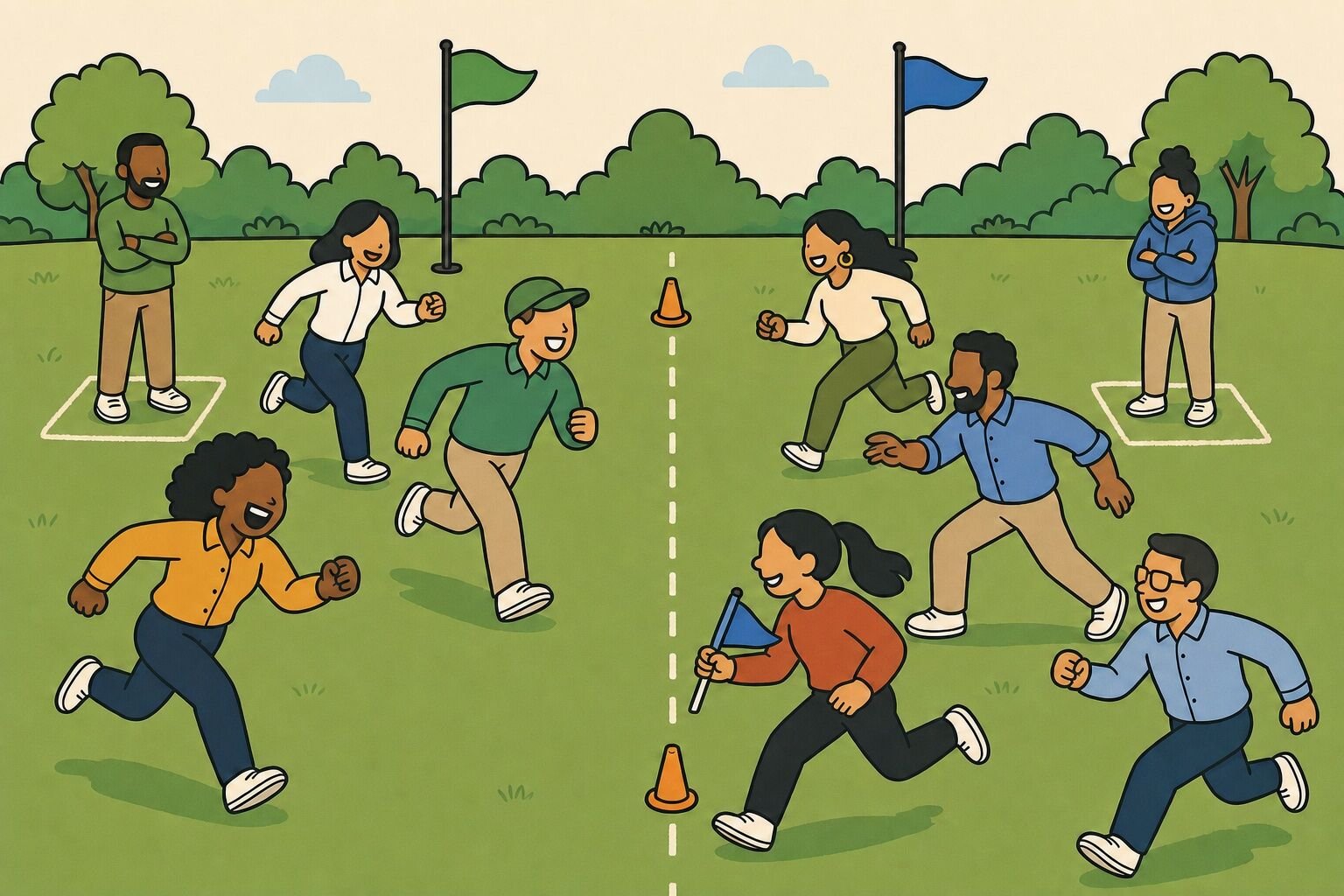
Capture the Flag may be the best large-group outdoor game ever invented, and it is still the one teams talk about afterward. Two territories, two flags, and one long stretch of open grass.
Here is how to play:
Best for: Strategy, competition, and big open spaces
Time: 20–40 minutes
Materials (cost): Two flags or bandanas and a set of cones ($15–$30)
What we've learned: The strategy huddle is what makes this a team game instead of a running game. Teams that assign defenders, runners, and a jailbreak crew in advance have a much better time than teams that sprint off unorganized.
Tug-of-War is the classic closer for an outdoor event. It takes 30 seconds to explain, every single person contributes, and the photos are excellent.
Here is how to play:
Best for: Ending a field day on a high
Time: 10–20 minutes
Materials (cost): Tug-of-war rope ($40–$80)
What we've learned: Never let anyone loop the rope around a wrist or waist. Say it out loud before every pull, because one person always tries it.
A relay circuit strings four to six short challenges into one running competition, so a big group cycles through stations instead of queueing for a single game.
Here is how to play:
Best for: Whole-group competition at a picnic or offsite
Time: 60–90 minutes
Materials (cost): Station supplies and a scoreboard ($60–$150)
What we've learned: Post the scores where everyone can see them. Visible standings are the difference between a relay that people take seriously and one where teams quietly stop running.
An outdoor scavenger hunt sends small teams across a park, campus, or neighborhood chasing a list of items, photos, and challenges. It is the most flexible game on this list, because the list is the game.
Here is how to play:
Best for: Exploring a park, campus, or downtown
Time: 30–60 minutes
Materials (cost): A printed list and phone cameras (free–$10)
What we've learned: Photo challenges beat find-an-object challenges. Objects create arguments about whether something counts, while photos create the moments people actually share afterward. Here are more scavenger hunt ideas.
An Amazing Race course chains checkpoints across a wider area, each with a challenge teams must finish before they get the clue to the next one. It fills an afternoon and works as the centerpiece of an offsite.
Here is how to play:
Best for: Half-day offsites and retreats
Time: 90 minutes or more
Materials (cost): Printed clues, envelopes, and volunteers ($40–$100)
What we've learned: Walk the whole route yourself the day before with a stopwatch. Courses that look 30 minutes long on a map almost always run twice that. Here is a set of DIY Amazing Race games to build challenges from.
Kickball is baseball with a big rubber ball and no skill barrier, which is why it remains the default company sport.
Here is how to play:
Best for: A casual sport everyone already understands
Time: 45–60 minutes
Materials (cost): Rubber kickball and bases ($25–$40)
What we've learned: Add a house rule that the kicking order must alternate between people from different departments. It quietly breaks up the cliques that otherwise pick teams together.
Ultimate Frisbee is a non-contact field sport where teams move a disc downfield by passing, and no one may run while holding it.
Here is how to play:
Best for: Groups with an active streak
Time: 30–60 minutes
Materials (cost): One disc and cones ($15–$25)
Group Juggle is a name-learning game disguised as a throwing challenge. A circle establishes one throwing pattern, then keeps adding balls until it collapses in laughter.
Here is how to play:
Best for: Learning names at a mixed-team event
Time: 10–15 minutes
Materials (cost): Three to five soft balls ($10–$20)
What we've learned: Insist on names every single throw. The moment the circle drops the names it becomes a juggling drill instead of an introduction, and the point is gone.
The Egg Drop Challenge gives teams a pile of scrap materials and one raw egg, and asks them to build something that survives a fall.
Here is how to play:
Best for: Creative problem-solving with a clear win condition
Time: 30–45 minutes
Materials (cost): Craft scraps and eggs ($15–$30)
What we've learned: Adding a presentation round is what turns this from a craft project into a team activity. Quiet teams suddenly have to agree on what their design was supposed to do.
Yard games are the backbone of any backyard gathering, patio happy hour, or company picnic. Nobody has to be athletic, play pauses naturally for conversation, and people drift in and out without anyone feeling left out.
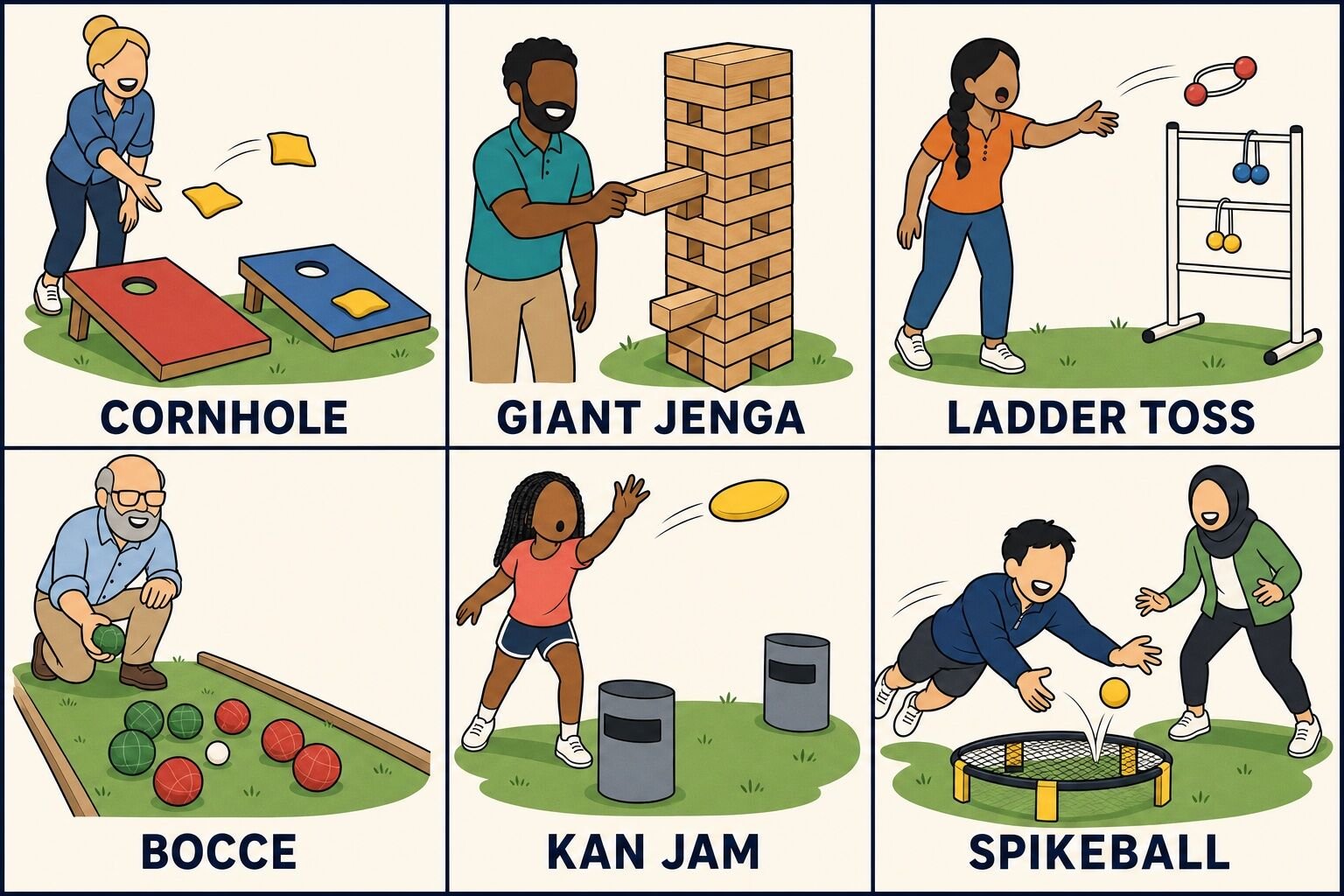
Cornhole is the most reliable yard game for adults. Two boards, eight bags, and a bracket, and a group will play for hours.
Here is how to play:
Best for: A tournament bracket that runs all afternoon
Time: 20–60 minutes
Materials (cost): Cornhole set ($80–$150)
What we've learned: Run cornhole as a bracket with a printed sheet rather than open play. A bracket gives people who do not know each other a reason to talk and a scheduled time to show up.
Giant Jenga is the standard tumbling tower scaled up to waist height, so a crowd can gather around one nerve-wracking block.
Here is how to play:
Best for: Low-pressure mingling with an audience
Time: 10–20 minutes
Materials (cost): Giant tumbling tower set ($60–$120)
Ladder Toss, also called ladder golf, has players throwing linked balls at a three-rung ladder. It travels well and sets up in under a minute.
Here is how to play:
Best for: Small backyards and patios
Time: 15–30 minutes
Materials (cost): Ladder toss set ($30–$60)
Bocce is a rolling game of precision where teams try to land heavy balls closest to a small target ball. It is the most conversational game on this list.
Here is how to play:
Best for: Groups who want to talk while they play
Time: 20–40 minutes
Materials (cost): Bocce set ($40–$90)
What we've learned: Bocce is the game to set up next to the food table. It moves slowly enough that people can hold a plate and still take a turn, which keeps the crowd from splitting into an eating group and a playing group.
Kan Jam is a two-on-two flying disc game where one partner throws and the other deflects the disc toward a slotted can.
Here is how to play:
Best for: Pairs who want a real competition
Time: 20–30 minutes
Materials (cost): Kan Jam set ($40–$60)
Spikeball, also known as roundnet, is played around a small trampoline-style net at ankle height, with two-person teams spiking a ball into it.
Here is how to play:
Best for: Groups that want something fast and athletic
Time: 20–40 minutes
Materials (cost): Roundnet set ($60–$100)
Giant Four in a Row is the classic disc-dropping strategy game scaled up to a freestanding frame, so a crowd can watch two people think.
Here is how to play:
Best for: Head-to-head strategy with an audience
Time: 10–20 minutes
Materials (cost): Giant four-in-a-row set ($70–$120)
Outdoor party games trade precision for volume. These are the loud, slightly ridiculous formats that work at a summer barbecue, a milestone celebration, or the afternoon block of a company picnic, where the goal is laughter rather than a leaderboard.
The Water Balloon Toss is a partner game where pairs step further apart after every successful catch, until the balloon does what water balloons do.
Here is how to play:
Best for: Hot days and picnics
Time: 15–20 minutes
Materials (cost): Balloons, water, and a bucket ($10–$20)
What we've learned: Warn people in advance that they might get wet. Soaking a colleague who came straight from a client meeting is the fastest way to turn a fun game into an apology.
The Sack Race is a hopping sprint in a burlap bag, and it is still one of the funniest things a group of adults can do in a field.
Here is how to play:
Best for: Picnics and field day heats
Time: 10–15 minutes
Materials (cost): Burlap sacks ($20–$40 for a set)
Outdoor Twister is the twisting balance game played on a giant grass mat, or painted straight onto the lawn with field-marking spray.
Here is how to play:
Best for: Smaller party crowds with an audience
Time: 10–20 minutes
Materials (cost): Mat or field-marking spray ($20–$40)
The Beach Ball Icebreaker turns a beach ball into a question machine. Whatever prompt lands under your thumb is the one you answer.
Here is how to play:
Best for: Getting a new or mixed group talking
Time: 10–20 minutes
Materials (cost): Beach ball and a marker ($8–$15)
What we've learned: Write the prompts yourself instead of buying a pre-printed ball. Prompts that reference your actual team, office, or upcoming plans get much better answers than generic favorites questions.
Chalk Pictionary Relay moves the drawing game onto a sidewalk or parking lot, with teams sprinting between the clue-giver and their drawing square.
Here is how to play:
Best for: Creative teams with pavement nearby
Time: 20–30 minutes
Materials (cost): Sidewalk chalk and word cards ($10)
Balloon Stomp gives everyone a balloon tied to one ankle and one instruction: protect yours, pop everyone else's. It is chaos, and it lasts about four minutes.
Here is how to play:
Best for: A loud opener that wakes everyone up
Time: 5–10 minutes
Materials (cost): Balloons and string ($10)
What we've learned: Run this on grass, never on pavement, and check for anyone in dress shoes or with a knee issue before you start. It is the most fun game here and the easiest one to get wrong.
Musical Blankets is musical chairs for a lawn, with picnic blankets instead of seats and whole groups instead of individuals.
Here is how to play:
Best for: Party crowds who want something silly and social
Time: 10–15 minutes
Materials (cost): Blankets and a speaker (free–$30)
These are the fillers. Use them when the caterer is 15 minutes late, when the group is drifting after lunch, or when you need one last shared moment before everyone gets back on the bus.
Minefield sends a blindfolded player across a field of obstacles using only their partner's voice. It is the sharpest communication exercise on this list and takes 10 minutes.
Here is how to play:
Best for: Communication under pressure
Time: 10–15 minutes
Materials (cost): Blindfolds and cones ($15–$25)
What we've learned: Guides almost always start with directions that only make sense from where they are standing, like "go left," without saying whose left. Point that out in the debrief and the second round gets dramatically better.
Count to Twenty asks a circle to count aloud to 20 with no order and no plan. If two people speak at once, the count resets. It sounds trivial and it is genuinely hard.
Here is how to play:
Best for: Focus, listening, and a shared small win
Time: 5 minutes
Materials (cost): None (free)
The Two-Minute Photo Challenge is one prompt, one timer, and a phone. Teams scatter, stage a photo, and come back to a vote.
Here is how to play:
Best for: Instant energy with zero setup
Time: 5–10 minutes
Materials (cost): Phones (free)
Freeze Frame asks small groups to build a still, silent tableau of a scene, then hold it while everyone else guesses what it is.
Here is how to play:
Best for: Creative groups and post-lunch slumps
Time: 10 minutes
Materials (cost): Scene cards (free)
Categories Circle is a rhythm game where the group claps a steady beat and players name items in a category on the beat, without repeating or hesitating.
Here is how to play:
Best for: Warming up a crowd before the main activity
Time: 5–10 minutes
Materials (cost): None (free)
Not everyone wants to sprint across a field, and a game plan that assumes they do quietly excludes people. These formats keep everyone in the same activity, whether they are standing, sitting, or using a mobility aid.
Human Bingo hands everyone a grid of "find someone who…" squares and turns a milling crowd into a conversation engine. Players walk at whatever pace suits them, and the game works just as well seated at picnic tables.
Here is how to play:
Best for: Mixing groups who do not know each other
Time: 15–20 minutes
Materials (cost): Printed cards and pens (free)
What we've learned: Write a handful of squares that only fit one or two specific people in the room. Those squares are the ones that send players hunting and get strangers talking.
A Storytelling Circle gives a group one prompt and passes the story around, each person adding a sentence or two. It is the natural evening activity once the sun drops and the active games are done.
Here is how to play:
Best for: Evenings, retreats, and campgrounds
Time: 20–40 minutes
Materials (cost): None (free)
What we've learned: The true-story version is the better one for work groups. Invented stories turn into a competition over who can be funniest, while real ones are what people remember about the trip.
An outdoor yoga session is the recovery block of an outdoor event: a guided stretch on the grass that resets a group after a competitive afternoon.
Here is how to play:
Best for: Winding down a long offsite
Time: 30–60 minutes
Materials (cost): Instructor and mats ($150–$400 per session)
What we've learned: Announce the seated variations from the front instead of waiting for someone to ask. People who need a modification usually will not raise their hand in front of coworkers. Here is more on team building yoga.
Picnic Trivia runs a full trivia tournament from picnic tables and blankets, so the whole group can compete while eating.
Here is how to play:
Best for: Competing without leaving the table
Time: 20–40 minutes
Materials (cost): Printed sheets and a loud voice (free)
What we've learned: The company round is always the best round. Questions about your own team's history get more shouting than any general knowledge category, and new hires learn the folklore in the process.
Playing outdoor games with coworkers is different from playing them with friends. The group did not choose each other, fitness levels vary more than anyone admits, and there is a power dynamic in the field whether or not anyone mentions it. A few adjustments make the difference.
Here is how we run outdoor games for work groups:
If you would rather have someone else handle equipment, hosting, and scoring, you can browse outdoor team building activities to book.
A few patterns show up across the outdoor events we run and the ones our clients plan themselves.
Outdoor season is short, and September is the peak. In-person team building is concentrated far more than most planners expect, and the good venues and hosts go early.
If you are planning an outdoor game day, put it on the calendar in the spring. By August, September Fridays at popular parks and venues are already gone.
Group size changes the game, not just the headcount. The same activity behaves completely differently at 12 people and at 60. Here is how we split it.
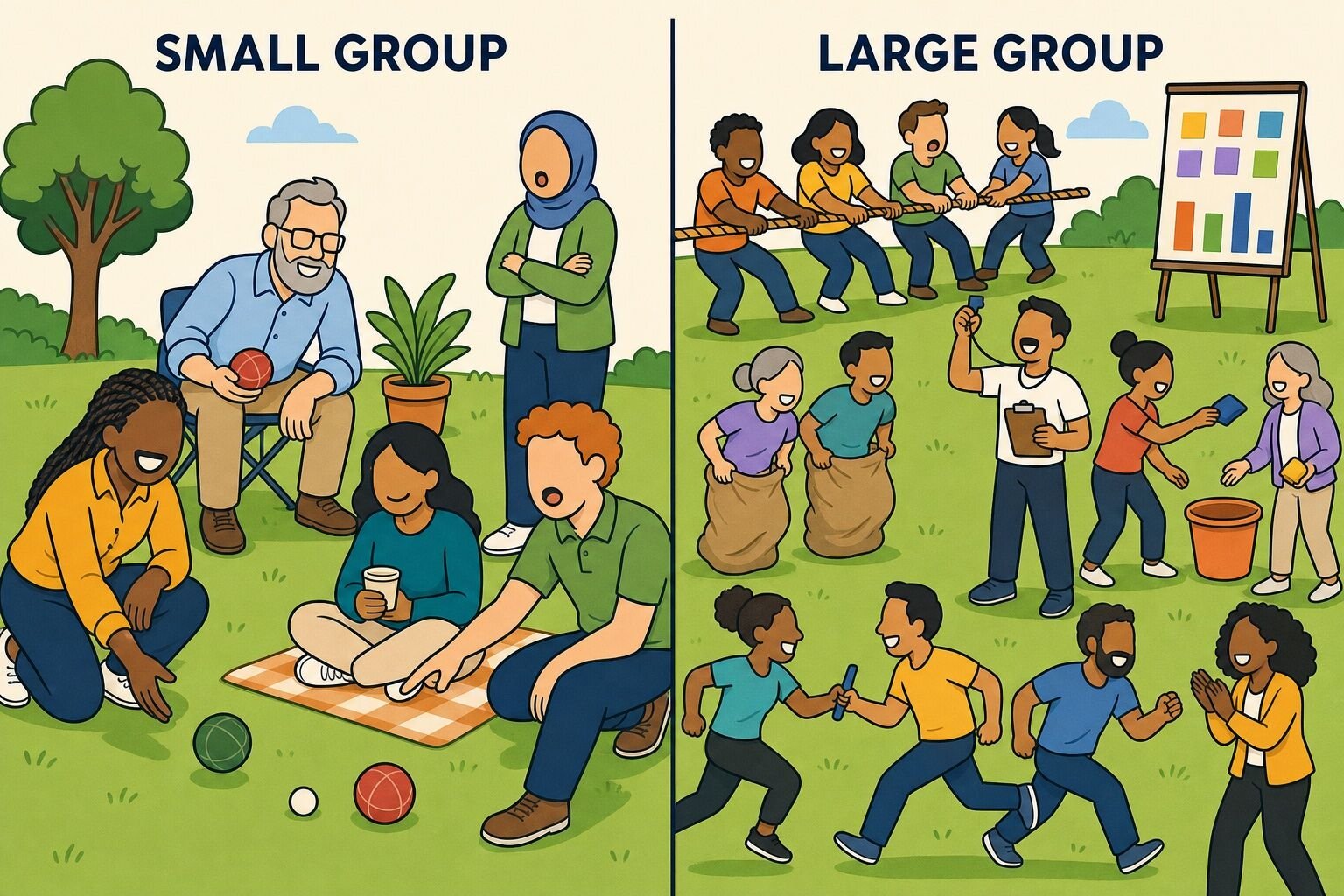
| Small groups (under 20) | Large groups (20+) | |
|---|---|---|
| What works | Circle games, yard games, conversational formats like Bocce and Storytelling Circle | Team-vs-team formats where everyone plays at once, like Capture the Flag and Field Day Relay Circuit |
| What breaks | Anything needing many teams, or a bracket that runs out of players by round two | Anything with one turn at a time, or rules that take more than 90 seconds to explain |
| Instructions | Explain once, standing in the circle | Explain to team captains, then let captains brief their teams |
| Equipment | One set per game | Multiple sets running in parallel, or stations on a rotation |
| Timing | Flexible, let good games run long | Hard whistle every block, or the schedule collapses |
| Biggest risk | One dominant personality takes over | A third of the group standing around waiting |
The bottleneck is almost always instructions, not the game. Rules that take four minutes to explain lose a field of adults. Demonstrate instead of describing: run one visible practice round with volunteers, then start for real.
Shade, water, and bathrooms decide the day. More outdoor events are ruined by a 90-degree afternoon with one water cooler than by a bad game choice. Scout the site, count the shaded seating, and find the nearest restroom before you finalize anything.
Competition works better than it should. Even a token prize changes how a group plays. A trophy that costs $15 and gets passed between departments produces more effort than a gift card nobody mentions again.
Plenty of outdoor games get recommended by lists that have clearly never run them with a group of adults. These are the ones we avoid, and why.
| Activity | Why skip it | Verdict |
|---|---|---|
| Trust falls | Being caught by coworkers is a physical-consent problem and a liability problem at the same time, and the trust it builds does not survive the parking lot. Minefield teaches the same lesson without anyone falling backwards. | Skip it |
| Three-legged races | Tying two colleagues together at the ankle forces physical closeness that nobody opted into, and ankle injuries on uneven grass are common. | Skip it |
| Human pyramids | People kneel on each other's backs with no training and no spotters. This is how outdoor events end in an urgent care waiting room. | Skip it |
| Truth or Dare | The dares that are actually fun cross professional lines, and the workplace-safe version is too watered down to be worth playing. If you want the format anyway, our truth or dare generator keeps the prompts safe for work. | Usually skip |
| Hopscotch | One person plays at a time while everyone else watches, and adults read it as a kids' game, so participation collapses after the first volunteer. | Not for adults |
| Fort building with natural materials | Long build time, minimal payoff, and it damages the site. Many parks explicitly prohibit moving deadwood. Use the Egg Drop Challenge for the same build-and-test energy. | Skip it |
| Water gun ambushes | Surprise soakings are a consent problem, and the people who get targeted are rarely the ones who wanted to play. Announced water games like Water Balloon Toss are fine. | Announce or skip |
| Mud runs and obstacle course races | These gate participation on fitness, require a change of clothes and a shower, and quietly exclude a big share of any work group. | Only if optional |
| Unstructured "go play outside" time | Without a game or a host, groups reform into the same cliques they arrived in, and the people who did not want to come stand near the food table. | Add structure |
Outdoor games are not complicated. The hard part is picking the right ones for the group in front of you and running them well: clear instructions, short blocks, a real option for everyone, and a plan for shade and weather.
Start with two or three games from this list rather than 10. A group that plays Cornhole and Capture the Flag properly will have a better afternoon than a group rushed through an over-packed schedule.
Next, check out our guides to team building camps, survival team building exercises, and office Olympics ideas.
Here are answers to common questions about outdoor games for adults and groups.
Outdoor games are group activities played in open-air spaces like yards, parks, fields, beaches and campgrounds. Examples include an outdoor scavenger hunt, capture the flag, tug-of-war, cornhole and a water balloon toss. The point of an outdoor game is to get a group moving, talking and competing in a setting with more room and fewer distractions than an indoor space.
The most reliable outdoor games for adults are the ones that scale with the crowd and pause naturally for conversation:
All five work for mixed fitness levels and take under a minute to explain.
The Human Knot, Camouflage, Sardines, Evolution, Shipwreck, Silent Line-Up, Ninja and a Walking Brainstorm all need nothing but open ground and a group of people. They are worth memorizing, because the moment you actually need a game is usually the moment the supplies are still in someone's trunk.
For 20 or more people, pick formats where everyone is active at the same time rather than taking turns. Capture the Flag, tug-of-war, a field day relay circuit with rotating stations, an outdoor scavenger hunt and Human Bingo all work at scale. Above about 25 people, brief team captains and let them brief their own teams, or the instructions eat the activity.
September is the peak month for in-person team building, accounting for 12% of in-person event volume in teambuilding.com platform data from 2023 to 2025. That means popular parks, venues and hosts book up over the summer, so put an outdoor game day on the calendar in the spring rather than waiting until August.
Publish the plan in advance so people know how physical the day is and what to wear, and run a real second activity alongside every active block instead of offering a spectator seat. Human Bingo, picnic trivia, bocce and a storytelling circle all work standing, seated or from a mobility aid. Announce seated variations from the front rather than waiting for someone to ask in front of their coworkers.
Comments (0)
Leave a Comment