21 Connection Games & Activities for Adults That Build Real Rapport
Connection games are short group activities that surface what people have in common and give them a reason to talk. Here are 21 our hosts actually run, with steps, timings, and the ones we skip.
Published
·
Updated
We have hosted 45,000+ team building events for 1,000,000+ participants, earning 83,000+ reviews with an average rating of 4.96 out of 5 as of August 2026. The most common brief we get is not "make our team more productive." It is some version of "these people work together every day and they still do not know each other."
That gap got wider when teams spread out. Half a team in an office, half at home, a few in other time zones, and the hallway conversations that used to do this work quietly just stopped happening.
Connection games are the cheapest fix we know for that problem. They are short, they need almost nothing, and they do one job well: give two people who have never spoken a specific reason to start. The 21 games below are the ones our hosts actually run, plus a few we have retired and will explain why.
Connection games are short group activities designed to surface what people have in common and give them a reason to talk. Examples include Something in Common, Mingle Bingo, and Personal Trivia. Unlike a general team building exercise, the goal is not to solve a task together. The goal is for each participant to leave knowing one specific, true thing about someone they did not know before. They are also called "connection activities," "connecting games," "team connection activities," "connect games," and "connection exercises."
One quick disambiguation: if you landed here looking for the New York Times' Connections word puzzle, that is a different thing. It is a solo daily grid game. Everything below is a group activity you run with a team, a class, or a room of strangers.
The case for spending meeting time on this is stronger than it used to be. The U.S. Surgeon General's 2023 advisory on loneliness and isolation states that lacking social connection can increase the risk of premature death as much as smoking up to 15 cigarettes a day, and explicitly recommends that employers make social connection a strategic priority in the workplace. That risk comparison rests on Holt-Lunstad, Smith and Layton's 2010 meta-analysis in PLoS Medicine, which pooled 148 studies covering 308,849 participants and found that people with stronger social relationships had a 50% increased likelihood of survival over the study periods. The authors compare the effect to quitting smoking and rank it above obesity and physical inactivity. It is observational work, so it shows association rather than cause, but it is why "do they have a friend here?" is a workplace question and not a soft one.
These four are the workhorses. They assume a mixed room of adults who may not want to perform, they work in person or on a video call, and none of them require anyone to disclose anything personal they did not volunteer.
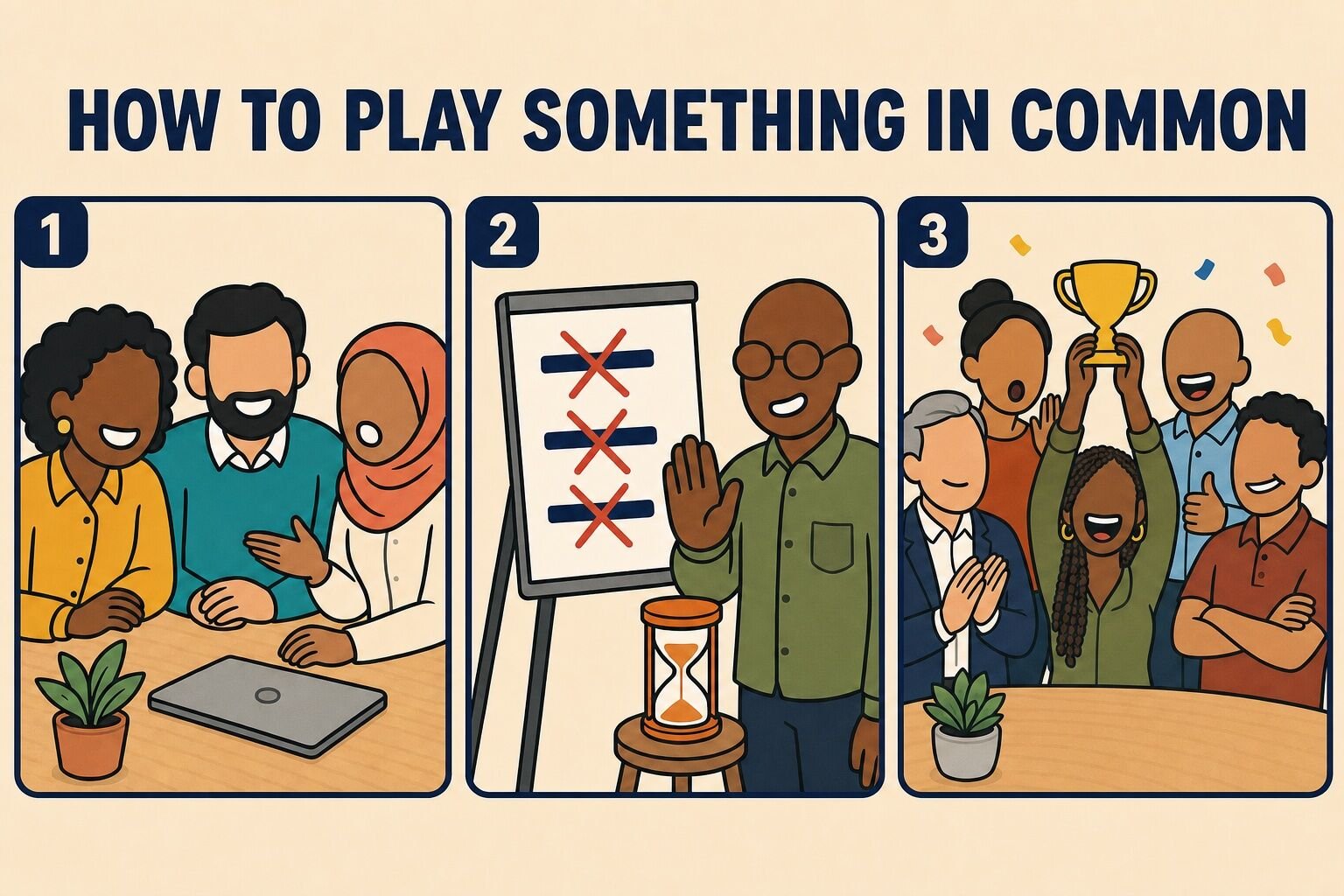
1. Something in Common
Something in Common is the game we reach for most often, because it scales from six people to six hundred without changing.
How to play:
Split the room into groups of four to six. In person, that is a table. On a video call, that is a breakout room.
Give each group five minutes to find one thing that is true of every single person in the group.
Read out the ban list before the timer starts: nothing about work, nothing about the meeting, and nothing everyone in the building shares. "We all have laptops" does not count.
Bring everyone back and have each group report their answer in one sentence.
The room votes on the most unusual commonality. Play a second round with reshuffled groups if you have time.
Best for: Turning a large meeting into a set of real conversations Time: 10 to 15 minutes Materials (cost): None (free)
What we've learned: The ban list is the entire game. Without it, every group returns with a variation of "we all work here" in ninety seconds and nobody talks for the remaining three and a half minutes. Reading the ban list out loud, before the timer, roughly doubles how long groups stay in conversation.
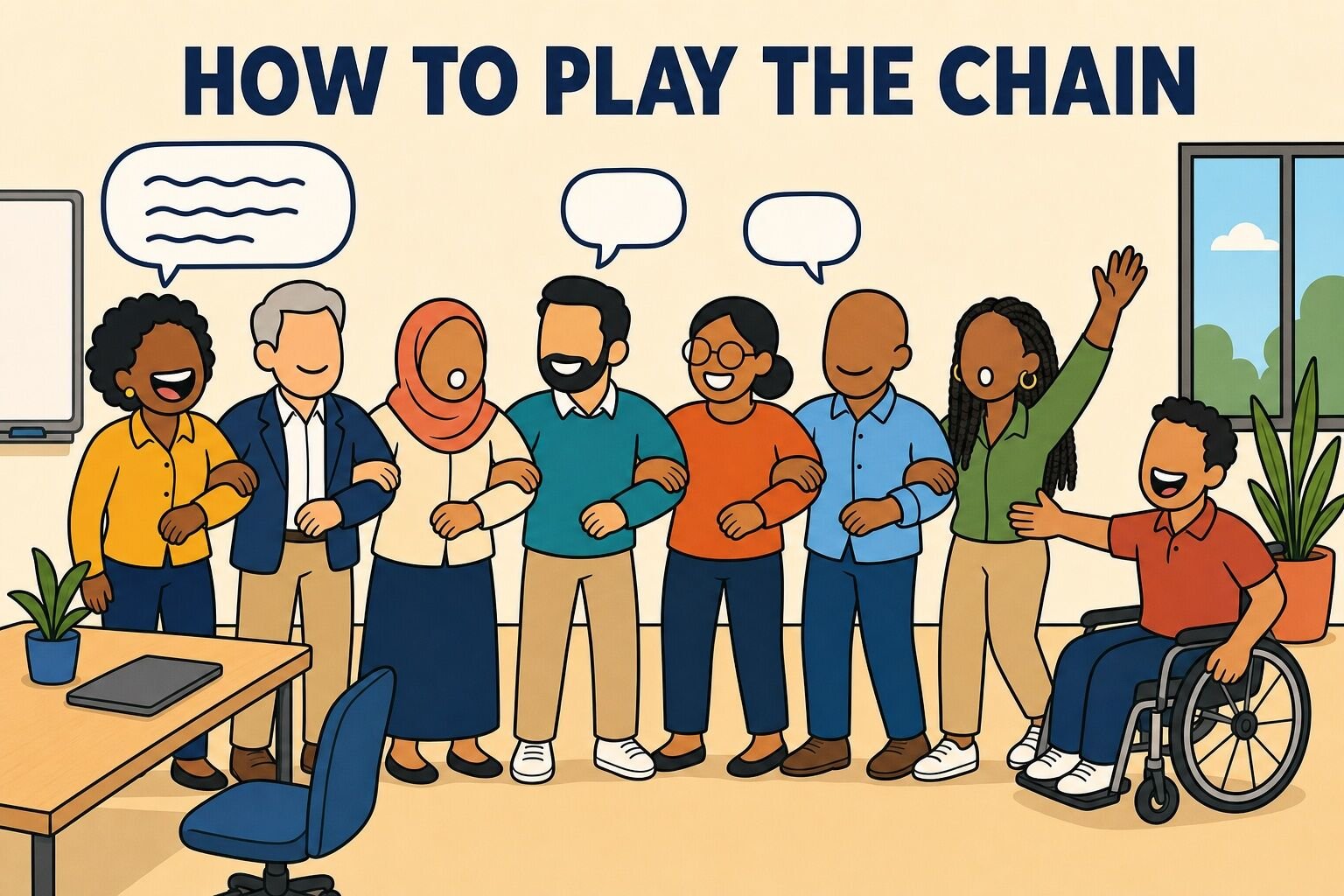
2. The Chain
The Chain links players together through shared experiences, and it gets a room moving without asking anyone to be funny on command.
How to play:
Players stand in a loose circle, or stay on camera for a virtual version.
The first player makes a specific statement about something they have done: "I have driven more than an hour for a sandwich."
Anyone who shares that experience links in. In person, they link arms with the speaker. On a call, they raise a hand and the host adds their name to a shared list.
The newest link makes the next statement, and the chain grows.
Play until everyone is connected. Then go back to the last few people to join and ask each of them to name something nobody else in the room has done.
Best for: Energizing a room and surfacing overlaps nobody expected Time: 10 to 20 minutes Materials (cost): None (free)
What we've learned: Specific statements build better chains than broad ones. "I like to travel" links half the room instantly and kills the suspense. "I have been to a country where I did not speak the language" links four people and produces three stories.
3. Personal Trivia
Personal Trivia turns your teammates into the quiz. It takes the most prep of anything on this list and consistently gets the biggest reaction.
How to play:
A week ahead, send a short form with five questions: a hidden talent, the furthest you have travelled, your first job, a food you refuse to eat, and one thing most teammates do not know about you.
Build a multiple-choice quiz where the question is the fact and the answer options are teammates.
Run it live and score on speed and accuracy. Any free quiz tool works.
After each answer, give the person ten seconds to explain. The explanation is the part people remember.
Best for: Teams who have met but do not actually know each other Time: 15 to 25 minutes Materials (cost): A form and a free quiz tool (free)
What we've learned: Over about twenty people, use photos rather than names as the answer options. Names of near-strangers are unguessable, so the game becomes a coin flip. Faces give people something to reason from. For more formats in this vein, see our guide to virtual trivia.
4. No One, Everyone
Each player names one thing they believe everyone in the group has done, and one thing they suspect nobody else has done.
How to play:
Going around the circle, each player says two statements: "Everyone here has burned a meal. No one here has been on live television."
The rest of the group signals agreement or disagreement with a thumbs up or thumbs down.
If someone disagrees with either claim, they say so and tell the story in under thirty seconds.
Score it if you like: one point for a correct "everyone," one point for a correct "no one."
Best for: Small and mid-size groups who enjoy a story Time: 10 to 20 minutes Materials (cost): None (free)
What we've learned: Cap each story at thirty seconds and enforce it cheerfully. One unlimited story per round is the difference between a fifteen-minute game and a forty-minute one.
Connection games for small groups
Small groups of four to eight are where connection games do their best work, because there is nowhere to hide and no need for breakout rooms. These three are built for pods and small teams.
5. Icebreaker Races
Icebreaker Races put a timer on getting to know each other, which stops people from overthinking their answers.
How to play:
Give each small group a list of questions and five minutes on the clock.
The group works down the list. They cannot move to the next question until every person has answered.
The team scores one point for every question the whole group answered inside the time limit.
When the timer stops, spend two minutes going back to the most interesting answer.
Best for: Getting equal participation without calling on anyone Time: 5 to 10 minutes Materials (cost): A question list (free)
What we've learned: The timer is doing the work here. The same questions asked without a clock produce careful, polished answers. With a clock, people say the first true thing that comes to mind, which is almost always more interesting. Our list of icebreaker questions works well as the source list.
6. The Overlap
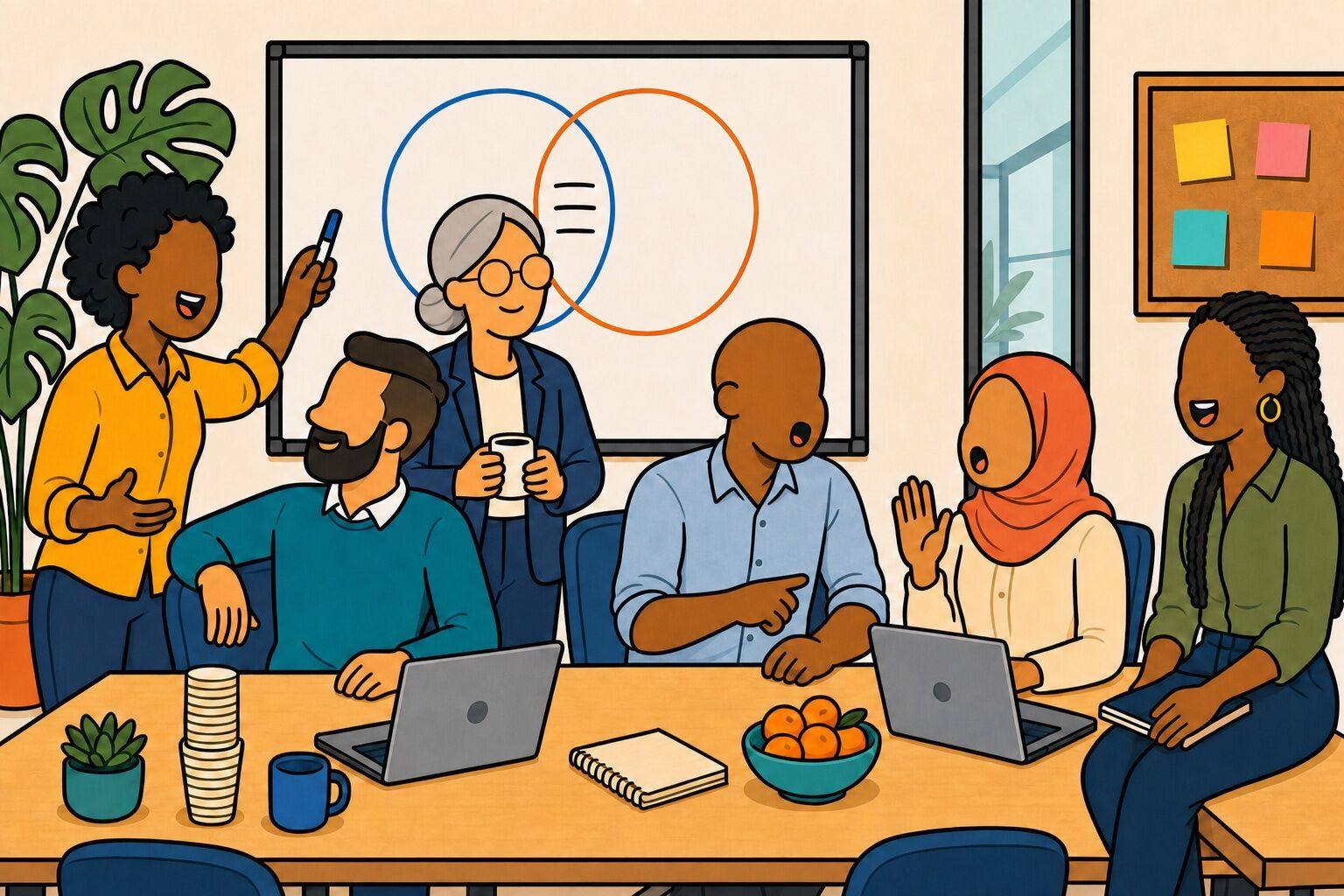
The Overlap is Something in Common played in pairs, with a drawing.
How to play:
Pair everyone up and give each pair a sheet of paper or a shared whiteboard frame.
Each pair draws two overlapping circles and writes their names above them.
They have four minutes to fill the overlapping middle with at least five things that are true of both of them, and the outer sections with one thing that makes each of them unusual.
Each pair reports their single best overlap to the room.
Rotate partners and run a second round if the group is new to each other.
Best for: Onboarding pairs, mentor matches, and small teams Time: 10 to 15 minutes Materials (cost): Paper and pens or a shared whiteboard (free)
7. Map It
Map It gives distributed teammates a visual reason to tell a story about themselves.
How to play:
Create a shared map. A collaborative online map works for remote teams; a printed world map and a box of pins works in an office.
Ask each person to mark one place that shaped them. Not where they live now, and not necessarily where they were born.
Go around and give everyone thirty seconds to say why that place.
Leave the map up. On a distributed team, it becomes the thing new hires add themselves to on day one.
Best for: Distributed and newly merged teams Time: 15 to 20 minutes Materials (cost): Free online map, or a printed map and pins (under $10)
What we've learned: Ask for "a place that shaped you," never "where are you from." The second question gets a city name and a full stop. The first one gets a story about a grandmother's kitchen or a summer job, which is the entire point of the exercise.
Connection games for large groups
Large group connection games have one job the small ones do not: manufacture the one-on-one conversations that a room of sixty people will never have on its own. These three do it with structure rather than volume. For more formats at this scale, see our large group icebreakers and large group energizers.
8. Mingle Bingo
Mingle Bingo, sometimes called Human Bingo, is the most reliable way we know to get a hundred strangers talking to each other in twenty minutes.
How to play:
Give every person a bingo card where each square is a description rather than a number: "has run a marathon," "speaks three languages," "has a pet that is not a cat or a dog."
Players circulate and find someone who matches a square. That person signs or initials the box.
One signature per person per card, so nobody can fill their card off a single friend.
Call the game when the first player gets a line, or keep going for a blackout.
Best for: All-hands meetings, conferences, and onboarding cohorts Time: 15 to 20 minutes Materials (cost): Printed or digital cards (free)
What we've learned: In a big room, play for blackout rather than five in a row. A line is won in about four minutes by whoever is most extroverted, and then everyone else stops. A blackout keeps the whole room circulating for the full twenty. For more variations, see icebreaker bingo and our guide to online team building bingo.
9. Person to Person
Person to Person is a fast in-person energizer that pairs and re-pairs a full room every ninety seconds.
How to play:
Everyone stands in an open space. An emcee calls out a pairing cue: "elbow to elbow," "high five to high five," "back to back."
Players find the nearest person and match the cue. Offer a no-contact option up front, such as matching a gesture at arm's length, so nobody has to opt out publicly.
When the emcee calls "person to person," the pairs turn to each other and each share three quick facts.
Pairs split, everyone finds a new partner, and the cycle repeats five or six times.
Best for: In-person groups of twenty or more who need to move Time: 10 to 15 minutes Materials (cost): Open floor space (free)
10. Speed Rounds
Speed Rounds is speed dating with the awkward part removed, because the host supplies the topic.
How to play:
Pair everyone off. In person, use two rows of chairs facing each other. On a call, use breakout rooms of two.
Put three minutes on the clock and give the room one prompt for that round.
When time is up, one row shifts one seat, or the host reshuffles the rooms, and a new prompt goes up.
Run five to seven rounds, then bring everyone back and ask for the best answer anyone heard.
Best for: New teams, offsites, and cross-department mixers Time: 20 to 30 minutes Materials (cost): A timer and a prompt list (free)
What we've learned: Every round needs a prompt. Rounds where the instruction is "just chat" reliably stall around the two-minute mark and both people end up staring at the timer. Our team bonding questions make a good prompt bank.
Connection activities for work
Connection activities for work have to survive contact with a calendar. The three below slot into meetings you are already having, or run in the background, which is why they are the ones that actually stick. They pair well with the formats in our list of team meeting games.
11. Appreciation Round
An Appreciation Round is a structured version of something most teams do badly or not at all.
How to play:
At the end of a project or a quarter, go around the group. Each person names one specific thing a teammate did recently that helped them.
Enforce one rule: a specific action, not an adjective. "Priya is great" does not count. "Priya rewrote the client deck at 9pm on Thursday" does.
Nobody may be thanked twice until everyone has been thanked once. The facilitator tracks this quietly.
Close it there. No discussion round, no follow-up actions.
Best for: Project wrap-ups, quarter closes, and retros Time: 10 to 20 minutes Materials (cost): None (free)
12. Rose, Bud, Thorn
Rose, Bud, Thorn is a three-word check-in that gives a recurring meeting a human opening.
How to play:
Each person shares a rose (something that went well), a bud (something they are looking forward to), and a thorn (something that is proving difficult).
Keep each answer to one sentence. Three people times three items is already a nine-item round.
Say out loud that the thorn is optional and the bud does not have to be about work.
Do not solve anything during the round. If a thorn needs action, note it and pick it up after.
Best for: Weekly team meetings and recurring standups Time: 5 to 15 minutes Materials (cost): None (free)
What we've learned: Make the thorn explicitly skippable, out loud, every time. When it is treated as mandatory, people invent a safe, work-shaped thorn and the round quietly turns into a status update, which is the thing you were trying to get away from.
13. Coffee Roulette
Coffee Roulette is the only item on this list that runs indefinitely without a facilitator, which is why it suits hybrid teams.
How to play:
Every week or fortnight, pair people at random across teams. A chat app can do this automatically, or a shuffled spreadsheet works fine.
Give each pair twenty minutes and a deadline of the end of the week to find the time themselves.
Send the pair a prompt along with the introduction, so neither person has to invent an opening.
Every month or so, ask in a public channel what people learned. That is what keeps sign-ups from decaying.
Best for: Distributed and hybrid organizations, ongoing Time: 20 minutes per pairing Materials (cost): Free chat app integration or a spreadsheet (free)
What we've learned: Pairing programs die from two causes: no prompt and no deadline. Pairs who get a question and a Friday deadline meet. Pairs who get an introduction and "find time sometime" do not. If your team lives in Slack, our Slack games list has more low-lift options.
Virtual connection games
Virtual connection games have to solve a problem that in-person games do not: on a video call, only one person can talk at a time, and the confident people take that slot. These three work around it. They run on any platform, including Zoom and Google Meet.
14. Photo Challenge
A Photo Challenge asks people to share a picture instead of an anecdote, which lowers the bar for the quieter half of the team.
How to play:
Post a prompt: a photo from exactly one year ago today, the view from your desk, the last thing you cooked, or a picture of you aged ten.
Everyone drops their photo into the chat or a shared album at the same time.
Spend five minutes letting the host pick three photos and ask the owner a follow-up question.
Run it async by posting the prompt in a channel on Monday and reviewing the album on Friday.
Best for: Virtual and async teams, and quieter groups Time: 10 to 20 minutes live, or a week async Materials (cost): A chat channel or shared album (free)
What we've learned: "Your camera roll from exactly one year ago today" outperforms themed prompts like "vacation" or "pets." Themed prompts get curated, flattering photos. The date prompt gets a blurry picture of a parking lot, which someone then has to explain, and the explanation is the connection.
15. Chat Waterfall
Chat Waterfall is a host technique more than a game, and it is the single most useful thing on this list for a video call with more than fifteen people.
How to play:
Ask one question with a short answer: the best thing you ate this week, the last app you deleted, your walk-on song.
Tell everyone to type their answer into the chat but not to press enter.
Count down from three. On "go," everyone sends at once and the chat fills in a single burst.
Read three answers out loud and ask each of those people one follow-up question.
Best for: Large video calls and teams where the same four people always answer Time: 3 to 5 minutes per question Materials (cost): The chat panel you already have (free)
What we've learned: The reason for the countdown is anchoring. When answers trickle in, the first one sets the tone and everyone else writes a variation of it. Sending all at once produces a genuinely varied wall of answers, and it is the only mechanic we know that gets close to full participation from a hundred-person call.
16. Group Playlists
A Group Playlist is the lowest-effort connection activity here, and it keeps working for weeks after you set it up.
How to play:
Create a collaborative playlist with a theme: songs from the year you turned sixteen, focus music, or songs that remind you of a place.
Share the link and ask everyone to add one or two tracks.
Once it is full, play it at a team social and challenge people to guess who added each song.
Keep it as the team's shared soundtrack. Add a new theme each quarter.
Best for: Remote teams who want something running in the background Time: 15 minutes to set up Materials (cost): A free music streaming account (free)
Quick connection activities
Quick connection activities fit inside a meeting you are already running. None of these take more than five minutes, and they can be repeated weekly without wearing out. For more short formats, see our list of quick team building activities.
17. This or That
This or That is a preference game that moves fast enough to work at any group size, from three people to a five-hundred-person webinar poll.
How to play:
Read out a pair of options. Everyone answers at once: hands up, emoji reaction, or a live poll.
Go quickly. Ten to fifteen prompts in five minutes.
When a vote splits close to evenly, stop and ask one person from each side to defend their answer in ten seconds.
Prompts that reliably split a room:
Morning or evening?
Window seat or aisle?
Cook or takeout?
Beach or mountains?
Text or call?
Plan the trip or wing it?
Sweet or savory breakfast?
Work in silence or with music?
Read the book or watch the adaptation?
Early to the airport or last call?
Best for: Meeting openers at any size Time: 5 minutes Materials (cost): None, or a free poll tool (free)
What we've learned: Close votes are the fun ones. A ninety-ten split gets a shrug; a fifty-two to forty-eight split gets an argument about airports that people are still having at lunch. Drop prompts that always land lopsided and keep the ones that divide the room. More formats like this live in our question games list.
18. Group Word Association
Group Word Association reveals which teammates think alike, and it takes about ninety seconds to explain.
How to play:
The host reads out a word. Everyone writes or types the first word that comes to mind, without pausing.
Reveal all answers at once.
Award a point to any pair of people who wrote the same word.
Run eight to ten words. Use a random word generator so nobody can accuse the host of steering it.
Best for: Warming up a quiet room before a working session Time: 5 minutes Materials (cost): None (free)
What we've learned: Abstract words beat concrete ones. "Chair" gets everyone writing "table." "Home" or "green" produces answers that people want to explain, which is where the connection actually happens. Our vocabulary games guide has more word-based options.
19. How Are You, Really?
This one is barely a game. It is a rule for the first three minutes of a recurring meeting, and it changes those meetings more than anything else on the list.
How to play:
Open the meeting by going around the group. Each person answers "how are you?" with one specific detail from the last day, not with "good" or "busy."
"Fine" is not an accepted answer. "Tired, the dog was up at four" is.
Nobody asks follow-up questions during the round unless the speaker invites them.
The facilitator goes first and models the specificity they want.
Best for: Daily standups and small recurring meetings Time: 3 to 5 minutes Materials (cost): None (free)
What we've learned: Our CEO keeps a public list of life lessons, and one of them is to answer "how are you?" with context beyond "good," because it turns a throwaway greeting into a real connection point. Run as a meeting rule, it is the highest-return three minutes in this article.
Picture connection games
Picture connection games are a different animal from the rest of this list. Instead of connecting people to each other, players connect images to each other to find a hidden word or phrase. They are a good brain break, they work at any group size, and they need no talking, which makes them useful when a room is fried. Teams who enjoy these usually also like our icebreaker riddles.
20. Picture Connection Puzzles
Each slide shows two or three simple images. Combine the sounds or the meanings and you get the answer.
How to play:
Build eight to twelve slides, each with two or three clip-art images side by side.
Show one slide at a time. Teams shout out, type in the chat, or write answers on paper.
Award a point for the first correct answer, and reveal the answer before moving on.
For a bonus round, swap the clip art for photos of teammates' desks, pets, or hometowns and ask the room to guess whose is whose.
Here is a starter set with the answers:
Picture clues
Answer
A bee + a leaf
Belief
A car + a pet
Carpet
A key + a board
Keyboard
A pan + a cake
Pancake
Butter + a fly
Butterfly
A note + a book
Notebook
A sun + a flower
Sunflower
Rain + a bow
Rainbow
A ham + a burger
Hamburger
A hand + a shaking hand
Handshake
Best for: Brain breaks, large rooms, and mixed-language groups Time: 10 to 15 minutes Materials (cost): A slide deck with clip art (free)
What we've learned: Do the personalized bonus round. Generic rebus puzzles are a pleasant five minutes; a slide showing three teammates' desks is the part that produces conversation afterwards, which is the only reason a connection game is on the agenda.
Connection activities for students
Connection activities for students have a different constraint: the group is usually larger, they will be together for months rather than an afternoon, and the first week sets the tone. Mingle Bingo, The Chain, and Speed Rounds all travel to a classroom or an orientation unchanged. This one is built for the longer timeline. Pair it with a few name games in week one.
21. People Passports
People Passports turn meeting each other into a collectable, which works far better with students and onboarding cohorts than a single icebreaker session does.
How to play:
Make a small booklet or shared document with one page per participant. Print them or keep them digital.
Each page carries two or three prompts: number of siblings, the strangest food combination you have tried, the job you wanted aged eight.
Give every participant a unique stamp, sticker, or emoji. When two people talk and fill in each other's prompts, they exchange marks.
Set a window of one to two weeks and a target, such as twenty stamps.
Completed passports are turned in for a small prize, and participants keep a copy as a reference for names.
Best for: Orientations, onboarding cohorts, and classrooms Time: Runs over one to two weeks Materials (cost): Printed booklets and stickers (under $2 per person)
What we've learned: Set a target number of stamps rather than "fill the whole passport." A full passport is unreachable in a cohort of a hundred and fifty, so people stop at four. A target of twenty is achievable, and almost everyone hits it.
What we have learned about running connection games
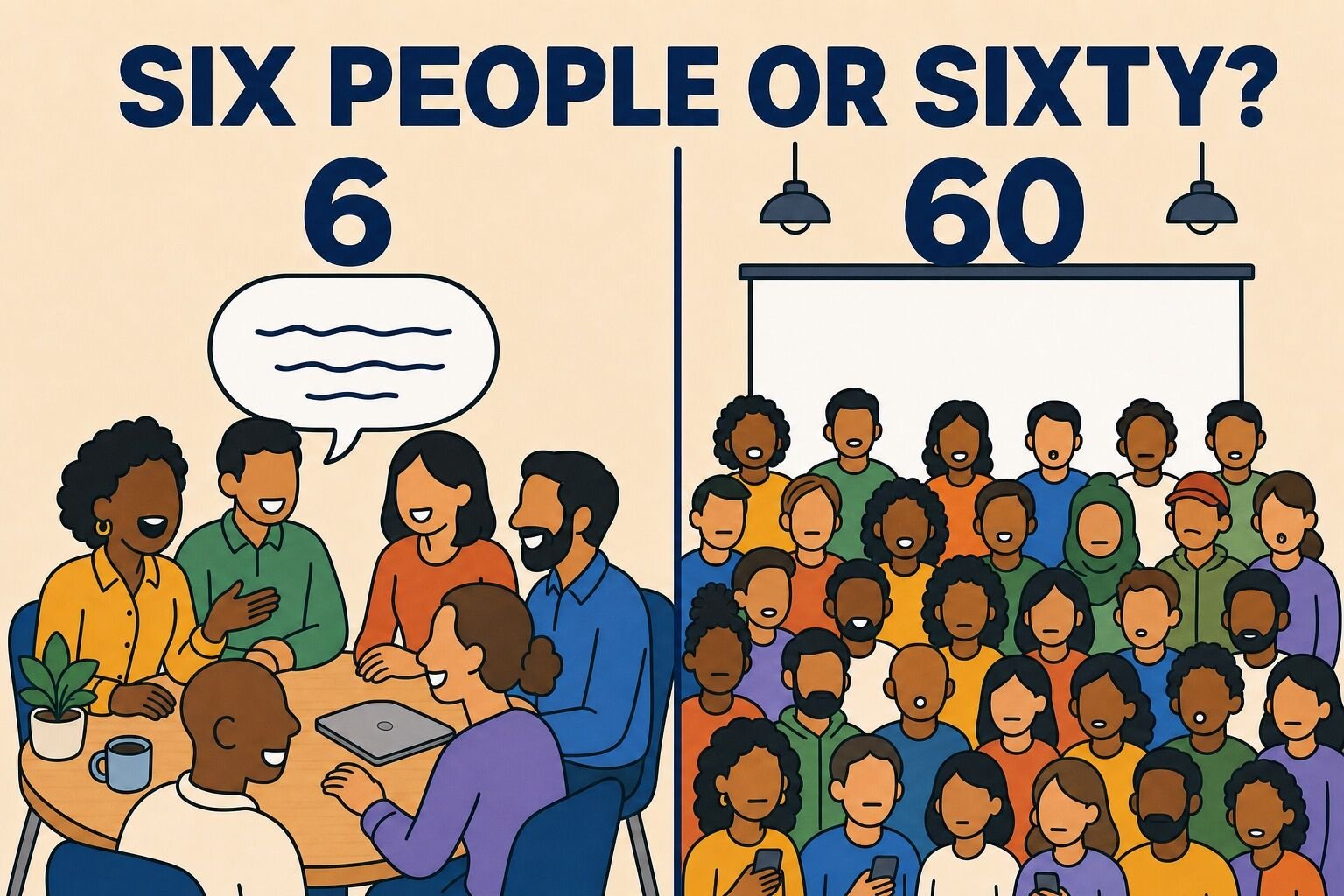
The median team building event we run has 16 participants, and half of all events fall between 10 and 27 people (teambuilding.com platform data as of August 2026). That number explains most of what goes wrong with connection games: they are designed for about a dozen people, and then run for sixty.
The fix is not a different game. It is breaking the room into the size the game was built for, and choosing a format that survives the split.
Group size
What changes
What to run
Under 8
Everyone can hear everyone. No breakouts, no facilitation overhead, and a pause is workable rather than fatal.
Three other things hold across almost every event we run.
Structure beats time. A twenty-minute game with a prompt and a timer produces more connection than a ninety-minute unstructured social. The unstructured version reliably sorts people back into the groups they already knew.
Specific beats deep. Teams get nervous about connection activities because they imagine being asked about their childhood. The ones that work at work are specific rather than deep: what you ate, where you have been, what is on your desk. Depth arrives later, on its own, once people have a reason to keep talking.
The follow-up question is the whole game. Any of these activities produces a list of facts. The connection happens when the host or a teammate asks the second question. Build thirty seconds of follow-up into every round and the same game does twice the work.
If you would rather have an experienced host run one of these for your team, we run virtual and in-person events you can browse here.
Connection games we do not recommend
Not everything filed under connection games belongs in a workplace or a classroom. Some of these are genuinely uncomfortable, some are just slow, and a couple are famous enough that they get suggested in every planning meeting anyway.
The Lame List
Activity
Why skip it
Verdict
Two Truths and a Lie
It works once, for a small group. Past about twelve people every participant needs a turn, the room does arithmetic instead of talking, and half the group has played it at three previous jobs.
Usually skip
Never Have I Ever
The mechanic is built on personal disclosure and the game is traditionally a drinking game. The workplace-safe version is not fun, and the fun version is not workplace-safe.
Skip it
Trust falls
Physical risk, an obvious consent problem, and no observable link to whether teammates trust each other on Monday. The name does a lot of heavy lifting.
Skip it
Deep-question decks with a new group
Card decks that ask about regrets and mortality are genuinely good with people you already know. Handed to a room of colleagues who met an hour ago, they produce polite, careful non-answers.
Wrong setting
Sharing circles about fears or hardship
This asks for disclosure people did not consent to when they accepted a calendar invite, and there is rarely anyone in the room qualified to handle what comes up.
Skip it
The daily word puzzle as a team activity
Solving the newspaper connections grid on a shared screen is a pleasant ritual, but one person types and everyone else watches. It connects nobody to anybody.
Not a connection game
Personality test reveals
Reading out four-letter types is a fast way to hand everyone a label they will be stuck with for two years, based on instruments with contested reliability.
Use with care
Unstructured virtual coffee
A video call with no prompt and no host becomes a meeting where some people happen to have a drink. Add a question and a timer and it turns into Coffee Roulette, which works.
Add structure
Final thoughts
Connection games get dismissed as filler because the bad ones are very bad. The good ones are doing something specific: they manufacture the first conversation between two people who would otherwise never have had it, and they do it in fifteen minutes with no budget. Everything else about a team, including the part where someone speaks up in a meeting because they know who is listening, gets easier after that.
Pick one from the list above, run it twice, and keep the one your team asks for again.
Answers to the questions teams ask most often before running a connection activity.
What are connection games?
Connection games are short group activities designed to surface what people have in common and give them a reason to talk. Examples include Something in Common, Mingle Bingo, The Chain, and Personal Trivia. Unlike a general team building exercise, the goal is not to complete a task together — it is for every participant to leave knowing one specific, true thing about someone they did not know before.
What are the best connection games for adults?
The most reliable connection games for adults are Something in Common (small groups find one unusual shared trait), The Chain (players link up through shared experiences), Mingle Bingo (a card of descriptions instead of numbers), and Speed Rounds (timed, prompted pairings). All four work in person or on a video call and need no materials beyond a timer.
How many people do you need for a connection game?
Most connection games are designed for eight to twelve people, and the median team building event we run has 16 participants, with half falling between 10 and 27. Above about 20 people, stop running whole-group turns and switch to pairs or breakout groups. Above 60, aim for each person having three real conversations rather than meeting everybody.
How do you run connection games on a video call?
Use breakout rooms to recreate the small-group size the game was built for, give every round an explicit prompt and a timer, and use the chat for simultaneous answers so the confident voices do not take every speaking slot. The Chat Waterfall technique — everyone types an answer and sends it on a countdown — gets participation from people who would never unmute.
Are connection games worth the meeting time?
The U.S. Surgeon General's 2023 advisory on loneliness recommends that employers make social connection a strategic priority, noting that lacking social connection can increase the risk of premature death as much as smoking up to 15 cigarettes a day. In practice, 15 structured minutes reliably produces more conversation than an hour of unstructured social time, which tends to sort people back into the groups they already knew.
What connection activities should you avoid at work?
Skip trust falls (physical risk and an obvious consent problem), Never Have I Ever (built on personal disclosure with drinking-game roots), and sharing circles about fears or hardship (they ask for disclosure nobody agreed to when they accepted the invite). Two Truths and a Lie is usually worth skipping too — it is fine once for a small group, but it stalls past about twelve people.

thanks a lot.... very interesting 👌 👍