27 Virtual Team Challenges for Remote Teams (1-Day to 30-Day Ideas)
27 virtual team challenges for remote teams, from one-day starters to 30-day streaks, plus hosted challenge events, the tools that track them, and the rules that decide whether anybody finishes.
Published
·
Updated
A virtual team challenge is the rare team building format that does not need everyone on a call at the same time. You post a goal, people opt in, a scoreboard fills up over a week or a month, and the team has something to talk about that isn't a status update.
We have been running virtual events for remote teams since 2020, and running our own fully distributed company alongside them. As of September 2026, teams have spent 30,000+ hours in live virtual team building events on teambuilding.com since 2021 — the equivalent of hosting back-to-back events nonstop for more than three years. We have also run internal challenges on our own team, which is where a lot of the advice below comes from, including the mistakes.
Trusted by teams at
This guide covers both kinds of challenge: the hosted, competitive events you can book for a single afternoon, and the free, self-run challenges that stretch across a week or a month. It also covers the other thing people search for under this phrase, which is the list of problems remote teams actually run into, and which challenge fixes each one.
A virtual team challenge is a goal a distributed team pursues together over a set period of time, tracked somewhere everyone can see. Examples include a 30-day step challenge, a week of inbox-zero Fridays, a hosted escape-room competition, or a month-long charity push. The point is not the goal itself. The point is that a shared, visible goal gives remote teammates a reason to talk to each other outside of work. These challenges are also called "virtual team building challenges," "remote team challenges," "online team challenges," "virtual team competitions," and "work challenge ideas."
Challenges earn their place on remote teams because the informal version of this behavior does not happen on its own. In a six-month randomized controlled trial of 1,612 Trip.com employees published in Nature, Bloom, Han and Liang found that hybrid work reduced quit rates by one third, from 7.20% to 4.80%, with no effect on performance or promotions over the following two years. Remote and hybrid arrangements keep people. What they do not do on their own is keep people connected, which is the job a challenge is doing.
Common challenges of virtual teams (and the challenge that fixes each)
"Virtual team challenges" has a second meaning, and it is the one managers usually type first: the problems that come with running a team nobody can walk over to. Those problems are real and reasonably well documented.
The clearest evidence is a natural experiment on Microsoft's own communication data. A Nature Human Behaviour study of 61,182 Microsoft employees by Yang and colleagues found that firm-wide remote work caused collaboration networks to become more static and siloed, with fewer bridges between groups, and shifted communication toward asynchronous channels. The authors concluded these changes "may make it harder for employees to acquire and share new information." Nobody quit, nobody stopped working. The team just quietly stopped meeting anyone outside its own cluster.
A challenge is a cheap, low-drama way to rebuild some of those bridges, because it gives people a reason to talk to someone they do not already work with. Here is the honest mapping of problem to fix, with each recommendation linked to its full instructions below.
Challenge of virtual teams
What it looks like day to day
A team challenge that helps
Isolation and weak ties
Teammates talk only to the two or three people they share tickets with, and new hires never break in.
One caveat we would rather say out loud: a challenge is a nudge, not a cure. If the underlying problem is a workload nobody can survive or a manager nobody trusts, a step challenge will make it worse, not better. Challenges work on the connection problem. They do not work on the management problem.
Virtual team challenge ideas you can book (hosted)
The fastest version of a virtual team challenge is the hosted kind: a facilitator runs a timed competition for your team, keeps score, and handles every piece of logistics. These are the formats to reach for when you want the challenge to happen this month rather than to become your side project.
The table below ranks our virtual challenge-format events by our Team Building Score, which combines overall satisfaction, participant recommendation scores, organizer reviews, engagement ratings and other post-event feedback. Every event shown has at least 20 post-event survey responses behind it.
Ranked by our Team Building Score — a running points total earned through confirmed bookings, verified reviews, ratings, and listing quality, recalculated nightly. Every event shown also has at least 30 post-event survey responses per question; the happier, connected, and NPS columns are computed from the 6,003+ survey responses collected for the 12 events listed here — a subset of all post-event surveys across our catalog. Updated October 2026.
Three of these deserve a specific call-out for challenge-shaped teams:
Do Good Dash is a 45-minute charity challenge. Teams race through rounds where points convert into real contributions, such as offsetting emissions and planting trees, so the competition produces something at the end of it.
Virtual team building challenges: escape rooms, quests and spy missions
When people search for "virtual team building challenges" rather than "virtual team challenges," they usually mean this narrower thing: a hosted puzzle format where the team has to solve something together against a clock. It is worth separating out, because it is the format that behaves least like a meeting and most like a game.
The mechanics are consistent across the good ones. The group splits into squads of roughly five to eight. Each squad gets clues in a shared document or on screen. Nobody has all the information, so the squad has to talk, divide the work and reconcile answers before the timer runs out. That structure is the reason these events surface teamwork behavior that a trivia quiz does not: you can win trivia by having one person who knows things, and you cannot win a puzzle quest that way.
Race a corporate-mystery puzzle gauntlet in small squads
60 minutes
Puzzle-forward teams on a tight hour
If you would rather build the puzzle experience yourself, the free version is the Async Escape Room Puzzle Drop below, which trades the host and the production for a week of asynchronous solving.
Where to book virtual team challenges
There are fewer companies selling challenge-format virtual events than you would expect, because most providers build one-off experiences rather than competitions with scoring. Here are the options we would actually consider, including our own.
$30 to $49 per person for the challenge formats above
Hosted competitions with real scoring, for 10 to 1,000+ people
Our pick for structured challenge events. The formats have been refined through tens of thousands of bookings and post-event surveys, and we publish how the ranking works.
Organizations that want one provider across virtual and in-person
An established provider with a broad corporate catalog, including charity-build and competition formats.
For the self-run challenges in the rest of this article, you are not buying an event, you are buying tracking. That is a much smaller purchase, and in most cases it is free.
Anything, including team totals, streaks and check-off grids
Free
A dedicated Slack or Teams channel
Daily posts, emoji check-offs and the running commentary that makes it fun
Free
Free virtual team challenges
Every challenge from here down is free to run. The six in this first group are the leanest of all: no equipment, no app, no budget line, nothing but a channel and a deadline. They are habit challenges, which means they work best over one to two weeks rather than a single day.
Here is the full list, with the group it suits and what it costs to run.
The Inbox Zero Challenge asks everyone to end the week with a sorted inbox rather than a full one.
Announce a Friday deadline on Monday. Between now and then, teammates archive, label or file every message so that Monday morning starts from a clean slate. Replying is not the requirement. Deciding is. Post a single thread on Friday and have people react with a check mark when they are done.
Best for: Teams buried in email and notifications Time: One week, roughly 30 minutes of actual work Materials (cost): One Slack or Teams thread (free)
What we've learned: Set the bar at "sorted," not "replied to." The first time we ran this internally we implied that zero meant answered, and participation collapsed by Wednesday because the goal was impossible for anyone with a real inbox.
2. Pomodoro Sprints
The Pomodoro technique is 25 minutes of focused work followed by a five-minute break, with a longer 15-minute break after four cycles. Doing it as a team turns a solo productivity trick into a group challenge.
Create a channel for the sprint. One person posts "sprint 1 starting" with the end time, then posts the break. Participants react with an emoji when they complete a block. Run four blocks, which fills a morning. Score it by the number of completed blocks per person, or simply celebrate anyone who finishes all four.
Best for: Teams with a shared deadline week Time: Half a day, repeatable Materials (cost): A channel and a timer (free)
What we've learned: The public start time is doing all the work here. A private pomodoro timer is easy to abandon at minute nine. A sprint with four colleagues watching the same clock is not.
3. Clean Desk Challenge
The Clean Desk Challenge is a one-week push to reclaim the workspace, which on a remote team is usually the corner of a room nobody else ever sees.
Post a before photo on Monday and an after photo on Friday, both entirely optional. Teammates vote on the most improved rather than the tidiest, which keeps people with small apartments and shared spaces in the game. Award the win to a transformation, not a showroom.
Best for: A light week where nobody wants a month-long commitment Time: One week Materials (cost): A phone camera (free)
What we've learned: Older versions of this challenge, including the one that used to live on this page, asked people to point their cameras at their desks during meetings to prove the space was clear. We would skip that. Voluntary before-and-after photos get the same energy without turning a game into an inspection.
4. Typing Races
Typing Races is the shortest challenge on this list and works as a meeting warmup.
Everyone takes the same one-minute test at typingtest.com, screenshots the result and drops it in a thread. Run it again two weeks later. The score that counts is the improvement between attempt one and attempt two, not the raw words per minute.
Best for: A five-minute energizer at the top of a call Time: 10 minutes total Materials (cost): A browser (free)
What we've learned: Scoring improvement instead of speed is the difference between a fun round and a leaderboard dominated by the same two people forever. That rule generalizes to almost every challenge in this article.
5. Language Challenge
A Language Challenge gives the team a 30-day streak to chase in a language app.
Participants pick any language, including one they already half-speak, and commit to 15 minutes a day. Post streak screenshots weekly. Teammates do not need to pick the same language, but if several do, end the month with a 15-minute call where everyone has to say one sentence out loud, however badly.
Best for: Teams that span countries and want a reason to talk about it Time: 15 minutes a day for 30 days Materials (cost): A free language app
What we've learned: The "say one sentence out loud" ending is what makes this stick. Without a moment where the learning gets used in front of other people, the streak is just a private app habit with a group chat attached.
6. Reading Challenge
A Reading Challenge runs over a quarter rather than a month, because books take longer than habits.
Each teammate sets their own number, which matters more than it sounds: a parent of two and a person with a long train commute should not be chasing the same target. Keep a shared list where people log finished titles and leave one-line reactions. For anyone short on time, allow long-form articles to count toward a smaller target.
Finish the quarter with a call where three or four people each spend two minutes on the best thing they read. For a structured version, see our book club games.
Best for: Teams that want a slower, lower-pressure challenge Time: One quarter Materials (cost): Library cards and a shared doc (free)
What we've learned: Self-set targets finish far more often than a single team-wide number. People complete the goal they chose, and quietly abandon the one that was chosen for them.
Virtual team fitness challenges
Virtual team fitness challenges are the most-searched flavor of this whole category, and the easiest to get wrong. The trap is building a single leaderboard that one marathon runner tops on day two, at which point everyone else quietly stops logging. All three below are designed around team totals and personal baselines instead.
If your fitness challenge is part of a broader wellbeing push, our guide to employee wellness programs covers the surrounding program, and the online team fitness guide linked above covers live classes.
7. Daily Step Challenge
The Daily Step Challenge is the default team fitness challenge for a reason: everyone already carries the tracker.
Set a team-wide daily target, usually somewhere between 5,000 and 10,000 steps per person, and log daily counts into a shared sheet or a Strava club. Score by team total against a collective goal, for example "as a team, walk the distance from Lisbon to Warsaw in 30 days," and post a progress map each Friday. For a deeper playbook, see our guide to running a step challenge at work.
Best for: Large groups, including whole companies Time: Two to four weeks Materials (cost): Phones or watches plus a shared sheet or Strava club (free)
What we've learned: Convert the total into a distance on a map. "4.2 million steps" means nothing to anyone. "We just walked across Portugal" gets posted in the company channel.
8. Commute-Free Minutes
Commute-Free Minutes is a challenge built specifically for remote teams, and it starts from an honest premise: working from home gave most people back the time they used to spend commuting, and most of that time went straight into more sitting.
Each participant estimates the commute they no longer have. For the length of the challenge, the goal is to spend a portion of those reclaimed minutes moving: a walk before the first meeting, a stretch between calls, a lunchtime loop around the block. People log minutes moved, not steps or miles, which puts a swim, a wheelchair push, a yoga video and a walk on equal footing. Our list of desk exercises works well as a menu for the shorter gaps.
Best for: Teams that went remote and never replaced the walk to the station Time: Two weeks Materials (cost): A shared sheet (free)
What we've learned: Counting minutes rather than distance is what makes this inclusive, and inclusivity is what keeps a fitness challenge alive past week one. The moment a format quietly excludes somebody, they stop logging, and a scoreboard with holes in it loses its pull for everyone.
9. Virtual Fitness Challenge
A general Virtual Fitness Challenge lets every participant set their own goal, so a beginner and a triathlete can compete on the same board.
At kickoff, each person writes down one measurable goal for the month. Goals can be static, such as moving for 20 minutes a day, or progressive, such as adding five minutes a week. Everyone shades a box on a shared grid for each day they hit their own goal. The score is the percentage of days completed, so the board is a comparison of consistency rather than of fitness. Our list of team building workouts is a good source of goals for people who do not have one.
Best for: Mixed-ability teams Time: 30 days Materials (cost): A shared spreadsheet (free)
What we've learned: Ask people to write the goal down publicly at kickoff. A goal that only exists in someone's head is the one that gets revised downward in week two.
Virtual team wellness challenges
Virtual team wellness challenges are worth running, and worth being honest about. A meta-analysis of 22 studies of workplace positive psychology interventions by Donaldson, Lee and Donaldson (2019) found a small positive effect on desirable work outcomes (g = .25) and a small-to-moderate effect on reducing undesirable ones (g = -.34). Small, positive and real. A gratitude thread is not going to fix a burnout problem, and anyone who tells you otherwise is selling something. Run these because they make a week slightly better, not because they replace a workload conversation.
10. Hydration Challenge
The Hydration Challenge is the easiest possible on-ramp, which makes it a good first challenge for a team that has never done one.
Pick a day. Post a message asking everyone to drink five glasses of water over the workday, and react to your own post with the emoji for the numbers one through five. Participants click the matching emoji as they finish each glass, so the tally builds in public with zero admin. Everyone who reaches five is entered into a small prize draw.
Best for: A first challenge, or a filler week Time: One day, or a week if you repeat it Materials (cost): A Slack or Teams post (free)
What we've learned: Emoji reactions on a single post are the lowest-friction scoreboard that exists. No spreadsheet, no app, no reminder emails, and everybody can see where the team stands at a glance.
11. Healthy Eating Challenge
In a Healthy Eating Challenge, each participant sets a personal food goal and checks it off daily for a few weeks.
Frame every goal as an addition rather than a restriction: three servings of vegetables a day, breakfast before the first meeting, meal prep twice a week, one new recipe a week. Participants log their own goal on a shared tracker and shade a box for each day they hit it. Close the challenge with a virtual team lunch where people share what they made.
Note: Diet culture can be genuinely harmful for anyone who has struggled with disordered eating. Keep the challenge focused on adding foods rather than cutting them, never track weight, and make participation clearly optional with no visible list of who opted out.
Best for: Wellness weeks and benefits-driven programs Time: Two to four weeks Materials (cost): A shared tracker (free)
What we've learned: Of everything in this section, this is the one to think hardest about before launching. If you cannot run it without weight talk, run the Commute-Free Minutes challenge instead and lose nothing.
12. Gratitude Chain
The Gratitude Chain turns recognition into a relay, and it is the single best challenge on this list for teams where the same three people get thanked for everything.
Start a thread and thank one teammate for something specific, naming the thing they did rather than the quality they have. That person thanks someone who has not been thanked yet, and so on. The rule that makes it work is simple: the chain cannot repeat a name until everyone has been thanked once. Post the remaining names each Monday so the chain does not stall.
Best for: Teams where recognition is lopsided Time: One to two weeks Materials (cost): One thread (free)
What we've learned: "Thanks for being awesome" is worse than nothing, because it signals that the thanker could not name a single thing you did. Require one concrete detail in every message, and the whole exercise changes character.
13. Kindness Challenge
A Kindness Challenge gives everyone a checklist of small good deeds to complete inside a set window.
Build a list of 10 to 15 items that mixes workplace and personal acts. Write a thank-you note. Leave a specific, useful comment on a teammate's document. Give a genuine compliment to someone outside your team. Support someone else's idea in a meeting before adding your own. Donate something you have not used in a year. Participants check off items and post one story at the end.
Best for: Culture-building and community weeks Time: One to four weeks Materials (cost): A checklist (free)
What we've learned: Half the list should be doable inside work hours. A kindness list made entirely of personal-life tasks turns into homework, and homework does not get done.
Funny virtual team challenges
Funny virtual team challenges have one job, which is to produce something worth screenshotting. They run short, they need no preparation, and they tend to be the challenges people ask to repeat.
14. Recreate the Photo
In Recreate the Photo, teammates restage a famous image, an old team photo, or a childhood picture of themselves, using only what is in the room.
Announce the category on Monday, collect entries by Thursday, and post the before-and-after pairs side by side on Friday. Teammates vote in two categories, most accurate and most committed, because the second one is where the good entries live. A cereal box standing in for a Renaissance hat should win something.
Best for: Teams that need a laugh more than a leaderboard Time: One week, 15 minutes of participation Materials (cost): Household props (free)
What we've learned: Give the category a constraint, such as "only things on your desk." Unlimited options produce fewer entries than tight ones, every time.
15. Online Finds
Online Finds is a scavenger hunt where the hunting ground is the internet. It is the challenge that requires the least from participants, which is why it is the one that runs longest.
Post a prompt in a channel and give people until the end of the day to reply with the best thing they can find. Prompts work best when they are oddly specific: the most unnecessary kitchen gadget for sale right now, the worst stock photo of a business meeting, a product review that escalates too far. A variation worth keeping in rotation is the GIF-Off, where the prompt is a feeling ("me on the third call of the morning") and entries are GIFs instead of links. Whoever collects the most emoji reactions wins the day.
Best for: Async teams and quiet channels Time: A day, repeating weekly Materials (cost): A channel (free)
What we've learned: Reactions, not a judge, should pick the winner. The moment one person is deciding what is funny, entries get written for that person instead of for the team.
16. Remote Minute to Win It
Remote Minute to Win It is a series of 60-second physical challenges played live on a call, and it is the fastest way to get energy into a flat meeting.
Pick four or five rounds that need only household objects: move a cookie from forehead to mouth without hands, stack cups one-handed, land a paper ball in a mug from three steps back, balance a book while doing a lap of the room. Split into teams, send one representative per round, and keep score in a corner of the screen. The whole thing should be over in 25 minutes.
Best for: Live calls that have gone flat Time: 20 to 30 minutes Materials (cost): Household objects (free)
What we've learned: Send the prop list the day before. Rounds where half the team is hunting for a paper cup while the other half watches are where this format dies.
Weekly virtual team challenges
Weekly virtual team challenges are the ones that run in the background of an ordinary month: a repeating prompt, a scoreboard that fills up, and a finish line four weeks out. This is the group to pick from if your team spans time zones, because none of them require everyone to be awake at once.
Want a ready-made board instead of building your own? This bingo card works as a month-long challenge sheet.
17. The Streak
The Streak is the most reusable format in this article, because the habit is a variable. You pick the behavior. The mechanic stays the same.
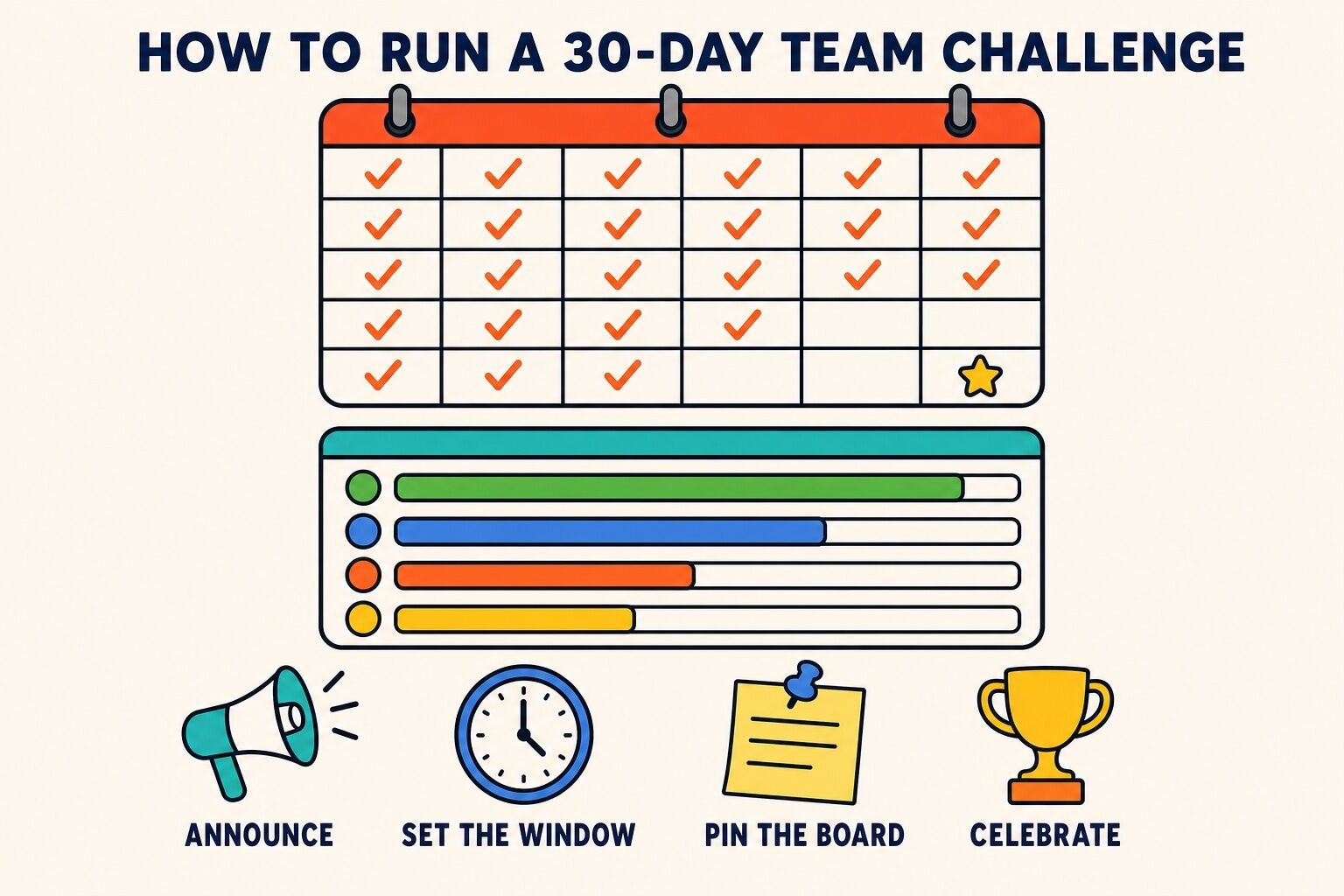
Choose one small daily action: post one thing you shipped, take a walk, read for 15 minutes, clear your notifications, say something specific and positive about a teammate's work. Build a grid with names down the side and the days of the month across the top. Each day a participant does the thing, they mark their own box. Nobody verifies anything, because verification kills it.
The scoring twist that makes this work is the recovery rule: one missed day does not end a streak, but two in a row does. Post the top three longest active streaks every Monday. Week two is where a streak challenge usually dies, and the Monday post is what carries it to week four.
Best for: Building one habit across a whole team Time: Four weeks Materials (cost): A shared grid (free)
What we've learned: The recovery rule is not a nicety, it is the whole design. In an all-or-nothing streak, everyone who misses a Tuesday drops out permanently on the Wednesday, and by week three you have three people left and a dead channel.
18. 30-Day Photo Prompt Challenge
The 30-Day Photo Prompt Challenge gives the team one photo prompt a day for a month, and turns out to be the best challenge here for teams spread across many time zones, because a photo posted at 3am is just as good as one posted at noon.
Publish all 30 prompts on day one so people can work ahead. Good prompts are concrete and slightly strange: your view right now, the oldest thing on your desk, something blue, your least photogenic meal, where you go when you need to think, a thing you own that nobody would guess. Post the daily prompt in a channel and let entries collect in a thread.
Need prompts? A random word makes a surprisingly good one:
Best for: Distributed teams with no overlapping hours Time: 30 days, two minutes a day Materials (cost): A phone camera (free)
What we've learned: Publish the whole prompt list upfront rather than revealing one a day. People plan around the prompts they like, and the ones who travel can bank entries ahead of a trip instead of dropping out of the challenge for a week.
19. Check-In Challenge
The Check-In Challenge asks every participant to have one real conversation with every teammate over the course of a month. It is the most direct answer to the silo problem, because it is aimed at exactly the relationships that remote work lets lapse.
Give each participant the full roster. Over four weeks, they have to make contact with every name on it at least once. Contact can be a 10-minute video coffee, a Slack conversation that is not about a ticket, or sending something the other person would actually find interesting. Participants tick names off their own list. At the end of the month, the people who cleared the roster get named in the company channel.
Best for: Teams of 8 to 60, especially after a reorg or a hiring wave Time: One month Materials (cost): A roster and a calendar (free)
What we've learned: Above roughly 60 people this stops working, because the arithmetic turns a friendly challenge into a second job. For bigger groups, assign each person a random set of eight names instead of the whole roster.
20. Bucket List Challenge
The Bucket List Challenge gives each person a list of small, out-of-the-ordinary things to do inside 30 days.
Build a list of 20 items and ask people to complete any 10. Items should be doable on a normal week: try a food you have never eaten, take a different route somewhere, call a friend you have not spoken to in a year, watch a film in a language you do not speak, go somewhere new within an hour of home, learn to make one cocktail properly. Participants log what they did and post one photo or one sentence. End with a call where everyone shares the one that surprised them.
Best for: Teams that want something less work-shaped Time: 30 days Materials (cost): Varies by item, most are free
What we've learned: Ten out of twenty beats a fixed list of ten. Choice raises completion, and it also keeps the challenge from quietly excluding anyone with less money, less mobility or less free time.
21. Cooking Challenge
A Cooking Challenge runs a shared recipe list across a month, with each participant working through it at their own pace.
Collect recipe nominations from the team, pick eight to twelve, and publish them as a checklist. Participants cook at least one a week and post a photo of the result, ideally including the failures. Offer tiers so that people with less time can still finish: four recipes for the bronze tier, eight for silver, all of them for gold. Close the challenge with a virtual lunch where everyone remakes their favorite.
If you would rather have someone teach the recipes, see our roundup of online cooking classes.
Best for: Teams that already talk about food in the channel Time: One month Materials (cost): Groceries, roughly $10 to $20 per recipe
What we've learned: Tiers are what save this one. A flat "cook all ten" target is fine for the two enthusiastic cooks and immediately hopeless for everyone with a commute, a toddler or a night shift.
22. Team Playlist Challenge
The Team Playlist Challenge builds one shared playlist over two weeks, with a rule that makes it a challenge rather than a folder.
Each participant adds two tracks, and every track has to come with a one-line reason: the song you play before a hard meeting, the song from the first concert you went to, the song that is objectively bad and that you love anyway. At the end, the team votes on the best story rather than the best song, and plays the winner's track at the start of the next all-hands.
Best for: Teams who want to learn something about each other without an icebreaker round Time: Two weeks Materials (cost): A collaborative playlist on any free music service
What we've learned: The one-line reason is the entire challenge. A playlist of 40 songs with no context is a folder. A playlist where every track has a sentence attached is the closest thing to a break room a remote team gets.
23. Charity Challenge
A Charity Challenge points the team's competitive energy at something outside the company, which is the reason it consistently outperforms the internal-only challenges on morale.
Pick one cause with the team rather than for them. Each participant pledges either an amount to raise or a number of hours to volunteer, then logs progress on a shared tracker with photos and short notes. Company matching, where it exists, lifts both participation and the total, so ask whether your organization already offers it. Celebrate the result with a specific number, not a general thank you: meals funded, trees planted, hours given. Our guide to online volunteering has remote-friendly options for teams without a local cause.
For the hosted version, Do Good Dash compresses the whole arc into 45 minutes, with points converting into real contributions as the team plays.
Best for: Company-wide challenges and CSR weeks Time: One month Materials (cost): Free to run; donations are the variable
What we've learned: Let the team choose the cause. A challenge attached to a cause chosen in a leadership meeting gets polite participation. One attached to a cause the team picked gets the group chat.
Virtual team competition ideas
Virtual team competition ideas are the challenges with a winner at the end. They run live or in rounds, they need a scorekeeper, and they are the right pick when the goal is energy rather than habit change.
24. Trivia Tournament
A Trivia Tournament stretches trivia across a quarter instead of burning it in one session, which turns a single good hour into a running storyline.
Split the group into fixed teams that stay together for the whole tournament, which matters more than the questions do. Run a 20-minute round every other week, keep a cumulative table, and post the standings after each round. Categories should rotate so no single team's knowledge dominates: general knowledge, music, company history, geography, an absurd specialist round. Crown a champion at the quarter's end.
Our virtual trivia guide has formats and question sources.
Best for: Teams that want a recurring fixture in the calendar Time: 20 minutes every other week, over a quarter Materials (cost): A question source and a scoreboard (free)
What we've learned: Fixed teams across the whole tournament are what create the rivalry. Reshuffling teams every round makes each session fine and the tournament forgettable.
25. Virtual Office Olympics
Virtual Office Olympics is a half-day of short competitions bundled into one event, with teams representing made-up nations and a medal table at the end.
Build a program of six to eight short events that each take under 15 minutes: a desk-chair obstacle description relay, home-office bowling, a speed scavenger hunt, a typing race, a trivia sprint, a paper-airplane distance contest. Teams pick a nation, a flag and an anthem, which is where most of the fun actually comes from. Award medals per event and publish a running table. The virtual office olympics guide linked at the top of this article has a full program you can copy.
Best for: Company-wide days and all-hands afternoons Time: Half a day Materials (cost): Household objects and a slide deck (free)
What we've learned: Mix teams across departments when you assign nations. Left to themselves, people form teams with the colleagues they already work with, which is the exact outcome a challenge is supposed to prevent.
26. Closest Without Going Over
Closest Without Going Over is a five-minute guessing game that works as a meeting opener, borrowed from the pricing round of a certain game show.
Ask a question with a precise numeric answer and have everyone post a guess in chat at the same time. The closest guess that does not exceed the true number wins. The best prompts are company-specific: new five-star reviews this month, support tickets closed last week, total customers as of this morning. Mix in absurd ones for variety: the world-record weight of a pumpkin, the number of steps in the Eiffel Tower.
Best for: The first five minutes of a recurring meeting Time: Five minutes Materials (cost): A chat window (free)
What we've learned: Company-specific numbers beat trivia numbers, because everyone leaves knowing a real fact about the business. This is the cheapest way we know to make a metric memorable.
27. Async Escape Room Puzzle Drop
The Async Escape Room Puzzle Drop is an escape room stretched over a week, which removes the one thing that stops distributed teams from doing escape rooms at all: everyone has to be online together.
Build or borrow a chain of five puzzles where each answer unlocks the next. Assign cross-department squads of five to eight people and give each squad a private channel. Drop puzzle one on Monday morning. Squads solve whenever they can, post the answer in their channel, and unlock the next. The first squad to finish all five before Friday wins. Free online escape rooms make a good source of puzzles if you do not want to write your own, and our roundup of free online escape rooms has options.
Best for: Breaking silos between departments, across time zones Time: One week, roughly 45 minutes of solving per person Materials (cost): Five puzzles and a channel per squad (free)
What we've learned: Group challenges become chaotic if everybody starts acting immediately. The squads that win are the ones that pause, work out the sequence, assign responsibilities, and only then execute. Point that out at the debrief, because it is the most transferable thing anyone learns all week.
How to run a virtual team challenge that people actually finish
Most virtual team challenges do not fail on the idea. They fail in week two, when the channel goes quiet and the organizer decides not to mention it again. These are the rules we run by, learned from our own team's challenges and from thousands of hosted events where the same dynamics show up compressed into 90 minutes.
Make it opt-in, and mean it. A mandatory wellness challenge is not a challenge, it is a task. Announce it, let people join, and never publish a list of who declined. A partial turnout of volunteers beats full attendance by conscripts, because the volunteers bring the energy that makes the thing worth watching.
Run it for one to four weeks. Under a week there is no time for a story to develop. Past four weeks, novelty is gone and the scoreboard becomes wallpaper. Almost everything on this list is built for a two-week or 30-day window, and the few one-day challenges are deliberately framed as starters.
Put the scoreboard somewhere people already look. The scoreboard is the challenge. If it lives in a document nobody opens, the challenge exists only in the organizer's head. Pin it in the channel, repost it every Monday, and keep it simple enough to read in five seconds. A grid of names and check marks beats a dashboard.
Keep prizes small and slightly silly. A $25 gift card, a custom emoji, a trophy graphic in someone's Slack profile for a month, naming rights over the next challenge. Large prizes distort behavior: people start optimizing, arguing about rules, and quietly resenting the winner. In our hosted events the most competitive rounds usually have nothing on the line but bragging rights, and that is exactly why they stay friendly.
Score teams, not individuals. Individual leaderboards produce one winner and a long tail of people who stopped trying on day three. Squads of five to eight keep everyone relevant because a quiet contributor still moves their team's number. Keep the squads small on purpose: six people can find something unusual they have in common, and sixty cannot. The same arithmetic governs whether anybody feels responsible for the score.
Use one channel, and post in it yourself. One dedicated channel, one pinned scoreboard, one weekly post from the organizer. The weekly post matters more than anything else on this list. If you want the mechanics to run themselves, Slack games and apps can handle reminders, but a human still has to care out loud once a week.
Finish it properly. Name the winners, post the final numbers, and say what happens next. Challenges that trail off teach the team that the next one will also trail off, and that is a much more expensive lesson than one abandoned step challenge.
What we've learned from running virtual team events
As of September 2026, teams have spent 30,000+ hours in live virtual team building events on teambuilding.com since 2021, and virtual is still where the demand is. Our own internal challenges have failed in every way described above, which is where most of the advice in this article comes from.
Competition is the engagement mechanism, not the point. When we mine post-event feedback for what participants actually loved, the scoring shows up constantly: points, buzzers, leaderboards, team names. It works because it gives people a reason to lean in without asking anyone to perform. Self-run challenges inherit the same property, which is why a plain shared goal with no scoreboard rarely survives contact with a busy week.
The scale range is wider than people assume. As of September 2026, the median virtual event on our platform has 16 participants, but we have hosted 448 virtual events with 100 or more participants, the largest with 1,000+ attendees. Challenges scale the same way, with the same adjustment: at size, you stop scoring individuals and start scoring squads. Our guide to virtual games for large groups covers the mechanics.
The organizer is the variable. In hosted events, participants name the host in their reviews constantly, and almost never mention the software. In a self-run challenge, you are the host, and the Monday post is your version of running the show.
Small teams vs large companies
The dividing line in practice sits around 15 people, which is close to the median team we host. The mechanics change on either side of it.
Small per-squad prizes, plus a company-wide announcement
Virtual team challenges we don't recommend
Some of the most-shared challenge ideas on the internet are, on closer inspection, either surveillance, a wellness liability, or a competition nobody can win. Here is the list we would skip.
The Lame List
Challenge
Why skip it
Verdict
Weight-loss challenges
Tracking colleagues' weight is a wellbeing risk and an HR problem in one. Run Commute-Free Minutes or a step challenge instead and you lose nothing.
Skip it
Screen-time or activity-tracking challenges
Anything that scores keyboard activity, logged hours or app usage reads as monitoring, regardless of intent.
Skip it
Cameras-on all-day co-working
Sitting on an open video call for eight hours is not connection, it is a webcam pointed at your living room.
Skip it
Perfect-attendance challenges
Rewards people for working while ill and punishes anyone with caring responsibilities or a chronic condition.
Skip it
Individual sales leaderboards dressed as team building
A revenue ranking is a performance management tool. Calling it a challenge does not make it social.
Not team building
Hustle challenges (earliest start, latest finish)
Competing on hours worked produces burnout and teaches the team exactly the wrong thing about what gets rewarded.
Skip it
100-day challenges
Enthusiasm reliably runs out somewhere around week three. Run a 30-day version and repeat it if it worked.
Too long
Big-prize challenges
Once the prize is worth winning, people optimize, argue about the rules and stop having fun. Keep prizes small.
Shrink the prize
Mandatory talent or performance challenges
Requiring people to perform on camera creates real anxiety, and the participation is never as voluntary as it looks.
Skip it
Open-ended challenges with no end date
Without a finish line there is no story, no winner and no reason to check the board. Every challenge needs a Friday.
Add a deadline
Final thoughts
The best virtual team challenges are small, visible and finite. A shared goal, a scoreboard someone updates on Mondays, four weeks, and a clear ending. That is the whole formula, and it works whether the goal is 10,000 steps, 30 photos or a puzzle chain that takes a week to unlock.
The mistake worth avoiding is treating a challenge as a culture program. It is not. It is a reason for two people who never work together to send each other a message, repeated often enough that it becomes normal. On a distributed team, that is worth quite a lot on its own.
If you would rather have a host handle the scoring, the logistics and the energy, browse our bookable virtual events, including every challenge format ranked above.
Answers drawn from teambuilding.com platform data and from running challenges on our own remote team.
What is a virtual team challenge?
A virtual team challenge is a goal a distributed team pursues together over a set period, tracked somewhere everyone can see. Examples include a 30-day step challenge, a week of inbox-zero Fridays, a month-long charity push, or a hosted escape-room competition. The shared, visible goal is what gives remote teammates a reason to talk outside of work.
How long should a virtual team challenge run?
One to four weeks. Under a week there is no time for a story to develop, and past four weeks the scoreboard becomes wallpaper. Most of the challenges in this guide are built for a two-week or 30-day window, and the one-day options, such as the hydration challenge, work best as starters for a team that has never run one.
What are the best free virtual team challenges?
The Streak, the 30-Day Photo Prompt Challenge and the Check-In Challenge are our picks, because each needs nothing but a channel and a shared grid. For fitness, a step challenge scored by team total rather than individual leaderboard is the most reliable. Every challenge in this guide is free to run apart from groceries for the cooking challenge and optional donations for the charity challenge.
How much do hosted virtual team challenges cost?
Hosted challenge-format events on teambuilding.com run $30 to $49 per person, typically 45 to 90 minutes, for groups from 10 people up to 1,000 or more. Do Good Dash is 45 minutes at $30 per person; the escape and quest formats such as Escape Everest and Art Heist run 60 to 90 minutes at $40 per person.
How do you get remote employees to actually participate?
Make it opt-in, put the scoreboard where people already look, score squads of five to eight instead of individuals, keep prizes small, and post an update yourself every Monday. The weekly post is the single biggest factor. Challenges do not usually fail on the idea; they fail in week two when the organizer stops mentioning it.
Do virtual wellness challenges actually work?
They help a little, reliably. A 2019 meta-analysis of 22 studies of workplace positive psychology interventions found a small positive effect on desirable work outcomes (g = .25) and a small-to-moderate effect on reducing undesirable ones. That is worth having, but a gratitude thread will not fix a burnout problem caused by workload, and framing it that way tends to backfire.



















Comments (0)
Leave a Comment