25 Office Retirement Party Ideas, Games & Activities Coworkers Remember
A planner's guide to office retirement parties: a four-week timeline, a 90-minute program that holds attention, 25 games and tribute activities with instructions, and the ideas we would skip.
Published
·
Updated
A retirement party is the last event a company throws for someone who may have given it twenty or thirty years. Get it right and the room gets a story it repeats for years. Get it wrong and a long career ends with a supermarket sheet cake in a break room and an awkward round of applause.
We run team celebrations for a living. As of September 2026, we have hosted more than 45,000 events since 2013, including retirement parties, farewells, milestone celebrations and end-of-year gatherings, for teams at Google, Amazon, Microsoft, Netflix, Capital One and thousands of smaller companies. Our catalog now includes 191 hosted Originals, 97 virtual and 94 in-person.
Trusted by teams at
This guide is the version we would hand a coworker who just got volunteered to plan the party: a realistic timeline, a program that holds attention, 25 ideas with instructions, and an honest list of the things to skip.
An office retirement party is a workplace celebration held to mark the end of an employee's career, usually in their final week. The format is typically a one to two hour gathering during work hours with food, a short program of toasts and tributes, a group gift, and games or activities that give coworkers something to do besides stand in a circle. These events are also called retirement celebrations, retirement functions, retirement send-offs, work retirement parties and retirement luncheons.
One note on intent before the logistics. A retirement party is a recognition event first and a party second. In a field experiment published in the Journal of Personality and Social Psychology, Adam Grant and Francesca Gino found that university fundraisers who received an in-person thank-you from a director made about 50% more voluntary calls the following week, rising from 41.4 to 62.6 on average, while a control group stayed flat. The mechanism was feeling socially valued, not confidence. Gratitude said out loud, in person, to a specific person, does real work. That is the whole job of the program below.
How to plan an office retirement party
Most retirement parties fail in the planning, not the party. The two most common mistakes are starting too late to get the right people in the room, and planning the event the committee wants instead of the one the retiree wants.
Start with a five-minute conversation with the retiree. Ask three questions: how big, how public, and who has to be there. Some people want the whole floor and a microphone. Plenty of others want twelve colleagues, a good lunch, and no speeches about them while they stand there. Both are valid, and the answer changes every decision that follows.
Then work backwards from the date.
When
What to do
Who owns it
4 weeks out
Confirm the date, budget and guest list with the retiree and their manager. Book the room or the hosted event.
Organizer
3 weeks out
Send the invite with a clear start and end time. Ask for photos, memories and video clips in the same message, with a deadline.
Organizer
2 weeks out
Order the group gift and the card. Line up three or four speakers and tell them the time limit.
Gift lead
1 week out
Order food. Build the slideshow. Prep game materials, prizes and printed sheets.
Food lead and game lead
2 days out
Send a reminder with the agenda. Confirm the retiree's family guests if any are coming.
Organizer
Day of
Set the room 30 minutes early. Test the screen and the microphone. Put one person on photos.
Organizer
A few planning decisions matter more than the rest:
Hold it on the clock. We recommend making team socials paid and on the clock, and a retirement party is the clearest case for it. An event scheduled at 5:30 p.m. quietly excludes parents, commuters and anyone on a different shift, and attendance is the entire point of a send-off.
Pick a time that protects the room. Mid-morning and early afternoon both work. Avoid the last hour of a Friday, when half the guest list has already mentally left.
Give the budget a shape. A workable split for an in-office party is roughly 50% food, 30% group gift, 20% decor, printing and prizes. For a hosted event, the per-person event cost usually replaces the food and decor lines.
Assign four owners. Organizer, food, gift and games. Parties planned by a committee of one get thin, and parties planned by a committee of nine never decide anything.
Sample retirement party program and agenda
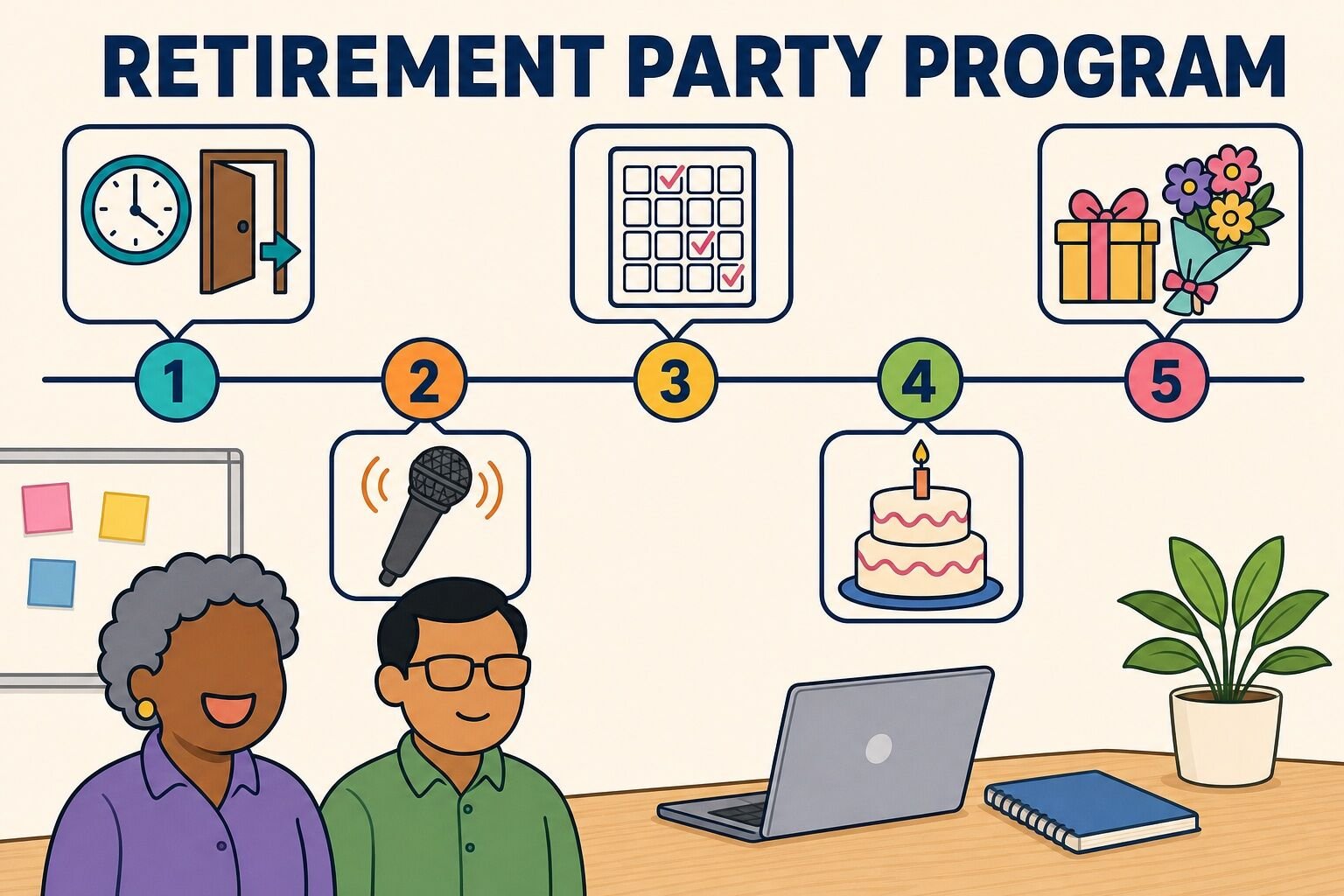
A retirement party needs a program for the same reason a wedding reception does. Left alone, the room splits into clusters, the toasts start late, and the guest of honor spends 90 minutes repeating the same conversation. Here is the 90-minute structure we use for celebration events, with a 60-minute version underneath.
Time
Segment
Notes
0:00 to 0:15
Arrival and food
Music on, food open. Nothing formal yet. Late arrivals get a grace period.
0:15 to 0:20
Welcome
The organizer opens, names the years of service and the plan for the hour.
0:20 to 0:35
Toasts and tributes
Three or four speakers, two minutes each, in a set order.
0:35 to 1:05
Games and activities
Two games from the lists below. Trivia about the retiree first, then something with movement.
1:05 to 1:20
Gift, cake and photos
Present the group gift, cut the cake, take the group photo while everyone is still in the room.
1:20 to 1:30
The retiree speaks, then open mingling
Give them the last word, then let the room go informal.
For a 60-minute party, keep the same order and cut one game and five minutes from each block. The segment to protect is the gift and photo block, because it is the part people remember and the part that produces the picture that goes on the wall.
Two rules keep a program on time. Tell every speaker their limit in advance and remind them the morning of, and hand the retiree the last word rather than the first, so the event builds toward them instead of peaking early.
The best retirement party events you can book
Plenty of teams run the whole party themselves, and the free ideas further down this page are enough to do that well. The case for booking a hosted event is narrower: the team is distributed, nobody has time to prepare, or the group is large enough that unstructured mingling will not work.
We ranked our celebration-friendly events using our Team Building Score, which combines overall satisfaction, participant recommendation scores, organizer reviews, engagement ratings and other post-event feedback from tens of thousands of surveys. Only events with at least 20 survey responses are included, and the ranking covers virtual and in-person formats.
Cheers and virtual farewells abound as we send your remote colleague off into the next chapter of their life! Customize the event based on the guest of honor.
Participate in engaging games and activities
Share personal anecdotes and well wishes
Customize the event to honor the retiree
Perfect for: Teams with retiring colleagues, Celebrating career milestones, Remote teams wanting a special send-off
Ranked by our Team Building Score — a running points total earned through confirmed bookings, verified reviews, ratings, and listing quality, recalculated nightly. Every event shown also has at least 30 post-event survey responses per question; the happier, connected, and NPS columns are computed from the 3,489+ survey responses collected for the 10 events listed here — a subset of all post-event surveys across our catalog. Updated October 2026.
For a retirement party specifically, the event built for the occasion is the Virtual Retirement Party. It runs 60 to 90 minutes for 10 to 1,000 guests at $50 per person, with a host who builds the hour around the retiree, including a personalized trivia round, a guided tribute segment and games that keep the group involved rather than watching.
What a host actually changes is the energy in the room. A facilitator keeps the momentum between segments, pulls in the quiet people, and makes sure the guest of honor is celebrated instead of managed.
We are a team building company, so treat our opinion accordingly. That said, most of the retirement parties we see booked are handled by one of three types of vendor: a hosted team building company, an experiences marketplace, or a local caterer and venue. The comparison below covers the first two, since the third depends entirely on your city.
Hosted celebrations for distributed or large teams, virtual and in-person
Our pick when the party needs a facilitator. The Virtual Retirement Party is purpose-built for the occasion, and our celebration formats are refined through post-event surveys.
The tribute slideshow, the trivia deck, printable certificates and signs.
Free
Retirement party games for work
Games do a specific job at a retirement party. They give the room something to do together, they surface stories the speeches miss, and they rescue the awkward middle stretch after the food and before the cake. The eight below are the ones we would run, and they work as party games for work generally.
Here are all 25 ideas at a glance, with full instructions below.
A quiz about the guest of honor is the most reliable opener at a retirement party, because it turns a long career into something the room can play with.
Ask the retiree for answers to 10 questions a week ahead, and tell them they can veto anything they would rather not share. Mix career facts with personal ones so newer hires have a chance:
What year did they start, and what was their first role?
Which project are they proudest of?
How many desks or offices have they had?
What is the first thing they plan to do in retirement?
Which coworker has been here almost as long?
Put the questions on slides or in a quiz app, split the room into teams of three or four, and read the questions aloud. Teams write answers on paper. After each question, let the retiree give the real answer and a 20-second story behind it. The stories are the actual point, and the scoring just keeps everyone honest.
Best for: 8 to 60 people Time: 15 to 20 minutes Materials (cost): Slides or a free quiz app, paper and pens (free)
What we've learned: Teams score answers, not stories, so the quiz runs long if you let every answer become an anecdote. Cap the retiree's commentary at 20 seconds per question and they will still tell the two stories that matter. For more question formats, see our list of trivia games.
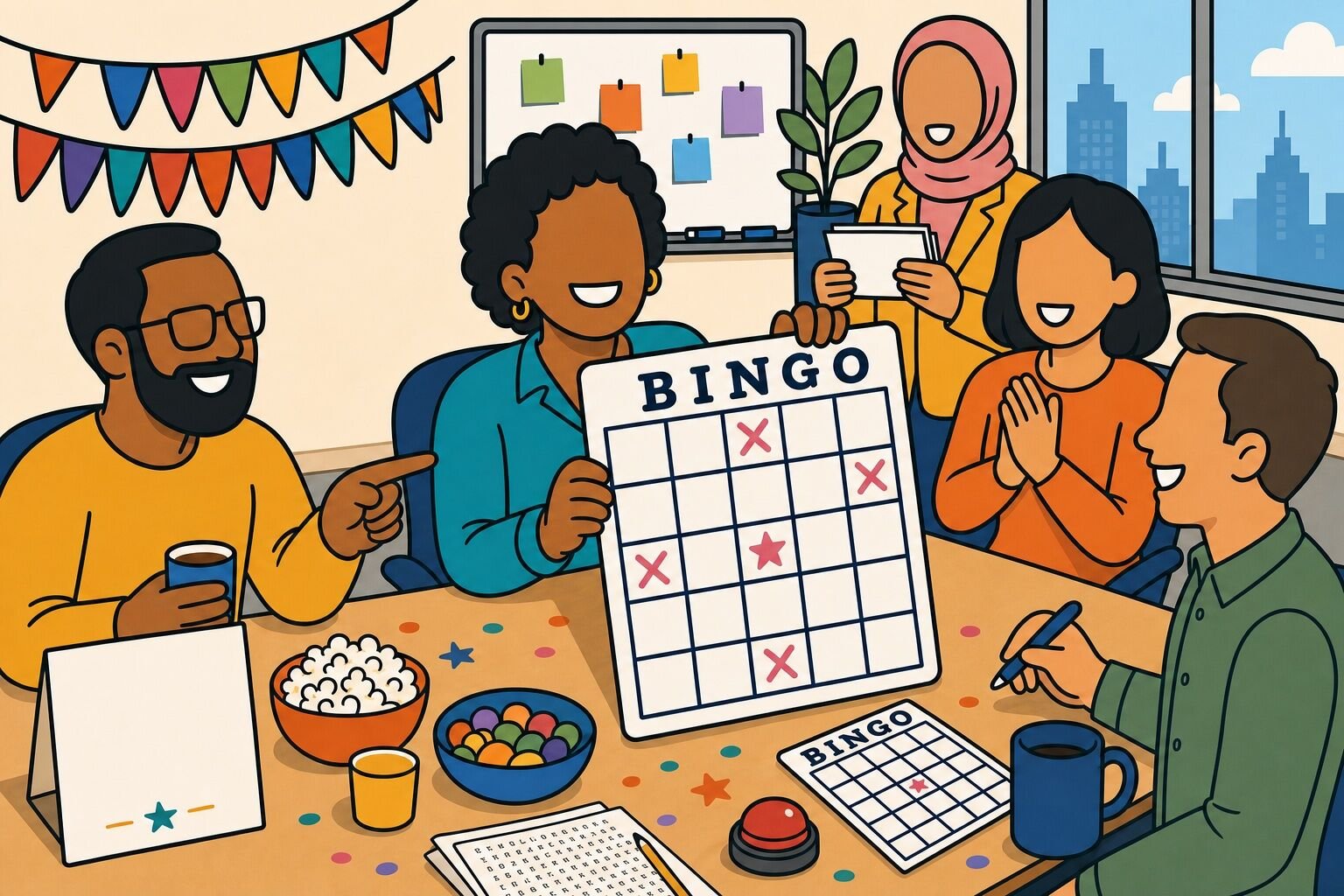
2. Retirement Bingo
Retirement Bingo is a mingling game. Instead of numbers, each square holds a statement about the retiree or about retirement, and players move around the room collecting signatures or marking squares as the host calls items out.
Squares work best when they are specific to the person: "was on the team when we moved buildings," "has been to their house for dinner," "was hired by them," "has received one of their 7 a.m. emails." Fill the rest with general prompts so newer employees can play too.
Print the cards, hand them out during the arrival window, and give the room 15 minutes to work through them before the toasts start. First to five in a row wins a small prize, and everyone keeps playing for a blackout while the food is still out.
Best for: 10 to 100+ people Time: 15 to 20 minutes Materials (cost): Printed cards and pens (free)
What we've learned: Bingo is the best tool we know for a room where departments do not usually mix, because the card gives people a reason to approach someone they have never spoken to. Here is more on online team building bingo if your group is remote.
3. Career Timeline Challenge
This game rewards the people who have been around the longest and teaches everyone else the history of the team.
Before the party, write 10 to 15 milestones from the retiree's career on index cards, one per card, with no dates: first day, first promotion, the office move, the big client win, the reorganization, the year they trained half the current team. Shuffle them.
Give each team a set and five minutes to arrange the cards in order on a table. Then walk the real timeline as a group, with the retiree correcting the record as you go. Award a point per correctly placed card.
Best for: 6 to 40 people Time: 15 minutes Materials (cost): Index cards and a marker (free)
What we've learned: Ask the retiree's longest-tenured colleague to help build the card set. They will remember three events HR has no record of, and those are the cards that get the biggest reaction.
4. Retirement Word Search
A word search is the arrival activity: something on every table that people can pick up alone while they wait for the room to fill.
Build the puzzle with a free generator and seed it with words tied to this specific career rather than generic retirement terms. Include project code names, the retiree's catchphrase, their hometown, their first job title and the names of the teams they have worked on. Print one per seat.
Hand a small prize to whoever finds every word first, and let the rest of the room keep working as the program starts.
Best for: Any group size Time: 10 minutes Materials (cost): Printed sheets and pens (printing only)
What we've learned: Puzzles pull attention away from the program, so use them before the welcome and never during the toasts. For more options in this category, see our list of word games.
5. Career Pictionary
Pictionary with a personalized prompt list is a quick way to get laughter into the room after a run of sentimental toasts.
Write 20 prompts drawn from the retiree's working life: their desk plant, the conference room they always booked, their commute, the office coffee machine, the product they launched, their standard lunch order. Split into two teams. One player draws on a whiteboard or flip chart while their team guesses, with a 60-second timer per turn.
Play five rounds per team, then hand the whiteboard drawings to the retiree as a keepsake.
Best for: 6 to 30 people Time: 15 to 20 minutes Materials (cost): Whiteboard or flip chart and markers (free)
What we've learned: Prompts about places and objects draw better than prompts about abstract achievements. "The parking lot" gets a laugh; "digital transformation" gets a stalled turn.
6. Send-Off Scavenger Hunt
A short hunt gets a seated room moving again, which matters in the back half of a two-hour party.
Write a list of 10 items or photos to find around the office, each tied to the retiree: the room where they ran their first meeting, the sign they laminated, a mug from a conference they attended, the oldest piece of equipment on the floor. Send teams out with phones and a 15-minute limit, then review the photos together on the screen.
Score one point per item and two points for the funniest photo, voted by the retiree.
Best for: 8 to 50 people Time: 20 minutes Materials (cost): A printed list and phones (free)
What we've learned: The review is the game. Teams sprint through the list and then spend ten happy minutes arguing over whose photo of the broken printer is better. Budget time for it. Here are more office scavenger hunts.
7. Retirement Mad Libs
Mad Libs produces a keepsake, which is why it belongs at a send-off rather than a regular office party.
Write a one-paragraph story template about the retiree's first day, or their last week, with 12 to 15 blanks marked for nouns, verbs, adjectives and numbers. Print copies. Give the room eight minutes to fill in the blanks in pairs, then have three or four pairs read theirs aloud.
Collect every sheet at the end, put them in a folder with the card, and hand the whole set to the retiree.
Best for: 5 to 30 people Time: 10 to 15 minutes Materials (cost): Printed templates and pens (printing only)
8. Guess Who Said It
Every long-tenured employee has a handful of phrases their team can quote from memory. This game turns those into a quiz.
Two weeks ahead, ask 8 to 10 colleagues for one line the retiree says constantly, plus one thing they themselves have said about the retiree. Anonymize the lines and read them out one at a time. The room guesses who said each one, and the retiree gets a vote too.
Keep it affectionate. The test for including a line is whether the retiree would repeat it themselves.
Best for: 8 to 40 people Time: 10 to 15 minutes Materials (cost): A collected list of quotes (free)
What we've learned: Collect the lines by direct message rather than in a group thread. In a group thread people write for the audience, and you end up with polished tributes instead of the real catchphrases.
Retirement party activities and tributes
These are the segments that carry the meaning of the event. Run one or two of them, not all seven, and give whichever you choose enough time to land.
9. Memory Bank
Memory Bank is the simplest tribute activity that still produces real stories.
Hand every guest an index card as they arrive and ask them to write one memory of working with the retiree, unsigned. Collect the cards in a bowl. Partway through the party, draw cards one at a time, read them aloud, and let the room guess who wrote each one.
Bundle the cards with a ribbon at the end and give them to the retiree.
Best for: 5 to 40 people Time: 15 to 20 minutes Materials (cost): Index cards, pens and a bowl (free)
What we've learned: Give people a prompt rather than a blank card. "Write about a time they helped you" produces stories, while "write a memory" produces "great colleague, will miss you."
10. Tribute Slideshow
A short photo slideshow is the emotional centerpiece of most retirement parties, and the reason most of them run over time.
Ask for photos three weeks out with a hard deadline, and collect them in one shared folder. Build 25 to 35 slides in chronological order, five seconds each, with one line of caption where the context is not obvious. Add music at low volume. Keep the whole thing under five minutes.
Play it right before the gift presentation, when the room is already seated and quiet.
Best for: Any group size Time: 4 to 5 minutes to play, about 2 hours to build Materials (cost): Slides software and a screen (free)
What we've learned: One person owns the slideshow. Shared editing produces 90 slides, three fonts and a soundtrack nobody chose. Assign it, set the slide cap, and let them build it.
11. Structured Toasts
Open-mic toasts either die in silence or run twenty minutes long. Structure fixes both.
Choose four speakers in advance and give each of them a two-minute limit and a specific angle so the speeches do not repeat: the manager covers impact, a long-time peer covers history, a newer teammate covers what they learned, and a friend from another department covers character. Tell each speaker their angle a week ahead.
Run them in that order, then hand the microphone to the retiree.
Best for: Any group size Time: 10 to 15 minutes Materials (cost): A microphone for rooms over 30 people (free)
What we've learned: A two-minute limit sounds harsh and works every time. The speakers who prepare cut their speech to the best 90 seconds, and the ones who wing it stop before they wander.
12. Digital Kudos Board
A digital card collects the people who cannot be in the room: remote colleagues, retired teammates, clients, and the person who left three years ago but still tells stories about the retiree.
Open a board two to three weeks ahead, seed it with three or four posts so nobody faces a blank page, and share the link everywhere the retiree has worked. Ask contributors for a photo or a 20-second video rather than text alone. Display it on the screen during the party and send the archive link to the retiree afterward.
Best for: Any group size Time: Asynchronous, plus 5 minutes at the party Materials (cost): A digital card tool (free tier, or about $6 for a larger board)
What we've learned: Boards fill in the last 48 hours regardless of when you open them, so send a reminder two days before the party. For programs that run year round, see employee recognition programs.
13. Bucket List Exchange
This activity points the party forward instead of backward, which is a relief after a slideshow.
Give everyone a card and ask them to write one thing they would do with a free year. Go around the room, read them out, and finish with the retiree sharing what is actually on their list. Then invite the room to recommend specifics: the trail, the class, the country, the cheap flight window.
Best for: 5 to 25 people Time: 15 minutes Materials (cost): Cards and pens (free)
14. Advice From the Retiree
Rather than only talking about the retiree, hand them the microphone and interview them. For a team that is losing decades of institutional knowledge, this is the most useful 15 minutes of the party.
Prepare six questions and ask them like a fireside chat: What has changed most since you started? What did you get wrong early on? What do you wish someone had told you at year five? Which decision are you proudest of? What should we stop doing? What comes next for you?
Record it if the retiree agrees. Teams replay these clips for years.
Best for: Any group size Time: 15 minutes Materials (cost): A printed question list, optional recording (free)
What we've learned: Send the questions in advance. A retiree who has thought about "what do you wish someone had told you" for a day gives an answer worth recording, and one asked cold gives a polite non-answer. Our list of icebreaker questions has more prompts if you want alternates.
15. Compliment Round
For teams of under 20, a round of specific compliments beats a general open floor, because everyone speaks and nobody has to volunteer.
Go around the circle and ask each person for one specific thing they appreciate about the retiree. Specific is the whole instruction: not "you were great to work with," but "you rewrote my first client proposal at 9 p.m. and never mentioned it again." Cap each person at 30 seconds.
If the room needs a warm-up, this generator produces prompts to get people started:
Best for: 5 to 20 people Time: 10 minutes Materials (cost): None (free)
Funny retirement party ideas
Funny is the most requested register for a retirement party and the easiest to get wrong. The reliable rule: joke about the work, the years and the shared history, never about age, health or what the retiree will do with their newly empty days.
16. Superlative Awards
Superlatives give the room a laugh and a genuine compliment in the same sentence.
Write six to eight awards specific to the retiree and the team: Most Likely to Answer Email at 6 a.m., Keeper of the Institutional Memory, Undefeated in the Conference Room Thermostat Wars, Best Explainer of the Old System. Print them as simple certificates. Present them with one sentence each, and give the retiree the final award.
Let coworkers win a few as well, so the retiree is handing something out rather than only receiving.
Best for: 8 to 50 people Time: 10 to 15 minutes Materials (cost): Printed certificates (printing only)
What we've learned: Write the awards with three people, not one. A single author writes inside jokes only their pod understands, and half the room sits through a punchline they cannot see. For a more formal version, see our employee award ceremony guide.
17. Then vs Now Price Guess
This game only works for a long tenure, which makes it perfect for a retirement.
Pull 8 to 10 prices from the year the retiree started: a gallon of gas, a stamp, a cup of coffee, a movie ticket, the average rent in your city, a new laptop, the company's headcount. Read each item and have teams write down their guess for that year's price. Closest guess wins the point, and the retiree confirms whether the number matches their memory.
Best for: 6 to 60 people Time: 10 minutes Materials (cost): A prepared list, paper and pens (free)
What we've learned: Include two company facts alongside the consumer prices, such as headcount or the number of offices in their first year. Those land harder than the price of gas, because everyone in the room can see the difference.
18. Mock Exit Interview
Set up two chairs at the front of the room and run a deliberately silly interview, game-show style.
The host asks questions in a mock-formal tone: What will you miss least about the 8 a.m. standup? Rate the office coffee on a scale of one to ten. Which meeting would you like to formally cancel on your way out? Who inherits your parking spot? Before the retiree answers, the room votes on what they think the answer will be, and correct guesses score a point.
Keep it to ten questions and let the last one be sincere.
Best for: 10 to 60 people Time: 15 minutes Materials (cost): A question list and two chairs (free)
What we've learned: Ask the retiree beforehand if they want to be in the hot seat. Some people love it, and for the rest this format is a small nightmare. Ask; do not assume.
19. Retirement Minute to Win It
Three one-minute challenges built from office supplies will beat any elaborate game you spend an evening preparing.
Run these back to back: stack 20 paper cups into a pyramid and take it down again; toss ten balled-up memos into a recycling bin from four feet; move five sticky notes from a desk to a wall using only one hand. Two players compete at a time while the room counts down. The retiree judges and breaks ties.
Best for: 8 to 40 people Time: 15 minutes Materials (cost): Paper cups, sticky notes, a bin (office supplies)
What we've learned: Two competitors at a time and a loud countdown is what makes this work. Everyone playing at once turns into noise, and the spectators are half the fun. Here are more minute to win it games.
Retirement luncheon and small office party ideas
Not every send-off needs a room of 60 people. For small teams, tight budgets or a retiree who would rather not be the center of a crowd, these three formats do the job.
20. Memory Menu Luncheon
A retirement luncheon is the default for a reason: it fits in the workday, it includes everyone, and the food does the hosting.
Cater from the restaurant the retiree has been ordering from for a decade, or book the table they always take clients to. Print a small menu card for each seat with their favorite dish renamed in their honor. Seat the retiree in the middle rather than at the head, run the toasts between the main course and dessert, and keep the whole thing to 75 minutes so the afternoon survives.
Best for: 6 to 40 people Time: 60 to 75 minutes Materials (cost): Catering or a restaurant booking ($15 to $30 per person)
What we've learned: Ask the retiree where they want to eat rather than surveying the team. A committee picks the safest option on the block, and the send-off lunch is the one meal that should be their choice.
21. Mocktail Toast Hour
A daytime party still deserves something to raise. Mocktails solve the workday problem and include everyone who does not drink.
Set up a small table with two prepared pitchers and a garnish tray: sparkling water with grapefruit and rosemary, and a ginger and lime cooler with mint. Name one after the retiree. Give everyone ten minutes to pour and mingle, then run a single toast so the hour has a peak.
Best for: 6 to 50 people Time: 45 minutes Materials (cost): Mixers, fruit, ice and cups ($5 to $10 per person)
22. Ten-Minute Desk-Side Send-Off
Some retirements happen on a Tuesday with no budget and no room booked. A ten-minute version done well still counts.
Gather the immediate team at the retiree's desk at a set time. The manager says two sentences about impact. Three colleagues each say one specific thank-you. Hand over the signed card and something small, take one group photo, and let everyone get back to work. The brevity is not the failure; skipping it would be.
Best for: 4 to 15 people Time: 10 minutes Materials (cost): A card and a small gift (under $50)
What we've learned: Put it on the calendar with a start time rather than letting it happen organically. Send-offs that depend on someone noticing the right moment are the ones that quietly do not happen.
Virtual and hybrid retirement party ideas
When the team is distributed, or the retiree's colleagues are spread across three time zones, the party moves online. The structure stays the same, but every segment needs a clearer owner and a tighter clock. We cover the full format in our guide to virtual team celebrations.
23. Hosted Virtual Retirement Party
Our Virtual Retirement Party is a 60 to 90 minute hosted event for 10 to 1,000 guests at $50 per person, rated 4.99 out of 5 across 74 reviews. A facilitator runs the program: a personalized trivia round built from what you tell them about the retiree, a guided tribute segment where guests share memories in a structure that actually works on video, and games that keep a large group participating.
Book it when the guest list is too big or too scattered for one person to both host and be present at their colleague's send-off.
Best for: 10 to 1,000 guests Time: 60 to 90 minutes Materials (cost): A hosted event ($50 per person)
24. Video Message Montage
For colleagues who cannot attend, a montage beats a wall of text in a chat thread.
Ask 10 to 15 people for a 30-second clip filmed on their phone, with one instruction: tell one story, do not list adjectives. Give a deadline a week before the party. Stitch the clips into a four-minute video in the order that tells the career chronologically, and play it after the toasts.
Best for: Any group size Time: 4 minutes to play, about 90 minutes to edit Materials (cost): Phone video and free editing software (free)
What we've learned: Send a sample clip with the request. People copy the example, and one 30-second model keeps a dozen colleagues from each recording three rambling minutes.
25. Would You Rather: Retirement Edition
A quick round of Would You Rather fills the gap while people join a call or find their seats, and it gets the quiet participants talking early.
Read a prompt, have everyone answer in the chat or by a show of hands, then ask two people to explain. Prompts that work:
Would you rather retire somewhere warm all year or somewhere with four real seasons?
Would you rather spend retirement learning one hard new skill or revisiting an old one you dropped?
Would you rather have a standing Tuesday lunch with former coworkers or a group chat that never stops?
Would you rather retire five years early on less, or five years later on more?
Would you rather be remembered here for the work or for the people you trained?
End on the last one and let the retiree answer it in full.
Best for: 5 to 30 people Time: 10 minutes Materials (cost): A prompt list (free)
Retirement party themes
A theme is optional, and a bad one is worse than none. The test is whether it says something true about the person. Themes built around the retiree's history or plans work; themes built around being old do not. If you want a theme to carry the whole event, budget for the entertainment as well, which our guide to corporate party entertainment covers.
Theme
How to run it
Best for
Through the Decades
Decorate around the year they started, play music from that era, and run the Then vs Now Price Guess as the main game.
Tenures over 20 years
The Next Chapter
Books as the visual motif. Each guest writes one line of advice on a bookplate that goes into a blank journal for the retiree.
Quiet, sentimental send-offs
Departure Lounge
Boarding-pass invitations, a destination board of everywhere they plan to go, luggage tags as favors.
Retirees with travel plans
Hobby Spotlight
Build the room around what they actually do on weekends: the garden, the workshop, the fishing trip, the choir.
A team that knows the person well
Tropical Send-Off
Bright colors, mocktails, and a playlist. The low-effort theme that reliably lifts a room at lunchtime.
Short-notice parties
Hall of Fame
Frame photos and career milestones like a museum wall, with the group photo taken in front of it.
Highly accomplished careers
Garden Brunch
Morning event, brunch catering, flowers on the tables. Easier on the budget than an evening party.
Daytime and budget-conscious teams
Company Throwback
Old logos, old product photos, old org charts, first-day badge photos of everyone in the room.
Long-standing companies
Retirement gift and speech ideas
The gift and the speech are the two parts of the party guests remember, and both reward specificity over spend.
Gift
Why it lands
Typical spend
A group-signed book of memories
Combines every contribution into one object the retiree keeps. Print the Kudos Board or the memory cards.
$30 to $80
An experience tied to their plans
A class, a membership or a trip credit for the thing they have said they will finally do.
$100 to $500 as a group gift
A piece of the office
Their nameplate, their chair, a framed print of the product they shipped or the building they worked in.
$0 to $60
An engraved milestone award
The formal option for a 20 or 30 year career, presented at the front of the room.
$75 to $250
A donation in their name
Right for retirees who have said they want nothing. Pick a cause they have actually supported.
Any amount
For more options across price points, see our list of gifts for employees. Whatever you choose, the group card goes with it, and our collection of retirement wishes has lines to borrow when colleagues freeze up in front of a blank page.
For the speech, four parts in this order work every time: name the years and the role, tell one specific story that shows how they worked, name the thing the team will keep doing because of them, then thank them directly and stop. Two minutes. If you need an opening or closing line, this generator produces quotes you can borrow:
What we've learned from running celebration events
A few patterns hold across the celebrations we run, whether it is a retirement, a farewell or an end-of-year party.
The party is often the first event we run for a team. A milestone is what finally gets a budget approved, and the experience decides whether the team does anything again. As of September 2026, 41% of companies that book an event with us come back to book at least one more.
Structure beats atmosphere. A room with good food and no program produces polite clusters of three. The same room with a 90-minute agenda, timed toasts and two games produces the event people describe afterward as fun. This is the single biggest difference between the parties that work and the ones that do not.
Recognition has to be specific and said out loud. The research on gratitude points the same way as our event feedback: the effect comes from a person feeling socially valued, which requires a named person saying a specific thing in front of others. "Thanks for everything" does not do it.
Group size changes the format completely. The mistake we see most often is running a small-group format in a large room.
Going around the room one by one. At 30 people that takes 25 minutes and loses the room.
40 and up
A host or MC, a microphone, Retirement Bingo during arrival, and a tight program with clear segments.
Open-mic toasts, activities that need everyone to hear a quiet answer, and anything unstructured.
The photo matters more than you think. Assign one person to take a real group photo before people start leaving. It is the artifact that ends up framed on a desk, and half the parties we see forget it until the room is half empty. Our broader employee appreciation ideas run on the same principle: the small deliberate act beats the grand improvised one.
Retirement party ideas we don't recommend
Search for retirement party ideas and you will find the same handful of suggestions repeated across hundreds of pages, several of which reliably land badly in a workplace. Here is what we would skip.
The Lame List
Activity
Why skip it
Verdict
Over-the-hill decorations and gag gifts
Black balloons, canes and "old timer" jokes make a career milestone into a joke about aging, in front of colleagues who are ten years behind them.
Skip it
Roasting the retiree
Roasts need a room that has agreed to the format and speakers who can land a joke. In a mixed workplace crowd, one misjudged line is what the party is remembered for.
Skip it
Surprise parties
A surprise removes the retiree's choice about their own send-off, including who attends and whether they get to speak. Ask them first.
Ask first
Open-mic toasts with no plan
Either nobody volunteers or one person talks for twelve minutes. Four named speakers with a time limit fixes it.
Add structure
An open bar at a workday party
Daytime drinking at a work event creates risk the organizer carries personally, and it excludes people who do not drink. Run a Mocktail Toast Hour instead.
Skip it
"What will you do with all that free time?" as an icebreaker
Not everyone retires by choice or into comfort, and this question can land on health, finances or family news the room does not know about.
Skip it
A card passed around and nothing else
For a two-year tenure this is fine. For a twenty-year career it reads as an afterthought, and everyone in the room notices.
Not enough
Speeches from executives who have never worked with them
A generic tribute from someone reading a bio is worse than no speech. Give the slot to a colleague with a real story.
Reassign it
An unclear group gift collection
"Chip in what you want" creates awkwardness in both directions. Name an amount, make it optional and private, and close the collection early.
Fix the ask
Final thoughts
The difference between a retirement party people remember and one they endure is not the budget. It is whether someone decided in advance what happens in each 15-minute block, asked the retiree what they actually wanted, and made sure the thank-you was specific and said out loud.
Pick three or four ideas from this page, not fifteen. One game to open, one tribute activity, a gift with a story attached, and a program that ends before the room does.
Answers to the questions planners ask us most often about office retirement parties.
How long should an office retirement party be?
Ninety minutes is the sweet spot for a full send-off, and 60 minutes works when the party sits inside a workday. Our hosted celebration events run 60 to 90 minutes for the same reason: under an hour the room ends just as quieter colleagues warm up, and past 90 minutes attention drops no matter how good the program is. A workable 90-minute split is 15 minutes of arrival and food, 5 minutes of welcome, 15 minutes of toasts, 30 minutes of games, 15 minutes for the gift, cake and group photo, and 10 minutes for the retiree to speak and the room to mingle.
What games should you play at a retirement party?
Pick two, not six. A personal trivia quiz about the retiree is the most reliable opener because it turns a long career into something the room can play with, and retirement bingo works during the arrival window because the card gives people a reason to talk to colleagues from other departments. For long tenures, a career timeline challenge or a then-versus-now price guess from the year they started gets the biggest reaction. Save anything with movement, like a short office scavenger hunt, for the back half when the room has been seated a while.
How far in advance should you plan a retirement party?
Four weeks is enough for an in-office party and is the point at which you can still get the right people in the room. Confirm the date, budget and guest list with the retiree and their manager at four weeks, send the invite and the request for photos and memories at three weeks, order the gift and brief your speakers at two weeks, handle food and game materials at one week, and send a reminder with the agenda two days out. Hosted events and catering for larger groups book up faster, so start at five or six weeks if the guest list runs past 50 people.
How much does an office retirement party cost?
A self-run office party is usually driven by food: catered lunch commonly runs $15 to $30 per person, with the group gift and printing on top. A useful split is roughly 50% food, 30% group gift, and 20% decor, printing and prizes. A hosted event replaces the food and decor lines, and most of our Originals run $35 to $60 per person, with a median of $50. The ten-minute desk-side send-off costs under $50 in total and still counts when there is no budget at all.
What should you avoid at an office retirement party?
Skip over-the-hill decorations and gag gifts, which turn a career milestone into a joke about aging in front of colleagues who are a decade behind. Skip the roast unless the retiree has asked for one. Do not make it a surprise without asking, because a surprise takes away their say over their own send-off. Avoid open-mic toasts with no plan, an open bar at a workday event, and asking a retiree what they will do with all that free time, since not everyone retires by choice or into comfort.
How do you throw a retirement party for a remote team?
Keep the same program and tighten the clock, because every segment needs a clearer owner on video. Collect messages asynchronously on a digital kudos board so remote and former colleagues can contribute, stitch 30-second phone clips from people who cannot attend into a four-minute montage, and assign one person to run the screen. If the guest list is large or scattered, a hosted Virtual Retirement Party covers 10 to 1,000 guests in 60 to 90 minutes at $50 per person, with a facilitator running the trivia and tribute segments so the organizer can be a guest at their colleague's send-off.



















Comments (0)
Leave a Comment