
30 Fun Office Activities for Employees (Small, Quick & Monthly Ideas)
A host-tested list of 30 fun office activities, from small five-minute games to monthly rituals, with instructions, group sizes and costs for in-office and hybrid teams.
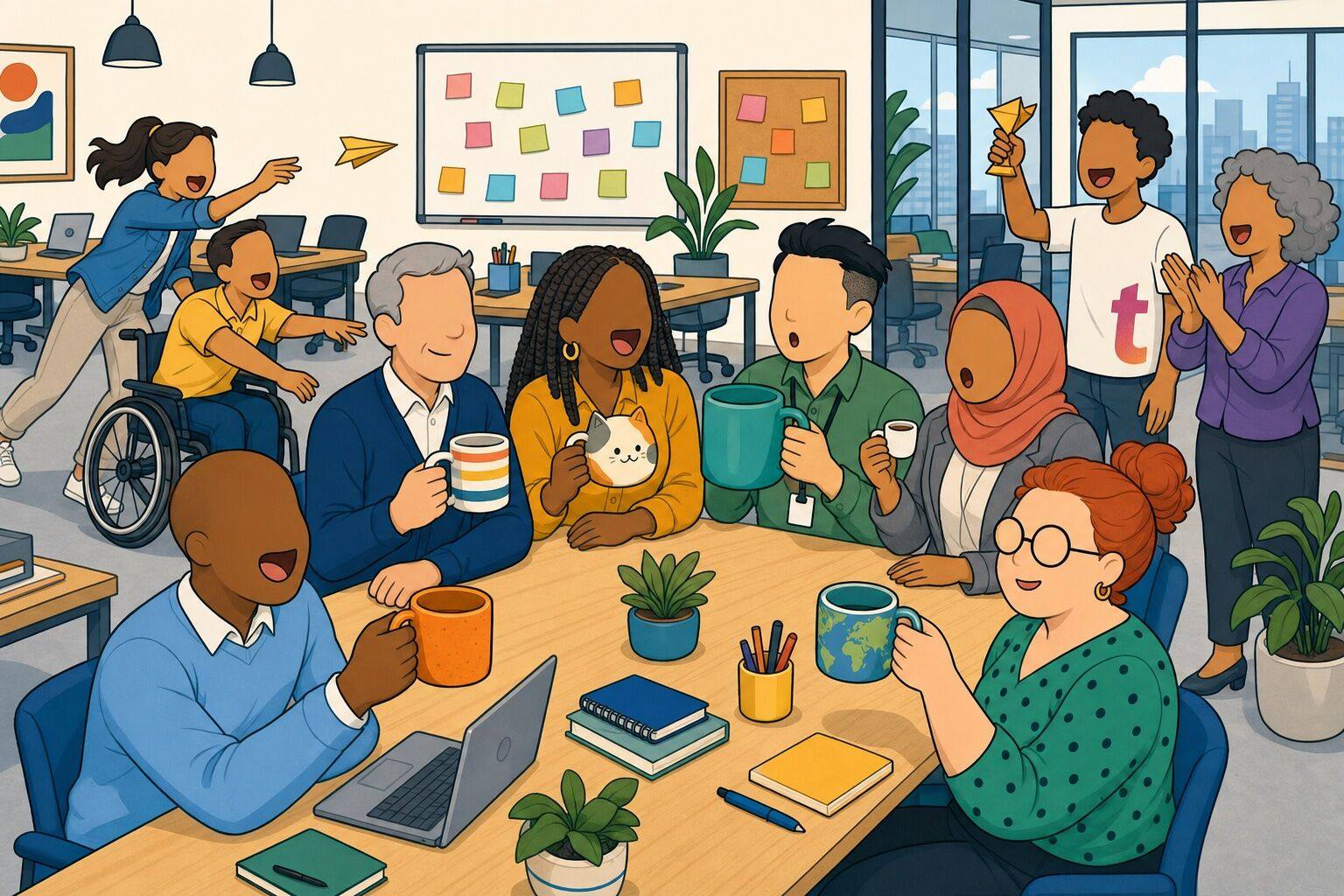
A host-tested list of 30 fun office activities, from small five-minute games to monthly rituals, with instructions, group sizes and costs for in-office and hybrid teams.
Most offices already have everything they need for a good time: a whiteboard, a kitchen, a stack of printer paper, and a room full of people who would rather laugh with each other than sit through another status update. What they are usually missing is a plan. That is what this list is for.
We build and host team experiences for a living, and fun office activities are the small, cheap, repeatable ideas we recommend most often to the managers who ask us what to do between events. Every activity below has step-by-step instructions, a group size, a time, and a real materials cost, and most can be run this afternoon with whatever is already in the supply closet.
This list includes:
Here we go!
Fun office activities are short games, challenges, and social rituals that employees do together in the workplace to break up the routine and get to know each other. Examples include a mug swap and story share, a paper airplane distance contest, and a monthly mystery lunch draw. The purpose is to give coworkers a reason to talk about something other than work, which is where most real workplace friendships start. These activities are also called fun activities at work, fun workplace activities, office fun ideas, and small fun activities for employees in the office.
Fun office activities are a subcategory of team building activities and the everyday end of indoor team building. They are similar to office game nights, things to do with coworkers, and party games for work, and the bigger ones grow into a full office party. This guide includes small fun activities for employees in the office, quick office activities, fun activities at work for teams, office activity ideas for departments, fun office games, fun office activities for large groups, and monthly office activities. Managers use them as employee engagement activities and as one of the simplest ways to build a positive work environment.
The case for doing this at all is simple. Gallup reports that only two in 10 U.S. employees strongly agree they have a best friend at work, and estimates that moving that ratio to six in 10 could mean 36% fewer safety incidents, 7% more engaged customers, and 12% higher profit (Gallup, "Why We Need Best Friends at Work," 2018). Friendships do not form in status meetings. They form over a shared mug story, a lost paper airplane, and a lunch with someone from a different floor, which is exactly what the activities below are designed to create.
Every activity in this guide is free or nearly free and works with materials you already have. Use the table to pick one, then jump to the instructions.
| Activity | Best for | Group size | Time | Cost |
|---|---|---|---|---|
| Mug Swap & Story Share | Getting to know coworkers | 4–20 | 15–30 min | Free |
| Better Than Good | Opening a meeting | 3–15 | 5–10 min | Free |
| Coffee Tasting Flight | Slow-morning bonding | 4–20 | 20–30 min | $10–$30 |
| Guess the Desk | Big laughs, low effort | 6–40 | 10–15 min | Free |
| Sneaky Costume Day | All-day, low-key fun | 5–100+ | All day | Free |
| Mystery Post-It Challenge | Puzzle lovers | 5–30 | 1–3 days | $5 for sticky notes |
| Compliment Round | Recognition | 4–30 | 10–15 min | Free |
| Origami Race | Quick competition | 3–30 | 10–15 min | Free |
| Paper Airplane Distance Contest | Energy and movement | 4–40 | 10–15 min | Free |
| Pancakes vs Waffles | Debate and decision-making | 5–30 | 10–15 min | Free |
| Lightning Scavenger Hunt | Waking up a room | 5–100+ | 5–10 min | Free |
| Would You Rather Wall | Passive, all-week fun | 5–100+ | 5 min per person | $5 for sticky notes |
| Three-Minute Talks | Knowledge sharing | 5–30 | 15–30 min | Free |
| Something in Common | Building relationships | 6–100+ | 15–20 min | Free |
| Skill Swap Sessions | Learning from each other | 4–20 | 30–45 min | Free |
| Office Talent Show with a Twist | Creativity and laughs | 8–50 | 30–60 min | Free |
| Office Scavenger Hunt | Cross-team mixing | 6–40 | 20–30 min | Free |
| DIY Terrarium Workshop | Creative hands-on time | 4–20 | 45–60 min | $8–$15 per person |
| Collaborative Mural | Shared creative projects | 5–50 | Ongoing | $15–$40 |
| Department Shadow Hour | Understanding other teams | 2–40 | 60 min | Free |
| Progressive Snack Tour | Cross-department bonding | 10–100+ | 30–45 min | $3–$5 per person |
| Quiz Bowl | Friendly competition | 6–50 | 20–45 min | Free |
| Office Bingo | Passive fun over a week | 5–100+ | Ongoing | Free printable |
| Board Game Tournament | Strategy and bonding | 4–30 | 45–90 min | $0–$40 |
| Office Olympics | Big groups, big energy | 15–200 | 60–120 min | $10–$30 |
| Snack Bracket | Whole-office participation | 15–500 | 1–2 weeks | $20–$60 |
| DIY Mini Golf Course | Building and playing together | 8–60 | 60–90 min | $10–$20 |
| Mystery Lunch Pairs | Meeting new coworkers | 6–200 | Monthly | Free |
| Desk Decor Theme of the Month | Creative expression | 5–100+ | Monthly | Free |
| Bucket List Board | Long-term connection | 5–100+ | Monthly | $5 for a board |
Small is the operative word. These activities need no budget approval, no room booking, and no more than a few minutes of anyone's attention. They are the ones we recommend to a manager who wants to start tomorrow.
Everyone has a mug with a story, and almost nobody has been asked about it. This activity is a low-key spin on show and tell that works because the prop does the talking.
Here is how to run it:
Ask one follow-up question per story. "Who gave it to you?" or "When did you last use it?" is where the conversation turns from a show-and-tell into a real exchange.
Best for: Getting to know coworkers
Time: 15–30 minutes
Materials (cost): Each person's own mug, coffee and tea (free)
What we have learned: Do not let people opt out by grabbing a plain office mug from the cupboard. The activity depends on the mug having a story, so send the reminder the day before and again that morning.
"How are you?" "Good." That exchange happens a thousand times a day in every office and communicates nothing. Better Than Good is a two-minute opener that bans the word "good" and turns the greeting into an actual check-in.
Here is how to run it:
This is one of our founder's standing life lessons, and it is the cheapest activity on this list. If your team needs a prompt beyond "how are you," our list of icebreaker questions has hundreds.
Best for: Opening any meeting
Time: 5–10 minutes
Materials (cost): None (free)
What we have learned: The manager should answer first, and honestly. If the leader says "great, no notes," everyone else will too, and the round is wasted.
The office already runs on coffee, so a tasting flight is the easiest possible upgrade to something everyone is doing anyway.
Here is how to run it:
Best for: Slow-morning bonding
Time: 20–30 minutes
Materials (cost): Three or four coffees, cups, scorecards ($10–$30)
What we have learned: Add a tea flight alongside the coffee. Roughly a quarter of any office does not drink coffee, and a tasting that excludes them is the opposite of the point.
Guess the Desk is a photo guessing game that generates more laughs per minute of prep than anything else we know. People are weirdly proud of their workspaces, and weirdly bad at recognizing each other's.
Here is how to run it:
Best for: Big laughs, low effort
Time: 10–15 minutes
Materials (cost): A phone camera and a slide deck (free)
What we have learned: Include the boss's desk. It is always the most-guessed slide, and it signals that leadership is playing too.
A full costume day is a big ask. Sneaky Costume Day keeps it subtle: employees build a "costume" out of small accessories, and coworkers try to guess what it is.
Here is how to run it:
For a more committed version, see our full list of dress up days.
Best for: All-day, low-key fun
Time: All day, two minutes of attention at a time
Materials (cost): Accessories people already own, sticky notes (free)
The Mystery Post-It Challenge is a slow-burn puzzle that lives on the office walls for a few days. One person designs it; everyone else solves it in the gaps between meetings.
Here is how to run it:
Best for: Puzzle lovers
Time: 1–3 days, a few minutes at a time
Materials (cost): One pad of colored sticky notes ($5)
What we have learned: Six clues is plenty. We have seen 20-clue chains die by Wednesday because nobody had time to finish; a short chain that everyone completes beats an epic that three people abandon.
A Compliment Round is structured recognition that takes ten minutes and costs nothing. Structure is what makes it work: without a format, "say something nice about a coworker" produces silence and one awkward volunteer.
Here is how to run it:
Stuck for wording? Our compliment generator will get you started:
Best for: Recognition
Time: 10–15 minutes
Materials (cost): Index cards and pens (free)
What we have learned: Assign the pairs rather than letting people choose. Chosen pairs cluster around the popular people; assigned pairs guarantee that the quiet coworker in accounting gets a card too.
These are the activities to reach for when a meeting ends early, a Friday afternoon drags, or a team needs a jolt before a big push. Each one starts and finishes inside a quarter of an hour, and none needs more than printer paper and a whiteboard.
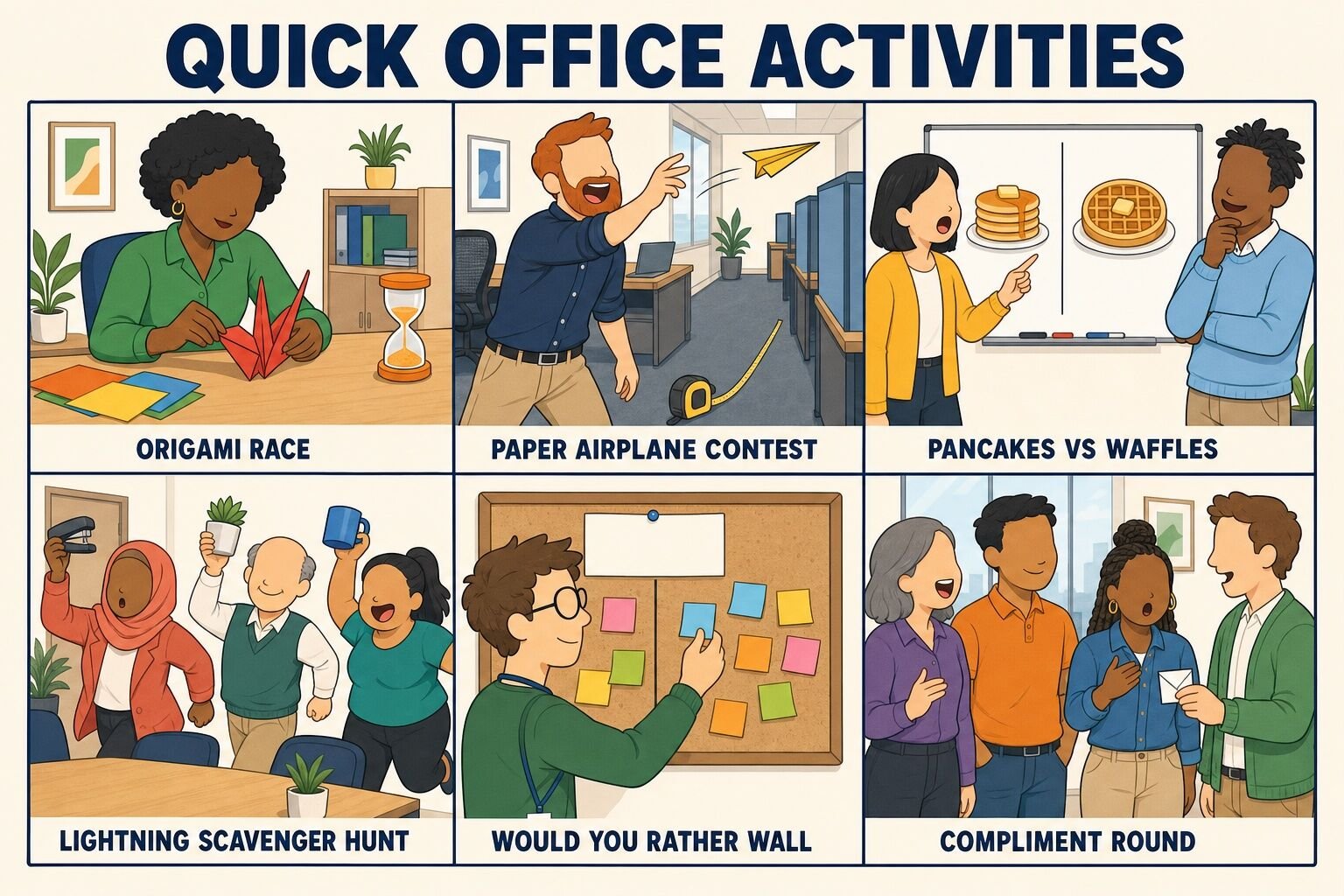
An Origami Race is a timed folding contest that turns a stack of scrap paper into ten minutes of surprisingly intense competition.
Here is how to run it:
Best for: Quick competition
Time: 10–15 minutes
Materials (cost): Printer paper, a timer (free)
What we have learned: The frog is the whole game. Everyone can make a cup, but only a few people can make a frog jump, and watching them try is better than the race.
Paper airplanes are the original office sport. A distance contest takes a hallway, a tape measure, and about ten minutes.
Here is how to run it:
Best for: Energy and movement
Time: 10–15 minutes
Materials (cost): Paper, masking tape, a tape measure (free)
Pancakes vs Waffles is a debate game we run in our hosted events, and it moves into an office with nothing but a whiteboard. The group must eliminate one of two things from existence forever, then the survivor faces a new challenger.
Here is how to run it:
Best for: Debate and decision-making
Time: 10–15 minutes
Materials (cost): A whiteboard (free)
What we have learned: Keep the stakes silly. The game loses its charm the moment someone proposes "waffles vs the new PTO policy," so set the tone with a ridiculous round early on.
Lightning Scavenger Hunts are one of our most-requested hosted games, and the office version is even easier than the video-call original: call out an item, and everyone races to find one and bring it back to the table.
Here is how to run it:
Need items? Our clue generator has hundreds:
Best for: Waking up a room
Time: 5–10 minutes
Materials (cost): Whatever is already lying around (free)
What we have learned: Alternate physical rounds with "show us on your phone" rounds (a photo of your pet, your most-used emoji). The phone rounds give the less mobile people in the room a chance to win.
A Would You Rather Wall is a passive activity that runs all week and takes each person about a minute. One question, two columns, a stack of sticky notes.
Here is how to run it:
Our full list of would you rather questions has enough prompts for a year, and the generator below will pick one for you:
Best for: Passive, all-week fun
Time: 5 minutes per person, over a week
Materials (cost): Sticky notes and a wall ($5)
These activities need a bit more structure and a full team to work: 20 to 30 minutes, a room, and everyone present. They are the ones we recommend for a monthly team meeting or the first hour of an offsite.
Three-Minute Talks are a mini lecture series where team members share something they know or love, with a hard time limit that keeps it painless.
Here is how to run it:
For the full-length inspiration, see our picks for the best TED talks for team building.
Best for: Knowledge sharing
Time: 15–30 minutes
Materials (cost): A timer, optional projector (free)
What we have learned: Non-work topics get more volunteers and better talks. "How I got into beekeeping" fills the room; "an overview of our Q3 pipeline" empties it.
Something in Common is a connection game from our hosted events. Small groups hunt for the most unusual thing every person in the group shares, then present it to the room.
Here is how to run it:
Best for: Building relationships
Time: 15–20 minutes
Materials (cost): None (free)
What we have learned: Ban the obvious categories out loud before the timer starts (job, location, coffee). Groups that are forced past the first three answers find the good ones.
A Skill Swap is a peer-taught mini class. It costs nothing, and it surfaces the talents that never show up on a job description.
Here is how to run it:
For a more formal version, see our guide to running a lunch and learn.
Best for: Learning from each other
Time: 30–45 minutes
Materials (cost): A meeting room (free)
A straight talent show puts a lot of pressure on a few performers. Adding a twist takes the pressure off and gets more of the office involved.
Here is how to run it:
Our list of talent show ideas has more twists and formats.
Best for: Creativity and laughs
Time: 30–60 minutes
Materials (cost): A room, a speaker, certificates (free)
An Office Scavenger Hunt sends mixed teams through the building on a list of clues, which is the best excuse we know for someone in sales to finally see where the engineers sit.
Here is how to run it:
We have a full guide to office scavenger hunts with printable clue lists.
Best for: Cross-team mixing
Time: 20–30 minutes
Materials (cost): A clue list and phones (free)
What we have learned: People clues beat object clues. "Find a coworker who has run a marathon" creates a conversation; "find a red stapler" creates a search.
Department activities have a specific job: getting one team to actually know the others. These ideas are built around mixing, sharing, or making something together that outlives the afternoon.
A terrarium workshop is a creative, hands-on hour that leaves everyone with a small plant for their desk and the office visibly greener.
Here is how to run it:
Best for: Creative hands-on time
Time: 45–60 minutes
Materials (cost): Jars, soil, pebbles, plants ($8–$15 per person)
A Collaborative Mural is one big piece of art that the whole office builds a little at a time. Hang it somewhere central and it becomes a fixture of the space.
Here is how to run it:
Best for: Shared creative projects
Time: Ongoing, a few minutes at a time
Materials (cost): Poster or paper roll, markers ($15–$40)
What we have learned: Give it a theme. A blank wall intimidates people; "draw your commute" or "the office in the year 2050" gets the first ten contributions on the wall by lunch.
A Shadow Hour pairs employees from different departments for a single hour of watching each other work. It is the fastest cure we know for "what does that team even do?"
Here is how to run it:
Best for: Understanding other teams
Time: 60 minutes
Materials (cost): None (free)
A Progressive Snack Tour is an office tour with food at every stop. Each department hosts one course, and the whole company walks the building together.
Here is how to run it:
Best for: Cross-department bonding
Time: 30–45 minutes
Materials (cost): Snacks and drinks ($3–$5 per person)
What we have learned: Themed tours (holiday decorations, everyone's favorite childhood snack) get more effort from hosts than open-ended ones, and the mystery-item stop is always the one people talk about afterward.
Games with scores, teams, and a winner. For a much longer list, see our full guide to office games; these three are the ones we would run first.
Quiz Bowl is office trivia with the pacing of a game show. Teams, buzzers (or hands), and a host with a good voice.
Here is how to run it:
Our trivia night guide has ready-made question sets.
Best for: Friendly competition
Time: 20–45 minutes
Materials (cost): Questions and a scoreboard (free)
What we have learned: The "this office" category is the one people remember. Questions about coworkers reward attention rather than trivia knowledge, so the quiet observer on the team finally gets to be the star.
Office Bingo turns the everyday quirks of the workplace into a game that runs in the background for a week.
Here is how to run it:
Play the card right here, or print it for the office:
Best for: Passive fun over a week
Time: Ongoing
Materials (cost): Printed cards (free)
A Board Game Tournament brings out the strategists. Run it over a lunch hour or a Friday afternoon with a bracket on the whiteboard.
Here is how to run it:
Best for: Strategy and bonding
Time: 45–90 minutes
Materials (cost): Games from home or one or two new ones ($0–$40)
What we have learned: Put a rules explainer at every table and keep the games short. The tournament dies at the table where one group is 45 minutes into a game nobody else knows how to play.
Above about 15 people, turn-taking games fall apart: nobody wants to wait for 40 coworkers to share a mug story. Large-group activities work because everyone plays at once, or because participation is spread over days rather than minutes.
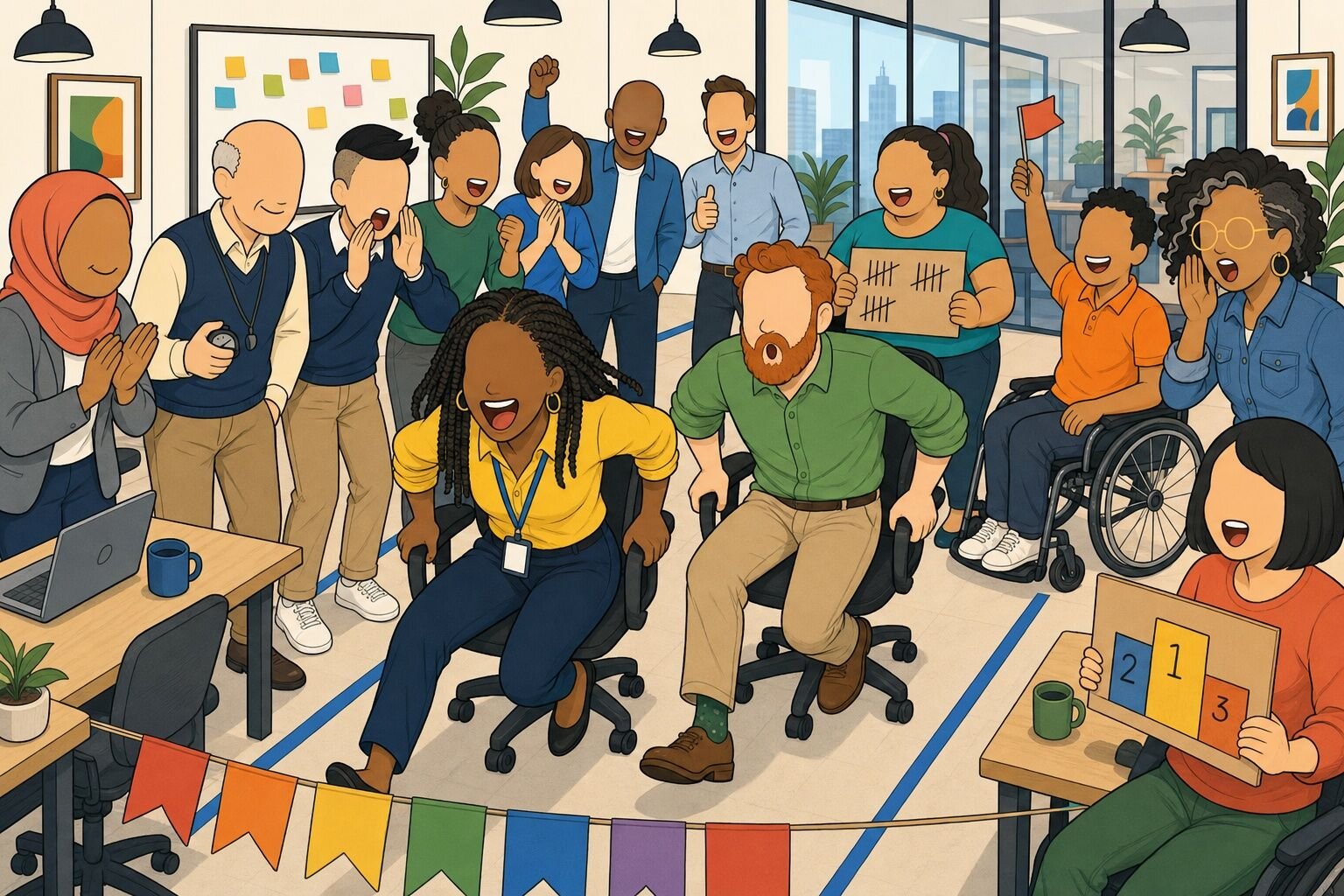
Office Olympics is the big one: a set of ridiculous events built from office supplies, run as a tournament between departments. It is loud, it is silly, and it is the activity people still mention a year later.
Here is how to run it:
Our full Office Olympics guide has 20+ events with rules and scoring.
Best for: Big groups, big energy
Time: 60–120 minutes
Materials (cost): Office supplies, tape, printed flags, medals ($10–$30)
What we have learned: Appoint a referee who is not competing and give them a whistle. Without one, every event ends in a good-natured argument that eats the schedule.
A Snack Bracket is a tournament of snacks, seeded and voted on over a week or two. Hundreds of people can play, each in about 30 seconds a day.
Here is how to run it:
For more tournament-style formats, see our list of work competitions.
Best for: Whole-office participation
Time: 1–2 weeks, 30 seconds a day
Materials (cost): Snacks and a poster ($20–$60)
What we have learned: Seed one obviously terrible snack as a joke entry. Nothing unites an office like a campaign to get plain rice cakes to the final.
A DIY Mini Golf Course splits the office into teams that each build one hole from office supplies, then everyone plays the whole course. The build is half the fun.
Here is how to run it:
Best for: Building and playing together
Time: 60–90 minutes
Materials (cost): Cardboard, tape, cups, putters or rulers, balls ($10–$20)
The activities that change an office are the ones that recur. A monthly ritual takes almost no planning after the first time and gives the team something to look forward to. For multi-week formats with a bit more competition, see our office challenge ideas.
Mystery Lunch Pairs randomly matches two coworkers for lunch once a month. It is the most reliable way we know to get people from different teams talking, because the randomness removes the awkwardness of asking.
Here is how to run it:
Our guide to hosting a team lunch has more formats for the group version.
Best for: Meeting new coworkers
Time: One lunch per month
Materials (cost): None (free), or a lunch stipend
What we have learned: Make it opt-in and keep the opt-in list public. Voluntary pairs actually show up; conscripted pairs quietly cancel.
A Desk Decor Theme gives people a new excuse each month to personalize their space, and a walk-around at month's end to judge the results.
Here is how to run it:
Best for: Creative expression
Time: Monthly, 10 minutes to judge
Materials (cost): Whatever people already own (free)
A Bucket List Board is a shared wall where coworkers post goals, personal or professional, and the office helps them get done. It is the slowest activity on this list and the one with the longest tail.
Here is how to run it:
For more ways to use the wall, see our list of office bulletin board ideas.
Best for: Long-term connection
Time: Monthly, a few minutes at a time
Materials (cost): A corkboard and pins ($5)
What we have learned: The "offers" step is what separates this from a wish list. A board of goals is nice; a board where the person in finance turns out to be a marathon coach is an office activity.
Most offices are hybrid now, which means "fun office activities" that only work for the people in the building quietly exclude everyone else. The fix is usually small: pick activities where the prop or the vote travels over a camera, and run the in-office group and the remote group as one room, not two.
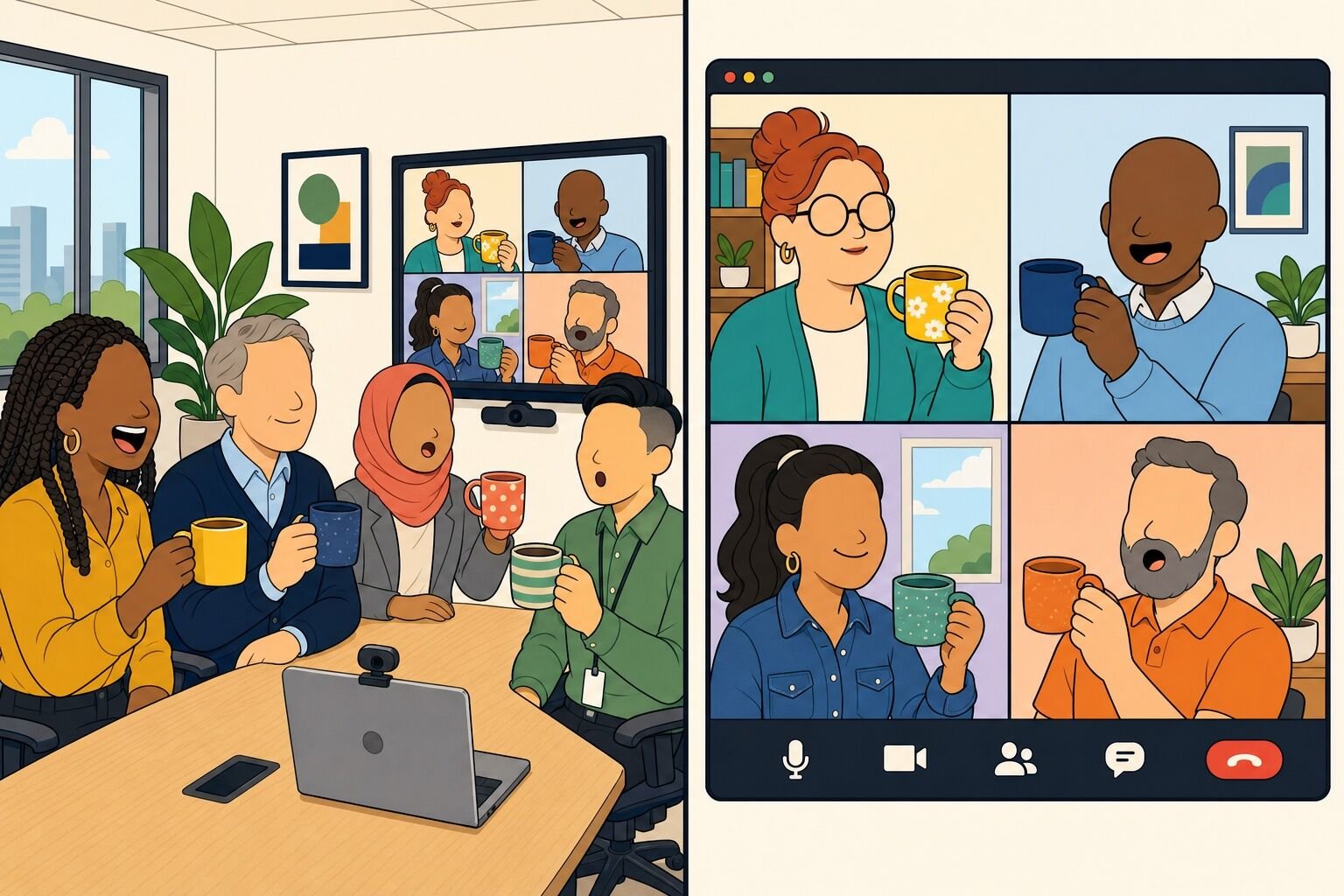
Here is how the activities in this guide adapt:
| Activity | Hybrid adaptation |
|---|---|
| Mug Swap & Story Share | Remote teammates hold their mug up to the camera; the office group sits within frame of one laptop, not six. |
| Better Than Good | Works unchanged. Call on remote people first so they are not left for last. |
| Guess the Desk | Ask remote teammates for a photo of their home desk. Those slides are always the hardest. |
| Pancakes vs Waffles | Vote in the chat instead of by hands so the tally is visible to everyone. |
| Lightning Scavenger Hunt | Remote players hunt their homes; office players hunt the floor. Same clues, same timer. |
| Would You Rather Wall | Mirror the wall as a poll in your chat tool and merge the counts on Friday. |
| Quiz Bowl | Put remote players on their own team with a dedicated buzzer word in chat. |
| Snack Bracket | Ship the finalists to remote teammates, or let them vote on the office's behalf from photos. |
| Mystery Lunch Pairs | Pair remote with remote for a video lunch, or mix and let the pair pick a format. |
For activities designed from the ground up for split rooms, see our guide to hybrid team building.
We have hosted team building events since 2016, most of them virtual, and the most interesting shift in our own bookings is the slow return of the office. In 2025, virtual events made up 83% of team building bookings on teambuilding.com, down from 100% in 2021, with in-person events at 17%. The people booking in-person events are usually the same managers who are also asking what to do in the office on the other 51 weeks of the year.
Employees, for their part, are not shy about what they want. In the APA's 2023 Work in America Survey of 2,515 employed U.S. adults, 92% of workers said it is important to them to work for an organization that values their emotional and psychological well-being (American Psychological Association / The Harris Poll, 2023). A ten-minute game on a Tuesday is not a wellbeing program, but it is a visible signal that the people who run the place think work should include some fun, and that signal is cheap to send.
A few things we have found true of office activities specifically:
Put it on the calendar. The activities that survive are the ones with a fixed slot: first Monday, last Friday, the top of the weekly meeting. "We should do something fun sometime" is how nothing happens.
Rotate the organizer. When the same person runs every activity, it becomes their thing. When it rotates, people bring their own ideas, and the office develops a taste of its own.
Plan in-person for September. Across our bookings, in-person events peak in September, at 12% of in-person volume, as teams come back from summer and before the holiday crunch. Office activities follow the same rhythm: the back-to-school weeks are the easiest time to launch a new monthly ritual and have it stick through the year.
Match the activity to the group size. This is the most common mistake we see, and it is the easiest one to fix.
| Group size | What changes | What to run |
|---|---|---|
| 3–12 people | Everyone can take a turn, so story and conversation formats work and go deep. | Mug Swap & Story Share, Coffee Tasting Flight, Three-Minute Talks |
| 13–40 people | Turn-taking gets slow. Split into small teams and have only a few groups report back. | Something in Common, Office Scavenger Hunt, Quiz Bowl |
| 40+ people | Nobody can take a turn. Everyone plays at once, or participation spreads across days. | Office Olympics, Snack Bracket, Office Bingo |
Make participation easy to decline. The fastest way to make an activity feel mandatory is to notice who skipped it. Opt-in activities with visible enthusiasm from leadership get better attendance than anything scheduled as "required fun."
Not everything that sounds fun in a planning meeting is fun in an office. Some of these are ideas we have watched fall flat; a few were on earlier versions of this very list.
| Activity | Why skip it | Verdict |
|---|---|---|
| Office ghost stories night | We had this on a previous version of this list. Dim lights and candles in a conference room read as awkward rather than spooky, and two people end up telling all the stories. | Cut from our list |
| Office dioramas | Another one we cut. An hour of glue and cardboard for a tabletop scene that gets thrown out on Monday. Heavy prep, low payoff. | Cut from our list |
| Pop-up art gallery of employees' work | Three people submit, everyone else feels obliged to admire, and the artists feel exposed. A collaborative mural gets the same creative energy with none of the pressure. | Cut from our list |
| Mandatory "fun Friday" | Anything with the word mandatory next to it stops being fun. Make it opt-in and make it good enough that people opt in. | Rename and reframe |
| Trust falls | A physical-risk exercise with real liability, built on a metaphor that does not survive contact with an actual workplace. | Skip it |
| Full-costume dress-up days, monthly | Once a year is a delight. Monthly, half the office quietly stops and the other half resents them. Sneaky Costume Day gets the same effect at a fraction of the effort. | Once a year, max |
| Open mic karaoke in the open-plan area | The people not participating are still at their desks trying to work. Karaoke belongs at an office party, off the clock, in a room with a door. | Move it to the party |
| Personality-test share-outs | Ten minutes is enough time to label colleagues and not nearly enough to discuss what the labels mean, which is how an office ends up with nicknames instead of insight. | Needs a workshop |
Fun office activities do not need a budget line or a committee. They need one person willing to put a paper airplane contest on the calendar and run it three months in a row. Pick a small one from the first section, run it at the top of your next team meeting, and see who volunteers to organize the one after that. The office you want is usually two or three rituals away from the office you have.
If you would rather have a host run it, our team leads virtual and in-person team building activities for teams of every size.
Next, read about fun at work, work social events, and games to play with coworkers.
Answers to the questions managers ask us most about fun activities in the office.
The easiest small activities need no budget and only a few minutes: a Mug Swap and Story Share where everyone brings a mug with a story, a Better Than Good check-in that bans the word "good," a Guess the Desk photo game, a Compliment Round with index cards, and a Would You Rather Wall of sticky notes by the kitchen. Each runs in 5 to 15 minutes with supplies already in the office.
An Origami Race, a Paper Airplane Distance Contest, Pancakes vs Waffles, and a Lightning Scavenger Hunt all start and finish inside 15 minutes. The common thread is that everyone plays at the same time, so nobody waits for a turn, and the only materials are printer paper, a whiteboard and a timer.
Above about 15 people, avoid anything where one person speaks at a time. Run Office Olympics as heats between department teams, a Snack Bracket where hundreds of people vote in 30 seconds a day, Office Bingo that plays in the background for a week, or a DIY Mini Golf Course where each team builds one hole. Everyone participates at once or over several days.
A short activity weekly and a bigger one monthly is the rhythm that sticks. Put a five-minute game at the top of the weekly team meeting and a monthly ritual such as Mystery Lunch Pairs or a Desk Decor Theme on a fixed date. Activities that live on the calendar survive; activities that happen "when there is time" usually stop after two tries.
Pick activities where the prop or the vote travels over a camera. Remote teammates can hold a mug up to the screen for Mug Swap, hunt their homes in a Lightning Scavenger Hunt, vote in chat for Pancakes vs Waffles, and be paired for a video lunch in Mystery Lunch Pairs. Treat the office group and the remote group as one room, and call on remote people first.
Workplace friendships form over shared experiences, not status meetings. Gallup reports that only two in 10 U.S. employees strongly agree they have a best friend at work, and estimates that moving that ratio to six in 10 could mean fewer safety incidents, more engaged customers and higher profit. Small, regular activities are the cheapest way to create the shared moments those friendships come from.
Comments (0)
Leave a Comment