30 Work Happy Hour Ideas, Games & Themes (With Alcohol-Free Options)
Most work happy hours fail because nobody mixes. Here are 30 happy hour games, activities and themes for work, each with instructions, group sizes, timings, costs and an alcohol-free version.
Published
·
Updated
Most work happy hours have the same problem: everyone shows up, collects a drink, and then stands in the exact cluster of people they sit with all week. Forty minutes later the extroverts are still talking, the rest of the team has quietly left, and nobody met anyone new. The drinks were never the point. The point was the mixing, and mixing does not happen on its own.
We run social events for corporate teams all year, in offices, at venues, and on video calls, and the fix is always the same: give the room one thing to do together. A trivia round, a stand-or-sit vote, a tasting with a scorecard. Ten minutes of structure is enough to get people talking to someone they do not already know, and the rest of the hour takes care of itself.
The 30 ideas below are the games, activities and themes that do that job. Every one includes step-by-step instructions, a group size, a time estimate and a cost, and every game works just as well with sparkling water as it does with a beer, because a happy hour that only works for the drinkers is not a team event.
A work happy hour is a short, informal social event, usually held late in the workday, where coworkers gather over drinks and snacks to relax and get to know each other outside of meetings. Work happy hour ideas are the games, activities and themes that give the gathering some structure, so people mix instead of standing in their usual groups. Examples include happy hour trivia, a mocktail and cocktail mixology class, a stand-or-sit "this or that" vote, and an Oktoberfest theme night. These events are also called office happy hours, company happy hours, team happy hours, work drinks, work socials and after-work mixers.
There is a reasonable case for the whole exercise beyond "people seem to like it." A 2019 review in Human Resource Management Review by Michel, Tews and Allen concluded that workplace fun has generally demonstrated benefits for individuals and organizations, and in a related field study of 195 restaurant servers, manager support for fun reduced employee turnover. The word that matters in that sentence is "support." The finding was not that a company bought a round; it was that managers visibly backed the fun. A happy hour the boss sponsors and then skips does not count.
One rule shapes everything on this list. Every game below is written so that "drink" means "take a sip of whatever is in your glass," and every activity has an alcohol-free version built in rather than bolted on. Roughly a third of any team either does not drink, is driving, is on medication, is pregnant, or simply has a 6 a.m. flight, and the happy hour ideas that leave those people watching are the ones that quietly kill attendance by the third month.
Happy hour games
These are the games we reach for first: quick to explain, playable while holding a glass, and built to get strangers talking. None of them need a projector, and most can start within two minutes of someone deciding to run them.
1. Happy Hour Trivia
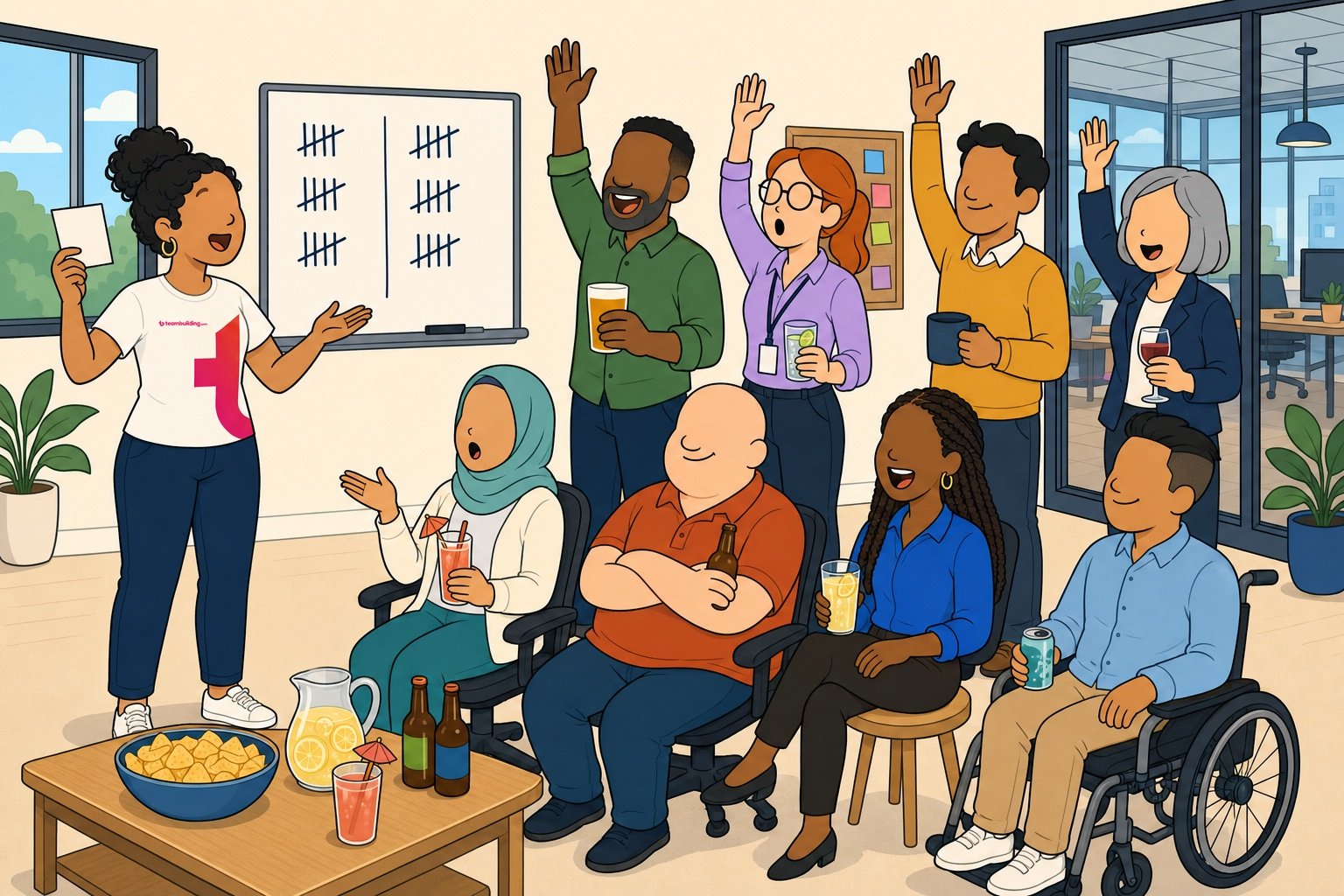
Trivia belongs in bars, which makes it the most natural happy hour game there is. The difference between a flat quiz and a great one is almost entirely in the question mix and the pacing.
How to play:
Write three rounds of six questions: one general round, one round themed to the drinks or snacks on the table, and one round about your own company (the year it was founded, the most-used emoji in the team channel, the name of the office plant).
Split the room into teams of four to six. Mix departments deliberately, and have each team pick a name.
Read each question twice. Teams write their answers on a card rather than shouting, so the quickest talker does not answer for everyone.
Score after each round and post the running total where the room can see it.
Make the last round a wager round: teams bet up to half their points on a single final question.
Best for: 8 to 60 people, any venue with tables Time: 20 to 30 minutes Materials (cost): Question cards, pens, and a scoreboard (free)
What we've learned: The company round is the one people talk about afterward. General knowledge questions reward whoever happens to know the capital of Mongolia; a question about your own office rewards everyone equally and produces the inside jokes that make a team feel like a team. Pull general questions from our list of trivia for adults, then write the company round yourself. For a quick warm-up round, use this generator:
2. Coworker Feud
A survey-style game show built entirely on your own team's answers. You poll the company in advance, rank the responses, and two teams compete to guess what their coworkers said. It is the game we get asked to run again most often, and the DIY version needs nothing but a form and a whiteboard.
How to play:
Three days before the happy hour, send a short form with six prompts, such as "name something people always say on a Monday" or "name a snack that disappears from the kitchen within an hour."
Tally the answers and write the top five responses for each prompt, with point values, on separate sheets of paper you can flip over.
Split into two teams. One player from each team faces off on the first prompt, and the higher-ranked answer wins control.
The controlling team guesses the remaining answers one at a time. Three misses hands the board to the other team for one steal.
Play all six prompts and double the points on the last one.
Best for: 10 to 50 people, indoors Time: 25 to 35 minutes Materials (cost): A survey form, paper, markers (free)
What we've learned: The survey is the game. Prompts about your specific office ("name a meeting that could have been an email") get funnier answers and bigger reactions than anything general. Here is a full set of Coworker Feud questions to start from.
3. Name That Tune
A playlist, a phone, and a speaker are all you need for the loudest ten minutes of the evening.
How to play:
Build a playlist of 20 songs spanning at least four decades and several genres, so no single age group has the advantage.
Play the first five seconds of each track. Teams shout the title and artist; the first correct answer scores.
Award a bonus point if a team can sing the next line.
For round two, let each team pick one song from their own phones to stump the others.
Best for: 6 to 40 people, anywhere with a speaker Time: 10 to 15 minutes Materials (cost): A playlist and a speaker (free)
What we've learned: Five seconds is the right clip length. Longer and the game gets easy and slow; shorter and only the music obsessives score. Include two or three songs from the year the company was founded for the same reason the company trivia round works.
4. Who's Most Likely To
Players read a prompt, everyone points at the person most likely to do it, and the person with the most fingers on them has to explain themselves. It is a fast way to surface the personalities on a team, and it works for a group that already knows each other a little.
How to play:
Prepare 15 prompts that are flattering or harmless: "most likely to win a game show," "most likely to have a secret podcast," "most likely to reply to an email at 2 a.m."
Read a prompt. On the count of three, everyone points.
The person with the most votes gets 30 seconds to defend or confirm the verdict.
Rotate who reads the prompts so no one person is running the game the whole time.
Best for: 5 to 20 people who already know each other Time: 10 to 15 minutes Materials (cost): A list of prompts (free)
What we've learned: Screen the prompts hard. "Most likely to be late" is funny to the person who is never late and uncomfortable for the person who is. Keep everything aspirational or absurd. Here are most likely to questions that pass the test.
5. Word Sneak
A stealth game that runs underneath the normal conversation of a happy hour, which makes it ideal for groups that do not want to stop mingling to play something.
How to play:
As guests arrive, hand each person a card with a secret word that is hard to use naturally: "avocado," "lighthouse," "trombone," "Mercedes."
The goal is to work the word into conversation without anyone noticing. Each successful use, confirmed by the player later, scores a point.
If a listener suspects a secret word, they say "sneak" and the speaker must admit it or deny it. A correct catch scores for the catcher; a wrong accusation costs a point.
Reveal words and tally scores in the last ten minutes.
Best for: 10 to 40 people who are mingling Time: Runs the whole event Materials (cost): Index cards (free)
What we've learned: The game works because it forces people to start conversations; you cannot sneak "trombone" into a chat you are not having. Give the quieter attendees the easier words.
6. Something in Common
Small groups race to find the most unusual thing every member shares. It is one of the simplest games we run and one of the few that gets a group of strangers past small talk in under five minutes.
How to play:
Split into groups of three to five, mixing people who do not usually work together.
Give each group five minutes to find three things every member has in common. Obvious answers like "we all work here" do not count.
Each group shares its most surprising commonality with the room.
The room votes on the most unusual answer. A shared childhood pet name beats a shared coffee order.
Best for: 9 to 100 people Time: 10 to 15 minutes Materials (cost): None (free)
What we've learned: Ban the easy answers up front. Once "we all like pizza" is off the table, groups start asking each other real questions, and that is the entire point of the game.
7. Charades
Charades earns its place at a happy hour because it needs no equipment and gets people out of their chairs. Adding a timer and a running score turns a polite parlor game into a competition.
How to play:
Write 30 prompts across categories such as movies, office life, sports and famous people. Include a few workplace-specific ones like "the Monday standup" or "the coffee machine breaking."
Split into two teams. One player acts, their team guesses, and a 60-second timer runs.
Score one point per correct guess and rotate the actor every turn.
Play to a set number of rounds rather than a set score, so the game ends on time.
Best for: 6 to 30 people, a room with some open floor Time: 15 to 20 minutes Materials (cost): Prompt slips and a timer (free)
What we've learned: Office-specific prompts get the biggest laughs and the fastest guesses. Grab extra prompts from our charades generator.
8. Mingle Bingo
A human bingo card turns the awkward first 20 minutes of a happy hour into a scavenger hunt for conversations. Each square describes a person ("has run a marathon," "speaks three languages"), and players have to find a coworker who matches and get their signature.
How to play:
Print a bingo card with 16 to 25 squares. Mix easy squares ("has a pet") with rare ones ("has met a celebrity").
Hand a card and a pen to each guest at the door. Each square must be signed by a different person, and players can only sign a square they genuinely match.
The first player to complete a row wins a small prize; the first full card wins a slightly bigger one.
Read out the best discoveries at the end: who met the celebrity, who has the marathon time.
Best for: 15 to 200 people Time: 20 to 30 minutes, run alongside mingling Materials (cost): Printed cards and pens ($0 to $10)
What we've learned: The rare squares carry the game, because they send people across the room asking strangers questions. Use this card as a starting point and swap in a few squares specific to your team:
Team building drinking games
Drinking games at work are a genre with a bad reputation, mostly earned. The versions that work for a team follow one house rule we call sip or skip: "drink" always means a single sip of whatever is in your glass, anyone can skip a sip and take a forfeit instead (answer a bonus question, do the next round's reading), and no game ever counts drinks. Under that rule, all six games below play identically for the person with an IPA and the person with a lemonade. Remote teams can run most of them on a call; here are online drinking games adapted for video.
9. This or That: Stand or Sit
The fastest game in this guide. A host reads two options, everyone votes with their body, and the minority sips. It works in a crowded bar because it needs no cards, no table and no explanation.
How to play:
The host reads a pair: "cats or dogs," "beach or mountains," "reply-all or ignore."
Everyone who picks the first option stands; everyone who picks the second stays seated (or raises a hand if the room is standing already).
The smaller side takes a sip. On a tie, everyone sips.
After ten prompts, hand the host role to whoever was in the minority most often.
Best for: 8 to 100+ people Time: 5 to 10 minutes Materials (cost): A list of prompts (free)
What we've learned: The game is only as good as the prompts, and the best ones are the mildly controversial ones: "pineapple on pizza" produces more debate than "summer or winter." Generate a fresh set here:
10. Two Truths and a Sip
The classic icebreaker with a happy hour scoring rule. Each player shares three statements, the group votes on the lie, and the sip goes to whoever guessed wrong.
How to play:
In groups of five to eight, each player writes two true statements about themselves and one lie. The lie should be plausible; the truths should be surprising.
A player reads all three. The group discusses for one minute, then votes on which statement is the lie.
Everyone who voted wrong takes a sip. If the whole group is fooled, the storyteller takes a victory sip instead.
Rotate until everyone has gone.
Best for: 5 to 8 people per group, any number of groups Time: 15 to 20 minutes Materials (cost): None (free)
What we've learned: The game drags when people get to write their statements on the spot, so give a two-minute prep window before the first round. Tips for better statements are in our guide to two truths and a lie.
11. Categories
A pub classic that rewards quick thinking. The host names a category, players go around the circle naming something in it, and the first person to hesitate or repeat an answer sips.
How to play:
Sit or stand in a circle of six to ten. The host names a category: "breakfast cereals," "things in a toolbox," "words that rhyme with meeting."
Going clockwise, each player names one item within three seconds. No repeats.
A pause, a repeat or a wrong answer ends the round, and that player sips and picks the next category.
Play eight to ten categories, then rotate the starting player.
Best for: 6 to 10 people per circle Time: 10 minutes Materials (cost): None (free)
What we've learned: Work-specific categories are the best ones: "names of our conference rooms," "things people have left in the office fridge." The three-second rule needs an actual count-out-loud, or the round never ends.
12. Would You Rather: Majority Sips
The twist on this one is that the majority drinks, not the minority, which rewards the contrarian and keeps the sip count low for everyone.
How to play:
The host reads a dilemma: "would you rather have every meeting be 15 minutes shorter or every Friday end at 3 p.m.?"
Players vote by raising a hand for option one, then option two.
The larger group sips. Anyone in the minority gets to explain their reasoning, which is where the conversation actually happens.
Ten prompts, then swap hosts.
Best for: 6 to 40 people Time: 10 minutes Materials (cost): A prompt list (free)
What we've learned: Dilemmas with a work angle produce the best discussions, and the reasons are more interesting than the votes. Start with our would you rather questions.
13. Flip Cup Relay
The one physical game in this section, and the loudest. Teams race to drink a small cup and flip it upside down by flicking the rim, one player at a time. Fill the cups with an inch of water, soda or beer, and the race plays the same.
How to play:
Line two teams of four to six along opposite sides of a table, one plastic cup per player, each filled about one inch.
On "go," the first players drink their cup, set it upright on the table edge, and flip it with a flick so it lands upside down.
The next teammate cannot start until the cup lands. First team to flip every cup wins.
Run a best-of-three, and mix the teams between rounds.
Best for: 8 to 24 people, a sturdy table Time: 10 minutes Materials (cost): Plastic cups and a roll of paper towel ($5 to $10)
What we've learned: One inch of liquid is the whole difference between a fun relay and a bad night. Announce "water cups are the fast cups" and half the room will choose them for the competitive advantage.
14. Guess the Drink
A blind taste test that works as a drinking game for everyone, including people who do not drink, because the mystery cups can be sodas, sparkling waters, cold brews or craft beers.
How to play:
Pour six numbered cups from bottles the players cannot see. For a mixed room, run two flights: one alcohol-free (colas, flavored seltzers, iced teas) and one alcoholic (lagers, ciders, a hard seltzer).
Players taste each cup and write down what they think it is: brand, flavor or style.
Reveal the answers. One point per correct brand, half a point for the right category.
The lowest scorer on each flight takes a sip of their least favorite cup; the highest scorer picks the next flight.
Best for: 6 to 30 people Time: 15 to 20 minutes Materials (cost): Six to twelve bottles and small cups ($20 to $40)
What we've learned: The alcohol-free flight is usually the harder one, and it is the one where the whole room plays. Cola brands are the great equalizer: nearly everyone is certain and nearly everyone is wrong.
Office happy hour ideas and activities
These are the bigger-ticket office happy hour ideas: an activity that runs for the bulk of the hour rather than a ten-minute game. They cost more than the games above, but they also carry the event on their own, so you do not need a host with a stack of prompts.
15. Mocktail and Cocktail Mixology Class
A guided class where the whole team makes the same two drinks, one with alcohol and one without, from the same base recipe. It is the most popular hosted format we run for happy hours, and the DIY version needs only a recipe, a shopping list and someone confident enough to demo.
How to run it:
Pick one base recipe with an easy alcohol-free twin: a margarita and a virgin margarita, a mojito and a mint limeade, a highball and a ginger fizz.
Set up stations for three to four people with a shaker, jigger, citrus, ice and the mixers. Put the spirits on a separate cart so nobody has to opt out in front of the group.
Demo one step at a time: measure, shake, strain, garnish. Everyone builds along.
Finish with a garnish contest judged by the room.
Best for: 8 to 40 people, a space with counters or tables Time: 45 to 60 minutes Materials (cost): Shakers, glassware, ingredients ($15 to $30 per person DIY; hosted classes are priced per person)
What we've learned: Building the mocktail first, then offering the spirit as an optional final step, is the single best structure for a mixed room. Nobody has to announce that they are not drinking, and the class produces two drinks per person instead of one.
16. Guided Tasting
A structured tasting with a scorecard turns "we tried some whiskey" into an activity with a beginning, a middle and a winner. Whiskey, wine and craft beer are the classics; coffee, hot sauce, olive oil and chocolate versions run exactly the same way and work for every team.
How to run it:
Choose four to six samples in one category with real variety: a peated and an unpeated scotch, a light lager and a stout, a Kenyan and a Sumatran coffee.
Print a scorecard with three columns: what you smell, what you taste, and a score out of ten.
Taste in order from lightest to heaviest. A guide (a local shop owner, a sommelier, or your most obsessive colleague) gives a 60-second intro to each.
Reveal a fact after each sample (price, origin, a story) and take a room vote on the favorite.
End with a blind re-taste of two samples and see who can identify them.
Best for: 6 to 30 people Time: 45 to 60 minutes Materials (cost): Samples, small cups, scorecards ($10 to $40 per person depending on the category)
What we've learned: Pour small. A tasting works because people compare, not because they consume, and one ounce per sample keeps everyone analytical through sample six. Reveal prices last; the cheap sample wins the vote more often than you would guess.
17. Paint and Sip
An artist walks the group through one painting step by step while everyone sips and chats. The output is a wall of 20 versions of the same sunset, which is funnier and more bonding than it sounds.
How to run it:
Book a local paint-and-sip studio, or buy canvases, acrylic sets and brushes and hire an art teacher or a talented colleague to lead.
Pick a simple subject with four or five clear stages: a skyline, a sunset over water, a single big flower.
Cover tables, set out water cups and paper towels, and put drinks and snacks on a separate table so nobody dips a brush in a cocktail.
Hang every finished canvas on one wall and hold a "people's choice" vote, plus a prize for the most creative departure from the instructions.
Best for: 8 to 30 people Time: 60 to 90 minutes Materials (cost): Canvases and paint ($15 to $25 per person DIY; studios price per seat)
What we've learned: The instructor's job is to keep the chatter going, not to produce good art. The event succeeds when people are talking while they paint, so pick a subject easy enough that nobody has to concentrate.
18. Happy Hour Scavenger Hunt
A photo scavenger hunt that runs across the venue, or around the block, and gets people moving between conversations instead of stuck in one.
How to run it:
Write 15 prompts that can be completed in the venue: "a team photo with a stranger's dog," "someone recreating the company logo with their body," "the oldest thing in the building."
Split into teams of three to five and give a 25-minute limit. Photos go to a shared group chat as evidence.
Score one point per prompt, with three bonus points for the most creative photo, judged by the room at the end.
Project or scroll the best photos as the closing act of the happy hour.
Best for: 10 to 60 people Time: 30 to 40 minutes Materials (cost): A prompt list and phones (free)
What we've learned: Keep the radius small. A hunt confined to the bar and the block outside produces more photos and more laughs than one that scatters people across a neighborhood. More prompt ideas are in our list of scavenger hunt ideas.
19. Snacks Around the World
A tasting table of snacks from six or seven countries, ideally chosen by the teammates who grew up eating them. It is a low-cost activity that gives every person at the table a story to tell.
How to run it:
Ask for volunteers to nominate a snack from their hometown or heritage, and order the rest from an international grocery or online specialty shop two weeks ahead.
Label each snack with the country and a one-line story, and number them for a scorecard.
Guests taste and rate each one. The nominator gets two minutes to explain what it is and when it is eaten.
Vote on a winner and a "most surprising."
Best for: 8 to 50 people Time: 30 minutes, alongside mingling Materials (cost): Snacks and labels ($3 to $6 per person)
What we've learned: The stories are the activity. A bag of chips from Japan is a snack; the same bag introduced by the person who ate it after school every day for ten years is a conversation. Pair it with a drinks version and you have a whole themed hour.
20. Karaoke and Open Mic
Karaoke divides rooms, which is exactly why it needs structure. Run it as an open mic with volunteer sign-ups, a few group numbers and an MC, and it becomes one of the most memorable happy hour activities there is.
How to run it:
Book a karaoke room or set up a laptop, a speaker, a mic and a playlist of lyric videos.
Open a sign-up sheet a week ahead with solo, duet and group slots. Nobody gets volunteered by someone else.
Appoint an MC who opens with a group number everyone knows, so the first solo is not the first song.
Alternate sign-up acts with two more whole-room singalongs, and keep a box of props (sunglasses, a feather boa, a tambourine) by the mic.
Give a "crowd favorite" prize, voted by applause, not a judged score.
Best for: 8 to 40 people, a private room or after-hours office Time: 45 to 90 minutes Materials (cost): Speaker and mic ($0 to $50 if you own them; karaoke rooms charge by the hour)
What we've learned: The group numbers are what make the solos possible. Once 30 people have shouted a chorus together, the bar for embarrassment is gone. If your team has more performers than singers, expand the format with these talent show ideas.
Happy hour themes for work
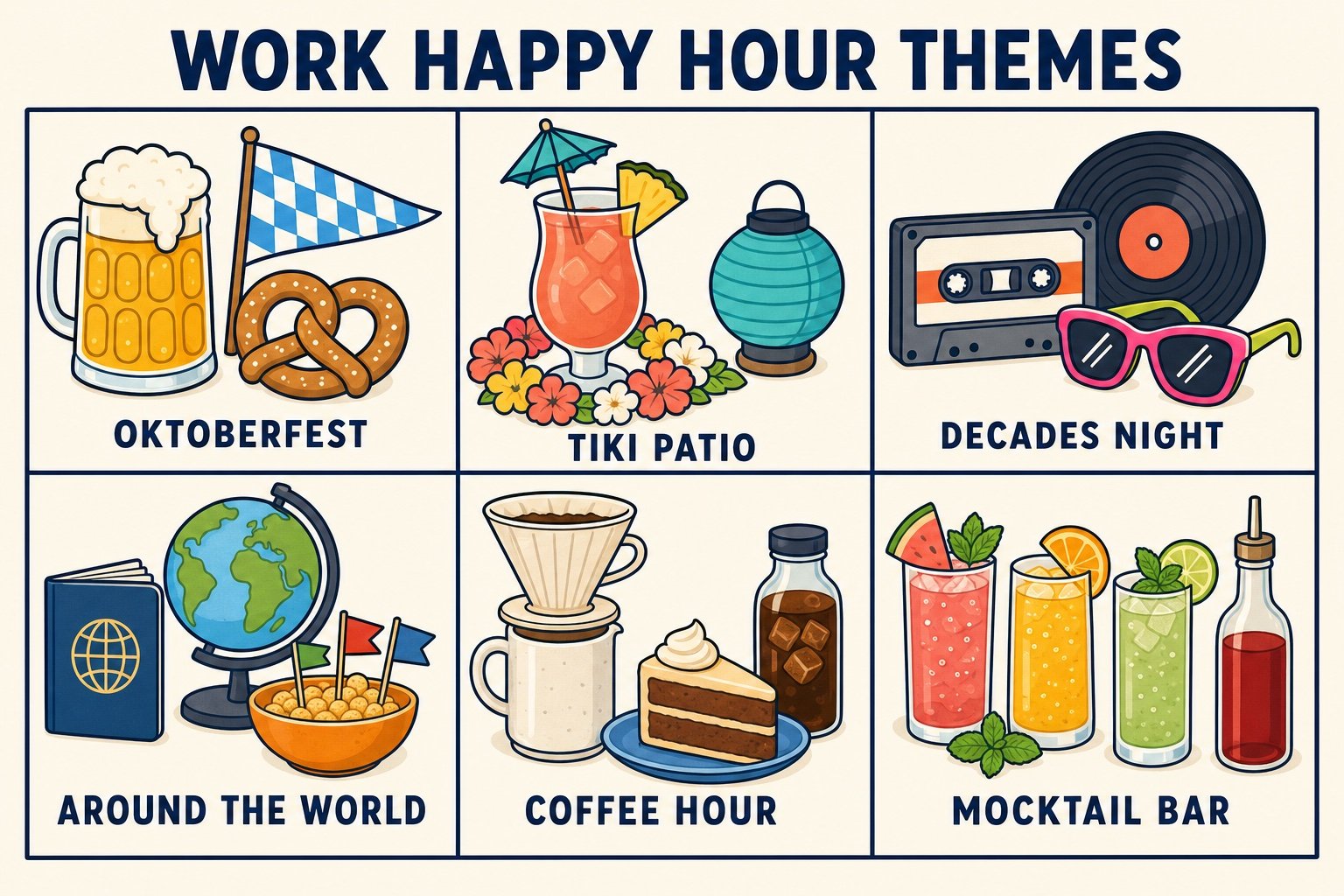
A theme gives a recurring happy hour a reason to feel different this month. It also solves the "what do we do" problem in one decision: the theme dictates the drinks, the snacks, the playlist and the game. Timing matters more than most planners expect. Across the events held on teambuilding.com from 2023 through 2025, December was the busiest month for team building events, accounting for 30% of events held, followed by October at 11%, so the holiday and Halloween themes book venues early while spring and summer slots are wide open.
The easiest theme to execute well, because the entire aesthetic is a long table, pretzels and a playlist of oompah music. It also lands in September, which is a quiet month on most event calendars.
How to run it:
Push tables together into one long biergarten row with blue-and-white checked paper.
Serve a German lager, a wheat beer and a non-alcoholic wheat beer or apple spritzer (Apfelschorle), plus soft pretzels, mustard and a sausage or veggie bratwurst tray.
Run a stein-holding contest with water-filled mugs: arms straight, last one holding wins.
Close with a relay race and a group toast the room learns in German ("Prost!").
Best for: 10 to 100 people Time: 60 to 90 minutes Materials (cost): Food, drinks and decor ($12 to $25 per person)
What we've learned: The stein-holding contest works with water and is the most competitive two minutes of the year. More traditions and game ideas are in our guide to Oktoberfest activities.
22. Tiki Patio Hour
A summer theme that moves the happy hour outside, or at least makes the break room feel like it did. Paper umbrellas do a surprising amount of work.
How to run it:
Set up on a patio, rooftop or the sunniest corner of the office with a few leis, paper lanterns and a beach playlist.
Serve one rum punch and one pineapple-lime cooler from matching dispensers, with fruit skewers and chips.
Hand out paper umbrellas and run a limbo line, or a "best tropical shirt" vote if the dress code allows.
Finish with a sunset group photo.
Best for: 10 to 80 people, an outdoor or bright space Time: 60 minutes Materials (cost): Decor, drinks, snacks ($8 to $20 per person)
What we've learned: Outdoor happy hours need an anchor activity more than indoor ones, because a patio scatters people. Put the game in the first 20 minutes. Our list of summer team building activities has more options for the season.
23. Decades Night
Pick a decade, and let the music, the snacks and an optional costume follow. It absorbs the dress-up energy of a costume party without requiring anyone to buy an outfit.
How to run it:
Choose the decade by team vote. The '90s wins most often, and the '80s produces the best playlists.
Build a two-hour playlist, source era snacks (Dunkaroos, Capri Sun and pizza bagels for the '90s), and name two drinks after the decade's hits.
Make costumes optional but rewarded: a prize for best look, and a "most committed" award.
Run a decade trivia round and a Name That Tune round drawn from the same years.
Best for: 10 to 60 people Time: 60 to 90 minutes Materials (cost): Snacks, playlist, prizes ($8 to $15 per person)
What we've learned: Optional costumes with a good prize beat mandatory ones every time. Roughly a third of the room will dress up, and that is enough to set the tone without making anyone uncomfortable.
24. Around the World Hour
Each department or table hosts a country: its snack, its drink (both ways) and one tradition to teach the room. It is the culture-show idea rebuilt as a theme with a mechanic, so it does not rely on one volunteer doing all the work.
How to run it:
Assign or let teams pick a country two weeks ahead. Teammates with a personal connection to a place get first choice.
Each table brings one snack, one drink with an alcohol-free version, and a one-minute lesson: a toast in the local language, a game, a custom.
Guests get a "passport" stamped at each table after they try the snack and learn the toast.
Award prizes for the most-stamped passport and the best table.
Best for: 20 to 100 people Time: 60 to 90 minutes Materials (cost): Passports and prizes, plus whatever each table spends ($5 to $15 per person)
What we've learned: The toast lesson is the part people remember. Teaching 40 coworkers to say "cheers" in Portuguese is a better bonding moment than any snack.
Alcohol-free happy hour ideas
Every idea in this guide works without alcohol, but these three are designed for it from the start, which makes them the right choice for teams with a dry policy, for daytime events, and for any group where a bar-centered format would leave people out. They also happen to be the cheapest happy hours to run.
25. Coffee and Dessert Hour
A 3 p.m. happy hour built around an espresso cart or a pour-over bar and a dessert table. It has the same social mechanics as the evening version and none of the ride-home logistics.
How to run it:
Book a mobile coffee cart, or set up two pour-over stations with a couple of single-origin beans and a cold brew keg.
Add a dessert tasting: three local bakeries, one item each, with a vote.
Run a coffee-tasting scorecard (see Guided Tasting) or a ten-minute trivia round.
End on time. Forty-five minutes is right for an afternoon break.
Best for: 10 to 100 people Time: 45 minutes Materials (cost): Coffee cart or beans, pastries ($6 to $12 per person)
What we've learned: Afternoon events get better attendance than after-work ones, because nobody has to choose between the team and their evening. Parents and commuters show up to a 3 p.m. coffee hour who would never make a 6 p.m. bar.
26. Build-Your-Own Mocktail Bar
A self-serve bar where the mocktail is the main event, not the consolation prize. A recipe card at each station means nobody needs a bartender.
How to run it:
Set out four bases (sparkling water, tonic, ginger beer, cold-brewed tea), six syrups and juices, fresh herbs, citrus, and a bowl of garnishes.
Print three recipe cards for named house drinks and leave space for a fourth: "your invention."
Run a mocktail-naming contest. Each invention needs a name and a one-line pitch; the room votes.
Add the winner to the menu for the next happy hour.
Best for: 8 to 60 people Time: 45 to 60 minutes Materials (cost): Mixers, syrups, garnishes, glassware ($5 to $10 per person)
What we've learned: Name the drinks after people, projects or inside jokes and the bar becomes a conversation piece. "The Q3 Launch" gets ordered more than "ginger-lime fizz."
27. Rooftop or Park Picnic
A picnic happy hour on the office roof or in the nearest park, with lemonade, iced tea and a lawn game or two. It is the most relaxed event on this list and the one that suits a small team best.
How to run it:
Pick a spot within a ten-minute walk and check the weather two days ahead, with an indoor fallback.
Bring blankets, two drink dispensers (lemonade and iced tea), a simple grazing spread, and one lawn game: cornhole, a frisbee, giant Jenga.
Best for: 5 to 30 people Time: 60 minutes Materials (cost): Food, drinks, blankets ($8 to $15 per person)
What we've learned: Blankets beat picnic tables. Sitting on the ground in a loose circle produces more cross-conversation than facing each other across a table, and it signals that the event is casual.
Happy hour ideas for large teams
Past about 40 people, a happy hour stops being a room and becomes a crowd, and crowds do not mix on their own. The three formats below are built for scale: they run in parallel across stations or tables, need a host with a microphone rather than a stack of cards, and give people a reason to walk to the other side of the venue. For more formats that scale, see our list of large group games.
28. Speed Networking Mixer
The cross-department meet and greet with a mechanic. Rotating conversations on a timer guarantee that every person meets six to eight coworkers from outside their team, which is the thing an unstructured mixer promises and almost never delivers.
How to run it:
Set up numbered high tables around the room, four to six people each. Give every guest a card with a table sequence that never repeats a partner.
Post one question per round on a screen: "what is the best thing that happened at work this month?" or "what does your team do that nobody else understands?"
Ring a bell every six minutes. Everyone moves to their next table.
Run five rounds, then open the room for free mingling. People now have five tables' worth of familiar faces.
Best for: 40 to 300 people Time: 30 to 40 minutes, then open mingling Materials (cost): Table numbers, cards, a bell, a screen (free to $20)
What we've learned: Six minutes is the sweet spot. Four feels rushed and ten drifts into small talk about the weather. Posting a question on the screen matters more for the introverts than the extroverts, because it removes the burden of starting the conversation. More prompts are in our list of icebreaker questions.
29. Happy Hour Olympics
Four or five game stations spread across the venue, with teams rotating through on a schedule. Lawn games and bar games are the natural fit, because they can be played one-handed with a drink in the other.
How to run it:
Set up stations: cornhole, giant Jenga, ring toss, a tabletop shuffleboard or a speed-stack of cups, and one trivia table.
Split the crowd into teams of six to eight with a captain and a name. Each station has a scorekeeper.
Rotate every 12 minutes. Teams earn points for wins and bonus points for cheering, costumes or a team chant.
Announce the medal table from a microphone at the end, with a podium photo.
Best for: 40 to 200 people, a venue with space Time: 60 to 75 minutes Materials (cost): Game rentals or purchases, scoreboards, medals ($100 to $400 total, reusable)
What we've learned: Bonus points for cheering are not a gimmick. They give the people who are bad at cornhole a way to contribute, and they are why the format works for a mixed crowd. Reuse the games for the rest of the year; cornhole in the break room is a two-minute game that outlives any single event.
30. Awards Toast
A ten-minute ceremony of light, specific awards at the end of a large happy hour. It gives the event an ending, gets the whole crowd facing one direction for a moment, and sends people home with a story about a colleague.
How to run it:
Two weeks ahead, collect nominations for six to ten silly-but-kind categories: "best meeting cameo by a pet," "most likely to fix the printer," "unofficial office DJ."
Buy inexpensive trophies or print certificates, and pick one MC with a microphone.
Keep each award to 45 seconds: the category, a one-line story, the winner, applause.
End with a group toast (any drink counts) and a photo of every winner.
Best for: 30 to 300 people Time: 10 to 15 minutes at the end of the event Materials (cost): Trophies or certificates ($2 to $10 each)
What we've learned: Specific beats prestigious. "Employee of the year" makes 299 people feel unrecognized; "the person who brought donuts on the worst Monday of Q2" makes the whole room laugh and remember the day. For a fuller recognition program, see these employee appreciation ideas.
All 30 work happy hour ideas at a glance
Use this table to match an idea to your group size, your time slot and your budget. Costs are per event unless noted, and every entry has an alcohol-free version described in its section.
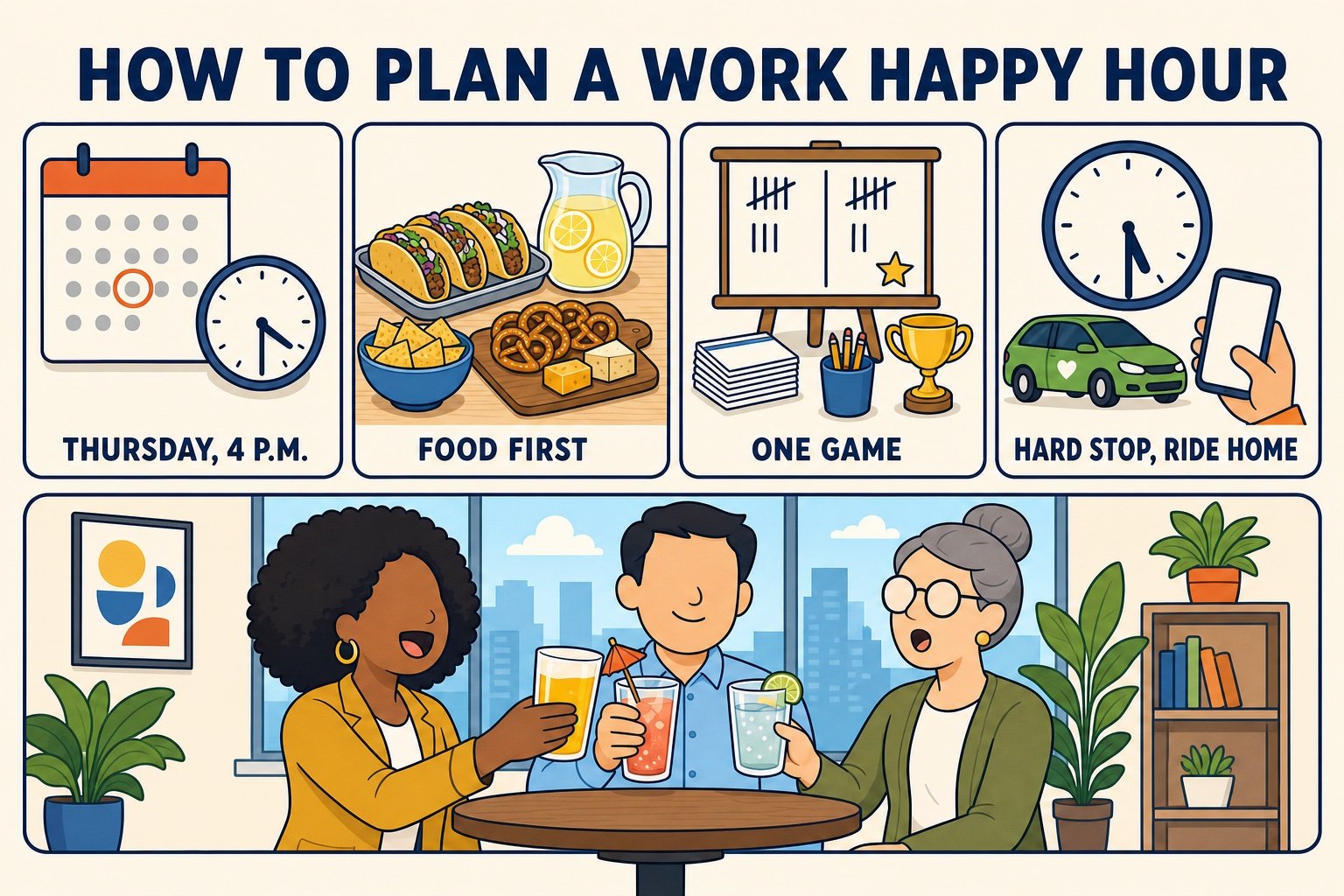
The ideas above only work if people show up, and attendance is decided by four planning choices long before anyone picks a game: the day, the time, the food and the ending. The data from our own events points in a clear direction on the first two.
Those numbers describe hosted events rather than office happy hours specifically, but they line up with what we see socially: Thursday feels like the start of the weekend without costing anyone their Friday night, and a 4 p.m. start on a workday gets far better attendance than a 6 p.m. one. An afternoon slot also lets the event count as work time. We recommend making team socials paid and on the clock to encourage participation, because an invitation to spend your own evening with your coworkers is a much bigger ask than an invitation to stop working an hour early.
Here is the agenda we use for a standard 90-minute office happy hour. Shorten it to 60 minutes by dropping the second game.
Time
What happens
Why
0:00
Doors open, drinks and food out, Mingle Bingo or Word Sneak cards handed out at the door
Gives early arrivals something to do besides stand by the snacks
A two-minute game gets the whole room to do one thing together
0:25
Main activity: trivia, a tasting, a mixology class or a themed game
The anchor that makes this event different from last month's
0:55
Free mingling, second round of food
People now have things to talk about
1:15
Closer: Awards Toast, scavenger hunt photo recap, or trivia results
An ending stops the event from trailing off
1:30
Hard stop, ride-home reminder
A published end time is the single most-appreciated planning detail
A few more planning rules we have settled on after running a lot of these:
Food first, always. Put substantial food out before the first drink is poured, not 40 minutes in. It changes the pace of the whole event.
Use a two-ticket system for alcohol. Two drink tickets per person, plus unlimited alcohol-free options, keeps the budget predictable and the event professional. Nobody has ever complained about a two-drink limit at a work event.
Make the alcohol-free drinks good. A single bottle of warm sparkling water tells non-drinkers they were an afterthought. A mocktail with a name and a garnish tells them the opposite.
Publish the end time and honor it. People plan around it, and a hard stop is also the cleanest way to close the bar.
Cover the ride home. Expense rideshares for anyone who wants one, and say so in the invitation.
Rotate the host. A work social committee with a different lead each month keeps the ideas fresh and spreads the work.
The invitation matters more than it seems, because it tells people whether attending is optional and what will actually happen. A template that works:
Subject: Thursday 4 p.m.: happy hour trivia (on the clock, ends at 5:30)
Team, we are closing laptops at 4 p.m. this Thursday for a happy hour in the second-floor lounge. Tacos arrive at 4, trivia starts at 4:25 in mixed teams, and the whole thing wraps by 5:30. Drinks and mocktails both on offer, rides home are on us, and this counts as work time. No need to RSVP, just show up. Bring a good team name.
What we've learned from hosting work socials
We host social events for corporate teams every week, in person and online, and the patterns below show up regardless of the industry, the venue or the drinks.
Structure is the difference between a happy hour and a bar tab. The events people remember had one thing the room did together. The ones people skip next time were unstructured, and "unstructured" in practice means the same three groups talking to themselves.
The first 15 minutes decide the event. If people arrive to a room with nothing happening, they form their default clusters and stay there. A card at the door, a host with a microphone, or a game that starts at minute two prevents that.
Alcohol is optional and the games should prove it. The moment a game punishes non-drinkers, a third of the room stops playing. Sip or skip, mocktails with names, and an alcohol-free tasting flight are not concessions; they are what keep the event a team event.
Attendance follows the calendar, not the enthusiasm. A Thursday afternoon on the clock beats a Friday evening off it, every time. Treat the social as work time and people will treat it as worth their time.
End on purpose. A closing toast, a results announcement or a photo gives people permission to leave together, which is a much better memory than a room slowly emptying.
Group size changes what works more than anything else. Here is how we adjust.
Group size
What changes
Formats that work
Host tip
5 to 15 people
Everyone can hear everyone, so one conversation can hold the room
Two Truths and a Sip, Categories, Guided Tasting, a picnic
Sit in one circle rather than at a long table, and let the game run without a formal host
16 to 40 people
Clusters form, so you need a mechanic that moves people between them
Trivia in mixed teams, Coworker Feud, Mixology Class, Mingle Bingo
Assign teams before the event so nobody has to pick a table
40 to 300 people
You cannot explain a game to the whole room without a microphone
Speed Networking Mixer, Happy Hour Olympics, Around the World stations, Awards Toast
Run activities at stations in parallel, and give every station its own scorekeeper
Happy hour ideas we don't recommend
Several of the ideas below appeared on the previous version of this list, and they have been copied across the internet since. They are here now because we have watched them fail, either because they only work for the heaviest drinkers in the room, because they turn a social into a liability, or because they are simply not much fun.
The Lame List
Activity
Why skip it
Verdict
Beer pong
A game whose entire scoring system is "drink more" does not belong at a work event, and the people who are good at it are not the people you want to reward. A Flip Cup Relay with one-inch pours gets the same energy without the volume.
Skip it
Shot roulette ("Where's the water?")
Mystery shots with a vodka penalty for wrong guesses is a college party, not a happy hour. It excludes non-drinkers entirely and it is how someone ends up sick in a work bathroom.
Skip it
Power hour and drink-count games
Any game that counts drinks or sets a pace is a liability with a scoreboard. The sip-or-skip rule exists so no game ever measures consumption.
Skip it
Never Have I Ever (the classic version)
The game runs on personal disclosures, and at work the interesting prompts are the ones HR would rather not hear. If you must, use work-friendly Never Have I Ever questions and drop the drinking rule.
Usually skip
Truth or Dare
The dares people remember are the ones that crossed a line, and the work-safe version is so tame it is boring. Our truth or dare generator is built for the workplace if you want to try anyway.
Usually skip
Balance and dexterity challenges after drinks
Balancing a book on your head on one leg, or reciting the alphabet backward, is a sobriety test dressed as a game. It is only funny if someone has had too much, which is the problem.
Skip it
Straight-face challenge with a drink penalty
A three-minute staring contest with sips for laughing is filler. The room was already laughing; you did not need a game for it.
Skip it
Open bar with no end time
Without a published stop, the event trails off, the bar bill doubles, and the last hour is the one that generates the complaints.
Set an end time
Mandatory Friday-night happy hours
Requiring people to give up their own evening for a work social breeds resentment, especially among parents and commuters. Move it to Thursday afternoon on the clock and the mandatory part becomes unnecessary.
Move it to work hours
Unstructured "drinks after work"
Without a game, a host or an anchor activity, this is a bar tab. The same clusters talk to each other and the new hires leave early. Add one activity from the list above.
Add structure
Final thoughts
A good work happy hour is not really about the drinks. It is a short, well-timed window where a team gets to be a group of people rather than a set of job titles, and the ideas on this list exist to make that window work for everyone in it: the trivia obsessives, the people who would rather sing, the person with the 6 a.m. flight and the colleague who does not drink. Pick one game, one anchor activity and a hard stop, put it on a Thursday afternoon, and you will have a better event than most companies manage with a much bigger bar tab.
If you would rather have a professional host run the trivia, the mixology class or the mixer for you, in the office or online, browse our hosted team events at teambuilding.com activities.
Common questions about planning games, activities and themes for a work happy hour.
What is a work happy hour?
A work happy hour is a short, informal social event, usually held late in the workday, where coworkers gather over drinks and snacks to relax and get to know each other outside of meetings. The best ones add light structure such as a trivia round, a stand-or-sit vote or a tasting, so people mix instead of staying in the groups they already sit with. Alcohol is optional, and the event works just as well with mocktails, coffee or lemonade.
What are good happy hour games for work?
The most reliable happy hour games are the ones you can explain in under a minute and play while holding a glass: happy hour trivia with a company-specific round, Coworker Feud built from a team survey, Name That Tune with five-second clips, Who's Most Likely To, Word Sneak, Something in Common, Charades and Mingle Bingo. All of them are free, and most run in 10 to 30 minutes.
Are team building drinking games appropriate at work?
They can be, if they follow a sip-or-skip rule: a drink always means one sip of whatever is in your glass, anyone can take a forfeit instead, and no game ever counts drinks or sets a pace. Under that rule, This or That: Stand or Sit, Two Truths and a Sip, Categories, Would You Rather with the majority sipping, a Flip Cup Relay with one-inch pours and a blind Guess the Drink tasting all play identically for drinkers and non-drinkers. Beer pong, shot roulette and power hour do not pass the test and are on our do-not-recommend list.
What are the best alcohol-free happy hour ideas?
A 3 p.m. coffee and dessert hour with a pour-over bar, a build-your-own mocktail bar with named house drinks and a naming contest, and a rooftop or park picnic with lemonade and a lawn game are all designed around no alcohol from the start. Afternoon alcohol-free events often get better attendance than evening bar events because parents and commuters do not have to choose between the team and their evening.
When is the best time to hold a work happy hour?
Thursday afternoon, on the clock. Across 22,000+ events on teambuilding.com since 2021, Thursday is the most popular day for a team building event (28% of events) and most events start between 2 p.m. and 4 p.m. local time, with in-person events peaking on Tuesdays. We recommend making team socials paid and on the clock to encourage participation, and publishing a hard end time, usually 60 to 90 minutes after the start.
How do you plan a work happy hour?
Pick a Thursday at around 4 p.m., put substantial food out before the first drink, use two drink tickets per person with unlimited alcohol-free options, schedule one anchor activity such as trivia or a mixology class at the 25-minute mark, close with a toast or results announcement, and end at a published time with rides home covered. Rotating the host through a social committee keeps monthly happy hours fresh.

Comments (0)
Leave a Comment