
24 Social Activities for Adults to Make Friends (Clubs, Classes & Groups)
The social clubs, classes and free activities we would actually recommend to an adult who wants a bigger social life, plus where to find groups near you.
The social clubs, classes and free activities we would actually recommend to an adult who wants a bigger social life, plus where to find groups near you.
Making friends as an adult is rarely hard because people are unfriendly. It is hard because the structures that used to do the work for you, a shared classroom, a dorm floor, a practice schedule, quietly disappear once school ends. Adult friendships have to be scheduled on purpose, and that is what a social activity really is: a standing reason to be in the same room as the same people again next week.
We plan group experiences for a living. As of August 2026, our team has hosted 45,000+ events for more than 1,000,000 participants, earning 83,000+ reviews with an average rating of 4.96 out of 5. Most of those groups are coworkers rather than strangers, but the mechanics are identical: put people around a shared activity, give them something to do with their hands, and connection happens as a byproduct. The activity is the excuse. Repetition is the engine.
That repetition matters more than most people realize. In a meta-analysis of 148 studies covering 308,849 participants published in PLoS Medicine, Holt-Lunstad, Smith and Layton found that people with stronger social relationships had a 50% increased likelihood of survival over the study periods, an effect the authors compare to quitting smoking and rank above obesity and physical inactivity. Joining a run club is not usually framed as a health decision. The research suggests it is one.
Below are the social activities, clubs and classes we would actually recommend to an adult who wants a bigger social life, plus the practical part most lists skip: where to find these groups near you, and how to walk into one when you do not know a single person there.
This list includes:
Here we go.
Social activities for adults are recurring group activities whose main purpose is spending time with other people. Examples of social activities include book clubs, run clubs, pottery classes, recreational sports leagues, volunteer projects, supper clubs and trivia nights. They can be free or paid, indoor or outdoor, organized by a club, a studio, a library or a group chat. They are also called social clubs, clubs for adults, social groups, hobby clubs, activity groups and meetup ideas for adults.
Social activities for adults are the personal-life branch of fun group activities. They are similar to connection games, group retreat activities and question games, which supply the conversation once a group exists. Within the category, this guide covers social clubs to join, hobby clubs and classes, free social activities and social activities for young adults, and the by-setting versions are indoor group games and outdoor group games.
One distinction is worth making early. A social event happens once. A social activity repeats. Repetition is what turns acquaintances into friends, so the formats below are sorted by how easy they are to keep doing.
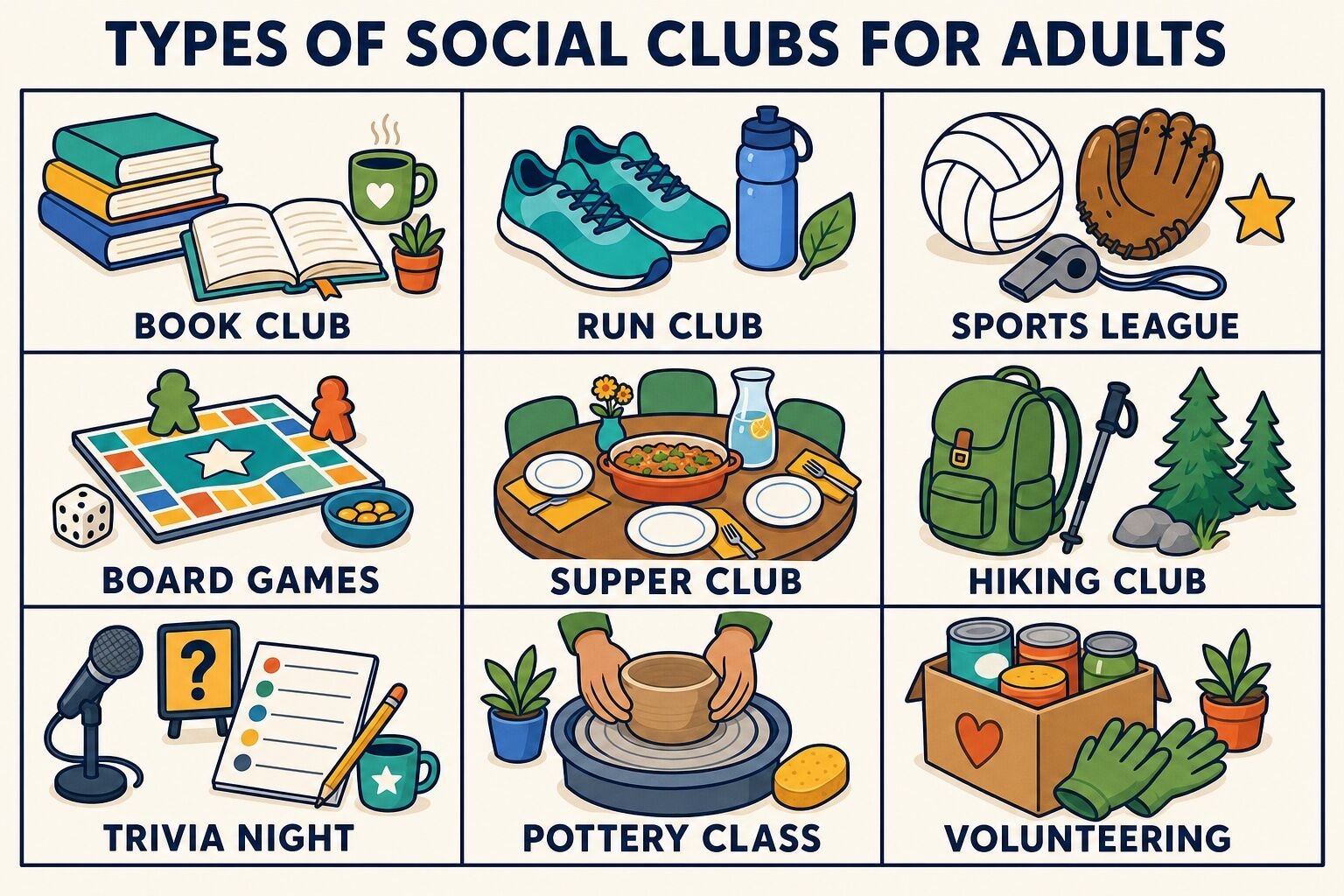
These are the club formats with the best odds of producing actual friendships: they meet on a schedule, they have a built-in activity so nobody has to manufacture conversation, and newcomers are expected. Here is the full list at a glance.
| Activity | Best for | Group size | Time | Typical cost |
|---|---|---|---|---|
| Book Clubs | Low-pressure monthly contact | 6–15 | 1–2 hours monthly | Free to $20 per book |
| Run Clubs | A weekly rhythm with built-in talking | 10–100+ | 45–90 minutes weekly | Free |
| Adult Sports Leagues | Meeting the same teammates for a season | 8–20 per team | 1–2 hours weekly | $50–$150 per season |
| Pickleball Groups | Drop-in play with constant partner swaps | 4–30 | 1–2 hours | Free to $10 drop-in |
| Board Game Nights | Structured conversation for quieter folks | 4–12 | 2–3 hours | Free to $10 table fee |
| Supper Clubs | Deeper conversation in a small group | 6–10 | 2–3 hours monthly | Cost of a dish |
| Hiking and Adventure Clubs | Long conversations and weekend plans | 6–30 | Half a day | Free to $40 per outing |
| Trivia Nights | A standing weeknight with a small team | 4–6 per team | 2 hours weekly | Free, plus what you order |
| Pottery and Open Studio Nights | Hands-on time with the same cohort | 6–12 | 2–3 hours weekly | $200–$400 per course |
| Cooking Classes | Teamwork and an obvious icebreaker | 8–20 | 2–3 hours | $60–$120 per class |
| Dance Classes | Meeting many people in one evening | 10–40 | 1–2 hours weekly | $15–$30 drop-in |
| Art Workshops and Paint Nights | Creative people, very low stakes | 8–25 | 2–3 hours | $35–$75 per session |
| Makerspaces and Repair Cafes | Practical skills plus regulars | 5–30 | 2–4 hours | Free to $100 monthly |
| Open Mics and Music Jams | Musicians and people who like an audience | 10–50 | 2–3 hours | Free to $10 cover |
| Community Choirs and Bands | Weekly commitment with a shared goal | 20–100+ | 2 hours weekly | $0–$120 per season |
| Volunteer Projects | Meeting people while doing something useful | 5–50 | 2–4 hours | Free |
| Community Garden Plots | Neighbors, repeated casual contact | 10–60 | 1–3 hours weekly | $20–$100 per season |
| Library Programs | Free, low-commitment first steps | 5–40 | 1–2 hours | Free |
| Clothing and Book Swaps | Hosting your own social event cheaply | 8–30 | 2–3 hours | Free |
| Museum Free Nights | A cheap standing plan with a friend or two | 2–10 | 2 hours | Free |
| Climbing Gyms | Partner-based sport, constant new faces | 2–20 | 1–2 hours | $20 day pass, $80+ monthly |
| Language Exchange Meetups | Structured talking with strangers | 10–40 | 1–2 hours weekly | Free |
| Improv Classes | Fast bonding and a built-in cohort | 10–16 | 2–3 hours weekly | $250–$400 per level |
| Industry and Interest Meetups | Niche interests and career-adjacent friends | 15–100+ | 2 hours monthly | Free to $25 |
A book club is the most forgiving social activity on this list, because the meeting has a guaranteed topic and nobody has to be charming to participate.
To join one, search Bookclubs.com, ask at your library or an independent bookstore, or check the bulletin board at a local cafe. To start one, invite six to eight people, pick a short book, set a fixed date such as the last Tuesday of the month, and send the next date before anyone leaves the first meeting.
If finishing a book each month is unrealistic, look for a silent reading club instead. Members gather at a cafe or bar, read their own books quietly for an hour, and then talk for the rest of the evening. The reading is the excuse, and the social part is the point. Once your group is running, these book club games keep discussion from stalling out.
Best for: Readers who want a low-pressure, recurring commitment
Time: 1 to 2 hours, usually monthly
Cost: Free if you use the library, up to $20 per book
What we have learned: Six to eight readers is the sweet spot. Below four, one cancellation kills the meeting. Above twelve, the discussion splinters into side conversations and the quieter members never speak.
Run clubs have become one of the most reliable ways for adults to make friends, and it is not really about running. It is about a recurring, free, drop-in event where talking to strangers is the norm rather than an intrusion.
Find one through a local running store, which almost always hosts a weekly group run, or through a free timed 5K such as parkrun. Look for the words "no-drop" or "all paces welcome," which means the group waits for the slowest runner. Arrive ten minutes early, tell someone it is your first time, and stay for the coffee afterward, which is where the actual socializing happens.
Best for: Building a weekly rhythm with conversation built in
Time: 45 to 90 minutes, weekly
Cost: Free
What we have learned: Side-by-side activities are easier than face-to-face ones for people who find small talk draining. Running, walking and driving all remove eye contact from the equation, which tends to make conversation flow more freely, not less.
A recreational league is a season-long commitment to the same eight to twenty people, which is exactly what friendship needs and what one-off events never provide.
Check your city or county parks and recreation department first, since municipal leagues are the cheapest option. Social leagues that run kickball, volleyball, softball and bowling also operate in most metro areas. If you do not have a team, register as a free agent and the league will place you on one, which is the single best use of the format for meeting people.
Best for: Repeated contact with the same group over several months
Time: 1 to 2 hours weekly for a 6 to 10 week season
Cost: $50 to $150 per season
What we have learned: The post-game hour matters more than the game. Teams that go somewhere together afterward stay in touch between seasons. Teams that leave the field separately rarely do.
Pickleball has a structural advantage over most sports: open play rotates partners constantly, so in ninety minutes you might play alongside a dozen different people.
Find courts and open-play sessions through your parks department, a local community center, or the court finder at USA Pickleball. Show up to a session labeled beginner or recreational, bring a paddle if you have one, and put yours in the queue. Somebody will explain the rotation within a minute of you asking.
Best for: Meeting many people quickly without a season-long commitment
Time: 1 to 2 hours
Cost: Free to $10 per drop-in session
Board game nights are the best format we know for people who would rather not be the one carrying a conversation. The game supplies structure, turns and things to react to.
Most game stores host a weekly open play night, and board game cafes usually run one too. Bring nothing your first time, say that you are new and would like to learn something, and you will be seated at a teaching table. If you want to host your own, pick games that play in under an hour and support six or more players, and set out one game everybody already knows for late arrivals. Our list of indoor group games has options that work with mixed skill levels.
Best for: Structured social time for quieter people
Time: 2 to 3 hours
Cost: Free, or a $5 to $10 table fee at a cafe
What we have learned: Teach one game well rather than offering five options. Groups that spend twenty minutes deciding what to play often never build momentum, while a host who says "we are playing this, I will explain as we go" gets a table that is laughing by minute five.
A supper club, sometimes called a dining club or an eating club, is a rotating dinner among the same small group. One person hosts, everyone brings a dish or chips in, and the group meets again next month at someone else's place.
Join one through a local food group or start your own with four to six people who each bring a friend you have not met. Fix the date pattern immediately, for example the second Sunday, so nobody has to negotiate scheduling every month. Assign a theme to each dinner to remove the "what should I make" paralysis. If conversation runs dry between courses, a few conversation games do the work without feeling like a party trick.
Best for: Depth rather than breadth, with the same handful of people
Time: 2 to 3 hours, monthly
Cost: Whatever your dish costs
What we have learned: Eating together is disproportionately effective at bonding groups, and the effect shows up in our own events: the sessions where people cook, taste or share food produce noticeably warmer rooms than the ones where they only talk.
Hiking clubs stack two useful things: hours of side-by-side conversation, and a shared experience that people reference for years afterward.
The Appalachian Mountain Club runs a national calendar of guided outings, and most regions have a local equivalent through a hiking club, an outdoor retailer or a conservation group. Filter for trips marked beginner or easy, read the pace description honestly, and message the trip leader beforehand to say you are new. Leaders almost always assign someone to hike with you.
For outings with a group you already have, our outdoor group games list travels well to a trailhead or a picnic area.
Best for: Long conversations and a built-in weekend plan
Time: Half a day
Cost: Free to $40 per outing, plus gas
Bar trivia gives you the two things that make a social activity durable: a fixed weekly time and a team that expects you.
Find a game by searching your city plus "bar trivia," checking the social accounts of nearby pubs and breweries, or asking the bartender at the place you already like. Arrive as a solo player and ask to join a short-handed team, which regulars are usually glad to allow. Come back the following week and you have a standing plan, which is more than most people manage in a year. Our list of trivia games is useful if you would rather host a night of your own.
Best for: A recurring weeknight with a small, consistent team
Time: About 2 hours, usually weekly
Cost: Free to play, plus whatever you order
What we have learned: Teams of four to six are ideal. Larger teams mean somebody is always sitting out the conversation, and the answer-by-committee process gets slow and a little annoying.
A class is a club with a syllabus. The multi-week format is the important part: you see the same faces on the same night for two months, which is close to the ideal conditions for making a friend as an adult. Prefer courses that run at least four sessions over one-off workshops.
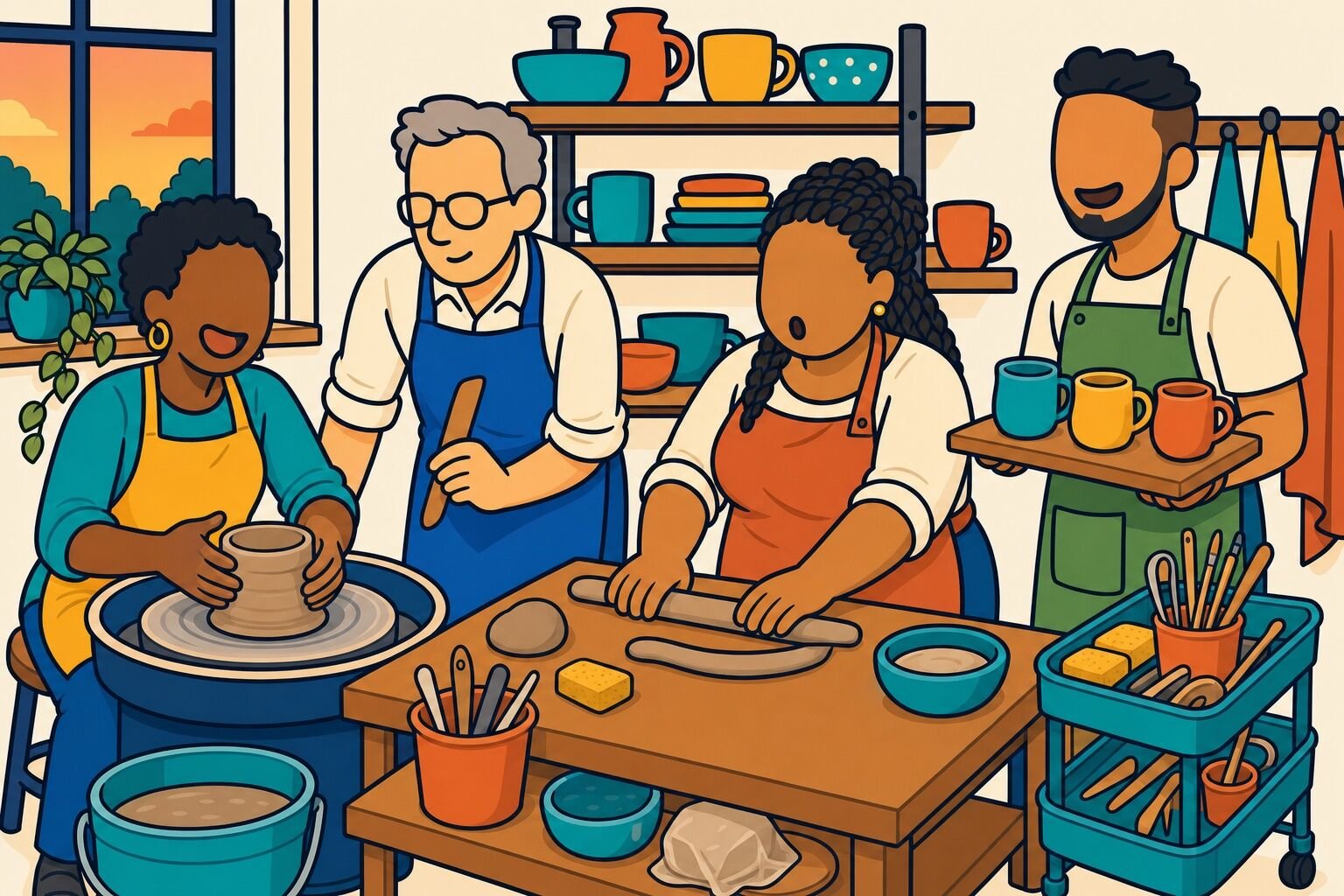
Wheel throwing is difficult, messy and genuinely funny to be bad at, which makes a pottery class one of the fastest-bonding rooms we have seen outside of our own events.
Look for a community studio, an art center or a parks department program offering a six to eight week beginner wheel course. Register for a weeknight session, arrive early enough to claim a wheel next to the same person each week, and take the open studio hours included in most memberships. Those unsupervised hours are where conversations actually happen.
Best for: Hands-on time with a fixed cohort
Time: 2 to 3 hours weekly for 6 to 8 weeks
Cost: $200 to $400 per course, including clay and firing
What we have learned: Activities where everyone is visibly bad at the same thing level a room faster than activities where skill is on display. Shared incompetence is an underrated social lubricant.
Cooking classes pair people at stations, which means you are given a partner and a task instead of having to find one.
Search a culinary school, kitchen store or community college near you, or book a hosted class through a marketplace like Cozymeal. Pick a hands-on class rather than a demonstration, ask the instructor to pair you with someone if seating is open, and stay for the meal at the end. If you want to try the format with people who are not local, we keep a list of online cooking classes.
Best for: Built-in teamwork and an obvious thing to talk about
Time: 2 to 3 hours
Cost: $60 to $120 per class
Partner dance styles like salsa, swing and two-step rotate partners on purpose, so a single beginner class can put you in conversation with fifteen people.
Find a studio offering a drop-in beginner class, ideally one attached to a weekly social dance afterward. Go alone, since going alone is normal and a partner is provided by the rotation. Stay for the first half hour of the social, ask one person to dance, and leave whenever you like.
Best for: Meeting a lot of people in one evening
Time: 1 to 2 hours weekly
Cost: $15 to $30 per drop-in class
Art workshops trade skill for permission. Nobody expects a good painting, so the stakes are low and the talking is easy.
Check local art centers, studios and museums for adult workshops, and look for traveling craft pop-ups that run sessions in bars and cafes, which are more social than a formal studio. Pick a series over a single night when you can, and sit at a shared table rather than an easel in the back. Our roundup of online art classes covers the remote version.
Best for: Creative, low-stakes evenings with new people
Time: 2 to 3 hours
Cost: $35 to $75 per session
Makerspaces are shared workshops with tools most people cannot keep at home: laser cutters, 3D printers, woodworking equipment, sewing machines. Repair cafes are their free, pop-up cousins, where volunteers help neighbors fix broken things.
Search your city plus "makerspace" or "repair cafe," then attend the open house or tour that nearly all of them run. Take the required safety training, which doubles as a small cohort class, then book a regular weekly slot. Regulars notice regulars.
Best for: Practical skills plus a community of repeat visitors
Time: 2 to 4 hours per visit
Cost: Free at repair cafes, $50 to $100 monthly for a membership
Open mics and jam sessions are the rare social activity where showing up alone is completely unremarkable, because half the room came to play rather than to socialize.
Look for a weekly open mic at a bar, cafe or music store, or a genre-specific jam such as a bluegrass or jazz session. You do not need to perform. Sit near the sign-up sheet, ask someone what they are playing, and go back the following week. If you do want to play, bring one short song you know cold.
Best for: Musicians, and people who like a low-commitment weekly haunt
Time: 2 to 3 hours
Cost: Free to a $10 cover
A community choir or concert band is a weekly rehearsal with a shared deadline, which produces the kind of camaraderie that a monthly meetup rarely reaches.
Search for a community chorus, civic band or "no audition" choir in your area. Many welcome new members at the start of each concert cycle, so ask when the next one begins. Sit with your section, learn the four names around you, and go to the post-rehearsal drinks that most groups quietly organize.
Best for: People who want one real commitment rather than five casual ones
Time: About 2 hours weekly per season
Cost: $0 to $120 per season, plus sheet music
What we have learned: Groups with a performance, a game day or a showcase at the end bond harder than groups that just meet. A shared deadline gives people a reason to depend on each other, and dependence is what turns a group into a team.
Cost is the most common reason people quit a new social habit, so it is worth building at least one free activity into your week. These five cost nothing beyond transport.
Volunteering is the best free social activity for adults, because the work gives every conversation a subject and the shift structure guarantees you are working alongside someone.
Search VolunteerMatch, a local food bank, an animal shelter, a trail crew or a habitat build. Choose a recurring shift rather than a one-time event, since the recurring shift is what produces familiar faces. Say yes to the group photo and the debrief at the end, awkward as both may be. For organizing a group effort, see our list of group volunteer opportunities.
Best for: Meeting people while doing something obviously worthwhile
Time: 2 to 4 hours per shift
Cost: Free
A community garden is a social activity disguised as a hobby. You end up at the same water spigot as the same neighbors, week after week, for an entire growing season.
Apply through your city parks department, a neighborhood association or a local land trust, and expect a waitlist in dense areas. If the wait is long, volunteer on the communal beds in the meantime, which usually gets you in the rotation faster. Show up to the seasonal workdays, where most of the garden's actual socializing happens.
Best for: Meeting neighbors through repeated, casual contact
Time: 1 to 3 hours weekly in season
Cost: $20 to $100 per season for a plot, free to volunteer
Public libraries quietly run some of the best free adult programming in the country, and almost nobody checks the calendar.
Pull up your library system's events page and look past the children's hours: author talks, language cafes, genealogy groups, seed libraries, maker labs, film series and job clubs are all common. Pick anything recurring, register if required, and sit in the middle rather than the back row. Librarians are also unusually good at telling you which local clubs are active.
Best for: A free, low-commitment way to start
Time: 1 to 2 hours
Cost: Free
A swap is the cheapest social event you can host yourself: everyone brings things they no longer want, everyone leaves with something new, and nobody has to cook.
Pick a category such as clothes, books, plant cuttings or kitchen gear. Ask each guest to bring five to ten items and one friend you have not met, set a table by category, and run one "free for all" round after people have browsed. Arrange in advance to donate the leftovers so cleanup is not your problem.
Best for: Hosting your own event without spending money
Time: 2 to 3 hours
Cost: Free
What we have learned: Asking every guest to bring one person you do not know is the single highest-leverage instruction in party planning. It grows the group, dilutes cliques, and gives your existing friends an easy job.
Most museums run a free evening or a discounted community night each month, and those nights draw a livelier crowd than a Sunday afternoon does.
Check the visit page of every museum within reach and put the free nights in your calendar as a repeating event. Invite one or two people each time rather than organizing a crowd. Give yourselves a loose game, such as each person picking a favorite piece and defending it over a drink afterward, which turns a quiet walkthrough into a conversation.
Best for: A cheap standing plan you can invite people into
Time: About 2 hours
Cost: Free
What we have learned: Our company started in 2013 running unconventional museum tours, and the lesson from thousands of them holds up for a casual visit: a museum becomes social the moment someone gives the group a task. Pick the piece you would steal, find the strangest object in the room, or argue for the most overrated painting.
Everything above works at any age. These four skew younger simply because that is who shows up: they tend to be evening activities, drop-in friendly, and full of people who also moved here recently.
Climbing gyms are among the most social athletic spaces going, because rope climbing requires a partner and bouldering produces a crowd standing around one problem offering suggestions.
Buy a day pass and take the intro class, which teaches safety and introduces you to other beginners at the same time. Go on the same two evenings each week so you overlap with the same regulars. On the bouldering mats, watching someone's attempt and then trying it yourself is a completely normal way to start talking.
Best for: A partner-based sport with a constant supply of new people
Time: 1 to 2 hours per session
Cost: Around $20 for a day pass, $80 or more monthly
A language exchange is a structured excuse to talk to strangers, which is exactly what makes it work for people who find unstructured mingling unbearable.
Find a weekly exchange at a cafe, university or cultural institute, usually organized by language table. Arrive, take the table for the language you are learning, and switch halfway through to help someone with yours. The format has an obvious script, so nobody has to invent an opening line.
Best for: Structured conversation with new people every week
Time: 1 to 2 hours weekly
Cost: Free, plus a coffee
An improv level one class is a cohort of ten to sixteen strangers who spend two months making each other laugh, which is close to a friendship cheat code.
Sign up for a beginner course at a comedy theater or improv school, not a one-night workshop. Expect the first class to feel ridiculous, because that is the point. Go to the informal drinks after class, which nearly every cohort organizes by week three. Our list of improv games shows what these sessions actually involve.
Best for: Fast bonding and a ready-made social group
Time: 2 to 3 hours weekly for 6 to 8 weeks
Cost: $250 to $400 per level
What we have learned: Improv teaches one rule that transfers directly to ordinary social life: accept what the other person offers and add to it. Most conversations that die do so because somebody blocked instead of building.
Meetups organized around a specific interest, whether that is machine learning, urban cycling, birding or horror films, gather people who have already opted into a subject you care about.
Browse Meetup and Eventbrite for groups that meet at least monthly, and check how recently the organizer posted before you commit. Prefer groups that do something, such as a ride, a build night or a screening, over groups that only mingle. Volunteering to help run one event will do more for you socially than attending ten.
Best for: Niche interests, and friendships that start from a shared subject
Time: About 2 hours, usually monthly
Cost: Free to $25
The hardest part of this is rarely choosing an activity. It is finding the specific group that meets near you, on a night you are free, that is actually still running. Here is where to look, in the order we would look.
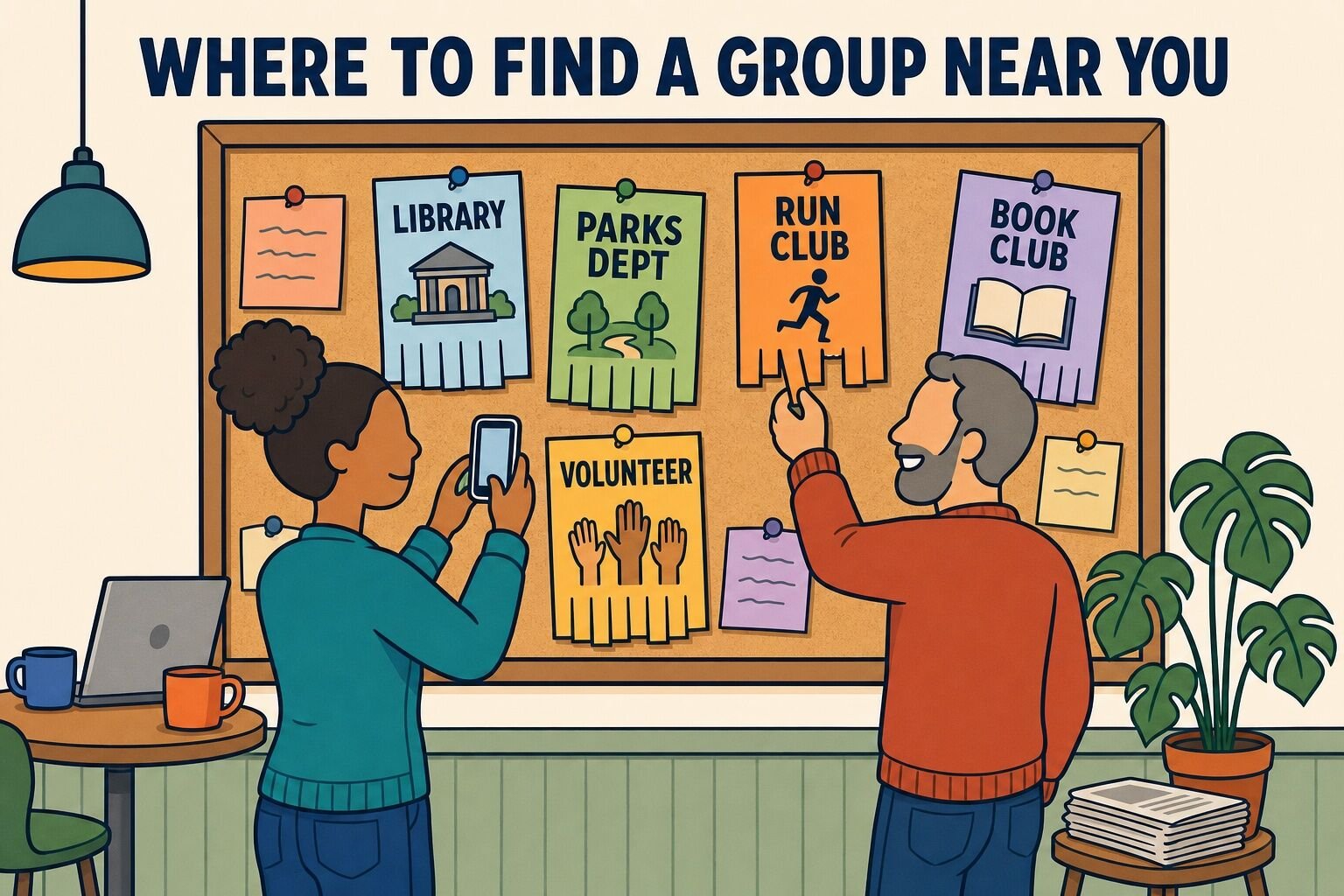
| Where to look | Best for | Cost | How to start |
|---|---|---|---|
| City parks and recreation department | Sports leagues, classes, garden plots, community centers | Free to low | Search your city name plus "parks and recreation activity guide" and read the seasonal catalog |
| Your public library | Free talks, clubs, language cafes, maker labs | Free | Open the events calendar on your library system's site and filter for adults |
| Meetup | Interest groups, hikes, language exchanges, board games | Free to $25 per event | Filter by interest, then check that the group has posted in the last month |
| Eventbrite | Classes, workshops, one-off socials and pop-ups | Free to $75 | Browse by "this weekend" and look for anything that repeats monthly |
| Local specialty stores | Run clubs, game nights, climbing meetups, craft circles | Usually free | Ask the running store, game shop, yarn store or bike shop what they host weekly |
| Nextdoor and neighborhood groups | Neighbors, cleanups, walking groups, block events | Free | Post what you are looking for rather than waiting for a listing |
| VolunteerMatch | Recurring volunteer shifts with the same crew | Free | Filter for ongoing opportunities, not one-day events |
| Bookclubs.com | Book clubs open to new members | Free | Search by location and format, including online clubs |
| Community colleges and adult education | Multi-week classes with the same cohort | $50 to $400 per course | Look for continuing education or community education catalogs |
| Cafe and coworking bulletin boards | Small, local, unlisted groups | Free | Photograph the board, then follow up by email that week |
Two practical filters. First, favor anything with a repeating date on the calendar, since a weekly or monthly slot does the remembering for you. Second, check recency before you go: an abandoned group page with a two-year-old post is the most common reason a first attempt fails.
Finding the group is the easy half. Walking in is the part people actually get stuck on, and the advice that usually gets offered, "just put yourself out there," is not a plan. Here is one.
First visits are almost always awkward, and that is information about first visits, not about the group. By the third visit, people recognize you, which changes every interaction. Decide in advance that you are going three times, and treat the first two as logistics rather than as a verdict.
Arriving early is the cheat code for anyone who dreads walking into a full room. Setup time is unstructured, the organizer is glad to see you, and talking to two or three people before the crowd arrives is far easier than joining a formed circle later.
Ask the organizer what needs doing: setting up chairs, running the sign-in sheet, keeping score, teaching a rule. A job gives you a reason to talk to everyone, a reason to be there, and a role that does not depend on being naturally outgoing. It is also how you become a regular fastest.
Do not try to meet everyone. Learn three names, repeat each one back when you hear it, and greet those three people by name next time. Being remembered is what makes someone come back, and you can be the person who does the remembering.
The opening question sets the ceiling for the conversation. "What got you into this?" or "how long have you been coming?" produce stories, while "what do you do?" produces a job title and a pause. When you need a supply of prompts that reliably start real conversations, our list of icebreaker questions is built for exactly this problem.
Groups convert into friendships at the point where someone suggests a smaller, adjacent plan: coffee after the run, a drink after trivia, a hike with two people from the class. Somebody has to say it first, and in most groups nobody does. Be the person who says it, and expect a reasonable number of no's, because scheduling is genuinely hard for everyone.
We design and run group experiences professionally, which means we get an unusual amount of feedback on what makes a room work. Most of it applies just as well to a Tuesday night pottery class as to a corporate event.
Group size decides the quality of the conversation. Across 23,000+ confirmed bookings on our platform through August 2026, the median group we run is 16 people, and half of all groups fall between 10 and 27. That range is not an accident. It is large enough to survive a few cancellations and small enough that everyone gets airtime. When you are choosing between two clubs, the smaller one will usually give you more actual conversation.
Doing beats mingling. The formats that produce friendships give people a task, a rotation or a game. Unstructured mixers put the entire burden on the most outgoing person in the room, and everyone else ends up talking to whoever they arrived with. If you have a choice between an event described as "networking and drinks" and one described as "we are building something," choose the second.
Laughing together is doing real work. In a brain-imaging study published in the Journal of Neuroscience, Manninen and colleagues found that 30 minutes of social laughter with close friends triggered endogenous opioid release in brain regions linked to pleasure and social bonding, which supports laughter as a neurochemical pathway for forming and maintaining social bonds. This is a reasonable argument for choosing the slightly silly activity over the sophisticated one.
The organizer is the product. In our events, roughly one in five reviews mentions the host by name. Participants do not remember the platform or the schedule, they remember who ran the room. The same is true of clubs: a group with an attentive organizer who notices newcomers will beat a better-designed group without one, every time.
Choose the group, not just the activity. Michael Alexis, our co-founder, keeps a running list of life lessons on his personal site, and one of them is the most useful filter we know for social activities: pursue groups where every member raises the average. If you leave a meeting slightly more energetic than you arrived, that is the group. If you leave flatter, no amount of scheduling discipline will fix it.
Introverts do not need a different list, they need a different format. Alexis also notes that the introvert and extrovert dichotomy oversimplifies what is really a spectrum. In practice the useful distinction is not who you are but what the activity asks of you: side-by-side formats with a built-in task, such as running, gardening, board games or making something, ask far less social improvisation than a party does, and they are on this list for that reason.
| Factor | Small groups (4 to 12) | Large groups (20 or more) |
|---|---|---|
| Best formats | Supper clubs, book clubs, board games, classes with a fixed cohort | Run clubs, choirs, leagues, open mics, drop-in meetups |
| How fast you are noticed | Immediately, by the second visit | Slowly, unless you take a job or join a subgroup |
| Pressure on you | Higher, everyone speaks | Lower, you can observe for a few sessions |
| Risk | Two cancellations can end a meeting | You can attend for months without meeting anyone |
| How to use it | Commit to the calendar and host once yourself | Find your four or five regulars and arrange something smaller |
The practical move is to run one of each: a large group that keeps supplying new faces, and a small one that turns some of them into friends.
Not everything marketed as a way to meet people is worth your Tuesday. These formats come up constantly in advice articles and tend to disappoint for structural reasons.
| Activity | Why skip it | Verdict |
|---|---|---|
| Going to a bar alone to meet people | There is no shared activity and no reason for anyone to talk to you, so the whole burden falls on your opening line at the exact moment you feel least like delivering one. | Skip it |
| Networking mixers as a friendship strategy | The format rewards transactions and business cards. People arrive with an agenda, conversations stay shallow, and almost nobody returns to the same room twice. | Skip it |
| Speed friending events | Rotating through five-minute conversations produces the anxiety of a job interview and none of the repetition that actually builds a friendship. | Usually skip |
| One-off festivals and ticketed events | They are a fine day out, but you will never see any of those people again. Treat them as entertainment rather than as a plan for making friends. | Not a social plan |
| Friend-finding apps on their own | The intent is right, but a chat thread with no shared activity usually stalls before the first meeting. Use them to find a group, then let the group do the work. | Use as a supplement |
| Movies, concerts and other silent formats | You can spend three hours beside someone without exchanging fifty words. Perfectly good outings, but schedule the conversation part before or after. | Add a talking half |
| Huge unstructured happy hours | In a room of 100 people with no format, most attendees talk to the person they came with and leave early. | Add structure |
| Signing up for five things at once | Spreading yourself across five activities means being a stranger in all of them. Two commitments you actually keep beat five you attend once. | Pick two |
Adult friendship runs on logistics more than chemistry. The people who have full social lives are usually not more charming than everyone else, they have simply attached themselves to two or three recurring things and kept showing up long enough to be a regular. Pick one club and one class from this list, put them in your calendar as repeating events, and give each of them three visits before you decide anything.
Next, take a look at our lists of fun games to play with friends, backyard games for adults and campfire games for things to do once your group exists.
Common questions about finding social clubs, groups and activities as an adult.
Common examples of social activities for adults include book clubs, run clubs, recreational sports leagues, pickleball open play, board game nights, supper clubs, hiking clubs, trivia nights, pottery and cooking classes, volunteer shifts, community choirs, community garden plots and library programs. The defining feature is not the activity itself but the repetition: a group that meets weekly or monthly gives you the repeat contact that friendships actually require.
Start local before you start online. Your city parks and recreation activity guide lists leagues, classes, community centers and garden plots, and your public library's events calendar carries free adult programming that almost nobody checks. After that, search Meetup and Eventbrite by interest, ask local specialty stores such as running stores, game shops and bike shops what they host weekly, and read cafe bulletin boards. Before committing to any listed group, confirm the organizer has posted within the last month, since abandoned group pages are the most common reason a first attempt fails.
The strongest free options are recurring volunteer shifts, run clubs, public library programs, community garden workdays, museum free nights and clothing or book swaps you host yourself. Volunteering is especially effective because the work supplies the conversation topic and the shift structure guarantees you are working alongside someone. Choose a recurring shift rather than a one-time event so you see familiar faces.
Decide in advance to attend three times, because first visits are awkward for everyone and by the third visit people recognize you. Arrive about ten minutes early, when setup time is unstructured and the organizer is glad to see you. Ask what needs doing and take a job, such as running the sign-in sheet or teaching a rule, which gives you a reason to talk to everyone. Learn three names rather than trying to meet the whole room, and use them next time.
Side-by-side formats with a built-in task ask far less social improvisation than a party does. Run clubs, board game nights, community gardens, makerspaces, pottery studios and volunteer shifts all give you something to do with your hands and a natural reason to speak or stay quiet. Small groups of roughly four to twelve people are also easier than large mixers, because the conversation has structure and nobody has to fight for airtime.
Climbing gyms, language exchange meetups, improv classes and interest-based meetups skew younger, largely because they are evening activities that welcome drop-ins and attract people who also arrived in the city recently. Multi-week improv or climbing intro courses work particularly well, since a fixed cohort meeting weekly for two months creates the repeat contact that one-off events never do.
Comments (0)
Leave a Comment