40 Team Building Activities for Work, from the Team Behind 45,000+ Events
40 team building activities that actually work — hosted events ranked by real survey data, free games for work with real instructions, and the planning lessons from 45,000+ events for 1,000,000+ participants since 2013.
Published
·
Updated
Since 2013, our team has run 45,000+ team building events for over 1,000,000 participants — first as Museum Hack, leading unconventional tours of world-class museums, and today as teambuilding.com, hosting events for teams at Google, Amazon, Microsoft, Apple, and dozens of other organizations. Along the way we have earned 83,000+ reviews with an average rating of 4.96 / 5.0 (as of August 2026), and collected post-event survey data from tens of thousands of participants telling us exactly which activities work and which fall flat.
This guide is what all of that experience adds up to. We started with the 46 activities in the previous version of this article, cut the ones that do not hold up in real rooms, upgraded the ones that do, and added formats adapted from our own hosted events — every activity gets real instructions, an honest time and materials estimate, and the facilitation lessons our hosts have learned running these with actual teams.
The timing matters more than ever: Gallup's latest State of the Global Workplace report found global employee engagement fell to 20% in 2025, and estimates low engagement costs the world economy approximately $10 trillion in lost productivity. Team building is not a cure-all, but done well, it is one of the fastest ways to give a team something to feel connected about.
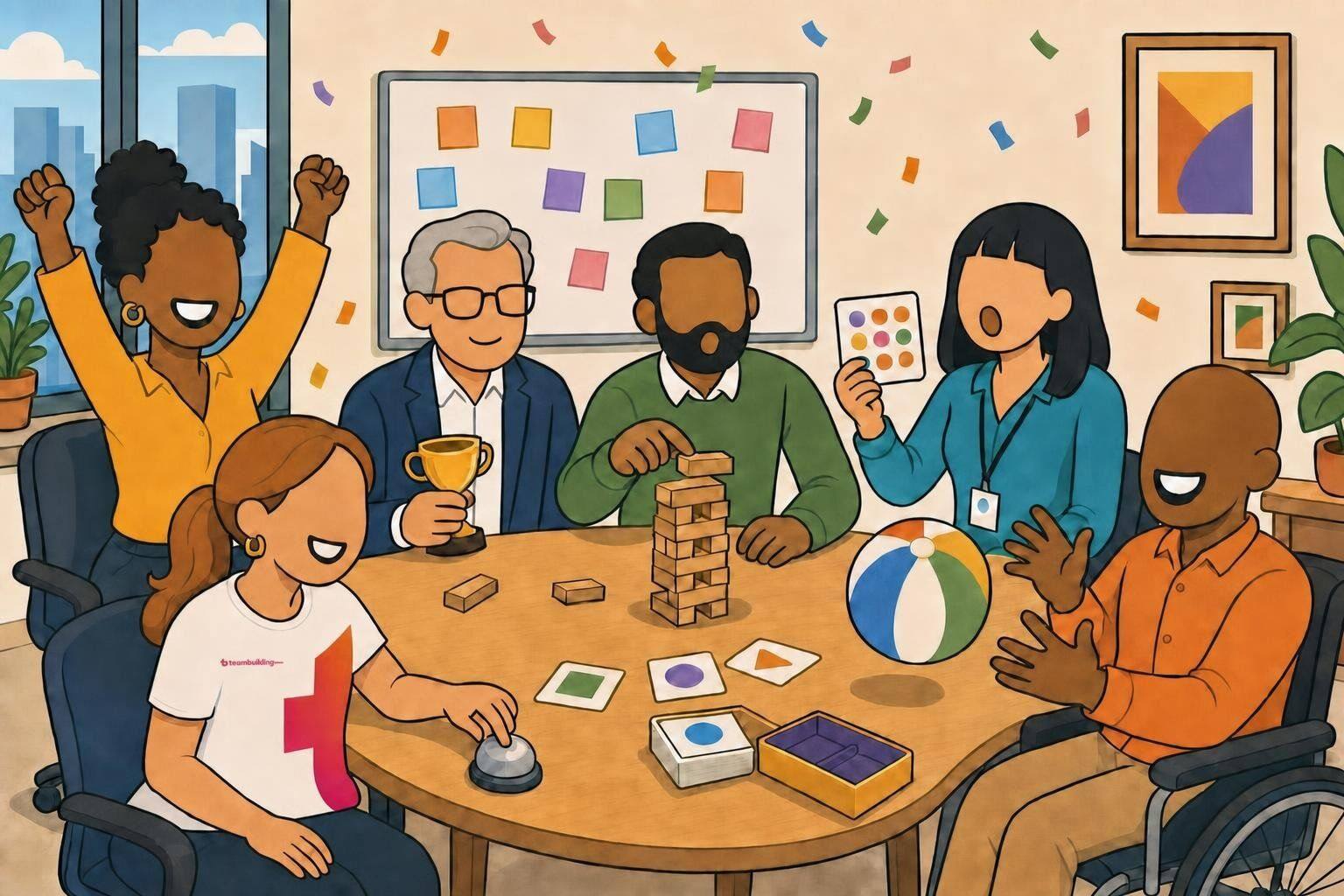
Team building activities are structured games, exercises, and events that help coworkers build relationships, practice working together, and have fun as a group. You will also hear them called team development activities, team bonding exercises, or teamwork games — the labels vary, the goal does not. The category runs from a five-minute icebreaker at the start of a meeting to a full-day offsite, and includes both activities you run yourself and professionally hosted events. For a deeper dive into the concept, see our guide to what team building actually is.
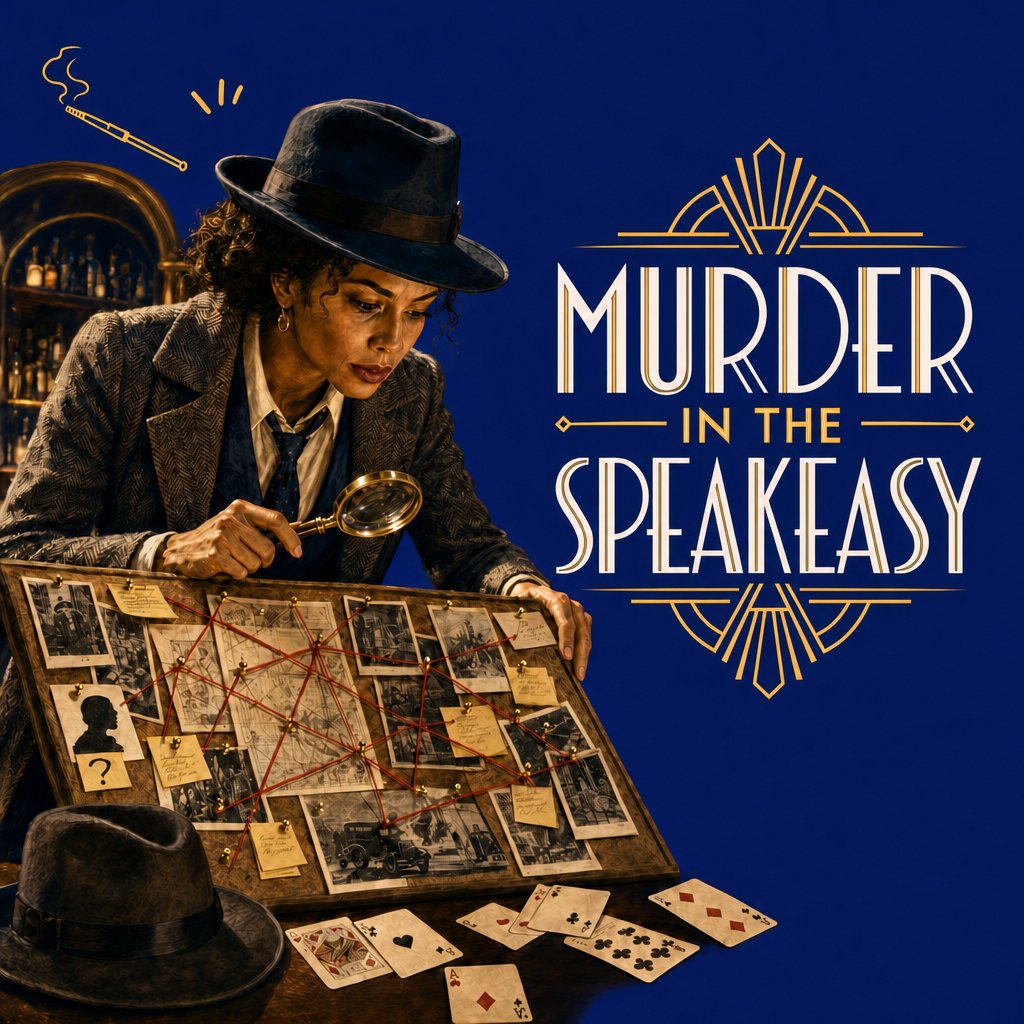
The best formats practice what we call stealth team building: designing events that blend fun with teamwork fundamentals, so participants come for the games and laughter and leave having practiced communication, collaboration, and connection — without a formal training frame. Nobody signs up hoping for trust falls and flip charts. People show up for a cook-off or a murder mystery, and the teamwork happens on the way.
Does it actually matter? The research says yes, as long as you connect the dots honestly. Team building activities are a tool for building engagement and relationships, and engagement is where the measurable business results live: Gallup's 11th Q12 meta-analysis — covering 183,806 business units across 347 organizations in 53 industries — found business units in the top quartile of employee engagement had 23% higher profitability and 78% lower absenteeism than bottom-quartile units. For more ways to move that needle, see our guide to employee engagement activities.
Happiness itself pays off, too. In a six-month field study of nearly 1,800 British Telecom call-center workers, University of Oxford researchers Clement Bellet, Jan-Emmanuel De Neve, and George Ward found that a one-point increase in self-reported weekly happiness was associated with a 12% increase in productivity, measured as weekly sales — and roughly 20% per point on complex tasks like selling and negotiating. Happier workers did not work more hours; they simply worked better.
In other words: an hour spent laughing with your team is not a break from productive work. It is some of the highest-leverage work a team does all week.
The best team building activities, ranked by real survey data
Calling any one activity "the best" is subjective — like naming the best movie or the best flavor of ice cream. So instead of opinions, we rank our own hosted events with our Team Building Score, which combines confirmed bookings, verified reviews, ratings, and post-event survey outcomes — and we publish exactly how it works.
Here are the top-ranked team building activities across our whole catalog, virtual and in-person:
Ranked by our Team Building Score — a running points total earned through confirmed bookings, verified reviews, ratings, and listing quality, recalculated nightly. Every event shown also has at least 30 post-event survey responses per question; the happier, connected, and NPS columns are computed from the 9,318+ survey responses collected for the 20 events listed here — a subset of all post-event surveys across our catalog. Updated October 2026.
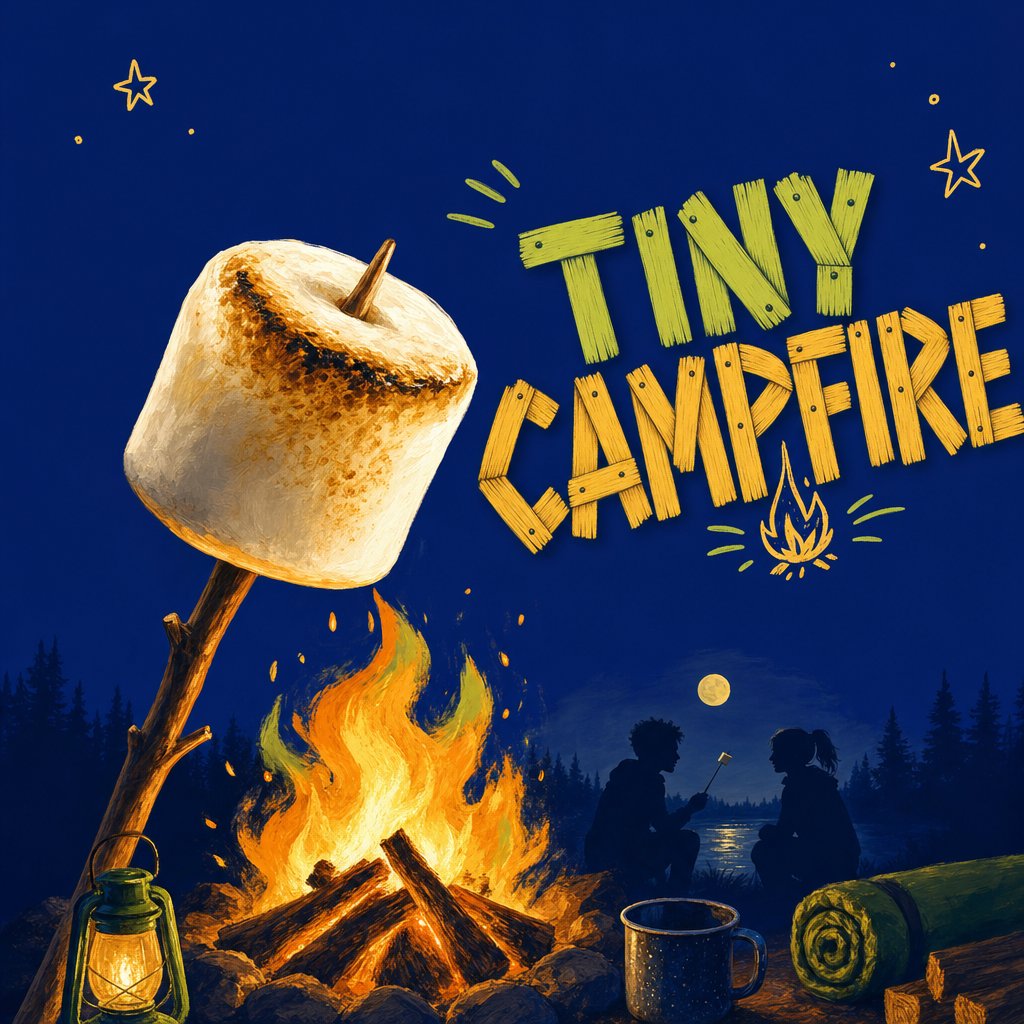
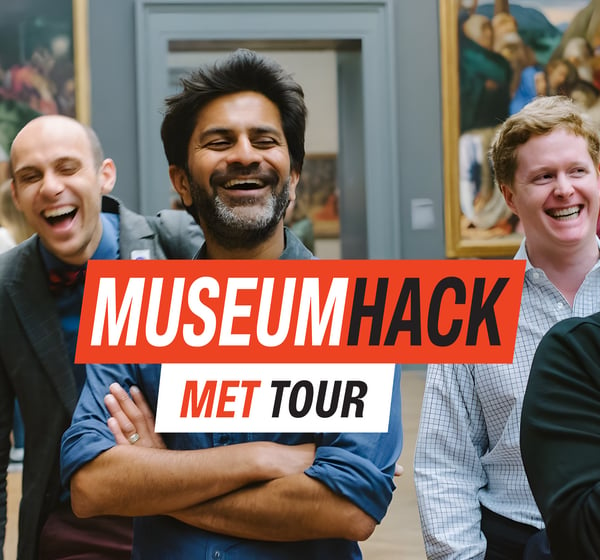
A few notes on reading the table. As of August 2026, tiny campfire — s'mores kits shipped to every desk, tiny tabletop fires, and competitive storytelling — holds the top score. Virtual formats dominate the rankings partly because they have had the most survey volume; on the in-person side, standouts include The Great Guac Off™, a fiercely competitive guacamole showdown, and our original Museum Hack tours at the Metropolitan Museum of Art, where teambuilding.com began.
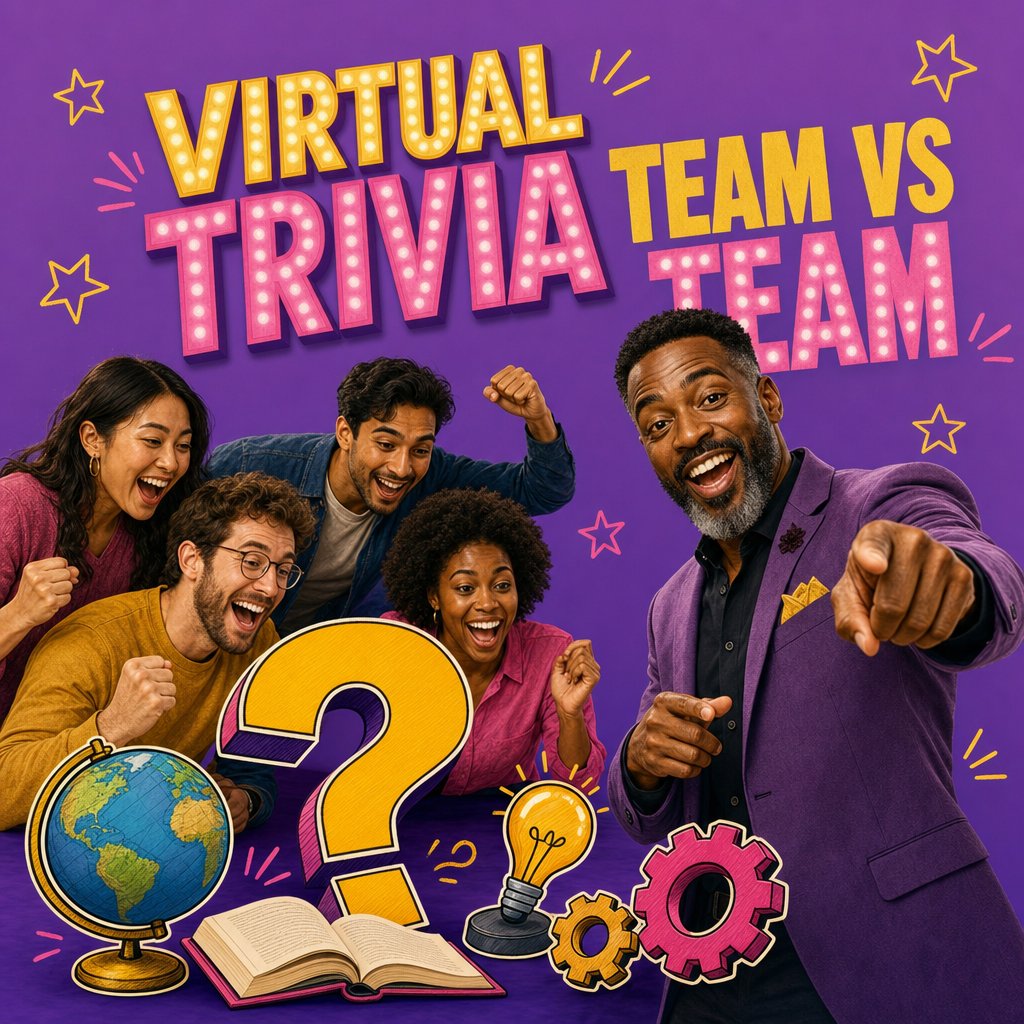
The outcomes are why teams keep booking. Looking at our virtual events specifically, where we survey every participant: of the 18,000+ virtual participants who have answered the outcome questions, 98% said the event made them happier and 91% said they felt more connected to their teammates (as of August 2026).
Where to book corporate team building events
There are hundreds of companies offering corporate team building, and frankly, we would not recommend most of them. The industry is full of impressive-sounding marketing language wrapped around experiences that are ultimately pretty mediocre — generic trivia, recycled workshop decks, or "custom experiences" that are anything but.
We are obviously biased: we run a team building company. But we have been in this industry since 2013, and we are happy to point to competitors when they offer something genuinely worthwhile. Here are the options we would actually consider, for both virtual and in-person events:
Hosted games and experiences, virtual and in-person, refined through post-event surveys
Our pick, and not just because it is us: we have refined our Originals through tens of thousands of bookings and we publish our rankings and survey outcomes.
Teams that want a large selection of activities and price points
Probably the strongest alternative to teambuilding.com. Confetti offers a broad range of games, classes, and workshops — think "quick energizer" more than "deep connection."
Teams that want highly produced, game-show-style hosted events
An established company in the team building space. Limited public reviews, but highly rated.
Booking a hosted event is the highest-certainty option — someone else sweats the logistics, and every person on your team gets to actually play, including the organizer. But it is not the only option: the rest of this guide is activities you can run yourself, most of them free.
40 team building activities you can run yourself
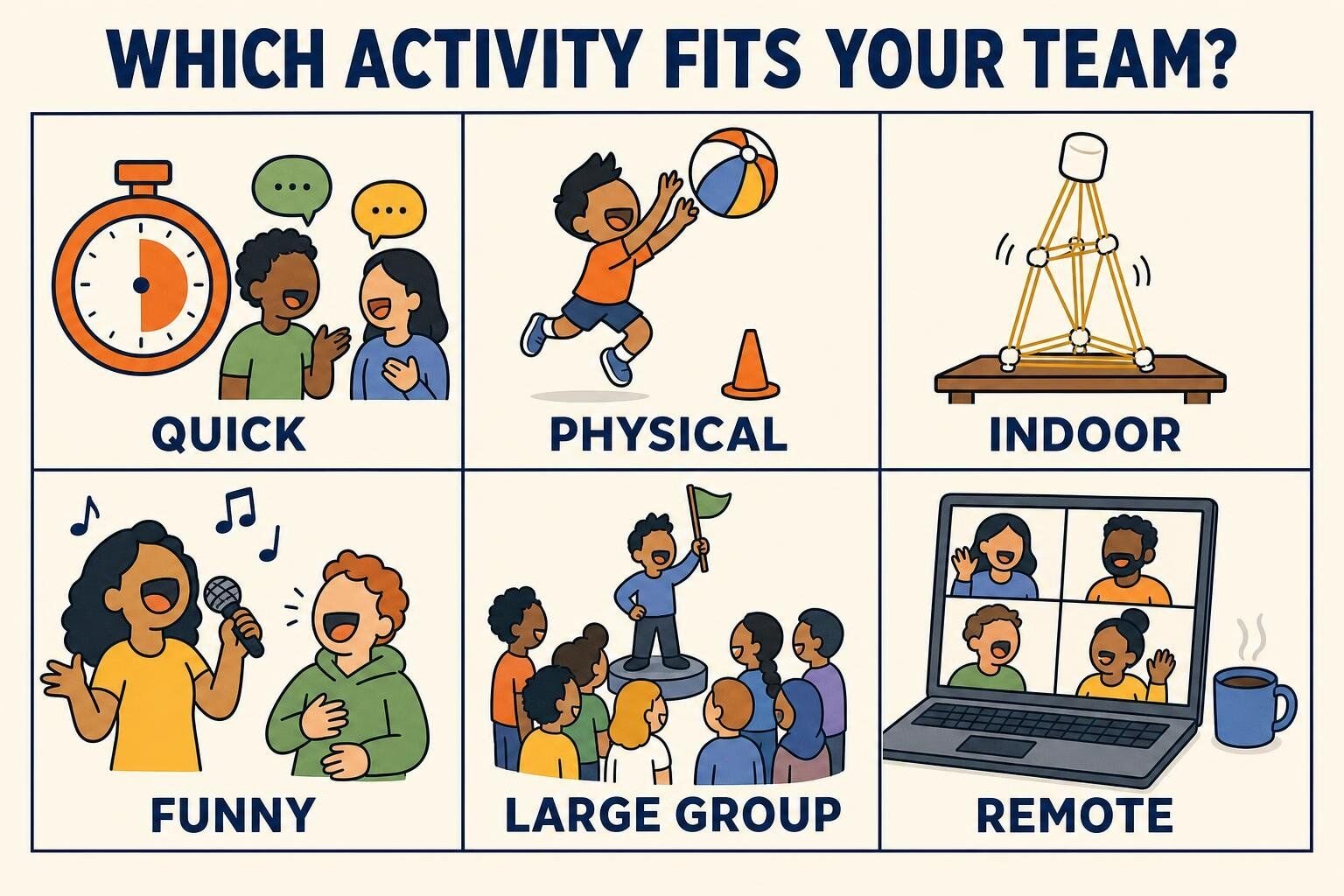
The following 40 team building ideas are organized by scenario — for work, the office, indoor days, big groups, small teams, and more. Most are free, every one includes real instructions, and many are adapted from games we run inside our own hosted events. Use the table to jump straight to a fit:
These team building exercises for work are designed to fit inside a normal workday: they respect people's time, need little prep, and build the kind of familiarity that makes collaboration easier. If you want more workplace-specific formats afterward, our full list of team building games is a good next stop.
1. Profile Bingo
Profile Bingo turns getting to know your coworkers into a game board. Each square contains a trait, experience, or fun fact — "has run a marathon," "speaks three languages," "once met a celebrity" — and players hunt for colleagues who match.
Best for: getting to know coworkers · Group size: 8–100+ · Time: 15–30 minutes · Materials: printed or digital bingo cards (free)
How to play:
Create bingo cards where each square names a trait or experience. Use facts sourced from your actual team for a much better game.
Hand out cards and set a timer for 15 minutes. Players mingle and collect a different coworker's name in each matching square.
First to complete a row shouts "Bingo!" — then keep playing for blackout if energy is high.
Debrief the best discoveries: the quiet analyst who used to be a touring musician always gets a follow-up conversation.
Play a round right here — this is a real board from our platform:
What we've learned: sourcing squares from your real team beats generic cards by a mile — people light up when a square is unmistakably about someone in the room. Grab more ready-made boards from our icebreaker bingo collection.
2. Office Trivia
Skip the pub-quiz questions about world capitals — the best workplace trivia is about your own company. When the answers are your own history, products, and inside jokes, the game doubles as culture-building.
Best for: company culture · Group size: 6–100+ · Time: 30–45 minutes · Materials: question list, score sheet (free)
How to play:
Write 20–30 questions about your company: founding stories, product milestones, "which department sends the most GIFs," office layout oddities.
Split into teams of 3–6 and appoint a quizmaster.
Run three rounds — history, people, and wildcard — with a points-on-the-board scoreboard everyone can see.
Award a small trophy that lives on the winning team's desk until the next round.
What we've learned: mix difficulty levels so new hires can score, and include a few questions only new hires would know ("what does the onboarding doc call the kitchen?") to flip the advantage. For ready-made question sets, see our trivia games guide.
3. Skill Share Sessions
Everyone on your team is quietly excellent at something that has nothing to do with their job description. Skill Share Sessions give those talents a stage — and teach the team something real in the process.
Best for: learning and connection · Group size: 4–30 · Time: 30–60 minutes · Materials: none (free)
How to play:
Invite volunteers to teach a skill in 10 minutes or less: latte art, chess openings, a magic trick, how to say hello in five languages.
Schedule two or three mini-lessons per session, monthly or quarterly.
Let the audience try the skill hands-on — the doing is where the fun lives.
Keep a running list of "skills taught" somewhere visible; it becomes a team trophy case.
What we've learned: cap lessons at 10 minutes. Passionate teachers will happily run 40, and the room's energy dips after 12. A hard timer keeps it electric.
4. The Newlywork Game
A workplace twist on the classic Newlywed Game: pairs of colleagues who work closely together compete to prove who knows their work partner best.
Best for: work friendships · Group size: 8–40 · Time: 30–45 minutes · Materials: question list, answer cards (free)
How to play:
Recruit 3–5 duos: desk mates, project partners, or manager-report pairs.
Round one: one partner answers questions about the other ("what is their go-to lunch order?" "what would they do with a free Friday?") while the subject writes their true answer separately.
Swap roles for round two, and let the audience vote on the best wrong answer — often the highlight.
What we've learned: keep questions work-adjacent and light. "What is their dream vacation?" plays great; anything about salaries, performance, or personal lives does not.
5. Office Time Capsule
A slow-burn activity with a huge payoff: the team seals predictions, artifacts, and notes today, then opens the box together in a year.
Best for: team milestones · Group size: 5–50 · Time: 30 minutes to seal, 30 to open · Materials: a box, paper, small artifacts (~$10)
How to play:
Set a theme: predictions for the company, a letter to your future self, or "the most 2026 object on your desk."
Give everyone 15 minutes to write or contribute an item.
Seal the box publicly, write the opening date on top in marker, and store it somewhere visible.
Calendar the opening — make it an event with snacks. Reading year-old predictions aloud is reliably hilarious.
What we've learned: the opening is the actual team building event, so schedule it when you seal the box. Capsules without a calendared opening date have a way of becoming permanent office furniture.
Office team building activities
These in-office team building activities take advantage of the one thing co-located teams have that remote teams envy: a shared physical space, and the spontaneous collisions that happen in it.
6. Real-Life Social Media Wall
A corkboard "feed" where the team posts photos, wins, and updates — likes and comments included, but on paper.
Best for: ongoing connection · Group size: 10–100+ · Time: ongoing · Materials: corkboard, pins, sticky notes (~$20)
How to play:
Mount a large corkboard in a high-traffic spot and split it into zones: photos, shout-outs, polls, and a weekly question.
Seed it with a few posts so nobody has to go first.
Provide heart-shaped sticky notes as "likes" and small squares for comments.
Refresh the weekly question every Monday — it keeps the wall alive.
What we've learned: appoint a rotating "wall editor" each month. Community boards thrive on light curation and die of neglect. More ideas in our guide to office bulletin board ideas.
7. Office Olympics
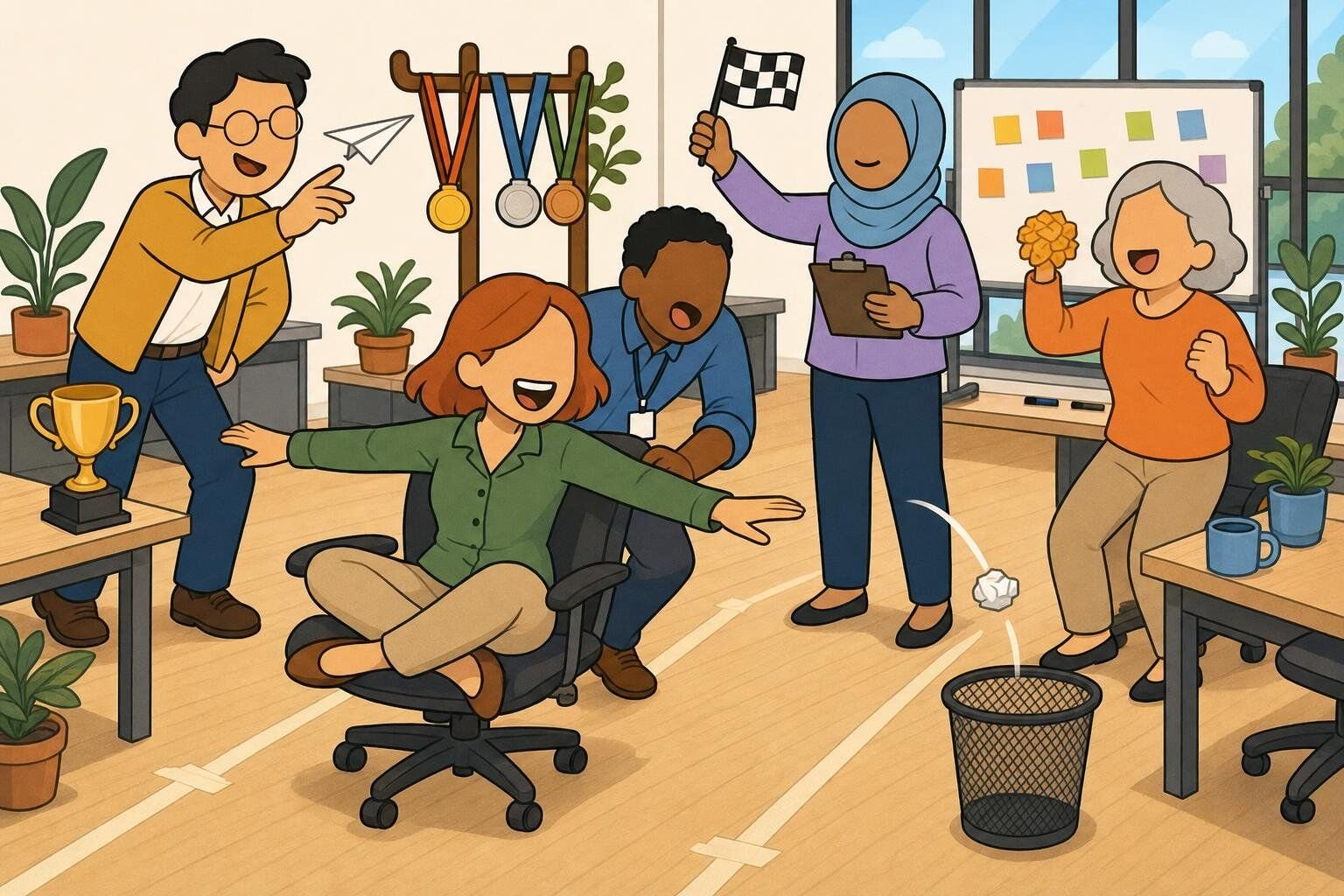
The definitive office game day: a series of ridiculous desk-sport events — chair curling, paper football, rubber-band archery — with medals, a podium, and zero athletic ability required.
Best for: energy and laughs · Group size: 8–50 · Time: 60–90 minutes · Materials: office supplies, printable medals (~$15)
How to play:
Pick 4–6 events: chair curling (glide a rolling chair to a target), trash-can basketball, paper airplane distance, sticky-note speed mosaics.
Draft mixed teams across departments and let each pick a country or team name to represent.
Run events tournament-style with a visible medal count.
Close with a podium ceremony and a comically serious national-anthem moment.
What we've learned: the opening ceremony is worth the extra ten minutes — a procession of teams holding hand-drawn flags sets the tone better than any pep talk. For more formats, see our list of office games.
8. Office Scavenger Hunt
Turn your own workplace into a game board. Teams race to find objects, decode clues, and complete photo challenges scattered through the office.
Best for: exploration and teamwork · Group size: 6–60 · Time: 30–60 minutes · Materials: clue list (free)
How to play:
Write 10–15 challenges in three flavors: find (the oldest object in the office), do (recreate a famous painting with desk supplies, photo required), and solve (a riddle whose answer is a location).
Split into teams of 3–5 with one phone per team for photo evidence.
Set a 30-minute timer and release everyone at once.
Reconvene and review photo evidence on a big screen — the judging is half the fun.
What we've learned: photo challenges beat item-collection challenges — they generate artifacts the team will re-share for months. Steal clue formats from our scavenger hunt clues library.
Indoor team building activities
Rainy day, heat wave, or just a windowless conference room — these indoor team building activities need nothing but a room and a table. For a full list of formats that work inside, see our guide to indoor team building.
9. The Marshmallow Challenge
The famous design challenge: build the tallest freestanding tower from spaghetti, tape, and string — with a marshmallow on top. Simple rules, surprisingly deep lessons about prototyping and teamwork.
Best for: collaboration under pressure · Group size: 4–40 · Time: 30–45 minutes · Materials: 20 sticks of spaghetti, 1 yard of tape, 1 yard of string, 1 marshmallow per team (~$10)
How to play:
Split into teams of 3–5, each with an identical kit.
Set an 18-minute timer: build the tallest freestanding structure that supports the marshmallow on top.
The marshmallow must be on top at the buzzer — no holding the tower.
Measure, crown the winners, then debrief: which teams prototyped early, and which spent 15 minutes planning a tower that collapsed at minute 17?
What we've learned: announce the "no hands at the buzzer" rule twice. Every session, at least one team plans to steady their tower at the end — and the collective gasp when it topples is a bonding moment all its own.
10. DIY Escape Room
You do not need a commercial venue to run an escape room — a conference room, a locked box, and a chain of puzzles will do. Designing the room is a team building activity for whoever builds it, too.
Best for: problem solving · Group size: 4–24 (in squads of 4–6) · Time: 45–90 minutes · Materials: padlocks, envelopes, printed puzzles (~$30)
How to play:
Choose a simple story: a colleague's farewell mystery, a "stolen" office trophy, a time-travel mishap.
Chain 5–7 puzzles where each answer unlocks the next: a cipher taped under a chair, a riddle whose answer is a locker code, a UV-pen message on a whiteboard.
Teams get 45 minutes and two hint tokens.
If you have multiple squads, run them in parallel with identical puzzle sets and race for the best time.
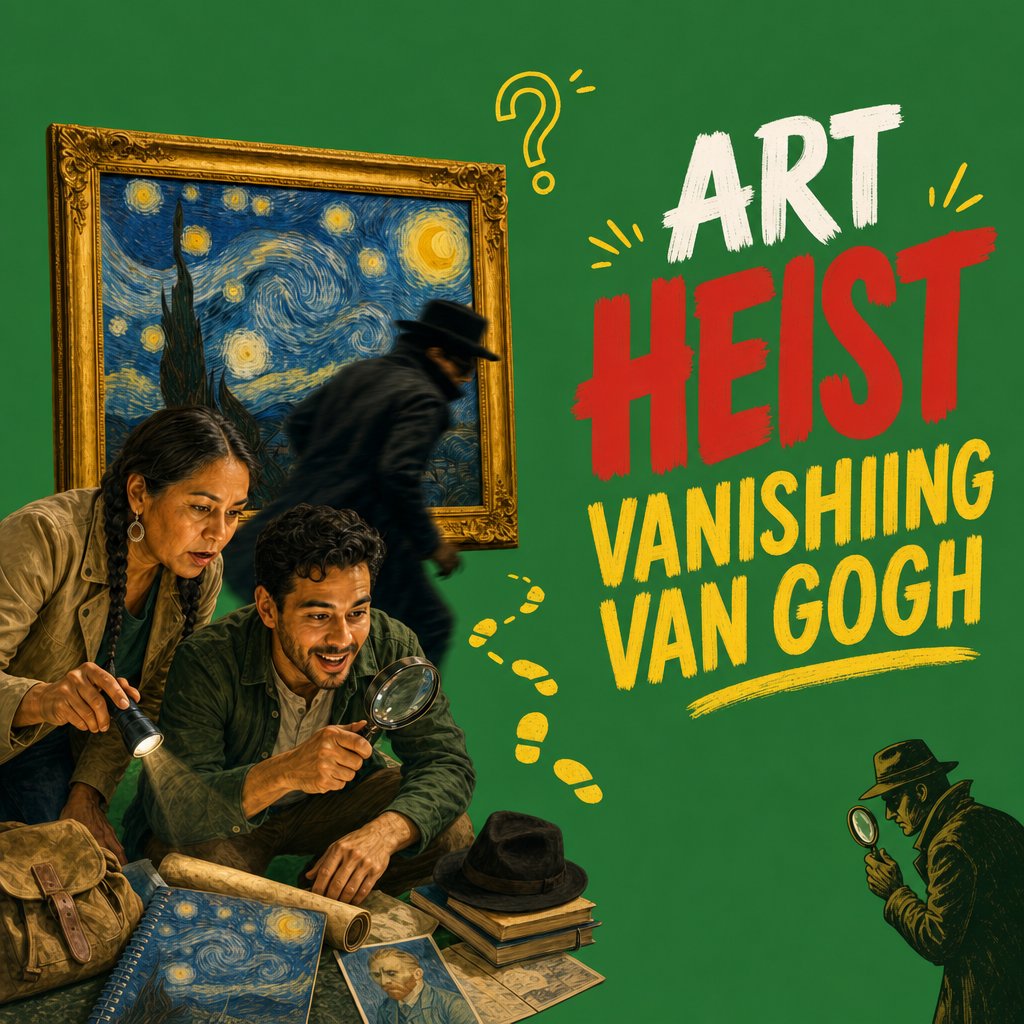
What we've learned: the two major keys to a satisfying puzzle experience are that the puzzle should feel doable — best when the team splits up duties and works together — and that the finale should land with a reveal, not a shrug. Warm up with our team building puzzles, or book the fully hosted version: Art Heist: The Vanishing Van Gogh, one of our most popular events.
11. Puzzle Relay
A jigsaw puzzle becomes a race when only one teammate can work on it at a time — and a strategy game when teams can trade pieces.
Best for: friendly competition · Group size: 8–40 · Time: 30–45 minutes · Materials: one 100–300 piece puzzle per team (~$10 each)
How to play:
Give each team an identical puzzle, face-down in a pile across the room.
Relay rules: one runner at a time sprints over, places up to three pieces, and tags the next teammate.
Twist: each team's pile secretly contains five pieces from another team's puzzle. Teams must discover this and negotiate trades to finish.
First completed puzzle wins.
What we've learned: the piece-swap twist changes everything — teams that treat rivals purely as competition finish last. It is the quietest lesson in cross-team collaboration we know.
12. The Egg Drop
An engineering classic: protect a raw egg from a two-story drop using only office scraps. Cheap, dramatic, and the closest thing team building has to a moon landing.
Best for: engineering and teamwork · Group size: 6–40 · Time: 45–60 minutes · Materials: eggs, straws, tape, newspaper, rubber bands (~$15)
How to play:
Teams of 3–5 get identical supply kits and one raw egg.
Allow 25 minutes to design and build a contraption that will protect the egg from a high drop.
Hold a naming ceremony — every vessel needs a name — then drop each one from a balcony, ladder, or stairwell.
Survivors advance to a higher drop until one team remains.
What we've learned: do the drop outdoors or over a tarp, and buy twice as many eggs as you think you need. The teams that test-drop early from low heights nearly always win — a prototype lesson that transfers directly to product work.
Physical team building activities
Physical team building activities get people out of their chairs and moving — which changes the energy of a group faster than any conversation. None of these require athleticism, and all of them can be scaled down for mixed abilities or moved outdoors (for more open-air formats, see our outdoor team building guide).
13. The Amazing Race: Office Edition
A city-block (or office-campus) race where teams complete challenge stations to earn their next clue. Equal parts adventure and teamwork under time pressure.
Best for: adventure and energy · Group size: 8–40 · Time: 60–120 minutes · Materials: clue envelopes, station props (~$25)
How to play:
Map 5–7 stations around your office, building, or neighborhood.
At each station, teams complete a challenge to earn the next clue: build something, solve something, or perform something (photo evidence required).
Include one "detour" choice — two challenge options of different flavors — so teams strategize around their strengths.
First team to the finish line wins; award a superlative to every team at the debrief.
What we've learned: put the most physical challenge in the middle of the race, not the start — early-race adrenaline plus cold muscles is how ankles get rolled. Full route templates in our Amazing Race games guide.
14. Rock Paper Scissors Entourage
The single fastest way to turn a room of professionals into a roaring crowd. Lose a match, become your conqueror's biggest fan — until one player has the entire room chanting their name.
Best for: instant energy · Group size: 10–500+ · Time: 5–10 minutes · Materials: none (free)
How to play:
Everyone pairs up and plays rock paper scissors, best of one.
Losers become the winner's entourage: they follow, cheer, and chant their champion's name.
Winners find new opponents; each victory absorbs the loser's entire entourage.
The final match is two players, each backed by half the room, at maximum volume.
What we've learned: this is our go-to opener for large in-person events — it works in a conference hall of 500 exactly as well as a team of 10, and it takes zero setup. Demand a proper award ceremony for the champion.
15. Mini Field Day
The nostalgia of elementary-school field day, rebuilt for adults in business casual: station-based games, team colors, and a points championship.
Best for: active competition · Group size: 10–100+ · Time: 60–120 minutes · Materials: beach balls, cones, buckets, bandanas (~$40)
How to play:
Set up 4–6 stations: beach ball keep-up, water-cup relay, cornhole, hula hoop pass, tug of war.
Draft teams, assign colors, and rotate squads through stations in 10-minute rounds.
Score every station and keep a running leaderboard visible.
Finish with an all-team finale — tug of war settles championships definitively.
What we've learned: hand out team bandanas at the start. A $2 prop triggers an astonishing amount of team identity, chanting, and strategy huddles. Want it fully produced with a host, equipment, and an emcee? Field Day is one of our most-booked in-person events.
16. Team Step Challenge
A weeks-long, low-key competition that builds camaraderie between events: teams compete on total steps, and the group chat fills with lunchtime-walk photos.
Best for: wellness and long-term bonding · Group size: 5–500+ · Time: 2–4 weeks, ambient · Materials: any step-counting phone or watch (free)
How to play:
Form teams of 4–6, mixing departments and fitness levels.
Track team average daily steps (not totals) so team size does not decide the winner.
Post a weekly leaderboard and add bonus challenges: most-scenic walk photo, best walking-meeting story.
Close with a small ceremony and a traveling trophy.
What we've learned: averages beat totals, and bonus photo challenges keep the back half of the challenge alive after the leaderboard gap widens. Our full step challenge guide has scoring templates.
Funny team building activities
Shared laughter is the fastest shortcut between "coworkers" and "team." These fun team building activities are engineered for laughs — no comedy skills required, and nobody gets embarrassed without volunteering for it.
17. Lip Sync Battle
Coworkers perform fully committed lip-sync routines to songs of their choosing. The gap between "quiet accountant" and "full-stadium Freddie Mercury impression" is where the magic lives.
Best for: laughs and stage moments · Group size: 8–100+ · Time: 45–60 minutes · Materials: speaker, playlist, optional props (free)
How to play:
Recruit volunteer acts — solo or group — a week ahead so people can secretly rehearse.
Give each act 60–90 seconds of their chosen song.
Judge on lip-sync accuracy, choreography, and commitment, with scorecards held up Olympics-style.
Award categories beyond first place: Best Prop, Most Unexpected, Crowd Favorite.
What we've learned: keep it strictly volunteer and let groups perform together — a five-person backup-dancer crew gives shy teammates a way to join the fun without carrying a spotlight alone.
18. Bad Idea Brainstorm
Flip the brainstorm: the goal is the worst possible solution to a real problem. Terrible ideas are funnier than good ones — and reversing them at the end regularly produces genuinely useful thinking.
Best for: creativity and humor · Group size: 4–30 · Time: 20–30 minutes · Materials: whiteboard or sticky notes (free)
How to play:
Pick a real prompt: "how should we welcome new hires?" or "how do we get more customer reviews?"
Teams get 10 minutes to design the worst conceivable solution, in loving detail.
Each team pitches their catastrophe with a straight face; the room votes for "most confidently terrible."
Final step: invert the winning bad ideas and see what real insights fall out.
What we've learned: the inversion step is the sleeper hit — "make onboarding a scavenger hunt with no map" flipped into a genuinely good onboarding buddy system in one of our own planning sessions.
19. Caption Contest
A five-minute-a-week ritual with an outsized return: post a photo, collect captions, crown a winner. Over months, it becomes your team's inside-joke factory.
Best for: ongoing team humor · Group size: 5–200+ · Time: 5 minutes a week · Materials: a chat channel (free)
How to play:
Every Monday, post one photo in a dedicated channel: a stock photo of confusing intensity, an office candid, or a pet in a work pose.
Captions accumulate all week; reactions serve as votes.
Friday: crown the winner, who picks (or supplies) next week's photo.
Keep a hall-of-fame doc of all-time greats.
What we've learned: letting the winner choose the next photo is the flywheel — it keeps ownership rotating and the photo genres evolving. This is also one of the easiest formats to run across offices and time zones.
20. Guess the Toddler
Everyone submits a childhood photo; the team matches photos to coworkers. Simple, universal, and reliably funnier than it has any right to be.
Best for: getting to know coworkers · Group size: 8–50 · Time: 15–30 minutes · Materials: photo submissions, slides (free)
How to play:
Collect one toddler-age photo per person, privately, a few days ahead.
Show photos one at a time while everyone writes their guesses.
Reveal answers with the photo's owner telling the story behind it.
Highest correct count wins; best backstory gets its own prize.
What we've learned: ask specifically for toddler photos, not baby photos — in photo guessing games, toddler photos work much better than newborn photos because recognizable features have started to develop, and the game actually gets better as the group gets larger.
Quick and easy team building activities
Five spare minutes at the top of a meeting is enough. These quick team building activities need zero prep and no materials — they are the ones our hosts reach for when a room needs warming up fast.
21. Icebreaker Lightning Round
One sharp question, answered by everyone in under 15 seconds each. The discipline is choosing a question with texture — "what is your most controversial food opinion?" beats "how was your weekend?" every time.
Best for: meeting warm-ups · Group size: 3–100+ · Time: 5–10 minutes · Materials: none (free)
How to play:
Pick one question with a strong point of view built in.
Model a 10-second answer yourself, then go around the room (or call on volunteers past ~15 people).
Ask one follow-up to the most interesting answer — that follow-up is where the connection happens.
Rotate who chooses the question each meeting.
What we've learned: follow-ups matter more than the question. People will talk forever about the things they love — an icebreaker answer is an invitation, not a box checked. Our library of icebreaker games has hundreds of tested prompts.
22. Common Factor
Small groups race to find the most unexpected thing every member has in common. "We all have jobs here" does not count.
Best for: finding shared ground · Group size: 6–40 (in groups of 4–6) · Time: 10–15 minutes · Materials: none (free)
How to play:
Split into groups of 4–6.
Set a 7-minute timer: find the most surprising trait, experience, or opinion shared by every member.
Obvious answers are banned — no workplaces, no "we all like food."
Groups report out; the room votes for the most unexpected common factor.
What we've learned: small groups are the whole trick — six people can discover something genuinely unusual they share; sixty people usually cannot. Keep groups under seven and the discoveries stay delightful.
23. This or That
Rapid-fire binary choices — coffee or tea, mountains or beach, call or text — where players physically move to the side of the room matching their answer.
Best for: quick debates · Group size: 5–100+ · Time: 5–15 minutes · Materials: none (free)
How to play:
Designate two sides of the room (or two reaction emojis on a video call).
Call out pairs and give ten seconds to commit to a side.
After each split, invite one person per side to defend their camp in a sentence.
Save your spiciest pairing for last and let the debate run a minute longer.
What we've learned: close votes are the most fun — a 52/48 split creates suspense, while a 95/5 split does not. Stack your list with genuinely contested pairings from our this or that questions collection.
24. Would You Rather
The classic dilemma game, workplace edition. The best prompts force a genuinely hard choice and reveal how your coworkers think.
Best for: conversation starters · Group size: 4–50 · Time: 5–15 minutes · Materials: none (free)
How to play:
Prepare 5–10 dilemmas: "would you rather have unlimited vacation you can never plan, or two fixed months off a year?"
Present one at a time; everyone commits before discussion opens.
Let two volunteers argue opposing sides for 60 seconds each.
Re-vote after the arguments — flipped votes are the scoreboard.
What we've learned: inconsequential topics are usually better than serious ones — people can argue with ridiculous conviction without bringing real workplace politics into the room. Start from our would you rather questions list.
Team building activities for small groups
Small teams have a superpower: depth. With three to twelve people you can run formats that would collapse in a crowd — real conversations, personal stories, and games where every voice gets airtime. For more, see our dedicated guide to team building activities for small groups.
25. Personal User Manuals
Each person writes a short "how to work with me" guide — communication preferences, feedback style, pet peeves, best hours — and walks the team through it. One of the highest practical-value activities on this list.
Best for: working relationships · Group size: 3–12 · Time: 45–60 minutes · Materials: a one-page template (free)
How to play:
Share a template with 5–6 prompts: "I do my best thinking when…", "the fastest way to annoy me is…", "give me feedback by…".
Everyone drafts their manual for 15 minutes.
Each person presents for 3–4 minutes, with one clarifying question from the group.
Store the manuals somewhere shared — they become gold for new teammates.
What we've learned: the "fastest way to annoy me" prompt gets the biggest laughs and the most useful honesty. Keep the tone light and the insights land without anyone getting defensive.
26. Team Playlist
Build a shared playlist where every track comes with a story. Music is a shortcut into personality that job titles never reveal.
Best for: everyday culture · Group size: 3–15 · Time: 15–30 minutes, then ongoing · Materials: any shared music service (free)
How to play:
Create a collaborative playlist with a theme: "songs that make you feel unstoppable" or "the first album you loved."
Everyone adds two tracks and, in your chat channel, one sentence about why.
Play it in the office or during breaks; guess-who-added-this becomes a spontaneous minigame.
Rotate themes monthly.
What we've learned: the one-sentence story requirement is what turns a playlist into team building — without it you get songs, with it you get people.
27. Group Timeline
Draw one long timeline on a whiteboard and populate it with both team milestones and personal ones. The overlaps — "you launched that feature the same month I adopted my dog" — knit a team's history together.
Best for: team history and trust · Group size: 4–12 · Time: 30–45 minutes · Materials: whiteboard, sticky notes (free)
How to play:
Draw a timeline from the team's founding (or five years back) to today.
Everyone adds 3–5 sticky notes: work milestones in one color, personal milestones they are comfortable sharing in another.
Walk the timeline together chronologically, letting each note get its 30-second story.
Photograph the finished wall — teams genuinely treasure these.
What we've learned: "milestones you are comfortable sharing" is the phrase that makes this work — consent built into the instructions means nobody discloses more than they want to. For lighter get-acquainted formats first, try these get to know you games.
Team building activities for large groups
Past about 15 people, formats that rely on everyone taking turns start to drag. Large-group team building activities need parallel play — everyone active at once, in squads or all together. (More openers for big rooms: large group icebreakers.)
28. Company Feud
Family Feud, powered by your own office. Survey the whole company in advance, then teams battle to guess the most popular answers on the board.
Best for: large-group game shows · Group size: 20–200+ · Time: 45–60 minutes · Materials: pre-event survey, slides (free)
How to play:
A week ahead, survey everyone with 6–8 prompts: "name a snack that disappears fastest from the kitchen," "name something people say on every video call."
Tally the top 5–6 answers per prompt into a hidden board.
On game day, two teams face off Feud-style: guess answers, earn points for popularity, three strikes passes control.
Rotate fresh players onto the podium each round so dozens of people get a turn.
What we've learned: the survey itself is half the fun — participation rates on the pre-event survey routinely beat every other company survey of the year. The reveal of what your own coworkers actually answered is the engine of the game.
29. Themed Speed Friending
Speed dating, minus the dating: rapid one-on-one conversations with rotating partners and a fresh prompt each round. The fastest way to put 50 strangers on a first-name basis.
Best for: meeting new people · Group size: 16–200+ · Time: 30–45 minutes · Materials: timer, prompt list (free)
How to play:
Arrange two facing lines or concentric circles of chairs.
Each round: 3 minutes, one themed prompt on screen — "a skill you would master instantly if you could," "the best meal you have ever eaten."
Rotate one line after each round so everyone meets someone new.
Run 6–8 rounds, then close by having a few volunteers introduce their favorite conversation partner to the room.
What we've learned: the closing introductions are the secret ingredient — being introduced by someone who just met you, enthusiastically, is a small and surprisingly moving trust exercise.
30. Photo Scavenger Hunt
Squads race through a checklist of photo and video challenges around the office, campus, or city block. Built-in parallel play makes it one of the few formats that gets better as the group gets bigger.
Best for: big-group adventures · Group size: 12–200+ · Time: 60–90 minutes · Materials: challenge list, phones (free)
How to play:
Write 15–20 challenges mixing easy ("whole team jumping mid-air") with creative ("recreate a movie poster") and local ("something older than everyone on your team combined").
Squads of 4–6 get 60 minutes, one phone per squad.
Weight points by difficulty, with bonus points for style.
Reconvene for a big-screen slideshow judging session — budget real time for it, because it is the best part.
What we've learned: the slideshow is the event. Cutting it to save ten minutes throws away the payoff every squad has been building toward. Full challenge lists in our scavenger hunt ideas guide.
Team building activities for adults
Team building activities for adults can lean into what grown-up teams actually enjoy: good food, a competitive streak, creative license, and the option of a drink in hand. These formats work equally well as after-hours socials or offsite anchors.
31. Team Cook-Off
Teams battle to produce the best dish under a time limit, then everyone eats the results. Cooking together compresses an entire project lifecycle — planning, division of labor, execution, deadline panic — into 90 delicious minutes.
Best for: creative competition · Group size: 6–40 · Time: 90–120 minutes · Materials: ingredients, kitchen or hot plates (~$15/person)
How to play:
Pick a format that fits your space: guacamole battle (no heat needed), sandwich showdown, or full chili cook-off.
Teams of 3–5 get identical base ingredients plus a "market" of extras to strategize over.
Set 45 minutes to cook, with judges scoring taste, presentation, and team spirit.
Eat everything together — the tasting is the team building.
What we've learned: no-heat formats like guacamole make this possible in any conference room, which is exactly why our hosted version, The Great Guac Off™, became one of our signature in-person events. More formats in our cook-off ideas guide.
32. Paint and Sip Night
Everyone paints the same subject, glass of wine (or sparkling cider) in hand, following a relaxed step-by-step lead. The point is not the art — it is 90 minutes of low-stakes conversation while hands are busy.
Best for: relaxed creativity · Group size: 6–30 · Time: 90–120 minutes · Materials: canvases, acrylics, brushes (~$10/person)
How to play:
Choose one simple subject — a sunset, a plant, your office mascot — and queue a beginner tutorial, or have your most artistic teammate lead.
Set up stations with canvas, paints, and drinks.
Paint along loosely; encourage going off-script.
Finish with a gallery walk where every painter titles their piece — titles are reliably funnier than the paintings.
What we've learned: identical subjects are what make the gallery walk work: thirty versions of the same sunset, from gorgeous to unhinged, is a portrait of the team itself.
33. Volunteer Day
Spend a half-day building, packing, planting, or serving for a cause the team chooses. Purpose is the one team building ingredient a game cannot manufacture.
Best for: purpose and impact · Group size: 5–100+ · Time: 2–8 hours · Materials: varies by project (often free; donations optional)
How to play:
Let the team nominate and vote on causes — chosen beats assigned, every time.
Book a group slot: food bank packing lines, park cleanups, and bike builds for kids all absorb large teams well.
Work side by side in mixed-department squads.
Close with a meal together and a quick round of "one moment that stuck with me."
What we've learned: hands-on beats fundraising for team building value — a packing line gives a team a shared, visible, finished thing. Our charity team building guide lists formats that scale from 5 to 500.
Communication and problem-solving team building activities
These classic team building exercises isolate one skill — giving directions, listening, coordinating under constraints — and turn it into a game. They pair a big laugh with a debrief that writes itself; find more in our communication games guide.
34. Back-to-Back Drawing
One partner describes a picture; the other draws it sight-unseen. The gap between what was said and what was drawn is the funniest communication lesson available.
Best for: clear communication · Group size: 4–40 (in pairs) · Time: 15–30 minutes · Materials: paper, pens, reference images (free)
How to play:
Pairs sit back to back: one holds a simple reference image, the other paper and pen.
The describer explains the image using only shapes and positions — no naming the object ("a circle above a triangle," not "a snowman").
Five minutes, then compare drawing to original, to universal laughter.
Swap roles with a new image; debrief what made descriptions work.
What we've learned: the no-naming rule is everything. Allow "snowman" and the game dies; ban it and you get a masterclass in precise language.
35. Silent Line-Up
The team must sort itself into order — by birthday, height of first apartment, distance from hometown — without speaking. Chaos, gestures, triumph.
Best for: nonverbal teamwork · Group size: 8–60 · Time: 10–15 minutes · Materials: none (free)
How to play:
Announce the sort criterion and the one rule: no talking, no writing.
Start the timer; the team self-organizes with gestures and mime.
Verify the order out loud when they claim victory — errors mean a new round with a new criterion.
Escalate difficulty: birthdays are easy, "years at the company, to the month" is expert tier.
What we've learned: run it twice back to back. Round one is chaos; round two, the team invents a system in seconds — and that visible improvement is the actual lesson.
36. The Minefield
A blindfolded teammate navigates an obstacle field guided only by a partner's voice. Trust and precise instructions, tested in real time.
Best for: trust and direction-giving · Group size: 6–24 · Time: 20–30 minutes · Materials: blindfolds, soft obstacles (free)
How to play:
Scatter soft obstacles — paper cups, pillows, foam balls — across an open space.
Pairs: one blindfolded in the field, one guiding from the edge by voice only.
Touching an obstacle sends the walker back to the start.
Run multiple pairs at once for a chaos multiplier: walkers must pick their guide's voice out of the noise.
What we've learned: the multi-pair variant is the keeper — filtering your partner's voice out of a noisy room is a startlingly good metaphor for real workplace communication, and the debrief makes itself.
37. Bridge Build
Two sub-teams build two halves of one bridge — in separate rooms, communicating only through brief "engineering calls." The halves meet at the end, and either join or hilariously do not.
Best for: cross-team collaboration · Group size: 8–40 · Time: 45–60 minutes · Materials: cardboard, tape, straws, scissors (~$20)
How to play:
Split into two teams in separate rooms, each with identical materials, building one half of a bridge that must span a one-meter gap.
Allow three 2-minute phone calls between teams — no photos, words only.
Build for 30 minutes.
The moment of truth: bring the halves together and test with a toy car. Debrief what the calls did and did not communicate.
What we've learned: teams that spend their first call agreeing on units and vocabulary nearly always succeed; teams that dive into design nearly always build two beautiful, incompatible halves. Every distributed company will recognize the result.
Remote team building activities
Remote and hybrid teams need connection most and get it least. The formats below are quick wins you can run on any video call — and for the complete playbook, including 15 more free formats and every hosted option, see our full guide to virtual team building activities and this list of Zoom games. Prefer it fully hosted? Online Office Games is our flagship virtual game show, and one of our most-booked events since 2020.
38. Lightning Scavenger Hunts
Rapid-fire rounds of "first person to bring back…" played from home offices. Pure energy, zero prep, and a guided tour of everyone's living space in the best way.
Best for: remote energy bursts · Group size: 5–100+ · Time: 10–20 minutes · Materials: none (free)
How to play:
Call out an item: "something yellow," "the oldest book you own," "a souvenir with a story."
Everyone sprints off-camera; first to return and show it wins the round.
Ask one-sentence backstories for the best finds.
Run 5–8 rounds, ending with a story-rich prompt to cool down.
What we've learned: alternate speed rounds with story rounds — the sprint gets the blood moving, the stories do the actual bonding. Full round lists in our lightning scavenger hunts guide.
39. Whose Workspace?
Teammates submit anonymous photos of their home workspaces; the team matches desk to owner. Delightfully revealing without anyone leaving their chair.
Best for: remote get-to-know-you · Group size: 6–40 · Time: 15–30 minutes · Materials: photo submissions, slides (free)
How to play:
Collect workspace photos privately — desks only, no faces or nameplates.
Show one at a time while everyone guesses the owner in chat.
Reveal, then let the owner give a 30-second tour of one interesting object in frame.
Most correct guesses wins; best desk object gets its own award.
What we've learned: the object tour beats the guessing — "why do you have a taxidermied duck?" launches better conversations than any icebreaker question ever written.
40. Virtual Coffee Roulette
Randomized 1:1 coffee chats across the company, on a recurring schedule. The lowest-effort, highest-compounding remote ritual we know.
Best for: remote relationships · Group size: 6–500+ · Time: 30 minutes per round · Materials: a randomizer or pairing bot (free)
How to play:
Opt-in sign-up — voluntary participation keeps the energy right.
Randomly pair people every two weeks, deliberately crossing departments and time zones where possible.
Provide three optional starter questions for pairs who want them.
Once a month, invite a volunteer pair to share their best discovery in the all-hands.
What we've learned: the all-hands share-out is the flywheel: hearing that the CFO and a junior designer discovered a shared obsession with birdwatching is what makes the next 20 people sign up.
What we've learned from 45,000+ team building events
Running 45,000+ events since 2013 (as of August 2026) generates a lot of data — confirmed bookings, post-event surveys, and tens of thousands of reviews. Here is what the numbers, and our hosts, keep telling us:
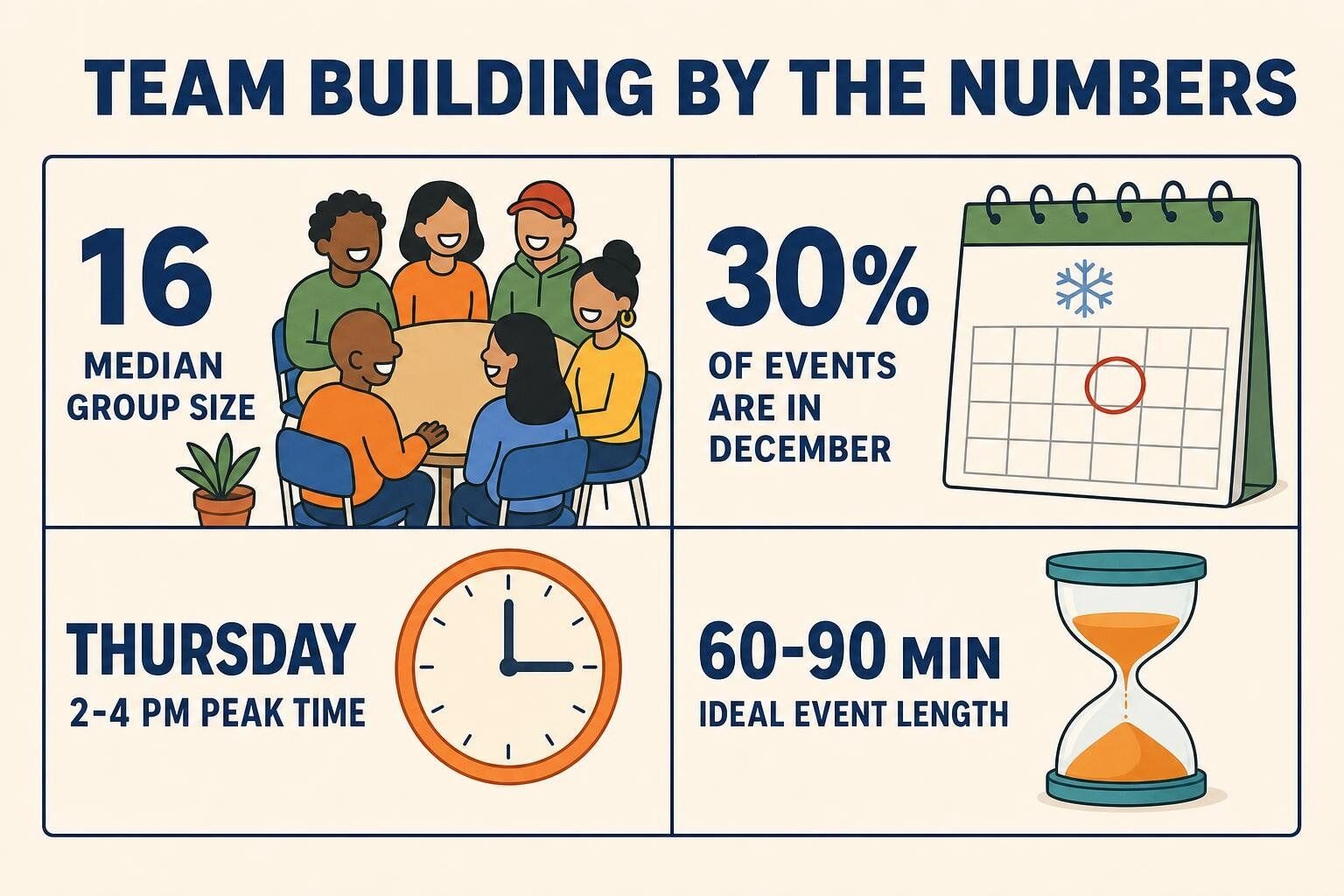
The typical team building event is smaller than you think. The median event on our platform has 16 participants, and half of all events fall between 10 and 27 people. If you are planning for a group that size, you are in the mainstream — most of the formats in this guide are tuned for exactly that range.
Thursday afternoon is prime time. Thursday is the most popular day to hold a team building event — 28% of events — and most start between 2 p.m. and 4 p.m. local time. The logic holds up in the room: late enough in the week to feel like a reward, early enough that nobody resents an after-hours obligation.
Book further ahead than feels necessary. Teams book events a median of 21 days in advance — 30 days for in-person events, which involve venues and logistics. The teams that scramble are almost always the ones planning around December.
About 15 people is the dividing line. Below roughly 15 participants, activities can run personal and high-touch, with everyone contributing out loud. Above it, you need structure: squads, stations, breakout rooms, and formats where everyone plays simultaneously. This single number should drive more of your planning than any other.
60 to 90 minutes is the sweet spot. Among our virtual events specifically, 88% run 60 to 90 minutes — by far the most common length — and when clients book shorter, they usually tell us afterward they wish they had booked the standard length. Shorter sessions end right as quieter teammates warm up.
Competition is the engine. When we mine our reviews for what participants actually loved, friendly competition comes up again and again — points, buzzers, leaderboards, and team names — while the stakes stay low, usually nothing more than bragging rights. Paisley Carswell, one of our longtime hosts, puts it this way:
People remember people. Roughly one in five published reviews of our virtual events mention the host by name — participants remember who ran the show, not the software. When you run activities yourself, that means the facilitator role matters more than the activity choice: whoever runs the game should be prepared, energetic, and playing along. And the connection work should not end when the event does — as our People and Culture Director Grace He told Nectar's State of Workplace Connection report, the goal is a workplace where "coworkers feel seen, heard, and respected" — team building events open that door, and everyday habits keep it open.
Match the format to the group size. A quick reference from our event design playbook:
Small groups (under ~15)
Large groups (15+)
What works
Personal, high-touch formats: user manuals, timelines, story-driven games with everyone speaking
Dedicated emcee or professional host pays for itself
Failure mode
Prompts too shallow for the intimacy available
Turn-taking formats where 40 people watch one person talk
Team building activities to avoid: the Lame List
Some activities survive on team building lists purely by tradition. Having watched thousands of rooms react, here are the ones we would skip — and what to run instead.
Activity
Why skip it
Verdict
Trust falls
The punchline of team building for a reason: physical risk, forced intimacy, and zero transferable lesson. Trust is the output of good team building, not the entry fee.
Skip it
The Human Knot
Mandatory prolonged hand-holding with coworkers is a lot to ask, and larger groups end up physically stuck. If your team genuinely loves contact games, run it right — but Silent Line-Up teaches the same coordination without the contact.
Usually skip
Mandatory karaoke or talent shows
Putting non-volunteers under performance pressure creates dread, not bonding. Opt-in versions with group acts are a different story — see our talent show ideas for formats that protect the shy.
Opt-in only
Never Have I Ever
Built around personal disclosures and traditionally a drinking game — a poor fit for most workplaces. If you like the format, use workplace-safe Never Have I Ever questions carefully.
Skip it
Personality-test theater
A full afternoon sorting the team into four-letter boxes produces labels, not relationships — and the science is shaky. A round of Personal User Manuals delivers the practical value without the pseudoscience.
Skip it
Endurance bootcamps and hazing-adjacent challenges
Mud runs and "push past your limits" events reward the fittest few and punish everyone else. Team building should never have a medical waiver.
Skip it
Mandatory weekend retreats
Claiming employees' personal time breeds resentment before the first icebreaker starts. Hold events during work hours — a Thursday afternoon beats a Saturday, every time.
Keep it on the clock
Final thoughts
Team building activities work when they respect two things: your team's time and their dignity. Pick formats that fit your group's size, keep participation voluntary where it counts, add a scoreboard for energy, and debrief just enough to name what the game revealed. Do that a few times a quarter, and "team building day" stops being a groan and starts being the thing people mention in reviews, all-hands, and exit-interview lists of what they will miss.
Answers based on platform data from 45,000+ team building events hosted since 2013 for teams like Google, Amazon, and Microsoft.
What are team building activities?
Team building activities are structured games, exercises, and events that help coworkers build relationships, practice working together, and have fun as a group. They range from five-minute icebreakers and office games to professionally hosted events like game shows, cook-offs, and murder mysteries, in both virtual and in-person formats.
What are good team building activities for work?
Good team building activities for work fit inside a normal workday and need little prep. Reliable options include Profile Bingo, office trivia built from your own company's history, Office Olympics, a photo scavenger hunt, the Marshmallow Challenge, and a team cook-off. For bigger moments, teams book hosted events such as game shows, escape-room-style mysteries, and field days.
How long should a team building activity last?
Quick icebreakers work in 5 to 15 minutes at the start of a meeting, while standalone events do best at 60 to 90 minutes — among the virtual events we host, 88% run in that window. Shorter sessions tend to end right as quieter teammates warm up, and multi-hour events need breaks and food to hold energy.
When should you schedule team building activities?
Thursday is the most popular day for team building events on our platform — 28% of events — with most starting between 2 p.m. and 4 p.m. local time. Teams book a median of 21 days in advance (30 days for in-person events), and December is the busiest month of the year at 30% of annual volume, so book end-of-year events especially early.
How many people do you need for team building activities?
Team building works at almost any size: the median event on our platform has 16 participants, and half of all events fall between 10 and 27 people. The practical dividing line is about 15 — below it, run personal, high-touch formats where everyone speaks; above it, use squads, stations, and games where everyone plays at once.
What is the best team building activity?
It depends on your group's size and format, so we rank our own events with a published Team Building Score that combines confirmed bookings, verified reviews, ratings, and post-event survey outcomes. As of August 2026, tiny campfire holds the top score, and across formats the common ingredient participants praise most is low-stakes friendly competition — points, buzzers, leaderboards, and team names.





















Comments (0)
Leave a Comment